- Market Value (2025): USD 356.6 Mn
- Estimated Value (2026): USD 610.0 Mn
- Forecast Value (2036): USD 815.4 Mn
- CAGR (2026-2036): 7.8%
High-Temperature Structural Resins Market Forecast and Outlook 2026 to 2036
The global high-temperature structural resins market was valued at USD 356.6 million in 2025 and reached USD 610.0 million in 2026. The market is estimated to reach USD 815.4 billion by 2036, expanding at a CAGR of 7.8% during the forecast period.
High-temperature structural resins are finding wider use in aircraft engines, electric drivetrains, power grid equipment and semiconductor tools, where components must withstand temperatures above 180°C without losing strength. Manufacturers are refining epoxy novolacs, bismaleimides, polyimides and cyanate esters for demanding industrial applications. In November 2026, Huntsman reported an 18% rise in third-quarter Advanced Materials revenue to USD 314 million, driven by aerospace, power grid and automotive sales. These applications are opening further avenues for market growth.
Key Takeaways
- Sales of high-temperature structural resins stood at USD 356.6 million in 2025
- Market value (2026): USD 610.0 million
- Forecast value (2036): USD 815.4 million
- Forecast CAGR (2026-2036): 7.8%
- Leading product type: Epoxy novolac (30.6%)
- Key market participants: Huntsman, Syensqo, Evonik, Mitsubishi Chemical, Westlake Epoxy, Sumitomo Bakelite
- Key growth regions: United Kingdom, Japan, Germany, France, Italy
Rising aircraft production is creating more opportunities for high-temperature structural resins, particularly as engine manufacturers use composite components in areas exposed to intense heat. In November 2026, Syensqo reported third-quarter Composite Materials net sales of EUR 361 million, marking 27% organic growth year over year. Resin manufacturers are also expanding qualified production capacity and refining curing processes to meet aerospace requirements. This activity is strengthening the market outlook across Europe and Japan.
High-Stability Edible Barriers Market
| Metric | Value |
|---|---|
| Estimated Value (2025) | USD 356.6 million |
| Estimated Value (2026) | USD 610.0 million |
| Forecast Value (2036) | USD 815.4 million |
| Forecast CAGR (2026 to 2036) | 7.8% |
Source: Fact.MR analysis. Updated Nov 24, 2026
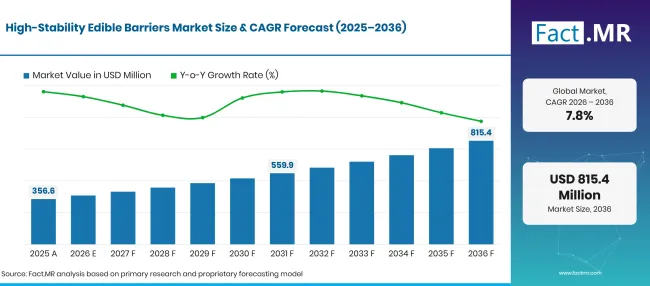
High Stability Edible Barriers Forecast Global 1 | Source: Fact.MR
Category
| Category | Segments |
|---|---|
| Product Type | Epoxy novolac, Bismaleimide, Polyimide, Cyanate ester, High-temperature phenolic |
| Material Form | Custom formulated, Liquid and dispersion, Film and sheet, Pellet and powder, Paste and gel |
| Performance Requirement | Chemical durability, Sustainability, Electrical and thermal, Mechanical strength, Heat resistance |
| End Use | Packaging and other, Industrial machinery, Electronics, Automotive, Construction |
| Region | United Kingdom; Japan; Germany; France; Italy |
Source: Fact.MR analysis. Updated Nov 24, 2026
Segmental Analysis
Why does epoxy novolac lead product demand in the High-Temperature Structural Resins Market?
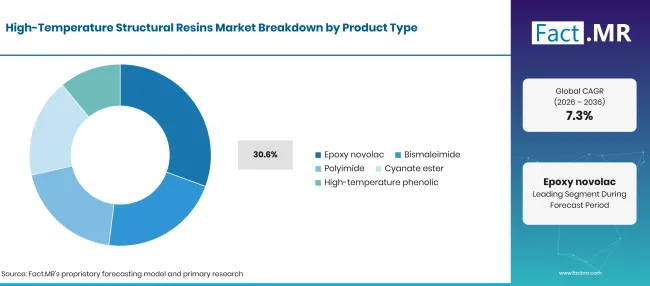
High Temperature Structural Resins Breakdown Product Type | Source: Fact.MR
Epoxy novolac captures 30.6% of the market in 2026, valued at USD 186.7 million, because its dense cross-linked structure delivers stronger thermal stability and chemical resistance than conventional epoxy grades. Its compatibility with established processing methods also keeps manufacturing costs manageable. Huntsman's Araldite ECN grades are designed for high-temperature adhesives, laminates, electrical components and protective coatings. Meanwhile, bismaleimide and cyanate ester resins are gaining traction in applications involving more extreme operating temperatures.
How is custom formulation leading form demand in the High-Temperature Structural Resins Market?
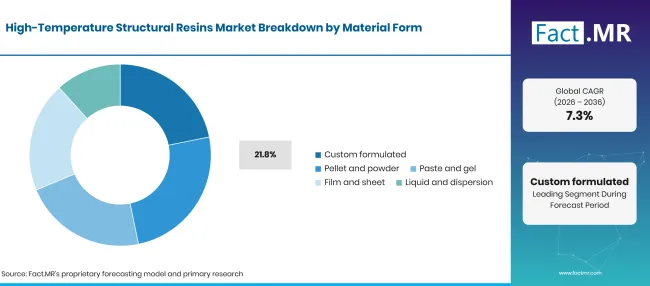
High Temperature Structural Resins Breakdown Material Form | Source: Fact.MR
Custom formulated systems generate 21.8% of market revenue in 2026, reaching USD 133.0 million, as aerospace and industrial manufacturers seek specific combinations of heat resistance, toughness, curing speed and mechanical strength. Standard formulations often cannot satisfy these varied operating conditions. In May 2025, Syensqo and Boeing demonstrated CYCOM 5250-4HT composite material as a lightweight alternative to titanium for the MQ-25 Stingray exhaust nozzle. Demand for prepregs and ready-to-use resin systems is also advancing as manufacturers streamline composite production.
Why does chemical durability lead performance demand in the High-Temperature Structural Resins Market?
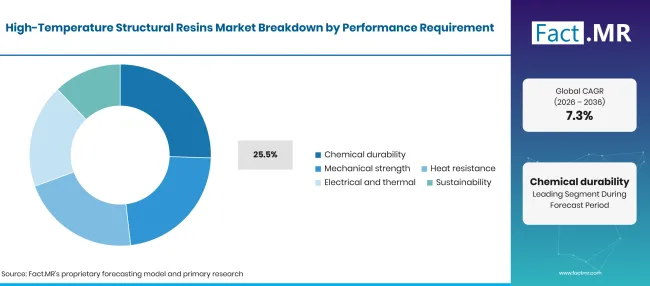
High Temperature Structural Resins Breakdown Performance Requirement | Source: Fact.MR
Chemical durability contributes 25.5% of market revenue in 2026, equivalent to USD 155.6 million, because structural components exposed to elevated temperatures must also withstand fuels, hydraulic fluids, coolants and industrial chemicals. This makes chemical stability essential for tanks, pumps, pipes and protective linings. Huntsman's Araldite EPN 1139 is designed with chemical resistance, solvent resistance and thermal stability for structural and electrical applications. Thermal stability and mechanical strength are also gaining attention as aerospace manufacturers develop lighter components for demanding operating environments.
How do packaging and other end uses lead demand in the High-Temperature Structural Resins Market?
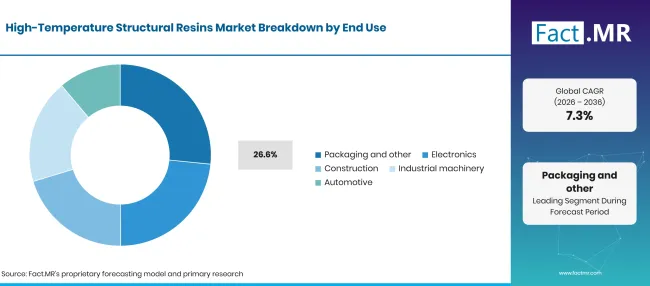
High Temperature Structural Resins Breakdown End Use | Source: Fact.MR
Packaging and other end uses account for 26.6% of market revenue in 2026, or USD 162.3 million, making this the largest end-use category. It is a grouped segment covering heat-resistant packaging alongside aerospace, energy and other specialty applications. The report does not break out revenue among these sub-applications. Aerospace is a significant demand driver, particularly for lightweight materials that must withstand engine heat and mechanical stress, as shown by Syensqo's May 2025 demonstration of CYCOM 5250-4HT for Boeing's MQ-25 exhaust nozzle. Energy and industrial equipment applications are also advancing as manufacturers seek durable, heat-resistant structural materials.
Drivers, Restraints and Trends
Driver
Rising Aircraft Production and Composite Adoption. Aircraft manufacturers are working through record order books, creating a strong market for structural materials that can withstand heat, vibration and mechanical stress without adding excessive weight. This is creating wider opportunities for high-temperature structural resins across engine structures, nacelles and aircraft interiors. In October 2026, Airbus reported 547 commercial aircraft deliveries during the first nine months, compared with 507 in the same period of 2025. Higher aircraft production and composite adoption are strengthening the market's long-term prospects.
Restraint
High Processing Costs and Qualification Challenges. High raw material costs, lengthy aerospace qualification procedures and complex curing requirements make high-temperature structural resins expensive to commercialize. Manufacturers also face difficulties maintaining consistent quality during processing. Huntsman reported higher raw material costs in its third-quarter 2026 results, while epoxy and composite handling can expose workers to skin and respiratory hazards. These issues can discourage smaller manufacturers from adopting advanced resin systems.
Trend
Composites for High-Temperature Structural Applications. Aircraft engine manufacturers are increasing composite use in structures exposed to demanding thermal and mechanical conditions. This is encouraging resin manufacturers to improve thermal stability, processing consistency and structural reliability. Safran reported third-quarter 2026 revenue of EUR 9,003 million, up 14.7%, supported by higher production and engine aftermarket activity. Future opportunities lie in scalable resin manufacturing and faster qualification of composite structures for next-generation aircraft. Similar adoption across aerospace and defence structures is widening the application base.
Trend
Greater Focus on Fire-Safe Composite Materials. Aircraft and rail manufacturers are placing greater emphasis on fire, smoke and toxicity performance alongside heat resistance. In July 2026, the UK's Aerospace Technology Institute published a composites growth framework targeting stronger domestic capabilities across aerospace composite manufacturing. This creates opportunities for resin manufacturers to develop materials that meet stricter fire-safety and structural performance requirements. Similar material innovation in aircraft and rail interiors is strengthening opportunities in the FST composite resin market.
Analysis by Key Country
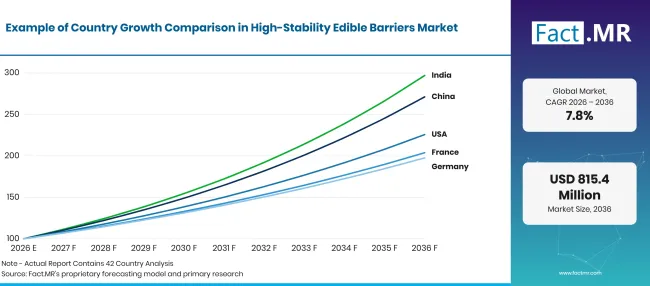
High Stability Edible Barriers Growth Index 1 | Source: Fact.MR
| Country | CAGR (2026-2036) |
|---|---|
| United Kingdom | 7.6% |
| Japan | 7.3% |
| Germany | 7.0% |
| France | 6.7% |
| Italy | 6.1% |
Source: Fact.MR analysis. Updated Nov 24, 2026
What is driving high-temperature structural resins demand in the United Kingdom?
The UK's strong aerospace manufacturing base is creating opportunities for high-temperature structural resins, particularly in lightweight wings, engine structures and advanced composite components.
In July 2026, the University of Sheffield opened the £54 million COMPASS facility to accelerate large-scale composite manufacturing, with Boeing as its first user. Investment in aerospace research, defence manufacturing and advanced materials is strengthening sales prospects for high-temperature resin systems.
How is next-generation aircraft materials development supporting high-temperature structural resins in Japan?
Japan's focus on next-generation aircraft materials is creating a favourable environment for high-temperature structural resins. In 2026, NEDO highlighted thermoplastic composite aircraft components that achieved around 30% weight reduction (baseline not specified) while maintaining comparable strength and durability.
These thermoplastic systems sit largely outside the thermoset-based resin categories covered in this report, but they signal growing aerospace investment in carbon-fibre processing and lightweight structures, which supports demand for thermoset systems such as bismaleimide and cyanate ester in the hottest zones of aircraft. Aerospace suppliers' efforts to improve production efficiency are adding to the country's market opportunities.
What is shaping high-temperature structural resins demand in Germany?
Germany's expanding aerospace and defence industry is creating a stronger market for heat-resistant composite materials.
The German Aerospace Industries Association reported in May 2026 that industry revenue reached EUR 62 billion in 2025, rising 19% year over year. Higher aircraft production, military aviation activity and investment in lightweight engineering are driving sales of high-temperature structural resins. Manufacturers are also exploring fibre-reinforced composites to improve component strength, corrosion resistance and weight efficiency.
How is aerospace output shaping high-temperature structural resins sales in France?
France benefits from its concentration of aircraft, engine and aerospace equipment manufacturers, which use advanced materials in demanding structural applications.
Safran reported EUR 31.3 billion in adjusted revenue for 2025, up 15%, in its February 2026 results. Higher engine production, aircraft deliveries and investment in next-generation aviation technologies are creating opportunities for high-temperature structural resins. The country's established aerospace supply chain also encourages material qualification and composite engineering.
Why is growth slower for high-temperature structural resins in Italy?
Italy's aerospace industry is creating opportunities for high-temperature structural resins through its involvement in international aircraft and defence programmes.
Leonardo's 2025 annual report, published in 2026, highlights its use of composite and hybrid materials in aerostructures for Boeing and Airbus aircraft, including the 787 and A321. Aircraft component production, defence aviation programmes and investment in automated composite assembly are driving sales of high-temperature structural resins.
Competitive Landscape
Competition in the high-temperature structural resins market is led by specialty resin producers. Huntsman competes through its Advanced Materials epoxy and bismaleimide lines, Syensqo competes through aerospace composite materials, Evonik competes with polyimide and specialty curing chemistry, Westlake Epoxy competes with epoxy novolacs, and Mitsubishi Chemical and Sumitomo Bakelite compete from Japan. Buyers select high-temperature structural resins on glass transition temperature, toughness, processability, qualification status and price.
From 2025 onward, competition shifted toward aerospace volume and faster processing. Huntsman's Advanced Materials sales rose 18% in the third quarter of 2026, Syensqo's composite sales rose 27% organically, Evonik lifted its outlook, and aircraft backlogs set records. Suppliers that hold program qualifications and can scale supply are best placed to grow.
Recent Developments
- On November 17, 2026, Huntsman and Olin Corporation announced the planned business structure of their combined company, OlinHuntsman, following their previously announced merger. The combined business will operate through four divisions, including Advanced Solutions and Polyurethanes.
- In January 2026, Syensqo entered into a five-year strategic supply agreement with Toray Composite Materials America to secure carbon fiber supplies for aerospace applications. The partnership will support existing and future commercial and defence aircraft programs.
- On March 12, 2026, Evonik expanded its distribution partnership with IMCD into the United States. The agreement allows IMCD to distribute Evonik's VISIOMER specialty methacrylates portfolio across applications such as coatings, adhesives, construction and composites.
- On May 28, 2026, Mitsubishi Chemical Group announced a joint venture with Accenture to accelerate AI-based business transformation and improve operational efficiency across its operations.
- On February 17, 2026, Westlake Epoxy expanded its distribution partnership with Brenntag into South and West India. The agreement covers epoxy resin products for coatings, adhesives and construction applications.
Key Players
Huntsman, Syensqo, Evonik, Mitsubishi Chemical, Westlake Epoxy, Sumitomo Bakelite
- Huntsman
- Syensqo
- Evonik
- Mitsubishi Chemical
- Westlake Epoxy
- Sumitomo Bakelite
Bibliography
- Airbus. (2026, October 28). Airbus reports nine-month (9m) 2026 results.
- Aerospace Technology Institute. (2026, July 20). ATI launches composites framework for growth to secure the UK's competitive advantage.
- Bundesverband der Deutschen Luft- und Raumfahrtindustrie. (2026, May 27). BDLI industry data 2026: Aerospace industry sets new records for revenue and employment.
- Huntsman Corporation. (n.d.). Advanced materials: High performance components selector guide.
- Huntsman Corporation. (2026). Quarterly report for the period ended September 30, 2026.
- Huntsman Corporation. (n.d.). ARALDITE EPN 1139: Product information.
- Leonardo S.p.A. (2026). 2025 annual report summary.
- New Energy and Industrial Technology Development Organization. (2026). Next-generation aircraft move closer to reality.
- Safran. (2026, February 13). Safran reports excellent financial performance in 2025 and raises its 2028 ambitions.
- Safran. (2026, October 23). Safran reports its third quarter 2026 revenue.
- Syensqo. (2025, May 21). Syensqo's composites demonstrate titanium replacement on Boeing applications.
- Syensqo. (2026, November 5). Third quarter 2026 results.
- University of Sheffield. (2026, July 16). Investing in the future of aerospace production: Landmark R&D facility to boost UK aircraft manufacturing.
Segmentation
Scope of Report
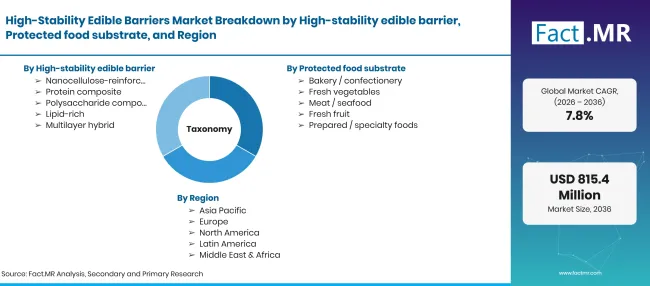
High Stability Edible Barriers Taxonomy 1 | Source: Fact.MR
| Items | Values |
|---|---|
| Quantitative Units (2026) | USD 610.0 Million |
| Product Type | Epoxy novolac, Bismaleimide, Polyimide, Cyanate ester, High-temperature phenolic |
| Material Form | Custom formulated, Liquid and dispersion, Film and sheet, Pellet and powder, Paste and gel |
| Performance Requirement | Chemical durability, Sustainability, Electrical and thermal, Mechanical strength, Heat resistance |
| End Use | Packaging and other, Industrial machinery, Electronics, Automotive, Construction |
| Regions Covered | North America, Latin America, Europe, East Asia, South Asia and Pacific, Middle East & Africa |
| Countries Covered | United Kingdom, Japan, Germany, France, Italy, and other countries |
| Key Companies Profiled | Huntsman, Syensqo, Evonik, Mitsubishi Chemical, Westlake Epoxy, Sumitomo Bakelite |
Source: Fact.MR analysis. Updated Nov 24, 2026
Frequently Asked Questions
How big is the global High-Temperature Structural Resins Market in 2026?
What will be the size of the market by 2036?
How fast will the market grow during the forecast period?
Which product type segment holds the largest share?
Who worked on this report


Preview the report firsthand - request a free sample
Free SampleGet the brochure for pricing and purchase details
Download PDF