- Market Value (2025): USD 268.8 Mn
- Estimated Value (2026): USD 290.0 Mn
- Forecast Value (2036): USD 620.3 Mn
- CAGR (2026-2036): 7.9%
Flame-Retardant Engineering Plastics Market Forecast and Outlook 2026 to 2036
The flame-retardant engineering plastics market is projected to grow from USD 290.0 million in 2026 to USD 620.3 million by 2036. Demand for flame-retardant engineering plastics is likely to grow at a CAGR of 7.9% over the forecast period.
Orders for flame-retardant engineering plastics are increasing as electrical installations, building products, data center hardware and electric vehicle parts must pass stricter fire tests while staying light and moldable. Specialist producers are offering polyamide, polypropylene, PBT, polycarbonate and PPS compounds with halogen-free flame retardants. Selected grades achieve UL 94 V-0 ratings at specified material thicknesses under controlled laboratory conditions. Smoke performance and suitability for building applications require separate testing under relevant fire-safety standards. For example, in November 2026, Celanese said demand from AI data center build-outs was lifting sales of technically demanding polymers in its Engineered Materials business.
Market figures and highlights for the Flame-Retardant Engineering Plastics Market
- Sales of flame-retardant engineering plastics stood at USD 268.8 million in 2025
- Flame-Retardant Engineering Plastics Market Value (2026): USD 290.0 million
- Flame-Retardant Engineering Plastics Market Forecast Value (2036): USD 620.3 million
- Flame-Retardant Engineering Plastics Market Forecast CAGR (2026-2036): 7.9%
- Leading Product Type: FR polyamide (27.4%)
- Companies profiled: BASF, SABIC, Covestro, Celanese, Envalior, Asahi Kasei
- Countries covered by growth analysis: France, Netherlands, Germany, United States, United Kingdom
In October 2026, BASF reported considerable third-quarter growth in EBITDA before special items, with earnings rising in its Materials segment among others. More businesses are purchasing flame-retardant engineering plastics as polymer producers recover and direct resources to specialty compounds. Specialist producers are replacing halogenated systems and adding recycled-content grades.
Flame-Retardant Engineering Plastics Market
| Metric | Value |
|---|---|
| Estimated Value in (2026) | USD 290.0 million |
| Forecast Value in (2036) | USD 620.3 million |
| Forecast CAGR (2026 to 2036) | 7.9% |
Source: Fact.MR analysis. Updated Nov 21, 2026
Source: Fact.MR analysis.
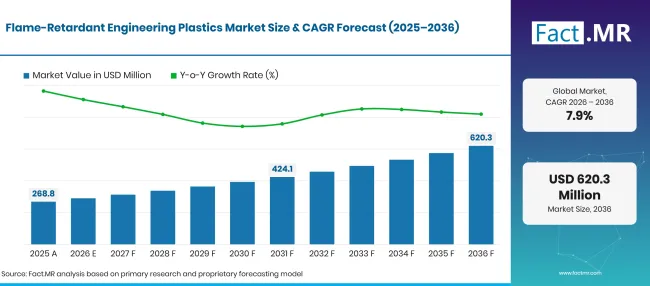
Flame Retardant Engineering Plastics Forecast Global | Source: Fact.MR
Category
| Category | Segments |
|---|---|
| Product Type | FR polyamide, FR polypropylene, FR PBT and PET, FR PPS and high-performance, FR polycarbonate |
| Material Form | Custom formulated, Pellet and powder, Liquid and dispersion, Paste and gel, Film and sheet |
| Performance Requirement | Mechanical strength, Sustainability, Heat resistance, Electrical and thermal, Chemical durability |
| End Use | Construction, Packaging and other, Industrial machinery, Electronics, Automotive |
| Region | France; Netherlands; Germany; United States; United Kingdom |
Source: Fact.MR analysis. Updated Nov 21, 2026
Segmental Analysis
Why does FR polyamide lead product demand in the Flame-Retardant Engineering Plastics Market?
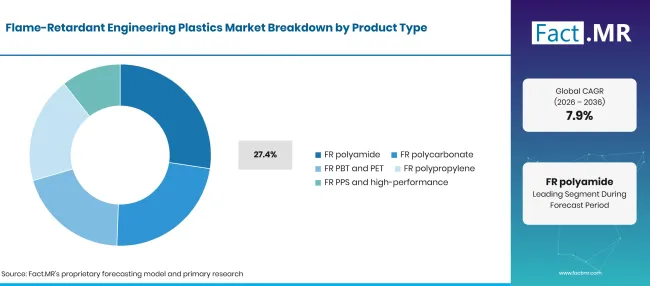
Flame Retardant Engineering Plastics Breakdown Product Type | Source: Fact.MR
FR polyamide holds 27.4% of the flame-retardant engineering plastics market in 2026, valued at USD 79.5 million, because polyamide 6 and 66 offer strength, heat resistance and electrical insulation for connectors, circuit breakers and terminal blocks. In January 2025, BASF introduced an Ultramid T6000 flame-retardant grade for terminal block applications, offering improved mechanical and electrical performance at high temperatures. Material suppliers are developing glass-filled, halogen-free grades for electrical components. Demand will continue to reflect safety requirements and approved material specifications.
How is custom formulation leading form demand in the Flame-Retardant Engineering Plastics Market?
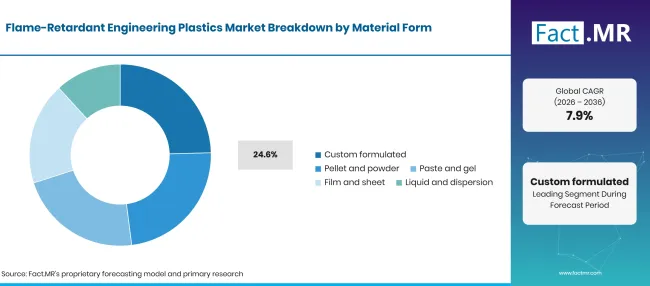
Flame Retardant Engineering Plastics Breakdown Material Form | Source: Fact.MR
Custom formulated compounds account for 24.6% of flame-retardant engineering plastics revenue in 2026, generating USD 71.3 million, because each component requires a suitable balance of fire resistance, color, glass content, flow and electrical tracking performance. In November 2025, BASF expanded local production of Ultradur PBT in India, including specialty flame-retardant grades for electrical and industrial applications. Compounders are adjusting material formulations to meet specific manufacturing requirements.
Why does mechanical strength lead performance demand in the Flame-Retardant Engineering Plastics Market?
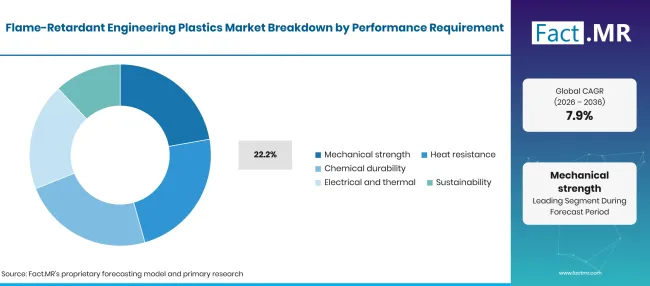
Flame Retardant Engineering Plastics Breakdown Performance Requirement | Source: Fact.MR
Mechanical strength represents 22.2% of flame-retardant engineering plastics revenue in 2026, equivalent to USD 64.4 million, as housings, clips and structural brackets must maintain strength while meeting fire safety requirements. In June 2025, BASF introduced Ultramid Advanced N3U42G6, a flame-retardant material for high-voltage connectors that combines high strength, electrical insulation and dimensional stability. Manufacturers are using reinforcing fibers and impact modifiers to improve material performance.
How is construction leading end-use demand in the Flame-Retardant Engineering Plastics Market?
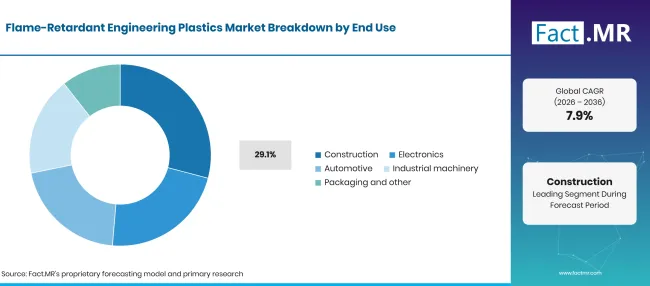
Flame Retardant Engineering Plastics Breakdown End Use | Source: Fact.MR
Construction holds 29.1% of flame-retardant engineering plastics revenue in 2026, worth USD 84.4 million, as building electrical systems require materials with suitable fire and electrical performance. Building-product requirements differ from small-scale plastic flammability ratings, with applicable tests addressing characteristics such as flame spread and smoke development. In January 2026, the European Union began applying its revised Construction Products Regulation, strengthening the framework for construction product safety and performance. Suppliers are developing materials for electrical installations and building equipment that meet relevant product specifications.
Flame-Retardant Engineering Plastics Market-Drivers, Restraints & Trends
Drivers
Orders for flame-retardant engineering plastics are increasing as fire safety rules for buildings tighten. For example, from 30 September 2026, amended guidance in England requires a second staircase in new blocks of flats with a storey 18 metres or more above ground level, and the Building Safety (Remediation of Unsafe Cladding etc) Bill was introduced on 14 October 2026. Specialist producers are supplying compliant electrical and building components.
Restraints
Flame-retardant engineering plastics face challenges from uneven industrial demand, raw material costs and restrictions on selected flame-retardant additives. In November 2026, Celanese reported a 1% year-on-year decline in Engineered Materials sales to approximately USD 1.4 billion for the third quarter. The comparison included a six-percentage-point impact from the divestiture of its Micromax business. Underlying segment performance was supported by growth initiatives and stronger demand in medical and electronics applications. Material qualification requirements and formulation costs will continue to influence purchasing decisions.
Trend
Halogen-Free and Recycled-Content Grades Demand for halogen-free compounds with post-consumer recycled content is rising as electronics and appliance brands set circularity targets. Suppliers are adapting flame retardant packages to variable recycled feedstock. The EU Packaging and Packaging Waste Regulation began to apply on 12 August 2026, adding to circularity pressure across plastics.
Trend
Electrification and Data Centres In October 2026, U.S. Census data showed data centre construction running at a record annual pace of about USD 85 billion in August 2026, up 73% in a year. Demand for flame-retardant connectors, busbar supports and battery parts is rising. Similar build-out is projected to drive sales of flame-retardant engineering plastics.
Flame-Retardant Engineering Plastics Market by Analysis by Key Country
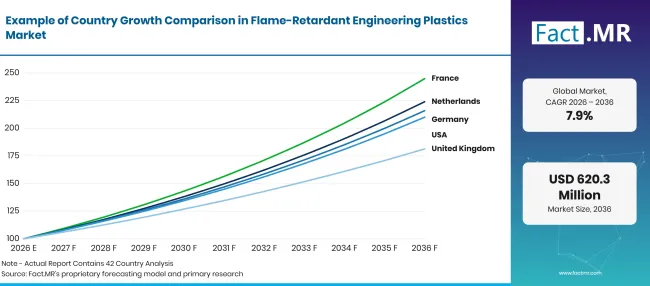
Flame Retardant Engineering Plastics Growth Index | Source: Fact.MR
| Country | CAGR (2026-2036) |
|---|---|
| France | 9.4% |
| Netherlands | 8.4% |
| Germany | 8.0% |
| United States | 7.7% |
| United Kingdom | 6.1% |
Source: Fact.MR analysis. Updated Nov 21, 2026
Source: Fact.MR analysis.
What is driving flame-retardant engineering plastics demand in France?
In November 2026, French chemicals group Arkema reported third-quarter organic sales growth of 6.6% with volumes up 3.3%.
Demand for flame-retardant engineering plastics in France is projected to grow at a 9.4% CAGR, the fastest among the five key countries, as electrical equipment makers, new buildings under RE2020 rules and aerospace suppliers raise orders.
How is the technology sector supporting flame-retardant engineering plastics sales in the Netherlands?
Sales of flame-retardant engineering plastics in the Netherlands are projected to grow at an 8.4% CAGR as high-tech equipment and energy infrastructure expand.
ASML reported record third-quarter 2026 results in October and guided full-year net sales of EUR 44 billion to EUR 45 billion. Suppliers of flame-retardant engineering plastics, including Envalior and SABIC with Dutch operations, are serving equipment and electrical customers.
What is shaping flame-retardant engineering plastics demand in Germany?
Demand for flame-retardant engineering plastics in Germany is projected to grow at an 8.0% CAGR as electrical, automotive and data centre projects advance.
Germany approved targets in March 2026 to at least double data centre capacity by 2030, and Amazon said in October 2026 that it planned to invest more than EUR 16 billion in the country in 2027. Suppliers of flame-retardant engineering plastics, including BASF and Covestro, are serving German connector and switchgear makers.
How is data centre building shaping flame-retardant engineering plastics sales in the United States?
Sales of flame-retardant engineering plastics in the United States are projected to grow at a 7.7% CAGR as data centre and grid equipment demand rises.
Census data showed data centre construction at a record annual pace of about USD 85 billion in August 2026. Suppliers of flame-retardant engineering plastics, including Celanese, are serving U.S. electrical component makers.
Why is growth slower for flame-retardant engineering plastics in the United Kingdom?
Demand for flame-retardant engineering plastics in the United Kingdom is projected to grow at a 6.1% CAGR, the slowest among the five countries, as the country has a smaller compounding and electrical manufacturing base and building projects face approval delays.
A September 2026 analysis found about 103,000 dwellings still waiting for cladding remediation to start. Specialist producers are serving UK building product and rail customers.
Competitive Analysis for Flame-Retardant Engineering Plastics Market
Competition in the flame-retardant engineering plastics market reflects differences in polymer chemistry, material performance and application requirements. BASF and Envalior supply flame-retardant polyamide and PBT grades for electrical components, while SABIC and Covestro offer polycarbonate materials and blends. Celanese provides engineering polymers for electronics and industrial equipment, and Asahi Kasei specializes in modified PPE and polyamide materials. Material selection depends on flame resistance at specific thicknesses, electrical tracking performance, mechanical strength, color stability and product approvals.
Electrification and demand for safer electronic components are influencing material development across the industry. In September 2026, BASF presented new flame-retardant polyamide and PPA grades with improved electrical insulation and heat resistance. Celanese also highlighted opportunities in AI data centre infrastructure during its third-quarter 2026 earnings discussions, alongside changes to its nylon manufacturing operations. The UK's February 2026 Construction Products Reform White Paper introduced proposals to strengthen product safety oversight. Manufacturers offering reliable thin-wall flame protection, halogen-free formulations and suitable recycled materials will be better positioned to meet changing customer specifications.
Recent Developments
- In January 2025, BASF introduced its flame-retardant Ultramid T6000 polyphthalamide grade for electric vehicle terminal blocks, offering improved electrical insulation, thermal shock resistance and durability in high-voltage automotive applications.
- In July 2025, SABIC introduced LNP THERMOTUF WF0087N, a flame-retardant PBT compound designed for nano-molded consumer electronics components, combining strong bonding with metal surfaces, impact resistance and reliable mechanical performance.
- In October 2025, Envalior launched Pocan BFN4232ZHR S1, a halogen-free flame-retardant PBT grade offering strong electrical insulation, dimensional stability and hydrolysis resistance for high-voltage connectors in electric vehicles and data centers.
Key Players in Flame-Retardant Engineering Plastics Market
Key companies profiled include BASF; SABIC; Covestro; Celanese; Envalior; and Asahi Kasei.
- BASF
- SABIC
- Covestro
- Celanese
- Envalior
- Asahi Kasei
Bibliography
- ASTM International. (2026). Standard test method for surface burning characteristics of building materials (ASTM E84-26a).
- Arkema. (2026, November 5). Third-quarter 2026 results.
- ASML Holding N.V. (2026, October 14). ASML reports €11.7 billion total net sales and €5.0 billion net income in Q3 2026.
- BASF. (2025, January 13). BASF launches innovative Ultramid T6000 grade for electric vehicle applications.
- BASF SE. (2026, October 28). BASF Group in third quarter 2026: Strength across all core businesses drives BASF Group’s considerable growth in EBITDA before special items.
- Celanese Corporation. (2026, November 2). Celanese Corporation reports third quarter earnings; exceeds third quarter guidance and raises full year outlook [Exhibit 99.1]. U.S. Securities and Exchange Commission.
- Envalior. (2025, October 8). New PBT from Envalior, debuting at K 2025 & the Battery Show North America, sets standard for high-voltage applications. Official product announcement
- Federal Statistical Office of Germany. (2026, October 16). Baugenehmigungen für Wohnungen im August 2026: +6,8 % zum Vorjahresmonat [Building permits for dwellings in August 2026: +6.8% year over year].
- LANXESS AG. (2026, November 9). LANXESS increases sales and earnings in the third quarter of 2026.
- Ministry of Housing, Communities and Local Government. (2026, September 16). Fire safety: Approved Document B. GOV.UK.
- Office for National Statistics. (2026, November 12). Construction output in Great Britain: September 2026, new orders and Construction Output Price Indices, July to September 2026.
- SABIC. (2025, July 16). SABIC debuts first FR PBT nano molding material with good bonding and mechanical properties.
- U.S. Census Bureau. (2026, October 1). Monthly construction spending, August 2026.
- U.S. Census Bureau. (2026, November 2). Monthly construction spending, September 2026.
Segmentation
Scope of Report
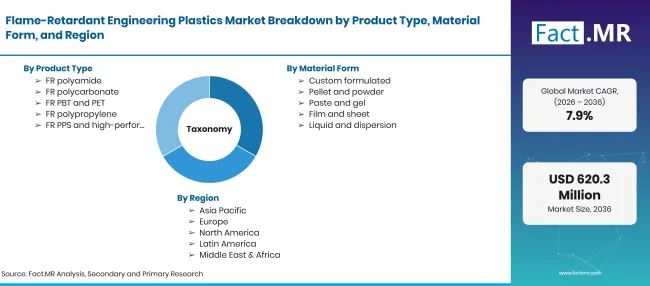
Flame Retardant Engineering Plastics Taxonomy | Source: Fact.MR
| Items | Values |
|---|---|
| Quantitative Units (2026) | USD 290.0 Million |
| Product Type | FR polyamide, FR polypropylene, FR PBT and PET, FR PPS and high-performance, FR polycarbonate |
| Material Form | Custom formulated, Pellet and powder, Liquid and dispersion, Paste and gel, Film and sheet |
| Performance Requirement | Mechanical strength, Sustainability, Heat resistance, Electrical and thermal, Chemical durability |
| End Use | Construction, Packaging and other, Industrial machinery, Electronics, Automotive |
| Regions Covered | North America, Latin America, Europe, East Asia, South Asia and Pacific, Middle East & Africa |
| Countries Covered | France, Netherlands, Germany, United States, United Kingdom, and other countries |
| Key Companies Profiled | BASF, SABIC, Covestro, Celanese, Envalior, Asahi Kasei |
| Additional Attributes | Dollar revenue in the Flame-Retardant Engineering Plastics Market is segmented by product type (FR polyamide, FR polypropylene, FR PBT and PET, FR PPS and high-performance, FR polycarbonate), material form, performance requirement, end use and region. |
Source: Fact.MR analysis. Updated Nov 21, 2026
Flame-Retardant Engineering Plastics Market by Segments
-
Product Type
- FR polyamide
- FR polypropylene
- FR PBT and PET
- FR PPS and high-performance
- FR polycarbonate
-
Material Form
- Custom formulated
- Pellet and powder
- Liquid and dispersion
- Paste and gel
- Film and sheet
-
Performance Requirement
- Mechanical strength
- Sustainability
- Heat resistance
- Electrical and thermal
- Chemical durability
-
End Use
- Construction
- Packaging and other
- Industrial machinery
- Electronics
- Automotive
-
Region:
- North America
- United States
- Canada
- Mexico
- Europe
- Germany
- United Kingdom
- France
- Italy
- Spain
- Rest of Europe
- Asia Pacific
- China
- India
- Japan
- South Korea
- Australia
- Rest of Asia Pacific
- Latin America
- Brazil
- Mexico
- Argentina
- Rest of Latin America
- Middle East & Africa
- GCC Countries
- South Africa
- Rest of Middle East & Africa
- North America
Frequently Asked Questions
How big is the global Flame-Retardant Engineering Plastics Market in 2026?
What will be the size of the Flame-Retardant Engineering Plastics Market by 2036?
How fast will the Flame-Retardant Engineering Plastics Market grow during the forecast period?
Which product type segment holds the largest share of the Flame-Retardant Engineering Plastics Market?
Who worked on this report


Preview the report firsthand - request a free sample
Free SampleGet the brochure for pricing and purchase details
Download PDF