- Base Value(2025): 56.9 Bn
- Estimated Value(2025): 56.9 Bn
- Forecast Value (2035): 97.2 Bn
- CAGR (2025 - 2035): 5.5%
Abrasives Market Outlook (2025 from 2035)
The global abrasives market is projected to grow from USD 56.9 billion in 2025 to USD 97.2 billion by 2035, with an annual growth rate of 5.5%, due to increased demand from the electronics, metalworking, automotive, and aerospace sectors.
High-performance grinding and finishing solutions are becoming necessary as these industries shift toward increased automation and precision. Abrasives that offer consistency, durability, and cost-effectiveness are increasingly sought after by manufacturers, driving continuous innovation and ensuring the market's resilience in the years to come.
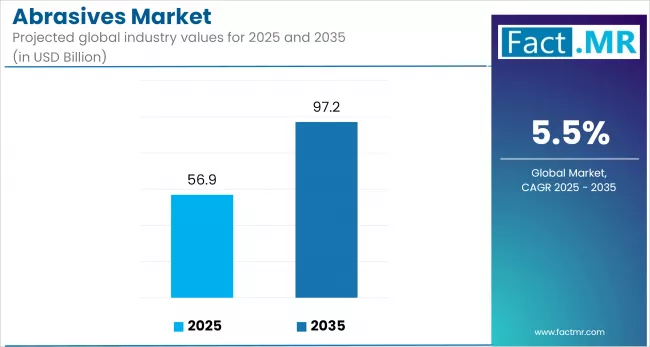
Abrasives Market | Source: Fact.MR
What are the Drivers of the Abrasives Market?
The market for abrasives is expanding steadily due to strong demand from the electronics, metalworking, automotive, and construction industries. The need for sophisticated abrasives to machine lightweight alloys and achieve precise tolerances in crucial components is growing as the production of electric vehicles expands globally.
The demand for grinding, cutting, and surface treatment solutions remains driven by the expansion of infrastructure in Asia, the Middle East, and Africa. High-performance abrasives that provide consistent output and operational reliability are becoming necessary as automation and robotics are incorporated into manufacturing.
Manufacturers are developing technologies using ceramic, diamond, and other engineered abrasives to meet these changing demands, which will improve precision, decrease downtime, and help the modern industry achieve its efficiency targets. It is anticipated that this innovation-driven strategy will enable the market to continue growing over the coming years.
What are the Regional Trends in the Abrasives Market?
With China's integrated supply chain and dominance in coated and bonded abrasives for heavy industry, electronics, and automobiles, the Asia Pacific region dominates the global abrasives market. While South Korea and Japan continue to have a high demand for super abrasives due to advanced automotive systems and precision electronics manufacturing, India's growth is accelerating due to the expansion of its manufacturing and infrastructure.
Investments in domestic manufacturing, electric vehicles, aerospace, and defense are driving North America's steady growth. With the help of legislative efforts to localize supply chains in vital industries like semiconductors and clean energy, the United States leads the world in specialized abrasives.
Europe is still committed to sustainability, quality, and legal compliance. While EU environmental regulations are promoting innovation in low-impact materials, markets such as Germany, France, and Italy are driving demand for high-performance, recyclable abrasives in the automotive, engineering, and renewable energy sectors.
The market for abrasives is growing moderately in Latin America, particularly in Brazil and Mexico, where mid-scale manufacturing and aftermarket demand are driving the expansion of metalworking, automotive production, and infrastructure development.
What are the Challenges and Restraining Factors in the Abrasives Market?
The volatility of raw material prices remains a significant concern, particularly for synthetic diamonds and aluminum oxide. Particularly in cost-sensitive industries, supply chains are being disrupted, and geopolitical tensions and changes in energy prices are squeezing margins.
With tighter regulations about waste management, energy use, and emissions in places like the USA and the EU, environmental and regulatory pressures are growing. These difficulties increase production costs, despite encouraging the development of sustainable materials.
Non-abrasive alternatives, such as waterjet machining and laser cutting, in high-precision industries, electronics, and aerospace, are gradually replacing traditional abrasives.
Limitations on recycling pose challenges to sustainability, particularly for bonded abrasives. Lack of recyclability may become a competitive disadvantage as OEMs place a higher priority on environmentally friendly supply chains.
Country-Wise Outlook
USA Abrasives Market Gains Traction amid Industrial Upgrades and Onshoring Initiatives
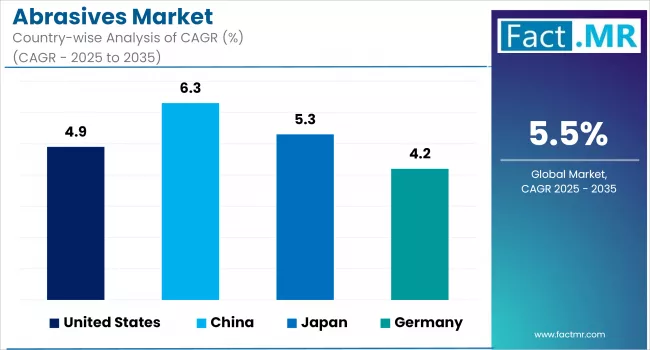
Abrasives Market Cagr Analysis By Country | Source: Fact.MR
The market for abrasives in the United States is expanding rapidly due to supply chain localization, infrastructure improvements, and renewed investments in domestic manufacturing. The need for abrasives is growing in the electronics, medical device, automotive, and aerospace industries as precision and efficiency become important.
The demand for advanced abrasives in the processing of battery components, electric drivetrains, and lightweight material machining has increased due to the shift to electric mobility. At the same time, the need for high-performance solutions where accuracy and throughput are crucial is being driven by increased federal support for semiconductor fabrication, defense, and renewable energy.
As a result, American producers are stepping up their innovation by creating sustainable abrasive materials, automating grinding systems, and designing specialized goods for high-tech uses. The United States is reaffirming its position as a leader in both traditional and cutting-edge abrasive technologies by emphasizing compliance, productivity, and technological advancement.
China Strengthens Its Position in the Global Abrasives Market
China leads the world in the production of key abrasive materials, including fused alumina, silicon carbide, and zirconia, due to its scale efficiencies, government-backed infrastructure, and robust supply chain network. Because of this combined advantage, Chinese producers can offer value-added and standardized abrasive products at competitive prices.
As one of the world's largest automobile industries, China remains a significant consumer of abrasives. Advanced abrasive solutions are needed to machine high-strength steel, aluminum alloys, and thermal management components as domestic OEMs like BYD, Geely, and NIO increase the production of electric and hybrid vehicles. The industry's changing technological needs are reflected in the growing use of abrasives in battery cell assembly, inverter housing, and precision grinding of e-motor components.
Simultaneously, the appliance and consumer electronics industries, supported by firms such as Xiaomi, Huawei, and Midea, maintain a high volume of demand for coated abrasives, which are used to finish display panels, housings, and small electronic components. Production lines are incorporating abrasive products with finer grits and improved surface uniformity as devices get thinner and more sophisticated.
The use of abrasives is also changing as a result of China's transition to intelligent manufacturing. The use of bonded and super abrasives has increased due to the development of CNC systems, smart factories, and robotic machining tools. This is especially true for multi-axis grinding, precision forming, and tool sharpening. To maintain performance under high mechanical and thermal loads, manufacturers are increasingly using vitrified bonds and engineered abrasives.
R&D in next-generation abrasives is being accelerated by national policies, such as "Made in China 2025," and sustained investment in strategic industries, including semiconductors, aerospace, and defense. This includes creating recyclable solutions, nano-structured abrasives, and hybrid ceramic materials that meet new international standards.
However, changes in manufacturing practices are being prompted by evolving environmental compliance requirements, particularly those related to energy consumption, chemical usage, and dust emissions. Furthermore, China's export competitiveness and global supply chains remain shaped by external factors, such as trade tensions and tariff adjustments.
Japan Advances Precision Applications in the Abrasives Market
Japan's longstanding advantages in precision engineering and high-value manufacturing support the country's robust and innovative abrasives market. Core industries that require ultra-reliable abrasive solutions for demanding technical applications, such as robotics, electronics, automotive, and aerospace, are the primary drivers of demand.
For the production of electric and hybrid vehicle components, particularly in areas such as lightweight chassis structures, battery housings, and compact powertrains, automakers like Toyota, Honda, and Nissan rely on precision abrasives. The demand for abrasives that can adhere to strict dimensional tolerances and high efficiency standards is being strengthened by the ongoing development of e-mobility technologies.
Japan is a vital link in the global supply chain for the semiconductor and electronics industries. For operations where exceptional surface accuracy and consistency are imperative, such as wafer thinning, micro-lens fabrication, and advanced chip packaging, super abrasives are indispensable. The importance of sophisticated abrasive technologies is further enhanced by the emergence of small, high-performing devices.
Japan's leadership is also influencing the use of abrasives in smart manufacturing and factory automation. The need for abrasives that can support fast, precise processes with little downtime is increasing as production lines incorporate robotics and CNC-based systems. These consist of long-lasting materials designed for automated settings, vitrified bonds, and engineered grains.
Category-wise Analysis
Bonded Abrasives to Exhibit Leading Share Among Product Types
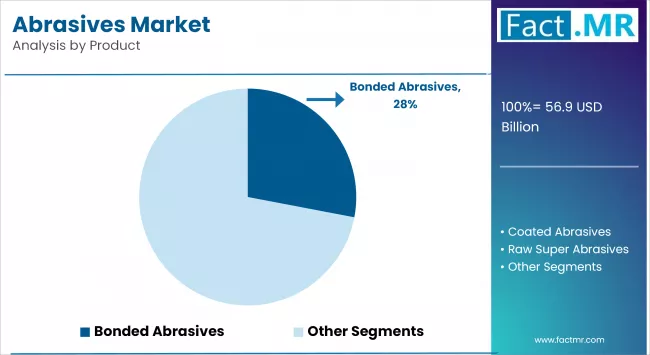
Abrasives Market Analysis By Product | Source: Fact.MR
Bonded abrasives remain a cornerstone of industrial operations, valued for their precision, longevity, and adaptability. These abrasives remain essential to industrial processes. They are extensively used in industries like foundries, heavy machinery, metal fabrication, and automotive, where precise dimensional tolerances and reliable material removal are crucial. Precision grinding, sharpening, and surface finishing are typical applications.
Bonded abrasives are available in various shapes, including wheels, segments, cones, and sticks, and can be tailored for use in both automated and manual systems. They are essential for machining engine parts, gears, and structural assemblies in high-performance sectors like aerospace and automotive, where dependability under extreme heat and pressure is crucial.
To meet the demands of high-speed, precision machining, technological developments in ceramic and resin bonding have greatly improved cutting efficiency, heat resistance, and product longevity. Bonded abrasives remain essential in contemporary production settings, as manufacturers seek scalable and affordable finishing solutions.
Machinery Category to Hold Leading Share in Abrasives Market by End User
The machinery segment remains a major driver of demand for abrasives due to its fundamental role in metalworking, equipment fabrication, and general industrial manufacturing. The processes of surface preparation, deburring, grinding, and finishing, all of which are necessary to preserve the functionality, accuracy, and longevity of machinery parts, require abrasives.
Applications include heavy industrial systems, construction and agricultural machinery, and machine tools, among other types of equipment. As global industrial output and automation trends accelerate, these industries rely on high-strength abrasives to meet stringent dimensional and surface quality requirements.
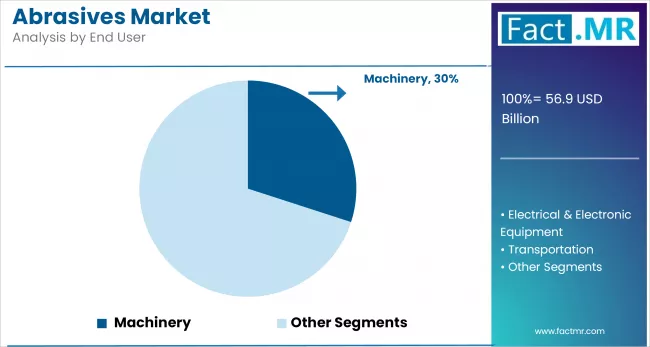
Abrasives Market Analysis By End User | Source: Fact.MR
Superabrasives and engineered bonded products have gained popularity due to the growing emphasis on energy-efficient machinery and precision engineering. OEMs are using customized abrasive solutions to improve part quality, reduce material loss, and increase production efficiency.
It is anticipated that the machinery segment will continue to be a steady, high-volume consumer of abrasives, driven by sustained investments in advanced manufacturing and equipment upgrades throughout Asia Pacific, North America, and Europe, thereby enhancing its strategic significance within the industry.
Asia Pacific Holds Leading Share in Abrasives Market
Due to its strong manufacturing base, extensive infrastructure development, and increasing use of industrial automation, the Asia Pacific continues to lead the world's abrasives market. The automotive, metalworking, electronics, and construction industries continue to experience robust demand from key markets, including China, India, Japan, and South Korea.
China dominates the region due to its extensive industrial base, which includes consumer goods, heavy machinery, and automobiles, as well as its well-integrated supply chain. The strong demand for bonded and coated abrasives is maintained by a persistent emphasis on domestic production and export-led expansion. Furthermore, the demand for precision-grade abrasive solutions is increasing due to government-led modernization initiatives and the push for smart manufacturing.
Major infrastructure projects, increased construction activity, and expanded manufacturing under the "Make in India" initiative are driving India's rapid market growth. The nation's industrial diversification is aided by the growing use of abrasives in the manufacturing of energy equipment, ships, and metal fabrication.
With robust demand linked to high-end electronics and sophisticated automotive manufacturing, South Korea and Japan continue to be innovation-driven markets. For high-precision machining, micro-grinding, and ultra-fine polishing, these industries depend on specialty abrasives. The development of super abrasives and engineered abrasives are being sustained by ongoing investments in robotics, semiconductors, and next-generation mobility.
Competitive Analysis
Leading companies in the fiercely competitive and quickly changing global abrasives industry include Saint-Gobain SA, 3M, DuPont, TYROLIT, and Henkel AG & Co. In various product categories and end-use sectors, KGaA, Abrasive Technology Inc., Allied High Tech Products Inc., Almatis GmbH, and ARC Abrasives Inc. are fierce competitors.
Leading businesses are emphasizing technical performance, application-specific innovation, and advanced material engineering as ways to stand out from the competition. Leading manufacturers of high-performance coated and bonded abrasives, 3M and Saint-Gobain, continue to support vital sectors like general precision manufacturing, automotive, and aerospace. In the meantime, DuPont and Henkel are using their extensive knowledge of chemicals to improve abrasive composites and create useful additives that raise the lifespan, effectiveness, and cost of products.
Superabrasives, nonwoven abrasives, and customized solutions for electronics, medical equipment, and automated industrial processes are among the markets that mid-market companies are occupying. There is a discernible trend toward abrasives tailored for high-precision automation, sustainability goals, and digital manufacturing environments, reflecting broader industrial priorities such as environmental impact, throughput, and regulatory compliance.
Strategic actions, such as capacity expansion, regional alliances, and targeted mergers and acquisitions, are also influencing the competitive environment. In high-growth segments, these initiatives seek to improve technical capabilities and expand market reach.
Recent Development
- In 2024, at GrindingHub in Stuttgart, Saint-Gobain introduced Razorstar, a high-performance ceramic grain designed for cooler, faster grinding, longer tool life, and lower energy use. The company also showcased its Q‑Flute Prime diamond grinding wheels for advanced tool machining, reinforcing its focus on precision, performance, and sustainability.
- In 2024, 3M unveiled new high-performance solutions, including 6JGS/6JGM diamond dressing rolls for gear grinding, the 6CVZ D93 ceramic diamond wheel for indexable inserts, and 1PVP additively manufactured CBN components. The company also highlighted the Cubitron™ II 92VC ceramic grinding wheel, reflecting its focus on customized geometries and precision applications.
Segmentation of the Abrasives Market
-
By Product :
- Bonded Abrasives
- Coated Abrasives
- Raw Super Abrasives
- Steel Abrasives
- Loose Abrasive Grains
- Others (including Nonwoven Abrasives)
-
By End User :
- Machinery
- Electrical & Electronic Equipment
- Transportation
- Metal Fabrication
-
By Region :
- North America
- Europe
- Asia Pacific
- Latin America
- MEA