Wide Mouth Bottles Market (2026 - 2036)
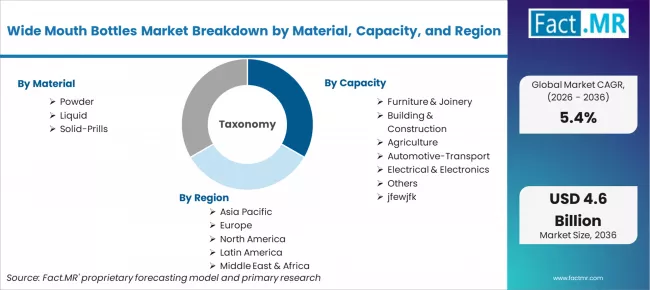
Wide Mouth Bottles Market is segmented by Material (Plastic, Stainless steel, Aluminum, Glass, Silicon, Others), Capacity (16-27 Oz, 8-12 Oz, 32 Oz, 40 Oz, 64 Oz, Above 1 Gallon), and Region. Forecast for 2026 to 2036.
Core Findings
Wide Mouth Bottles Market Size, Market Forecast and Outlook By Fact.MR
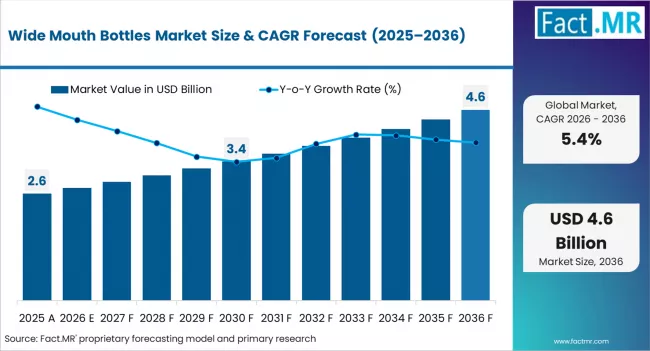
The wide mouth bottles market was valued at USD 2.60 billion in 2025, projected to reach USD 2.74 billion in 2026, and is forecast to expand to USD 4.64 billion by 2036 at a 5.4% CAGR. is being reshaped by the convergence of hydration-as-lifestyle branding and single-use plastic reduction mandates, where reusable stainless steel and aluminum formats are capturing share from disposable plastic bottles across outdoor recreation, workplace, and institutional procurement channels.
The absolute dollar expansion between 2026 and 2036 amounts to approximately USD 1.90 billion. Growth reflects consumer willingness to pay premiums for durable, reusable hydration vessels combined with institutional purchasing programmes at schools, corporate offices, and government facilities replacing single-use plastic bottle supplies. Material cost fluctuations in stainless steel and resin, along with evolving consumer preference cycles, act as the primary variables influencing category growth rates.
Institutional procurement managers at U.S. school districts and university systems are issuing requests for proposal that explicitly require BPA-free, reusable wide mouth bottle specifications for campus hydration programmes. Suppliers unable to demonstrate third-party safety certifications and minimum durability ratings face exclusion from public sector procurement shortlists.
All major regional markets reflect differentiated growth parameters. USA sets the pace at 5.9% CAGR. China registers at 4.5% CAGR. Germany registers at 4.1% CAGR. India registers at 3.8% CAGR. South Korea registers at 3.3% CAGR.
Wide Mouth Bottles Market Key Takeaways
| Metric | Details |
|---|---|
| Industry Size (2026) | USD 2.74 billion |
| Industry Value (2036) | USD 4.64 billion |
| CAGR (2026 to 2036) | 5.4% |
Wide Mouth Bottles Market Definition
Wide mouth bottles are beverage containers with an opening diameter typically exceeding 45 mm, designed for easy filling, cleaning, and the addition of ice cubes, fruit infusions, or supplements. They are manufactured in plastic (HDPE, Tritan, PP), stainless steel, aluminum, glass, and silicone materials across capacity ranges from 8 oz to above 1 gallon. End-use applications span personal hydration, outdoor recreation, sports, institutional distribution, and industrial fluid storage.
Wide Mouth Bottles Market Inclusions
Market scope covers global and regional revenue for wide mouth bottles across plastic, stainless steel, aluminum, glass, silicone, and other material types. Capacity segments include 8 to 12 oz, 16 to 27 oz, 32 oz, 40 oz, 64 oz, and above 1 gallon. The forecast spans 2026 to 2036.
Wide Mouth Bottles Market Exclusions
The scope excludes narrow-neck bottles, baby bottles, laboratory bottles, and pharmaceutical packaging containers. Single-use PET water bottles sold as packaged beverages are excluded unless designed for reuse. Industrial chemical storage containers and jerrycans with wide openings are outside the boundary.
Wide Mouth Bottles Market Research Methodology
- Primary Research: Analysts engaged with procurement specialists, process engineers, and supply chain directors across producing and consuming regions to map the specific decision criteria triggering purchasing and specification changes.
- Desk Research: Data collection aggregated regulatory filings, trade body publications, standards body documentation, and company disclosures relevant to the product category.
- Market-Sizing and Forecasting: Baseline values derive from a bottom-up aggregation of production volumes and trade flows, applying region-specific demand curves to project adoption velocity through 2036.
- Data Validation and Update Cycle: Projections are tested against publicly reported industry expenditure guidance and cross-referenced with primary interview data to ensure internal consistency.
Summary of Wide Mouth Bottles Market
- Wide Mouth Bottles Market Definition
- Wide mouth bottles are beverage containers with an opening diameter typically exceeding 45 mm, designed for easy filling, cleaning, and the addition of ice cubes, fruit infusions, or supplements. They are manufactured in plastic (HDPE, Tritan, PP), stainless steel, aluminum, glass, and silicone materials across capacity ranges from 8 oz to above 1 gallon.
- Demand Drivers in the Market
- Single-use plastic legislation: The European Union Single-Use Plastics Directive (2019/904) and California's SB 54 Plastic Pollution Prevention and Packaging Producer Responsibility Act mandate measurable reductions in single-use plastic bottle consumption.
- Outdoor recreation participation growth: The Outdoor Industry Association reported that 175.8 million Americans participated in outdoor recreation at least once in 2023, the highest level recorded.
- Insulated bottle technology: Vacuum-insulated double-wall stainless steel construction, commercialized at scale by CamelBak and Klean Kanteen, maintains beverage temperature for 12 to 24 hours.
- Key Segments Analyzed in the Fact.MR Report
- Plastic material: 45.0% share in 2026.
- 16-27 Oz capacity: 35.0% share in 2026.
- USA: 5.9% compound growth through 2036.
- Analyst Opinion at Fact.MR
- The structural shift centers on material preference. Plastic wide mouth bottles, historically dominant due to low manufacturing cost and light weight, face consumer pushback over microplastic concerns and environmental perception. Stainless steel formats, led by brands such as CamelBak, Klean Kanteen, and SIGG, command retail prices 3 to 5 times higher than plastic equivalents but deliver longer product lifecycles. The 40 oz insulated stainless steel format has emerged as a cultural phenomenon in North American consumer markets, creating demand volumes that challenge legacy plastic bottle manufacturing capacity allocation decisions..
- Strategic Implications / Executive Takeaways
- Procurement teams must establish multi-year supply agreements with qualified producers to secure allocation ahead of anticipated demand increases.
- Product development resources should prioritize formulations that meet tightening regulatory specifications in key import markets.
- Regional expansion strategies must account for divergent growth rates and regulatory environments across major consuming nations.
Wide Mouth Bottles Market Distribution Strategies
Every manufacturer uses different distribution channels to reach out to the end consumer and to capture the market, the distribution channel can be through specialty stores, hypermarkets & supermarkets, convenience stores, and others.
Here hypermarket and supermarket dominate the market as the variety of product under a single roof which enables the consumer right product by comparing it with other. On the other hand, the online market demotivates the customer because of the waiting time case if the waiting time is reduced the online channel would be the next dominating channel as its been observed the penetration of e-commerce, easy payment, and smart devices gives the edge in its segment.
Wide Mouth Bottles Market: Regional insights
.webp)
The Asia Pacific dominates the market because of the growing economy of a country like China and India. Because the larger population of the country contributes to the number of the consumer of the reusable water bottle.
People are moving towards the healthy lifestyle and thinking of sustainable environment thus reusable water bottle is used against the disposable one. Apart from this urbanization and change in lifestyle plays a key role in contributing to market growth across the globe.
Wide Mouth Bottles Market: End-user
Bottles are widely used for packaging, mixing, conduct experiment, and many more. Here plastic bottles are widely used because of their cost-effective material, flexible, durable properties in the industry like pharmaceutical industries, Laboratory (use to store less reactive chemical), food and beverages (for packing soft drinks, liquor, water, etc.)
Glass wide-mouth bottles are known for their non-reactive nature as they do not react with the fluid and fluid can easily store. It is mainly used in the laboratory ( storage of highly reactive material and for mixing), for style statement as glass is more transparent and does not get dull with time, used to store expensive liquor as liquor does not react with the glass. And also used in the pharmaceutical industry to store medicines.
Market Drivers for Wide-mouth Bottle
Wide mouth bottles with a larger opening allow inlet and outlet more efficiently with less spill of fluid which gives the wide mouth bottle a benefit. These kinds of bottles mainly target the chemical market, pharmaceutical market, food and beverages industries, and many more.
Plastic and glass wide-mouth bottles lead the market as industries with a premium product and less reactive material prefer glass wide bottles for packaging and industries working in bulk with low reactive material usually prefer plastic wide-mouth bottles as plastic bottles.
Wide Mouth bottle Or Narrow mouth bottle: Which is better?
The wide-mouth bottle has a larger opening as compared to the narrow-mouth bottle which makes the inlet and outlet more convenient. Thus the demand for wide mouth bottles is expected to be high in the market
Whereas narrow mouth bottle can easily airtight because of smaller cross-section area therefore if we compare on market share wide mouth is more in commercial use and narrow moth bottle are mainly used for domestic or household purposes.
Wide Mouth Bottles Market: Market Insights
The bottle market is dominated by plastic bottles because of low-cost manufacturing, the great life expectancy of plastic makes the plastic bottle reusable and gain consumer interest.
According to the blogs published by the mathematics of sustainability reusable plastic bottles are more environment-friendly, reusable, and more convenient which takes advantage of a traditional plastic bottle.
Bibliography
- Outdoor Industry Association. (2024). Outdoor participation trends report 2024. OIA.
- Eastman Chemical Company. (2024). Tritan copolyester: Technical data sheet and food contact compliance. Eastman.
- European Commission. (2019). Directive (EU) 2019/904: Single-use plastics. Official Journal of the European Union.
- U.S. Department of Agriculture. (2024). School nutrition programme guidelines: Hydration infrastructure standards. USDA.
- CamelBak Products, LLC. (2024). Product line technical specifications: Insulated wide mouth bottles. CamelBak.
- California State Legislature. (2022). SB 54: Plastic Pollution Prevention and Packaging Producer Responsibility Act. California Legislature.
This bibliography is provided for reader reference. The full Fact.MR report contains the complete reference list with primary research documentation.
This Report Addresses
- Market sizing and quantitative forecast metrics detailing the precise expenditure dedicated to wide mouth bottles across major industrial sectors through 2036.
- Segmentation analysis mapping the adoption patterns of specific material categories and evaluating the technical and economic factors driving segment share distribution.
- Regional deployment intelligence comparing growth trajectories across Asia Pacific, North America, Europe, Latin America, and Middle East and Africa.
- Regulatory compliance assessment analyzing how evolving standards and policies affect product specifications and market access in key consuming regions.
- Competitive posture evaluation tracking the positioning of leading producers and the structural factors determining competitive advantage.
- Capital investment strategic guidance defining the procurement and capacity planning considerations for industry participants.
- Supply chain risk analysis identifying the specific feedstock, logistics, and regulatory variables that constrain market expansion.
- Custom data delivery formats encompassing interactive dashboards, raw Excel datasets, and PDF narrative reports.
Scope of the Report

| Metric | Value |
|---|---|
| Quantitative Units | USD 2.74 billion to USD 4.64 billion, at a CAGR of 5.4% |
| Market Definition | Wide mouth bottles are beverage containers with an opening diameter typically exceeding 45 mm, designed for easy filling, cleaning, and the addition of ice cubes, fruit infusions, or supplements. They are manufactured in plastic (HDPE, Tritan, PP), stainless steel, aluminum, glass, and silicone materials across capacity ranges from 8 oz to above 1 gallon. |
| Material Segmentation | Plastic, Stainless steel, Aluminum, Glass, Silicon, Others |
| Capacity Segmentation | 16-27 Oz, 8-12 Oz, 32 Oz, 40 Oz, 64 Oz, Above 1 Gallon |
| Regions Covered | North America, Latin America, Europe, East Asia, South Asia, Oceania, Middle East & Africa |
| Countries Covered | USA, Germany, China, India, South Korea, and 40 plus countries |
| Key Companies Profiled | Amcor, Berry Global, Plastipak Holdings, Inc., Graham Packaging Company, Tupperware Brands Corporation, CamelBak Products, LLC, Klean Kanteen, Inc., SIGG Switzerland AG, Borosil, Milton, Comar LLC, Andler Packaging Group, Bulk Apothecary |
| Forecast Period | 2026 to 2036 |
| Approach | Hybrid top-down and bottom-up methodology reconciling production, trade, and consumption data with primary research validation. |
Table of Content
- Executive Summary
- Global Market Outlook
- Demand to side Trends
- Supply to side Trends
- Technology Roadmap Analysis
- Analysis and Recommendations
- Market Overview
- Market Coverage / Taxonomy
- Market Definition / Scope / Limitations
- Research Methodology
- Chapter Orientation
- Analytical Lens and Working Hypotheses
- Market Structure, Signals, and Trend Drivers
- Benchmarking and Cross-market Comparability
- Market Sizing, Forecasting, and Opportunity Mapping
- Research Design and Evidence Framework
- Desk Research Programme (Secondary Evidence)
- Company Annual and Sustainability Reports
- Peer-reviewed Journals and Academic Literature
- Corporate Websites, Product Literature, and Technical Notes
- Earnings Decks and Investor Briefings
- Statutory Filings and Regulatory Disclosures
- Technical White Papers and Standards Notes
- Trade Journals, Industry Magazines, and Analyst Briefs
- Conference Proceedings, Webinars, and Seminar Materials
- Government Statistics Portals and Public Data Releases
- Press Releases and Reputable Media Coverage
- Specialist Newsletters and Curated Briefings
- Sector Databases and Reference Repositories
- Fact.MR Internal Proprietary Databases and Historical Market Datasets
- Subscription Datasets and Paid Sources
- Social Channels, Communities, and Digital Listening Inputs
- Additional Desk Sources
- Expert Input and Fieldwork (Primary Evidence)
- Primary Modes
- Qualitative Interviews and Expert Elicitation
- Quantitative Surveys and Structured Data Capture
- Blended Approach
- Why Primary Evidence is Used
- Field Techniques
- Interviews
- Surveys
- Focus Groups
- Observational and In-context Research
- Social and Community Interactions
- Stakeholder Universe Engaged
- C-suite Leaders
- Board Members
- Presidents and Vice Presidents
- R&D and Innovation Heads
- Technical Specialists
- Domain Subject-matter Experts
- Scientists
- Physicians and Other Healthcare Professionals
- Governance, Ethics, and Data Stewardship
- Research Ethics
- Data Integrity and Handling
- Primary Modes
- Tooling, Models, and Reference Databases
- Desk Research Programme (Secondary Evidence)
- Data Engineering and Model Build
- Data Acquisition and Ingestion
- Cleaning, Normalisation, and Verification
- Synthesis, Triangulation, and Analysis
- Quality Assurance and Audit Trail
- Market Background
- Market Dynamics
- Drivers
- Restraints
- Opportunity
- Trends
- Scenario Forecast
- Demand in Optimistic Scenario
- Demand in Likely Scenario
- Demand in Conservative Scenario
- Opportunity Map Analysis
- Product Life Cycle Analysis
- Supply Chain Analysis
- Investment Feasibility Matrix
- Value Chain Analysis
- PESTLE and Porter’s Analysis
- Regulatory Landscape
- Regional Parent Market Outlook
- Production and Consumption Statistics
- Import and Export Statistics
- Market Dynamics
- Global Market Analysis 2021 to 2025 and Forecast, 2026 to 2036
- Historical Market Size Value (USD Million) Analysis, 2021 to 2025
- Current and Future Market Size Value (USD Million) Projections, 2026 to 2036
- Y to o to Y Growth Trend Analysis
- Absolute $ Opportunity Analysis
- Global Market Pricing Analysis 2021 to 2025 and Forecast 2026 to 2036
- Global Market Analysis 2021 to 2025 and Forecast 2026 to 2036, By Material
- Introduction / Key Findings
- Historical Market Size Value (USD Million) Analysis By Material, 2021 to 2025
- Current and Future Market Size Value (USD Million) Analysis and Forecast By Material, 2026 to 2036
- Plastic
- Stainless steel
- Aluminum
- Glass
- Silicon
- Others
- Plastic
- Y to o to Y Growth Trend Analysis By Material, 2021 to 2025
- Absolute $ Opportunity Analysis By Material, 2026 to 2036
- Global Market Analysis 2021 to 2025 and Forecast 2026 to 2036, By Capacity
- Introduction / Key Findings
- Historical Market Size Value (USD Million) Analysis By Capacity, 2021 to 2025
- Current and Future Market Size Value (USD Million) Analysis and Forecast By Capacity, 2026 to 2036
- 16-27 Oz
- 8-12 Oz
- 32 Oz
- 40 Oz
- 64 Oz
- Above 1 Gallon
- 16-27 Oz
- Y to o to Y Growth Trend Analysis By Capacity, 2021 to 2025
- Absolute $ Opportunity Analysis By Capacity, 2026 to 2036
- Global Market Analysis 2021 to 2025 and Forecast 2026 to 2036, By Region
- Introduction
- Historical Market Size Value (USD Million) Analysis By Region, 2021 to 2025
- Current Market Size Value (USD Million) Analysis and Forecast By Region, 2026 to 2036
- North America
- Latin America
- Western Europe
- Eastern Europe
- East Asia
- South Asia and Pacific
- Middle East & Africa
- Market Attractiveness Analysis By Region
- North America Market Analysis 2021 to 2025 and Forecast 2026 to 2036, By Country
- Historical Market Size Value (USD Million) Trend Analysis By Market Taxonomy, 2021 to 2025
- Market Size Value (USD Million) Forecast By Market Taxonomy, 2026 to 2036
- By Country
- USA
- Canada
- Mexico
- By Material
- By Capacity
- By Country
- Market Attractiveness Analysis
- By Country
- By Material
- By Capacity
- Key Takeaways
- Latin America Market Analysis 2021 to 2025 and Forecast 2026 to 2036, By Country
- Historical Market Size Value (USD Million) Trend Analysis By Market Taxonomy, 2021 to 2025
- Market Size Value (USD Million) Forecast By Market Taxonomy, 2026 to 2036
- By Country
- Brazil
- Chile
- Rest of Latin America
- By Material
- By Capacity
- By Country
- Market Attractiveness Analysis
- By Country
- By Material
- By Capacity
- Key Takeaways
- Western Europe Market Analysis 2021 to 2025 and Forecast 2026 to 2036, By Country
- Historical Market Size Value (USD Million) Trend Analysis By Market Taxonomy, 2021 to 2025
- Market Size Value (USD Million) Forecast By Market Taxonomy, 2026 to 2036
- By Country
- Germany
- UK
- Italy
- Spain
- France
- Nordic
- BENELUX
- Rest of Western Europe
- By Material
- By Capacity
- By Country
- Market Attractiveness Analysis
- By Country
- By Material
- By Capacity
- Key Takeaways
- Eastern Europe Market Analysis 2021 to 2025 and Forecast 2026 to 2036, By Country
- Historical Market Size Value (USD Million) Trend Analysis By Market Taxonomy, 2021 to 2025
- Market Size Value (USD Million) Forecast By Market Taxonomy, 2026 to 2036
- By Country
- Russia
- Poland
- Hungary
- Balkan & Baltic
- Rest of Eastern Europe
- By Material
- By Capacity
- By Country
- Market Attractiveness Analysis
- By Country
- By Material
- By Capacity
- Key Takeaways
- East Asia Market Analysis 2021 to 2025 and Forecast 2026 to 2036, By Country
- Historical Market Size Value (USD Million) Trend Analysis By Market Taxonomy, 2021 to 2025
- Market Size Value (USD Million) Forecast By Market Taxonomy, 2026 to 2036
- By Country
- China
- Japan
- South Korea
- By Material
- By Capacity
- By Country
- Market Attractiveness Analysis
- By Country
- By Material
- By Capacity
- Key Takeaways
- South Asia and Pacific Market Analysis 2021 to 2025 and Forecast 2026 to 2036, By Country
- Historical Market Size Value (USD Million) Trend Analysis By Market Taxonomy, 2021 to 2025
- Market Size Value (USD Million) Forecast By Market Taxonomy, 2026 to 2036
- By Country
- India
- ASEAN
- Australia & New Zealand
- Rest of South Asia and Pacific
- By Material
- By Capacity
- By Country
- Market Attractiveness Analysis
- By Country
- By Material
- By Capacity
- Key Takeaways
- Middle East & Africa Market Analysis 2021 to 2025 and Forecast 2026 to 2036, By Country
- Historical Market Size Value (USD Million) Trend Analysis By Market Taxonomy, 2021 to 2025
- Market Size Value (USD Million) Forecast By Market Taxonomy, 2026 to 2036
- By Country
- Kingdom of Saudi Arabia
- Other GCC Countries
- Turkiye
- South Africa
- Other African Union
- Rest of Middle East & Africa
- By Material
- By Capacity
- By Country
- Market Attractiveness Analysis
- By Country
- By Material
- By Capacity
- Key Takeaways
- Key Countries Market Analysis
- USA
- Pricing Analysis
- Market Share Analysis, 2025
- By Material
- By Capacity
- Canada
- Pricing Analysis
- Market Share Analysis, 2025
- By Material
- By Capacity
- Mexico
- Pricing Analysis
- Market Share Analysis, 2025
- By Material
- By Capacity
- Brazil
- Pricing Analysis
- Market Share Analysis, 2025
- By Material
- By Capacity
- Chile
- Pricing Analysis
- Market Share Analysis, 2025
- By Material
- By Capacity
- Germany
- Pricing Analysis
- Market Share Analysis, 2025
- By Material
- By Capacity
- UK
- Pricing Analysis
- Market Share Analysis, 2025
- By Material
- By Capacity
- Italy
- Pricing Analysis
- Market Share Analysis, 2025
- By Material
- By Capacity
- Spain
- Pricing Analysis
- Market Share Analysis, 2025
- By Material
- By Capacity
- France
- Pricing Analysis
- Market Share Analysis, 2025
- By Material
- By Capacity
- India
- Pricing Analysis
- Market Share Analysis, 2025
- By Material
- By Capacity
- ASEAN
- Pricing Analysis
- Market Share Analysis, 2025
- By Material
- By Capacity
- Australia & New Zealand
- Pricing Analysis
- Market Share Analysis, 2025
- By Material
- By Capacity
- China
- Pricing Analysis
- Market Share Analysis, 2025
- By Material
- By Capacity
- Japan
- Pricing Analysis
- Market Share Analysis, 2025
- By Material
- By Capacity
- South Korea
- Pricing Analysis
- Market Share Analysis, 2025
- By Material
- By Capacity
- Russia
- Pricing Analysis
- Market Share Analysis, 2025
- By Material
- By Capacity
- Poland
- Pricing Analysis
- Market Share Analysis, 2025
- By Material
- By Capacity
- Hungary
- Pricing Analysis
- Market Share Analysis, 2025
- By Material
- By Capacity
- Kingdom of Saudi Arabia
- Pricing Analysis
- Market Share Analysis, 2025
- By Material
- By Capacity
- Turkiye
- Pricing Analysis
- Market Share Analysis, 2025
- By Material
- By Capacity
- South Africa
- Pricing Analysis
- Market Share Analysis, 2025
- By Material
- By Capacity
- USA
- Market Structure Analysis
- Competition Dashboard
- Competition Benchmarking
- Market Share Analysis of Top Players
- By Regional
- By Material
- By Capacity
- Competition Analysis
- Competition Deep Dive
- Amcor
- Overview
- Product Portfolio
- Profitability by Market Segments (Product/Age /Sales Channel/Region)
- Sales Footprint
- Strategy Overview
- Marketing Strategy
- Product Strategy
- Channel Strategy
- Berry Global
- Plastipak Holdings, Inc.
- Graham Packaging Company
- Tupperware Brands Corporation
- CamelBak Products, LLC
- Klean Kanteen, Inc.
- SIGG Switzerland AG
- Borosil
- Milton
- Comar LLC
- Andler Packaging Group
- Bulk Apothecary
- Amcor
- Competition Deep Dive
- Assumptions & Acronyms Used
List Of Table
- Table 1: Global Market Value (USD Million) Forecast by Region, 2021 to 2036
- Table 2: Global Market Value (USD Million) Forecast by Material, 2021 to 2036
- Table 3: Global Market Value (USD Million) Forecast by Capacity, 2021 to 2036
- Table 4: North America Market Value (USD Million) Forecast by Country, 2021 to 2036
- Table 5: North America Market Value (USD Million) Forecast by Material, 2021 to 2036
- Table 6: North America Market Value (USD Million) Forecast by Capacity, 2021 to 2036
- Table 7: Latin America Market Value (USD Million) Forecast by Country, 2021 to 2036
- Table 8: Latin America Market Value (USD Million) Forecast by Material, 2021 to 2036
- Table 9: Latin America Market Value (USD Million) Forecast by Capacity, 2021 to 2036
- Table 10: Western Europe Market Value (USD Million) Forecast by Country, 2021 to 2036
- Table 11: Western Europe Market Value (USD Million) Forecast by Material, 2021 to 2036
- Table 12: Western Europe Market Value (USD Million) Forecast by Capacity, 2021 to 2036
- Table 13: Eastern Europe Market Value (USD Million) Forecast by Country, 2021 to 2036
- Table 14: Eastern Europe Market Value (USD Million) Forecast by Material, 2021 to 2036
- Table 15: Eastern Europe Market Value (USD Million) Forecast by Capacity, 2021 to 2036
- Table 16: East Asia Market Value (USD Million) Forecast by Country, 2021 to 2036
- Table 17: East Asia Market Value (USD Million) Forecast by Material, 2021 to 2036
- Table 18: East Asia Market Value (USD Million) Forecast by Capacity, 2021 to 2036
- Table 19: South Asia and Pacific Market Value (USD Million) Forecast by Country, 2021 to 2036
- Table 20: South Asia and Pacific Market Value (USD Million) Forecast by Material, 2021 to 2036
- Table 21: South Asia and Pacific Market Value (USD Million) Forecast by Capacity, 2021 to 2036
- Table 22: Middle East & Africa Market Value (USD Million) Forecast by Country, 2021 to 2036
- Table 23: Middle East & Africa Market Value (USD Million) Forecast by Material, 2021 to 2036
- Table 24: Middle East & Africa Market Value (USD Million) Forecast by Capacity, 2021 to 2036
List Of Figures
- Figure 1: Global Market Pricing Analysis
- Figure 2: Global Market Value (USD Million) Forecast 2021 to 2036
- Figure 3: Global Market Value Share and BPS Analysis by Material, 2026 and 2036
- Figure 4: Global Market Y-o-Y Growth Comparison by Material, 2026 to 2036
- Figure 5: Global Market Attractiveness Analysis by Material
- Figure 6: Global Market Value Share and BPS Analysis by Capacity, 2026 and 2036
- Figure 7: Global Market Y-o-Y Growth Comparison by Capacity, 2026 to 2036
- Figure 8: Global Market Attractiveness Analysis by Capacity
- Figure 9: Global Market Value (USD Million) Share and BPS Analysis by Region, 2026 and 2036
- Figure 10: Global Market Y-o-Y Growth Comparison by Region, 2026 to 2036
- Figure 11: Global Market Attractiveness Analysis by Region
- Figure 12: North America Market Incremental Dollar Opportunity, 2026 to 2036
- Figure 13: Latin America Market Incremental Dollar Opportunity, 2026 to 2036
- Figure 14: Western Europe Market Incremental Dollar Opportunity, 2026 to 2036
- Figure 15: Eastern Europe Market Incremental Dollar Opportunity, 2026 to 2036
- Figure 16: East Asia Market Incremental Dollar Opportunity, 2026 to 2036
- Figure 17: South Asia and Pacific Market Incremental Dollar Opportunity, 2026 to 2036
- Figure 18: Middle East & Africa Market Incremental Dollar Opportunity, 2026 to 2036
- Figure 19: North America Market Value Share and BPS Analysis by Country, 2026 and 2036
- Figure 20: North America Market Value Share and BPS Analysis by Material, 2026 and 2036
- Figure 21: North America Market Y-o-Y Growth Comparison by Material, 2026 to 2036
- Figure 22: North America Market Attractiveness Analysis by Material
- Figure 23: North America Market Value Share and BPS Analysis by Capacity, 2026 and 2036
- Figure 24: North America Market Y-o-Y Growth Comparison by Capacity, 2026 to 2036
- Figure 25: North America Market Attractiveness Analysis by Capacity
- Figure 26: Latin America Market Value Share and BPS Analysis by Country, 2026 and 2036
- Figure 27: Latin America Market Value Share and BPS Analysis by Material, 2026 and 2036
- Figure 28: Latin America Market Y-o-Y Growth Comparison by Material, 2026 to 2036
- Figure 29: Latin America Market Attractiveness Analysis by Material
- Figure 30: Latin America Market Value Share and BPS Analysis by Capacity, 2026 and 2036
- Figure 31: Latin America Market Y-o-Y Growth Comparison by Capacity, 2026 to 2036
- Figure 32: Latin America Market Attractiveness Analysis by Capacity
- Figure 33: Western Europe Market Value Share and BPS Analysis by Country, 2026 and 2036
- Figure 34: Western Europe Market Value Share and BPS Analysis by Material, 2026 and 2036
- Figure 35: Western Europe Market Y-o-Y Growth Comparison by Material, 2026 to 2036
- Figure 36: Western Europe Market Attractiveness Analysis by Material
- Figure 37: Western Europe Market Value Share and BPS Analysis by Capacity, 2026 and 2036
- Figure 38: Western Europe Market Y-o-Y Growth Comparison by Capacity, 2026 to 2036
- Figure 39: Western Europe Market Attractiveness Analysis by Capacity
- Figure 40: Eastern Europe Market Value Share and BPS Analysis by Country, 2026 and 2036
- Figure 41: Eastern Europe Market Value Share and BPS Analysis by Material, 2026 and 2036
- Figure 42: Eastern Europe Market Y-o-Y Growth Comparison by Material, 2026 to 2036
- Figure 43: Eastern Europe Market Attractiveness Analysis by Material
- Figure 44: Eastern Europe Market Value Share and BPS Analysis by Capacity, 2026 and 2036
- Figure 45: Eastern Europe Market Y-o-Y Growth Comparison by Capacity, 2026 to 2036
- Figure 46: Eastern Europe Market Attractiveness Analysis by Capacity
- Figure 47: East Asia Market Value Share and BPS Analysis by Country, 2026 and 2036
- Figure 48: East Asia Market Value Share and BPS Analysis by Material, 2026 and 2036
- Figure 49: East Asia Market Y-o-Y Growth Comparison by Material, 2026 to 2036
- Figure 50: East Asia Market Attractiveness Analysis by Material
- Figure 51: East Asia Market Value Share and BPS Analysis by Capacity, 2026 and 2036
- Figure 52: East Asia Market Y-o-Y Growth Comparison by Capacity, 2026 to 2036
- Figure 53: East Asia Market Attractiveness Analysis by Capacity
- Figure 54: South Asia and Pacific Market Value Share and BPS Analysis by Country, 2026 and 2036
- Figure 55: South Asia and Pacific Market Value Share and BPS Analysis by Material, 2026 and 2036
- Figure 56: South Asia and Pacific Market Y-o-Y Growth Comparison by Material, 2026 to 2036
- Figure 57: South Asia and Pacific Market Attractiveness Analysis by Material
- Figure 58: South Asia and Pacific Market Value Share and BPS Analysis by Capacity, 2026 and 2036
- Figure 59: South Asia and Pacific Market Y-o-Y Growth Comparison by Capacity, 2026 to 2036
- Figure 60: South Asia and Pacific Market Attractiveness Analysis by Capacity
- Figure 61: Middle East & Africa Market Value Share and BPS Analysis by Country, 2026 and 2036
- Figure 62: Middle East & Africa Market Value Share and BPS Analysis by Material, 2026 and 2036
- Figure 63: Middle East & Africa Market Y-o-Y Growth Comparison by Material, 2026 to 2036
- Figure 64: Middle East & Africa Market Attractiveness Analysis by Material
- Figure 65: Middle East & Africa Market Value Share and BPS Analysis by Capacity, 2026 and 2036
- Figure 66: Middle East & Africa Market Y-o-Y Growth Comparison by Capacity, 2026 to 2036
- Figure 67: Middle East & Africa Market Attractiveness Analysis by Capacity
- Figure 68: Global Market - Tier Structure Analysis
- Figure 69: Global Market - Company Share Analysis
- Frequently Asked Questions -
How large is the demand for Wide Mouth Bottles in the global market in 2026?
Demand for Wide Mouth Bottles in the global market is estimated to be valued at USD 2.74 billion in 2026.
What will be the market size of Wide Mouth Bottles in the global market by 2036?
Market size for Wide Mouth Bottles is projected to reach USD 4.64 billion by 2036.
What is the expected demand growth for Wide Mouth Bottles in the global market between 2026 and 2036?
Demand for Wide Mouth Bottles is expected to grow at a CAGR of 5.4% between 2026 and 2036.
Which Material is poised to lead global sales by 2026?
Plastic accounts for 45.0% share in 2026.
How is the Capacity segment structured in this report?
16-27 Oz holds a 35.0% share in 2026 within the Capacity segment.
What is the growth outlook for USA in this report?
USA is projected to grow at a CAGR of 5.9% during 2026 to 2036.
What is Wide Mouth Bottles and what is it mainly used for?
Wide mouth bottles are beverage containers with an opening diameter typically exceeding 45 mm, designed for easy filling, cleaning, and the addition of ice cubes, fruit infusions, or supplements. They are manufactured in plastic (HDPE, Tritan, PP), stainless steel, aluminum, glass, and silicone materials across capacity ranges from 8 oz to above 1 gallon.
How does Fact.MR build and validate the Wide Mouth Bottles forecast?
Forecasting models apply a hybrid top-down and bottom-up methodology starting with production and trade data, and cross-validate projections against primary research findings and quarterly industry data releases.