- Market Value (2025): USD 1.2 Bn
- Estimated Value (2026): USD 1.3 Bn
- Forecast Value (2036): USD 2.7 Bn
- CAGR (2026-2036): 7.5%
What is the absorbable hemostat pads market forecast to be worth by 2036?
USD 1.3 billion in 2026 to USD 2.7 billion by 2036, at 7.50% CAGR.
- The absorbable hemostat pads market crossed a valuation of USD 1.2 billion in 2025.
- Demand is expected to increase from USD 1.3 billion in 2026 to USD 2.7 billion by 2036.
- The market is forecast to record 7.5% CAGR from 2026 to 2036 as hospitals use pad and sheet formats to manage capillary, venous and small arterial bleeding during surgery.
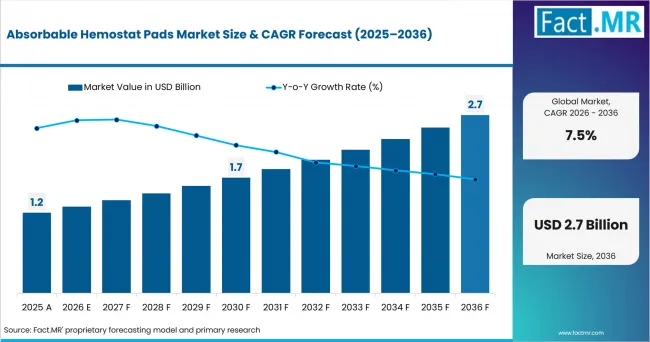
Absorbable Hemostat Pads Market Market Value Analysis | Source: Fact.MR
What are the defining numbers behind absorbable hemostat pads market growth?
USD 1.4 billion absolute opportunity by 2036, led by pad-format adoption in surgical bleeding control.
- Demand Drivers in the Market
- Surgeons need absorbable pads that help control diffuse oozing when suturing alone is not practical.
- Operating room managers need hemostat products that are easy to stock and simple to apply during high-pressure procedures.
- Trauma coordinators need ready-to-use formats for bleeding control when procedure time is limited.
- Hospital supply chain teams need standardized pad sizes across general surgery, cardiovascular and orthopedic departments.
- Key Segments Analyzed
- By Material: Oxidized regenerated cellulose is expected to hold 41.0% share in 2026 because surgeons are familiar with fabric-based absorbable hemostats.
- By Format: Pads lead because they suit broad surgical use and direct surface application. The segment is projected to capture 38.0% share in 2026.
- By Procedure: General surgery is likely to account for 33.0% share in 2026 because absorbable pads are used across frequent abdominal and soft-tissue procedures.
- By End User: Hospitals lead because complex surgeries are concentrated in large operative departments. The segment is expected to hold 59.0% share in 2026.
- By Geography: The United States is projected to record 8.2% CAGR through 2036 as hospitals standardize absorbable hemostat pads across procedure lines.
- Analyst Opinion at Fact.MR
- Shambhu Nath Jha, Senior Analyst at Fact.MR, states, “Absorbable hemostat pads are workflow tools used during diffuse bleeding control. We see operating teams using them as workflow tools when bleeding is broad, tissue surfaces are uneven and product removal would slow closure. Suppliers that prove handling and material fit will defend stronger positions than suppliers selling only generic pads.”
- Strategic Implications
- Hemostat suppliers should design pads around tissue contact and procedure-specific handling.
- Hospitals should standardize pad formats by procedure line to reduce stock variation.
- ASCs can improve case readiness by aligning hemostat pad formats with scheduled surgery types.
- Distributors should separate pad-format hemostats from broad sealant and wound dressing categories.
Absorbable hemostat pads sit inside the wider surgical equipment ecosystem because they are used during operative bleeding control. The category differs from broad surgical sealants because pads and sheets provide local mechanical contact at the bleeding site. They are selected when surgeons need a conformable material that can be placed and left to absorb after the bleeding point is controlled.
FDA documentation for the SURGICEL family identifies absorbable hemostat products under non-collagen based absorbable hemostatic agents. [1] This supports the scope because oxidized regenerated cellulose pads and sheets are a major material family in surgical bleeding control.
The United States is projected to record 8.2% CAGR through 2036 as hospitals use absorbable hemostat pads across general surgery and cardiovascular procedures. Germany is expected to post 7.8% CAGR through 2036 as surgical departments standardize adjunctive bleeding-control materials. Japan is likely to record 7.5% CAGR as precision surgery programs favor predictable pad formats. China is forecast to advance at 7.2% CAGR as hospital surgery volumes create recurring hemostat use. India is set to record 6.9% CAGR as specialty surgical centers expand access to absorbable bleeding-control products.
How does the absorbable hemostat pads market break down by segment?
Oxidized regenerated cellulose leads at 41.0%; pads lead at 38.0%.
Which material dominates?
Oxidized regenerated cellulose holds 41.0% share in 2026.
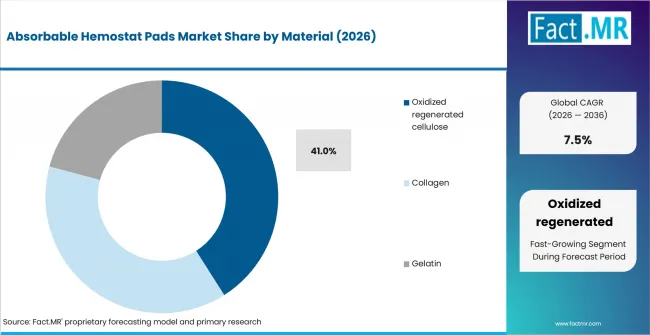
Absorbable Hemostat Pads Market Analysis By Material | Source: Fact.MR
Oxidized regenerated cellulose is expected to hold 41.0% share in 2026 because surgeons are familiar with fabric-based absorbable hemostats that can be cut and placed over bleeding tissue. These materials fit broad surgical use because they are flexible and can cover irregular surfaces. Collagen pads are important where tissue sealing and surface contact matter. Gelatin sponges serve procedures that need absorbent structure. Chitosan and polysaccharide-based pads create differentiation where suppliers focus on material-driven clot support. Baxter’s HEMOPATCH is described as a ready-to-use absorbable collagen pad for tissue sealing, dura sealing and hemostasis. [2]
Which format dominates?
Pads lead with 38.0% share in 2026.
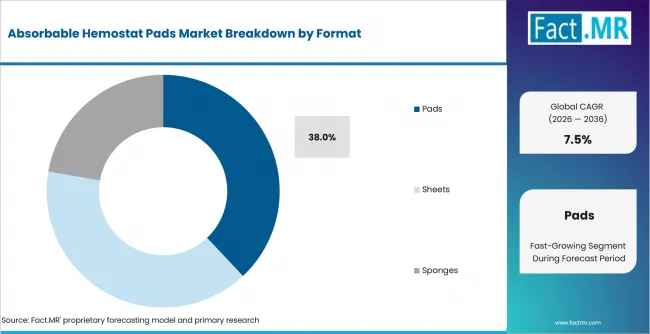
Absorbable Hemostat Pads Market Analysis By Format | Source: Fact.MR
Pads lead because surgeons can place them directly on the bleeding surface without complicated preparation. The segment is projected to capture 38.0% share in 2026 as pads fit general surgery, orthopedic and gynecology workflows. Sheets are preferred where wider surface coverage is needed. Sponges support absorption-led hemostasis when oozing is diffuse. Strips fit narrow application sites. Layered composites create premium opportunities where suppliers combine contact strength with absorbability. Format selection connects with biomedical textiles because woven and structured biomaterials influence how the product handles inside the operative field.
Which procedure dominates?
General surgery holds 33.0% share in 2026.
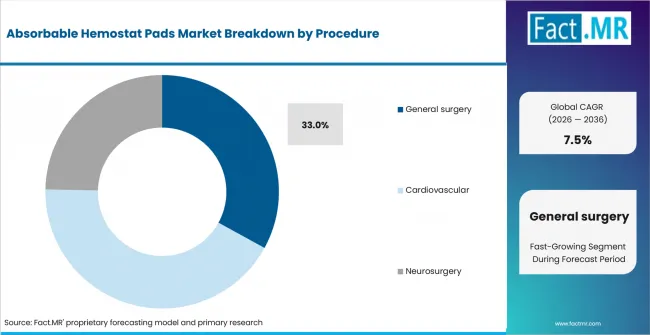
Absorbable Hemostat Pads Market Analysis By Procedure | Source: Fact.MR
General surgery leads because absorbable hemostat pads are used across abdominal and soft-tissue procedures where bleeding can occur on uneven surfaces. The procedure segment is likely to account for 33.0% share in 2026 as surgeons use pads when ligation or cautery alone is not enough. Cardiovascular procedures require dependable hemostasis around delicate tissue and graft sites. Orthopedic surgery supports demand where bone and soft-tissue bleeding occur together. Neurosurgery uses specialized pads where compression risk must be managed carefully. B. Braun’s Lyostypt is used for hemostasis of capillary bleeding, oozing hemorrhages and bleeding of parenchymal organs. [3]
Which end user dominates?
Hospitals account for 59.0% share in 2026.
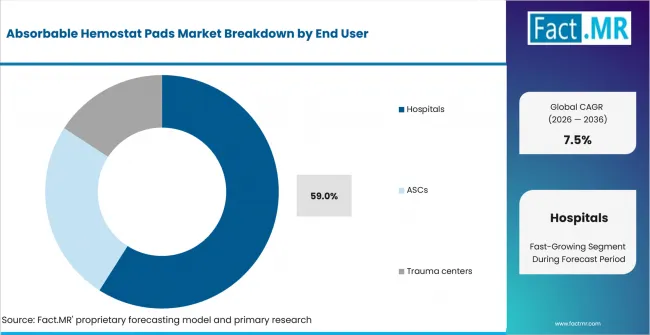
Absorbable Hemostat Pads Market Analysis By End User | Source: Fact.MR
Hospitals lead because complex operations and emergency cases are concentrated in full-service surgical departments. These institutions carry multiple materials and formats so surgical teams can match bleeding type with product handling. The hospital segment is expected to hold 59.0% share in 2026 because large facilities manage general surgery, cardiovascular, orthopedic and neurosurgery caseloads. ASCs use selected formats for scheduled procedures. Trauma centers need rapid access to pads during acute bleeding control. Specialty surgical centers prefer products that match narrow procedure lines. Military medical units value field-ready formats for controlled bleeding support.
What is accelerating absorbable hemostat pad adoption, and what is holding it back?
Complex surgery use and ready-to-use pad formats drive it, while routine surgical consumable price pressure and overlap with sealants restrain it.
Drivers Impact Analysis
| DRIVER | (~) % IMPACT ON CAGR | GEOGRAPHIC RELEVANCE | IMPACT TIMELINE |
|---|---|---|---|
| Wider use of adjunctive hemostats in complex surgeries | +0.9% | North America, Europe, East Asia | Medium term (2-4 years) |
| Shift toward ready-to-use pad and sheet formats | +0.7% | Global, strongest in hospitals and trauma centers | Short term (≤ 2 years) |
| Growth in cardiovascular and orthopedic procedures | +0.6% | United States, Germany, Japan, China | Medium term (2-4 years) |
| Hospital standardization of absorbable bleeding-control materials | +0.5% | Global, strongest in large health systems | Medium term (2-4 years) |
| Military and trauma use of fast-placement hemostat formats | +0.3% | United States, India, Middle East | Long term (≥ 4 years) |
Source: Fact.MR analysis. Updated Jun 30, 2026
- Complex surgery use: Complex surgeries are the main demand base because bleeding can occur across broad tissue surfaces where clips or sutures are not enough. Surgeons use absorbable pads when they need a product that can be pressed onto the site and left in place after hemostasis. This is especially relevant in cardiovascular, orthopedic and neurosurgical cases where removal can disturb the clot.
- Ready-to-use pad formats: Ready-to-use pads reduce preparation time for operating room teams. Products that can be opened, placed and trimmed quickly fit high-pressure surgery better than formats that require mixing or assembly. CuraMedical describes CuraSpon as a sterile absorbable gelatin hemostat developed for intraoperative bleeding control. [5] This supports the shift toward simple, absorbable formats that can be used during active surgical workflow.
- Procedure expansion: Cardiovascular and orthopedic procedures support pad demand because bleeding control often requires local surface contact. In orthopedic procedures, tissue and bone-adjacent bleeding can require absorbent formats. Cardiovascular teams need products that help manage oozing around delicate operative sites. These procedure groups support recurring demand for pads, sheets and sponges.
- Hospital standardization: Hospitals are standardizing hemostat pad product sets to reduce variation in operating room inventory. A narrower product set helps supply chain teams manage stock and helps surgeons know what is available during procedures. This driver favors suppliers that offer multiple material options and clear procedure guidance.
- Military and trauma use: Military medical units and trauma centers create demand for products that can be placed quickly during acute bleeding control. Pads and sponges are useful because they can be handled under time pressure. These settings value product reliability and packaging discipline. The opportunity is smaller than hospital use, but it supports premium positioning for fast-placement formats.
Opportunity Impact Analysis
| OPPORTUNITY | (~) % IMPACT ON CAGR | GEOGRAPHIC RELEVANCE | IMPACT TIMELINE |
|---|---|---|---|
| Layered composite pads for high-risk bleeding sites | +0.6% | North America, Europe, Japan | Medium term (2-4 years) |
| Chitosan and polysaccharide pads for material differentiation | +0.5% | East Asia, North America, Europe | Long term (≥ 4 years) |
| Procedure-specific hemostat pad kits for hospitals | +0.4% | United States, Germany, China | Medium term (2-4 years) |
| ASC-ready small pad formats for scheduled surgery | +0.3% | United States, India, Gulf countries | Short term (≤ 2 years) |
Source: Fact.MR analysis. Updated Jun 30, 2026
- Layered composite pads:Layered composite pads create opportunity where surgeons need stronger contact with the bleeding site and better handling during placement. These products can command higher value when they reduce slippage or improve conformity. The opportunity is strongest in cardiovascular, neurosurgery and orthopedic cases where tissue surfaces can be delicate or irregular.
- Chitosan and polysaccharide pads:Chitosan and polysaccharide-based pads give suppliers a path to stand apart from traditional oxidized cellulose and gelatin products. The opportunity depends on clinical confidence and product education. Hospitals may test these formats when they want material diversity inside the hemostat portfolio. Suppliers need clear positioning around handling, absorption and safety.
- Procedure-specific kits:Procedure-specific kits help hospitals match hemostat pads with common surgical workflows. A kit can include pads, strips or layered formats selected for the procedure type. This can reduce stock confusion and support consistent operating room setup. The opportunity connects with tissue glue products where hospitals often evaluate adjunctive closure and bleeding-control tools together.
- ASC-ready formats:ASCs need smaller, easy-to-stock absorbable pads that fit scheduled surgery. These centers usually avoid broad inventory complexity. Compact pad formats can support general surgery, gynecology and orthopedic procedures in outpatient settings. Suppliers can gain traction by offering clear product sizing and reliable distributor availability.
Restraints Impact Analysis
| RESTRAINT | (~) % IMPACT ON CAGR | GEOGRAPHIC RELEVANCE | IMPACT TIMELINE |
|---|---|---|---|
| Price pressure on routine surgical consumables | -0.6% | Global, strongest in public hospitals | Medium term (2-4 years) |
| Overlap with sealants, powders and flowable hemostats | -0.4% | North America, Europe, Japan | Short term (≤ 2 years) |
| Material-specific safety and swelling concerns | -0.3% | Global, strongest in neurosurgery and confined spaces | Medium term (2-4 years) |
| Surgeon preference lock-in around established brands | -0.2% | Mature hospital systems | Long term (≥ 4 years) |
Source: Fact.MR analysis. Updated Jun 30, 2026
- Single-use price pressure:Price pressure is a major restraint because absorbable pads are used repeatedly and many hospitals treat them as routine surgical consumables. Purchasing teams may compare pads by unit price when material differences are not obvious. Suppliers need to prove handling performance and procedure fit to defend value.
- Category overlap:Absorbable hemostat pads compete with powders, sealants, flowable matrices and energy-based approaches. In some procedures, surgeons may choose a flowable product instead of a pad. This overlap can slow pad adoption unless the bleeding site clearly favors direct surface contact. Positioning must be precise to avoid confusion with broader hemostat categories.
- Material-specific concerns:Material-specific limitations can slow use in delicate surgical sites. Some absorbable materials swell after placement, which makes confined-space use more sensitive. Surgeons must select the right material and remove the product when labeling requires it. This restraint is strongest in neurosurgery and around narrow anatomical spaces.
- Surgeon preference lock-in:Surgeons often build habits around hemostat brands that they trust. Even when alternative pads are available, switching can be slow if the current product performs predictably. New suppliers need strong training and trial support. Without surgeon confidence, procurement access alone may not convert into steady use.
Which countries are scaling absorbable hemostat pads fastest?
United States 8.2%; Germany 7.8%; Japan 7.5%; China 7.2%; India 6.9%.
Based on regional analysis, the absorbable hemostat pads market is segmented into North America, Europe, East Asia, South Asia, Latin America, and Middle East and Africa.
| Country | CAGR |
|---|---|
| United States | 8.2% |
| Germany | 7.8% |
| Japan | 7.5% |
| China | 7.2% |
| India | 6.9% |
Source: Fact.MR analysis. Updated Jun 30, 2026
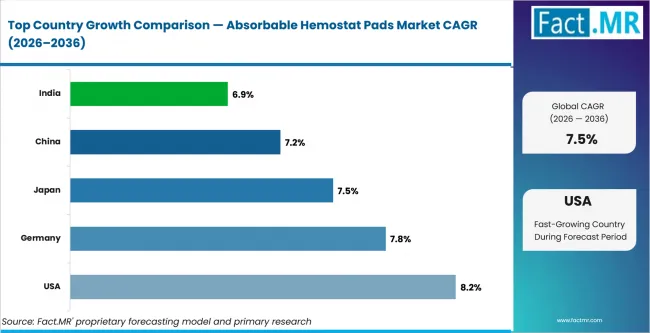
Absorbable Hemostat Pads Market Cagr Analysis By Country | Source: Fact.MR
What is powering the United States lead?
8.2% CAGR, driven by Johnson & Johnson and high surgical consumable standardization.
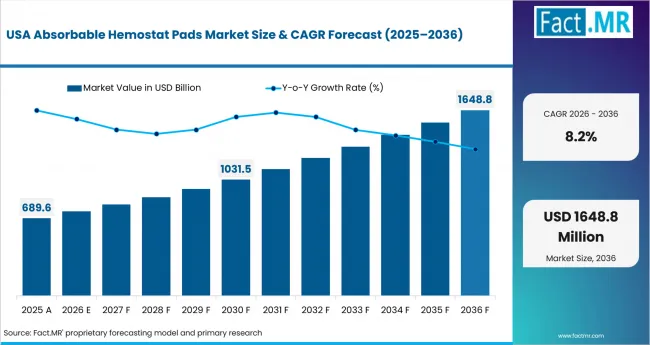
Absorbable Hemostat Pads Market Country Value Analysis | Source: Fact.MR
The United States is projected to record 8.2% CAGR from 2026 to 2036 as hospitals use absorbable hemostat pads across general surgery, cardiovascular and orthopedic procedures. Johnson & Johnson’s SURGICEL Original absorbable hemostat is indicated to assist control of capillary, venous and small arterial hemorrhage when conventional methods are impractical or ineffective. [4] Growth will favor suppliers with broad hospital contracting and strong surgeon familiarity.
How is Germany scaling absorbable hemostat pad demand?
7.8% CAGR, scaling through structured hospital procurement and specialty surgery depth.
Hospitals need absorbable pads that support documented bleeding-control protocols without increasing operating room complexity. Germany is expected to post 7.8% CAGR through 2036 as cardiovascular, orthopedic and neurosurgery departments standardize adjunctive hemostat use. Growth will favor suppliers that support clinical documentation and stable material availability.
What supports Japan’s outlook?
7.5% CAGR, driven by precision surgery programs and careful material selection.
Japan is likely to record 7.5% CAGR by 2036 as advanced hospitals use hemostat pads in delicate surgical settings. Surgical teams value predictable absorption and controlled placement. Demand will favor pads and sheets that work cleanly in compact operating fields.
What underpins China’s growth?
7.2% CAGR, scaling through higher hospital surgery capacity and specialty procedure expansion.
Absorbable hemostat pad demand will grow as procedure volume rises in urban hospitals. China is forecast to advance at 7.2% CAGR through 2036 as general surgery and orthopedic departments use more adjunctive bleeding-control products. Cost-effective pad formats with strong distributor support will have better traction.
How is India scaling absorbable hemostat pad adoption?
6.9% CAGR, driven by private hospital networks and trauma-care expansion.
India is set to record 6.9% CAGR through 2036 as specialty surgical centers and trauma units expand access to absorbable hemostat products. Demand will benefit from general surgery, orthopedic and gynecology procedures. Suppliers with affordable pads and reliable hospital channel coverage will be better placed.
Who leads the absorbable hemostat pads market?
Johnson & Johnson and Baxter lead through established absorbable hemostat portfolios.
Absorbable hemostat pads are supplied by biosurgery companies, surgical consumable firms and specialty hemostat manufacturers. Johnson & Johnson leads through the SURGICEL family and oxidized regenerated cellulose-based formats. Baxter competes through HEMOPATCH and broader surgical hemostasis products. BD, Pfizer, B. Braun and Gelita Medical add depth through collagen, gelatin and absorbable hemostat capabilities.
CuraMedical is relevant through CuraSpon, CuraCel and CuraTamp product families. Samyang Biopharm developed oxidized regenerated cellulose technology to produce SurgiGuard, an absorbable hemostatic agent. [6] This makes Asia-based manufacturers important as hospital systems seek material alternatives and regional supply. Competition also connects with wound care biologics where hospitals evaluate biologically derived materials for tissue repair and bleeding-control use cases.
Competition through 2036 will depend on material fit, surgeon confidence and hospital contracting. Suppliers that compete only on generic pad availability will face pricing pressure. Suppliers that prove handling and absorption behavior can defend stronger value. Pad-format hemostats also sit near next-generation wound closure because surgical teams increasingly evaluate closure and hemostasis as connected procedure needs.
Which companies are the key providers?
Johnson & Johnson and Baxter are key providers. BD and Pfizer are also profiled. B. Braun, Gelita Medical, CuraMedical and Samyang Biopharm complete the company set.
- Johnson & Johnson
- Baxter
- BD
- Pfizer
- B. Braun
- Gelita Medical
- CuraMedical
- Samyang Biopharm
Bibliography
- [1] U.S. Food and Drug Administration. (2026, June 15). Premarket approval: SURGICEL Family of Absorbable Hemostat. FDA.
- [2] Baxter International Inc. (2025, April 10). Baxter launches new room-temperature HEMOPATCH sealing hemostat for rapid and convenient application during surgery. Baxter.
- [3] B. Braun. (2026). Lyostypt®: Local haemostatic agent. B. Braun.
- [4] Johnson & Johnson MedTech. (2026). SURGICEL™ Original Absorbable Hemostat. Johnson & Johnson MedTech.
- [5] CuraMedical. (2026). CuraSpon® absorbable gelatin sponge. CuraMedical.
- [6] Samyang Biopharm. (2026). Medical device: Biosurgery and hemostatic agents. Samyang Biopharm.
- [7] BD. (2026). Avitene™ Microfibrillar Collagen Hemostat. BD.
- [8] Pfizer. (2024). GELFOAM® Sterile Sponge: Prescribing information. Pfizer.
- [9] Gelita Medical GmbH. (2026). Absorbable hemostats based on oxidized cellulose and gelatin. Gelita Medical.
This Report Addresses
- Strategic intelligence on absorbable hemostat pads across material and format.
- Segment analysis covering Oxidized Regenerated Cellulose and Pads.
- Regional outlook covering the United States, Germany, Japan, China, and India.
- Competitive analysis of Johnson & Johnson, Baxter, BD, Pfizer, B. Braun, Gelita Medical, CuraMedical and Samyang Biopharm.
- Technology assessment covering absorbability, tissue conformity, swelling behavior and placement control.
- Use case assessment covering general surgery, cardiovascular, orthopedic, neurosurgery and gynecology procedures.
- Primary interviews, provider checks and official source review support the forecast.
What does the absorbable hemostat pads market cover?
Absorbable pad and sponge formats used for local surgical hemostasis.
The absorbable hemostat pads market covers oxidized regenerated cellulose and polysaccharide-based pads used to assist surgical bleeding control. These products are applied directly to bleeding surfaces when conventional methods are impractical or take longer than the procedure team can accept.
The market differs from broad topical hemostat coverage because the scope is limited to absorbable pad and layered-composite formats. Powders and flowable matrices are excluded unless they are sold as part of a pad or sheet-based system.
What is included in the scope?
Pad and sheet-format absorbable hemostats used across major surgical procedures.
The scope includes oxidized regenerated cellulose pads and polysaccharide-based formats. It includes pads and layered composites. Procedure coverage includes general surgery, cardiovascular, orthopedic, neurosurgery, and gynecology.
The scope includes products supplied to hospitals and military medical units. It includes sterile single-use pads used as adjuncts to ligation, cautery or suturing. The category also connects with wound sealants where surgeons combine physical hemostat placement with sealing approaches.
What is excluded from the scope?
Non-absorbable dressings and broad surgical sealants are outside the scope.
The scope excludes non-absorbable external wound dressings and flowable matrices when no pad or sheet format is involved. It also excludes sutures and electrosurgical devices because those products close or cauterize tissue through different mechanisms. Broader advanced wound dressing products are outside scope when they are used after surgery rather than inside the operative field.
How was the analysis built?
100+ sources, 40+ company portfolios, 25+ countries, 20+ interviews.
- Primary Research:
- Primary research includes interviews with general surgeons and cardiovascular surgeons. It includes input from operating room managers, trauma coordinators and hospital supply chain heads.
- Desk Research:
- Desk research reviews FDA device documentation and official company hemostat portfolios. It covers absorbable hemostat pads and surgical bleeding-control product labels.
- Market-Sizing and Forecasting:
- Forecasting uses surgical procedure volume and procedure-specific usage intensity.
- Data Validation and Update Cycle:
- Forecasts are validated through provider checks and procurement feedback. Product portfolio reviews and surgical consumable adoption signals help confirm market direction.
Segmentation
What is the report’s scope and coverage?
| Attribute | Details |
|---|---|
| Quantitative Units | USD Billion in 2026 to USD Billion by 2036 at CAGR |
| Market Definition | Absorbable pad, sheet and sponge formats used to assist local surgical hemostasis |
| Material | Oxidized regenerated cellulose; collagen; gelatin; chitosan; polysaccharide-based pads |
| Format | Pads; sheets; sponges; strips; layered composites |
| Procedure | General surgery; cardiovascular; orthopedic; neurosurgery; gynecology |
| End User | Hospitals; ASCs; trauma centers; specialty surgical centers; military medical units |
| Regions Covered | North America; Europe; East Asia; South Asia; Latin America; Middle East and Africa |
| Countries Covered | United States; Germany; Japan; China; India |
| Key Companies Profiled | Johnson & Johnson; Baxter; BD; Pfizer; B. Braun; Gelita Medical; CuraMedical; Samyang Biopharm |
| Forecast Period | 2026 to 2036 |
| Approach | Hybrid top-down and bottom-up approach using surgical procedure volume, hemostat pad attachment rates, material mix and provider validation |
Source: Fact.MR analysis. Updated Jun 30, 2026
How is the market segmented?
-
By Material:
- Oxidized regenerated cellulose
- Collagen
- Gelatin
- Chitosan
- Polysaccharide-based pads
-
By Format:
- Pads
- Sheets
- Sponges
- Strips
- Layered composites
-
By Procedure:
- General surgery
- Cardiovascular
- Orthopedic
- Neurosurgery
- Gynecology
-
By End User:
- Hospitals
- ASCs
- Trauma centers
- Specialty surgical centers
- Military medical units
-
Region:
- North America
- United States
- Canada
- Europe
- Germany
- United Kingdm
- France
- Italy
- Netherlands
- East Asia
- Japan
- China
- South Krea
- South Asia
- India
- Thailand
- Singapore
- Latin America
- Brazil
- Mexic
- Chile
- Middle East & Africa
- UAE
- Saudi Arabia
- South Africa
- Israel
- North America
Frequently Asked Questions
Which material leads the Absorbable Hemostat Pads Market?
Which format leads the Absorbable Hemostat Pads Market?
Which procedure leads the Absorbable Hemostat Pads Market?
Which end user leads the Absorbable Hemostat Pads Market?
Which region leads the Absorbable Hemostat Pads Market?
Which country expands fastest in the Absorbable Hemostat Pads Market?
How does Germany perform in the Absorbable Hemostat Pads Market?
How does Japan perform in the Absorbable Hemostat Pads Market?
How does China perform in the Absorbable Hemostat Pads Market?
How does India perform in the Absorbable Hemostat Pads Market?
What is the primary driver in the Absorbable Hemostat Pads Market?
What is the main restraint in the Absorbable Hemostat Pads Market?
Why are oxidized regenerated cellulose pads important?
Why do hospitals dominate demand?
Who worked on this report


Preview the report firsthand - request a free sample
Free SampleGet the brochure for pricing and purchase details
Download PDF