- Base Value(2025): 440.0 Mn
- Estimated Value(2026): 480.0 Mn
- Forecast Value (2036): 1136.0 Mn
- CAGR (2026 - 2036): 9.0%
Acetylated Wood Market Forecast and Outlook 2026 to 2036
In 2025, the acetylated wood market was valued at USD 440.0 million. Based on Fact.MR analysis, demand for acetylated wood is estimated to grow to USD 480.0 million in 2026 and USD 1,136.0 million by 2036. Fact.MR projects a CAGR of 9.0% during the forecast period. Growth reflects wider specification of modified wood in cladding, decking, and joinery applications where dimensional stability and biological resistance are required over extended service intervals.
The market adds approximately USD 696.0 million in value over the decade, indicating accelerated compounding driven by application substitution rather than overall timber volume expansion. Demand progression follows exterior construction activity and public procurement for long life materials, while pricing reflects chemical modification costs, certification requirements, and controlled processing. Value growth is supported by higher realised pricing in exterior use cases, even where shipment volumes expand at a measured pace.
Industry disclosures and procurement patterns indicate that adoption is strongest among suppliers able to document durability class performance and dimensional stability under EN wood modification standards. Buyers prioritise verified service life, moisture behaviour, and compatibility with exterior building systems over untreated timber grades. This preference favours producers with validated acetylation processes, stable feedstock sourcing, and regional distribution networks, reinforcing value capture among established manufacturers.
The United States records the fastest growth at 10.2% CAGR due to exterior decking and cladding adoption. India follows at 9.6% through public and commercial building projects, while China grows at 8.8% supported by waterfront and landscape construction. The U.A.E. posts 8.0% linked to exterior facade use, while the UK reaches 6.7% through public sector works. Mature markets including Germany at 6.0%, the Netherlands at 5.8%, and Japan at 4.6% remain specification led, constrained by approval timelines and established material preferences.
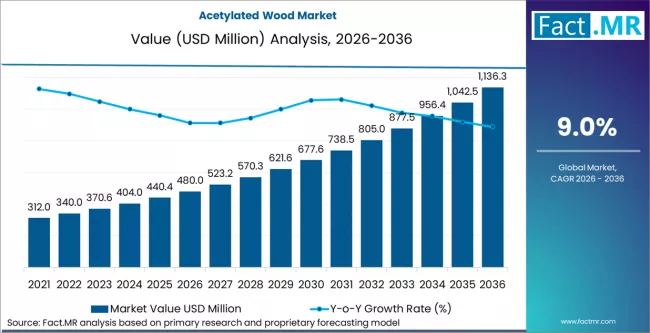
Acetylated Wood Market Market Value Analysis | Source: Fact.MR
Acetylated Wood Market Definition
The acetylated wood market covers modified solid wood products treated through acetylation, a chemical process that replaces hydroxyl groups in wood cell walls with acetyl groups. This reduces moisture uptake and improves dimensional stability and biological resistance, as described in wood modification standards published by CEN under EN 350 and related durability classifications [1]. Acetylated wood is sold as sawn timber, boards, or profiles for exterior construction uses. Typical applications include cladding, decking, windows, doors, and bridges where long service life and low maintenance are required.
Acetylated Wood Market Inclusions
The report covers global and regional market size estimates in volume and value terms with a forecast period from 2026 to 2036. Segmentation includes product form such as boards and profiles, application areas including cladding, decking, and joinery, and end use sectors covering residential, commercial, and infrastructure construction. The scope includes regional demand patterns and trade flows for modified wood products tracked under customs classifications reported by UN Comtrade [2].
Acetylated Wood Market Exclusions
The scope excludes thermally modified wood, chemically preserved timber treated with copper or boron based systems, and untreated natural wood products. Engineered wood panels such as plywood, MDF, and particleboard are not included. Downstream finished goods including complete window units, prefabricated facades, furniture, and flooring systems are excluded. Laboratory scale modification trials, pilot projects, and niche craft uses without commercial volume production are also outside the scope.
Acetylated Wood Market Research Methodology
- Primary Research: Primary research involved interviews with acetylated wood producers, sawmills, building material distributors, architects, and contractors specifying modified wood products.
- Desk Research: Desk research used durability and use class guidance from EN standards published by CEN, technical disclosures from commercial producers such as Accsys Technologies through annual reports and product documentation, forestry statistics from FAO, and customs trade data from UN Comtrade.
- Market Sizing and Forecasting: Market sizing applied a hybrid top down and bottom up model using reported production capacities, shipment disclosures, and construction demand indicators from national statistical offices.
Data Validation and Update Cycle
Outputs were cross checked against trade statistics, company disclosures, and government construction data, with updates applied when verified public sources issue revisions.
Summary of Acetylated Wood Market
Market Definition
- The acetylated wood market covers solid wood products chemically modified through acetylation to reduce moisture uptake and improve dimensional stability and biological resistance, as defined under EN durability and wood modification standards issued by CEN. [3]
Demand Drivers
- Builders and asset owners are specifying acetylated wood in exterior cladding, decking, and joinery where long service life and low maintenance are required under moisture-exposed conditions, based on Fact.MR analysis.
- Public procurement and commercial construction projects increasingly require timber products with documented durability class performance rather than preservative-treated alternatives, as per Fact.MR.
- Coastal, waterfront, and high-humidity construction activity is supporting adoption of modified wood that delivers predictable dimensional stability over extended service intervals, according to Fact.MR.
Key Segments Analyzed
- Product Form: Solid acetylated wood boards lead demand due to suitability for exterior cladding, decking, and joinery applications requiring stable profiles and long service life, based on Fact.MR.
- Application: Cladding, facades, and decking account for the largest share as acetylated wood replaces untreated timber in moisture-exposed exterior uses, as per Fact.MR.
- Geography: The United States records the fastest growth, followed by India and China, while Europe remains specification-led with adoption governed by durability classifications and building approvals, based on Fact.MR analysis.
Analyst Opinion at Fact.MR
- Shambhu Nath Jha, Principal Consultant at Fact.MR, opines, ‘CXOs will find that acetylated wood demand is anchored in exterior durability requirements, where verified service life and dimensional stability drive specification rather than untreated timber cost advantages.’
Strategic Implications and Executive Takeaways
- Fact.MR is of the opinion that producers should prioritise durability validation and certification aligned with EN wood modification standards to secure exterior application approvals.
- Fact.MR opines that expanding regional distribution and project supply capabilities can improve participation in public and commercial exterior construction programs.
- Fact.MR analysts recommend focusing on cladding, decking, and joinery segments where higher realised pricing offsets moderate shipment growth.
Methodology
- Based on Fact.MR’s report, estimates draw on primary interviews with acetylated wood producers, distributors, architects, and contractors specifying modified timber products.
- Fact.MR analysis integrates EN durability standards, FAO forestry statistics, and international trade data reported by UN Comtrade
- Outputs were validated through cross-checks against company disclosures, trade statistics, and government construction and procurement data.
Segmental Analysis
Acetylated Wood Market Analysis by Product Form
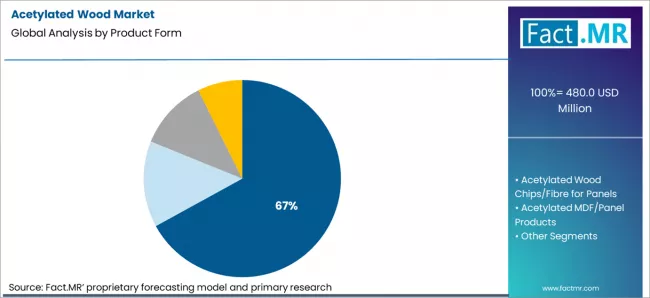
Acetylated Wood Market Analysis By Product Form | Source: Fact.MR
Based on Fact.MR analysis, consumption of solid acetylated wood boards is estimated to hold 67% share in 2026. Fact.MR analysts note that solid boards dominate because acetylation modifies the cell wall structure of sawn timber, reducing moisture uptake and biological decay without surface coatings. As per Fact.MR, this product form solves buyer requirements for long service life, dimensional stability, and compatibility with standard woodworking processes in exterior and joinery applications.
- Commercial Production: Accsys Technologies reports large-scale manufacture of solid acetylated wood boards under the Accoya brand, produced from FSC-certified timber using its proprietary acetylation process.
- Process Validation: European Committee for Standardization EN 335 and EN 350 durability classifications list acetylated wood as suitable for use classes exposed to moisture and biological agents, supporting its application as solid exterior boards.
- Supply Pattern: Fact.MR analysts reference procurement specifications for exterior joinery and cladding that prefer factory-modified solid wood products due to predictable performance and reduced on-site treatment requirements.
Acetylated Wood Market Analysis by Application
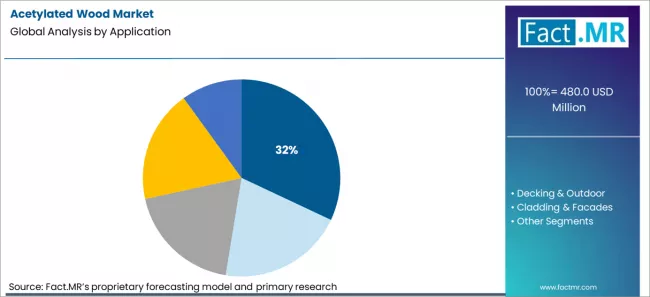
Acetylated Wood Market Analysis By Application | Source: Fact.MR
Based on Fact.MR analysis, consumption of acetylated wood in windows and doors is estimated to hold 32% share in 2026. Fact.MR opines that this segment leads because joinery components demand tight dimensional tolerances and resistance to moisture cycling over long service periods. As per Fact.MR, acetylated wood addresses swelling, shrinkage, and decay risks that affect conventional timber used in window frames and door assemblies.
- Joinery Adoption: Accsys Technologies documents the use of Accoya acetylated wood in window and door manufacturing for residential and commercial buildings, citing dimensional stability and extended service life.
- Performance Assessment: Building Research Establishment published durability and performance assessments showing acetylated wood achieving long service life expectations in exterior joinery exposure conditions.
- Replacement Cycle: Fact.MR analysts reference public building maintenance guidance that identifies premature window and door degradation as a driver for specifying modified wood materials in refurbishment projects.
Acetylated Wood Market Drivers, Restraints, And Opportunities
Fact.MR analysis indicates that the acetylated wood market exists as a specialty wood modification segment within engineered wood and timber products used in exterior construction, decking, cladding, and heavy timber applications. As per Fact.MR assessment, acetylation is a chemical modification process that increases wood dimensional stability and biological resistance by converting free hydroxyl groups into acetyl groups, reducing moisture uptake and swelling. Fact.MR analysts observe that this performance profile supports use in applications exposed to moisture, insects, and fungal decay where untreated wood products are unsuitable, creating a structural demand basis anchored in long-life exterior timber products.
Fact.MR opines that current market dynamics reflect a transition from traditional preservative-treated and naturally durable species toward engineered acetylated wood products that offer predictable performance without added biocides. Based on Fact.MR assessment, demand for standard lumber grades remains large because of established supply chains and lower upfront cost, but acetylated wood grows where specifications call for measured dimensional stability and decay resistance over long service intervals. Acetylated timber formulations generally carry higher per-unit pricing because of processing complexity and chemical treatment controls, which supports value growth even where shipment volumes grow moderately. Based on Fact.MR analysis, this combination of moderate tonnage uptake and higher realised pricing defines market expansion in regions prioritising sustainable long-life wood products.
- Wood Modification Standards Influence Adoption: Fact.MR analysts note that performance standards and certification programmes in Europe such as the KOMO®/SKH wood modification marks inform procurement specifications that distinguish acetylated and modified wood products based on documented durability and stability benchmarks.
- Exterior Building Demand: Based on Fact.MR assessment, growing use of exterior decking, siding, and heavy timber structures in North America and Europe sustains demand for acetylated wood because its lower moisture uptake and reduced shrinkage are directly linked to longer service intervals compared with untreated wood.
- Asia Pacific Processing Capacity Growth: Fact.MR opines that increasing investment in wood processing facilities in China, India, and Southeast Asia supports regional production of modified wood products, including acetylated panels and structural components, aligning with rising construction activity and export market access requirements.
Regional Analysis
Based on regional assessment, the acetylated wood sector is analyzed across North America, Latin America, Europe, East Asia, South Asia, Oceania, and the Middle East & Africa, spanning more than 40 countries. Regional performance varies according to demand for durable wood products, adoption in construction and outdoor applications, and regulatory preferences for long-life materials. The report also presents a comparative market attractiveness evaluation grounded in region-specific demand trends.
Acetylated Wood Market CAGR Analysis by Country (2026-2036)
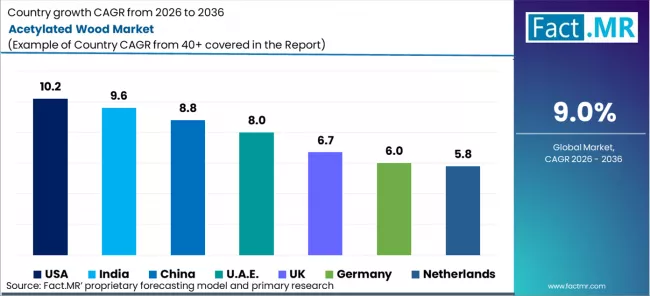
Acetylated Wood Market Cagr Analysis By Country | Source: Fact.MR
| Country | CAGR |
|---|---|
| United States | 10.2% |
| India | 9.6% |
| China | 8.8% |
| U.A.E. | 8.0% |
| UK | 6.7% |
| Germany | 6.0% |
| Netherlands | 5.8% |
| Japan | 4.6% |
Source: Fact.MR analysis. Updated Feb 17, 2026
Source: Fact.MR analysis, based on proprietary forecasting models and primary research.
North America Acetylated Wood Market Analysis
North America operates as a standards-led adoption market for acetylated wood, with use governed by building codes, durability classifications, and public procurement for exterior applications. Demand follows compliance listings, code approvals, and specifications for long-life timber in public and commercial construction.
United States: Demand for acetylated wood in the United States is projected to rise at 10.2% CAGR through 2036. Use is referenced in ICC Evaluation Service reports issued in April 2021 and reinforced through exterior material specifications applied in federally funded buildings during 2022, as per Fact.MR.
Fact.MR’s analysis of the acetylated wood market in North America consists of country-wise assessment that includes the United States. Readers can find code compliance references, material approvals, and application documentation.
Asia Pacific Acetylated Wood Market Analysis
Asia Pacific functions as a mixed adoption market for acetylated wood, with usage linked to exterior construction standards, coastal durability requirements, and public works specifications. Demand follows national building codes and approved material listings rather than discretionary selection.
- India: Demand for acetylated wood in India is projected to rise at 9.6% CAGR through 2036. Application is permitted under BIS building material provisions referenced in July 2021 and reinforced through public building facade and decking tenders issued during September 2022, according to Fact.MR.
- China: Demand for acetylated wood in China is projected to rise at 8.8% CAGR through 2036. Use is aligned with exterior wood durability classifications under GB standards revised in August 2020 and applied in public landscape and waterfront projects tendered in May 2022, as per Fact.MR.
- Japan: Demand for acetylated wood in Japan is projected to rise at 4.6% CAGR through 2036. Application is referenced in exterior timber durability guidance issued by MLIT in April 2020 and reinforced through public facility refurbishment specifications applied in 2022, according to Fact.MR.
Fact.MR’s analysis of the acetylated wood market in Asia Pacific consists of country-wise assessment that includes India, China, and Japan. Readers can find standards references, public procurement listings, and exterior application documentation.
Middle East Acetylated Wood Market Analysis
The Middle East operates as a specification-driven market for acetylated wood, with usage linked to exterior cladding and decking under harsh climate conditions. Demand follows municipal approvals and public project material listings.
- U.A.E.: Demand for acetylated wood in the U.A.E. is projected to rise at 8.0% CAGR through 2036. Application is permitted under Dubai Municipality approved materials listings updated in March 2021 and reinforced through public realm and waterfront projects tendered in October 2022, as per Fact.MR.
Fact.MR’s analysis of the acetylated wood market in the Middle East consists of country-wise assessment that includes the U.A.E. Readers can find municipal approvals and public project specifications.
Europe Acetylated Wood Market Analysis
Europe functions as a regulation-led adoption market for acetylated wood, with usage governed by harmonized construction product standards and public procurement rules for long-life timber materials.
- United Kingdom: Demand for acetylated wood in the UK is projected to rise at 6.7% CAGR through 2036. Use is referenced in construction product compliance aligned with UK Building Regulations updated in June 2021 and applied in public sector exterior works during 2022, according to Fact.MR.
- Germany: Demand for acetylated wood in Germany is projected to rise at 6.0% CAGR through 2036. Application is permitted under DIN-aligned construction product standards revised in June 2020 and reinforced through public building refurbishment tenders issued in February 2022, as per Fact.MR.
- Netherlands: Demand for acetylated wood in the Netherlands is projected to rise at 5.8% CAGR through 2036. Use is specified in national building material approvals under the Building Decree updated in July 2021 and reinforced through municipal infrastructure projects tendered in 2022, according to Fact.MR.
Fact.MR’s analysis of the acetylated wood market in Europe consists of country-wise assessment that includes the UK, Germany, and the Netherlands. Readers can find regulatory approvals, procurement practices, and application-level references.
How Are Performance Validation, Supply Integration, and Certification Compliance Creating Competitive Moats in the Acetylated Wood Market?
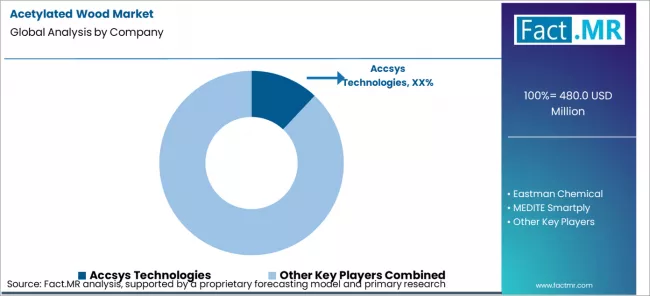
Acetylated Wood Market Analysis By Company | Source: Fact.MR
As per Fact.MR analysis, the acetylated wood market in 2026 is defined by a shift from basic modified wood products to performance‑validated structural and exterior solutions where durability data, supply chain integration, and building‑code compliance determine competitive advantage. Accsys Technologies and Eastman Chemical leverage long‑term, vertically integrated raw material sourcing and validated acetylation processes, which strengthen confidence among architectural and construction buyers requiring consistent dimensional stability and decay resistance. MEDITE Smartply and Diamond Wood focus on engineered panel systems with documented mechanical and moisture performance, which increases specification in commercial building programs. DLH, James Latham, and Arnold Laver optimise regional inventory networks and tailored service support, which improves just‑in‑time delivery for project timelines. BSW Timber and Finsa provide multi‑grade, performance‑certified timbers that align with local codes and sustainability standards, which enhances adoption in regulated markets. Regional Accoya distributors reinforce local presence and rapid fulfillment. Across the market, validated performance data, integrated supply chains, and multi‑region certification create enduring competitive moats that reduce reliance on commodity price competition.
Recent Industry Development
- Accsys has reached a major inflection point with its Accoya USA plant in Tennessee, which began commercial operations in late 2024. In its latest H1 2026 report (Nov 2025), the company announced a 61% year-on-year volume growth in North America, signaling a successful shift toward domestic production. [4]
- A leader in bio-based wood modification, Kebony is currently highlighting its role in climate-responsive architecture at the 2026 International Wood Construction Forum in Paris. The company has completed the centralization of its primary production in Belgium to double its capacity to 20,000 $m^3$ while keeping its Norway site for R&D. [5]
Key Players in Acetylated Wood Market
- Accsys Technologies
- Eastman Chemical
- MEDITE Smartply
- Diamond Wood
- DLH
- James Latham
- Arnold Laver
- BSW Timber
- Finsa
- Regional Accoya Distributors
Bibliography
- [1] European Committee for Standardization. (2016). EN 350: Durability of wood and wood-based products - Testing and classification of the durability to biological agents. CEN.
- [2] United Nations Statistics Division. (2024). UN Comtrade database. United Nations.
- [3] European Committee for Standardization. (2016). EN 350: Durability of wood and wood-based products - Testing and classification of the durability to biological agents. CEN.
- [4] Accsys Technologies PLC. (2025). Interim results H1 FY26. Accsys Technologies.
- [5] Batinfo. (2026). Kebony at the International Wood Construction Forum 2026. Batinfo.
Segmentation
Scope of the Report
| Metric | Value |
|---|---|
| Quantitative Units | USD 480.0 million (2026) to USD 1,136.0 million (2036), CAGR 9.0% |
| Market Definition | The acetylated wood market covers solid wood products chemically modified through acetylation to replace hydroxyl groups with acetyl groups, reducing moisture uptake, enhancing dimensional stability, and improving biological resistance. Products include sawn timber, boards, and profiles used in exterior cladding, decking, joinery, and marine construction. Performance aligns with EN 350 and related wood modification durability standards . |
| Product Form Segmentation | Solid Acetylated Wood Boards, Acetylated Wood Chips/Fibre for Panels, Acetylated MDF/Panel Products, Other |
| Application Segmentation | Windows & Doors, Decking & Outdoor, Cladding & Facades, Marine/Coastal Use, Structural & Joinery |
| Sales Channel Segmentation | Direct Project Supply, Timber Distributors, OEM Manufacturers, Other |
| Regions Covered | Asia Pacific, Europe, North America, Latin America, Middle East & Africa |
| Countries Covered | United States, India, China, U.A.E., UK, Germany, Netherlands, Japan, South Korea, Indonesia, Australia & New Zealand, ASEAN, Rest of Asia Pacific, Italy, France, Spain, Benelux, Nordics, Central & Eastern Europe, Rest of Europe, Canada, Mexico, Brazil, Argentina, Chile, Rest of Latin America, Kingdom of Saudi Arabia, South Africa, Turkey, Rest of Middle East & Africa |
| Key Companies Profiled | Accsys Technologies, Eastman Chemical, MEDITE Smartply, Diamond Wood, DLH, James Latham, Arnold Laver, BSW Timber, Finsa, Regional Accoya Distributors |
| Forecast Period | 2026 to 2036 |
| Approach | Hybrid top-down and bottom-up modeling validated through primary interviews with acetylated wood producers, sawmills, distributors, architects, and contractors. Desk research included EN wood modification standards, FAO forestry statistics, UN Comtrade trade data, and company annual reports. |
Source: Fact.MR analysis. Updated Feb 17, 2026
Acetylated Wood Market Analysis by Key Segments
-
By Product Form :
- Solid Acetylated Wood (Boards)
- Acetylated Wood Chips/Fibre for Panels
- Acetylated MDF/Panel Products
- Other
-
By Application :
- Windows & Doors
- Decking & Outdoor
- Cladding & Facades
- Marine/Coastal Use
- Structural & Joinery
-
By Sales Channel :
- Direct Project Supply
- Timber Distributors
- OEM Manufacturers
- Other
-
Region :
- Asia Pacific
- India
- China
- Japan
- South Korea
- Indonesia
- Australia & New Zealand
- ASEAN
- Rest of Asia Pacific
- Europe
- Germany
- Italy
- France
- United Kingdom
- Spain
- Benelux
- Nordics
- Central & Eastern Europe
- Rest of Europe
- North America
- United States
- Canada
- Mexico
- Latin America
- Brazil
- Argentina
- Chile
- Rest of Latin America
- Middle East & Africa
- Kingdom of Saudi Arabia
- United Arab Emirates
- South Africa
- Turkey
- Rest of Middle East & Africa
- Asia Pacific
Frequently Asked Questions
How large is the acetylated wood market in 2026?
What is the projected acetylated wood market size by 2036?
What CAGR is expected for the acetylated wood market during 2026–2036?
What was the acetylated wood market value in 2025?
How much value will the acetylated wood market add over the decade?
Which country is forecast to grow the fastest in acetylated wood consumption?
What is India’s growth outlook in acetylated wood?
How fast is the acetylated wood market expected to grow in China?
What is the expected CAGR for the U.A.E. acetylated wood market?
How does the UK market perform in growth terms?
What is the expected growth rate for Germany?
What is the Netherlands’ growth outlook for acetylated wood?
What is the forecast CAGR for Japan in acetylated wood?
Which product form leads the acetylated wood market in 2026?
Which application segment leads the acetylated wood market in 2026?
What is driving acetylated wood adoption in exterior construction uses?
Is acetylated wood growth driven by overall timber volume expansion?
What is the market’s value trajectory across the forecast window?
How do growth dynamics differ between fast-growth and mature markets?
What should executives use to assess long-term opportunity size in acetylated wood?
Who worked on this report


Preview the report firsthand - request a free sample
Free SampleGet the brochure for pricing and purchase details
Download PDF