- Market Value (2025): USD 314.0 Mn
- Estimated Value (2026): USD 335.0 Mn
- Forecast Value (2036): USD 640.0 Mn
- CAGR (2026-2036): 6.7%
What is the Acid Dosing Skids Market forecast to be worth by 2036?
USD 335.0 million in 2026 to USD 640.0 million by 2036, at a 6.7% CAGR.
- The acid dosing skids market crossed a valuation of USD 314.0 million in 2025, supported by demand from municipal utilities and industrial plants that require accurate acid feed systems.
- Demand is projected to increase from USD 335.0 million in 2026 to USD 640.0 million by 2036.
- The market is forecast to record a 6.7% CAGR from 2026 to 2036 as pH control, corrosion control and operator safety remain central purchase reasons.
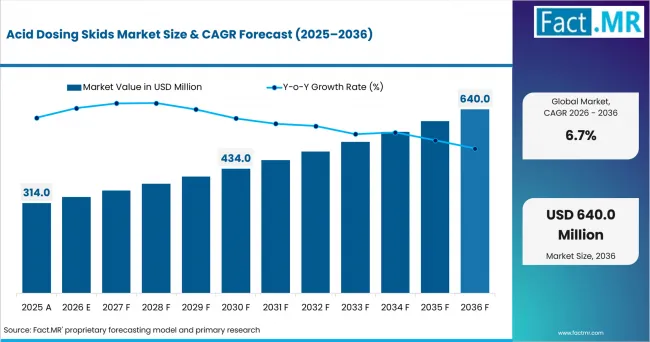
Acid Dosing Skids Market Value Analysis | Source: Fact.MR
What are the defining numbers behind Acid Dosing Skids Market growth?
USD 305.0 million absolute opportunity is expected by 2036.
- Demand Drivers in the Market
- Steady pH control is expected to support demand because water treatment, corrosion control and discharge quality depend on accurate acid dosing. Clear records also help operators confirm that the right amount was added.
- Automatic dosing systems are anticipated to reduce excess acid use in cooling and process-water lines. Too much acid can damage pipes and other equipment further along the system.
- Enclosed skids with leak alarms are projected to see wider use because strong acids must be contained before operators work near the pumps and valves.
- Dosing linked to water flow is estimated to keep treatment more consistent when water quality, plant use or cooling demand changes during the day.
- Key Segments Analyzed
- By Pump Technology: Diaphragm Metering Pumps are expected to hold 34.0% share in 2026 supported by their sealed fluid path and dependable handling of corrosive acid streams.
- By Acid Type: Sulfuric Acid is projected to account for 30.0% share in 2026 owing to its widespread use across pH adjustment, neutralization and industrial water-treatment processes.
- By Application: Water & Wastewater pH Control is anticipated to capture 32.0% share in 2026 due to continuous dosing requirements for regulatory compliance and stable treatment performance.
- By Material of Construction: PVC/CPVC Skids are estimated to represent 30.0% share in 2026 attributable to their corrosion resistance and cost-effective suitability for many acid-handling installations.
- By End User: Municipal Utilities are forecast to hold 30.0% share in 2026 driven by continuous chemical dosing operations across drinking water and wastewater treatment facilities.
- Analyst Opinion at Fact.MR
- Shambhu Nath Jha, Senior Analyst at Fact.MR, states, “Engineers look at dosing accuracy and how well the skid works across low and high flow rates. For acid use, the safety review focuses on leak control and automatic shutdown features. The materials must also withstand the acid during daily operation. Equipment companies that explain these safety points clearly are likely to build trust faster than those that discuss pump performance alone.”
- Strategic Implications
- Municipal water authorities can set clear rules for acid storage, hose connection and daily dosing before installing new skids at several treatment sites.
- Equipment companies should choose pumps and construction materials that match the acid strength and working temperature. Clear records on material use can help operators prevent corrosion and avoid early seal replacement.
- Water-treatment plants can compare dosing accuracy, leak control and ease of maintenance before choosing a skid. They should also check whether the system keeps pH steady when water flow and treatment demand change.
China is projected to record a 7.9% CAGR from 2026 to 2036, supported by industrial water treatment and chemical-processing demand. UAE is estimated to post a 7.4% CAGR through desalination, water reuse and compact chemical-dosing projects. The USA is anticipated to advance at a 6.7% CAGR as utilities and industrial plants upgrade acid-handling systems. Japan is forecast to record a 6.6% CAGR through precise dosing requirements across high-quality manufacturing and water treatment. The United Kingdom is projected at 6.4%, while Germany is estimated to post a 6.1% CAGR through replacement work and stricter chemical-handling practices.
How does the Acid Dosing Skids Market break down by segment?
Diaphragm metering pumps are expected to lead Pump Technology at 34.0%, and Sulfuric acid is projected to lead Acid Type at 30.0% share in 2026.
Why do Diaphragm Metering Pumps lead Pump Technology?
Diaphragm Metering Pumps are projected to account for 34.0% share in 2026.
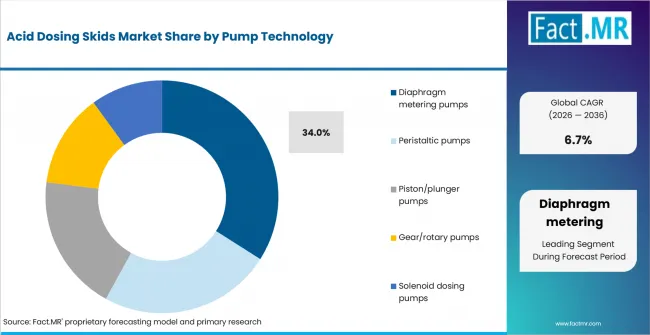
Acid Dosing Skids Market Analysis By Pump Technology | Source: Fact.MR
These pumps keep the acid separate from the moving drive parts. The diaphragm creates a sealed path for the liquid, which lowers the chance of leaks around shafts and seals. This makes the pump well suited to corrosive acids that can cause safety problems and frequent repair work. It also gives a steady and accurate dose at low flow rates, even when pressure changes. These benefits make diaphragm pumps a reliable choice for daily acid dosing in water-treatment and industrial systems.
Why does Sulfuric Acid lead Acid Type?
Sulfuric Acid holds 30.0% share in 2026.
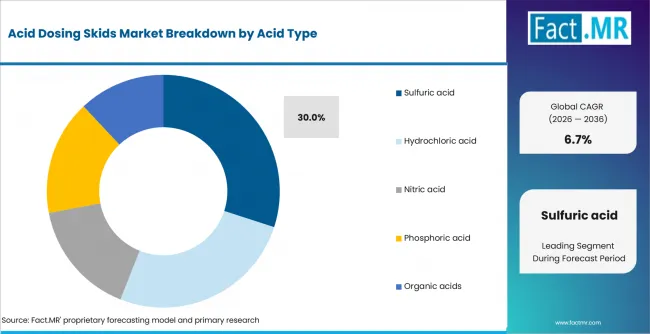
Acid Dosing Skids Market Analysis By Acid Type | Source: Fact.MR
Sulfuric acid is widely used for neutralization, pH control and cooling-water treatment. Many plants already have clear rules for its storage, transfer and safe handling. They also know which materials can withstand it. This makes new dosing systems easier to review and approve than systems that use less common acids. Its use across both municipal and industrial plants also creates steady demand in several applications.
Why does Water & Wastewater pH Control lead Application demand?
Water & Wastewater pH Control account for 32.0% share in 2026.
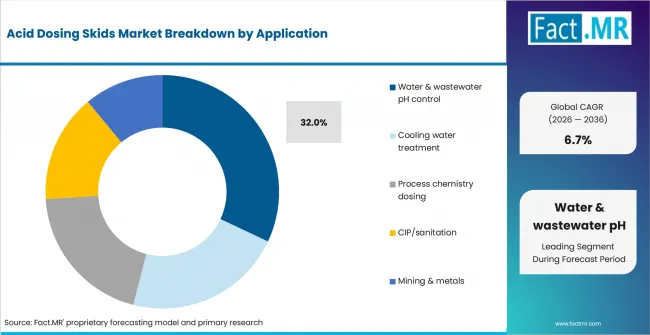
Acid Dosing Skids Market Analysis By Application | Source: Fact.MR
Treatment plants must keep pH within a set range before water is discharged, reused or sent to the next treatment step. Acid dosing skids allow operators to adjust pH when water flow or chemical levels change. This work continues throughout the year, which creates regular demand for pump use, calibration and maintenance. pH control is usually part of daily plant work and official treatment records, not a short-term task.
Why do PVC/CPVC Skids lead Material of Construction?
PVC/CPVC Skids lead with 30.0% share in 2026.
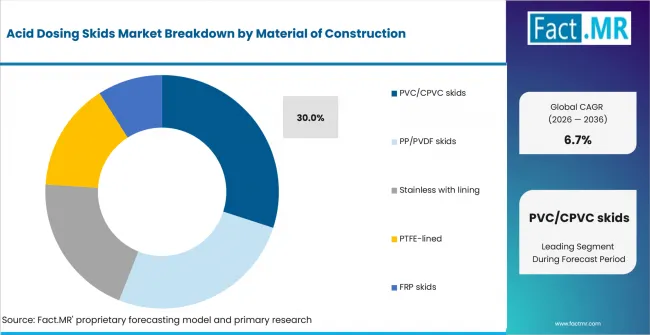
Acid Dosing Skids Market Analysis By Material Of Construction | Source: Fact.MR
PVC and CPVC offer good protection against corrosion at a manageable cost. They work well with many dilute and medium-strength acids without the higher cost of lined steel or special metal grades. These materials are also easier to use for small frames, pipes and leak-control sections. They do have limits, especially at high temperatures or with stronger acid levels. When used within the right conditions, they give plants a familiar and practical option that is easier to maintain.
Why do Municipal Utilities lead End User demand?
Municipal Utilities account for 30.0% share in 2026.
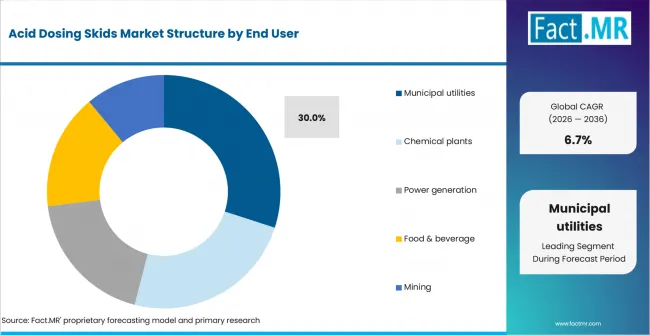
Acid Dosing Skids Market Analysis By End User | Source: Fact.MR
Water and wastewater plants use acid dosing at several points for treatment, neutralization and discharge control. These systems are checked through planned maintenance, chemical records and regular safety reviews. Utilities also prefer equipment that keeps dosing steady without constant adjustment by operators. Proven designs, easy access to spare parts and dependable service often influence the final choice. Daily use and strict recordkeeping continue to support replacement and upgrade demand.
What is accelerating Acid Dosing Skids Market adoption, and what is holding it back?
Water-quality compliance is anticipated to expand Acid Dosing Skids Market demand. Chemical compatibility risk is expected to restrain projects when material selection is unclear.
Drivers Impact Analysis
| DRIVER | (~) % IMPACT ON CAGR | GEOGRAPHIC RELEVANCE | IMPACT TIMELINE |
|---|---|---|---|
| Water-quality compliance | +1.9% | Municipal water and wastewater | Short term (<=2 years) |
| Industrial cooling and process water | +1.4% | Power, chemicals and manufacturing | Short term (<=2 years) |
| Operator-safety upgrades | +1.0% | Regulated industrial markets | Medium term (2-4 years) |
| Automation of chemical consumption | +0.6% | Global | Medium term (2-4 years) |
Source: Fact.MR analysis. Updated Jul 21, 2026
- Water-quality compliance: Stable pH control is expected to raise skid demand because treatment plants need clear dosing records. This is most visible in municipal water and wastewater plants where operators track chemical feed against discharge or quality limits.
- Industrial cooling and process water: Cooling loops and process streams are anticipated to support replacement demand. Acid overfeed harms pipes and heat exchangers. Controlled dosing therefore becomes a cost-control tool for downstream equipment.
- Operator-safety upgrades: Enclosed cabinets, leak sensors and safer access points are projected to support upgrades in regulated industrial sites. The purchase logic is tied to reducing direct contact with corrosive chemicals.
- Automation of chemical consumption: Flow signals, tank-level sensors and feedback control are estimated to improve dose consistency. These controls help smaller teams manage several dosing points without constant manual adjustment.
Opportunity Impact Analysis
| OPPORTUNITY | (~) % IMPACT ON CAGR | GEOGRAPHIC RELEVANCE | IMPACT TIMELINE |
|---|---|---|---|
| Standardized chemical-specific skids | +1.2% | China and UAE | Short term (<=2 years) |
| Remote condition monitoring | +0.9% | China and UAE | Medium term (2-4 years) |
| Service and calibration contracts | +0.6% | China and UAE | Short term (<=2 years) |
Source: Fact.MR analysis. Updated Jul 21, 2026
- Standardized chemical-specific skids: Prequalified material sets are expected to shorten approval time for utilities and industrial plants. This is especially useful where many sites repeat similar pH correction duties.
- Remote condition monitoring: Tank-level sensing, pump-stroke confirmation and leak alarms are projected to create value where staffing is limited. Remote alerts also help operators prevent dry running and missed dosing events.
- Service and calibration contracts: Calibration visits and diaphragm replacement are anticipated to widen aftermarket revenue. The service need stays visible because dosing accuracy changes as pumps wear and acids attack wetted parts.
Restraints Impact Analysis
| RESTRAINT | (~) % IMPACT ON CAGR | GEOGRAPHIC RELEVANCE | IMPACT TIMELINE |
|---|---|---|---|
| Chemical compatibility risk | -1.5% | Global | Short term (<=2 years) |
| Site-specific safety requirements | -1.1% | Global | Medium term (2-4 years) |
| Low-cost local fabrication | -0.8% | Global | Short term (<=2 years) |
Source: Fact.MR analysis. Updated Jul 21, 2026
- Chemical compatibility risk: The wrong elastomer or plastic is expected to delay approvals because acid concentration and temperature change the compatibility decision. A small specification error creates safety and downtime risk.
- Site-specific safety requirements: Ventilation and bunding are anticipated to make many projects site-specific. Unloading access and drain routing add another layer of engineering review.
- Low-cost local fabrication: Regional integrators are expected to pressure pricing on simple single-pump packages. Larger suppliers must prove the value of testing, documentation and spare-part support.
Which countries are scaling Acid Dosing Skids Market fastest?
A global growth rate represents the weighted average of all markets included in the analysis. It therefore does not need to match the rate recorded by each country shown in the comparison. China and the UAE remain above the 6.7% global figure, while Japan, the United Kingdom and Germany remain below it. The six countries presented are illustrative examples, and their comparison with the worldwide rate makes this difference visible.
- The countries are distinguished less by their CAGRs and more by the type of acid-dosing work creating demand.
- China follows a new-project route through municipal water and wastewater construction. Packaged skids are suited to treatment sites that want tested dosing equipment with less assembly work. The UAE takes a different path through desalination, cooling-water systems and industrial reuse projects where compact dosing packages support continuous chemical control.
- The USA and Japan remain closely aligned near the global rate. USA demand comes mainly from replacement of aging dosing equipment and upgrades to corrosion-control systems. Japan places more weight on compact layouts, automation and long service intervals.
- The United Kingdom develops through scheduled utility investment and periodic replacement of chemical-feed assets, while Germany relies on careful upgrades across an established installed base.
- Markets with broadly similar CAGRs can therefore follow substantially different development paths. Material compatibility, safety approval, calibration records and spare-part access influence how quickly a dosing project moves from review into purchase.
The full report examines these dynamics for every market included in the study. It provides country-level CAGR analysis across North America, Latin America, Europe, East Asia, South Asia, Oceania, and the Middle East and Africa.
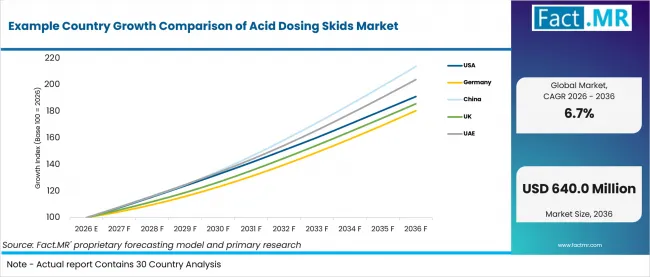
Example Country Growth Comparison Of Acid Dosing Skids Market | Source: Fact.MR
| COUNTRY | CAGR, 2026 to 2036 |
|---|---|
| UAE | 7.4% |
| USA | 6.7% |
| Japan | 6.6% |
| UK | 6.4% |
| Germany | 6.1% |
Source: Fact.MR analysis. Updated Jul 21, 2026
How is the UAE scaling demand?
7.4% CAGR, driven by desalination and wider use of treated wastewater.
The UAE’s 7.4% CAGR reflects its strong dependence on desalinated water and recycled wastewater. Acid dosing skids are used for pH control, membrane pretreatment, cleaning and cooling-water treatment, making them an important part of large water and industrial facilities.
What supports USA adoption?
6.7% CAGR, led by lead-pipe replacement and stronger corrosion control.
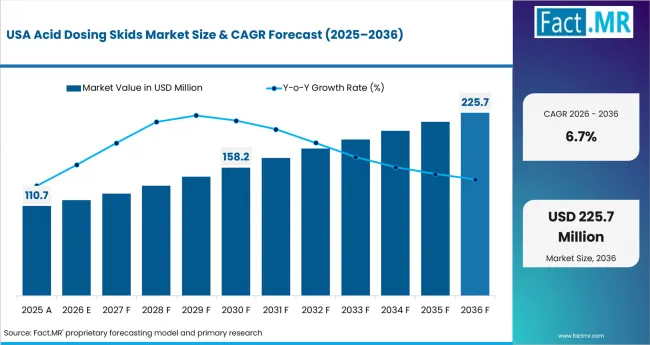
Acid Dosing Skids Market Country Value Analysis | Source: Fact.MR
The USA’s 6.7% CAGR is supported by drinking-water projects that include replacing old lead service lines and improving corrosion control. The EPA reports that about 4 million lead service lines are still in use, and updated rules require water utilities to improve replacement plans and corrosion management. These projects increase the need for accurate pH control, controlled chemical dosing and clear operating records, supporting demand for enclosed acid dosing skids.
What underpins Japan’s growth?
6.6% CAGR, supported by labor-saving equipment and automated systems.
Japan’s 6.6% CAGR is linked to a smaller workforce available to operate and maintain water infrastructure. The Ministry of Land, Infrastructure, Transport and Tourism has highlighted worker shortages and encourages the use of labor-saving equipment. Compact acid dosing skids with automatic controls and alarm functions help plants maintain steady chemical dosing while reducing manual work.
How is the UK developing demand?
6.4% CAGR, linked to long-term investment in water infrastructure.
Demand in the UK is expected to grow through planned utility projects rather than one-off equipment purchases. Water companies are investing in treatment plants, sewer systems, pollution control and drinking-water facilities. These projects create opportunities to replace older dosing equipment and install new chemical-feed systems.
What shapes Germany’s outlook?
6.1% CAGR, driven by upgrades at existing wastewater plants.
Germany’s 6.1% CAGR comes mainly from improving existing treatment plants rather than building new municipal systems. Many projects focus on better nutrient removal, treatment of difficult contaminants, phosphorus recovery and more accurate chemical use. Acid dosing skids fit these upgrades because they can be added to existing treatment lines without major changes to the rest of the plant.
Who leads the Acid Dosing Skids Market?
Grundfos and ProMinent have a strong position in complete chemical dosing systems. SEKO and Milton Roy also compete through ready-built skid packages.
Grundfos offers chemical dosing systems for water treatment and industrial use. Its range includes floor-mounted and panel-mounted units that can be adjusted for different site needs. ProMinent provides DULCODOS systems that bring pumps, controls and other parts together in one unit. SEKO offers dosing and injection skids for wastewater, chemical processing and other industrial uses. Milton Roy’s DosaSkid range covers chemical preparation, storage and injection.
LEWA has a stronger role in custom projects where acid must be added at high pressure or under difficult working conditions. Its systems can include pumps, tanks, pipes, measuring devices and controls based on the needs of the project. Lutz-JESCO serves water-treatment and chemical-processing sites with modular systems that are assembled and tested before they reach the site.
From 2026 to 2036, companies are expected to compete on dosing accuracy, material strength and how much installation work is completed before delivery. Water utilities and industrial plants are also likely to compare automatic controls, leak protection, ease of maintenance and nearby service support. Companies that provide tested skids matched to the acid strength, flow rate and working pressure at each site are likely to win more projects.
Which companies are the key providers?
Key companies include Grundfos; ProMinent; SEKO; Milton Roy; LEWA; Lutz-JESCO.
- Grundfos
- ProMinent
- SEKO
- Milton Roy
- LEWA
- Lutz-JESCO
Bibliography
- U.S. Environmental Protection Agency. (2026, May 21). Clean Watersheds Needs Survey. U.S. Environmental Protection Agency.
- Grundfos. (2025). Get specific solutions for chemical dosing with Grundfos.
- ProMinent GmbH. (2025). Waste water treatment.
This Report Addresses
- The report provides strategic intelligence on Acid Dosing Skids Market across Pump Technology and Acid Type choices that shape purchasing decisions.
- Segment analysis covers Diaphragm metering pumps as the share leader within the 2026 market structure.
- Regional outlook evaluates China and UAE alongside USA and Japan, while UK and Germany complete the growth comparison.
- Competitive analysis profiles Grundfos and ProMinent alongside SEKO and Milton Roy, followed by additional active providers.
- Use-case assessment covers the categories and applications that shape acid dosing skids market demand across the forecast period.
What does the Acid Dosing Skids Market cover?
Configured dosing packages are used to add a controlled amount of mineral or organic acid to water, wastewater, cooling lines or industrial process streams.
The Acid Dosing Skids Market covers complete systems that combine a skid frame, metering pump, piping, valves, containment, sensors and controls for accurate acid feed. Coverage includes systems used for pH adjustment, neutralization, cooling-water treatment, process chemistry, CIP and sanitation, and mining or metals applications. The market includes diaphragm, peristaltic, piston or plunger, gear or rotary, and solenoid dosing-pump systems. It also covers skids designed for sulfuric, hydrochloric, nitric, phosphoric and organic acids.
The market differs from the broader chemical-handling equipment sector because commercial value comes from the configured dosing package and its direct engineering function. Bulk acid storage, general pipe installation and full water-treatment plant spending remain outside the boundary. Standalone pumps are also excluded when they are sold without the supporting skid, piping, controls and safety components.
What is included in the scope?
Acid dosing skids are used across municipal utilities, chemical plants, power-generation sites, food and beverage facilities, and mining operations.
The scope includes Pump Technology and Acid Type alongside Application, Material of Construction and End User. Pump coverage spans diaphragm metering pumps, peristaltic pumps, piston or plunger pumps, gear or rotary pumps and solenoid dosing pumps. Acid coverage includes sulfuric acid, hydrochloric acid, nitric acid, phosphoric acid and organic acids. Applications include water and wastewater pH control, cooling-water treatment, process chemistry dosing, CIP and sanitation, and mining or metals processing.
The scope also includes PVC or CPVC skids, PP or PVDF skids, lined stainless-steel systems, PTFE-lined packages and FRP skids. Skid frames, metering pumps, suction and discharge piping, valves, calibration columns, pulsation dampeners, leak containment, sensors and local controls remain within the boundary when they are delivered as part of the configured dosing unit.
What is excluded from the scope?
Bulk acid storage, chemical purchases and equipment sold outside a complete dosing package remain outside the scope of this market.
The scope excludes bulk acid tanks and acid purchase contracts. Standalone metering pumps without a skid are excluded, along with general pipework installed separately at the site. Full treatment-plant construction, civil work and unrelated water-treatment equipment are also outside the boundary. The market does not include the value of the water, wastewater or industrial process facility in which the skid is installed.
How Was the Analysis Built?
The analysis draws on 120+ sources, 35+ company portfolios, 25+ countries, and more than 20 industry interviews.
- Primary Research: Primary research includes discussions with manufacturers, service providers, technology developers, distributors, end users, procurement teams, and subject-matter experts. These conversations examine purchasing priorities, product adoption, operational challenges, approval requirements, competitive positioning, and the factors that influence wider market acceptance.
- Desk Research: Desk research covers government statistics, regulatory publications, company filings, trade data, technical studies, industry associations, standards, public policy, and other authoritative sources. Every source used in the analysis is documented in the bibliography.
- Market Sizing and Forecasting: Market estimates combine historical performance, demand indicators, pricing and volume trends, segment shares, company participation, country-level growth, adoption patterns, investment activity, and barriers to market expansion.
- Data Validation and Update Cycle: Findings are validated by comparing primary interviews with public data, company activity, regulatory changes, trade patterns, and industry developments. Regular updates review new product launches, capacity changes, partnerships, approvals, procurement trends, and shifts in commercial adoption.
Segmentation
What is the report's scope and coverage?
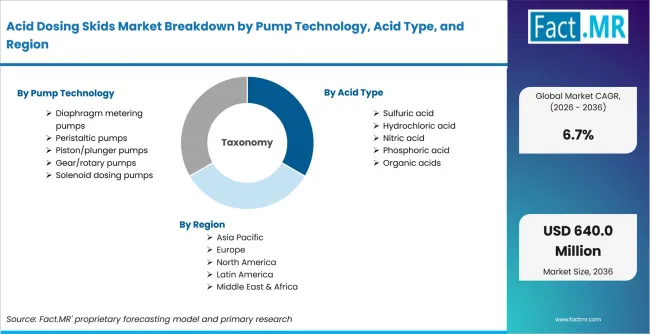
Acid Dosing Skids Market Breakdown By Pump Technology, Acid Type, And Region | Source: Fact.MR
| Attribute | Details |
|---|---|
| Quantitative Units | USD million in 2026 to USD million by 2036 at a CAGR |
| Market Definition | An acid dosing skid meters a controlled flow of mineral or organic acid into a water or process stream through a configured package of pumps, piping, valves, containment, sensors and controls. |
| Pump Technology | Diaphragm metering pumps; Peristaltic pumps; Piston/plunger pumps; Gear/rotary pumps; Solenoid dosing pumps |
| Acid Type | Sulfuric acid; Hydrochloric acid; Nitric acid; Phosphoric acid; Organic acids |
| Application | Water & wastewater pH control; Cooling water treatment; Process chemistry dosing; CIP/sanitation; Mining & metals |
| Material of Construction | PVC/CPVC skids; PP/PVDF skids; Stainless with lining; PTFE-lined; FRP skids |
| End User | Municipal utilities; Chemical plants; Power generation; Food & beverage; Mining |
| Regions Covered | North America; Latin America; Europe; East Asia; South Asia & Oceania; Middle East & Africa |
| Countries Covered | USA; Canada; Brazil; Mexico; Germany; U.K.; France; Italy; Spain; South Korea; Japan; China; India; Australia & New Zealand; GCC Countries; South Africa; UAE |
| Key Companies Profiled | Grundfos; ProMinent; SEKO; Milton Roy; LEWA; Lutz-JESCO |
| Forecast Period | 2026 to 2036 |
| Approach | Hybrid top-down and bottom-up approach using demand indicators across Pump Technology, Acid Type, Application, Material of Construction and End User; country-level growth; company participation and adoption trends |
Source: Fact.MR analysis. Updated Jul 21, 2026
How is the market segmented?
-
By Pump Technology:
- Diaphragm metering pumps
- Peristaltic pumps
- Piston/plunger pumps
- Gear/rotary pumps
- Solenoid dosing pumps
-
By Acid Type:
- Sulfuric acid
- Hydrochloric acid
- Nitric acid
- Phosphoric acid
- Organic acids
-
By Application:
- Water & wastewater pH control
- Cooling water treatment
- Process chemistry dosing
- CIP/sanitation
- Mining & metals
-
By Material of Construction:
- PVC/CPVC skids
- PP/PVDF skids
- Stainless with lining
- PTFE-lined
- FRP skids
-
By End User:
- Municipal utilities
- Chemical plants
- Power generation
- Food & beverage
- Mining
-
By Region
- North America
- USA
- Canada
- Latin America
- Brazil
- Mexico
- Rest of Latin America
- Europe
- Germany
- U.K.
- France
- Italy
- Spain
- Rest of Europe
- East Asia
- South Korea
- Japan
- China
- South Asia & Oceania
- India
- Australia & New Zealand
- Rest of South Asia & Oceania
- Middle East & Africa
- GCC Countries
- South Africa
- UAE
- Rest of Middle East & Africa
- North America
Frequently Asked Questions
Which Pump Technology leads the Acid Dosing Skids Market?
Which Acid Type leads the Acid Dosing Skids Market?
Which Application leads the Acid Dosing Skids Market?
Which Material of Construction leads the Acid Dosing Skids Market?
Which End User leads the Acid Dosing Skids Market?
Which country records the highest CAGR in the Acid Dosing Skids Market?
How does UAE perform in the Acid Dosing Skids Market?
How does USA perform in the Acid Dosing Skids Market?
What is the primary driver in the Acid Dosing Skids Market?
What is the main restraint in the Acid Dosing Skids Market?
Who worked on this report


Preview the report firsthand - request a free sample
Free SampleGet the brochure for pricing and purchase details
Download PDF