- Market Value (2025): USD 157.3 Mn
- Estimated Value (2026): USD 163.8 Mn
- Forecast Value (2036): USD 245.2 Mn
- CAGR (2026-2036): 4.1%
Marine Thinner Market Forecast and Outlook 2026 to 2036
Fact.MR studies that the marine thinners market surpassed a value of USD 157.3 million in 2025 and is projected to grow from USD 163.8 million in 2026 to USD 245.2 million by 2036. Demand for marine thinners is likely to grow at a CAGR of 4.1% over the forecast period.
Demand for marine thinners is rising as shipyards and boat owners apply epoxy, polyurethane and antifouling systems that need the correct solvent for spraying, cleaning and viscosity control. Suppliers of marine thinners are matching thinners to coating systems and lowering hazardous solvent content. For example, in December 2024, Hanwha completed its acquisition of Philly Shipyard in the United States, adding commercial shipbuilding capacity that consumes coatings and thinners. Similar shipbuilding investment is projected to drive sales of marine thinners through 2036.
Key Takeaways from the Marine Thinner Market
- Marine Thinner Market Value (2025): USD 157.3 million
- Marine Thinner Market Value (2026): USD 163.8 million
- Marine Thinner Market Forecast Value (2036): USD 245.2 million
- Marine Thinner Market Forecast CAGR (2026-2036): 4.1%
- Leading Product Type: Epoxy Thinner (38.5%)
- Key Market Participants: AkzoNobel N.V., PPG Industries, Inc., Sherwin-Williams Company, Jotun Group, Hempel A/S, Nippon Paint Holdings Co., Ltd.
- Key Growth Regions: United Kingdom, Japan, Brazil, United States, Germany
In January 2025, Navantia UK completed its acquisition of Harland & Wolff's shipyards, including Belfast and Appledore, securing work on Royal Navy support ships. Demand for marine thinners is growing as revived yards ramp up coating work. Suppliers of marine thinners are supporting yards with technical service teams. Similar yard revivals are projected to drive sales of marine thinners in Europe and North America.
Marine Thinner Market
| Metric | Value |
|---|---|
| Estimated Value in (2026) | USD 163.8 million |
| Forecast Value in (2036) | USD 245.2 million |
| Forecast CAGR (2026 to 2036) | 4.1% |
Source: Fact.MR analysis. Updated Nov 20, 2026
Source: Fact.MR analysis.
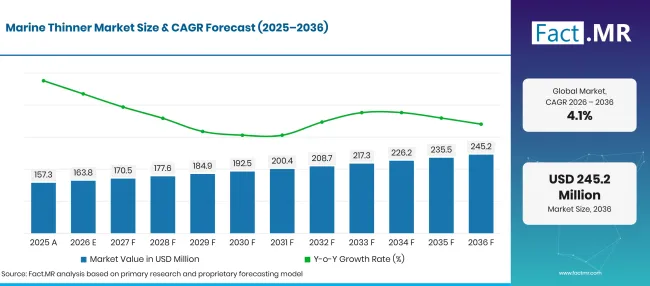
Marine Thinner Market Forecast Global | Source: Fact.MR
Category
| Category | Segments |
|---|---|
| Product Type | Epoxy Thinner, Polyurethane Thinner, Acrylic Thinner, Others |
| Application | Commercial Vessels, Recreational Boats, Offshore Structures, Others |
| Distribution Channel | Marine Supply Stores, Online Stores, Specialty Retailers, Others |
| End-User | Shipbuilding, Maintenance and Repair, Offshore Oil and Gas, Others |
| Region | United Kingdom; Japan; Brazil; United States; Germany |
Source: Fact.MR analysis. Updated Nov 20, 2026
Segmental Analysis
What is driving epoxy thinner demand in the Marine Thinner Market?
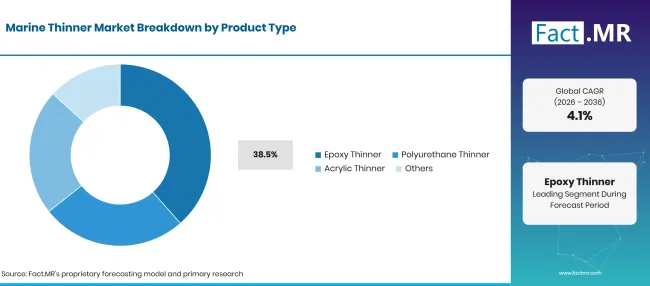
Marine Thinner Market Breakdown Product Type | Source: Fact.MR
Demand is supported by the use of epoxy primers and protective coatings on ship hulls, ballast tanks and other steel surfaces exposed to saltwater and moisture. Demand for epoxy thinner leads with 38.5% of revenue in 2026, about USD 63.1 million, as epoxy primers and barrier coats protect hulls, tanks and ballast spaces from corrosion. Polyurethane and acrylic thinners serve topcoats. Suppliers such as Jotun, Hempel and AkzoNobel specify dedicated epoxy thinners for each system. Similar corrosion protection needs are projected to keep epoxy thinner in the lead. Shipbuilding activity also supports consumption, as India’s Ministry of Ports, Shipping and Waterways reported in March 2026 that 456 vessels across 288 shipbuilding contracts had received in-principle financial assistance approvals, representing contracts worth ₹19,748 crore. These projects create demand for coating systems and their compatible thinners during vessel construction.
Which vessel category accounts for the largest application demand?
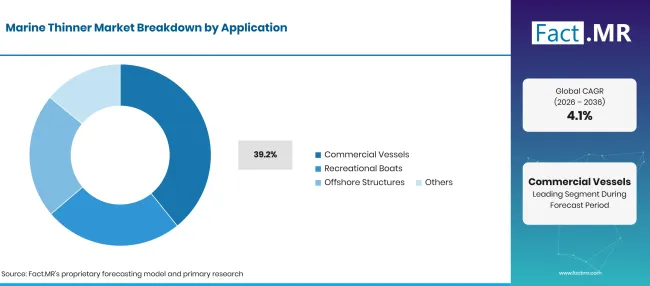
Marine Thinner Market Breakdown Application | Source: Fact.MR
Sales of commercial vessels represents 39.2% of revenue in 2026, about USD 64.2 million, as large hull and tank areas consume high coating and thinner volumes at newbuilding and dry-docking. Recreational boats and offshore structures follow. Suppliers are serving yards in Asia and Europe. Similar fleet maintenance is projected to keep commercial vessels the leading application. Cargo ships, tankers and other working vessels require protective coatings across extensive hull, deck and tank surfaces, generating recurring thinner consumption during construction, recoating and dry-docking. In July 2026, the Indian government announced a shipbuilding strategy that includes a fleet acquisition plan covering more than 400 vessels, providing longer-term order visibility for domestic shipyards. The scale of commercial vessel construction and maintenance therefore supports this segment’s leading position.
How are marine supply stores contributing to thinner sales?
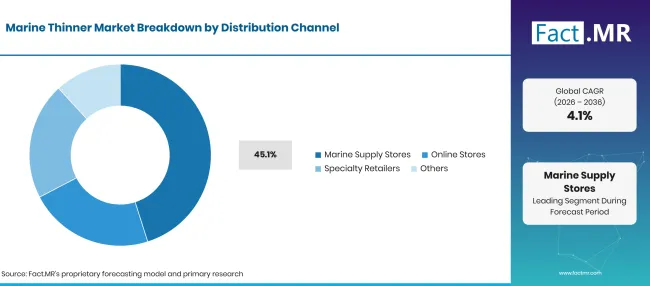
Marine Thinner Market Breakdown Distribution Channel | Source: Fact.MR
Marine supply stores segment holds 45.1% of revenue in 2026, about USD 73.9 million, as boatyards, repairers and owners buy thinners alongside paints at chandleries. Shipyards buy directly from coating makers. Suppliers are stocking chandleries with matched products. Similar repair buying is projected to keep marine stores in the lead. Their role is supported by purchases from smaller repair yards, boat operators and maintenance contractors that source paints, primers, solvents and application accessories through established marine distributors. Shipyards and large vessel operators often procure directly from coating manufacturers for major projects, but chandleries remain important for routine maintenance and smaller-volume requirements. India’s Ministry of Ports, Shipping and Waterways approved a ₹1,570-crore ship repair facility at Vadinar in May 2026, including two floating dry docks, highlighting investment in repair infrastructure that can support demand for marine coating supplies.
What is sustaining shipbuilding demand for marine thinners?
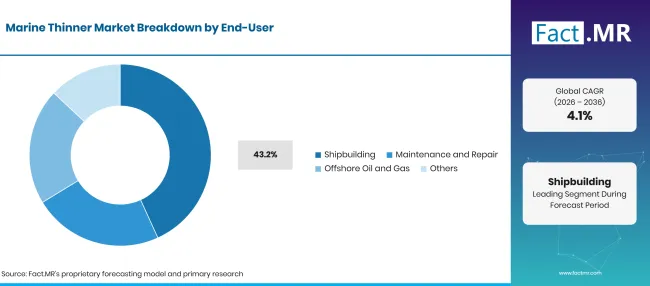
Marine Thinner Market Breakdown End User | Source: Fact.MR
Shipbuilding accounts for 43.2% of revenue in 2026, about USD 70.8 million, as newbuild coating consumes the largest volumes. Maintenance and repair and offshore oil and gas follow. Suppliers are serving shipbuilders with on-site technicians. Similar newbuilding is projected to keep shipbuilding in the lead. New vessels require multiple coating stages, including surface preparation, primers, intermediate coats and finishing layers, creating demand for compatible thinners throughout production. India’s government reported in July 2026 that national shipbuilding output increased by 41%, from 40,923 gross tonnage in 2024 to 57,637 gross tonnage in 2025. The government’s ₹69,725-crore shipbuilding support package and plans to expand annual capacity to 4.5 million gross tonnage further indicate investment in newbuilding activity.
Marine Thinner Market-Drivers, Restraints & Trends
Drivers: IMO decarbonization and fleet renewal
The shift toward high-solids and solvent-free marine coatings creates an opportunity for suppliers to develop compatible low-VOC thinners and application-specific formulations. The European Commission’s Joint Research Centre describes high-solids epoxy coatings as widely used on underwater ship surfaces, external areas, holds and water tanks, with VOC content generally at or above 150 g/l for coatings applied below the waterline. It also identifies solvent-free two-component coatings as an option for ship and yacht manufacturing. These technologies can reduce VOC emissions, but they may also lower the quantity of conventional thinner required. Suppliers that formulate products for viscosity adjustment, application performance and compatibility with newer coating systems may be better positioned to retain sales.
Trend: Shipyard investment in the United States and United Kingdom
Government-backed shipyard investment is strengthening the outlook for marine coating suppliers in Western markets. In the United States, the 2026 Maritime Action Plan prioritizes shipyard modernization and expansion, while the Navy’s May 2026 shipbuilding plan reports more than USD 20 billion in congressional appropriations between FY2018 and FY2026 for shipbuilding industrial-base resilience and expansion. In the United Kingdom, the government reported a GBP 157 million investment programme across Navantia UK’s four shipyards in November 2026, including around GBP 100 million for Belfast, with the new fabrication hall supporting construction of three Fleet Solid Support ships. More shipbuilding and repair activity can expand the addressable market for marine coatings and compatible thinners.
VOC-emission controls constrain the use of conventional solvent-based marine coatings and can limit demand for solvent-rich thinners. For example, Ohio’s shipbuilding and ship-repair rules establish VOC content limits for marine coatings and apply additional controls to facilities with significant emissions. The U.S. EPA also identifies VOC reduction as a regulatory objective because these compounds contribute to ground-level ozone formation. As shipyards and coating suppliers respond with compliant formulations, demand may shift toward lower-VOC products and application systems requiring less added solvent. This creates a challenge for conventional thinner volumes, although suitable thinners remain necessary for coating systems that specify them.
Opportunity: Low-VOC and high-solids coating systems
The IMO’s 2023 greenhouse gas strategy targets net-zero emissions from international shipping by or around 2050, with a 2030 target to reduce carbon intensity by at least 40% compared with 2008. These targets encourage investment in more energy-efficient vessels and associated protective coating systems. In 2026, the U.S. Maritime Action Plan reported that the country builds less than 1% of commercial ships globally and identified shipyard modernization, domestic capacity and workforce development as priorities. This policy focus, alongside vessel replacement and construction activity, can support demand for marine primers, topcoats and the thinners used in their application.
Restraints: VOC limits and reduced solvent requirements
The shift toward high-solids and solvent-free marine coatings creates an opportunity for suppliers to develop compatible low-VOC thinners and application-specific formulations. The European Commission’s Joint Research Centre describes high-solids epoxy coatings as widely used on underwater ship surfaces, external areas, holds and water tanks, with VOC content generally at or above 150 g/l for coatings applied below the waterline. It also identifies solvent-free two-component coatings as an option for ship and yacht manufacturing. These technologies can reduce VOC emissions, but they may also lower the quantity of conventional thinner required. Suppliers that formulate products for viscosity adjustment, application performance and compatibility with newer coating systems may be better positioned to retain sales.
Trend: Shipyard investment in the United States and United Kingdom
Government-backed shipyard investment is strengthening the outlook for marine coating suppliers in Western markets. In the United States, the 2026 Maritime Action Plan prioritizes shipyard modernization and expansion, while the Navy’s May 2026 shipbuilding plan reports more than USD 20 billion in congressional appropriations between FY2018 and FY2026 for shipbuilding industrial-base resilience and expansion. In the United Kingdom, the government reported a GBP 157 million investment programme across Navantia UK’s four shipyards in November 2026, including around GBP 100 million for Belfast, with the new fabrication hall supporting construction of three Fleet Solid Support ships. More shipbuilding and repair activity can expand the addressable market for marine coatings and compatible thinners.
Marine Thinner Market by Analysis by Key Country
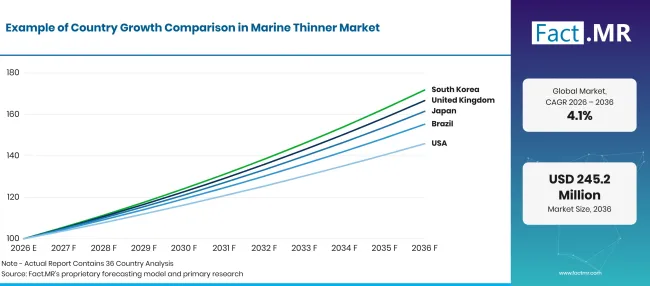
Marine Thinner Market Growth Index | Source: Fact.MR
| Country | CAGR (2026-2036) |
|---|---|
| United Kingdom | 5.2% |
| Japan | 4.9% |
| Brazil | 4.5% |
| United States | 3.9% |
| Germany | 3.2% |
Source: Fact.MR analysis. Updated Nov 20, 2026
Source: Fact.MR analysis.
What is making the United Kingdom the fastest-growing market for marine thinners?
Demand for marine thinners in the United Kingdom is anticipated to grow at a 5.2% CAGR, the fastest among the five key countries, as Navantia UK revives Harland & Wolff yards and Royal Navy programs proceed.
Suppliers are serving revived yards. Similar naval work is projected to drive sales. In November 2026, the Ministry of Defence reported that Navantia UK had opened a new fabrication hall at Belfast as part of a GBP 157 million investment programme across four UK shipyards. The facility will support construction of three Fleet Solid Support ships and contribute to 900 skilled jobs and apprenticeships in Belfast. The programme creates opportunities for marine coating suppliers serving vessel fabrication, maintenance and repair activities. Greater shipyard utilization is expected to strengthen demand for compatible primers, paints and application thinners.
What is driving marine thinner demand in Japan?
Sales of marine thinners in Japan is estimated to record a 4.9% CAGR as the government pursues plans to revive domestic shipbuilding output. Nippon Paint Marine, Chugoku Marine Paints and Kansai Paint serve Japanese yards. Similar policy is projected to drive sales in Japan.
In September 2026, the Ministry of Land, Infrastructure, Transport and Tourism reported that eight approved shipbuilding-capacity plans represented approximately JPY 900 billion in public-private investment, with government support of up to JPY 311 billion. The programme includes funding for automation, dock expansion and crane installation, while the national roadmap targets annual shipbuilding capacity of 18 million gross tonnes, compared with 9.07 million gross tonnes in 2024. Increased construction and repair activity could support sales of marine coatings and compatible thinners.
What is supporting marine thinner demand in Brazil?
Demand for marine thinners in Brazil are anticipated to represent at a 4.5% CAGR as Transpetro's fleet renewal and Petrobras offshore work bring coating demand to local yards.
Similar investment is projected to drive sales. The National Agency of Petroleum, Natural Gas and Biofuels (ANP) lists eight Transpetro gas carriers under contract, with steel cutting for the first vessel scheduled for June 2026. Four additional MR1 tankers were contracted in April 2026, with construction of the first vessel scheduled to begin in December 2026. Separately, Petrobras signed contracts in May 2026 for two offshore FPSOs under the Sergipe Águas Profundas project, involving investment exceeding BRL 60 billion.
How is shipyard investment shaping marine thinner sales in the United States?
Sales of marine thinners in the United States are projected to grow at a 3.9% CAGR as Hanwha's Philly Shipyard and naval yards expand.
Sherwin-Williams and PPG supply US yards. Similar investment is projected to support sales. In July 2026, the U.S. Department of Transportation announced a USD 2 billion investment to build two military ships at Hanwha Philly Shipyard. The August 2026 White House memorandum on rebuilding the U.S. Navy and shipbuilding industrial base also identified capacity constraints and large order backlogs across major naval programmes. These initiatives could increase requirements for surface preparation, protective coatings and associated application materials. Manufacturers such as PPG and Sherwin-Williams may benefit from wider shipyard activity.
Why is marine thinner growth slower in Germany?
Demand for marine thinners in Germany is estimated to record a 3.2% CAGR, the slowest among the five key countries, as commercial shipbuilding is small and cruise yards such as Meyer Werft restructured in 2024. Similar conditions are projected to keep growth slower.
Destatis reported that new orders in the manufacture of other transport equipment, including ships, aircraft, trains and military vehicles, increased by 126.4% month on month in July 2026, largely because of unusually large orders. However, the same category recorded a 61.5% decline in August 2026. This volatility highlights the uneven timing of major shipbuilding contracts and the difficulty of sustaining consistent demand across the supply chain. Germany's marine thinner sales are therefore likely to depend on specialist vessel construction, repair work and the timing of individual shipyard projects rather than broad-based increases in commercial shipbuilding.
Competitive Landscape for Marine Thinner Market
Competition in the marine thinner market is driven by global marine coatings manufacturers offering compatible thinner formulations for epoxy, polyurethane, acrylic and antifouling systems. AkzoNobel, PPG Industries, Sherwin-Williams, Jotun, Hempel, Nippon Paint and Axalta compete through product compatibility, solvent performance, application consistency and technical support. Their portfolios address shipbuilding, vessel maintenance, protective coating applications and marine repair requirements.
Growing environmental requirements are encouraging marine coating manufacturers to develop low-VOC formulations and improve application efficiency. Companies are prioritizing compatible thinner formulations, controlled evaporation rates and technical support for shipyards, vessel owners and marine maintenance contractors. Manufacturers with comprehensive marine coating portfolios, established distribution networks and strong application expertise are better positioned to expand their market presence.
Recent Developments
- In January 2025, Navantia UK completed its acquisition of Harland & Wolff yards.
- In November 2026, the European Commission conditionally approved AkzoNobel’s proposed merger with Axalta. The combined business will include marine and protective coatings, although completion remains subject to outstanding approvals.
- In August 2026, PPG launched its ONE RANGE portfolio of five one-component marine coatings at SMM Hamburg. The ready-to-use products simplify onboard maintenance through waterborne, alkyd and polyurethane coating technologies.
- In September 2026, Jotun published new analysis indicating that its Imperial Fouling Protection System could deliver approximately 50% lower lifecycle carbon emissions than conventional antifouling systems over 30 years.
- In May 2026, Sherwin-Williams and Nippon Paint jointly proposed acquiring AkzoNobel, with Sherwin-Williams targeting its marine, protective and other coatings businesses. AkzoNobel rejected the proposal, so no acquisition was completed.
- In October 2026, Nippon Paint announced the acquisition of AkzoNobel’s Decorative Paints business in Southeast Asia for USD 1.35 billion.
- In November 2026, Axalta and AkzoNobel received conditional European Commission approval for their proposed merger. The planned combination includes marine and protective coatings and is expected to close in early 2027.
Key Players in Marine Thinner Market
Key companies profiled include AkzoNobel N.V.; PPG Industries, Inc.; Sherwin-Williams Company; Jotun Group; Hempel A/S; Nippon Paint Holdings Co., Ltd.; and Axalta Coating Systems Ltd.
- AkzoNobel N.V.
- PPG Industries, Inc.
- Sherwin-Williams Company
- Jotun Group
- Hempel A/S
- Nippon Paint Holdings Co., Ltd.
- Axalta Coating Systems Ltd.
Bibliography
- AkzoNobel. (2026, November 6). European Commission approves AkzoNobel and Axalta merger of equals.
- AkzoNobel. (2026, October 5). AkzoNobel to sell Decorative Paints Southeast Asia business to Nippon Paint for $1.35 billion
- Axalta Coating Systems Ltd. (2026, November 6). European Commission approves AkzoNobel and Axalta merger of equals
- Destatis. (2026, September 4). New orders in manufacturing in July 2026: +2.5% on the previous month
- Destatis. (2026, October 6). New orders in manufacturing in August 2026: −10.6% on the previous month
- Government of India, Ministry of Ports, Shipping and Waterways. (2026, March 14). Shipbuilding financial assistance policy. Press Information Bureau
- Government of India, Ministry of Ports, Shipping and Waterways. (2026, May 5). Cabinet approves ship repair facility at Vadinar, Gujarat. Press Information Bureau.
- Government of India, Ministry of Ports, Shipping and Waterways. (2026, July 15). Greenfield shipbuilding cluster to come up in Porbandar, Gujarat. Press Information Bureau.
- Hanwha Philly Shipyard. (n.d.). About us.
- Hempel A/S. (2026, September 14). Hempel secures 3-year global hull coatings agreement with Maersk for fleet dry dockings.
- Jotun. (2026, September 8). Jotun Yachting highlights 50% lower carbon footprint with Imperial fouling protection.
- Ministry of Defence. (2026, September 3). Key milestone reached for future Navy support ship as names of sister ships announced. GOV.UK.
- Ministry of Defence, Northern Ireland Office, Sarah Owen MP, & Luke Pollard MP. (2026, November 2). New Belfast fabrication hall to support shipbuilding for decades. GOV.UK.
- Ministry of Land, Infrastructure, Transport and Tourism. (2025, December 26). Shipbuilding revitalization roadmap. Government of Japan.
- Ministry of Land, Infrastructure, Transport and Tourism. (2026, September 11). Promoting fundamental strengthening of shipbuilding capacity toward the revitalization of the shipbuilding industry. Government of Japan.
- Navantia UK. (2025, January 27). Navantia UK completes acquisition of Harland & Wolff.
- Nippon Paint Holdings Co., Ltd. (2026, October 5). Notice regarding acquisitions of Akzo Nobel's Decorative Paints business in Southeast Asia.
- Petrobras. (2026, May 29). Petrobras signs contracts for two FPSOs for the Sergipe Deepwater project.
- PPG Industries, Inc. (2026, August 31). PPG introduces PPG ONE RANGE portfolio for onboard maintenance.
- Sherwin-Williams Company. (2026). Nippon Paint Group and Sherwin-Williams confirm joint proposal to acquire AkzoNobel
- U.S. Department of Transportation. (2026, July 17). Trump's Transportation Secretary Duffy, White House OMB Director Vought celebrate christening of “Lone Star State,” announce $2 billion investment to build two new military ships in Philadelphia.
- U.S. Government. (2026, August 13). Rebuilding the United States Navy and America's shipbuilding industrial base. The White House.
- Agência Nacional do Petróleo, Gás Natural e Biocombustíveis. (n.d.). Mensuração e fiscalização de conteúdo local em navios-tanque e gaseiros.
Segmentation
Scope of Report
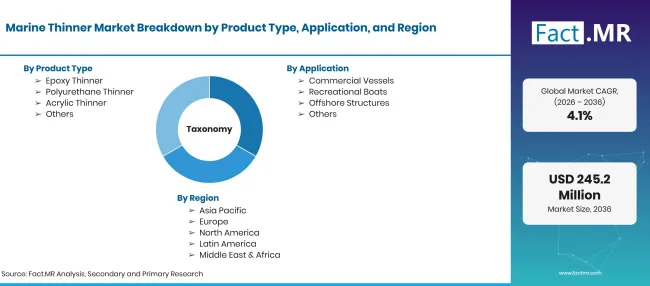
Marine Thinner Market Taxonomy | Source: Fact.MR
| Items | Values |
|---|---|
| Quantitative Units (2026) | USD 163.8 Million |
| Product Type | Epoxy Thinner, Polyurethane Thinner, Acrylic Thinner, Others |
| Application | Commercial Vessels, Recreational Boats, Offshore Structures, Others |
| Distribution Channel | Marine Supply Stores, Online Stores, Specialty Retailers, Others |
| End-User | Shipbuilding, Maintenance and Repair, Offshore Oil and Gas, Others |
| Regions Covered | North America, Latin America, Europe, East Asia, South Asia and Pacific, Middle East & Africa |
| Countries Covered | United States, Germany, Japan, United Kingdom, Brazil, and other countries |
| Key Companies Profiled | AkzoNobel N.V.; PPG Industries, Inc.; Sherwin-Williams Company; Jotun Group; Hempel A/S; Nippon Paint Holdings Co., Ltd.; Axalta Coating Systems Ltd. |
| Additional Attributes | Dollar revenue in the Marine Thinner Market is segmented by product type (epoxy thinner, polyurethane thinner, acrylic thinner); application (commercial vessels, recreational boats, offshore structures); distribution channel (marine supply stores, online stores, specialty retailers); end-user (shipbuilding, maintenance and repair, offshore oil and gas) and region. |
Source: Fact.MR analysis. Updated Nov 20, 2026
Marine Thinner Market by Segments
-
Product Type
- Epoxy Thinner
- Polyurethane Thinner
- Acrylic Thinner
- Others
-
Application
- Commercial Vessels
- Recreational Boats
- Offshore Structures
- Others
-
Distribution Channel
- Marine Supply Stores
- Online Stores
- Specialty Retailers
- Others
-
End-User
- Shipbuilding
- Maintenance and Repair
- Offshore Oil and Gas
- Others
-
Region:
- North America
- United States
- Canada
- Mexico
- Europe
- Germany
- United Kingdom
- France
- Italy
- Spain
- Rest of Europe
- Asia Pacific
- China
- India
- Japan
- South Korea
- Australia
- Rest of Asia Pacific
- Latin America
- Brazil
- Mexico
- Argentina
- Rest of Latin America
- Middle East & Africa
- GCC Countries
- South Africa
- Rest of Middle East & Africa
- North America
Frequently Asked Questions
How big is the global Marine Thinner Market in 2026?
What will be the size of the Marine Thinner Market by 2036?
How fast will the Marine Thinner Market grow during the forecast period?
Which product type segment holds the largest share of the Marine Thinner Market?
Who worked on this report


Preview the report firsthand - request a free sample
Free SampleGet the brochure for pricing and purchase details
Download PDF