- Base Value(2025): 587.1 Mn
- Estimated Value(2026): 620 Mn
- Forecast Value (2036): 1069 Mn
- CAGR (2026 - 2036): 5.6%
Acoustic Louver Panels Market Forecast 2026 to 2036
In 2025, the acoustic louver panels market was valued at USD 587.1 million. Based on Future Market Insights' analysis, demand for acoustic louver panels is estimated to grow to USD 620 million in 2026 and USD 1,069 million by 2036. FMI projects a CAGR of 5.6% during the forecast period.
The absolute dollar growth from 2026 to 2036 is USD 449 million. This growth is driven by increasing demand for effective noise reduction solutions in urban construction, industrial applications, and transportation sectors. While growth is steady, challenges such as fluctuating material costs and regulatory requirements may limit the pace of market expansion in some regions.
India leads with a CAGR of 6.7%, driven by rapid urbanization and construction growth. Saudi Arabia follows with a 6.3% CAGR, supported by increasing infrastructure development and noise control needs. The UAE grows at 6.0%, driven by its construction boom and demand for noise reduction in commercial spaces. Vietnam, with a 5.6% CAGR, benefits from expanding urban development and growing awareness of noise pollution. Indonesia grows at 5.4%, supported by increasing construction projects and industrialization. Mexico experiences 5.0% growth, fueled by infrastructure development and noise control regulations. The USA and Germany experience slower growth at 3.3% and 2.8%, respectively, due to more mature markets and established noise control standards.
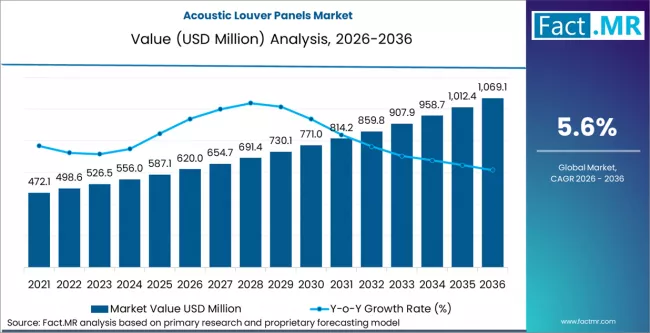
Acoustic Louver Panels Market Market Value Analysis | Source: Fact.MR
Acoustic Louver Panels Market Definition
The acoustic louver panels market involves the production and sale of architectural panels designed to permit airflow while reducing sound transmission. These panels combine louvered structures with sound‑absorbing or blocking materials to control noise in ventilated spaces. Their primary function is to provide ventilation and acoustic mitigation in buildings and infrastructure. Key end uses include commercial buildings, industrial facilities, data centers, transportation terminals, and HVAC systems where airflow and noise control are required.
Market Inclusions
This report covers global and regional market sizes for acoustic louver panels across a defined forecast period. It includes segment breakdowns by product type (metal louver panels, fiberglass louver panels, composite systems), application (facades, mechanical rooms, duct openings), and end user. Pricing trends, raw material supply, and trade flow analysis are also provided to reflect market dynamics.
Market Exclusions
The scope excludes standard louvers without acoustic features and unrelated building materials like solid doors, windows, or non‑acoustic partitions. It omits other noise‑control products such as acoustic baffles, ceiling clouds, and free‑standing barriers. Niche louvers used exclusively in specialized industrial equipment without architectural relevance are not covered.
Research Methodology
- Primary Research: Interviews were conducted with architects, acoustic consultants, HVAC engineers, and panel manufacturers.
- Desk Research: Data was sourced from industry reports, construction statistics, and trade association publications.
- Market‑Sizing and Forecasting: A hybrid approach was used, combining top‑down construction and ventilation market estimates with bottom‑up shipment data.
Data Validation and Update Cycle
Findings were validated by expert review and aligned with recent sales and project data, with periodic updates.
Acoustic Louver Panels Market Summary
Acoustic Louver Panels Market Definition
The acoustic louver panels market refers to the production and sale of specialized panels designed to permit airflow while simultaneously reducing sound transmission in various environments. These panels are used in building ventilation systems, industrial facilities, data centers, and transportation terminals to control noise levels while maintaining air circulation. They incorporate materials such as aluminum, galvanized steel, and stainless steel, and are essential for managing noise in commercial, residential, and industrial applications.
Demand Drivers in the Market
- Urbanization & Infrastructure Development: The increasing focus on noise control in rapidly growing urban areas and infrastructure projects is fueling demand for acoustic louver panels.
- Regulatory Noise Control: Stricter environmental regulations and noise control standards in commercial and industrial settings are encouraging the adoption of soundproofing technologies like acoustic louvers.
- Environmental Noise Pollution Awareness: Heightened awareness of the negative impacts of noise pollution on health and productivity is driving greater use of acoustic louver solutions in various sectors.
Key Segments Analyzed in the FMR Report
- Product Type: Mass Loaded Vinyl (MLV) membranes dominate, with 59% of the market share by 2026. These materials are favored for their ability to effectively attenuate sound while being lightweight and durable.
- Application: Commercial HVAC Systems are projected to account for 49% of the market by 2026, driven by the growing demand for quieter environments in office buildings, shopping malls, and other commercial spaces.
- Material: Aluminum will dominate the market, with 59% of the share by 2026, due to its lightweight properties, corrosion resistance, and acoustic performance.
- Sales Channel: HVAC Contractors and Distributors are critical channels, with 49% of the market share, due to their role in supplying products to contractors and large-scale construction projects.
Analyst Opinion at FMR
Shambhu Nath Jha, Principal Consultant, FactMR suggests that "The acoustic louver panels market is set for steady growth, driven by urbanization, noise regulation enforcement, and the increasing adoption of sustainable building materials. However, cost fluctuations and regulatory challenges may limit growth in certain regions."
Strategic Implications/Executive Takeaways
- Focus on Regulatory Compliance: Prioritize the development of acoustic louver panels that meet evolving building codes and environmental standards.
- Cost-Efficiency vs. Performance: In cost-sensitive regions, balance performance with cost-effective material choices, especially for basic noise control projects.
- Leverage Distribution Networks: Strengthen ties with HVAC contractors and building material distributors to optimize product reach across diverse regions.
Methodology
- Primary Research: Interviews were conducted with industry experts including architects, HVAC engineers, and panel manufacturers.
- Desk Research: Public data from construction reports, trade association publications, and noise control standards were analyzed.
- Market Sizing and Forecasting: A hybrid model combining top-down construction demand estimates with bottom-up shipment data was employed for forecast accuracy.
Segmental Analysis
Acoustic Louver Panels Market Analysis by Material
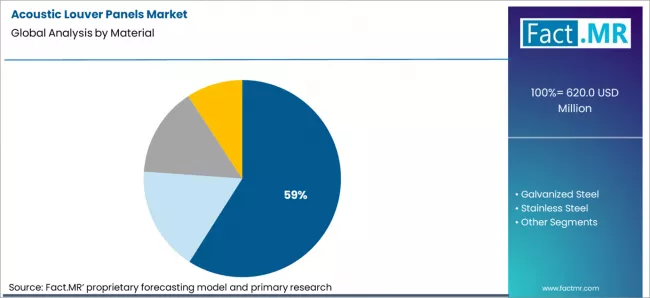
Acoustic Louver Panels Market Analysis By Material | Source: Fact.MR
- Market Overview: Aluminum is expected to capture 59% of the acoustic louver panels market by 2026. Aluminum's lightweight, corrosion-resistant properties, combined with its ability to effectively reduce sound transmission, make it the preferred material for acoustic louver panels. These panels are widely used in various noise control applications due to aluminum's versatility, ease of fabrication, and durability.
- Demand Drivers:
- Corrosion Resistance and Durability: Aluminum is highly resistant to corrosion, which makes it ideal for use in outdoor and industrial environments where exposure to the elements is common. This property drives its preference in applications like HVAC systems and industrial facilities.
- Lightweight and Ease of Installation: Aluminum’s light weight and ease of handling make it a cost-effective choice for acoustic louver panels, especially in large-scale installations where ease of installation is crucial.
- Aesthetic and Design Flexibility: Aluminum can be easily molded into different shapes and finishes, offering both functional and aesthetic advantages for architectural applications in commercial and industrial settings.
Acoustic Louver Panels Market Analysis by Application
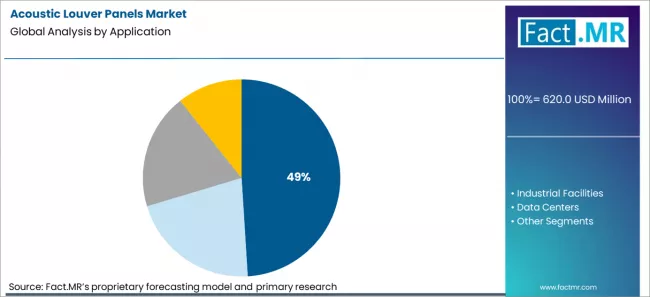
Acoustic Louver Panels Market Analysis By Application | Source: Fact.MR
- Market Overview: Commercial HVAC systems are projected to account for 49% of the market share by 2026. Acoustic louver panels are an essential component in commercial HVAC systems, as they help control noise levels in ventilation systems, ensuring a quieter and more comfortable environment in office buildings, shopping malls, and other commercial spaces.
- Demand Drivers:
- Rising Demand for Quiet Indoor Environments: As noise pollution concerns increase in commercial buildings, the demand for HVAC systems that operate quietly is also growing. Acoustic louver panels play a vital role in reducing noise emissions from air handling units and duct systems.
- Regulatory Standards and Compliance: Many regions have noise control regulations for commercial buildings, which require the integration of soundproofing solutions like acoustic louvers in HVAC systems. This regulatory push is further driving the demand for these panels.
- Energy Efficiency and Comfort: Modern HVAC systems are being designed not only for energy efficiency but also to improve indoor air quality and comfort. Acoustic louver panels contribute to this goal by reducing noise without compromising the system's performance.
Acoustic Louver Panels Market Drivers, Restraints, and Opportunities
FMR analysts observe that the acoustic louver panels market is a mature, performance‑oriented segment within architectural and industrial noise control. Historically, standard louvers focused on airflow and weather protection with little regard for sound attenuation; as noise criteria in buildings, HVAC systems, and industrial facilities tightened, demand emerged for louvers that combine airflow performance with acoustic attenuation. The 2026 valuation reflects this structural reality, tied to ongoing construction, retrofit activities, and regulatory mandates for indoor environmental quality that include measurable noise limits.
While demand for basic louvers with minimal acoustic properties remains substantial in cost‑led projects, higher‑performance acoustic louver panels with engineered sound attenuation are gaining share. These advanced panels command higher per‑unit prices, contributing to net value growth even as overall unit volumes align with broader construction and retrofit cycles. The market exists at its current size because measurable acoustic performance is increasingly specified in codes and design standards where occupant comfort and regulatory compliance matter.
- Acoustic Performance Demand: Designers and facility operators are prioritizing noise control in HVAC and facade systems, boosting adoption of louver panels that reduce sound transmission without sacrificing airflow.
- Regulatory Noise Standards: Building codes and standards such as ASHRAE ventilation criteria and local indoor environmental quality mandates are encouraging use of certified acoustic louver solutions that meet defined sound attenuation requirements.
- Regional Specification Trends: In North America and Europe, stringent indoor noise and ventilation codes drive higher uptake of acoustic louver panels, while in some Asia‑Pacific markets basic airflow‑focused louvers still hold volume share.
Regional Analysis
The market analysis covers key global regions, including South Asia and Pacific, Middle East & Africa, North America, Latin America, and Western Europe. It is segmented geographically, with specific market dynamics for each region. The full report provides a detailed market attractiveness analysis.
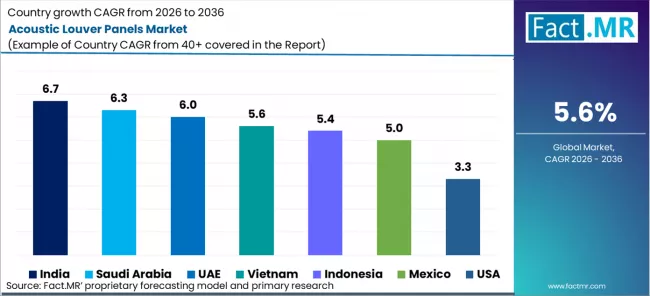
Acoustic Louver Panels Market Cagr Analysis By Country | Source: Fact.MR
| Country | CAGR (2026-2036) |
|---|---|
| India | 6.7% |
| Saudi Arabia | 6.3% |
| UAE | 6.0% |
| Vietnam | 5.6% |
| Indonesia | 5.4% |
| Mexico | 5.0% |
| USA | 3.3% |
| Germany | 2.8% |
Source: Fact.MR analysis. Updated Feb 17, 2026
Source: Fact MR (FMR) analysis, based on proprietary forecasting model and primary research.
South Asia and Pacific:
South Asia and Pacific represent a "growing market" for acoustic louver panels, driven by rapid urbanization and an increasing demand for noise control solutions in construction and infrastructure projects.
- India: Demand for acoustic louver panels in India is projected to rise at 6.7% CAGR through 2036. The expansion of urban areas and rising awareness of noise pollution in both residential and commercial buildings contribute to significant market growth.
- Vietnam: Demand for acoustic louver panels in Vietnam is projected to rise at 5.6% CAGR through 2036. Urban growth and an increasing need for soundproofing solutions in buildings continue to drive the demand for these panels in Vietnam.
- Indonesia: Demand for acoustic louver panels in Indonesia is projected to rise at 5.4% CAGR through 2036. Increased demand for noise control in commercial and residential sectors is driving growth in the market as the country focuses on modernizing its infrastructure.
Middle East & Africa:
The Middle East, especially countries like Saudi Arabia and the UAE, continues to be a "key region for acoustic solutions," with rapid urbanization and growing demand for high-quality construction products.
- Saudi Arabia: Demand for acoustic louver panels in Saudi Arabia is projected to rise at 6.3% CAGR through 2036. The ongoing infrastructure development and a strong focus on urban development projects contribute to the market's growth.
- UAE: Demand for acoustic louver panels in the UAE is projected to rise at 6.0% CAGR through 2036. The UAE’s strong real estate market and emphasis on high-quality construction lead to increased demand for noise-reducing solutions like acoustic louver panels.
Latin America:
In Latin America, particularly in Mexico, the market for acoustic louver panels is growing due to increasing construction activity and a focus on improving building acoustics.
- Mexico: Demand for acoustic louver panels in Mexico is projected to rise at 5.0% CAGR through 2036. The country’s growing construction sector and rising awareness of noise control in buildings continue to contribute to the market’s growth.
North America:
The USA remains a significant market for acoustic louver panels, driven by the growing demand for noise-reduction technologies in commercial and residential spaces.
- USA: Demand for acoustic louver panels in the U.S. is projected to rise at 3.3% CAGR through 2036. Rising commercial and residential building activity and an increased focus on energy-efficient building solutions support market growth.
Western Europe:
Germany represents a "mature market" for acoustic louver panels, with a steady demand driven by regulatory requirements for noise control in construction and urban planning.
- Germany: Demand for acoustic louver panels in Germany is projected to rise at 2.8% CAGR through 2036. Germany’s stringent regulations regarding noise reduction in building projects and the growing demand for sustainable construction solutions support steady market growth.
Fact MR's analysis of the Acoustic Louver Panels Market in South Asia and Pacific, Middle East & Africa, North America, Latin America, and Western Europe consists of country-wise assessments that include India, Saudi Arabia, UAE, Vietnam, Indonesia, Mexico, the United States, and Germany. Readers can find detailed trends, regulatory updates, and company-specific investments shaping the market’s growth in these countries.
How Are Key Players Competing in the Acoustic Louver Panels Market?
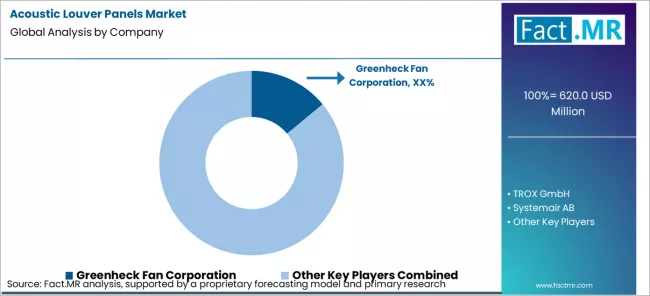
Acoustic Louver Panels Market Analysis By Company | Source: Fact.MR
In the acoustic louver panels market, leading companies like Greenheck Fan Corporation, TROX GmbH, and Systemair AB are focusing on providing advanced solutions for noise reduction and air distribution in industrial and commercial applications. FläktGroup Holding GmbH and Johnson Controls International plc (with its Ruskin brand) prioritize energy-efficient and acoustically optimized louver systems. Price Industries Limited, Halton Group, and Lindab International AB differentiate themselves through high-performance panels that meet regulatory standards while offering customization for specific noise control needs. Nailor Industries Inc. targets the North American market with robust and reliable louver solutions that cater to both aesthetic and acoustic performance. These companies are leveraging innovative designs and materials to meet the growing demand for sound control in HVAC systems.
Recent Industry Developments
- Product launch - Soundcoat QuietFlow Acoustic Louvers System (Announced May 5, 2025): Soundcoat debuted its QuietFlow Acoustic Louvers System using fire-resistant, 3D-cut melamine foam to reduce fan noise while maintaining airflow efficiency.
- Product launch - Feature-Tec FTACL-101 / FTACL-102 Acoustic Louvers (Published Jan 21, 2026): Feature-Tec announced its self-developed FTACL-101 and FTACL-102 Acoustic Louvers for inlet/exhaust noise reduction applications in power generation and building exhaust systems.
- Patent - Acoustic blinds with angled blades forming an acoustic-screen-like system (Published Jan 3, 2024): This patent publication discloses acoustic blinds whose blades are angled to form a system similar to an acoustic barrier wall, using mineral wool fill and metal mesh closure.
Key Players of the Acoustic Louver Panels Market
- Greenheck Fan Corporation
- TROX GmbH
- Systemair AB
- FläktGroup Holding GmbH
- Johnson Controls International plc
- Price Industries Limited
- Halton Group
- Lindab International AB
- Nailor Industries Inc.
Report Scope
| Metric | Value |
|---|---|
| Quantitative Units | USD 620 million (2026) to USD 1,069 million (2036), at a CAGR of 5.6% |
| Market Definition | The Acoustic Louver Panels Market includes products designed to reduce noise levels in HVAC systems, industrial facilities, and other environments, providing soundproofing while maintaining air flow. |
| By Louver Type | Acoustic Intake Louvers, Acoustic Exhaust Louvers, Combination Weather + Acoustic Louvers, Other |
| By Application | Commercial HVAC Systems, Industrial Facilities, Data Centers, Others |
| By Material | Aluminum, Galvanized Steel, Stainless Steel, Other |
| By Sales Channel | HVAC Contractors, Direct OEM Sales, Distributors, Other |
| Regions Covered | North America, Latin America, Europe, East Asia, South Asia, Oceania, Middle East and Africa |
| Countries Covered | United States, Canada, Mexico, Brazil, Argentina, Germany, France, United Kingdom, Italy, Spain, China, India, Japan, South Korea, Indonesia, Australia, and 40+ countries |
| Key Companies Profiled | Greenheck Fan Corporation, TROX GmbH, Systemair AB, FläktGroup Holding GmbH, Johnson Controls International plc (Ruskin is a brand/business unit), Price Industries Limited, Halton Group, Lindab International AB, Nailor Industries Inc. |
| Forecast Period | 2026 to 2036 |
| Approach | Hybrid top-down and bottom-up market modeling validated through primary interviews with manufacturers and supported by trade data benchmarking and market research. |
Source: Fact.MR analysis. Updated Feb 17, 2026
Bibliographies
- Product Launch - Soundcoat QuietFlow Acoustic Louvers System: Soundcoat. (2025, May 5). Soundcoat launches QuietFlow Acoustic Louvers System. Soundcoat. [1]
- Product Launch - Feature-Tec FTACL-101 / FTACL-102 Acoustic Louvers: Feature-Tec. (2026, January 21). Feature-Tec announces FTACL-101 and FTACL-102 Acoustic Louvers. Feature-Tec. [2]
- Patent - Acoustic Blinds with Angled Blades Forming an Acoustic-Screen-Like System: U.S. Patent No. PL130881U1. (2024, January 3). Acoustic blinds with angled blades forming an acoustic-screen-like system. Google Patents. [3]
Segmentation
Acoustic Louver Panels Market Key Segments
-
By Louver Type :
- Acoustic Intake Louvers
- Acoustic Exhaust Louvers
- Combination Weather + Acoustic Louvers
- Other
-
By Application :
- Commercial HVAC Systems
- Industrial Facilities
- Data Centers
- Others
-
By Material :
- Aluminum
- Galvanized Steel
- Stainless Steel
- Other
-
By Sales Channel :
- HVAC Contractors
- Direct OEM Sales
- Distributors
- Other
-
Region :
- North America
- USA
- Canada
- Mexico
- Europe
- Germany
- UK
- France
- Italy
- Spain
- Nordic Countries
- BENELUX
- Rest of Europe
- Asia Pacific
- China
- Japan
- South Korea
- India
- Australia
- Rest of Asia Pacific
- Latin America
- Brazil
- Argentina
- Rest of Latin America
- Middle East and Africa
- Kingdom of Saudi Arabia
- United Arab Emirates
- South Africa
- Rest of Middle East and Africa
- Other Regions
- Oceania
- Central Asia
- Other Markets
- North America
Frequently Asked Questions
How large is the demand for Acoustic Louver Panels in the global market in 2026?
What will be the market size of Acoustic Louver Panels in the global market by 2036?
What is the expected demand growth for Acoustic Louver Panels in the global market between 2026 and 2036?
Which material is expected to dominate the market?
Which region is expected to show the highest growth rate for Acoustic Louver Panels?
How significant is the growth outlook for Saudi Arabia in this market?
What is the growth outlook for the United States in this report?
What is the growth forecast for Germany in the Acoustic Louver Panels market?
Which company is identified as a leading player in the Acoustic Louver Panels market?
What are Acoustic Louver Panels used for?
What does the Acoustic Louver Panels market include in this report?
How is the market forecast developed in this report?
What is meant by the Acoustic Louver Panels market in this report?
Who worked on this report


Preview the report firsthand - request a free sample
Free SampleGet the brochure for pricing and purchase details
Download PDF