- Market Value (2025): USD 3.17 Bn
- Estimated Value (2026): USD 3.37 Bn
- Forecast Value (2036): USD 6.3 Bn
- CAGR (2026-2036): 6.5%
What is the Topical Hemostatic Agents Market forecast to be worth by 2036?
USD 3.4 billion in 2026 to USD 6.3 billion by 2036, with a reported 6.5% CAGR.
- The topical hemostatic agents market reached USD 3.17 billion in 2025.
- Revenue is expected to increase from USD 3.37 billion in 2026 to USD 6.3 billion by 2036 as surgical teams use materials suited to particular bleeding conditions.
- A 6.5% CAGR across 2026 to 2036 reflects hospital surgical use alongside wider access to suitable outpatient procedures.
| Year | Basis | Market Value (USD billion) |
|---|---|---|
| 2025 | Actual | 3.17 |
| 2026 | Estimate | 3.37 |
| 2036 | Forecast | 6.3 |
| CAGR 2026 to 2036 | Forecast period | 6.5% |
Source: Fact.MR analysis. Updated Nov 10, 2026
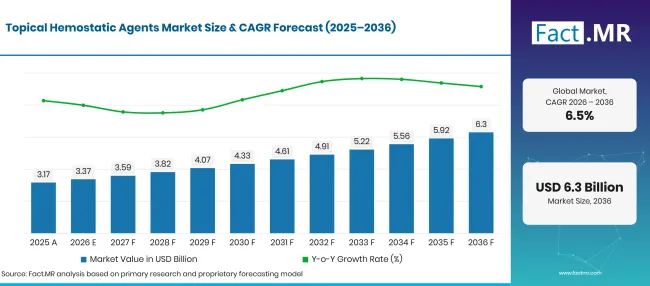
Topical Hemostatic Agents Market Forecast Global | Source: Fact.MR
What are the defining numbers behind Topical Hemostatic Agents Market growth?
The projected increase is USD 2.9 billion between 2026 and 2036.
- Demand Drivers in the Market
- Surgeons may need a topical hemostat when diffuse bleeding is difficult to manage with sutures or clips alone. The appropriate material depends on the intensity of bleeding, access to the tissue and whether the product can be applied in the intended surgical setting.
- Hospitals keep a range of sterile hemostatic products available because planned procedures and urgent operations can create different bleeding-control needs. Clinical teams select each product according to the approved instructions, while supply teams plan stock around the procedures performed most often.
- Outpatient surgeons work within the covered-procedure framework updated by CMS for 2026.
- Access to the bleeding site affects whether a sheet, sponge, powder or flowable material is practical. Clinicians also review the individual device instructions, since preparation methods and permitted uses differ across products.
- Purchasing teams review storage requirements and packaging alongside per-case use. Products requiring little preparation may suit different surgical workflows from agents that need mixing or assembly.
- Key Segments Analyzed
- By Product Type: Gelatin-Based is projected to hold 32.5% share in 2026 due to its familiar sponge and matrix forms for surgical bleeding control.
- By Application: Surgical Wound Care is forecast to represent 58.2% share in 2026 as surgeons address bleeding arising during tissue dissection and closure.
- By End-User: Hospitals are estimated to account for 61.3% share in 2026 because operating theaters handle a wide range of procedures and maintain dedicated surgical stocks.
- Analyst Opinion at Fact.MR
- Shambhu Nath Jha, Principal Consultant at Fact.MR, states, “Surgeons judge a topical hemostat by how well its form suits the tissue and bleeding conditions encountered during an operation. Handling, approved indications and dependable stock availability can matter as much as the cost of an individual pack.”
- Strategic Implications
- Manufacturers should make product instructions easy to compare across sheets, powders and absorbable matrices so operating-room teams can select products for the intended use.
- Hospital buyers should assess pack sizes against actual procedure needs, especially where opening unused material increases waste and procedure cost.
- Surgical center managers should review approved indications before adding new products to standardized supply lists for elective procedures.
- Distributors should maintain dependable stock levels for common formulations and separate specialist items according to clinical handling requirements.
The United Kingdom is forecast to record a 7.8% CAGR, followed by Japan at 6.2% and Brazil at 5.4%. Germany is projected to advance at 5.0%, while the United States records a 4.6% CAGR. Hospitals and surgical centers follow different purchasing arrangements across countries.
How does the Topical Hemostatic Agents Market break down by segment?
Gelatin-Based leads Product Type at 32.5%; Surgical Wound Care leads Application at 58.2%; Hospitals lead End-User at 61.3%.
Which Product Type dominates?
Gelatin-Based accounts for 32.5% of 2026 value.
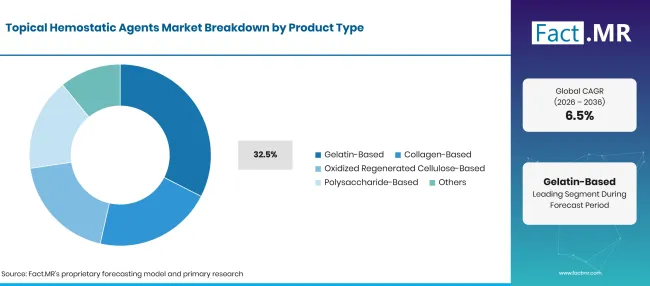
Topical Hemostatic Agents Market Breakdown Product Type | Source: Fact.MR
| Product Type | Share (2026) |
|---|---|
| Gelatin-Based (Leading segment) | 32.5% |
| Other segments combined | 67.5% |
| Total | 100.0% |
Source: Fact.MR analysis. Updated Nov 10, 2026
Gelatin sponges and matrices give surgical teams an absorbable material for local bleeding control. Collagen-based products offer another surface that supports clot formation. Oxidized regenerated cellulose sheets can cover irregular tissue sites. Polysaccharide powders are suited to defined applications where a dry agent is appropriate. Clinicians review approved indications and preparation steps before choosing a product.
What leads the Application segment?
Surgical Wound Care represents 58.2% of 2026 sales.
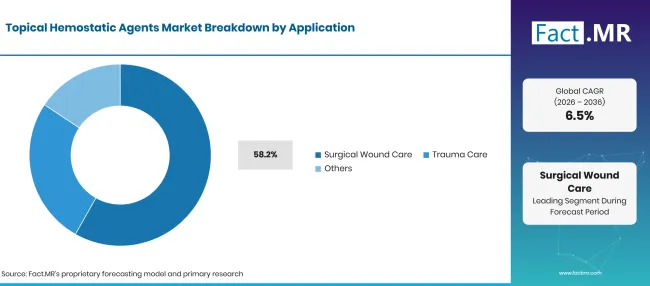
Topical Hemostatic Agents Market Breakdown Application | Source: Fact.MR
| Application | Share (2026) |
|---|---|
| Surgical Wound Care (Leading segment) | 58.2% |
| Other segments combined | 41.8% |
| Total | 100.0% |
Source: Fact.MR analysis. Updated Nov 10, 2026
Surgical wound care covers bleeding control during open and minimally invasive procedures, where a surgeon may choose a sheet for a broad surface or a matrix for a more confined area. Trauma care introduces different operating conditions and bleeding patterns. Hospitals maintain products suited to the procedures they perform instead of relying on a single formulation for every case.
How does End-User shape demand?
Hospitals make up 61.3% of 2026 demand.
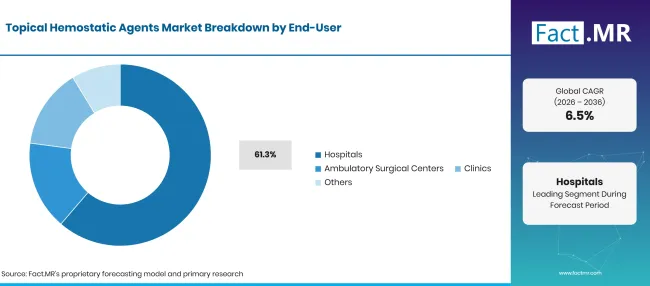
Topical Hemostatic Agents Market Breakdown End User | Source: Fact.MR
| End-User | Share (2026) |
|---|---|
| Hospitals (Leading segment) | 61.3% |
| Other segments combined | 38.7% |
| Total | 100.0% |
Source: Fact.MR analysis. Updated Nov 10, 2026
Hospitals use hemostatic agents across surgical specialties and usually approve their use through clinical review. Ambulatory centers stock products that match the procedures they routinely perform. Clinics use an adjunctive hemostat only when their work and approved instructions make it appropriate. Hospitals are forecast to retain the 61.3% end-user share in 2026, reflecting their wider procedural mix. Fibrin sealants form a related but distinct category.
What is accelerating Topical Hemostatic Agents Market adoption, and what is holding it back?
Surgical wound demand and procedural access are expected to support adoption. Product indication limits and operating-room budgets remain relevant.
Drivers Impact Analysis
| DRIVER | % IMPACT ON CAGR | GEOGRAPHIC RELEVANCE | IMPACT TIMELINE |
|---|---|---|---|
| Use in surgical wound care | +1.2% | Global | Short term |
| Outpatient procedure access | +0.9% | United States; UK | Medium term |
| Better handling in confined sites | +0.7% | Global | Medium term |
| Operating-room product standardization | +0.5% | Germany; Japan; USA | Medium term |
| Trauma surgery readiness | +0.3% | Global | Long term |
Source: Fact.MR analysis. Updated Nov 10, 2026
Opportunity Impact Analysis
| OPPORTUNITY | % IMPACT ON CAGR | GEOGRAPHIC RELEVANCE | IMPACT TIMELINE |
|---|---|---|---|
| Tailored powders for accessible sites | +0.7% | Global | Medium term |
| Day-surgery supply packs | +0.5% | USA; UK | Medium term |
| Clinical training and product selection | +0.4% | Germany; Japan | Long term |
| More consistent distributor supply | +0.3% | Brazil; Global | Medium term |
Source: Fact.MR analysis. Updated Nov 10, 2026
Restraints Impact Analysis
| RESTRAINT | % IMPACT ON CAGR | GEOGRAPHIC RELEVANCE | IMPACT TIMELINE |
|---|---|---|---|
| Application and tissue restrictions | -0.8% | Global | Short term |
| Hospital budget scrutiny | -0.6% | USA; UK; Brazil | Medium term |
| Surgeon training requirements | -0.4% | Global | Medium term |
| Supply and storage constraints | -0.3% | Global | Long term |
Source: Fact.MR analysis. Updated Nov 10, 2026
Which countries are scaling the Topical Hemostatic Agents Market through 2036?
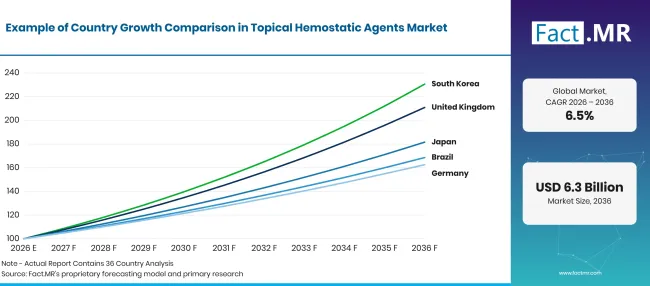
Topical Hemostatic Agents Market Growth Index | Source: Fact.MR
| Country | CAGR (2026 to 2036) |
|---|---|
| UK | 7.8% |
| Japan | 6.2% |
| Brazil | 5.4% |
| Germany | 5.0% |
| USA | 4.6% |
Source: Fact.MR analysis. Updated Nov 10, 2026
How is the United Kingdom developing demand?
7.8% CAGR, influenced by elective-care access and surgical supply planning.
The United Kingdom is forecast to grow at 7.8% CAGR as hospitals work through planned surgical cases and manage the materials used across operating rooms. NHS England reported in April 2025 that services delivered 3,106,424 additional elective operations, outpatient appointments and diagnostic tests from July 2024 to January 2025 [2]. Stock planning becomes more demanding when case dates change. NHS England reported 7.2 million referral-to-treatment pathways awaiting treatment at the end of February 2026 [3].
How is Japan scaling demand?
6.2% CAGR, linked to aging-related surgical needs and product-specific assessment.
Japan is projected to advance at 6.2% CAGR, with surgical teams placing careful weight on product handling for older patients and specialist operations. The Statistics Bureau reported in September 2026 that people aged at least 65 represented 29.6% of the population [4]. Gelatin sponges and oxidized cellulose sheets have different handling characteristics, so clinicians assess them for the operation in question.
How is Brazil developing surgical hemostat demand?
5.4% CAGR, shaped by public surgical activity and reliable material supply.
Brazil is forecast to record 5.4% CAGR as public hospitals manage substantial surgical activity and plan supplies for recurring operating lists. Brazil’s federal government reported on September 30, 2026, that the Unified Health System completed more than 7.5 million elective surgeries in the first half of 2026, up 8% from the corresponding period of 2025 [6]. Public hospitals are expected to compare absorbable materials by use and shelf life.
What supports Germany’s adoption?
5.0% CAGR, tied to hospital procedure mix and careful device selection.
Germany is expected to grow at 5.0% CAGR because surgical departments evaluate hemostatic agents alongside established operating-room practices. Destatis reported in October 2026 that hospitals treated 17.7 million inpatients during 2025 [5]. German clinical teams select absorbable sheets or matrices according to the bleeding surface and the product’s approved uses.
What is supporting United States adoption?
4.6% CAGR, connected to a broad surgical network and outpatient care.
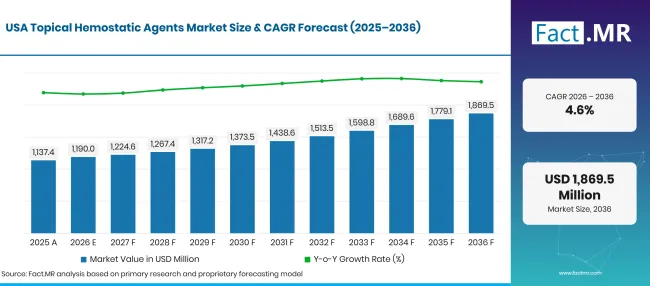
Topical Hemostatic Agents Market Forecast Usa | Source: Fact.MR
The United States is forecast to grow at 4.6% CAGR, supported by a broad surgical network spanning hospitals and ambulatory surgical centers. Topical hemostatic agents are used across varied procedures, while separate inpatient and outpatient purchasing channels help maintain demand across different surgical settings and care environments.
Who leads the Topical Hemostatic Agents Market?
Competitive positioning depends on product type and clinical indication. Johnson & Johnson markets oxidized regenerated cellulose hemostats through Ethicon, while Baxter has an established FLOSEAL portfolio.
BD offers the Arista AH polysaccharide powder and Pfizer lists GELFOAM gelatin sponge. Medtronic supplies hemostatic products for defined surgical settings. B. Braun and Integra LifeSciences have surgical product lines that include materials used in bleeding management.
Which companies are the key providers?
Key companies include Hemostasis LLC; Johnson & Johnson; Baxter International Inc.; Pfizer Inc.; B. Braun Melsungen AG; Integra LifeSciences Corporation; Becton, Dickinson and Company; CSL Behring; Medtronic plc.
- Hemostasis LLC
- Johnson & Johnson
- Baxter International Inc.
- Pfizer Inc.
- B. Braun Melsungen AG
- Integra LifeSciences Corporation
- Becton, Dickinson and Company
- CSL Behring
- Medtronic plc
Bibliography
- [1] Centers for Medicare & Medicaid Services. (2025, November 21). Calendar Year 2026 Hospital Outpatient Prospective Payment System (OPPS) and Ambulatory Surgical Center Final Rule (CMS-1834-FC).
- [2] NHS England. (2025, April 10). Over three million additional appointments delivered as NHS exceeds faster diagnosis standard for cancer.
- [3] NHS England. (2026, April 16). NHS referral to treatment (RTT) waiting times data: February 2026.
- [4] Statistics Bureau of Japan. (2026, September 20). Statistical Topics No. 149: Statistics on Older Persons in Japan.
- [5] Statistisches Bundesamt (Destatis). (2026, October 28). 1,2 % mehr Krankenhausbehandlungen im Jahr 2025.
- [6] Secretaria de Comunicação Social, Governo do Brasil. (2026, September 30). Brasil realiza mais de 7,5 milhões de cirurgias eletivas no SUS no primeiro semestre, 8% a mais do que em 2025.
This Report Answers
- The analysis distinguishes gelatin, collagen, cellulose and polysaccharide hemostats by product properties and surgical handling.
- Application analysis explains why surgical wound care accounts for the larger share of market value.
- End-user analysis compares operating-room requirements in hospitals with the narrower procedural mix of ambulatory centers.
- Country outlooks examine surgical system conditions in the UK, Japan, Brazil, Germany and the USA.
- Competitive coverage reviews established medical suppliers and the product evidence needed for meaningful comparisons.
What does the Topical Hemostatic Agents Market cover?
Topical agents assist clinicians in controlling bleeding at surgical surfaces. Covered formats include absorbable sponges, sheets, powders and matrices. Each product is used within its approved indications. Topical hemostat coverage examines alternative product categories.
What is included in the scope?
The analysis covers gelatin, collagen, oxidized regenerated cellulose and polysaccharide hemostats.
It includes hospitals, surgical centers, clinics and suitable trauma care.
What is excluded from the scope?
Systemic medicines affecting clotting are excluded.
General dressings without hemostatic indications and devices used only for vessel closure are also outside the scope. Separate surgical sealants and adhesives products form an adjacent medical-device category.
How Was the Analysis Built?
The analysis draws on 120+ sources, 35+ company portfolios, 25+ countries, and more than 20 industry interviews.
- Primary Research: Primary research includes discussions with manufacturers, service providers, technology developers, distributors, end users, and subject-matter experts. These conversations examine purchasing priorities, product adoption, operational challenges, approval requirements, competitive positioning, and the factors that influence wider market acceptance.
- Desk Research: Desk research covers government statistics, regulatory publications, company filings, trade data, technical studies, industry associations, standards, public policy, and other authoritative sources. Every source used in the analysis is documented in the bibliography.
- Market Sizing and Forecasting: Market estimates combine historical performance, demand indicators, pricing and volume trends, segment shares, company participation, country-level growth, adoption patterns, investment activity, and barriers to market expansion.
- Data Validation and Update Cycle: Findings are validated by comparing primary interviews with public data, company activity, regulatory changes, trade patterns, and industry developments. Regular updates review new product launches, capacity changes, partnerships, approvals, and shifts in commercial adoption.
Segmentation
What is the report’s scope and coverage?
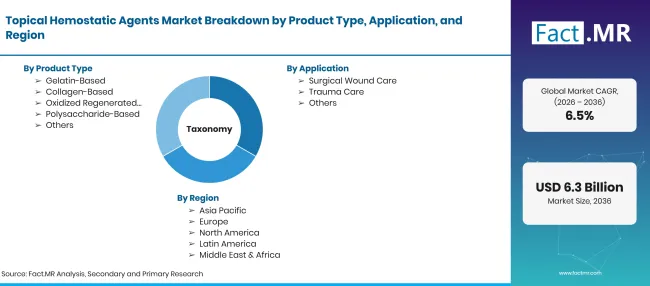
Topical Hemostatic Agents Market Taxonomy | Source: Fact.MR
| Attribute | Details |
|---|---|
| Quantitative Units | USD billion |
| Market Definition | Topically applied absorbable materials used as adjuncts to bleeding control during surgery and appropriate trauma care. |
| Product Type | Gelatin-Based; Collagen-Based; Oxidized Regenerated Cellulose-Based; Polysaccharide-Based; Others |
| Application | Surgical Wound Care; Trauma Care |
| End-User | Hospitals; Ambulatory Surgical Centers; Clinics; Others |
| Regions Covered | North America; Latin America; Western Europe; Eastern Europe; East Asia; South Asia & Pacific; Middle East & Africa |
| Countries Covered | UK; Japan; Brazil; Germany; USA |
| Companies Profiled | Hemostasis LLC; Johnson & Johnson; Baxter International Inc.; Pfizer Inc.; B. Braun Melsungen AG; Integra LifeSciences Corporation; Becton, Dickinson and Company; CSL Behring; Medtronic plc |
| Forecast Period | 2026 to 2036 |
| Approach | Comparison of end-user settings and product use, with official healthcare activity data and product-level descriptions. |
Source: Fact.MR analysis. Updated Nov 10, 2026
How is the market segmented?
-
By Product Type
- Gelatin-Based
- Collagen-Based
- Oxidized Regenerated Cellulose-Based
- Polysaccharide-Based
- Others
-
By Application
- Surgical Wound Care
- Trauma Care
-
By End-User
- Hospitals
- Ambulatory Surgical Centers
- Clinics
- Others
-
By Region
- North America
- Latin America
- Western Europe
- Eastern Europe
- East Asia
- South Asia & Pacific
- Middle East & Africa
Frequently Asked Questions
How big is the topical hemostatic agents market in 2026?
What CAGR applies to the topical hemostatic agents market?
Which product type has the largest share?
Which application leads the market?
Which end-user segment represents the largest share?
Which country has the highest forecast growth?
Which firms supply topical hemostatic agents?
Who worked on this report


Preview the report firsthand - request a free sample
Free SampleGet the brochure for pricing and purchase details
Download PDF