- Base Value(2025): 1.3 Bn
- Estimated Value(2026): 1.4 Bn
- Forecast Value (2036): 2.8 Bn
- CAGR (2026 - 2036): 6.8%
Acoustic Membranes Market Forecast 2026 to 2036
In 2025, the acoustic membranes market was valued at USD 1.3 billion. Based on Fact MR's analysis, demand for acoustic membranes is estimated to grow to USD 1.4 billion in 2026 and USD 2.8 billion by 2036. FMR projects a CAGR of 6.8% during the forecast period.
The absolute dollar growth from 2026 to 2036 is USD 1.4 billion. This significant growth is driven by rising demand for noise-reducing solutions across industries, including construction, automotive, and consumer electronics. The market's expansion is supported by growing urbanization, heightened awareness of noise pollution, and regulatory requirements. However, growth may face challenges due to material costs, production complexities, and regional regulatory constraints.
India leads with a CAGR of 8.4%, driven by rapid urbanization and infrastructure development. Vietnam follows with a 7.9% CAGR, supported by the growing demand for soundproofing solutions. Indonesia, with a 7.6% CAGR, benefits from increasing infrastructure projects and noise control requirements. Saudi Arabia and the UAE show CAGRs of 7.0% and 6.7%, respectively, driven by construction growth and demand for noise management in commercial spaces. Mexico grows at 6.1%, supported by expanding construction and industrial sectors. China grows at 5.6%, reflecting steady demand in the automotive and construction sectors. The USA experiences slower growth at 3.9%, driven by a mature market and existing noise control regulations.
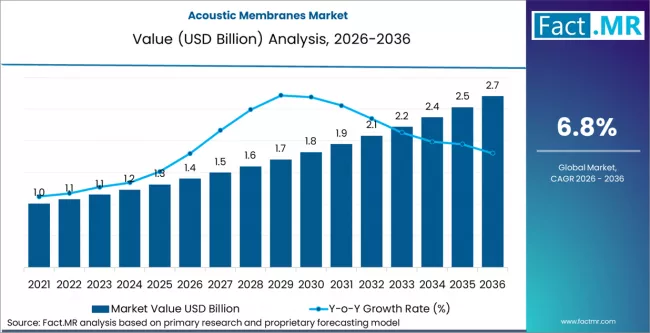
Acoustic Membranes Market Market Value Analysis | Source: Fact.MR
Acoustic Membranes Market Definition
The Acoustic Membranes Market refers to the production and sale of thin, flexible materials engineered to control, block, or absorb sound in building and industrial settings. These membranes are made from polymers, composites, or layered materials that disrupt sound waves and reduce noise transmission through walls, floors, and ceilings. Their primary function is to enhance acoustic performance and comfort. Key end uses include commercial and residential construction, transportation applications (rail, automotive), and industrial facilities requiring noise control.
Market Inclusions
This report covers global and regional market sizes for acoustic membranes with a defined forecast period. It includes segment breakdowns by material type (PVC, rubber, polymer composites), application (flooring underlays, partition liners, ceiling systems, transportation acoustics), and end user. Pricing trends, raw material supply, and trade flow data are also analyzed to capture comprehensive market dynamics.
Market Exclusions
The scope excludes unrelated sound‑control products such as acoustic foam panels, fabric absorbers, and standalone insulation batts. Finished architectural systems like acoustic wall panels or ceiling grids are not covered. Niche vibration isolation products used solely in machinery or equipment mounts are omitted to focus strictly on sound‑transmission membranes.
Research Methodology
- Primary Research: Interviews were conducted with product engineers, procurement specialists, acoustic consultants, and manufacturers.
- Desk Research: Public data was sourced from industry reports, construction statistics, and trade association publications.
- Market‑Sizing and Forecasting: A hybrid model was used, combining top‑down construction and noise‑control material demand with bottom‑up shipment data.
Data Validation and Update Cycle
Findings were validated through expert review and aligned with recent sales and project data, with periodic updates.
Acoustic Membranes Market Summary
Acoustic Membranes Market Definition
The Acoustic Membranes Market refers to the production and sale of thin, flexible materials designed to reduce sound transmission in buildings and industrial settings. These membranes use materials like polymers, composites, or layered substances to block, absorb, or dampen sound waves, enhancing acoustic comfort. Key applications include commercial and residential construction, automotive, and industrial sectors where noise control is essential.
Demand Drivers in the Market
- Urbanization and Construction Growth: The market sees rising demand from rapid urbanization and increased infrastructure development, particularly in emerging economies.
- Noise Pollution Concerns: Growing awareness of environmental noise pollution and its negative impacts is driving demand for soundproofing solutions.
- Regulatory Requirements: Stricter noise control regulations in building codes are forcing industries to adopt advanced acoustic solutions for noise mitigation.
Key Segments Analyzed in the FMR Report
- Product Type: Mass Loaded Vinyl (MLV) membranes are set to dominate the market, holding 51% of the share by 2026 due to their superior soundproofing capabilities and flexibility.
- Installation: Acoustic membranes are mainly used in walls & partitions, floors & underlayment, and ceilings.
- End Use: Commercial construction holds a major portion of the market, with increasing demand for noise control in offices, meeting rooms, and other commercial spaces.
- Sales Channel: Building material distributors are expected to account for 49% of market share, playing a crucial role in product distribution.
Analyst Opinion at FMR
Fact MR analyst, Shambhu Nath Jha, Principal Consultant suggests that "The acoustic membranes market is expected to grow significantly, driven by increased construction activities, urbanization, and demand for noise reduction in both residential and commercial buildings. However, material costs and production complexities may pose challenges to growth."
Strategic Implications/Executive Takeaways
- Focus on Performance: Prioritize higher performance acoustic membranes that deliver better noise reduction and meet regulatory standards.
- Cost vs. Quality: In mature markets, balancing cost efficiency with high-quality soundproofing solutions will be key for competing in cost-sensitive regions.
- Leverage Distribution Networks: Strengthen relationships with building material distributors to maximize product reach in the global market.
Methodology
- The analysis is based on primary research from industry experts such as product engineers and acoustic consultants.
- Desk research involved reviewing industry reports, trade associations, and construction statistics.
- Market sizing and forecasts were validated through a hybrid top-down and bottom-up model, integrating both construction demand data and product shipment statistics.
Segmental Analysis
Acoustic Membranes Market Analysis by Product Type
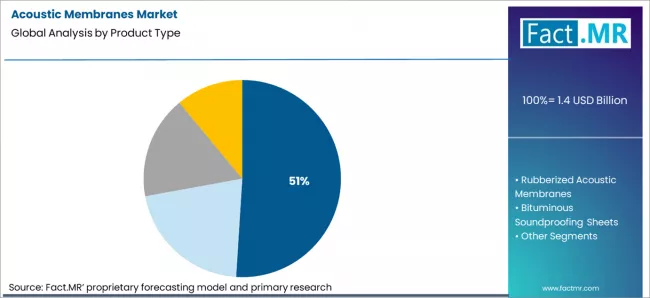
Acoustic Membranes Market Analysis By Product Type | Source: Fact.MR
- Market Overview: Mass Loaded Vinyl (MLV) membranes are expected to hold 51% of the market share by 2026. MLV is widely regarded for its superior soundproofing capabilities, providing effective noise control in both commercial and residential applications. Its flexible, high-density composition makes it ideal for reducing sound transmission through walls, floors, and ceilings.
- Demand Drivers:
- Superior Sound Insulation: MLV membranes are highly effective in blocking airborne sound, making them a preferred choice for noise reduction in residential buildings, offices, and entertainment venues.
- Ease of Installation and Versatility: MLV membranes are easy to install and can be used in a wide range of applications, from new construction projects to retrofitting existing buildings. Their adaptability to various surface types boosts their demand.
- Increasing Noise Pollution Concerns: As urbanization continues to rise, noise pollution becomes an increasingly significant concern. MLV membranes are gaining popularity in efforts to create quieter, more comfortable environments in homes, offices, and public spaces.
Acoustic Membranes Market Analysis by Sales Channel
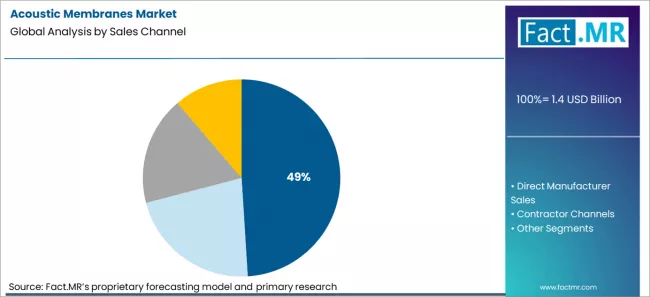
Acoustic Membranes Market Analysis By Sales Channel | Source: Fact.MR
- Market Overview: Building material distributors are projected to account for 49% of the market share by 2026. These distributors play a key role in supplying acoustic membranes to construction companies, contractors, and DIY consumers. Their established networks and extensive reach make them a critical sales channel for acoustic membrane products.
- Demand Drivers:
- Widespread Distribution Network: Building material distributors offer easy access to a wide range of construction and acoustic solutions, making it easier for consumers and contractors to purchase the necessary materials for soundproofing.
- Increased Construction Activity: As construction projects expand globally, the demand for high-quality materials like acoustic membranes to meet noise control regulations rises, driving the role of distributors in supplying these products to the market.
- Cost and Logistics Efficiency: Distributors offer competitive pricing, bulk sales, and logistical support, making them a preferred option for contractors and businesses looking to streamline their procurement of acoustic membranes.
Acoustic Membranes Market Drivers, Restraints, and Opportunities
FMR analysts observe that the acoustic membranes market is a mature, performance‑driven segment within noise control and building acoustics. Historically, basic porous absorbers and panels served many applications, but growing expectations for lower transmission loss in walls, floors, and partitions created structural demand for engineered acoustic membranes. The 2026 valuation reflects this baseline demand tied to global construction, retrofit projects, and industrial noise control, bolstered by measurable sound reduction standards in buildings, studios, and transportation sectors.
While demand for basic partition materials remains large, advanced acoustic membranes with high mass‑law performance and flexible installation are gaining share. These engineered membranes carry higher per‑unit costs, contributing to net market value growth even as overall unit volumes grow with construction and regulatory requirements. The market exists at its current size because measurable acoustic performance is increasingly specified early in design and enforced through standards, making these membranes essential in many applications.
- Performance Specification Trends: As designers and occupants prioritize noise control, demand rises for engineered membranes that deliver higher transmission loss than traditional absorbers.
- Regulatory Standards Influence: Standards such as ISO 717 in building acoustics and local sound insulation codes push adoption of certified acoustic membranes that meet specific isolation criteria, supporting higher pricing.
- Regional Construction Dynamics: In Europe and North America, stringent acoustic and building codes drive greater uptake of advanced membranes, while in some Asia‑Pacific markets cost‑led materials still dominate basic applications.
Regional Analysis
The market analysis covers key global regions, including South Asia and Pacific, Middle East & Africa, North America, Latin America, and East Asia. It is segmented geographically, with specific market dynamics for each region. The full report provides a detailed market attractiveness analysis.
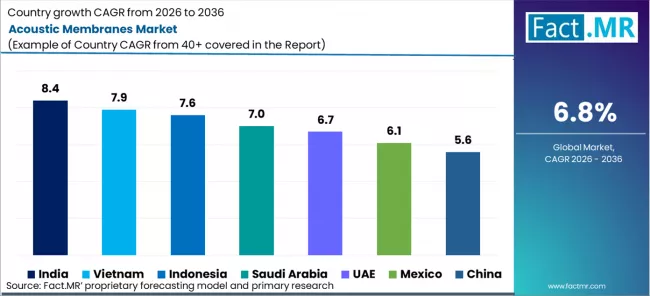
Acoustic Membranes Market Cagr Analysis By Country | Source: Fact.MR
| Country | CAGR (2026-2036) |
|---|---|
| India | 8.4% |
| Vietnam | 7.9% |
| Indonesia | 7.6% |
| Saudi Arabia | 7.0% |
| UAE | 6.7% |
| Mexico | 6.1% |
| China | 5.6% |
| USA | 3.9% |
Source: Fact.MR analysis. Updated Feb 17, 2026
Source: Fact MR (FMR) analysis, based on proprietary forecasting model and primary research.
South Asia and Pacific:
South Asia and Pacific represent a "rapidly growing market" for acoustic membranes, driven by increasing construction activities and the demand for noise control solutions in residential, commercial, and industrial buildings.
- India: Demand for acoustic membranes in India is projected to rise at 8.4% CAGR through 2036. Rapid urbanization and infrastructural development, along with a growing need for soundproofing solutions in commercial spaces, continue to drive the market's expansion.
- Vietnam: Demand for acoustic membranes in Vietnam is projected to rise at 7.9% CAGR through 2036. Urban growth and increased awareness of noise pollution contribute significantly to the demand for acoustic solutions in both commercial and residential buildings.
- Indonesia: Demand for acoustic membranes in Indonesia is projected to rise at 7.6% CAGR through 2036. The expanding construction industry and a growing need for effective soundproofing solutions in urban areas support steady market growth.
Middle East & Africa:
The Middle East and Africa are key regions for the acoustic membranes market, where urban development and noise pollution management are driving demand for advanced soundproofing technologies.
- Saudi Arabia: Demand for acoustic membranes in Saudi Arabia is projected to rise at 7.0% CAGR through 2036. Government-backed urban development projects and a focus on improving building acoustics continue to support market growth.
- UAE: Demand for acoustic membranes in the UAE is projected to rise at 6.7% CAGR through 2036. The UAE's real estate boom and focus on soundproofing solutions in residential and commercial buildings further drive the market forward.
Latin America:
In Latin America, particularly Mexico, the market for acoustic membranes is expanding due to growth in the construction sector and increasing demand for noise control solutions.
- Mexico: Demand for acoustic membranes in Mexico is projected to rise at 6.1% CAGR through 2036. The country’s growing construction sector and demand for noise reduction technologies in residential and commercial developments contribute to the market's expansion.
East Asia:
China remains a "dominant player in construction and infrastructure development," with increasing demand for acoustic solutions across various sectors.
- China: Demand for acoustic membranes in China is projected to rise at 5.6% CAGR through 2036. China’s booming construction industry and growing focus on environmental noise control continue to drive demand for acoustic membranes.
North America:
North America, especially the USA, continues to see steady growth in the acoustic membranes market, with increasing demand for soundproofing in commercial and residential projects.
- USA: Demand for acoustic membranes in the U.S. is projected to rise at 3.9% CAGR through 2036. The construction industry's growth and rising demand for noise reduction technologies in both commercial and residential spaces contribute to moderate market expansion.
Fact MR's analysis of the Acoustic Membranes Market in South Asia and Pacific, Middle East & Africa, North America, Latin America, and East Asia consists of country-wise assessments that include India, Vietnam, Indonesia, Saudi Arabia, UAE, Mexico, China, and the United States. Readers can find detailed trends, regulatory updates, and company-specific investments shaping the market’s growth in these countries.
How Are Key Players Competing in the Acoustic Membranes Market?
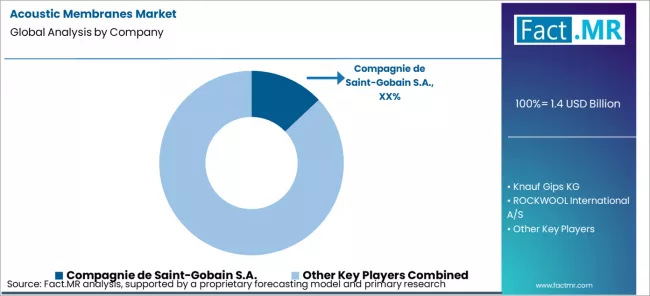
Acoustic Membranes Market Analysis By Company | Source: Fact.MR
The acoustic membranes market is evolving with major players like Compagnie de Saint-Gobain S.A., Knauf Gips KG, and ROCKWOOL International A/S focusing on developing innovative solutions for noise reduction in construction and automotive applications. SOPREMA Group and Sika AG emphasize sound insulation technologies that comply with environmental and energy efficiency standards. 3M Company, Owens Corning, and Johns Manville provide advanced acoustic materials that enhance the acoustic performance of building structures while maintaining sustainability. Carlisle Construction Materials LLC targets both residential and commercial sectors with products that balance acoustic comfort and durability. These players are differentiating by offering high-performance, cost-effective, and eco-friendly acoustic membrane solutions.
Recent Industry Developments
- Product launch - MERCACUSTIC extra-thin acoustic barrier (Article noted Oct 2024 edition): MERCACUSTIC reported the launch of an extra-thin acoustic barrier described as a 100% recycled synthetic membrane designed to deliver airborne noise insulation with very low thickness.
- R&D breakthrough - MIT sound-suppressing “silk” fabric membrane (Published May 7, 2024): MIT researchers reported a hair-thin silk-based fabric that can suppress noise by vibrating under applied voltage, demonstrating an advanced membrane-style acoustic control approach for room-scale sound reduction.
- Patent - Soundproof structure using a membrane-like member + Helmholtz resonance interaction (Grant published Oct 9, 2024): The European patent EP3761305B1 discloses a soundproof structure where a membrane-like member interacts with resonance mechanisms to improve sound absorption/insulation across frequency bands.
Key Players of the Acoustic Membranes Market
- Compagnie de Saint-Gobain S.A.
- Knauf Gips KG
- ROCKWOOL International A/S
- SOPREMA Group
- Sika AG
- 3M Company
- Owens Corning
- Johns Manville
- Carlisle Construction Materials LLC
Report Scope
| Metric | Value |
|---|---|
| Quantitative Units | USD 1.4 billion (2026) to USD 2.8 billion (2036), at a CAGR of 6.8% |
| Market Definition | The Acoustic Membranes Market includes products designed to provide soundproofing and noise reduction in various construction applications, enhancing acoustical performance in buildings. |
| By Product Type | Mass Loaded Vinyl (MLV) Membranes, Rubberized Acoustic Membranes, Bituminous Soundproofing Sheets, Other |
| By Installation | Walls & Partitions, Floors & Underlayment, Ceilings, Ducting & Others |
| By End Use | Commercial Construction, Residential Construction, Industrial Buildings, Others |
| By Sales Channel | Building Material Distributors, Direct Manufacturer Sales, Contractor Channels, Other |
| Regions Covered | North America, Latin America, Europe, East Asia, South Asia, Oceania, Middle East and Africa |
| Countries Covered | United States, Canada, Mexico, Brazil, Argentina, Germany, France, United Kingdom, Italy, Spain, China, India, Japan, South Korea, Indonesia, Australia, and 40+ countries |
| Key Companies Profiled | Compagnie de Saint-Gobain S.A., Knauf Gips KG, ROCKWOOL International A/S, SOPREMA Group, Sika AG, 3M Company, Owens Corning, Johns Manville, Carlisle Construction Materials LLC |
| Forecast Period | 2026 to 2036 |
| Approach | Hybrid top-down and bottom-up market modeling validated through primary interviews with manufacturers and supported by trade data benchmarking and market research. |
Source: Fact.MR analysis. Updated Feb 17, 2026
Bibliographies
- Product Launch - MERCACUSTIC Extra-Thin Acoustic Barrier: MERCACUSTIC. (2024, October). MERCACUSTIC launches extra-thin acoustic barrier. MERCACUSTIC. [1]
- R&D Breakthrough - MIT Sound-Suppressing “Silk” Fabric Membrane: MIT News. (2024, May 7). MIT researchers develop sound-suppressing silk fabric membrane. MIT News. [2]
- Patent - Soundproof Structure Using a Membrane-Like Member + Helmholtz Resonance Interaction: European Patent No. EP3761305B1. (2024, October 9). Soundproof structure using a membrane-like member + Helmholtz resonance interaction. European Publication Server. [3]
Segmentation
Acoustic Membranes Market Key Segments
-
By Product Type :
- Mass Loaded Vinyl (MLV) Membranes
- Rubberized Acoustic Membranes
- Bituminous Soundproofing Sheets
- Other
-
By Installation :
- Walls & Partitions
- Floors & Underlayment
- Ceilings
- Ducting & Others
-
By End Use :
- Commercial Construction
- Residential Construction
- Industrial Buildings
- Others
-
By Sales Channel :
- Building Material Distributors
- Direct Manufacturer Sales
- Contractor Channels
- Other
-
Region :
- North America
- USA
- Canada
- Mexico
- Europe
- Germany
- UK
- France
- Italy
- Spain
- Nordic Countries
- BENELUX
- Rest of Europe
- Asia Pacific
- China
- Japan
- South Korea
- India
- Australia
- Rest of Asia Pacific
- Latin America
- Brazil
- Argentina
- Rest of Latin America
- Middle East and Africa
- Kingdom of Saudi Arabia
- United Arab Emirates
- South Africa
- Rest of Middle East and Africa
- Other Regions
- Oceania
- Central Asia
- Other Markets
- North America
Frequently Asked Questions
How large is the demand for Acoustic Membranes in the global market in 2026?
What will be the market size of Acoustic Membranes in the global market by 2036?
What is the expected demand growth for Acoustic Membranes in the global market between 2026 and 2036?
Which product type is expected to dominate the market?
Which region is expected to show the highest growth rate for Acoustic Membranes?
How significant is the growth outlook for Vietnam in this market?
What is the growth outlook for the United States in this report?
What is the growth forecast for Saudi Arabia in the Acoustic Membranes market?
Which European market is highlighted in this analysis?
Which company is identified as a leading player in the Acoustic Membranes market?
What are Acoustic Membranes used for?
What does the Acoustic Membranes market include in this report?
How is the market forecast developed in this report?
What is meant by the Acoustic Membranes market in this report?
Who worked on this report


Preview the report firsthand - request a free sample
Free SampleGet the brochure for pricing and purchase details
Download PDF