Digital Printed Cartons Market Size, Share, Growth and Forecast (2026 - 2036)
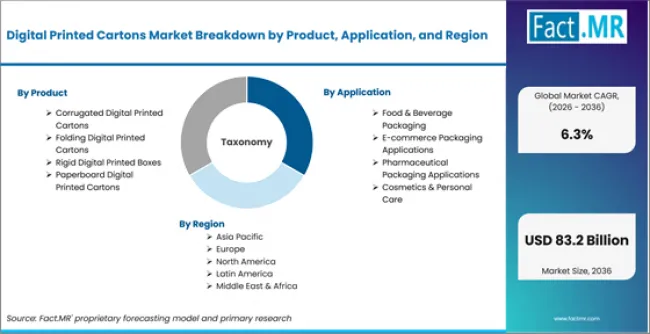
The Digital Printed Cartons Market is segmented by Product (Corrugated Digital Printed Cartons, Folding Digital Printed Cartons, Rigid Digital Printed Boxes, Paperboard Digital Printed Cartons), Application (Food & Beverage Packaging, E-commerce Packaging Applications, Pharmaceutical Packaging Applications, Cosmetics & Personal Care), End Use (FMCG Companies, E-commerce Companies, Pharmaceutical Companies, Cosmetics & Personal Care Companies), and Region. Forecast for 2026 to 2036.
Digital Printed Cartons Market Analysis and Forecast by Fact.MR
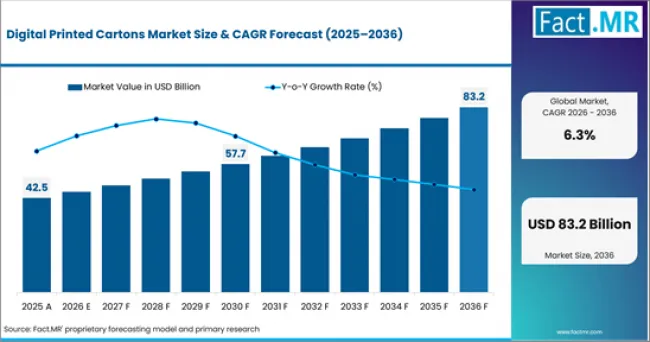
- The Digital Printed Cartons Market is expected to grow from USD 45.2 billion in 2026 to USD 83.2 billion by 2036, at a 6.3% CAGR.
- The market is driven by FMCG demand for shorter production runs, personalized packaging, digital printing adoption across cartons, and sustainability requirements favoring water-based digital inks.
- Corrugated Digital Printed Cartons account for 34.7% product share, while FMCG Companies contribute 72.3% of end-use demand.
Summary of Digital Printed Cartons Market
- Market Snapshot
- In 2025, the global Digital Printed Cartons Market was valued at approximately USD 42.5 billion.
- The market is estimated to reach USD 45.2 billion in 2026 and is projected to attain USD 83.2 billion by 2036.
- The digital printed cartons market is likely to expand at a CAGR of 6.3% during the forecast period.
- The market is anticipated to create an absolute dollar opportunity of USD 38.0 billion between 2026 and 2036.
- Corrugated Digital Printed Cartons accounts for 34.7% of product segment share in 2026.
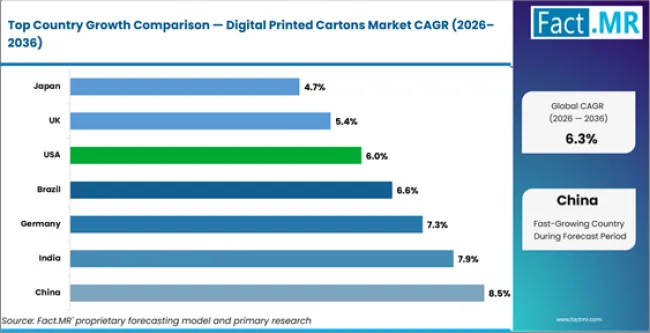
- China (8.5%) and India (7.9%) are the key growth markets during the forecast period.
- Demand and Growth Drivers
- FMCG brand demand for shorter production runs, seasonal packaging variations, and promotional customization is driving conversion from analog to digital carton printing, as brands seek to execute targeted marketing campaigns through packaging without the cost and lead time of plate-making.
- The elimination of printing plates in digital production reduces setup costs and waste, making shorter carton runs more practical than many analog workflows.
- Variable data printing capability enabling unique QR codes, serialization, and personalized content on every carton is creating new packaging functionality for brand engagement and supply chain traceability.
- Water-based digital ink systems that reduce volatile organic compound emissions are improving environmental compliance for carton converters facing tightening air quality regulations.
- Product and Segment View
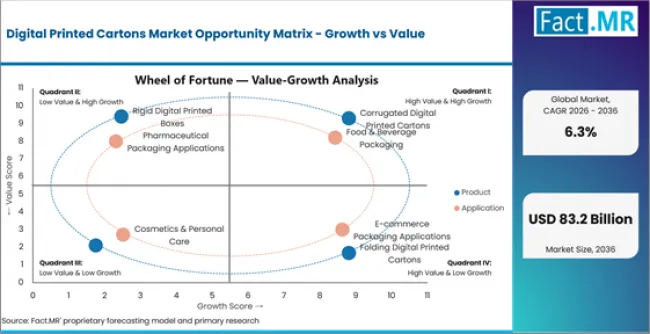
- Corrugated Digital Printed Cartons accounts for 34.7% of the product segment in 2026, supported by growing adoption of single-pass inkjet technology for e-commerce shipping and retail-ready shelf packaging.
- FMCG Companies represents 72.3% of end use demand in 2026, reflecting the dominant procurement position of consumer goods brands in food, beverage, and personal care categories.
- Water Based Ink Formulations leads the formulation segment with 44.5% share in 2026, supported by environmental regulatory compliance and food-contact safety requirements favoring low-migration water-based inks.
- Key segmentation includes:
- Product Type: Corrugated Digital Printed Cartons, Folding Digital Printed Cartons, Rigid Digital Printed Boxes, and Paperboard Digital Printed Cartons
- End Use: FMCG Companies, E-commerce Companies, Pharmaceutical Companies, and Cosmetics & Personal Care Companies
- Ink Technology: Water-based Ink Formulations, UV-curable Ink Formulations, and Solvent-based Ink Formulations
- These systems enable:
- Short-run production capability making 500 to 5,000 unit print orders economically viable without plate costs, enabling seasonal and promotional packaging variations.
- Variable data and personalization printing placing unique content on every carton, supporting QR code engagement, serialized traceability, and anti-counterfeiting.
- Rapid job changeover reducing production lead times from weeks to days, enabling faster time-to-market for new product launches.
- Geography and Competitive Outlook
- North America holds a significant market share, supported by strong FMCG and e-commerce packaging demand, established HP Indigo and single-pass inkjet adoption, and brand investment in personalized packaging.
- Asia Pacific is the fastest-growing region, with China (8.5%) and India (7.9%) expanding through FMCG packaging volume growth and e-commerce shipping carton demand.
- Europe maintains steady demand, with Germany (7.3%) supported by premium packaging requirements and sustainability regulation compliance.
- Tetra Pak, CCL Industries, WestRock, Smurfit Kappa, HP Inc., Durst, Graphic Packaging, and Elopak are among the key companies.
- Analyst Opinion
- Shambhu Nath Jha, Principal Consultant at Fact.MR, says "The digital printed cartons market is at an inflection point where digital printing is transitioning from a complement to analog production into a primary method for an expanding range of applications. The economics have shifted. As single-pass inkjet speed and quality approach flexographic levels, the remaining advantages of analog narrow to ultra-high-volume commodity runs. Digital printing is becoming more competitive for short and medium runs while supporting customization, variable data, and faster campaign changes."
Key Growth Drivers, Constraints, and Opportunities
Key Factors Driving Growth
- FMCG brand investment in packaging personalization and shorter production runs is the primary driver, as consumer goods companies seek regionally targeted and promotion-specific carton packaging that analog printing economics do not support below 10,000 to 50,000 unit run lengths.
- E-commerce shipping carton demand is creating high-volume opportunities for digitally printed corrugated packaging, as online retailers and DTC brands use branded shipping boxes as customer touchpoints benefiting from variable graphics.
- Food-contact safety regulations and environmental compliance requirements favor water-based and low-migration digital ink systems that meet packaging safety standards for direct food contact applications.
Key Market Constraints
- Digital printing speed and cost-per-unit remain higher than analog for run lengths exceeding 50,000 units, limiting displacement in ultra-high-volume commodity carton production.
- Capital investment requirements for high-speed single-pass inkjet systems create adoption barriers for small and mid-size converters.
- Color consistency management across digital runs requires calibration investment that adds operational complexity compared to analog workflows.
Key Opportunity Areas
- Connected packaging using unique QR codes and serialized identifiers on every carton creates new value propositions generating post-purchase consumer engagement and supply chain visibility.
- Sustainability-driven demand for reduced packaging waste supports digital printing, as plate elimination and lower setup waste improve environmental profiles.
- Aseptic carton digital printing, pioneered by Tetra Pak Custom Printing, opens a high-volume application segment where digital enables mass customization at commercial speeds.
Segment-wise Analysis of the Digital Printed Cartons Market
- Corrugated digital printed cartons hold 34.7% of the product segment in 2026, supported by e-commerce shipping and retail-ready shelf packaging adoption.
- FMCG companies account for 72.3% of end-use demand in 2026, driven by consumer goods brands requiring carton packaging with increasing customization.
- Folding carton digital prints are the fastest-growing format as single-pass inkjet technology reaches competitive quality and speed levels.
The digital printed cartons market is segmented by product, application, end use, technology, ink formulation, distribution channel, and region. Corrugated formats lead by volume through e-commerce shipping demand, while folding cartons represent the highest-growth format as digital quality approaches flexographic standards.
Which Product Segment Dominates the Digital Printed Cartons Market?
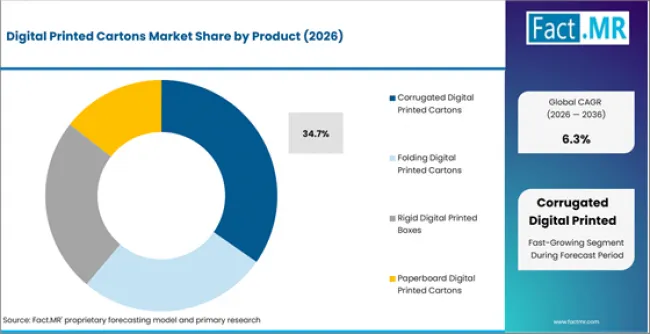
Corrugated digital printed cartons account for 34.7% of the product segment in 2026. Their leadership reflects rapid adoption of digital printing for e-commerce shipping boxes and retail-ready corrugated packaging. Single-pass inkjet systems operating at speeds exceeding 100 meters per minute are making digital corrugated printing increasingly competitive with analog alternatives for medium-run production.
Folding carton digital prints hold a growing share, driven by food, beverage, pharmaceutical, and personal care brand demand for short-run promotional packaging and seasonal variations that analog processes cannot economically produce.
Which End-Use Segment Dominates the Digital Printed Cartons Market?
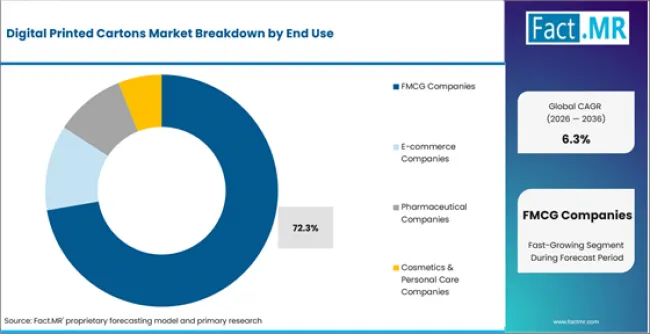
FMCG companies are expected to lead the end-use segment with a 72.3% share in 2026. This dominance reflects the scale of carton consumption in food, beverage, personal care, and household products, combined with growing brand investment in personalized packaging.
E-commerce and retail hold a growing share, driven by direct-to-consumer brands requiring branded shipping cartons and the expanding use of digitally printed retail-ready packaging for both online fulfillment and in-store display.
Which Technology Trend is Shaping the Next Phase of Growth in the Digital Printed Cartons Market?
Single-pass inkjet technology reaching production speeds and print quality levels that compete with flexographic printing is the most significant trend. Single-pass inkjet systems from leading press suppliers are improving speed and quality for carton applications, supporting wider converter adoption, shifting the economic crossover point to progressively higher run lengths.
This speed and quality convergence means the run length below which digital is cost-competitive expands from 5,000 to 25,000 units, progressively displacing analog production. Connected packaging using unique QR codes on every carton creates new value propositions that analog cannot deliver.
Regional Outlook Across Key Markets
- China leads growth at 8.5%, driven by the largest FMCG packaging market globally, rapid e-commerce expansion, and growing digital printing equipment adoption by Chinese carton converters.
- India follows at 7.9%, supported by FMCG packaging volume growth, expanding e-commerce logistics, and increasing brand investment in packaging differentiation.
- North America maintains a significant share, with demand driven by brand personalization programs and e-commerce packaging investment across the United States.
- Germany leads European growth at 7.3%, supported by premium packaging requirements and converter adoption of high-speed digital systems.
.webp)
CAGR Table
| Country | CAGR (%) |
|---|---|
| China | 8.5% |
| India | 7.9% |
| Germany | 7.3% |
| Brazil | 6.6% |
| USA | 6.0% |
Source: Fact.MR analysis, based on proprietary forecasting model and primary research.
Market Outlook for Digital Printed Cartons in the United States
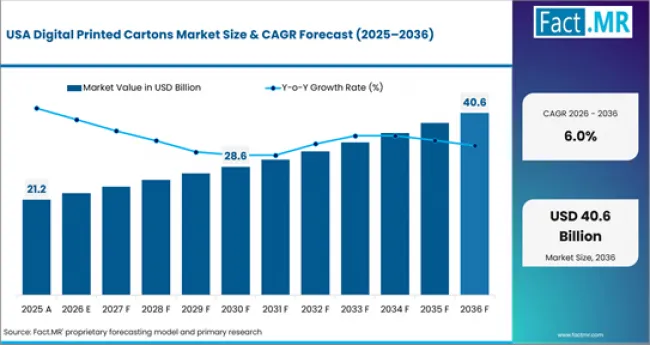
The USA digital printed cartons market is projected to grow at a CAGR of 6.0% through 2036. FMCG brand personalization programs and e-commerce branded shipping carton demand are the primary drivers. The installed base of HP Indigo and single-pass systems at US converters is among the largest globally.
- FMCG personalization and seasonal packaging programs create sustained demand for short-run digital carton production.
- E-commerce branded shipping carton requirements drive corrugated digital printing demand.
Digital Printed Cartons Demand Trends in China
Domestic FMCG packaging volume growth and rapid e-commerce expansion create the largest growth opportunity in Asia Pacific. Chinese converters are investing in digital equipment to serve brands seeking shorter runs and faster time-to-market for promotional packaging variations.
- FMCG packaging volume growth creates large-scale demand for digital carton printing.
- E-commerce expansion drives branded corrugated carton demand across online retail.
India Digital Printed Cartons Market Opportunity Outlook
Expanding FMCG production and e-commerce logistics infrastructure create demand for digital printed cartons. Growing brand investment in packaging differentiation supports converter adoption of digital printing technology.
- FMCG brand differentiation investment supports demand for digitally printed folding cartons.
- E-commerce logistics expansion creates corrugated digital printing demand for branded shipping cartons.
Germany Digital Printed Cartons Demand Analysis
Premium packaging requirements and EU sustainability regulations shape demand. German converters are early adopters of high-speed single-pass inkjet systems serving domestic and European FMCG brands.
- EU sustainability regulations favor digital processes that reduce plate waste and minimize ink consumption.
- German converter adoption of single-pass inkjet provides production capacity for high-quality digital carton printing.
Competitive Benchmarking and Company Positioning
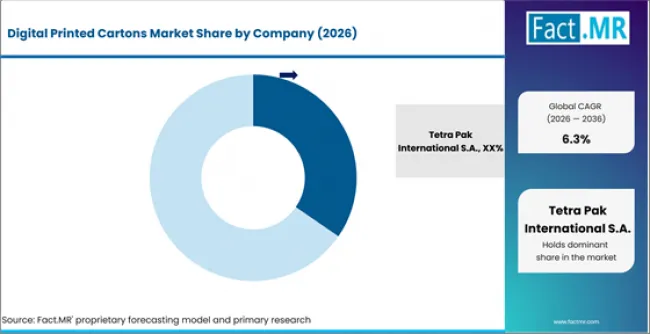
Digital Printed Cartons Market Analysis By Company
- Tetra Pak, WestRock, and Smurfit Kappa hold leading positions through large-scale carton converting operations, established FMCG brand relationships, and growing digital printing capability.
- HP Inc. and Durst compete as technology providers, shaping production capability and quality standards across the digital carton market through press installations at converter facilities.
- Brand demand for packaging personalization creates competitive advantage for converters investing early in high-speed digital capability.
The competitive landscape spans carton converters, digital printing equipment manufacturers, and ink suppliers. WestRock, Smurfit Kappa, and Graphic Packaging compete as large-scale converters integrating digital alongside analog production. HP Inc., Durst, and EFI compete as technology providers. Tetra Pak operates its own digital infrastructure for aseptic carton customization.
Strategic priorities include expanding single-pass inkjet capacity, developing water-based ink formulations for food-contact compliance, and building connected packaging capabilities.
Key Companies in the Digital Printed Cartons Market
- Tetra Pak, WestRock, and Smurfit Kappa are among the leading participants, supported by large-scale converting operations and growing digital production capability.
- CCL Industries, Graphic Packaging, Elopak, and Pactiv Evergreen hold positions across specialty and food carton segments.
- HP Inc., Durst, EFI, and Xerox compete as technology providers.
Recent Industry Developments
- Tetra Pak, Custom Printing for Aseptic Carton Personalization, Tetra Pak continued promoting Tetra Pak® Custom Printing for aseptic cartons in 2025. The solution helps beverage brands use carton packaging for more flexible designs, small campaign runs, and stronger shelf visibility.
- HP Inc., Indigo Digital Press Portfolio for Labels and Packaging, HP Inc. continued positioning its Indigo digital press portfolio for labels and packaging applications. The HP Indigo V12 supports high-speed digital label production, while HP Indigo 35K is a stronger fit for folding carton production.
- Clairol, ColorStrong Product Launch with Recycled Packaging Materials, Clairol launched ColorStrong in January 2025 as a new bonding hair color line. The company stated that the product is packaged in eco-friendly recycled materials.
Leading Companies Shaping the Digital Printed Cartons Market
- Tetra Pak International S.A.
- CCL Industries
- Elopak Inc.
- Novolex / Pactiv Evergreen
- Refresco Gerber N.V.
- SIG Group AG / SIG Combibloc
- Nippon Paper Industries Co., Ltd.
Sources and Research References
- Clairol. (2025). ColorStrong zero ammonia permanent hair dye.
- HP Inc. (2026). HP Indigo V12 Digital Press.
- HP Inc. (2026). HP Indigo digital presses.
- Tetra Pak. (2025, September 16). Tetra Pak returns to PACK EXPO to empower brands to grow.
- Tetra Pak. (2026). Tetra Pak® Custom Printing.
- Wella Company. (2025, January 28). Clairol unveils its first-ever bonding hair color line.
This bibliography is provided for reader reference and is not exhaustive. The full report contains the complete reference list and detailed citations.
Key Questions This Report Addresses
- What is the current and future size of the Digital Printed Cartons Market?
- How fast is the market expected to grow between 2026 and 2036?
- Which product type leads by 2026?
- Which end-use segment accounts for highest demand?
- What drives FMCG adoption of digital carton printing?
- How is single-pass inkjet technology influencing growth?
- Why are China and India the fastest-growing markets?
- How are connected packaging applications supporting demand?
- Which countries show fastest growth through 2036?
- Who are the key companies?
- How does Fact.MR validate the forecast?
Digital Printed Cartons Market Definition
The Digital Printed Cartons Market covers carton packaging produced using digital inkjet and electrophotographic printing technologies for FMCG, e-commerce, pharmaceutical, and industrial packaging applications across corrugated, folding carton, rigid box, and aseptic formats.
Digital Printed Cartons Market Inclusions
- The scope covers global and regional market size and forecasts for 2026 to 2036 across product type, end use, ink technology, and region.
- It includes corrugated, folding carton, rigid box, and aseptic carton formats printed using digital systems.
- The report covers technology trends, ink formulation developments, and the competitive landscape.
Digital Printed Cartons Market Exclusions
- The scope excludes analog-printed cartons produced using flexographic, offset, and gravure processes.
- It excludes digital printing equipment sales and ink manufacturing operations sold independently.
- The report excludes flexible packaging, labels, and non-carton formats.
Digital Printed Cartons Market Research Methodology
- The methodology combines secondary research, primary interviews, and forecast modelling.
- It draws on 100+ secondary sources and benchmarks 55+ company portfolios.
- Market sizing covers 30+ countries through a demand-side model, supported by top-down validation.
- Key inputs include FMCG packaging spend, e-commerce shipping volume, digital press installation data, and converter adoption rates.
- Primary validation includes 25+ interviews across converters, brand owners, and equipment manufacturers.
Scope of Analysis

| Parameter | Details |
|---|---|
| Quantitative Units | USD 45.2 billion to USD 83.2 billion, at a CAGR of 6.3% |
| Market Definition | The Digital Printed Cartons Market covers carton packaging produced using digital printing technologies for FMCG, e-commerce, pharmaceutical, and industrial applications. |
| Regions Covered | North America, Latin America, Europe, East Asia, South Asia and Pacific, Middle East and Africa |
| Countries Covered | USA, Canada, UK, Germany, China, India, 30 plus countries |
| Key Companies | Tetra Pak International S.A., CCL Industries, Elopak Inc., Novolex / Pactiv Evergreen, Refresco Gerber N.V., SIG Group AG / SIG Combibloc, Nippon Paper Industries Co., Ltd |
| Forecast Period | 2026 to 2036 |
| Approach | Hybrid demand-side methodology built on FMCG packaging spend, e-commerce volume, digital press installation data, and primary interviews across converters, brands, and equipment manufacturers. |
Digital Printed Cartons Market Segmentation
-
Digital Printed Cartons Market Segmented by Product:
- Corrugated Digital Printed Cartons
- Single Wall Corrugated Cartons
- Retail Packaging Cartons
- E-commerce Shipping Cartons
- Double Wall Corrugated Cartons
- Industrial Transport Cartons
- Heavy Duty Storage Cartons
- Single Wall Corrugated Cartons
- Folding Digital Printed Cartons
- Rigid Folding Cartons
- Premium Retail Display Boxes
- Luxury Product Packaging Boxes
- Lightweight Folding Cartons
- Food Grade Folding Boxes
- Pharmaceutical Packaging Boxes
- Rigid Folding Cartons
- Rigid Digital Printed Boxes
- Luxury Rigid Boxes
- Cosmetics Packaging Boxes
- Gift Packaging Boxes
- Industrial Rigid Boxes
- Electronics Packaging Boxes
- Automotive Spare Packaging Boxes
- Luxury Rigid Boxes
- Paperboard Digital Printed Cartons
- Coated Paperboard Cartons
- High Gloss Printed Cartons
- Matte Finish Printed Cartons
- Uncoated Paperboard Cartons
- Eco Friendly Packaging Cartons
- Recyclable Packaging Boxes
- Coated Paperboard Cartons
- Corrugated Digital Printed Cartons
-
Digital Printed Cartons Market Segmented by Application:
- Food & Beverage Packaging
- Packaged Food Applications
- Snack Food Packaging
- Frozen Food Packaging
- Beverage Packaging Applications
- Juice Carton Packaging
- Alcoholic Beverage Cartons
- Packaged Food Applications
- E-commerce Packaging Applications
- Retail Shipping Applications
- Small Parcel Delivery Cartons
- Subscription Box Packaging
- Marketplace Fulfillment Packaging
- Multi Vendor Product Packaging
- Direct to Consumer Packaging
- Retail Shipping Applications
- Pharmaceutical Packaging Applications
- Medicine Packaging Applications
- Prescription Drug Cartons
- OTC Medicine Packaging
- Healthcare Supply Packaging
- Medical Device Packaging
- Diagnostic Kit Packaging
- Medicine Packaging Applications
- Cosmetics & Personal Care
- Beauty Product Packaging
- Skincare Product Boxes
- Makeup Packaging Boxes
- Personal Care Packaging
- Haircare Product Boxes
- Hygiene Product Packaging
- Beauty Product Packaging
- Food & Beverage Packaging
-
Digital Printed Cartons Market Segmented by End Use:
- FMCG Companies
- Food Manufacturing Companies
- Packaged Food Producers
- Snack & Confectionery Brands
- Beverage Companies
- Soft Drink Manufacturers
- Alcoholic Beverage Producers
- Food Manufacturing Companies
- E-commerce Companies
- Online Retail Platforms
- Marketplace Sellers
- Direct Brand Stores
- Logistics & Fulfillment Firms
- Warehousing Service Providers
- Last Mile Delivery Operators
- Online Retail Platforms
- Pharmaceutical Companies
- Drug Manufacturing Companies
- Generic Medicine Producers
- Specialty Pharma Firms
- Healthcare Supply Firms
- Medical Device Companies
- Diagnostic Product Firms
- Drug Manufacturing Companies
- Cosmetics & Personal Care Companies
- Beauty Product Manufacturers
- Skincare Brands
- Cosmetic Product Brands
- Personal Hygiene Companies
- Soap & Sanitizer Manufacturers
- Haircare Product Companies
- Beauty Product Manufacturers
- FMCG Companies
-
Digital Printed Cartons Market Segmented by Technology:
- Inkjet Digital Printing Technology
- Single Pass Inkjet Systems
- High Speed Packaging Printers
- Industrial Inkjet Heads
- Multi Pass Inkjet Systems
- High Resolution Print Systems
- Variable Data Printing Systems
- Single Pass Inkjet Systems
- Laser Printing Technology
- Direct Laser Engraving Systems
- Packaging Surface Laser Printing
- High Precision Marking Systems
- Laser Coding Systems
- Batch Coding Solutions
- Traceability Printing Systems
- Direct Laser Engraving Systems
- Flexographic Hybrid Printing
- Digital Flexo Hybrid Systems
- Color Management Systems
- Multi Layer Printing Systems
- Inline Hybrid Printing Systems
- Real Time Print Adjustment Systems
- Automated Registration Systems
- Digital Flexo Hybrid Systems
- Inkjet Digital Printing Technology
-
Digital Printed Cartons Market Segmented by Formulation:
- Water Based Ink Formulations
- Eco Friendly Ink Systems
- Low VOC Ink Solutions
- Biodegradable Ink Systems
- High Adhesion Ink Systems
- Coated Surface Ink Formulations
- Fast Dry Ink Systems
- Eco Friendly Ink Systems
- UV Curable Ink Formulations
- Radiation Curable Systems
- Instant Cure Ink Systems
- High Durability UV Inks
- Hybrid UV Ink Systems
- Dual Cure Ink Formulations
- Scratch Resistant Ink Systems
- Radiation Curable Systems
- Solvent Based Ink Formulations
- Industrial Ink Systems
- High Gloss Ink Formulations
- Deep Color Penetration Inks
- Fast Evaporation Systems
- Quick Dry Solvent Inks
- Heavy Duty Packaging Inks
- Industrial Ink Systems
- Water Based Ink Formulations
-
Digital Printed Cartons Market Segmented by Distribution Channel:
- Direct Manufacturer Sales
- Enterprise Supply Contracts
- FMCG Brand Agreements
- E-commerce Packaging Contracts
- Bulk Procurement Deals
- Long Term Supply Agreements
- Industrial Volume Orders
- Enterprise Supply Contracts
- Packaging Distributors
- Regional Packaging Suppliers
- Local Print & Packaging Vendors
- Wholesale Packaging Distributors
- Specialty Packaging Dealers
- Custom Packaging Solution Providers
- Premium Packaging Distributors
- Regional Packaging Suppliers
- Online B2B Platforms
- Digital Packaging Marketplaces
- Industrial Ordering Platforms
- Cloud Based Print Ordering Systems
- Manufacturer Portals
- Direct Custom Design Platforms
- On Demand Printing Systems
- Digital Packaging Marketplaces
- Direct Manufacturer Sales
-
Digital Printed Cartons Market by Region:
- North America
- USA
- Canada
- Mexico
- Latin America
- Brazil
- Chile
- Rest of Latin America
- Western Europe
- Germany
- UK
- Italy
- Spain
- France
- Nordic
- BENELUX
- Rest of Western Europe
- Eastern Europe
- Russia
- Poland
- Hungary
- Balkan & Baltic
- Rest of Eastern Europe
- East Asia
- China
- Japan
- South Korea
- South Asia and Pacific
- India
- ASEAN
- Australia & New Zealand
- Rest of South Asia and Pacific
- Middle East & Africa
- Kingdom of Saudi Arabia
- Other GCC Countries
- Turkiye
- South Africa
- Other African Union
- Rest of Middle East & Africa
- North America
- Frequently Asked Questions -
How big is the digital printed cartons market in 2026?
The global digital printed cartons market is estimated to be valued at USD 45.2 billion in 2026.
What will be the size of the digital printed cartons market in 2036?
The market size for the digital printed cartons market is projected to reach USD 83.2 billion by 2036.
What CAGR is expected for the digital printed cartons market between 2026 and 2036?
The digital printed cartons market is expected to grow at a 6.3% CAGR between 2026 and 2036.
What are the key products in the digital printed cartons market?
The key products in the digital printed cartons market are Corrugated Digital Printed Cartons, Folding Digital Printed Cartons, Rigid Digital Printed Boxes and Paperboard Digital Printed Cartons.
Which application segment is expected to contribute the leading share in the digital printed cartons market in 2026?
In terms of application, the Food & Beverage Packaging segment is expected to command 61.9% share in the digital printed cartons market in 2026.
Table of Content
- Key Takeaways
- Market Size and CAGR
- Top Growth Driver
- Fastest Growing Segment
- Leading Region
- Key Companies
- Emerging Opportunities
- Executive Summary
- Global Market Outlook
- Demand-side Trends
- Supply-side Trends
- Technology Roadmap Analysis
- Analysis and Recommendations
- Analyst Perspective (What is happening? Why now? What should investors know?)
- Key Questions Answered
- How large is the market?
- What is the CAGR?
- What are key trends?
- Which region dominates?
- Who are the leaders?
- Market Overview
- Market Coverage / Taxonomy
- Market Definition / Scope / Limitations
- Research Methodology
- Chapter Orientation
- Analytical Lens and Working Hypotheses
- Market Structure, Signals, and Trend Drivers
- Benchmarking and Cross-market Comparability
- Market Sizing, Forecasting, and Opportunity Mapping
- Research Design and Evidence Framework
- Desk Research Programme (Secondary Evidence)
- Expert Input and Fieldwork (Primary Evidence)
- Tooling, Models, and Reference Databases
- Data Engineering and Model Build
- Quality Assurance and Audit Trail
- Market Background
- Market Dynamics (Drivers, Restraints, Opportunity, Trends)
- Scenario Forecast (Optimistic, Likely, Conservative)
- Impact Analysis
- AI Impact
- Sustainability Impact
- Regulatory Impact
- Technology Impact
- Consumer / Buyer Analysis
- Purchase Drivers
- Adoption Barriers
- Buyer Journey
- Opportunity Map Analysis
- Product Life Cycle Analysis
- Supply Chain Analysis
- Investment Feasibility Matrix
- Value Chain Analysis
- PESTLE and Porter's Analysis
- Regulatory Landscape
- Regional Parent Market Outlook
- Production and Consumption Statistics
- Import and Export Statistics
- Global Market Analysis and Forecast, 2021 to 2036
- Historical Market Size Value (USD Million) Analysis, 2021 to 2025
- Current and Future Market Size Value (USD Million) Projections, 2026 to 2036
- Y-o-Y Growth Trend Analysis
- Absolute $ Opportunity Analysis
- Global Market Pricing Analysis, 2021 to 2036
- Global Market Analysis and Forecast, By Product, 2021 to 2036
- Introduction / Key Findings
- Historical Market Size Value (USD Million) Analysis By Product, 2021 to 2025
- Current and Future Market Size Value (USD Million) Analysis and Forecast By Product, 2026 to 2036
- Corrugated Digital Printed Cartons
- Single Wall Corrugated Cartons
- Double Wall Corrugated Cartons
- Folding Digital Printed Cartons
- Rigid Folding Cartons
- Lightweight Folding Cartons
- Rigid Digital Printed Boxes
- Luxury Rigid Boxes
- Industrial Rigid Boxes
- Paperboard Digital Printed Cartons
- Coated Paperboard Cartons
- Uncoated Paperboard Cartons
- Corrugated Digital Printed Cartons
- Y-o-Y Growth Trend Analysis By Product, 2021 to 2025
- Absolute $ Opportunity Analysis By Product, 2026 to 2036
- Global Market Analysis and Forecast, By Application, 2021 to 2036
- Introduction / Key Findings
- Historical Market Size Value (USD Million) Analysis By Application, 2021 to 2025
- Current and Future Market Size Value (USD Million) Analysis and Forecast By Application, 2026 to 2036
- Food & Beverage Packaging
- Packaged Food Applications
- Beverage Packaging Applications
- E-commerce Packaging Applications
- Retail Shipping Applications
- Marketplace Fulfillment Packaging
- Pharmaceutical Packaging Applications
- Medicine Packaging Applications
- Healthcare Supply Packaging
- Cosmetics & Personal Care
- Beauty Product Packaging
- Personal Care Packaging
- Food & Beverage Packaging
- Y-o-Y Growth Trend Analysis By Application, 2021 to 2025
- Absolute $ Opportunity Analysis By Application, 2026 to 2036
- Global Market Analysis and Forecast, By End Use, 2021 to 2036
- Introduction / Key Findings
- Historical Market Size Value (USD Million) Analysis By End Use, 2021 to 2025
- Current and Future Market Size Value (USD Million) Analysis and Forecast By End Use, 2026 to 2036
- FMCG Companies
- Food Manufacturing Companies
- Beverage Companies
- E-commerce Companies
- Online Retail Platforms
- Logistics & Fulfillment Firms
- Pharmaceutical Companies
- Drug Manufacturing Companies
- Healthcare Supply Firms
- Cosmetics & Personal Care Companies
- Beauty Product Manufacturers
- Personal Hygiene Companies
- FMCG Companies
- Y-o-Y Growth Trend Analysis By End Use, 2021 to 2025
- Absolute $ Opportunity Analysis By End Use, 2026 to 2036
- Global Market Analysis and Forecast, By Technology, 2021 to 2036
- Introduction / Key Findings
- Historical Market Size Value (USD Million) Analysis By Technology, 2021 to 2025
- Current and Future Market Size Value (USD Million) Analysis and Forecast By Technology, 2026 to 2036
- Inkjet Digital Printing Technology
- Single Pass Inkjet Systems
- Multi Pass Inkjet Systems
- Laser Printing Technology
- Direct Laser Engraving Systems
- Laser Coding Systems
- Flexographic Hybrid Printing
- Digital Flexo Hybrid Systems
- Inline Hybrid Printing Systems
- Inkjet Digital Printing Technology
- Y-o-Y Growth Trend Analysis By Technology, 2021 to 2025
- Absolute $ Opportunity Analysis By Technology, 2026 to 2036
- Global Market Analysis and Forecast, By Formulation, 2021 to 2036
- Introduction / Key Findings
- Historical Market Size Value (USD Million) Analysis By Formulation, 2021 to 2025
- Current and Future Market Size Value (USD Million) Analysis and Forecast By Formulation, 2026 to 2036
- Water Based Ink Formulations
- Eco Friendly Ink Systems
- High Adhesion Ink Systems
- UV Curable Ink Formulations
- Radiation Curable Systems
- Hybrid UV Ink Systems
- Solvent Based Ink Formulations
- Industrial Ink Systems
- Fast Evaporation Systems
- Water Based Ink Formulations
- Y-o-Y Growth Trend Analysis By Formulation, 2021 to 2025
- Absolute $ Opportunity Analysis By Formulation, 2026 to 2036
- Global Market Analysis and Forecast, By Distribution Channel
- Introduction / Key Findings
- Historical Market Size Value (USD Million) Analysis By Distribution Channel, 2021 to 2025
- Current and Future Market Size Value (USD Million) Analysis and Forecast By Distribution Channel, 2026 to 2036
- Direct Manufacturer Sales
- Enterprise Supply Contracts
- Bulk Procurement Deals
- Packaging Distributors
- Regional Packaging Suppliers
- Specialty Packaging Dealers
- Online B2B Platforms
- Digital Packaging Marketplaces
- Manufacturer Portals
- Direct Manufacturer Sales
- Y-o-Y Growth Trend Analysis By Distribution Channel, 2021 to 2025
- Absolute $ Opportunity Analysis By Distribution Channel, 2026 to 2036
- Global Market Analysis and Forecast, By Region, 2021 to 2036
- Introduction
- Historical Market Size Value (USD Million) Analysis By Region, 2021 to 2025
- Current Market Size Value (USD Million) Analysis and Forecast By Region, 2026 to 2036
- North America
- Latin America
- Western Europe
- Eastern Europe
- East Asia
- South Asia and Pacific
- Middle East & Africa
- Market Attractiveness Analysis By Region
- North America Market Analysis and Forecast, By Country, 2021 to 2036
- Historical Market Size Value (USD Million) Trend Analysis By Market Taxonomy, 2021 to 2025
- Market Size Value (USD Million) Forecast By Market Taxonomy, 2026 to 2036
- By Country
- USA
- Canada
- Mexico
- By Product
- By Application
- By End Use
- By Technology
- By Formulation
- By Distribution Channel
- By Country
- Market Attractiveness Analysis
- By Country
- By Product
- By Application
- By End Use
- By Technology
- By Formulation
- By Distribution Channel
- Key Takeaways
- Latin America Market Analysis and Forecast, By Country
- Historical Market Size Value (USD Million) Trend Analysis By Market Taxonomy, 2021 to 2025
- Market Size Value (USD Million) Forecast By Market Taxonomy, 2026 to 2036
- By Country
- Brazil
- Chile
- Rest of Latin America
- By Product
- By Application
- By End Use
- By Technology
- By Formulation
- By Distribution Channel
- By Country
- Market Attractiveness Analysis
- By Country
- By Product
- By Application
- By End Use
- By Technology
- By Formulation
- By Distribution Channel
- Key Takeaways
- Western Europe Market Analysis and Forecast, By Country
- Historical Market Size Value (USD Million) Trend Analysis By Market Taxonomy, 2021 to 2025
- Market Size Value (USD Million) Forecast By Market Taxonomy, 2026 to 2036
- By Country
- Germany
- UK
- Italy
- Spain
- France
- Nordic
- BENELUX
- Rest of Western Europe
- By Product
- By Application
- By End Use
- By Technology
- By Formulation
- By Distribution Channel
- By Country
- Market Attractiveness Analysis
- By Country
- By Product
- By Application
- By End Use
- By Technology
- By Formulation
- By Distribution Channel
- Key Takeaways
- Eastern Europe Market Analysis and Forecast, By Country
- Historical Market Size Value (USD Million) Trend Analysis By Market Taxonomy, 2021 to 2025
- Market Size Value (USD Million) Forecast By Market Taxonomy, 2026 to 2036
- By Country
- Russia
- Poland
- Hungary
- Balkan & Baltic
- Rest of Eastern Europe
- By Product
- By Application
- By End Use
- By Technology
- By Formulation
- By Distribution Channel
- By Country
- Market Attractiveness Analysis
- By Country
- By Product
- By Application
- By End Use
- By Technology
- By Formulation
- By Distribution Channel
- Key Takeaways
- East Asia Market Analysis and Forecast, By Country
- Historical Market Size Value (USD Million) Trend Analysis By Market Taxonomy, 2021 to 2025
- Market Size Value (USD Million) Forecast By Market Taxonomy, 2026 to 2036
- By Country
- China
- Japan
- South Korea
- By Product
- By Application
- By End Use
- By Technology
- By Formulation
- By Distribution Channel
- By Country
- Market Attractiveness Analysis
- By Country
- By Product
- By Application
- By End Use
- By Technology
- By Formulation
- By Distribution Channel
- Key Takeaways
- South Asia and Pacific Market Analysis and Forecast, By Country
- Historical Market Size Value (USD Million) Trend Analysis By Market Taxonomy, 2021 to 2025
- Market Size Value (USD Million) Forecast By Market Taxonomy, 2026 to 2036
- By Country
- India
- ASEAN
- Australia & New Zealand
- Rest of South Asia and Pacific
- By Product
- By Application
- By End Use
- By Technology
- By Formulation
- By Distribution Channel
- By Country
- Market Attractiveness Analysis
- By Country
- By Product
- By Application
- By End Use
- By Technology
- By Formulation
- By Distribution Channel
- Key Takeaways
- Middle East & Africa Market Analysis and Forecast, By Country
- Historical Market Size Value (USD Million) Trend Analysis By Market Taxonomy, 2021 to 2025
- Market Size Value (USD Million) Forecast By Market Taxonomy, 2026 to 2036
- By Country
- Kingdom of Saudi Arabia
- Other GCC Countries
- Turkiye
- South Africa
- Other African Union
- Rest of Middle East & Africa
- By Product
- By Application
- By End Use
- By Technology
- By Formulation
- By Distribution Channel
- By Country
- Market Attractiveness Analysis
- By Country
- By Product
- By Application
- By End Use
- By Technology
- By Formulation
- By Distribution Channel
- Key Takeaways
- Key Countries Market Analysis
- USA
- Pricing Analysis
- Market Share Analysis, 2025
- By Product
- By Application
- By End Use
- By Technology
- By Formulation
- By Distribution Channel
- Canada
- Pricing Analysis
- Market Share Analysis, 2025
- By Product
- By Application
- By End Use
- By Technology
- By Formulation
- By Distribution Channel
- Mexico
- Pricing Analysis
- Market Share Analysis, 2025
- By Product
- By Application
- By End Use
- By Technology
- By Formulation
- By Distribution Channel
- Brazil
- Pricing Analysis
- Market Share Analysis, 2025
- By Product
- By Application
- By End Use
- By Technology
- By Formulation
- By Distribution Channel
- Chile
- Pricing Analysis
- Market Share Analysis, 2025
- By Product
- By Application
- By End Use
- By Technology
- By Formulation
- By Distribution Channel
- Germany
- Pricing Analysis
- Market Share Analysis, 2025
- By Product
- By Application
- By End Use
- By Technology
- By Formulation
- By Distribution Channel
- UK
- Pricing Analysis
- Market Share Analysis, 2025
- By Product
- By Application
- By End Use
- By Technology
- By Formulation
- By Distribution Channel
- Italy
- Pricing Analysis
- Market Share Analysis, 2025
- By Product
- By Application
- By End Use
- By Technology
- By Formulation
- By Distribution Channel
- Spain
- Pricing Analysis
- Market Share Analysis, 2025
- By Product
- By Application
- By End Use
- By Technology
- By Formulation
- By Distribution Channel
- France
- Pricing Analysis
- Market Share Analysis, 2025
- By Product
- By Application
- By End Use
- By Technology
- By Formulation
- By Distribution Channel
- India
- Pricing Analysis
- Market Share Analysis, 2025
- By Product
- By Application
- By End Use
- By Technology
- By Formulation
- By Distribution Channel
- ASEAN
- Pricing Analysis
- Market Share Analysis, 2025
- By Product
- By Application
- By End Use
- By Technology
- By Formulation
- By Distribution Channel
- Australia & New Zealand
- Pricing Analysis
- Market Share Analysis, 2025
- By Product
- By Application
- By End Use
- By Technology
- By Formulation
- By Distribution Channel
- China
- Pricing Analysis
- Market Share Analysis, 2025
- By Product
- By Application
- By End Use
- By Technology
- By Formulation
- By Distribution Channel
- Japan
- Pricing Analysis
- Market Share Analysis, 2025
- By Product
- By Application
- By End Use
- By Technology
- By Formulation
- By Distribution Channel
- South Korea
- Pricing Analysis
- Market Share Analysis, 2025
- By Product
- By Application
- By End Use
- By Technology
- By Formulation
- By Distribution Channel
- Russia
- Pricing Analysis
- Market Share Analysis, 2025
- By Product
- By Application
- By End Use
- By Technology
- By Formulation
- By Distribution Channel
- Poland
- Pricing Analysis
- Market Share Analysis, 2025
- By Product
- By Application
- By End Use
- By Technology
- By Formulation
- By Distribution Channel
- Hungary
- Pricing Analysis
- Market Share Analysis, 2025
- By Product
- By Application
- By End Use
- By Technology
- By Formulation
- By Distribution Channel
- Kingdom of Saudi Arabia
- Pricing Analysis
- Market Share Analysis, 2025
- By Product
- By Application
- By End Use
- By Technology
- By Formulation
- By Distribution Channel
- Turkiye
- Pricing Analysis
- Market Share Analysis, 2025
- By Product
- By Application
- By End Use
- By Technology
- By Formulation
- By Distribution Channel
- South Africa
- Pricing Analysis
- Market Share Analysis, 2025
- By Product
- By Application
- By End Use
- By Technology
- By Formulation
- By Distribution Channel
- USA
- Market Structure Analysis
- Competition Dashboard
- Competition Benchmarking
- Market Share Analysis of Top Players
- By Regional
- By Product
- By Application
- By End Use
- By Technology
- By Formulation
- By Distribution Channel
- Emerging Startups
- Innovation Benchmarking
- Competition Analysis
- Competition Deep Dive
- Tetra Pak International S.A.
- Overview
- Product Portfolio
- Profitability by Market Segments (Product/Age /Sales Channel/Region)
- Sales Footprint
- Strategy Overview
- Marketing Strategy
- Product Strategy
- Channel Strategy
- CCL Industries
- Elopak Inc.
- Novolex / Pactiv Evergreen
- Refresco Gerber N.V.
- SIG Group AG / SIG Combibloc
- Nippon Paper Industries Co., Ltd
- POLYOAK PACKAGING GROUP (PTY) Ltd.
- The BoxMaker Inc.
- UFlex Ltd.
- LAMI PACKAGING (KUNSHAN) CO., Ltd
- Packman Packaging Private Limited
- ZRP Printing Group Co., Ltd.
- Tetra Pak International S.A.
- Competition Deep Dive
- Case Studies
- Success Stories
- Recent Developments
- Assumptions & Acronyms Used
List Of Table
- Table 1: Global Market Value (USD Million) Forecast by Region, 2021 to 2036
- Table 2: Global Market Value (USD Million) Forecast by Product, 2021 to 2036
- Table 3: Global Market Value (USD Million) Forecast by Application, 2021 to 2036
- Table 4: Global Market Value (USD Million) Forecast by End Use, 2021 to 2036
- Table 5: Global Market Value (USD Million) Forecast by Technology, 2021 to 2036
- Table 6: Global Market Value (USD Million) Forecast by Formulation, 2021 to 2036
- Table 7: Global Market Value (USD Million) Forecast by Distribution Channel, 2021 to 2036
- Table 8: Global Market rma_anu Forecast by rma_anu, 2021 to 2036
- Table 9: North America Market Value (USD Million) Forecast by Country, 2021 to 2036
- Table 10: North America Market Value (USD Million) Forecast by Product, 2021 to 2036
- Table 11: North America Market Value (USD Million) Forecast by Application, 2021 to 2036
- Table 12: North America Market Value (USD Million) Forecast by End Use, 2021 to 2036
- Table 13: North America Market Value (USD Million) Forecast by Technology, 2021 to 2036
- Table 14: North America Market Value (USD Million) Forecast by Formulation, 2021 to 2036
- Table 15: North America Market Value (USD Million) Forecast by Distribution Channel, 2021 to 2036
- Table 16: Latin America Market Value (USD Million) Forecast by Country, 2021 to 2036
- Table 17: Latin America Market Value (USD Million) Forecast by Product, 2021 to 2036
- Table 18: Latin America Market Value (USD Million) Forecast by Application, 2021 to 2036
- Table 19: Latin America Market Value (USD Million) Forecast by End Use, 2021 to 2036
- Table 20: Latin America Market Value (USD Million) Forecast by Technology, 2021 to 2036
- Table 21: Latin America Market Value (USD Million) Forecast by Formulation, 2021 to 2036
- Table 22: Latin America Market Value (USD Million) Forecast by Distribution Channel, 2021 to 2036
- Table 23: Western Europe Market Value (USD Million) Forecast by Country, 2021 to 2036
- Table 24: Western Europe Market Value (USD Million) Forecast by Product, 2021 to 2036
- Table 25: Western Europe Market Value (USD Million) Forecast by Application, 2021 to 2036
- Table 26: Western Europe Market Value (USD Million) Forecast by End Use, 2021 to 2036
- Table 27: Western Europe Market Value (USD Million) Forecast by Technology, 2021 to 2036
- Table 28: Western Europe Market Value (USD Million) Forecast by Formulation, 2021 to 2036
- Table 29: Western Europe Market Value (USD Million) Forecast by Distribution Channel, 2021 to 2036
- Table 30: Eastern Europe Market Value (USD Million) Forecast by Country, 2021 to 2036
- Table 31: Eastern Europe Market Value (USD Million) Forecast by Product, 2021 to 2036
- Table 32: Eastern Europe Market Value (USD Million) Forecast by Application, 2021 to 2036
- Table 33: Eastern Europe Market Value (USD Million) Forecast by End Use, 2021 to 2036
- Table 34: Eastern Europe Market Value (USD Million) Forecast by Technology, 2021 to 2036
- Table 35: Eastern Europe Market Value (USD Million) Forecast by Formulation, 2021 to 2036
- Table 36: Eastern Europe Market Value (USD Million) Forecast by Distribution Channel, 2021 to 2036
- Table 37: East Asia Market Value (USD Million) Forecast by Country, 2021 to 2036
- Table 38: East Asia Market Value (USD Million) Forecast by Product, 2021 to 2036
- Table 39: East Asia Market Value (USD Million) Forecast by Application, 2021 to 2036
- Table 40: East Asia Market Value (USD Million) Forecast by End Use, 2021 to 2036
- Table 41: East Asia Market Value (USD Million) Forecast by Technology, 2021 to 2036
- Table 42: East Asia Market Value (USD Million) Forecast by Formulation, 2021 to 2036
- Table 43: East Asia Market Value (USD Million) Forecast by Distribution Channel, 2021 to 2036
- Table 44: South Asia and Pacific Market Value (USD Million) Forecast by Country, 2021 to 2036
- Table 45: South Asia and Pacific Market Value (USD Million) Forecast by Product, 2021 to 2036
- Table 46: South Asia and Pacific Market Value (USD Million) Forecast by Application, 2021 to 2036
- Table 47: South Asia and Pacific Market Value (USD Million) Forecast by End Use, 2021 to 2036
- Table 48: South Asia and Pacific Market Value (USD Million) Forecast by Technology, 2021 to 2036
- Table 49: South Asia and Pacific Market Value (USD Million) Forecast by Formulation, 2021 to 2036
- Table 50: South Asia and Pacific Market Value (USD Million) Forecast by Distribution Channel, 2021 to 2036
- Table 51: Middle East & Africa Market Value (USD Million) Forecast by Country, 2021 to 2036
- Table 52: Middle East & Africa Market Value (USD Million) Forecast by Product, 2021 to 2036
- Table 53: Middle East & Africa Market Value (USD Million) Forecast by Application, 2021 to 2036
- Table 54: Middle East & Africa Market Value (USD Million) Forecast by End Use, 2021 to 2036
- Table 55: Middle East & Africa Market Value (USD Million) Forecast by Technology, 2021 to 2036
- Table 56: Middle East & Africa Market Value (USD Million) Forecast by Formulation, 2021 to 2036
- Table 57: Middle East & Africa Market Value (USD Million) Forecast by Distribution Channel, 2021 to 2036
List Of Figures
- Figure 1: Global Market Pricing Analysis
- Figure 2: Global Market Value (USD Million) Forecast 2021 to 2036
- Figure 3: Global Market Value Share and BPS Analysis by Product, 2026 and 2036
- Figure 4: Global Market Y-o-Y Growth Comparison by Product, 2026 to 2036
- Figure 5: Global Market Attractiveness Analysis by Product
- Figure 6: Global Market Value Share and BPS Analysis by Application, 2026 and 2036
- Figure 7: Global Market Y-o-Y Growth Comparison by Application, 2026 to 2036
- Figure 8: Global Market Attractiveness Analysis by Application
- Figure 9: Global Market Value Share and BPS Analysis by End Use, 2026 and 2036
- Figure 10: Global Market Y-o-Y Growth Comparison by End Use, 2026 to 2036
- Figure 11: Global Market Attractiveness Analysis by End Use
- Figure 12: Global Market Value Share and BPS Analysis by Technology, 2026 and 2036
- Figure 13: Global Market Y-o-Y Growth Comparison by Technology, 2026 to 2036
- Figure 14: Global Market Attractiveness Analysis by Technology
- Figure 15: Global Market Value Share and BPS Analysis by Formulation, 2026 and 2036
- Figure 16: Global Market Y-o-Y Growth Comparison by Formulation, 2026 to 2036
- Figure 17: Global Market Attractiveness Analysis by Formulation
- Figure 18: Global Market Value Share and BPS Analysis by Distribution Channel, 2026 and 2036
- Figure 19: Global Market Y-o-Y Growth Comparison by Distribution Channel, 2026 to 2036
- Figure 20: Global Market Attractiveness Analysis by Distribution Channel
- Figure 21: Global Market Value (USD Million) Share and BPS Analysis by Region, 2026 and 2036
- Figure 22: Global Market Y-o-Y Growth Comparison by Region, 2026 to 2036
- Figure 23: Global Market Attractiveness Analysis by Region
- Figure 24: North America Market Incremental Dollar Opportunity, 2026 to 2036
- Figure 25: Latin America Market Incremental Dollar Opportunity, 2026 to 2036
- Figure 26: Western Europe Market Incremental Dollar Opportunity, 2026 to 2036
- Figure 27: Eastern Europe Market Incremental Dollar Opportunity, 2026 to 2036
- Figure 28: East Asia Market Incremental Dollar Opportunity, 2026 to 2036
- Figure 29: South Asia and Pacific Market Incremental Dollar Opportunity, 2026 to 2036
- Figure 30: Middle East & Africa Market Incremental Dollar Opportunity, 2026 to 2036
- Figure 31: North America Market Value Share and BPS Analysis by Country, 2026 and 2036
- Figure 32: North America Market Value Share and BPS Analysis by Product, 2026 and 2036
- Figure 33: North America Market Y-o-Y Growth Comparison by Product, 2026 to 2036
- Figure 34: North America Market Attractiveness Analysis by Product
- Figure 35: North America Market Value Share and BPS Analysis by Application, 2026 and 2036
- Figure 36: North America Market Y-o-Y Growth Comparison by Application, 2026 to 2036
- Figure 37: North America Market Attractiveness Analysis by Application
- Figure 38: North America Market Value Share and BPS Analysis by End Use, 2026 and 2036
- Figure 39: North America Market Y-o-Y Growth Comparison by End Use, 2026 to 2036
- Figure 40: North America Market Attractiveness Analysis by End Use
- Figure 41: North America Market Value Share and BPS Analysis by Technology, 2026 and 2036
- Figure 42: North America Market Y-o-Y Growth Comparison by Technology, 2026 to 2036
- Figure 43: North America Market Attractiveness Analysis by Technology
- Figure 44: North America Market Value Share and BPS Analysis by Formulation, 2026 and 2036
- Figure 45: North America Market Y-o-Y Growth Comparison by Formulation, 2026 to 2036
- Figure 46: North America Market Attractiveness Analysis by Formulation
- Figure 47: North America Market Value Share and BPS Analysis by Distribution Channel, 2026 and 2036
- Figure 48: North America Market Y-o-Y Growth Comparison by Distribution Channel, 2026 to 2036
- Figure 49: North America Market Attractiveness Analysis by Distribution Channel
- Figure 50: Latin America Market Value Share and BPS Analysis by Country, 2026 and 2036
- Figure 51: Latin America Market Value Share and BPS Analysis by Product, 2026 and 2036
- Figure 52: Latin America Market Y-o-Y Growth Comparison by Product, 2026 to 2036
- Figure 53: Latin America Market Attractiveness Analysis by Product
- Figure 54: Latin America Market Value Share and BPS Analysis by Application, 2026 and 2036
- Figure 55: Latin America Market Y-o-Y Growth Comparison by Application, 2026 to 2036
- Figure 56: Latin America Market Attractiveness Analysis by Application
- Figure 57: Latin America Market Value Share and BPS Analysis by End Use, 2026 and 2036
- Figure 58: Latin America Market Y-o-Y Growth Comparison by End Use, 2026 to 2036
- Figure 59: Latin America Market Attractiveness Analysis by End Use
- Figure 60: Latin America Market Value Share and BPS Analysis by Technology, 2026 and 2036
- Figure 61: Latin America Market Y-o-Y Growth Comparison by Technology, 2026 to 2036
- Figure 62: Latin America Market Attractiveness Analysis by Technology
- Figure 63: Latin America Market Value Share and BPS Analysis by Formulation, 2026 and 2036
- Figure 64: Latin America Market Y-o-Y Growth Comparison by Formulation, 2026 to 2036
- Figure 65: Latin America Market Attractiveness Analysis by Formulation
- Figure 66: Latin America Market Value Share and BPS Analysis by Distribution Channel, 2026 and 2036
- Figure 67: Latin America Market Y-o-Y Growth Comparison by Distribution Channel, 2026 to 2036
- Figure 68: Latin America Market Attractiveness Analysis by Distribution Channel
- Figure 69: Western Europe Market Value Share and BPS Analysis by Country, 2026 and 2036
- Figure 70: Western Europe Market Value Share and BPS Analysis by Product, 2026 and 2036
- Figure 71: Western Europe Market Y-o-Y Growth Comparison by Product, 2026 to 2036
- Figure 72: Western Europe Market Attractiveness Analysis by Product
- Figure 73: Western Europe Market Value Share and BPS Analysis by Application, 2026 and 2036
- Figure 74: Western Europe Market Y-o-Y Growth Comparison by Application, 2026 to 2036
- Figure 75: Western Europe Market Attractiveness Analysis by Application
- Figure 76: Western Europe Market Value Share and BPS Analysis by End Use, 2026 and 2036
- Figure 77: Western Europe Market Y-o-Y Growth Comparison by End Use, 2026 to 2036
- Figure 78: Western Europe Market Attractiveness Analysis by End Use
- Figure 79: Western Europe Market Value Share and BPS Analysis by Technology, 2026 and 2036
- Figure 80: Western Europe Market Y-o-Y Growth Comparison by Technology, 2026 to 2036
- Figure 81: Western Europe Market Attractiveness Analysis by Technology
- Figure 82: Western Europe Market Value Share and BPS Analysis by Formulation, 2026 and 2036
- Figure 83: Western Europe Market Y-o-Y Growth Comparison by Formulation, 2026 to 2036
- Figure 84: Western Europe Market Attractiveness Analysis by Formulation
- Figure 85: Western Europe Market Value Share and BPS Analysis by Distribution Channel, 2026 and 2036
- Figure 86: Western Europe Market Y-o-Y Growth Comparison by Distribution Channel, 2026 to 2036
- Figure 87: Western Europe Market Attractiveness Analysis by Distribution Channel
- Figure 88: Eastern Europe Market Value Share and BPS Analysis by Country, 2026 and 2036
- Figure 89: Eastern Europe Market Value Share and BPS Analysis by Product, 2026 and 2036
- Figure 90: Eastern Europe Market Y-o-Y Growth Comparison by Product, 2026 to 2036
- Figure 91: Eastern Europe Market Attractiveness Analysis by Product
- Figure 92: Eastern Europe Market Value Share and BPS Analysis by Application, 2026 and 2036
- Figure 93: Eastern Europe Market Y-o-Y Growth Comparison by Application, 2026 to 2036
- Figure 94: Eastern Europe Market Attractiveness Analysis by Application
- Figure 95: Eastern Europe Market Value Share and BPS Analysis by End Use, 2026 and 2036
- Figure 96: Eastern Europe Market Y-o-Y Growth Comparison by End Use, 2026 to 2036
- Figure 97: Eastern Europe Market Attractiveness Analysis by End Use
- Figure 98: Eastern Europe Market Value Share and BPS Analysis by Technology, 2026 and 2036
- Figure 99: Eastern Europe Market Y-o-Y Growth Comparison by Technology, 2026 to 2036
- Figure 100: Eastern Europe Market Attractiveness Analysis by Technology
- Figure 101: Eastern Europe Market Value Share and BPS Analysis by Formulation, 2026 and 2036
- Figure 102: Eastern Europe Market Y-o-Y Growth Comparison by Formulation, 2026 to 2036
- Figure 103: Eastern Europe Market Attractiveness Analysis by Formulation
- Figure 104: Eastern Europe Market Value Share and BPS Analysis by Distribution Channel, 2026 and 2036
- Figure 105: Eastern Europe Market Y-o-Y Growth Comparison by Distribution Channel, 2026 to 2036
- Figure 106: Eastern Europe Market Attractiveness Analysis by Distribution Channel
- Figure 107: East Asia Market Value Share and BPS Analysis by Country, 2026 and 2036
- Figure 108: East Asia Market Value Share and BPS Analysis by Product, 2026 and 2036
- Figure 109: East Asia Market Y-o-Y Growth Comparison by Product, 2026 to 2036
- Figure 110: East Asia Market Attractiveness Analysis by Product
- Figure 111: East Asia Market Value Share and BPS Analysis by Application, 2026 and 2036
- Figure 112: East Asia Market Y-o-Y Growth Comparison by Application, 2026 to 2036
- Figure 113: East Asia Market Attractiveness Analysis by Application
- Figure 114: East Asia Market Value Share and BPS Analysis by End Use, 2026 and 2036
- Figure 115: East Asia Market Y-o-Y Growth Comparison by End Use, 2026 to 2036
- Figure 116: East Asia Market Attractiveness Analysis by End Use
- Figure 117: East Asia Market Value Share and BPS Analysis by Technology, 2026 and 2036
- Figure 118: East Asia Market Y-o-Y Growth Comparison by Technology, 2026 to 2036
- Figure 119: East Asia Market Attractiveness Analysis by Technology
- Figure 120: East Asia Market Value Share and BPS Analysis by Formulation, 2026 and 2036
- Figure 121: East Asia Market Y-o-Y Growth Comparison by Formulation, 2026 to 2036
- Figure 122: East Asia Market Attractiveness Analysis by Formulation
- Figure 123: East Asia Market Value Share and BPS Analysis by Distribution Channel, 2026 and 2036
- Figure 124: East Asia Market Y-o-Y Growth Comparison by Distribution Channel, 2026 to 2036
- Figure 125: East Asia Market Attractiveness Analysis by Distribution Channel
- Figure 126: South Asia and Pacific Market Value Share and BPS Analysis by Country, 2026 and 2036
- Figure 127: South Asia and Pacific Market Value Share and BPS Analysis by Product, 2026 and 2036
- Figure 128: South Asia and Pacific Market Y-o-Y Growth Comparison by Product, 2026 to 2036
- Figure 129: South Asia and Pacific Market Attractiveness Analysis by Product
- Figure 130: South Asia and Pacific Market Value Share and BPS Analysis by Application, 2026 and 2036
- Figure 131: South Asia and Pacific Market Y-o-Y Growth Comparison by Application, 2026 to 2036
- Figure 132: South Asia and Pacific Market Attractiveness Analysis by Application
- Figure 133: South Asia and Pacific Market Value Share and BPS Analysis by End Use, 2026 and 2036
- Figure 134: South Asia and Pacific Market Y-o-Y Growth Comparison by End Use, 2026 to 2036
- Figure 135: South Asia and Pacific Market Attractiveness Analysis by End Use
- Figure 136: South Asia and Pacific Market Value Share and BPS Analysis by Technology, 2026 and 2036
- Figure 137: South Asia and Pacific Market Y-o-Y Growth Comparison by Technology, 2026 to 2036
- Figure 138: South Asia and Pacific Market Attractiveness Analysis by Technology
- Figure 139: South Asia and Pacific Market Value Share and BPS Analysis by Formulation, 2026 and 2036
- Figure 140: South Asia and Pacific Market Y-o-Y Growth Comparison by Formulation, 2026 to 2036
- Figure 141: South Asia and Pacific Market Attractiveness Analysis by Formulation
- Figure 142: South Asia and Pacific Market Value Share and BPS Analysis by Distribution Channel, 2026 and 2036
- Figure 143: South Asia and Pacific Market Y-o-Y Growth Comparison by Distribution Channel, 2026 to 2036
- Figure 144: South Asia and Pacific Market Attractiveness Analysis by Distribution Channel
- Figure 145: Middle East & Africa Market Value Share and BPS Analysis by Country, 2026 and 2036
- Figure 146: Middle East & Africa Market Value Share and BPS Analysis by Product, 2026 and 2036
- Figure 147: Middle East & Africa Market Y-o-Y Growth Comparison by Product, 2026 to 2036
- Figure 148: Middle East & Africa Market Attractiveness Analysis by Product
- Figure 149: Middle East & Africa Market Value Share and BPS Analysis by Application, 2026 and 2036
- Figure 150: Middle East & Africa Market Y-o-Y Growth Comparison by Application, 2026 to 2036
- Figure 151: Middle East & Africa Market Attractiveness Analysis by Application
- Figure 152: Middle East & Africa Market Value Share and BPS Analysis by End Use, 2026 and 2036
- Figure 153: Middle East & Africa Market Y-o-Y Growth Comparison by End Use, 2026 to 2036
- Figure 154: Middle East & Africa Market Attractiveness Analysis by End Use
- Figure 155: Middle East & Africa Market Value Share and BPS Analysis by Technology, 2026 and 2036
- Figure 156: Middle East & Africa Market Y-o-Y Growth Comparison by Technology, 2026 to 2036
- Figure 157: Middle East & Africa Market Attractiveness Analysis by Technology
- Figure 158: Middle East & Africa Market Value Share and BPS Analysis by Formulation, 2026 and 2036
- Figure 159: Middle East & Africa Market Y-o-Y Growth Comparison by Formulation, 2026 to 2036
- Figure 160: Middle East & Africa Market Attractiveness Analysis by Formulation
- Figure 161: Middle East & Africa Market Value Share and BPS Analysis by Distribution Channel, 2026 and 2036
- Figure 162: Middle East & Africa Market Y-o-Y Growth Comparison by Distribution Channel, 2026 to 2036
- Figure 163: Middle East & Africa Market Attractiveness Analysis by Distribution Channel
- Figure 164: Global Market - Tier Structure Analysis
- Figure 165: Global Market - Company Share Analysis