3-Hydroxybutyrolactone Market Size, Share, Growth and Forecast (2026 - 2036)

The 3-Hydroxybutyrolactone Market is segmented by Isomer Type (S-3-Hydroxybutyrolactone, R-3-Hydroxybutyrolactone, Racemic 3-Hydroxybutyrolactone), by Purity Grade, by Form, and by End, and by Region. Forecast for 2026 to 2036.

3-Hydroxybutyrolactone Market Size, Market Forecast and Outlook by Fact.MR

  • The 3-hydroxybutyrolactone market crossed a valuation of USD 198.4 million in 2025.
  • Demand is expected to increase from USD 213.9 million in 2026 to USD 453.3 million by 2036.
  • The market is forecast to record 7.8% CAGR from 2026 to 2036 as pharmaceutical intermediate demand and chiral synthesis needs support steady uptake.
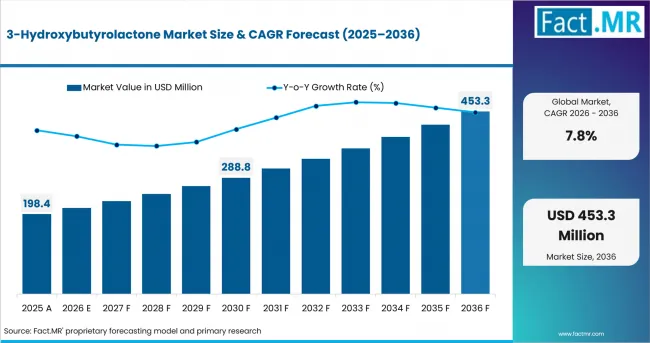
3 Hydroxybutyrolactone Market Value Analysis

Metric Details
Industry Size 2026 USD 213.9 million
Industry Value 2036 USD 453.3 million
CAGR 2026 to 2036 7.8%

Summary of 3-Hydroxybutyrolactone Market

  • Demand Drivers in the Market
    • Chiral Intermediate Need: API producers use 3-hydroxybutyrolactone in synthesis routes that need controlled stereo chemistry.
    • High-Purity Demand: Chemical users need high-purity grades because impurity control affects repeat reaction performance.
    • Bio-Based Route Interest: Bio-based production routes are gaining attention as chemical producers look for cleaner chiral intermediate supply.
  • Key Segments Analyzed
    • By Isomer Type: S-3-hydroxybutyrolactone is expected to hold 42.0% share in 2026 because many synthesis routes need chiral control.
    • By Purity Grade: Above 99% grades are likely to hold 48.0% share in 2026 because sensitive pharmaceutical synthesis needs high purity.
    • By Form: Liquid grades are projected to hold 76.0% share in 2026 because 3-HBL is commonly handled as a liquid reagent.
    • By Application: Pharmaceutical intermediates lead application demand with 58.0% share in 2026 due to chiral API route use.
    • By End User: Pharmaceutical manufacturers are expected to hold 46.0% share in 2026 because API synthesis remains the core use base.
    • By Geography: China leads the country outlook with 9.4% CAGR through 2036 as intermediate production expands.
  • Analyst Opinion at Fact.MR
    • Shambhu Nath Jha, Principal Consultant at Fact.MR, notes, “3-hydroxybutyrolactone is a small-volume chemical market with strict quality needs. Manufacturers do not select it only on price. Purity and repeat batch quality decide whether the material can enter regulated synthesis.”
  • Strategic Implications
    • Purity Control: Suppliers need tighter impurity documentation for API intermediate buyers.
    • Route Security: CDMOs should qualify backup sources before adding 3-HBL to regulated synthesis plans.
    • Technical Support: Producers must support quality records and handling data for sensitive chemical users.

3-hydroxybutyrolactone demand is becoming more purity-led. Manufacturers need material that supports drug intermediate synthesis with less separation work. A 2025 Chem article states that (S)-3-hydroxy-γ-butyrolactone is used in the synthesis of statins and other important drugs. [1] This keeps stereochemical quality central to supplier selection.

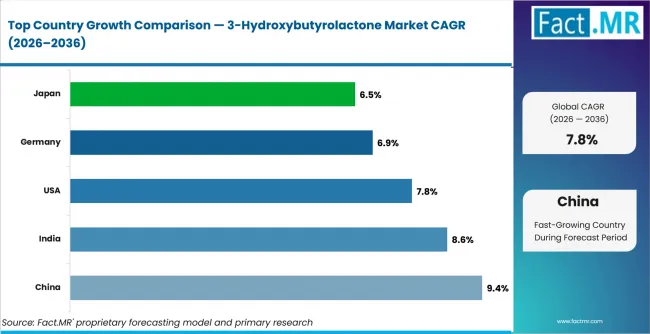
China is projected to record 9.4% CAGR from 2026 to 2036 as pharmaceutical intermediate production supports demand. India is likely to post 8.6% CAGR through 2036 because API synthesis and CDMO activity expand. The United States is expected to register 7.8% CAGR by 2036 as specialty chemical and pharma research use continues. Germany is forecast to advance at 6.9% CAGR from 2026 to 2036 as fine chemical users need verified chiral intermediates. Japan is set to record 6.5% CAGR by 2036 as high-purity reagent and pharmaceutical synthesis use stays steady.

Segmental Analysis

3-Hydroxybutyrolactone Market Analysis by Isomer Type
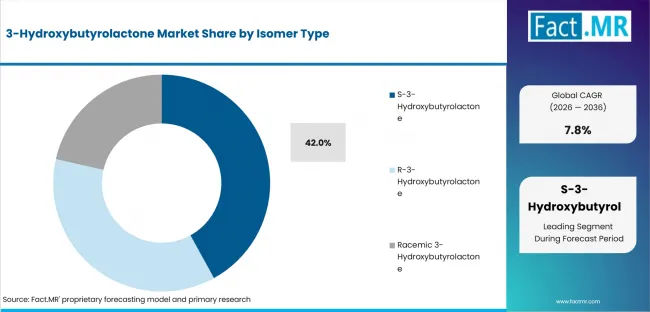
3 Hydroxybutyrolactone Market Analysis By Isomer Type

S-3-hydroxybutyrolactone is expected to hold 42.0% share in 2026 because drug synthesis needs defined stereochemistry. R-isomer grades serve selected asymmetric synthesis routes. Racemic grades support research and fine chemical work.

  • S-Isomer Demand: S-isomer grades help API makers protect chirality during sensitive synthesis and validation steps.
  • R-Isomer Use: R-isomer supply supports route-specific synthesis needs for selected fine chemical buyers.
  • Racemic Access: Racemic material helps research teams test pathways before switching to chiral grades.

3-Hydroxybutyrolactone Market Analysis by Purity Grade
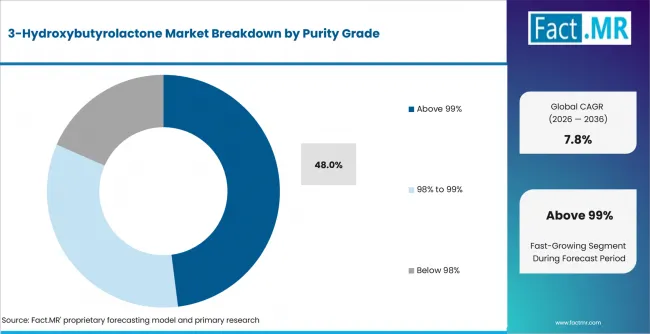
3 Hydroxybutyrolactone Market Analysis By Purity Grade

High-purity grades carry most commercial value because regulated synthesis needs tighter impurity control. Lower grades are used only in processes that can tolerate more variation. Above 99% grades are likely to hold 48.0% share in 2026 as API intermediate users demand better batch consistency.

  • High Purity: Above 99% grades reduce rework risk for buyers using sensitive synthesis routes.
  • Mid Purity: 98% to 99% grades suit fine chemical users with moderate specification pressure.
  • Lower Grade: Below 98% grades fit early research work and less demanding route screening.

3-Hydroxybutyrolactone Market Analysis by Form
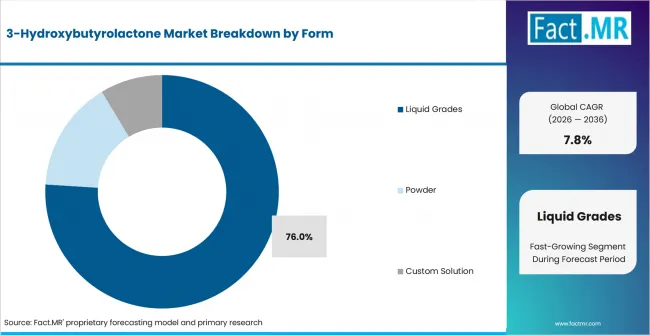
3 Hydroxybutyrolactone Market Analysis By Form

Liquid grades remain the main commercial form because 3-hydroxybutyrolactone is usually supplied as a liquid reagent. Custom solutions support users that need easier dosing into validated routes. Powder forms are limited and depend on derivative or formulated supply. Liquid grades are projected to hold 76.0% share in 2026 because direct handling fits synthesis workflows.

  • Liquid Handling: Liquid grades support direct dosing into reaction systems with fewer preparation steps.
  • Custom Solution: Custom solutions help CDMOs simplify controlled addition during batch-scale synthesis.
  • Specialty Format: Powder or formulated supply serves projects needing specific storage or transport conditions.

3-Hydroxybutyrolactone Market Analysis by Application
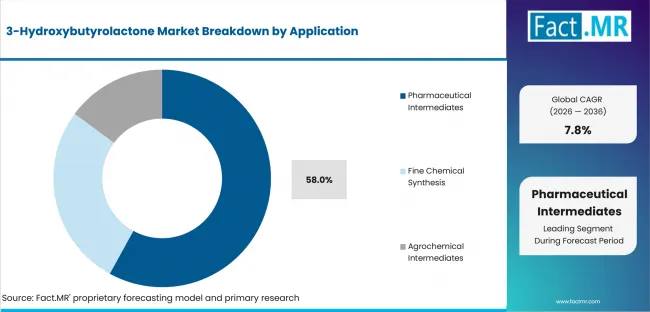
3 Hydroxybutyrolactone Market Analysis By Application

Pharmaceutical intermediates lead because 3-HBL supports chiral synthesis routes for high-value drugs. Fu et al. stated in 2025 that optically active 3-hydroxy-γ-butyrolactone serves as a key chiral synthon in organic synthesis and medicinal chemistry [2]. Fine chemical synthesis uses the molecule for stereospecific building block needs. Pharmaceutical intermediates are anticipated to capture 58.0% share in 2026 as drug route development keeps demand concentrated.

  • API Routes: Pharmaceutical synthesis uses 3-HBL to introduce chirality into selected molecule pathways.
  • Fine Chemicals: Fine chemical producers use 3-HBL when route design needs lactone functionality.
  • Research Reagents: Research labs use small volumes for reaction screening and method development.

3-Hydroxybutyrolactone Market Analysis by End User

3 Hydroxybutyrolactone Market Analysis By End User

Pharmaceutical manufacturers are expected to hold 46.0% share in 2026 because API intermediate synthesis remains the main use base. CDMOs need qualified material for customer projects. Specialty chemical producers use 3-HBL for chiral and lactone chemistry. Research institutes use smaller volumes. Agrochemical manufacturers remain selective because route economics guide adoption.

  • Pharma Use: Pharmaceutical manufacturers need verified stereochemistry before using 3-HBL in API routes.
  • CDMO Demand: CDMOs require reliable suppliers that can support repeat batches and audit needs.
  • Research Base: Institutes use 3-HBL for synthesis studies and early route screening.

3-Hydroxybutyrolactone Market Drivers, Restraints, and Opportunities

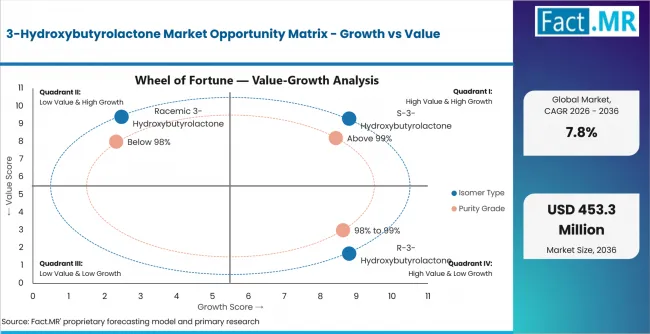
3 Hydroxybutyrolactone Market Opportunity Matrix Growth Vs Value

Chiral synthesis demand is the main driver for 3-hydroxybutyrolactone. Corti et al. stated in 2025 that 3-hydroxy-γ-butyrolactone is a chiral building block involved in the production of different active pharmaceutical ingredients [3]. Pharmaceutical producers need intermediates that help build stereochemically defined compounds.

Scale and qualification are the main restraints. The market is small compared with bulk solvents. Users often need purity records before changing suppliers. Some grades are sold through specialty chemical channels at small volumes.

Opportunities in the 3-Hydroxybutyrolactone Market

  • Bio-Based HBL: Producers can explore glucose-based routes for buyers reviewing lower-emission intermediate sourcing.
  • High-Purity Supply: Suppliers can target API users that need stronger chiral quality documentation.
  • CDMO Support: Chemical firms can serve CDMOs with custom pack sizes and batch traceability.

Regional Analysis

Based on regional analysis, the 3-hydroxybutyrolactone market is segmented into North America, Latin America, Europe, East Asia, South Asia & Oceania and Middle East and Africa.

Top Country Growth Comparison 3 Hydroxybutyrolactone Market Cagr (2026 2036)

Country CAGR 2026 to 2036
China 9.4%
India 8.6%
United States 7.8%
Germany 6.9%
Japan 6.5%

3 Hydroxybutyrolactone Market Cagr Analysis By Country

East Asia 3-Hydroxybutyrolactone Market Analysis

East Asia demand comes from pharmaceutical intermediates and specialty chemical production. China leads regional adoption because local chemical producers serve domestic and export synthesis demand. Japan supports high-purity reagent use through research and pharmaceutical development.

  • China: China is projected to record 9.4% CAGR from 2026 to 2036 as pharmaceutical intermediate production expands. Local specialty chemical producers can support lower-cost supply. Mnaufacturers still need consistent purity and stereochemical records. Suppliers with repeat batch reliability will gain better access.
  • Japan: Japan has steady demand from pharmaceutical research and high-purity reagent users. Chemical manufacturers value documentation and controlled material quality. Japan is set to record 6.5% CAGR through 2036 as regulated synthesis and research demand continue. Supplier reputation will shape customer retention.

South Asia & Oceania 3-Hydroxybutyrolactone Market Analysis

South Asia demand is supported by API manufacturing and contract synthesis. India leads regional demand because CDMOs and pharmaceutical manufacturers use chiral intermediates in route development.

  • India: India API and CDMO base supports demand for 3-hydroxybutyrolactone in regulated synthesis. Mnaufacturers need reliable chiral intermediates for route development. India is likely to post 8.6% CAGR over the study period as pharmaceutical outsourcing expands. Suppliers with audit-ready documentation will gain stronger demand.

North America 3-Hydroxybutyrolactone Market Analysis
3 Hydroxybutyrolactone Market Country Value Analysis

North America demand is led by the United States through pharmaceutical research and specialty synthesis. Users need small-volume high-purity supply over commodity chemical shipments.

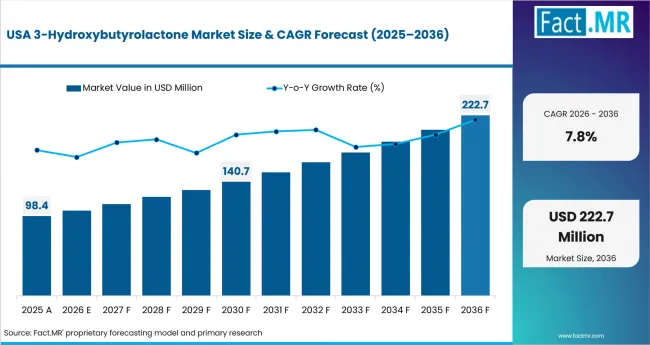
  • United States: The United States has a large pharma research base and specialty chemical user group. Chiral synthesis work will support demand for 3-hydroxybutyrolactone. The United States is forecast to grow at 7.8% CAGR from 2026 to 2036. Users will focus on supplier qualification and traceability. Smaller pack sizes will support lab-scale use.

Europe 3-Hydroxybutyrolactone Market Analysis

3 Hydroxybutyrolactone Market Europe Country Market Share Analysis, 2026 & 2036

Europe demand comes from regulated pharmaceutical synthesis and high-quality specialty chemical sourcing. Germany leads through fine chemical and pharma development demand. European buyers will prioritize documentation and impurity control.

  • Germany: Germany fine chemical and pharmaceutical base supports demand for high-purity 3-HBL. Buyers need verified grades for synthesis and route testing. Germany is forecast to advance at 6.9% CAGR over the forecast period as specialty synthesis demand continues. Technical documentation will remain a key purchase filter.

Competitive Aligners for Market Suppliers
3 Hydroxybutyrolactone Market Analysis By Company

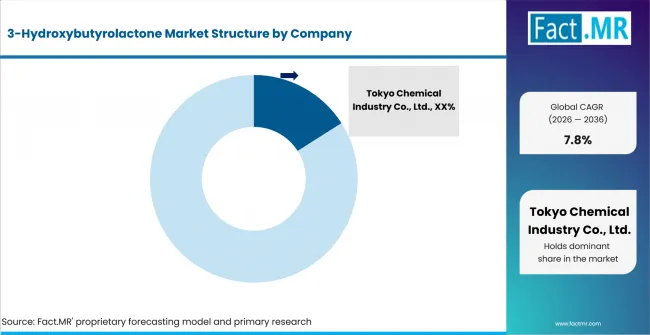
The 3-hydroxybutyrolactone market is supported by reagent suppliers and specialty chemical companies. Tokyo Chemical Industry Co. Ltd. serves research and synthesis users. TCI provides product documentation for (R)-(+)-α-Hydroxy-γ-butyrolactone. Merck KGaA and Thermo Fisher Scientific Inc. bring wider catalog access and strong documentation systems. Alfa Chemistry and LGC Standards (TRC) support specialty supply and reference material needs.

Vendor selection will depend on purity level and stereochemical reliability. API users will look for repeat batches with clear certificates. Research users will prefer small packs and fast dispatch. Steady supply will be important because chiral intermediates need close batch control.

Competition will depend on quality records and route support. Large suppliers can gain from catalog reach and trusted documents. Suppliers with weak batch history will stay focused on early research demand by 2036.

Key Companies in 3-Hydroxybutyrolactone Market

  • Tokyo Chemical Industry Co., Ltd.
  • Merck KGaA
  • Thermo Fisher Scientific Inc.
  • Alfa Chemistry
  • LGC Standards (TRC)

Bibliography

  • [1] Waters, J. O. P., Jamalzade, E., Abdulrazzaq, H. T., Kuch, N., Gunukula, S., Dumesic, J. A., Kersten, P. J., & Schwartz, T. J. (2025, December 11). Production of biorenewable, enantiopure (S)-3-hydroxy-γ-butyrolactone for pharmaceutical applications. Chem.
  • [2] Fu, H.-K., Lu, T.-Q., Zuo, M.-C., Da, X.-Y., Wang, H.-H., Chen, Y.-Z., & Wan, N.-W. (2025). Artificial biocatalytic cascades for the enantiocomplementary synthesis of 3-hydroxy-γ-butyrolactones. Green Chemistry, 27, 10194–10204.
  • [3] Corti, M., Princiotto, S., Zuccolo, M., Beretta, G., Dallavalle, S., Pinto, A., Annunziata, F., & Borgonovo, G. (2025, June). Valorization of saffron waste as a natural source of 3-hydroxy-γ-butyrolactone, a valuable chiral building block for pharmaceutical applications. Tetrahedron Green Chemistry, 5, Article 100069.
  • [4] Patriarca, A., Saccoccio, M., Bortolami, M., Toniolo, C., Vicario, G., Serafini, I., Attisani, A., De Rosa, M., Spagnoli, M., De Vita, D., Santi, L., & Sciubba, F. (2026). From field to lab: Exploring the phytochemical potential of Calabrian saffron (Crocus sativus L.) biowaste. Agronomy, 16(4), Article 485.

This Report Addresses

  • grade, form, application and end user.
  • Forecast mapping from USD 213.9 million in 2026 to USD 453.3 million by 2036.
  • Segment analysis covering S-3-HBL, above 99% purity, liquid form, pharmaceutical intermediates and pharma users.
  • Regional outlook covering China, India, the United States, Germany and Japan.
  • Competitive analysis of Tokyo Chemical Industry Co., Ltd., Merck KGaA, Thermo Fisher Scientific Inc., Alfa Chemistry, LGC Standards (TRC).
  • Product assessment covering chiral 3-HBL, racemic 3-HBL, high-purity grades and custom synthesis supply.
  • Primary interviews, supplier checks, official source review and synthesis-route validation support the forecast.

3-Hydroxybutyrolactone Market Definition

The 3-hydroxybutyrolactone market covers chiral and racemic hydroxy lactone compounds used as intermediates in pharmaceutical synthesis and fine chemical production. It includes S-isomer and R-isomer grades. The market is distinct from gamma-butyrolactone because 3-hydroxybutyrolactone carries a hydroxyl group that supports chiral synthesis routes.

3-Hydroxybutyrolactone Market Inclusions

The scope includes S-3-hydroxybutyrolactone and R-3-hydroxybutyrolactone. Racemic grades are included when sold for synthesis or research use. Liquid grades and high-purity custom solutions are included.

3-Hydroxybutyrolactone Market Exclusions

The scope excludes gamma-butyrolactone and 3-hydroxybutyric acid. It also excludes finished APIs and finished pharmaceutical products. Research samples with no commercial supply record are excluded from market sizing. Finished agrochemicals and polymer products are outside scope because the market tracks the intermediate chemical.

3-Hydroxybutyrolactone Market Research Methodology

  • Primary Research
    • Primary research includes interviews with API intermediate buyers and fine chemical producers across regulated synthesis projects.
  • Desk Research
    • Desk research reviews product certificates and official chemical records with supplier data sheets for market validation.
  • Market-Sizing and Forecasting
    • Forecasting uses purity demand and application adoption with end-user qualification cycles across specialty synthesis.
  • Data Validation and Update Cycle
    • Forecasts are validated through supplier checks and technical buyer feedback with batch-level quality evidence.

Scope of the Report

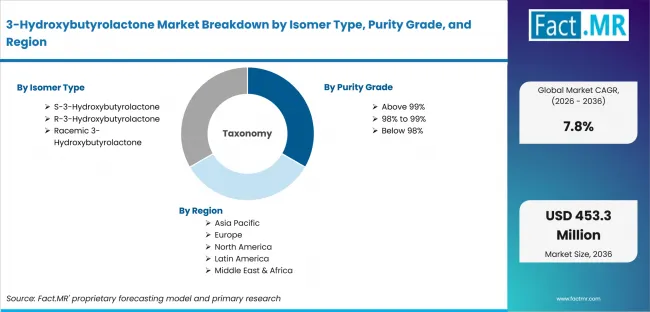
3 Hydroxybutyrolactone Market Breakdown By Isomer Type, Purity Grade, And Region

Attribute Details
Quantitative Units USD 213.9 million in 2026 to USD 453.3 million by 2036 at 7.8% CAGR
Market Definition Chiral and racemic hydroxy lactone intermediates used in pharmaceutical and fine chemical synthesis
Isomer Type S-3-Hydroxybutyrolactone, R-3-Hydroxybutyrolactone, Racemic 3-Hydroxybutyrolactone
Purity Grade Above 99%, 98% to 99%, Below 98%
Form Liquid, Powder, Custom Solution
Application Pharmaceutical Intermediates, Fine Chemical Synthesis, Agrochemical Intermediates, Polymer Intermediates, Research Reagents
End User Pharmaceutical Manufacturers, CDMOs, Specialty Chemical Producers, Research Institutes, Agrochemical Manufacturers
Regions Covered North America, Latin America, Europe, East Asia, South Asia & Oceania, Middle East and Africa
Countries Covered China, India, United States, Germany, Japan
Key Companies Profiled Tokyo Chemical Industry Co., Ltd., Merck KGaA, Thermo Fisher Scientific Inc., Alfa Chemistry, LGC Standards (TRC)
Forecast Period 2026 to 2036
Approach Hybrid top-down and bottom-up approach using isomer demand, purity grade use, form demand, application uptake and end-user validation

3-Hydroxybutyrolactone Market Analysis by Segments

  • By Isomer Type:

    • S-3-Hydroxybutyrolactone
    • R-3-Hydroxybutyrolactone
    • Racemic 3-Hydroxybutyrolactone
  • By Purity Grade:

    • Above 99%
    • 98% to 99%
    • Below 98%
  • By Form:

    • Liquid
    • Powder
    • Custom Solution
  • By Application:

    • Pharmaceutical Intermediates
    • Fine Chemical Synthesis
    • Agrochemical Intermediates
    • Polymer Intermediates
    • Research Reagents
  • By End User:

    • Pharmaceutical Manufacturers
    • CDMOs
    • Specialty Chemical Producers
    • Research Institutes
    • Agrochemical Manufacturers
  • Region:

    • North America
      • United States
      • Canada
    • Europe
      • Germany
      • United Kingdom
      • France
      • Italy
      • Spain
    • Asia Pacific
      • China
      • Japan
      • South Korea
      • Taiwan
      • Singapore
    • Latin America
      • Brazil
      • Mexico
      • Argentina
    • Middle East & Africa
      • GCC Countries
      • South Africa
      • Israel

- Frequently Asked Questions -

What is the 3-Hydroxybutyrolactone Market size in 2026?

The 3-hydroxybutyrolactone market is estimated to reach USD 213.9 million in 2026 as chiral intermediate demand expands.

What will the 3-Hydroxybutyrolactone Market be worth by 2036?

The market is projected to reach USD 453.3 million by 2036 as pharmaceutical synthesis demand increases.

What CAGR is projected for the 3-Hydroxybutyrolactone Market?

The 3-hydroxybutyrolactone market is forecast to record 7.8% CAGR from 2026 to 2036.

Which isomer type leads the market?

S-3-hydroxybutyrolactone leads with 42.0% share in 2026 because many drug synthesis routes need chiral control.

Which country is expected to expand fastest in the market?

China is projected to record 9.4% CAGR through 2036 as pharmaceutical intermediate production expands.

How does India perform in the market?

India is likely to post 8.6% CAGR through 2036 as API and CDMO activity expands.

What is the main driver in the market?

The main driver is chiral synthesis demand. Pharmaceutical producers need intermediates that support stereochemically defined routes.

What is the main restraint in the market?

The main restraint is supplier qualification. Buyers need purity and stereochemical records before switching sources.

Why is S-3-hydroxybutyrolactone important?

S-3-hydroxybutyrolactone is important because it supports drug synthesis routes that need defined chirality.

Why is high purity important?

High purity is important because impurities can affect route yield and regulated intermediate approval.

Table of Content

  1. Executive Summary
    • Global Market Outlook
    • Demand to side Trends
    • Supply to side Trends
    • Technology Roadmap Analysis
    • Analysis and Recommendations
  2. Market Overview
    • Market Coverage / Taxonomy
    • Market Definition / Scope / Limitations
  3. Research Methodology
    • Chapter Orientation
    • Analytical Lens and Working Hypotheses
      • Market Structure, Signals, and Trend Drivers
      • Benchmarking and Cross-market Comparability
      • Market Sizing, Forecasting, and Opportunity Mapping
    • Research Design and Evidence Framework
      • Desk Research Programme (Secondary Evidence)
        • Company Annual and Sustainability Reports
        • Peer-reviewed Journals and Academic Literature
        • Corporate Websites, Product Literature, and Technical Notes
        • Earnings Decks and Investor Briefings
        • Statutory Filings and Regulatory Disclosures
        • Technical White Papers and Standards Notes
        • Trade Journals, Industry Magazines, and Analyst Briefs
        • Conference Proceedings, Webinars, and Seminar Materials
        • Government Statistics Portals and Public Data Releases
        • Press Releases and Reputable Media Coverage
        • Specialist Newsletters and Curated Briefings
        • Sector Databases and Reference Repositories
        • Fact.MR Internal Proprietary Databases and Historical Market Datasets
        • Subscription Datasets and Paid Sources
        • Social Channels, Communities, and Digital Listening Inputs
        • Additional Desk Sources
      • Expert Input and Fieldwork (Primary Evidence)
        • Primary Modes
          • Qualitative Interviews and Expert Elicitation
          • Quantitative Surveys and Structured Data Capture
          • Blended Approach
        • Why Primary Evidence is Used
        • Field Techniques
          • Interviews
          • Surveys
          • Focus Groups
          • Observational and In-context Research
          • Social and Community Interactions
        • Stakeholder Universe Engaged
          • C-suite Leaders
          • Board Members
          • Presidents and Vice Presidents
          • R&D and Innovation Heads
          • Technical Specialists
          • Domain Subject-matter Experts
          • Scientists
          • Physicians and Other Healthcare Professionals
        • Governance, Ethics, and Data Stewardship
          • Research Ethics
          • Data Integrity and Handling
      • Tooling, Models, and Reference Databases
    • Data Engineering and Model Build
      • Data Acquisition and Ingestion
      • Cleaning, Normalisation, and Verification
      • Synthesis, Triangulation, and Analysis
    • Quality Assurance and Audit Trail
  4. Market Background
    • Market Dynamics
      • Drivers
      • Restraints
      • Opportunity
      • Trends
    • Scenario Forecast
      • Demand in Optimistic Scenario
      • Demand in Likely Scenario
      • Demand in Conservative Scenario
    • Opportunity Map Analysis
    • Product Life Cycle Analysis
    • Supply Chain Analysis
    • Investment Feasibility Matrix
    • Value Chain Analysis
    • PESTLE and Porter’s Analysis
    • Regulatory Landscape
    • Regional Parent Market Outlook
    • Production and Consumption Statistics
    • Import and Export Statistics
  5. Global Market Analysis 2021 to 2025 and Forecast, 2026 to 2036
    • Historical Market Size Value (USD Million) Analysis, 2021 to 2025
    • Current and Future Market Size Value (USD Million) Projections, 2026 to 2036
      • Y to o to Y Growth Trend Analysis
      • Absolute $ Opportunity Analysis
  6. Global Market Pricing Analysis 2021 to 2025 and Forecast 2026 to 2036
  7. Global Market Analysis 2021 to 2025 and Forecast 2026 to 2036, By Service Type
    • Introduction / Key Findings
    • Historical Market Size Value (USD Million) Analysis By Service Type , 2021 to 2025
    • Current and Future Market Size Value (USD Million) Analysis and Forecast By Service Type , 2026 to 2036
      • 3D Imaging Measurement Services
      • 3D Mapping Services
      • 3D Visualization Services
    • Y to o to Y Growth Trend Analysis By Service Type , 2021 to 2025
    • Absolute $ Opportunity Analysis By Service Type , 2026 to 2036
  8. Global Market Analysis 2021 to 2025 and Forecast 2026 to 2036, By Technology
    • Introduction / Key Findings
    • Historical Market Size Value (USD Million) Analysis By Technology, 2021 to 2025
    • Current and Future Market Size Value (USD Million) Analysis and Forecast By Technology, 2026 to 2036
      • Laser Scanning
      • Structured Light Imaging
      • Time-of-Flight (ToF)
    • Y to o to Y Growth Trend Analysis By Technology, 2021 to 2025
    • Absolute $ Opportunity Analysis By Technology, 2026 to 2036
  9. Global Market Analysis 2021 to 2025 and Forecast 2026 to 2036, By Deployment Mode
    • Introduction / Key Findings
    • Historical Market Size Value (USD Million) Analysis By Deployment Mode, 2021 to 2025
    • Current and Future Market Size Value (USD Million) Analysis and Forecast By Deployment Mode, 2026 to 2036
      • On-site Services
      • Remote Services
      • Hybrid Services
    • Y to o to Y Growth Trend Analysis By Deployment Mode, 2021 to 2025
    • Absolute $ Opportunity Analysis By Deployment Mode, 2026 to 2036
  10. Global Market Analysis 2021 to 2025 and Forecast 2026 to 2036, By End-use Industry
    • Introduction / Key Findings
    • Historical Market Size Value (USD Million) Analysis By End-use Industry, 2021 to 2025
    • Current and Future Market Size Value (USD Million) Analysis and Forecast By End-use Industry, 2026 to 2036
      • Construction & Infrastructure
      • Manufacturing
      • Automotive
    • Y to o to Y Growth Trend Analysis By End-use Industry, 2021 to 2025
    • Absolute $ Opportunity Analysis By End-use Industry, 2026 to 2036
  11. Global Market Analysis 2021 to 2025 and Forecast 2026 to 2036, By Application
    • Introduction / Key Findings
    • Historical Market Size Value (USD Million) Analysis By Application, 2021 to 2025
    • Current and Future Market Size Value (USD Million) Analysis and Forecast By Application, 2026 to 2036
      • Site Surveying & Mapping
      • Asset Documentation
      • Quality Inspection
    • Y to o to Y Growth Trend Analysis By Application, 2021 to 2025
    • Absolute $ Opportunity Analysis By Application, 2026 to 2036
  12. Global Market Analysis 2021 to 2025 and Forecast 2026 to 2036, By Region
    • Introduction
    • Historical Market Size Value (USD Million) Analysis By Region, 2021 to 2025
    • Current Market Size Value (USD Million) Analysis and Forecast By Region, 2026 to 2036
      • North America
      • Latin America
      • Western Europe
      • Eastern Europe
      • East Asia
      • South Asia and Pacific
      • Middle East & Africa
    • Market Attractiveness Analysis By Region
  13. North America Market Analysis 2021 to 2025 and Forecast 2026 to 2036, By Country
    • Historical Market Size Value (USD Million) Trend Analysis By Market Taxonomy, 2021 to 2025
    • Market Size Value (USD Million) Forecast By Market Taxonomy, 2026 to 2036
      • By Country
        • USA
        • Canada
        • Mexico
      • By Service Type
      • By Technology
      • By Deployment Mode
      • By End-use Industry
      • By Application
    • Market Attractiveness Analysis
      • By Country
      • By Service Type
      • By Technology
      • By Deployment Mode
      • By End-use Industry
      • By Application
    • Key Takeaways
  14. Latin America Market Analysis 2021 to 2025 and Forecast 2026 to 2036, By Country
    • Historical Market Size Value (USD Million) Trend Analysis By Market Taxonomy, 2021 to 2025
    • Market Size Value (USD Million) Forecast By Market Taxonomy, 2026 to 2036
      • By Country
        • Brazil
        • Chile
        • Rest of Latin America
      • By Service Type
      • By Technology
      • By Deployment Mode
      • By End-use Industry
      • By Application
    • Market Attractiveness Analysis
      • By Country
      • By Service Type
      • By Technology
      • By Deployment Mode
      • By End-use Industry
      • By Application
    • Key Takeaways
  15. Western Europe Market Analysis 2021 to 2025 and Forecast 2026 to 2036, By Country
    • Historical Market Size Value (USD Million) Trend Analysis By Market Taxonomy, 2021 to 2025
    • Market Size Value (USD Million) Forecast By Market Taxonomy, 2026 to 2036
      • By Country
        • Germany
        • UK
        • Italy
        • Spain
        • France
        • Nordic
        • BENELUX
        • Rest of Western Europe
      • By Service Type
      • By Technology
      • By Deployment Mode
      • By End-use Industry
      • By Application
    • Market Attractiveness Analysis
      • By Country
      • By Service Type
      • By Technology
      • By Deployment Mode
      • By End-use Industry
      • By Application
    • Key Takeaways
  16. Eastern Europe Market Analysis 2021 to 2025 and Forecast 2026 to 2036, By Country
    • Historical Market Size Value (USD Million) Trend Analysis By Market Taxonomy, 2021 to 2025
    • Market Size Value (USD Million) Forecast By Market Taxonomy, 2026 to 2036
      • By Country
        • Russia
        • Poland
        • Hungary
        • Balkan & Baltic
        • Rest of Eastern Europe
      • By Service Type
      • By Technology
      • By Deployment Mode
      • By End-use Industry
      • By Application
    • Market Attractiveness Analysis
      • By Country
      • By Service Type
      • By Technology
      • By Deployment Mode
      • By End-use Industry
      • By Application
    • Key Takeaways
  17. East Asia Market Analysis 2021 to 2025 and Forecast 2026 to 2036, By Country
    • Historical Market Size Value (USD Million) Trend Analysis By Market Taxonomy, 2021 to 2025
    • Market Size Value (USD Million) Forecast By Market Taxonomy, 2026 to 2036
      • By Country
        • China
        • Japan
        • South Korea
      • By Service Type
      • By Technology
      • By Deployment Mode
      • By End-use Industry
      • By Application
    • Market Attractiveness Analysis
      • By Country
      • By Service Type
      • By Technology
      • By Deployment Mode
      • By End-use Industry
      • By Application
    • Key Takeaways
  18. South Asia and Pacific Market Analysis 2021 to 2025 and Forecast 2026 to 2036, By Country
    • Historical Market Size Value (USD Million) Trend Analysis By Market Taxonomy, 2021 to 2025
    • Market Size Value (USD Million) Forecast By Market Taxonomy, 2026 to 2036
      • By Country
        • India
        • ASEAN
        • Australia & New Zealand
        • Rest of South Asia and Pacific
      • By Service Type
      • By Technology
      • By Deployment Mode
      • By End-use Industry
      • By Application
    • Market Attractiveness Analysis
      • By Country
      • By Service Type
      • By Technology
      • By Deployment Mode
      • By End-use Industry
      • By Application
    • Key Takeaways
  19. Middle East & Africa Market Analysis 2021 to 2025 and Forecast 2026 to 2036, By Country
    • Historical Market Size Value (USD Million) Trend Analysis By Market Taxonomy, 2021 to 2025
    • Market Size Value (USD Million) Forecast By Market Taxonomy, 2026 to 2036
      • By Country
        • Kingdom of Saudi Arabia
        • Other GCC Countries
        • Turkiye
        • South Africa
        • Other African Union
        • Rest of Middle East & Africa
      • By Service Type
      • By Technology
      • By Deployment Mode
      • By End-use Industry
      • By Application
    • Market Attractiveness Analysis
      • By Country
      • By Service Type
      • By Technology
      • By Deployment Mode
      • By End-use Industry
      • By Application
    • Key Takeaways
  20. Key Countries Market Analysis
    • USA
      • Pricing Analysis
      • Market Share Analysis, 2025
        • By Service Type
        • By Technology
        • By Deployment Mode
        • By End-use Industry
        • By Application
    • Canada
      • Pricing Analysis
      • Market Share Analysis, 2025
        • By Service Type
        • By Technology
        • By Deployment Mode
        • By End-use Industry
        • By Application
    • Mexico
      • Pricing Analysis
      • Market Share Analysis, 2025
        • By Service Type
        • By Technology
        • By Deployment Mode
        • By End-use Industry
        • By Application
    • Brazil
      • Pricing Analysis
      • Market Share Analysis, 2025
        • By Service Type
        • By Technology
        • By Deployment Mode
        • By End-use Industry
        • By Application
    • Chile
      • Pricing Analysis
      • Market Share Analysis, 2025
        • By Service Type
        • By Technology
        • By Deployment Mode
        • By End-use Industry
        • By Application
    • Germany
      • Pricing Analysis
      • Market Share Analysis, 2025
        • By Service Type
        • By Technology
        • By Deployment Mode
        • By End-use Industry
        • By Application
    • UK
      • Pricing Analysis
      • Market Share Analysis, 2025
        • By Service Type
        • By Technology
        • By Deployment Mode
        • By End-use Industry
        • By Application
    • Italy
      • Pricing Analysis
      • Market Share Analysis, 2025
        • By Service Type
        • By Technology
        • By Deployment Mode
        • By End-use Industry
        • By Application
    • Spain
      • Pricing Analysis
      • Market Share Analysis, 2025
        • By Service Type
        • By Technology
        • By Deployment Mode
        • By End-use Industry
        • By Application
    • France
      • Pricing Analysis
      • Market Share Analysis, 2025
        • By Service Type
        • By Technology
        • By Deployment Mode
        • By End-use Industry
        • By Application
    • India
      • Pricing Analysis
      • Market Share Analysis, 2025
        • By Service Type
        • By Technology
        • By Deployment Mode
        • By End-use Industry
        • By Application
    • ASEAN
      • Pricing Analysis
      • Market Share Analysis, 2025
        • By Service Type
        • By Technology
        • By Deployment Mode
        • By End-use Industry
        • By Application
    • Australia & New Zealand
      • Pricing Analysis
      • Market Share Analysis, 2025
        • By Service Type
        • By Technology
        • By Deployment Mode
        • By End-use Industry
        • By Application
    • China
      • Pricing Analysis
      • Market Share Analysis, 2025
        • By Service Type
        • By Technology
        • By Deployment Mode
        • By End-use Industry
        • By Application
    • Japan
      • Pricing Analysis
      • Market Share Analysis, 2025
        • By Service Type
        • By Technology
        • By Deployment Mode
        • By End-use Industry
        • By Application
    • South Korea
      • Pricing Analysis
      • Market Share Analysis, 2025
        • By Service Type
        • By Technology
        • By Deployment Mode
        • By End-use Industry
        • By Application
    • Russia
      • Pricing Analysis
      • Market Share Analysis, 2025
        • By Service Type
        • By Technology
        • By Deployment Mode
        • By End-use Industry
        • By Application
    • Poland
      • Pricing Analysis
      • Market Share Analysis, 2025
        • By Service Type
        • By Technology
        • By Deployment Mode
        • By End-use Industry
        • By Application
    • Hungary
      • Pricing Analysis
      • Market Share Analysis, 2025
        • By Service Type
        • By Technology
        • By Deployment Mode
        • By End-use Industry
        • By Application
    • Kingdom of Saudi Arabia
      • Pricing Analysis
      • Market Share Analysis, 2025
        • By Service Type
        • By Technology
        • By Deployment Mode
        • By End-use Industry
        • By Application
    • Turkiye
      • Pricing Analysis
      • Market Share Analysis, 2025
        • By Service Type
        • By Technology
        • By Deployment Mode
        • By End-use Industry
        • By Application
    • South Africa
      • Pricing Analysis
      • Market Share Analysis, 2025
        • By Service Type
        • By Technology
        • By Deployment Mode
        • By End-use Industry
        • By Application
  21. Market Structure Analysis
    • Competition Dashboard
    • Competition Benchmarking
    • Market Share Analysis of Top Players
      • By Regional
      • By Service Type
      • By Technology
      • By Deployment Mode
      • By End-use Industry
      • By Application
  22. Competition Analysis
    • Competition Deep Dive
      • Hexagon AB
        • Overview
        • Product Portfolio
        • Profitability by Market Segments (Product/Age /Sales Channel/Region)
        • Sales Footprint
        • Strategy Overview
          • Marketing Strategy
          • Product Strategy
          • Channel Strategy
      • FARO Technologies, Inc.
      • Trimble Inc.
      • Topcon Corporation
  23. Assumptions & Acronyms Used

List Of Table

  • Table 1: Global Market Value (USD Million) Forecast by Region, 2021 to 2036
  • Table 2: Global Market Value (USD Million) Forecast by Service Type, 2021 to 2036
  • Table 3: Global Market Value (USD Million) Forecast by Technology, 2021 to 2036
  • Table 4: Global Market Value (USD Million) Forecast by Deployment Mode, 2021 to 2036
  • Table 5: Global Market Value (USD Million) Forecast by End-use Industry, 2021 to 2036
  • Table 6: Global Market Value (USD Million) Forecast by Application, 2021 to 2036
  • Table 7: North America Market Value (USD Million) Forecast by Country, 2021 to 2036
  • Table 8: North America Market Value (USD Million) Forecast by Service Type, 2021 to 2036
  • Table 9: North America Market Value (USD Million) Forecast by Technology, 2021 to 2036
  • Table 10: North America Market Value (USD Million) Forecast by Deployment Mode, 2021 to 2036
  • Table 11: North America Market Value (USD Million) Forecast by End-use Industry, 2021 to 2036
  • Table 12: North America Market Value (USD Million) Forecast by Application, 2021 to 2036
  • Table 13: Latin America Market Value (USD Million) Forecast by Country, 2021 to 2036
  • Table 14: Latin America Market Value (USD Million) Forecast by Service Type, 2021 to 2036
  • Table 15: Latin America Market Value (USD Million) Forecast by Technology, 2021 to 2036
  • Table 16: Latin America Market Value (USD Million) Forecast by Deployment Mode, 2021 to 2036
  • Table 17: Latin America Market Value (USD Million) Forecast by End-use Industry, 2021 to 2036
  • Table 18: Latin America Market Value (USD Million) Forecast by Application, 2021 to 2036
  • Table 19: Western Europe Market Value (USD Million) Forecast by Country, 2021 to 2036
  • Table 20: Western Europe Market Value (USD Million) Forecast by Service Type, 2021 to 2036
  • Table 21: Western Europe Market Value (USD Million) Forecast by Technology, 2021 to 2036
  • Table 22: Western Europe Market Value (USD Million) Forecast by Deployment Mode, 2021 to 2036
  • Table 23: Western Europe Market Value (USD Million) Forecast by End-use Industry, 2021 to 2036
  • Table 24: Western Europe Market Value (USD Million) Forecast by Application, 2021 to 2036
  • Table 25: Eastern Europe Market Value (USD Million) Forecast by Country, 2021 to 2036
  • Table 26: Eastern Europe Market Value (USD Million) Forecast by Service Type, 2021 to 2036
  • Table 27: Eastern Europe Market Value (USD Million) Forecast by Technology, 2021 to 2036
  • Table 28: Eastern Europe Market Value (USD Million) Forecast by Deployment Mode, 2021 to 2036
  • Table 29: Eastern Europe Market Value (USD Million) Forecast by End-use Industry, 2021 to 2036
  • Table 30: Eastern Europe Market Value (USD Million) Forecast by Application, 2021 to 2036
  • Table 31: East Asia Market Value (USD Million) Forecast by Country, 2021 to 2036
  • Table 32: East Asia Market Value (USD Million) Forecast by Service Type, 2021 to 2036
  • Table 33: East Asia Market Value (USD Million) Forecast by Technology, 2021 to 2036
  • Table 34: East Asia Market Value (USD Million) Forecast by Deployment Mode, 2021 to 2036
  • Table 35: East Asia Market Value (USD Million) Forecast by End-use Industry, 2021 to 2036
  • Table 36: East Asia Market Value (USD Million) Forecast by Application, 2021 to 2036
  • Table 37: South Asia and Pacific Market Value (USD Million) Forecast by Country, 2021 to 2036
  • Table 38: South Asia and Pacific Market Value (USD Million) Forecast by Service Type, 2021 to 2036
  • Table 39: South Asia and Pacific Market Value (USD Million) Forecast by Technology, 2021 to 2036
  • Table 40: South Asia and Pacific Market Value (USD Million) Forecast by Deployment Mode, 2021 to 2036
  • Table 41: South Asia and Pacific Market Value (USD Million) Forecast by End-use Industry, 2021 to 2036
  • Table 42: South Asia and Pacific Market Value (USD Million) Forecast by Application, 2021 to 2036
  • Table 43: Middle East & Africa Market Value (USD Million) Forecast by Country, 2021 to 2036
  • Table 44: Middle East & Africa Market Value (USD Million) Forecast by Service Type, 2021 to 2036
  • Table 45: Middle East & Africa Market Value (USD Million) Forecast by Technology, 2021 to 2036
  • Table 46: Middle East & Africa Market Value (USD Million) Forecast by Deployment Mode, 2021 to 2036
  • Table 47: Middle East & Africa Market Value (USD Million) Forecast by End-use Industry, 2021 to 2036
  • Table 48: Middle East & Africa Market Value (USD Million) Forecast by Application, 2021 to 2036

List Of Figures

  • Figure 1: Global Market Pricing Analysis
  • Figure 2: Global Market Value (USD Million) Forecast 2021-2036
  • Figure 3: Global Market Value Share and BPS Analysis by Service Type, 2026 and 2036
  • Figure 4: Global Market Y-o-Y Growth Comparison by Service Type, 2026 to 2036
  • Figure 5: Global Market Attractiveness Analysis by Service Type
  • Figure 6: Global Market Value Share and BPS Analysis by Technology, 2026 and 2036
  • Figure 7: Global Market Y-o-Y Growth Comparison by Technology, 2026 to 2036
  • Figure 8: Global Market Attractiveness Analysis by Technology
  • Figure 9: Global Market Value Share and BPS Analysis by Deployment Mode, 2026 and 2036
  • Figure 10: Global Market Y-o-Y Growth Comparison by Deployment Mode, 2026 to 2036
  • Figure 11: Global Market Attractiveness Analysis by Deployment Mode
  • Figure 12: Global Market Value Share and BPS Analysis by End-use Industry, 2026 and 2036
  • Figure 13: Global Market Y-o-Y Growth Comparison by End-use Industry, 2026 to 2036
  • Figure 14: Global Market Attractiveness Analysis by End-use Industry
  • Figure 15: Global Market Value Share and BPS Analysis by Application, 2026 and 2036
  • Figure 16: Global Market Y-o-Y Growth Comparison by Application, 2026 to 2036
  • Figure 17: Global Market Attractiveness Analysis by Application
  • Figure 18: Global Market Value (USD Million) Share and BPS Analysis by Region, 2026 and 2036
  • Figure 19: Global Market Y-o-Y Growth Comparison by Region, 2026 to 2036
  • Figure 20: Global Market Attractiveness Analysis by Region
  • Figure 21: North America Market Incremental Dollar Opportunity, 2026 to 2036
  • Figure 22: Latin America Market Incremental Dollar Opportunity, 2026 to 2036
  • Figure 23: Western Europe Market Incremental Dollar Opportunity, 2026 to 2036
  • Figure 24: Eastern Europe Market Incremental Dollar Opportunity, 2026 to 2036
  • Figure 25: East Asia Market Incremental Dollar Opportunity, 2026 to 2036
  • Figure 26: South Asia and Pacific Market Incremental Dollar Opportunity, 2026 to 2036
  • Figure 27: Middle East & Africa Market Incremental Dollar Opportunity, 2026 to 2036
  • Figure 28: North America Market Value Share and BPS Analysis by Country, 2026 and 2036
  • Figure 29: North America Market Value Share and BPS Analysis by Service Type, 2026 and 2036
  • Figure 30: North America Market Y-o-Y Growth Comparison by Service Type, 2026 to 2036
  • Figure 31: North America Market Attractiveness Analysis by Service Type
  • Figure 32: North America Market Value Share and BPS Analysis by Technology, 2026 and 2036
  • Figure 33: North America Market Y-o-Y Growth Comparison by Technology, 2026 to 2036
  • Figure 34: North America Market Attractiveness Analysis by Technology
  • Figure 35: North America Market Value Share and BPS Analysis by Deployment Mode, 2026 and 2036
  • Figure 36: North America Market Y-o-Y Growth Comparison by Deployment Mode, 2026 to 2036
  • Figure 37: North America Market Attractiveness Analysis by Deployment Mode
  • Figure 38: North America Market Value Share and BPS Analysis by End-use Industry, 2026 and 2036
  • Figure 39: North America Market Y-o-Y Growth Comparison by End-use Industry, 2026 to 2036
  • Figure 40: North America Market Attractiveness Analysis by End-use Industry
  • Figure 41: North America Market Value Share and BPS Analysis by Application, 2026 and 2036
  • Figure 42: North America Market Y-o-Y Growth Comparison by Application, 2026 to 2036
  • Figure 43: North America Market Attractiveness Analysis by Application
  • Figure 44: Latin America Market Value Share and BPS Analysis by Country, 2026 and 2036
  • Figure 45: Latin America Market Value Share and BPS Analysis by Service Type, 2026 and 2036
  • Figure 46: Latin America Market Y-o-Y Growth Comparison by Service Type, 2026 to 2036
  • Figure 47: Latin America Market Attractiveness Analysis by Service Type
  • Figure 48: Latin America Market Value Share and BPS Analysis by Technology, 2026 and 2036
  • Figure 49: Latin America Market Y-o-Y Growth Comparison by Technology, 2026 to 2036
  • Figure 50: Latin America Market Attractiveness Analysis by Technology
  • Figure 51: Latin America Market Value Share and BPS Analysis by Deployment Mode, 2026 and 2036
  • Figure 52: Latin America Market Y-o-Y Growth Comparison by Deployment Mode, 2026 to 2036
  • Figure 53: Latin America Market Attractiveness Analysis by Deployment Mode
  • Figure 54: Latin America Market Value Share and BPS Analysis by End-use Industry, 2026 and 2036
  • Figure 55: Latin America Market Y-o-Y Growth Comparison by End-use Industry, 2026 to 2036
  • Figure 56: Latin America Market Attractiveness Analysis by End-use Industry
  • Figure 57: Latin America Market Value Share and BPS Analysis by Application, 2026 and 2036
  • Figure 58: Latin America Market Y-o-Y Growth Comparison by Application, 2026 to 2036
  • Figure 59: Latin America Market Attractiveness Analysis by Application
  • Figure 60: Western Europe Market Value Share and BPS Analysis by Country, 2026 and 2036
  • Figure 61: Western Europe Market Value Share and BPS Analysis by Service Type, 2026 and 2036
  • Figure 62: Western Europe Market Y-o-Y Growth Comparison by Service Type, 2026 to 2036
  • Figure 63: Western Europe Market Attractiveness Analysis by Service Type
  • Figure 64: Western Europe Market Value Share and BPS Analysis by Technology, 2026 and 2036
  • Figure 65: Western Europe Market Y-o-Y Growth Comparison by Technology, 2026 to 2036
  • Figure 66: Western Europe Market Attractiveness Analysis by Technology
  • Figure 67: Western Europe Market Value Share and BPS Analysis by Deployment Mode, 2026 and 2036
  • Figure 68: Western Europe Market Y-o-Y Growth Comparison by Deployment Mode, 2026 to 2036
  • Figure 69: Western Europe Market Attractiveness Analysis by Deployment Mode
  • Figure 70: Western Europe Market Value Share and BPS Analysis by End-use Industry, 2026 and 2036
  • Figure 71: Western Europe Market Y-o-Y Growth Comparison by End-use Industry, 2026 to 2036
  • Figure 72: Western Europe Market Attractiveness Analysis by End-use Industry
  • Figure 73: Western Europe Market Value Share and BPS Analysis by Application, 2026 and 2036
  • Figure 74: Western Europe Market Y-o-Y Growth Comparison by Application, 2026 to 2036
  • Figure 75: Western Europe Market Attractiveness Analysis by Application
  • Figure 76: Eastern Europe Market Value Share and BPS Analysis by Country, 2026 and 2036
  • Figure 77: Eastern Europe Market Value Share and BPS Analysis by Service Type, 2026 and 2036
  • Figure 78: Eastern Europe Market Y-o-Y Growth Comparison by Service Type, 2026 to 2036
  • Figure 79: Eastern Europe Market Attractiveness Analysis by Service Type
  • Figure 80: Eastern Europe Market Value Share and BPS Analysis by Technology, 2026 and 2036
  • Figure 81: Eastern Europe Market Y-o-Y Growth Comparison by Technology, 2026 to 2036
  • Figure 82: Eastern Europe Market Attractiveness Analysis by Technology
  • Figure 83: Eastern Europe Market Value Share and BPS Analysis by Deployment Mode, 2026 and 2036
  • Figure 84: Eastern Europe Market Y-o-Y Growth Comparison by Deployment Mode, 2026 to 2036
  • Figure 85: Eastern Europe Market Attractiveness Analysis by Deployment Mode
  • Figure 86: Eastern Europe Market Value Share and BPS Analysis by End-use Industry, 2026 and 2036
  • Figure 87: Eastern Europe Market Y-o-Y Growth Comparison by End-use Industry, 2026 to 2036
  • Figure 88: Eastern Europe Market Attractiveness Analysis by End-use Industry
  • Figure 89: Eastern Europe Market Value Share and BPS Analysis by Application, 2026 and 2036
  • Figure 90: Eastern Europe Market Y-o-Y Growth Comparison by Application, 2026 to 2036
  • Figure 91: Eastern Europe Market Attractiveness Analysis by Application
  • Figure 92: East Asia Market Value Share and BPS Analysis by Country, 2026 and 2036
  • Figure 93: East Asia Market Value Share and BPS Analysis by Service Type, 2026 and 2036
  • Figure 94: East Asia Market Y-o-Y Growth Comparison by Service Type, 2026 to 2036
  • Figure 95: East Asia Market Attractiveness Analysis by Service Type
  • Figure 96: East Asia Market Value Share and BPS Analysis by Technology, 2026 and 2036
  • Figure 97: East Asia Market Y-o-Y Growth Comparison by Technology, 2026 to 2036
  • Figure 98: East Asia Market Attractiveness Analysis by Technology
  • Figure 99: East Asia Market Value Share and BPS Analysis by Deployment Mode, 2026 and 2036
  • Figure 100: East Asia Market Y-o-Y Growth Comparison by Deployment Mode, 2026 to 2036
  • Figure 101: East Asia Market Attractiveness Analysis by Deployment Mode
  • Figure 102: East Asia Market Value Share and BPS Analysis by End-use Industry, 2026 and 2036
  • Figure 103: East Asia Market Y-o-Y Growth Comparison by End-use Industry, 2026 to 2036
  • Figure 104: East Asia Market Attractiveness Analysis by End-use Industry
  • Figure 105: East Asia Market Value Share and BPS Analysis by Application, 2026 and 2036
  • Figure 106: East Asia Market Y-o-Y Growth Comparison by Application, 2026 to 2036
  • Figure 107: East Asia Market Attractiveness Analysis by Application
  • Figure 108: South Asia and Pacific Market Value Share and BPS Analysis by Country, 2026 and 2036
  • Figure 109: South Asia and Pacific Market Value Share and BPS Analysis by Service Type, 2026 and 2036
  • Figure 110: South Asia and Pacific Market Y-o-Y Growth Comparison by Service Type, 2026 to 2036
  • Figure 111: South Asia and Pacific Market Attractiveness Analysis by Service Type
  • Figure 112: South Asia and Pacific Market Value Share and BPS Analysis by Technology, 2026 and 2036
  • Figure 113: South Asia and Pacific Market Y-o-Y Growth Comparison by Technology, 2026 to 2036
  • Figure 114: South Asia and Pacific Market Attractiveness Analysis by Technology
  • Figure 115: South Asia and Pacific Market Value Share and BPS Analysis by Deployment Mode, 2026 and 2036
  • Figure 116: South Asia and Pacific Market Y-o-Y Growth Comparison by Deployment Mode, 2026 to 2036
  • Figure 117: South Asia and Pacific Market Attractiveness Analysis by Deployment Mode
  • Figure 118: South Asia and Pacific Market Value Share and BPS Analysis by End-use Industry, 2026 and 2036
  • Figure 119: South Asia and Pacific Market Y-o-Y Growth Comparison by End-use Industry, 2026 to 2036
  • Figure 120: South Asia and Pacific Market Attractiveness Analysis by End-use Industry
  • Figure 121: South Asia and Pacific Market Value Share and BPS Analysis by Application, 2026 and 2036
  • Figure 122: South Asia and Pacific Market Y-o-Y Growth Comparison by Application, 2026 to 2036
  • Figure 123: South Asia and Pacific Market Attractiveness Analysis by Application
  • Figure 124: Middle East & Africa Market Value Share and BPS Analysis by Country, 2026 and 2036
  • Figure 125: Middle East & Africa Market Value Share and BPS Analysis by Service Type, 2026 and 2036
  • Figure 126: Middle East & Africa Market Y-o-Y Growth Comparison by Service Type, 2026 to 2036
  • Figure 127: Middle East & Africa Market Attractiveness Analysis by Service Type
  • Figure 128: Middle East & Africa Market Value Share and BPS Analysis by Technology, 2026 and 2036
  • Figure 129: Middle East & Africa Market Y-o-Y Growth Comparison by Technology, 2026 to 2036
  • Figure 130: Middle East & Africa Market Attractiveness Analysis by Technology
  • Figure 131: Middle East & Africa Market Value Share and BPS Analysis by Deployment Mode, 2026 and 2036
  • Figure 132: Middle East & Africa Market Y-o-Y Growth Comparison by Deployment Mode, 2026 to 2036
  • Figure 133: Middle East & Africa Market Attractiveness Analysis by Deployment Mode
  • Figure 134: Middle East & Africa Market Value Share and BPS Analysis by End-use Industry, 2026 and 2036
  • Figure 135: Middle East & Africa Market Y-o-Y Growth Comparison by End-use Industry, 2026 to 2036
  • Figure 136: Middle East & Africa Market Attractiveness Analysis by End-use Industry
  • Figure 137: Middle East & Africa Market Value Share and BPS Analysis by Application, 2026 and 2036
  • Figure 138: Middle East & Africa Market Y-o-Y Growth Comparison by Application, 2026 to 2036
  • Figure 139: Middle East & Africa Market Attractiveness Analysis by Application
  • Figure 140: Global Market - Tier Structure Analysis
  • Figure 141: Global Market - Company Share Analysis

3-Hydroxybutyrolactone Market