- Market Value (2025): USD 15.0 Bn
- Estimated Value (2026): USD 15.8 Bn
- Forecast Value (2036): USD 27.7 Bn
- CAGR (2026-2036): 5.8%
What is the Actuated Valves Market forecast to be worth by 2036?
USD 15.8 billion in 2026 to USD 27.7 billion by 2036 at a 5.8% CAGR.
- The actuated valves market was valued at USD 15.0 billion in 2025, with oil and gas operators and water utilities placing most orders.
- Revenue will advance from USD 15.8 billion in 2026 to USD 27.7 billion by 2036 as manual valves on older lines give way to motorized units.
- Annual growth will hold at 5.8% CAGR between 2026 and 2036, since remote operation and plant automation keep spreading across process industries.
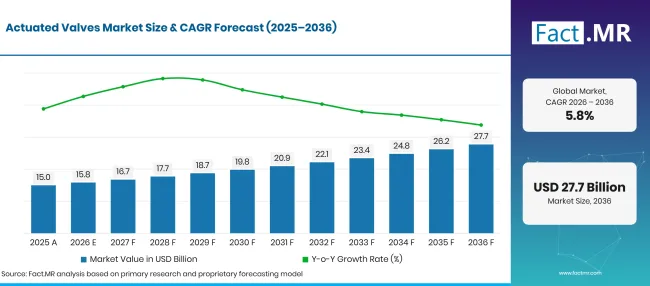
Actuated Valves Market Forecast Global | Source: Fact.MR
| Year | Basis | Market Value (USD billion) |
|---|---|---|
| 2025 | Actual | 15.0 |
| 2026 | Estimate | 15.8 |
| 2036 | Forecast | 27.7 |
| CAGR 2026 to 2036 | Forecast period | 5.8% |
Source: Fact.MR analysis. Updated Oct 26, 2026
What are the defining numbers behind Actuated Valves Market growth?
USD 11.9 billion in fresh revenue will open up from 2026 to 2036, drawn mostly from electric actuation and oil and gas duty.
- Demand Drivers in the Market
- Many industrial valves are still turned by hand. Plants that automate process control fit electric actuators to these valves so operators can open, close and throttle them from a control room.
- Oil and gas operators keep spending on the upkeep and debottlenecking of existing fields, pipelines and terminals. The International Energy Agency put upstream oil and gas investment at just under USD 570 billion in 2025, about 4% lower than in 2024 [1]. Even a softer capital cycle leaves a large installed base of wellhead, pipeline and process valves that need actuator replacement.
- Ageing water networks, lead pipe replacement and treatment plant upgrades are driving utility orders for automated isolation and control valves. Utilities also add actuators at pumping stations so that remote sites can run without a full-time crew.
- Chemical processing and power generation call for precise valve positioning on steam, feedwater and reactor lines. Nuclear restarts and new gas turbines bring added demand for qualified actuators with long service records.
- Connected actuators report torque, stroke time and fault data back to plant systems, which supports predictive maintenance. In August 2025, the U.S. Environmental Protection Agency published a report calling for a holistic approach to cybersecurity in the water sector [2]. Utilities now ask suppliers to show that networked actuators meet these security expectations.
- Key Segments Analyzed
- By Actuation Type: Electric Actuated Valves will hold 38.2% share in 2026, as they position accurately and connect directly to digital control systems.
- By Valve Type: Ball Valves will account for 34.0% share in 2026, given their tight shutoff and quick quarter-turn action on pipelines and process lines.
- By Application: Oil & Gas will capture 28.4% share in 2026 through remote isolation duties at wellheads, pipelines and processing plants.
- Analyst Opinion at Fact.MR
- Shambhu Nath Jha, Principal Consultant at Fact.MR, states, “Plant owners want valves they can operate and check from a control room, and that wish now drives most actuator orders. Electric units will gain ground wherever compressed air is costly to supply, while pneumatic units will hold their place in fast-acting safety duty. Suppliers that pair a valve with a matched actuator, diagnostics and field service will win the long replacement contracts.”
- Strategic Implications
- Valve manufacturers should match electric, pneumatic and hydraulic actuation to the pressure and cycle demands of each application, since a mismatched actuator shortens valve life.
- Automation companies should connect actuated valves with plant control platforms and fault detection tools that cut unplanned downtime.
- Suppliers to municipal water projects should offer long service lives and maintenance contracts that fit how treatment plants and distribution networks budget.
- Distributors and service firms should stock spare parts locally and train technicians to retrofit actuators onto valves already in the line.
Brazil will lead the five at 6.9% CAGR, helped by sanitation expansion and offshore oil output. Japan follows at 6.5%, where reactor restarts and industrial water renewal call for qualified valves. The United States will post 5.6%, with record crude output and lead pipe removal keeping utilities and producers active. A 5.1% rate for the United Kingdom reflects a large water investment program for ageing mains. Germany trails at 4.6% as weaker industrial output slows new plant spending.
How does the Actuated Valves Market break down by segment?
Electric Actuated Valves will lead Actuation Type at 38.2%; Ball Valves will head Valve Type at 34.0%; Oil & Gas will top Application at 28.4%.
Which Actuation Type dominates?
Electric Actuated Valves take 38.2% of 2026 revenue.
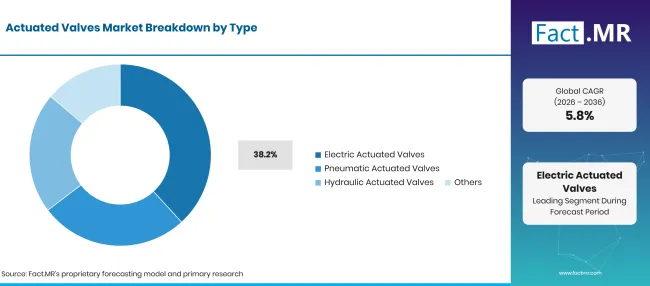
Actuated Valves Market Breakdown Type | Source: Fact.MR
| Actuation Type | Share (2026) |
|---|---|
| Electric Actuated Valves (Leading segment) | 38.2% |
| Other segments combined | 61.8%* |
| Total | 100.0% |
Source: Fact.MR analysis. Updated Oct 26, 2026
Facilities that need exact positioning and remote operation are moving to motor-driven actuators. These units run without compressed air, which suits sites where electrical supply and digital control are already in place. Selection still depends on torque, duty cycle, operating conditions and how often a valve must move. Power networks are expanding the field for electric actuation. The International Energy Agency reported that grid spending runs at about USD 400 billion a year [1]. Pneumatic valves remain common in plants with compressed-air networks and in fail-safe duty, and the control valve is often paired with pneumatic positioners. Hydraulic units serve heavy-force jobs such as large pipeline valves.
What leads the Valve Type segment?
Ball Valves represent 34.0% of 2026 sales.
| Valve Type | Share (2026) |
|---|---|
| Ball Valves (Leading segment) | 34.0% |
| Other segments combined | 66.0%* |
| Total | 100.0% |
Source: Fact.MR analysis. Updated Oct 26, 2026
Pipeline and gas operators favor ball valves for tight shutoff and a short quarter-turn stroke that a compact actuator can drive. Gas exports add new pipeline and terminal duty. The U.S. Energy Information Administration reported that U.S. LNG exports averaged 15.1 Bcf/d in 2025, up 26% from 2024 [3]. Butterfly valves suit large water lines at lower cost per inch of bore, and the high performance butterfly valve has moved into process duty. Globe, gate and plug designs serve throttling and isolation work across the wider industrial valve base.
What supports Oil & Gas within Application?
Oil & Gas holds 28.4% of 2026 value.
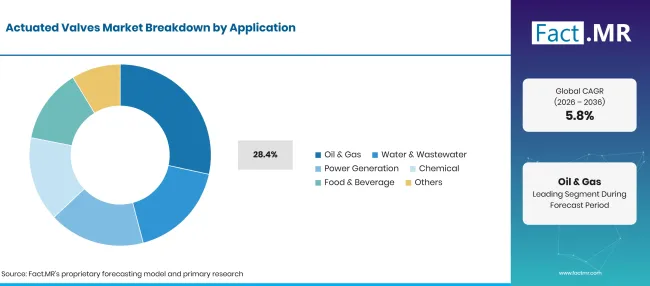
Actuated Valves Market Breakdown Application | Source: Fact.MR
| Application | Share (2026) |
|---|---|
| Oil & Gas (Leading segment) | 28.4% |
| Other segments combined | 71.6%* |
| Total | 100.0% |
Source: Fact.MR analysis. Updated Oct 26, 2026
Hazardous areas and remote sites make manual valve operation slow and risky for crews. Producers use actuated valves to isolate wells, manage flow and protect equipment across production sites, pipelines, storage and processing plants. Pressure, temperature and fluid properties set the choice of valve and actuator. Subsea and high-pressure lines often rely on fluid power, and the hydraulic valve remains standard on many wellhead control panels. Water and wastewater form the next application group, followed by power generation, chemical, and food and beverage plants.
What is accelerating Actuated Valves Market adoption, and what is holding it back?
Plant automation, infrastructure renewal and the push for remote operation are drawing more buyers toward actuated valves. High installation cost, integration work and ongoing upkeep hold purchases back where manual valves still do the job.
Drivers Impact Analysis
|
DRIVER |
(~) % IMPACT ON CAGR |
GEOGRAPHIC RELEVANCE |
IMPACT TIMELINE |
|
Industrial facilities replacing manual valves with automated units for tighter process control and remote operation |
+1.6% |
Global |
Medium term (2-4 years) |
|
Municipal investment in water treatment, distribution networks and ageing pipe renewal |
+1.2% |
North America, Western Europe, Latin America |
Short term (<= 2 years) |
|
Upkeep and debottlenecking of oil and gas production, pipeline and processing assets |
+1.0% |
North America, Middle East & Africa, Latin America |
Medium term (2-4 years) |
|
Connected actuators for equipment monitoring and predictive maintenance |
+0.7% |
North America, Western Europe, East Asia |
Long term (>= 4 years) |
Source: Fact.MR analysis. Updated Oct 26, 2026
Opportunity Impact Analysis
|
OPPORTUNITY |
(~) % IMPACT ON CAGR |
GEOGRAPHIC RELEVANCE |
IMPACT TIMELINE |
|
Smart actuators offering remote diagnostics and condition monitoring |
+0.6% |
Global |
Medium term (2-4 years) |
|
Automated valve packages for municipal water treatment and distribution projects |
+0.4% |
Latin America, Western Europe, North America |
Medium term (2-4 years) |
|
Replacement of pneumatic or manual operation with electric actuation |
+0.3% |
Western Europe, North America, East Asia |
Long term (>= 4 years) |
|
Aftermarket servicing, retrofits and scheduled actuator replacement |
+0.2% |
Global |
Long term (>= 4 years) |
Source: Fact.MR analysis. Updated Oct 26, 2026
Restraints Impact Analysis
|
RESTRAINT |
(~) % IMPACT ON CAGR |
GEOGRAPHIC RELEVANCE |
IMPACT TIMELINE |
|
High upfront cost of actuators, controls and installation work |
-0.4% |
Global |
Short term (<= 2 years) |
|
Difficulty connecting modern actuators to legacy plant control systems |
-0.3% |
Global |
Medium term (2-4 years) |
|
Calibration, maintenance and specialist servicing expenses |
-0.2% |
Global |
Medium term (2-4 years) |
|
Delayed infrastructure projects and tight capital budgets in cost-sensitive markets |
-0.1% |
Latin America, Middle East & Africa |
Long term (>= 4 years) |
Source: Fact.MR analysis. Updated Oct 26, 2026
Which countries are scaling the Actuated Valves Market through 2036?
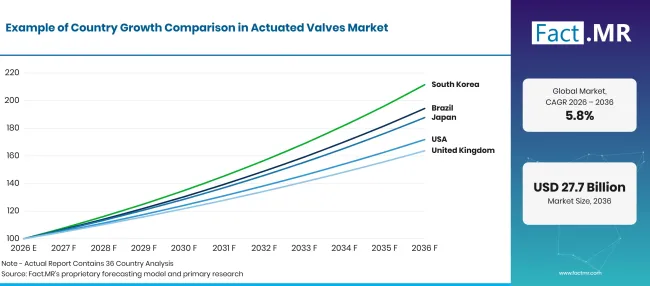
Actuated Valves Market Growth Index | Source: Fact.MR
| Country | CAGR (2026 to 2036) |
|---|---|
| Brazil | 6.9% |
| Japan | 6.5% |
| United States | 5.6% |
| United Kingdom | 5.1% |
| Germany | 4.6% |
Source: Fact.MR analysis. Updated Oct 26, 2026
What supports Brazil’s adoption?
6.9% CAGR, driven by sanitation projects and new offshore production units.
Sewer coverage still has room to grow in Brazil. IBGE reported that 70.4% of households had sewage drained through the general network or a connected septic tank in 2024, up from 68.1% in 2019 [4]. Each new treatment plant and pumping station adds actuated isolation and control valves. Offshore output also rose, with Petrobras producing 2.99 million barrels of oil equivalent per day in 2025, up 11% from 2024 [5].
How is Japan developing demand?
6.5% CAGR, reflecting nuclear restarts and renewal of industrial water systems.
Japan’s power sector is bringing idle reactors back into service. The Agency for Natural Resources and Energy reported that 14 reactors have been restarted [6]. Restarted units need qualified valves and actuators on cooling, feedwater and safety lines. Industrial waterworks operators are also renewing ageing pipes and strengthening facilities against earthquakes, which brings retrofit work for motor-operated valves.
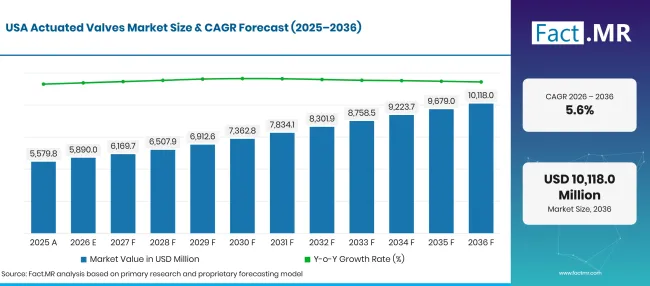
What is supporting the United States’ adoption?
5.6% CAGR, helped by record crude output and federal funding for lead pipe removal.
Actuated Valves Market Forecast Usa | Source: Fact.MR
The U.S. Energy Information Administration reported that U.S. crude oil production averaged a record 13.6 million barrels per day in 2025, up 3% from 2024 [7]. Production at this level keeps gathering lines and tank farms busy with valve automation. On the water side, the EPA announced USD 3 billion in new state funding in November 2025 and estimated that about 4 million lead service lines remain in use [8].
How is the United Kingdom scaling demand?
5.1% CAGR, as water companies deliver a five-year investment program.
The UK government’s 2026 water white paper describes a £104 billion investment program that the water sector will deliver between 2025 and 2030 [9]. The same paper notes that about 60% of water mains were built before 1981 [9]. Mains renewal, treatment upgrades and storm overflow work all require automated valves. Chemical and energy sites add steady industrial orders.
How does Germany perform?
4.6% CAGR, as industrial output softens and process plants defer new lines.
Germany’s industrial base still buys valves for automation and replacement, but new capacity is scarce. Destatis reported that industrial production fell 1.3% in 2025, while output in energy-intensive industries fell 2.6% [10]. Chemical and process plants are therefore focused on upgrades to existing lines. Water utilities and machine builders provide a steadier base of demand.
Who leads the Actuated Valves Market?
Competition splits into three camps. Valve-and-actuator groups such as Emerson, Flowserve and Crane sell complete assemblies to process plants and compete on breadth and engineering depth. Actuation specialists like Rotork win on torque range, diagnostics and service reach.
In February 2025, Rotork added multiport selector valve control to its IQ3 Pro electric actuators, allowing one valve to replace several actuated valves on wellhead skids [11]. Emerson extended its Fisher GX line in May 2025 with a bolted bonnet globe valve that lets technicians service the actuator without opening the valve body [12]. A third camp serves specific end users: SLB supplies valves and actuation for production and midstream lines, AVK focuses on water and gas networks, and Valmet sells Neles valves to process industries. Valmet signed a nationwide agreement in August 2025 to supply Neles valve, actuator and positioner parts to Petrobras [13]. Field service capacity and diagnostic data will separate the stronger suppliers through 2036.
Which companies are the key providers?
Key companies include Emerson Electric Co.; Flowserve Corporation; Crane Company; Rotork plc; SLB; AVK Group; and Valmet.
- Emerson Electric Co.
- Flowserve Corporation
- Crane Company
- Rotork plc
- SLB
- AVK Group
- Valmet
Bibliography
- [1] International Energy Agency. (2025, June 5). World Energy Investment 2025: Executive summary.
- [2] U.S. Environmental Protection Agency. (2025, August 4). Securing the Future of Water: Addressing Cyber Threats Today.
- [3] U.S. Energy Information Administration. (2026, July 14). Global liquefied natural gas trade volumes reached record high in 2025.
- [4] Instituto Brasileiro de Geografia e Estatística (IBGE). (2025, August 22). Coleta de lixo atende 93% dos domicílios, mas 4,7 milhões ainda queimam resíduos em 2024 [Waste collection serves 93% of households, but 4.7 million still burned waste in 2024].
- [5] Petrobras. (2026, January 16). Petrobras surpasses 2025 production targets.
- [6] Agency for Natural Resources and Energy, Japan. (2025, October 6). The Restart of Nuclear Power Plants: Why is it necessary? How is safety assured?.
- [7] U.S. Energy Information Administration. (2026, March 31). U.S. crude oil production rose in 2025, setting new record.
- [8] U.S. Environmental Protection Agency. (2025, November 25). EPA Announces $3 Billion in New Funding for States to Reduce Lead in Drinking Water.
- [9] Department for Environment, Food & Rural Affairs. (2026, February 19). A new vision for water.
- [10] Statistisches Bundesamt (Destatis). (2026, February 6). Produktion im Dezember 2025: -1,9 % zum Vormonat [Production in December 2025: -1.9% on the previous month].
- [11] Rotork. (2025, February 11). Rotork adds multiport selector valve control to the IQ3 Pro range.
- [12] Emerson. (2025, May 28). Emerson’s New Bolted Bonnet Valve Improves Maintenance for Critical Fluid Applications.
- [13] Valmet. (2025, August 11). Valmet signs a strategic agreement to deliver valve services to Petrobras in Brazil.
This Report Answers
- Revenue for actuated valves is split by actuation type, valve type and application.
- Readers learn why electric actuation, ball valves and oil and gas duty lead their segments in 2026.
- Water renewal, energy output and industrial activity frame the growth gap among the five listed countries.
- Supplier profiles group valve makers, actuation specialists and end-use focused firms by how they compete.
- Drivers, opportunities and restraints carry an estimated impact on the forecast growth rate.
What does the Actuated Valves Market cover?
This market takes in valves that open, close or regulate flow through a powered mechanism, without depending only on a handwheel or lever. Electric, pneumatic, hydraulic and other actuation methods are all counted.
Demand is tracked across oil and gas production and processing, water and wastewater treatment, power generation, chemical manufacturing, and food and beverage plants. Industrial sites form the main customer group, with commercial buildings and residential systems adding smaller volumes.
What is included in the scope?
Valve and actuator assemblies sold for new plants, upgrade projects and replacement of existing actuated valves are in scope. Integrated positioners, limit switches and local controls count when sold with the assembly.
Thermoplastic designs used in chemical dosing and water treatment, such as the actuated plastic valve, are counted alongside metal valves.
What is excluded from the scope?
This assessment leaves out manually operated valves without an actuator, as do standalone actuators sold without a valve. General automation hardware, controllers and software sold separately are also left out.
Self-acting devices such as the spring-loaded pressure relief valve are excluded, since they open on line pressure without an actuator. Spare parts and seals sold on their own are not counted.
How Was the Analysis Built?
The analysis draws on 120+ sources, 35+ company portfolios, 25+ countries, and more than 20 industry interviews.
- Primary Research: Primary research includes discussions with manufacturers, service providers, technology developers, distributors, end users, and subject-matter experts. These conversations examine purchasing priorities, product adoption, operational challenges, approval requirements, competitive positioning, and the factors that influence wider market acceptance.
- Desk Research: Desk research covers government statistics, regulatory publications, company filings, trade data, technical studies, industry associations, standards, public policy, and other authoritative sources. Every source used in the analysis is documented in the bibliography.
- Market Sizing and Forecasting: Market estimates combine historical performance, demand indicators, pricing and volume trends, segment shares, company participation, country-level growth, adoption patterns, investment activity, and barriers to market expansion.
- Data Validation and Update Cycle: Findings are validated by comparing primary interviews with public data, company activity, regulatory changes, trade patterns, and industry developments. Regular updates review new product launches, capacity changes, partnerships, approvals, and shifts in commercial adoption.
Segmentation
What is the report’s scope and coverage?
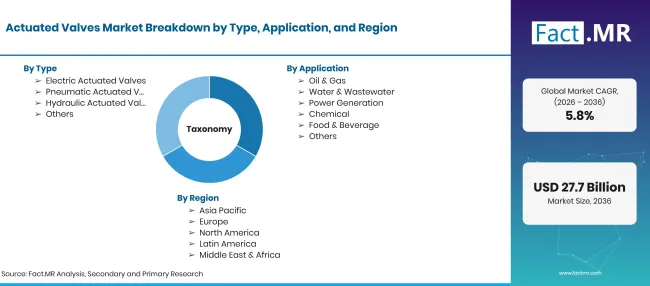
Actuated Valves Market Taxonomy | Source: Fact.MR
| Attribute | Details |
|---|---|
| Quantitative Units | USD billion in 2026 to USD billion by 2036 at CAGR |
| Market Definition | Valves fitted with electric, pneumatic, hydraulic or other powered actuators for automated or remote flow control. Revenue is counted for the valve and actuator sold as one assembly. |
| Actuation Type | Electric Actuated Valves; Pneumatic Actuated Valves; Hydraulic Actuated Valves; Others |
| Valve Type | Ball Valves; Butterfly Valves; Globe Valves; Gate Valves; Plug Valves; Others |
| Application | Oil & Gas; Water & Wastewater; Power Generation; Chemical; Food & Beverage; Others |
| Regions Covered | North America; Latin America; Western Europe; Eastern Europe; East Asia; South Asia & Pacific; Middle East & Africa |
| Countries Covered | Brazil; Japan; United States; United Kingdom; Germany |
| Companies Profiled | Emerson Electric Co.; Flowserve Corporation; Crane Company; Rotork plc; SLB; AVK Group; Valmet |
| Forecast Period | 2026 to 2036 |
| Approach | Top-down and bottom-up model built on installed valve bases by application, actuator retrofit rates, water and energy capital programs by country, and supplier portfolio review. |
Source: Fact.MR analysis. Updated Oct 26, 2026
How is the market segmented?
-
By Actuation Type
- Electric Actuated Valves
- Pneumatic Actuated Valves
- Hydraulic Actuated Valves
- Others
-
By Valve Type
- Ball Valves
- Butterfly Valves
- Globe Valves
- Gate Valves
- Plug Valves
- Others
-
By Application
- Oil & Gas
- Water & Wastewater
- Power Generation
- Chemical
- Food & Beverage
- Others
-
By Region
- North America
- Latin America
- Western Europe
- Eastern Europe
- East Asia
- South Asia & Pacific
- Middle East & Africa
Frequently Asked Questions
How big is the actuated valves market in 2026?
What is the CAGR of the actuated valves market from 2026 to 2036?
Which actuation type leads the actuated valves market?
Which valve type leads the actuated valves market?
Which application leads the actuated valves market?
Which country will grow the most in the actuated valves market?
Who are the main companies in the actuated valves market?
Who worked on this report


Preview the report firsthand - request a free sample
Free SampleGet the brochure for pricing and purchase details
Download PDF