- Market Value (2025): USD 335.8 Mn
- Estimated Value (2026): USD 410.0 Mn
- Forecast Value (2036): USD 3020.0 Mn
- CAGR (2026-2036): 22.1%
What is the EV Battery Coolant Control Valves Market forecast to be worth by 2036?
USD 410.0 million in 2026 to USD 3,020.0 million by 2036 at 22.1% CAGR.
- The EV battery coolant control valves market crossed a valuation of USD 335.8 million in 2025.
- Demand is projected to increase from USD 410.0 million in 2026 to USD 3,020.0 million by 2036.
- The market is forecast to record 22.1% CAGR from 2026 to 2036 as OEMs qualify multi-loop thermal systems for BEV platforms.
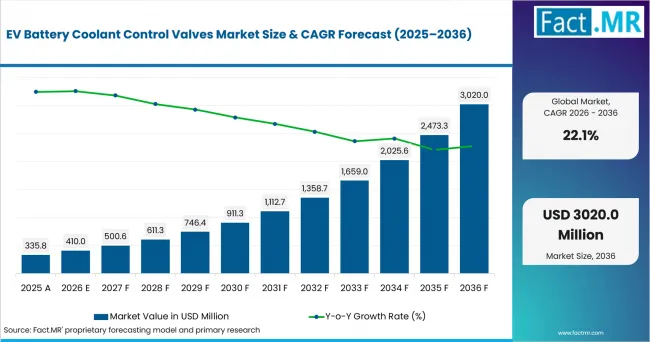
Ev Battery Coolant Control Valves Market Value Analysis | Source: Fact.MR
What are the defining numbers behind EV Battery Coolant Control Valves Market growth?
USD 2,610.0 million absolute opportunity by 2036, led by Multi-way rotary valves, Electric actuation and BEV platforms.
- Demand Drivers in the Market
- OEM thermal teams need valve architectures that simplify battery and heat-pump routing across shared coolant loops.
- The IEA reported in May 2026 that global electric car sales exceeded 20.0 million in 2025, equal to about one-quarter of car sales.
- Thermal module suppliers need valve blocks that connect coolant routing with heat-pump and refrigerant functions.
- Battery engineers are expected to favor actuated valves that support fast-charging preconditioning and pack temperature balance.
- Key Segments Analyzed
- By Valve Type: Multi-way rotary valves are expected to hold 43.0% share in 2026 owing to their ability to combine several coolant paths.
- By Actuation: Electric actuation is projected to account for 68.0% share in 2026 because software-controlled coolant routing supports EV thermal strategies.
- By Vehicle Type: BEV platforms are anticipated to capture 61.0% share in 2026 since battery-only drivetrains require dedicated thermal loops.
- By Sales Channel: OEM fitment is estimated to represent 78.0% share in 2026 due to factory-level validation and warranty control.
- Analyst Opinion at Fact.MR
- Shambhu Nath Jha, Principal Consultant at Fact.MR, states, "Coolant control valves are moving from small plumbing parts to platform-critical thermal devices. Production acceptance is expected to depend on leak performance, actuator repeatability and software-ready valve response. Suppliers should combine compact module design, cold-weather test evidence and launch support near EV assembly sites."
- Strategic Implications
- OEM engineering teams should test valve response with battery preconditioning cycles before platform freeze.
- Tier-1 suppliers should document actuator durability and coolant compatibility across the full launch test plan.
- Procurement teams should compare module value against single-valve pricing before late redesign cost appears.
- Investors should separate direct coolant-valve exposure from broader thermal claims without liquid routing control.
South Korea is forecast to post 24.2% CAGR through 2036 supported by EV sales growth and local thermal-system suppliers. Hungary is projected to record 24.0% CAGR as EV assembly becomes concentrated around Debrecen. The United States is expected to advance at 22.8% CAGR owing to battery-platform investment and regional sourcing. Japan is anticipated to reach 21.6% CAGR through hybrid-to-BEV thermal engineering. Germany is estimated to post 21.5% CAGR with strict validation near premium OEM programs. France is forecast to record 21.4% CAGR as highway charging access improves EV usability.
How does the EV Battery Coolant Control Valves Market break down by segment?
Multi-way rotary valves lead Valve Type at 43.0%; Electric actuation leads Actuation at 68.0%.
Which valve type dominates?
Multi-way rotary valves are projected to account for 43.0% share in 2026.
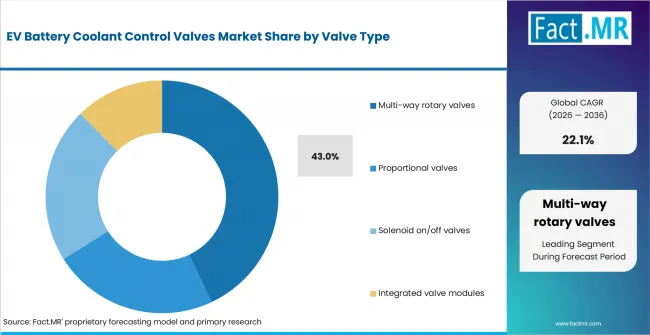
Ev Battery Coolant Control Valves Market Analysis By Valve Type | Source: Fact.MR
Multi-way rotary valves are expected to lead valve type revenue because they reduce the number of separate coolant routing devices. Proportional valves are projected to serve circuits that need variable flow during charging or cabin heating. Solenoid on/off valves are estimated to retain demand where simple isolation is enough. Integrated valve modules are anticipated to gain attention when OEMs want fewer hoses and shorter assembly time.
What leads the Actuation segment?
Electric actuation is expected to hold 68.0% share in 2026.
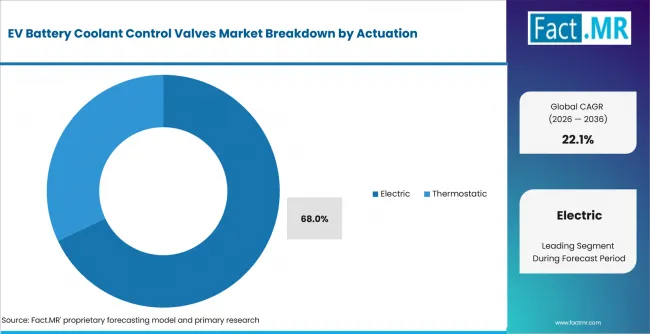
Ev Battery Coolant Control Valves Market Analysis By Actuation | Source: Fact.MR
Electric actuation is forecast to lead the actuation segment because software-controlled cooling is central to battery temperature control. Thermostatic actuation remains useful where a mechanical temperature response is acceptable. Bosch’s thermal management portfolio includes coolant proportional valves for complex switching control in preintegrated thermal modules. That product framing matches OEM interest in repeatable coolant-flow control.
How does Vehicle Type shape demand?
BEV platforms are anticipated to lead with 61.0% share in 2026.
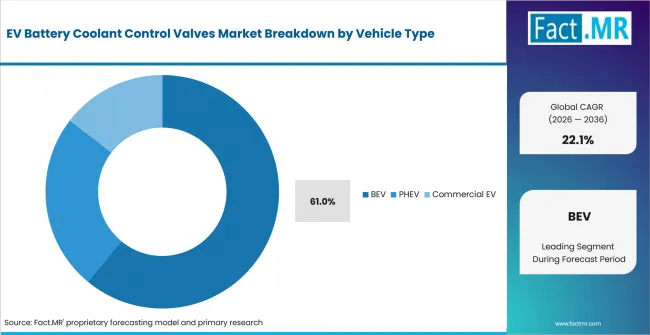
Ev Battery Coolant Control Valves Market Analysis By Vehicle Type | Source: Fact.MR
BEV platforms are anticipated to lead vehicle type demand since they rely on battery-only propulsion and stricter pack temperature control. PHEVs are expected to need coolant routing across mixed battery and engine operating modes. Commercial EVs are estimated to use fewer units at first but require durable valves for longer daily duty cycles. The IEA said in May 2026 that electric car sales are expected to reach 23.0 million in 2026.
What supports OEM within Sales Channel?
OEM sales are estimated to represent 78.0% share in 2026.
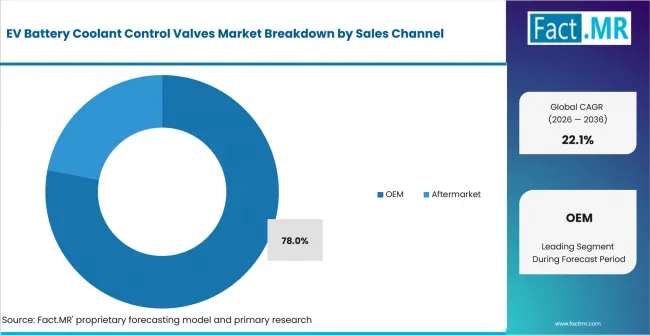
Ev Battery Coolant Control Valves Market Analysis By Sales Channel | Source: Fact.MR
OEM sales are projected to lead the channel mix because coolant valves are approved during vehicle platform design. Aftermarket demand is expected to form around replacement, crash repair and thermal-module service needs. Factory-fit modules are tested before launch so coolant valves can be approved with pumps, sensors and control software.
What is accelerating EV Battery Coolant Control Valves Market adoption, and what is holding it back?
BEV thermal integration drives it; validation cost restrains it.
Drivers Impact Analysis
| Driver | (~) % Impact on CAGR | Geographic Relevance | Impact Timeline |
|---|---|---|---|
| BEV platform thermal integration | +5.6% | Germany, United States, South Korea | Short term (<= 2 years) |
| Battery preconditioning needs | +4.7% | Cold-climate and fast-charging markets | Short term (<= 2 years) |
| Multi-loop heat-pump architectures | +4.1% | Europe and East Asia | Medium term (2-4 years) |
| OEM module consolidation | +3.2% | Germany, Hungary, France | Medium term (2-4 years) |
| Actuator and sensor integration | +2.4% | Global EV platforms | Long term (>= 4 years) |
Source: Fact.MR analysis. Updated Aug 18, 2026
- BEV platform thermal integration: EV battery packs need active coolant routing during charging, driving and cabin heating. Multi-way valves are expected to reduce hose count and simplify assembly at OEM plants.
- OEM module consolidation: Module sourcing is expected to favor suppliers that combine valves with pumps and sensors. MAHLE said in May 2025 that its BEV thermal system includes HVAC, cooling, controller and coolant pump content.
- Actuator and sensor integration: Electric valves are forecast to benefit from software-controlled thermal control. Battery monitoring explains why battery pack sensors remain adjacent to coolant control.
Opportunity Impact Analysis
| Opportunity | (~) % Impact on CAGR | Geographic Relevance | Impact Timeline |
|---|---|---|---|
| Integrated coolant modules | +2.0% | Germany, South Korea, Hungary | Medium term (2-4 years) |
| Cold-weather range protection | +1.5% | Japan, Germany, United States | Medium term (2-4 years) |
| Aftermarket thermal service | +1.1% | United States and Europe | Long term (>= 4 years) |
| Thermal manifold redesign | +0.8% | Europe and East Asia | Long term (>= 4 years) |
Source: Fact.MR analysis. Updated Aug 18, 2026
- Cold-weather range protection: Battery preheating and heat-pump operation are expected to increase the value of precise coolant routing. Adjacent battery conditioners show how thermal preparation is becoming a separate design need.
- Thermal manifold redesign: OEMs are anticipated to move toward fewer components around the pack. Related coolant circulation systems include valves as part of pumps, hoses and heat exchangers.
Restraints Impact Analysis
| Restraint | (~) % Impact on CAGR | Geographic Relevance | Impact Timeline |
|---|---|---|---|
| Leak-test burden | -2.1% | Global OEM programs | Short term (<= 2 years) |
| Software and actuator validation | -1.8% | Germany, Japan, United States | Short term (<= 2 years) |
| Cost pressure in mass-market EVs | -1.4% | France, United States, Hungary | Medium term (2-4 years) |
| Aftermarket identification risk | -0.9% | Europe and North America | Long term (>= 4 years) |
Source: Fact.MR analysis. Updated Aug 18, 2026
- Leak-test burden: Coolant valve approval is constrained by sealing performance under vibration and temperature cycling. Leakage risk can delay release.
- Software and actuator validation: Electric valves must respond repeatably to controller commands. Validation increases when one valve family serves several programs.
- Cost pressure in mass-market EVs: Affordable EV programs are expected to pressure valves and actuators. Suppliers must balance compact design with manufacturable parts.
Which countries are scaling EV Battery Coolant Control Valves Market fastest?
- The country comparison spans 2.80 percentage points and forms three practical growth bands across the forecast period.
- South Korea remains 0.18 percentage point above Hungary through EV sales growth and local thermal-system supply.
- Hungary remains 1.14 percentage points above the United States as new electric vehicle production concentrates in a smaller manufacturing base.
- The United States remains 1.22 percentage points above Japan through battery-platform investment and local thermal-module sourcing.
- Japan remains 0.11 percentage point above Germany as hybrid-to-BEV thermal know-how supports precision valve engineering.
- Germany remains 0.15 percentage point above France while Germany holds 26.0% listed country share.
- France closes the displayed range at 21.4% and holds 13.0% listed country share.
Comparable CAGRs create different entry conditions because EV assembly depth and supplier validation capability vary by country. Full coverage includes North America, Latin America, Europe, East Asia, South Asia and Pacific, Middle East and Africa.
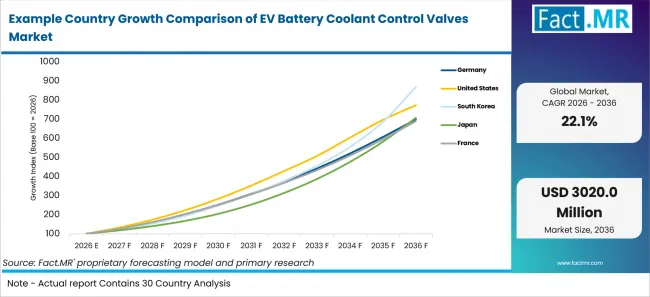
Example Country Growth Comparison Of Ev Battery Coolant Control Valves Market | Source: Fact.MR
| Country | CAGR (2026-2036) |
|---|---|
| South Korea | 24.2% |
| Hungary | 24.0% |
| United States | 22.8% |
| Japan | 21.6% |
| Germany | 21.5% |
| France | 21.4% |
Source: Fact.MR analysis. Updated Aug 18, 2026
What supports South Korea adoption?
24.2% CAGR, supported by EV sales growth and local thermal-system supply.
South Korea’s growth is supported by rapid EV adoption and established automotive supply chains. MOTIR reported 216,000 electric vehicles sold in 2025, up 52.0%, while IEA placed the electric-car sales share at 11.0%. Local OEM programs favor documented coolant-loop performance, although strict platform approval and country-specific coolant specifications can extend supplier validation.
How is Hungary scaling demand?
24.0% CAGR, backed by localized EV assembly and battery-pack integration.
Hungary’s expansion is tied to growing EV manufacturing and battery integration around major vehicle plants. BMW’s Debrecen factory can produce up to 150,000 vehicles annually, while the country’s BEV fleet reached 101,534 vehicles at the end of 2025. Local pack assembly supports coolant-valve modules, although dependence on a limited number of large programs can shift order timing.
How is the United States developing demand?
22.8% CAGR, supported by EV platform investment and thermal-module localization.
The United States benefits from expanding electrified-vehicle production and localized thermal-system sourcing. EIA reported that hybrid, battery-electric and plug-in hybrid models represented 24% of new U.S. light-duty vehicle sales in Q2 2026, while BEVs alone accounted for 6%. The IEA reported that North American electric-car production increased 10% in 2025. Continued battery-manufacturing investment provides a supportive backdrop for EV thermal-management and coolant-routing demand, although changing EV incentives and market conditions may influence manufacturers’ platform strategies.
How does Japan perform?
21.6% CAGR, led by hybrid-to-BEV thermal engineering and supplier process discipline.
Japan’s outlook reflects strong hybrid engineering capabilities and a gradual transition toward BEV-specific thermal systems. Electric cars accounted for less than 3% of car sales in Japan in 2025, according to the IEA. Separately, METI increased the maximum CEV subsidy for eligible EVs from ¥900,000 to ¥1.3 million for vehicles newly registered from January 1, 2026. Precision manufacturing supports low-leakage valves, though hybrid strength and changing battery layouts can slow broader multi-loop adoption.
What supports Germany growth?
21.5% CAGR, supported by high-value BEV platforms and strict thermal validation.
Germany’s demand is reinforced by premium EV programs and established thermal-management suppliers. BEV registrations reached 545,142 in 2025, up 43.2%, while total electric-car sales approached 850,000. Suppliers such as Rheinmetall, Bosch and MAHLE support thermal-management development, although lengthy cold-weather, charging and leak-test qualification can extend approval cycles.
How is France positioned?
21.4% CAGR, backed by highway charging access and European electrification policy.
France benefits from broad charging access, continued vehicle electrification and supportive policy measures. Expanding charging infrastructure encourages wider EV adoption, while European platform sourcing strengthens demand for standardized coolant-valve architectures. Affordability pressures and changing incentive eligibility may still influence sourcing strategies and supplier qualification decisions.
Who leads the EV Battery Coolant Control Valves Market?
Rheinmetall and Robert Bosch show the clearest direct relevance, while MAHLE and Valeo strengthen the wider EV thermal-management and coolant-module landscape.
Rheinmetall supports EV thermal systems through dedicated coolant-valve offerings. Robert Bosch contributes coolant proportional valves designed for complex switching and pre-integrated thermal modules. MAHLE adds broader BEV thermal-system capability combining cooling, control and coolant-pump functions. Valeo extends the competitive field through Smart Coolant Modules, while Hanon Systems contributes integrated EV cooling solutions. Schaeffler, including the Vitesco Technologies portfolio, broadens the supplier landscape for electrified-vehicle thermal systems.
Which companies are the key providers?
Key companies include Rheinmetall AG, Robert Bosch GmbH, Schaeffler AG including the Vitesco Technologies portfolio, Hanon Systems, MAHLE Group and Valeo.
- Rheinmetall AG
- Robert Bosch GmbH
- Schaeffler AG including the Vitesco Technologies portfolio
- Hanon Systems
- MAHLE Group
- Valeo
Bibliography
- BMW Group. (2025, September 17). Efficient, sustainable, digital: New BMW Group Plant Debrecen set to begin series production of the BMW iX3 in late October.
- European Alternative Fuels Observatory. (2026, January 27). Hungary: More than 100,000 BEVs on the roads by end of 2025.
- Federal Ministry for Economic Affairs and Energy. (2026, January 27). Great prospects for electric mobility.
- Hanon Systems. (2026, March 31). Hanon Systems supplies highly integrated cooling entity for electric vehicles.
- Hungarian Investment Promotion Agency. (2025, September 26). BMW plant inaugurated in Debrecen.
- International Energy Agency. (2026, May 20). Global EV Outlook 2026.
- MAHLE. (2025, May 15). MAHLE India receives award for Intelligent Thermal Management System.
- Ministry of Economy, Trade and Industry. (2025, December 19). Press conference by Minister Akazawa (Excerpt).
- Ministry of Trade, Industry and Resources. (2026, January 15). Automobile exports hit record high of $72 billion in 2025.
- Schaeffler AG. (2024, October 1). Merger of Vitesco Technologies Group AG into Schaeffler AG successfully completed.
- U.S. Energy Information Administration. (2026, July 27). Hybrid sales rise while battery electric sales remain lower after tax credit expiration.
This Report Answers
- The report provides strategic intelligence on the EV Battery Coolant Control Valves Market across Valve Type and Actuation choices that shape EV thermal routing.
- Segment analysis covers Multi-way rotary valves and Electric actuation as the share leaders within the 2026 market.
- Country outlook evaluates South Korea and Hungary alongside the United States. Japan, Germany and France complete the growth comparison.
- Competitive analysis profiles Rheinmetall and Robert Bosch alongside Schaeffler, Hanon Systems, MAHLE and Valeo.
- Scope boundaries distinguish coolant valves from electric vehicle battery coolant, battery thermal plates and battery conditioners.
What does the EV Battery Coolant Control Valves Market cover?
EV battery coolant control valves route liquid coolant through battery packs, power electronics, drive units and cabin-linked thermal loops.
The market covers standalone valves and valve modules used in factory-approved EV thermal circuits. It is adjacent to motorized valves, automotive semiconductors and control unit platforms where electronic control enables precise coolant behavior.
What is included in the scope?
The scope includes multi-way rotary, proportional, solenoid on/off and integrated valve modules used in BEV, PHEV and commercial EV programs.
It includes electric and thermostatic actuation where the valve controls liquid coolant movement. Coverage extends to OEM line fit and replacement demand tied to approved EV thermal systems. Related integrated thermal manifolds and coolant circulation systems are referenced only where valves are part of the thermal circuit.
What is excluded from the scope?
General engine coolant valves for internal combustion vehicles remain outside the scope unless they are used in plug-in hybrid battery thermal circuits.
The market excludes coolant fluids, hoses, pumps and heat exchangers when sold without a valve-control function. It also excludes battery packs, cells and electric vehicle components that do not depend on liquid coolant routing.
How Was the Analysis Built?
The analysis draws on 120+ sources, 35+ company portfolios, 25+ countries, and more than 20 industry interviews.
- Primary Research: Primary research includes discussions with manufacturers, service providers, technology developers, distributors, end users, procurement teams, and subject-matter experts. These conversations examine purchasing priorities, product adoption, operational challenges, approval requirements, competitive positioning, and the factors that influence wider market acceptance.
- Desk Research: Desk research covers government statistics, regulatory publications, company filings, trade data, technical studies, industry associations, standards, public policy, and other authoritative sources. Every source used in the analysis is documented in the bibliography.
- Market Sizing and Forecasting: Market estimates combine historical performance, demand indicators, pricing and volume trends, segment shares, company participation, country-level growth, adoption patterns, investment activity, and barriers to market expansion.
- Data Validation and Update Cycle: Findings are validated by comparing primary interviews with public data, company activity, regulatory changes, trade patterns, and industry developments. Regular updates review new product launches, capacity changes, partnerships, approvals, procurement trends, and shifts in commercial adoption.
Segmentation
What is the report’s scope and coverage?
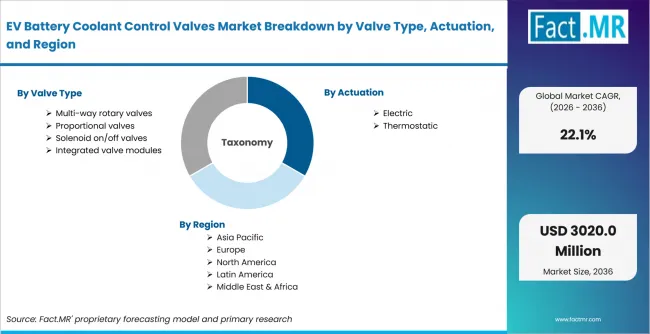
Ev Battery Coolant Control Valves Market Breakdown By Valve Type, Actuation, And Region | Source: Fact.MR
| Attribute | Details |
|---|---|
| Quantitative Units | USD million |
| Market Definition | Coolant-flow control valves used in electric vehicle battery and powertrain thermal circuits where liquid routing affects charging, battery safety and range performance |
| Valve Type | Multi-way rotary valves; Proportional valves; Solenoid on/off valves; Integrated valve modules |
| Actuation | Electric; Thermostatic |
| Vehicle Type | BEV; PHEV; Commercial EV |
| Sales Channel | OEM; Aftermarket |
| Regions Covered | North America; Latin America; Europe; East Asia; South Asia and Pacific; Middle East and Africa |
| Countries Covered | Germany; United States; South Korea; Japan; France; Hungary |
| Key Companies Profiled | Rheinmetall AG; Robert Bosch GmbH; Schaeffler AG; Hanon Systems; MAHLE Group; Valeo |
| Forecast Period | 2026 to 2036 |
| Approach | Hybrid top-down and bottom-up approach using EV production indicators; battery thermal management requirements; coolant-valve qualification; segment shares; country adoption patterns; official statistics and company portfolio review |
Source: Fact.MR analysis. Updated Aug 18, 2026
How is the market segmented?
-
By Valve Type
- Multi-way rotary valves
- Proportional valves
- Solenoid on/off valves
- Integrated valve modules
-
By Actuation
- Electric
- Thermostatic
-
By Vehicle Type
- BEV
- PHEV
- Commercial EV
-
By Sales Channel
- OEM
- Aftermarket
-
By Region
- North America
- Latin America
- Europe
- East Asia
- South Asia and Oceania
- Middle East and Africa
Frequently Asked Questions
How big is the EV battery coolant control valves market in 2026?
What is the CAGR of the EV battery coolant control valves market from 2026 to 2036?
Which valve type leads the EV battery coolant control valves market?
Which actuation type leads the EV battery coolant control valves market?
Who are the leading companies in the EV battery coolant control valves market?
Who worked on this report


Preview the report firsthand - request a free sample
Free SampleGet the brochure for pricing and purchase details
Download PDF