- Market Value (2025): USD 2.38 Bn
- Estimated Value (2026): USD 2.5 Bn
- Forecast Value (2036): USD 4.02 Bn
- CAGR (2026-2036): 4.9%
What is the Flanged Gate Valves Market forecast to be worth by 2036?
USD 2.5 billion in 2026 to USD 4.0 billion by 2036 at a 4.9% CAGR.
- The flanged gate valves market was valued at USD 2.38 billion in 2025.
- Modernization of fluid transportation networks and investment in water and wastewater infrastructure are contributing to revenue growth from USD 2.5 billion in 2026 to USD 4.02 billion by 2036.
- Between 2026 and 2036, the market is forecast to grow at a 4.9% CAGR as industrial investment and the replacement of aging equipment sustain purchasing activity.
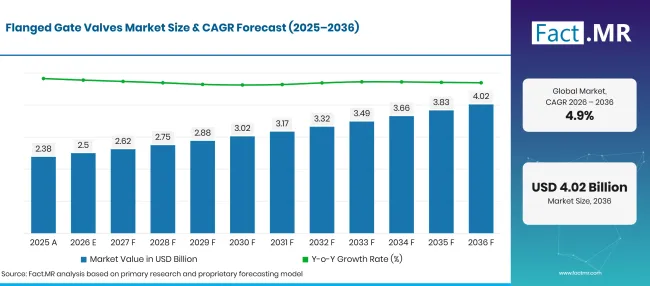
Flanged Gate Valves Market Forecast Global | Source: Fact.MR
| Year | Basis | Market Value (USD billion) |
|---|---|---|
| 2025 | Actual | 2.38 |
| 2026 | Estimate | 2.5 |
| 2036 | Forecast | 4.02 |
| CAGR (2026–2036) | Forecast period | 4.9% |
Source: Fact.MR analysis. Updated Oct 28, 2026
What are the defining numbers behind Flanged Gate Valves Market growth?
The decade from 2026 to 2036 adds USD 1.5 billion in market value. This increase reflects refurbishment of existing fluid transportation infrastructure, alongside investment in water treatment facilities and industrial installations.
- Demand Drivers in the Market
- In March 2026, India's Ministry of Petroleum and Natural Gas announced a framework for time-bound approvals of natural gas and petroleum product pipeline infrastructure. Pipeline development may create requirements for compatible isolation valves, subject to project engineering specifications. [1]
- IndianOil reported liquid transportation throughput of 102.5 million tonnes and natural gas throughput of 3,991 million standard cubic metres during 2025–26. Continued operation of extensive transmission networks sustains requirements for isolation equipment, maintenance, and component replacement. [2]
- U.S. drinking-water infrastructure funding includes federal allotments for lead service line replacement through the Drinking Water State Revolving Fund. Such investments support water-network renewal and may create requirements for compatible isolation equipment where specified in project designs. [3]
- Industrial plants and power generation facilities require dependable shutoff mechanisms during maintenance and system upgrades. Pressure ratings and material grades vary according to fluid composition, operating temperature, and exposure to corrosive substances.
- Water treatment projects and process-industry installations create replacement opportunities when existing valves experience wear or corrosion. Cast iron remains relevant in suitable distribution systems, while demanding operating environments require materials selected for specific service conditions.
- Key Segments Analyzed
- By Material Type: Cast iron accounts for 38.5% of the market in 2026, reflecting its established role in water distribution and other applications compatible with its mechanical properties and operating characteristics.
- By Application: Oil and Gas contributes 36.9% of the market in 2026, reflecting isolation requirements across transmission networks, processing units, storage terminals, and related energy infrastructure.
- By End-User: Industrial users lead with 62.4% of the market in 2026, reflecting purchasing requirements across manufacturing, processing, utilities, and other facilities that depend on fluid-isolation equipment.
- Analyst Opinion at Fact.MR
- Shambhu Nath Jha, Principal Consultant at Fact.MR, states, "Demand for flanged gate valves through 2036 is closely linked to infrastructure maintenance, water utility development, and industrial operating requirements. Oil and gas, water and wastewater, and power generation remain important application areas. Purchasing decisions depend on material suitability, pressure ratings, and compatibility with established piping arrangements, particularly where replacement work must be completed without extensive modifications."
- Strategic Implications
- Valve manufacturers need product portfolios suited to different operating environments, ranging from municipal water distribution to oil and gas, chemical processing, and power generation.
- Industrial buyers prioritize pressure limits, fluid composition, corrosion exposure, and maintenance accessibility when selecting flanged gate valves.
- Water infrastructure projects require equipment compatible with existing pipe dimensions and engineering specifications. Cast iron remains relevant where operating conditions align with its mechanical characteristics.
- Oil and gas operators emphasize verified performance, material traceability, and compliance with applicable technical standards when purchasing valves for critical fluid transportation systems.
- Access to replacement components, technical guidance, and maintenance assistance remains important for operators managing extensive installed equipment and seeking to minimize operational downtime.
The United States leads market growth at a 6.1% CAGR, followed by Germany at 5.6% and Brazil at 4.9%. Japan and the United Kingdom record CAGRs of 3.8% and 3.5%, respectively. Their growth trajectories reflect differences in infrastructure expenditure, industrial activity, equipment modernization, and maintenance requirements.
How does the Flanged Gate Valves Market break down by segment?
Cast Iron leads Material Type with a 38.5% share; Oil and Gas ranks first in Application at 36.9%; Industrial users dominate End-User demand with 62.4%.
Which Material Type leads?
Cast iron accounts for 38.5% of the market in 2026.
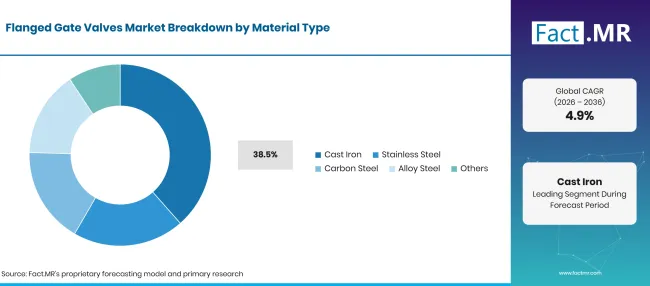
Flanged Gate Valves Market Breakdown Material Type | Source: Fact.MR
| Material Type | Share (2026) |
|---|---|
| Cast Iron (Leading segment) | 38.5% |
| Other segments combined | 61.5%* |
| Total | 100.0% |
Source: Fact.MR analysis. Updated Oct 28, 2026
Cast iron leads the flanged gate valves market because of its established use in water distribution and other compatible fluid-handling systems. Its suitability for lower- and moderate-pressure applications, practical installation characteristics, and familiarity among infrastructure operators strengthen its position against stainless steel, carbon steel, and alloy steel alternatives. Other materials serve installations requiring different levels of corrosion resistance, pressure tolerance, and durability under specific operating conditions. Stainless steel and specialized alloys are relevant where fluid composition, temperature, or environmental exposure calls for more demanding material properties.
What supports Oil and Gas within Application?
Oil and Gas contributes 36.9% of market revenue in 2026.
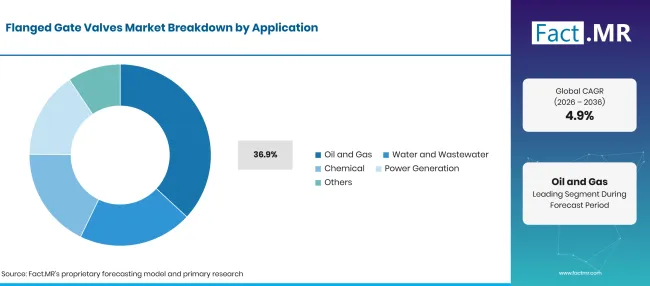
Flanged Gate Valves Market Breakdown Application | Source: Fact.MR
| Application | Share (2026) |
|---|---|
| Oil and Gas (Leading segment) | 36.9% |
| Other segments combined | 63.1%* |
| Total | 100.0% |
Source: Fact.MR analysis. Updated Oct 28, 2026
Continuous fluid transportation and stringent isolation requirements make oil and gas the leading application for flanged gate valves. Production sites, refineries, storage terminals, and transmission facilities use these mechanisms to isolate sections during routine servicing, inspection, and equipment maintenance. Bolted flange connections are compatible with established industrial piping arrangements, facilitating replacement and system upgrades. Energy operations span extensive transportation networks and processing installations, generating purchasing requirements for both new projects and ongoing maintenance.
How does End-User shape demand?
Industrial users lead with 62.4% of the market in 2026.
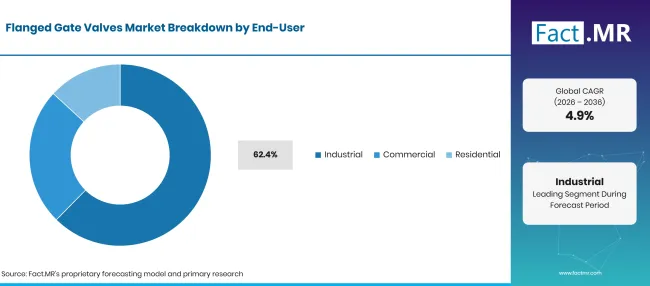
Flanged Gate Valves Market Breakdown End User | Source: Fact.MR
| End-User | Share (2026) |
|---|---|
| Industrial (Leading segment) | 62.4% |
| Other segments combined | 37.6%* |
| Total | 100.0% |
Source: Fact.MR analysis. Updated Oct 28, 2026
Frequent flow-isolation requirements across manufacturing plants, processing facilities, and energy operations place industrial users at the forefront of flanged gate valve demand. These establishments use valves to isolate equipment sections during servicing, process modifications, and scheduled shutdowns. Their extensive piping arrangements also create continuing replacement requirements as components age or operating conditions change. Industrial facilities generally involve more complex fluid-handling operations and broader equipment applications than residential and commercial settings, sustaining demand across varied service environments.
What is accelerating Flanged Gate Valves Market adoption, and what is holding it back?
Infrastructure refurbishment, water utility investment, and industrial maintenance underpin market demand. However, material expenses, stringent engineering specifications, installation costs, and competition from alternative valve designs influence purchasing decisions and may postpone certain projects.
Drivers Impact Analysis
| Driver | (~) % Impact on CAGR | Geographic Relevance | Impact Timeline |
|---|---|---|---|
| Replacement of aging flanged gate valves in industrial piping and processing facilities | +1.5% | Global | Short term (≤ 2 years) |
| Investment in oil and gas transportation, processing, and storage infrastructure | +1.1% | Global, particularly major energy markets | Medium term (2–4 years) |
| Modernization of water distribution and wastewater treatment networks | +0.8% | Global | Medium to long term (2–4 years and beyond) |
| Industrial plant refurbishment requiring dependable isolation and flow shutoff | +0.5% | North America, Europe, Asia Pacific | Short to medium term (≤ 4 years) |
Source: Fact.MR analysis. Updated Oct 28, 2026
Opportunity Impact Analysis
| Opportunity | (~) % Impact on CAGR | Geographic Relevance | Impact Timeline |
|---|---|---|---|
| Development of corrosion-resistant flanged gate valves for demanding process environments | +0.6% | Global | Medium term (2–4 years) |
| Expansion of water and wastewater treatment infrastructure in developing markets | +0.5% | Latin America, Asia Pacific, Europe | Medium to long term (2–4 years and beyond) |
| Replacement programs combining compatible equipment, technical assistance, and maintenance | +0.3% | Global | Short to medium term (≤ 4 years) |
| Application-specific steel and alloy valves for industrial and energy installations | +0.2% | North America, Europe, East Asia | Medium term (2–4 years) |
Source: Fact.MR analysis. Updated Oct 28, 2026
Restraints Impact Analysis
| Restraint | (~) % Impact on CAGR | Geographic Relevance | Impact Timeline |
|---|---|---|---|
| High purchase costs for valves designed for demanding pressure, temperature, and material requirements | -0.4% | Global | Short term (≤ 2 years) |
| Installation and maintenance expenses across extensive industrial piping systems | -0.3% | Global | Short to medium term (≤ 4 years) |
| Corrosion, wear, and material incompatibility under unsuitable operating conditions | -0.2% | Global | Ongoing |
| Competition from alternative valve designs in applications requiring throttling or frequent operation | -0.1% | Global | Medium to long term (2–4 years and beyond) |
Source: Fact.MR analysis. Updated Oct 28, 2026
Which countries are scaling the Flanged Gate Valves Market through 2036?
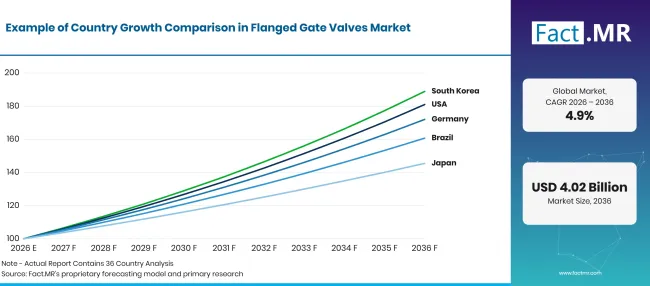
Flanged Gate Valves Market Growth Index 1 | Source: Fact.MR
| Country | CAGR (2026 to 2036) |
|---|---|
| United States | 6.1% |
| Germany | 5.6% |
| Brazil | 4.9% |
| Japan | 3.8% |
| United Kingdom | 3.5% |
Source: Fact.MR analysis. Updated Oct 28, 2026
What supports Germany's adoption?
5.6% CAGR, supported by energy infrastructure, industrial maintenance, and water-system upgrades.
Germany's growth is linked to demand for industrial process equipment, equipment maintenance, and water infrastructure renewal. Chemical production, power generation, and municipal water services have distinct operating requirements that influence valve specifications. [4]
Purchasers evaluate performance over the service life of an installation, particularly when existing components no longer meet updated operating or maintenance standards. Replacement activity also reflects the need to maintain reliability across established industrial facilities. Technical documentation, quality assurance, and compliance with engineering standards remain important considerations during procurement.
How is Brazil developing demand?
4.9% CAGR, linked to process industries, equipment replacement, and municipal water infrastructure renewal.
Brazil's demand is associated with water infrastructure, energy facilities, and industrial development. Water distribution and wastewater treatment projects require isolation equipment at pumping stations, treatment plants, and fluid transportation connections. [5]
Oil and gas operations also use gate valves across processing and transmission facilities. Maintenance requirements at established installations contribute to purchasing activity alongside new construction. Project specifications, local technical requirements, material suitability, and the availability of maintenance assistance influence competitive positioning in the Brazilian market.
What is supporting the United States' adoption?
6.1% CAGR, driven by water projects, energy facilities, and oil and gas maintenance activity.
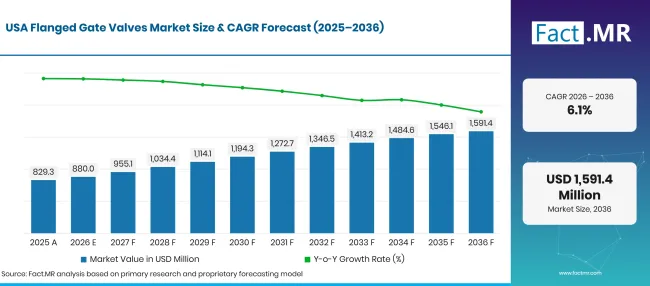
Flanged Gate Valves Market Forecast Usa | Source: Fact.MR
Demand in the United States spans energy infrastructure, industrial establishments, and water and wastewater services. Oil and gas installations require valves for isolation during transportation, processing, and storage operations.
Industrial operators replace aging components through planned maintenance programs. Municipal utilities also purchase equipment for distribution network rehabilitation and treatment facility upgrades. Manufacturers offering appropriate pressure classes, documented material specifications, and dependable replacement assistance are well positioned to address these requirements.
How is the United Kingdom scaling demand?
3.5% CAGR, shaped by industrial equipment upgrades and replacement across established facilities.
United Kingdom demand is associated with industrial asset maintenance and water infrastructure upgrades. Established facilities require replacement valves when equipment approaches the end of its service life or operating conditions change.
Water and wastewater operators need reliable isolation mechanisms for treatment processes, inspection, and repairs. Procurement decisions reflect engineering specifications, maintenance budgets, compatibility with installed equipment, and anticipated service life. These conditions create opportunities through refurbishment and replacement activity as well as new installations.
How does Japan perform?
3.8% CAGR, supported by water infrastructure refurbishment and ongoing industrial asset maintenance.
Japan's demand arises from industrial maintenance, process equipment upgrades, and water infrastructure requirements. Manufacturing and process industries depend on reliable fluid-handling arrangements, while utility operators require isolation mechanisms for inspections and repairs.
Established industrial assets create replacement opportunities when valves experience wear or become unsuitable for revised operating conditions. Space constraints, installation dimensions, and compatibility with existing equipment also influence product selection. These requirements encourage purchasers to assess mechanical reliability and installation suitability alongside acquisition costs.
Who leads the Flanged Gate Valves Market?
Competition spans diversified flow-control manufacturers and specialists serving particular valve categories or end markets. Emerson Electric Co. and Flowserve Corporation operate across broad industrial applications, while SLB (CAMERON) has substantial involvement in energy-related equipment and services. Crane Company and Velan Inc. have established positions in industrial valve manufacturing.
For water infrastructure, AVK Holding A/S and Mueller Co. (Mueller Water Products, Inc.) are notable participants. KSB SE & Co. KGaA, KITZ Corporation, and Powell Valves further diversify the competitive field across industrial process applications and municipal installations.
Purchasers in process industries and utilities assess whether valves withstand specified pressure conditions, remain compatible with handled fluids, and permit maintenance without unnecessary operational disruption. Manufacturers with strong technical assistance throughout the equipment lifecycle, rather than sales support alone, are better placed to build lasting customer relationships.
Which companies are the key providers?
Key companies include Emerson Electric Co.; Flowserve Corporation; SLB (CAMERON); Velan Inc.; Crane Company; AVK Holding A/S; KSB SE & Co. KGaA; KITZ Corporation; Mueller Co. (Mueller Water Products, Inc.); and Powell Valves.
- Emerson Electric Co.
- Flowserve Corporation
- SLB (CAMERON)
- Velan Inc.
- Crane Company
- AVK Holding A/S
- KSB SE & Co. KGaA
- KITZ Corporation
- Mueller Co. (Mueller Water Products, Inc.)
- Powell Valves
Bibliography
- [1] Ministry of Petroleum and Natural Gas, Government of India. (2026, March 24). Government notifies landmark order to strengthen natural gas infrastructure and improve ease of doing business. Press Information Bureau. Official PIB release
- [2] Indian Oil Corporation Limited. (2026). Integrated annual report 2025–26. https://iocl.com/annual-reportIndianOil Annual Reports
- [3] U.S. Environmental Protection Agency. (2025, November 25). Fiscal Year 2025 lead service line replacement allotments for the Drinking Water State Revolving Fund provisions of the Infrastructure Investment and Jobs Act. EPA DWSRF source
- [4] Bundesnetzagentur. (2026, January 12). Bundesnetzagentur publishes gas supply figures for 2025. https://www.bundesnetzagentur.de/EN/Areas/Energy/Companies/SecurityOfSupply/GasSupply/start.htmlBundesnetzagentur source
- [5] Ministério das Cidades. (2026, January 14). Brasil tem ano de investimentos e avanços em saneamento básico. https://www.gov.br/cidades/pt-br/assuntos/noticias-1/noticia-mcid-n-1879Brazil Ministry of Cities source
This Report Answers
- How is the flanged gate valves market expected to develop between 2026 and 2036?
- Which material type, application, and end-user category leads the market in 2026?
- How do industrial fluid-handling requirements and water infrastructure maintenance shape demand?
- Why do the United States, Germany, Brazil, Japan, and the United Kingdom have different growth rates?
- Which manufacturers participate in the market, and how do their valve portfolios address industrial and infrastructure requirements?
- How do material selection, technical standards, operating conditions, and maintenance costs affect purchasing decisions?
How is the flanged gate valves market expected to develop between 2026 and 2036? • Which material type, application, and end-user category leads the market in 2026? • How do industrial fluid-handling requirements and water infrastructure maintenance shape demand? • Why do the United States, Germany, Brazil, Japan, and the United Kingdom have different growth rates? • Which manufacturers participate in the market, and how do their valve portfolios address industrial and infrastructure requirements? • How do material selection, technical standards, operating conditions, and maintenance costs affect purchasing decisions?
Flanged gate valves are mechanical flow-isolation devices installed between piping sections using bolted flange connections. Opening the valve raises the gate out of the flow path, while closing it lowers the gate to isolate flow. Gate valves are primarily intended for fully open or fully closed service rather than routine throttling. These devices are used in compatible water distribution, oil and gas, chemical processing, power generation, and industrial piping applications.
The market assessment covers valves classified by material type, application, and end-user. It considers cast iron, stainless steel, carbon steel, alloy steel, and other material categories, alongside demand from industrial, commercial, and residential installations. Geographic coverage includes the major regions and five specified countries.
What is included in the scope?
The scope includes flanged gate valves used for fluid isolation in industrial, commercial, residential, and infrastructure applications. It covers the material categories listed in the market segmentation and the end-use applications identified in the dataset.
Demand assessment considers new installations, replacement purchases, industrial plant maintenance, and infrastructure refurbishment. Product selection factors include material compatibility, pressure and temperature requirements, flange connections, applicable standards, and operating conditions.
What is excluded from the scope?
Control valves, butterfly valves, ball valves, check valves, and other distinct categories are excluded when they do not qualify as flanged gate valves under the market definition. Pumps, piping infrastructure, independently sold actuators, and broader fluid-handling equipment also fall outside the defined product market.
General maintenance services, construction contracts, and industrial infrastructure expenditure are not counted as valve market revenue unless they directly correspond to the sale of qualifying flanged gate valves.
How Was the Analysis Built?
The assessment considers public research, company portfolios, industry data, and geographic demand indicators. Quantities of source documents and interviews require confirmation from internal research records.
- Primary Research: Primary research includes discussions with manufacturers, service providers, technology developers, distributors, end users, and subject-matter experts. These conversations examine purchasing priorities, product adoption, operational challenges, approval requirements, competitive positioning, and the factors that influence wider market acceptance.
- Desk Research: Desk research covers government statistics, regulatory publications, company filings, trade data, technical studies, industry associations, standards, public policy, and other authoritative sources. Every source used in the analysis is documented in the bibliography.
- Market Sizing and Forecasting: Market estimates combine historical performance, demand indicators, pricing and volume trends, segment shares, company participation, country-level growth, adoption patterns, investment activity, and barriers to market expansion.
- Data Validation and Update Cycle: Findings are validated by comparing primary interviews with public data, company activity, regulatory changes, trade patterns, and industry developments. Regular updates review new product launches, capacity changes, partnerships, approvals, and shifts in commercial adoption.
How is the Flanged Gate Valves Market segmented?
By Material Type
- Cast Iron
- Stainless Steel
- Carbon Steel
- Alloy Steel
- Others
By Valve Size
- Up to 2 Inches
- 2–6 Inches
- 6–12 Inches
- 12–24 Inches
- Above 24 Inches
By Pressure Rating
- Class 150
- Class 300
- Class 600
- Class 900
- Class 1500 and Above
By Application
- Oil and Gas
- Water and Wastewater
- Chemical
- Power Generation
- Others
By End User
- Industrial
- Commercial
- Residential
By Distribution Channel
- Direct Sales
- Distributors
- Online Channels
By Region
- North America
- Latin America
- Western Europe
- Eastern Europe
- East Asia
- South Asia and Pacific
- Middle East and Africa
Segmentation
What is the report's scope and coverage?
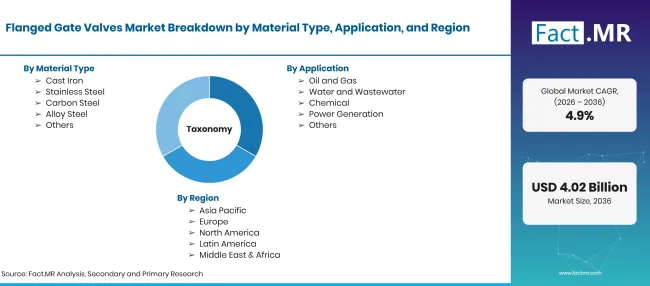
Flanged Gate Valves Market Taxonomy | Source: Fact.MR
| Attribute | Details |
|---|---|
| Quantitative Units | USD billion in 2026 to USD billion by 2036, at CAGR |
| Market Definition | Flanged gate valves used to isolate or control the on-off flow of fluids in compatible piping and industrial systems, classified by material, application, end-user, and region |
| Material Type | Cast Iron; Stainless Steel; Carbon Steel; Alloy Steel; Others |
| Application | Oil and Gas; Water and Wastewater; Chemical; Power Generation; Others |
| End-User | Industrial; Commercial; Residential |
| Regions Covered | North America; Latin America; Western Europe; Eastern Europe; East Asia; South Asia & Pacific; Middle East & Africa |
| Countries Covered | United States; Germany; Brazil; Japan; United Kingdom |
| Companies Profiled | Emerson Electric Co.; Flowserve Corporation; SLB (CAMERON); Velan Inc.; Crane Company; AVK Holding A/S; KSB SE & Co. KGaA; KITZ Corporation; Mueller Co. (Mueller Water Products, Inc.); Powell Valves |
| Forecast Period | 2026 to 2036 |
| Approach | Market assessment using the available market values, segment shares, country growth rates, product categories, application requirements, and competitive landscape |
Source: Fact.MR analysis. Updated Oct 28, 2026
Frequently Asked Questions
How large is the flanged gate valves market in 2026?
What growth rate will the flanged gate valves market record from 2026 to 2036?
Which material type leads the flanged gate valves market?
Which application leads the flanged gate valves market?
Which end-user leads the flanged gate valves market?
Which country will grow the most in the flanged gate valves market?
Who are the main companies in the flanged gate valves market?
Who worked on this report


Preview the report firsthand - request a free sample
Free SampleGet the brochure for pricing and purchase details
Download PDF