- Base Value(2025): 2.8 Bn
- Estimated Value(2025): 2.8 Bn
- Forecast Value (2035): 4.6 Bn
- CAGR (2025 - 2035): 5.1%
AdBlue Market Forecast and Outlook 2025 to 2035
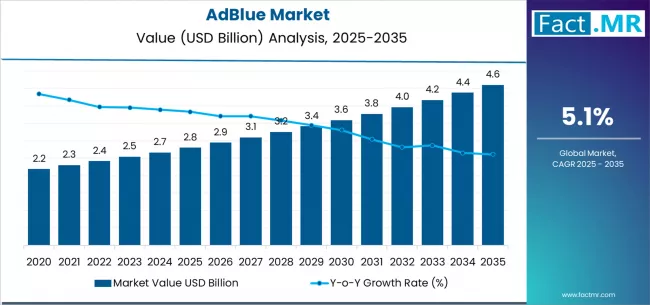
The AdBlue market's trajectory from USD 2.8 billion in 2025 to USD 4.6 billion by 2035 represents robust expansion, the market will rise at a CAGR of 5.1% which demonstrating accelerating adoption of selective catalytic reduction technologies and growing investment in diesel exhaust fluid solutions across commercial transportation, agricultural machinery, and industrial equipment operations worldwide.
The market operates within a dynamic landscape characterized by expanding emission control applications, fleet modernization initiatives, and growing demand for compliant exhaust treatment across commercial vehicle operations, construction equipment, agricultural machinery, and marine diesel applications. Market dynamics reflect increasing investment in NOx reduction technologies, accelerating adoption of SCR systems, and rising demand for versatile emission control solutions that support diverse operational requirements and regulatory compliance specifications.
Quick Stats for AdBlue Market
- AdBlue Market Value (2025): USD 2.8 billion
- AdBlue Market Forecast Value (2035): USD 4.6 billion
- AdBlue Market Forecast CAGR: 5.1%
- Leading Application in AdBlue Market: Commercial Vehicles
- Key Growth Regions in AdBlue Market: Asia Pacific, Europe, and North America
- Key Players in AdBlue Market: BASF SE, Yara International ASA, CF Industries Holdings, OCI N.V.
- Where revenue comes from - Now Vs Next (Industry-level view)
Adblue Market Market Value Analysis | Source: Fact.MR
Commercial fleet procurement patterns demonstrate shifting preferences toward comprehensive AdBlue supply systems that combine product availability, distribution reliability, and quality assurance capabilities. Transportation companies and equipment operators prioritize solution consistency, regulatory compliance, and operational compatibility when selecting diesel exhaust fluid suppliers for critical applications including heavy-duty trucks, construction machinery, agricultural equipment, and marine vessels.
The market benefits from expanding diesel engine installations across transportation, construction, and agricultural sectors, driving demand for sophisticated emission control technologies that enable regulatory compliance and operational continuity. Growing emphasis on environmental regulations and emission standards creates opportunities for suppliers offering validated AdBlue systems with comprehensive distribution networks and quality assurance capabilities.
Technology advancement influences market evolution through integration of automated dosing systems, enhanced fluid formulations, and advanced storage solutions that improve system performance and operational outcomes. Suppliers focus on developing distribution solutions that accommodate varying consumption patterns, storage requirements, and delivery specifications while maintaining consistent quality throughout extended supply periods.
The AdBlue market demonstrates strong growth fundamentals driven by expanding commercial vehicle activities, fleet infrastructure development, and increasing demand for emission control technologies across multiple transportation sectors and operational applications.
The first half of the decade (2025-2030) will witness market growth from USD 2.8 billion to approximately USD 3.5 billion, adding USD 0.7 billion in value, representing 39% of the total forecast period expansion. This phase will be characterized by rapid adoption of advanced SCR technologies, driven by regulatory compliance programs and increasing demand for enhanced emission control capabilities across commercial applications.
The latter half (2030-2035) will experience accelerated growth from USD 3.5 billion to USD 4.6 billion, representing an addition of USD 1.1 billion or 61% of the decade's expansion. This period will be defined by mass market penetration of automated dosing systems, integration with fleet management platforms, and seamless connectivity with existing vehicle infrastructure.
| Period | Primary Revenue Buckets | Share | Notes |
|---|---|---|---|
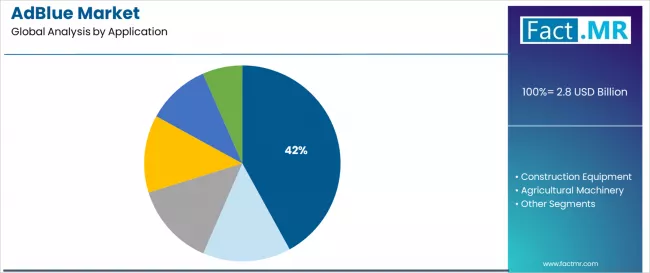
| Today | Commercial vehicles | 42% | Heavy-duty trucks, delivery vehicles |
| Construction equipment | 18% | Excavators, bulldozers, cranes | |
| Agricultural machinery | 16% | Tractors, harvesters, irrigation systems | |
| Marine applications | 12% | Commercial vessels, fishing boats | |
| Power generation | 8% | Diesel generators, backup systems | |
| Rail transport | 4% | Locomotives, rail maintenance equipment | |
| Future (3-5 yrs) | Electric hybrid systems | 28-32% | Hybrid commercial vehicles, range extenders |
| Advanced commercial fleets | 24-28% | Automated vehicles, smart logistics | |
| Construction automation | 16-20% | Autonomous equipment, smart construction | |
| Precision agriculture | 14-18% | Smart farming equipment, automated systems | |
| Marine compliance | 10-14% | IMO 2020 compliance, emission zones | |
| Specialized applications | 6-10% | Mining equipment, industrial generators |
Source: Fact.MR analysis. Updated Nov 6, 2025
AdBlue Market Key Takeaways
At-a-Glance Metrics
| Metric | Value |
|---|---|
| Market Value (2025) → | USD 2.8 billion |
| Market Forecast (2035) ↑ | USD 4.6 billion |
| Growth Rate ★ | 5.1% CAGR |
| Leading Application → | Commercial Vehicles |
| Primary End-Use → | Transportation Companies |
Source: Fact.MR analysis. Updated Nov 6, 2025
The market demonstrates strong fundamentals with commercial vehicle applications capturing dominant share through advanced emission control capabilities and fleet management optimization. Transportation companies drive primary demand, supported by increasing regulatory requirements and operational compliance initiatives. Geographic distribution remains concentrated in regions with established commercial vehicle infrastructure, while emerging economies show accelerating adoption rates driven by emission standard implementation and rising environmental awareness.
Imperatives for Stakeholders in AdBlue Market
Design for compliance assurance, not just supply
- Offer complete emission control systems: AdBlue supply + dosing equipment + storage solutions + monitoring systems + quality control protocols + maintenance guidelines.
- Preconfigured fleet management workflows: consumption monitoring, supply scheduling, quality assurance protocols, and compliance tracking systems for commercial operations.
Fleet integration readiness
- Real-time consumption monitoring, quality tracking, and fleet management integration (vehicle connectivity, supply management systems).
Compliance-by-design approach
- Advanced supply distribution systems, real-time quality monitoring, compliance validation, and comprehensive documentation systems.
Value-based supply models
- Clear AdBlue pricing + transparent service tiers (delivery services, quality testing, compliance guarantees); subscriptions for supply management and technical support.
Segmental Analysis
The market is segmented by application into commercial vehicles, construction equipment, agricultural machinery, marine applications, power generation systems, and rail transport, representing evolution from basic emission control to sophisticated NOx reduction technologies for comprehensive regulatory compliance and environmental performance optimization. The end-use segmentation divides the market into transportation companies, construction contractors, agricultural operators, marine fleet operators, and power generation facilities, reflecting distinct requirements for supply volumes, delivery schedules, and quality specifications.
The product segmentation covers standard AdBlue solutions, premium formulations, and specialized blends, while distribution channels span direct supply, retail networks, and integrated fleet services. Geographic distribution covers North America, Latin America, Western Europe, Eastern Europe, Asia Pacific, South Asia, and Middle East & Africa, with developed markets leading consumption while emerging economies show accelerating growth patterns driven by emission standard implementation programs.
The segmentation structure reveals technology progression from basic urea solutions toward sophisticated emission control systems with enhanced performance capabilities, while application diversity spans from standard compliance to specialized high-performance procedures requiring precise NOx reduction solutions.
By Application, the Commercial Vehicles Segment Accounts for Dominant Market Share
Adblue Market Analysis By Application | Source: Fact.MR
Commercial vehicle applications command the leading position in the AdBlue market with 42% market share through proven emission control technologies, including enhanced NOx reduction, reliable compliance capabilities, and fleet optimization that enable transportation operators to achieve regulatory compliance across diverse operational and route environments.
The segment benefits from fleet operator preference for comprehensive AdBlue systems that provide consistent quality, regulatory compliance, and supply reliability without requiring extensive infrastructure modifications. Advanced distribution features enable enhanced emission control, precise dosing management, and integration with existing fleet systems, where compliance consistency and operational continuity represent critical operational requirements.
Commercial vehicle applications differentiate through proven regulatory compliance, comprehensive supply specifications, and integration with established fleet management systems that enhance operational effectiveness while maintaining optimal emission standards suitable for diverse transportation applications.
Key market characteristics:
- Advanced formulation standards with optimized NOx reduction and regulatory compliance capabilities
- Enhanced operational effectiveness, enabling 94-97% satisfaction with consistent emission performance
- Fleet compatibility, including automated dosing, consumption monitoring, and compliance validation for transportation operations
By End-Use, Transportation Companies Drive Market Leadership
Adblue Market Analysis By End Use | Source: Fact.MR
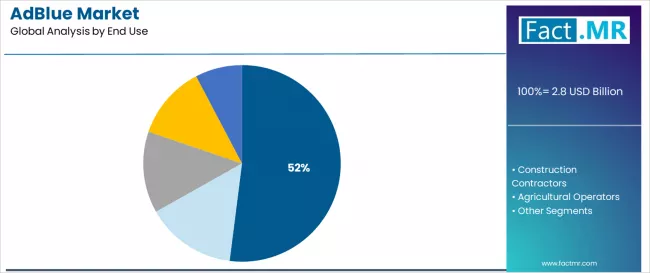
Transportation companies dominate the market with a 52% share, reflecting the primary demand source for AdBlue technology in fleet compliance and emission management. Transportation companies provide direct market demand for standardized AdBlue systems, driving volume consumption and supply optimization while maintaining quality consistency and regulatory requirements.
Transportation companies deploy AdBlue technologies to enhance leet optimization, emission compliance, and operational assurance that drive consistent demand while providing access to latest emission control technologies.
What are the Drivers, Restraints, and Key Trends of the AdBlue Market?
| Category | Factor | Impact | Why It Matters |
|---|---|---|---|
| Driver | Emission regulations & Euro VI standards (NOx reduction requirements, compliance mandates) | ★★★★★ | Growing regulatory framework requires advanced emission control systems with enhanced NOx reduction capabilities and compliance validation proven effective across commercial applications. |
| Driver | Commercial vehicle fleet expansion & logistics growth (e-commerce delivery, freight transport) | ★★★★★ | Transforms emission requirements from "basic compliance" to "operational emission control"; operators that offer comprehensive AdBlue systems and monitoring features gain competitive advantage. |
| Driver | Construction industry growth & equipment modernization (infrastructure projects, urban development) | ★★★★☆ | Modern construction facilities need sophisticated, validated emission control systems; demand for compliant and efficient solutions expanding addressable market. |
| Restraint | Storage infrastructure costs & handling complexity (especially for smaller fleets) | ★★★★☆ | Smaller fleet operators defer AdBlue infrastructure upgrades; increases cost sensitivity and slows advanced system adoption in price-conscious markets. |
| Restraint | Product freezing concerns & temperature sensitivity (winter operations, storage challenges) | ★★★☆☆ | Temperature limitations constrain traditional AdBlue applications and increase handling costs, potentially limiting adoption in extreme climate regions. |
| Trend | Automated dosing systems & smart fleet integration (IoT connectivity, consumption optimization) | ★★★★★ | Advanced monitoring capabilities, consumption optimization, and predictive maintenance transform operations; automation and efficiency enhancement become core value propositions. |
| Trend | Alternative fuel integration & hybrid systems (diesel-electric combinations, range extenders) | ★★★★☆ | Hybrid emission systems for specific applications and compliance protocols; specialized dosing and targeted optimization capabilities drive competition toward integrated solutions. |
Source: Fact.MR analysis. Updated Nov 6, 2025
Analysis of the AdBlue Market by Key Country
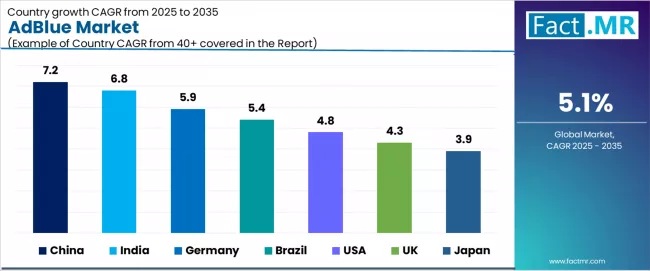
The AdBlue market demonstrates varied regional dynamics with growth leaders including China (7.2% growth rate) and India (6.8% growth rate) driving expansion through commercial vehicle development and emission standard implementation initiatives. Steady performers encompass Germany (5.9% growth rate), Brazil (5.4% growth rate), and developed regions, benefiting from established transportation infrastructure and regulatory compliance growth.
Mature markets feature USA (4.8% growth rate), UK (4.3% growth rate), and Japan (3.9% growth rate), where fleet modernization and compliance requirements support consistent growth patterns. Regional synthesis reveals Asia Pacific markets leading adoption through commercial vehicle expansion and emission standard development, while European countries maintain steady expansion supported by regulatory advancement and technology investment. North American markets show strong growth driven by fleet compliance and emission control trends.
Adblue Market Cagr Analysis By Country | Source: Fact.MR
| Country | 2025-2035 Growth | How to win | What to watch out |
|---|---|---|---|
| China | 7.2% | Focus on cost-effective supply solutions | Regulatory changes; local production |
| India | 6.8% | Lead with commercial vehicle applications | Import restrictions; infrastructure barriers |
| Germany | 5.9% | Provide premium supply systems | Over-regulation; lengthy approvals |
| Brazil | 5.4% | Offer value-oriented solutions | Currency fluctuations; import duties |
| USA | 4.8% | Push fleet integration | Compliance costs; scaling challenges |
| UK | 4.3% | Focus on logistics applications | Economic impacts; funding constraints |
| Japan | 3.9% | Emphasize quality standards | Traditional preferences; adoption rates |
Source: Fact.MR analysis. Updated Nov 6, 2025
China Drives Fastest Market Growth
China establishes fastest market growth through aggressive commercial vehicle development programs and comprehensive emission standard implementation, integrating advanced AdBlue systems as standard components in transportation fleets and commercial vehicle operations. The country's 7.2% growth rate reflects government initiatives promoting emission control modernization and domestic AdBlue capabilities that mandate use of NOx reduction systems in commercial and industrial vehicles. Growth concentrates in major transportation hubs, including Beijing, Shanghai, and Guangzhou, where emission control development showcases integrated AdBlue systems that appeal to fleet operators seeking compliance capabilities and operational applications.
Chinese manufacturers are developing cost-effective AdBlue solutions that combine domestic production advantages with advanced emission control features, including enhanced quality standards and improved supply capabilities. Distribution channels through commercial vehicle suppliers and fleet management integrators expand market access, while government support for emission control development supports adoption across diverse transportation and commercial segments.
Strategic Market Indicators:
- Government emission control programs providing substantial funding for domestic AdBlue technology development
- Export market development for cost-effective supply solutions targeting emerging commercial markets
India Emerges as High-Growth Market
In Mumbai, Delhi, and Bangalore, transportation companies and commercial operators are implementing AdBlue systems as standard equipment for emission compliance and operational efficiency applications, driven by increasing government environmental investment and regulatory development programs that emphasize importance of NOx reduction capabilities.
The market holds a 6.8% growth rate, supported by government emission initiatives and vehicle modernization programs that promote advanced AdBlue systems for commercial and transportation fleets. Indian operators are adopting emission control systems that provide consistent NOx reduction and compliance features, particularly appealing in urban regions where emission control and environmental compliance represent critical operational requirements.
Market expansion benefits from growing commercial vehicle capabilities and international technology partnerships that enable domestic production of advanced AdBlue systems for transportation and commercial applications. Technology adoption follows patterns established in emission control equipment, where compliance and efficiency drive procurement decisions and operational deployment.
Market Intelligence Brief:
- Vehicle modernization programs emphasizing AdBlue systems for emission effectiveness and operational compliance
- Local manufacturers partnering with international providers for emission control equipment development
- Transportation facilities implementing AdBlue systems for compliance optimization and quality management
Germany Maintains Technology Leadership
Germany's advanced transportation market demonstrates sophisticated AdBlue deployment with documented compliance effectiveness in commercial applications and fleet operations through integration with existing vehicle systems and transportation infrastructure.
The country leverages engineering expertise in emission control technologies and precision systems integration to maintain a 5.9% growth rate. Transportation centers, including Bavaria, North Rhine-Westphalia, and Baden-Württemberg, showcase premium installations where AdBlue systems integrate with comprehensive fleet platforms and vehicle management systems to optimize emission compliance and operational effectiveness.
German suppliers prioritize system quality and EU compliance in AdBlue development, creating demand for premium systems with advanced features, including fleet integration and quality management systems. The market benefits from established transportation infrastructure and willingness to invest in advanced emission control technologies that provide long-term operational benefits and compliance with international emission standards.
Market Intelligence Brief:
- Engineering focuses on EU standardization and emission compliance, driving premium segment growth
- Technology collaboration between German suppliers and international AdBlue companies
- Professional training programs expanding AdBlue system integration in transportation scenarios
Brazil Shows Strong Regional Leadership
Brazil's market expansion benefits from diverse commercial demand, including transportation modernization in São Paulo and Rio de Janeiro, fleet upgrades, and government environmental programs that increasingly incorporate precision AdBlue solutions for emission applications. The country maintains a 5.4% growth rate, driven by rising commercial activity and increasing recognition of emission control benefits, including accurate compliance management and enhanced operational effectiveness.
Market dynamics focus on cost-effective AdBlue solutions that balance emission control performance with affordability considerations important to Brazilian transportation operators. Growing commercial development creates continued demand for modern AdBlue systems in new fleet infrastructure and vehicle modernization projects.
Strategic Market Considerations:
- Commercial and transportation segments leading growth with focus on emission control and operational compliance applications
- Regional fleet requirements driving diverse product portfolio from basic AdBlue systems to premium solutions
- Import dependency challenges offset by potential local production partnerships with international suppliers
- Government environmental initiatives beginning to influence procurement standards and AdBlue requirements
USA Maintains Market Leadership
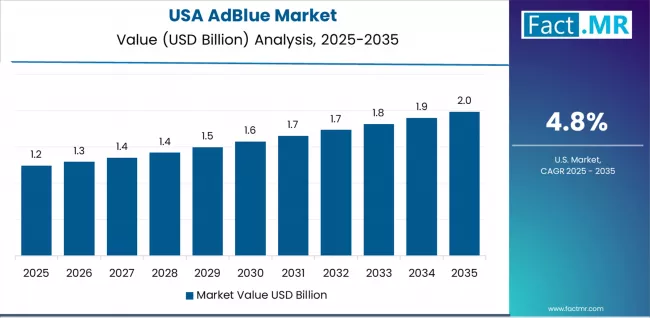
Adblue Market Country Value Analysis | Source: Fact.MR
USA establishes market leadership through comprehensive fleet programs and advanced transportation infrastructure development, integrating AdBlue systems across commercial and logistics applications. The country's 4.8% growth rate reflects established transportation relationships and mature emission control technology adoption that supports widespread use of NOx reduction systems in commercial and industrial fleets. Growth concentrates in major logistics centers, including California, Texas, and Illinois, where AdBlue technology showcases mature deployment that appeals to fleet operators seeking proven compliance capabilities and operational optimization applications.
American suppliers leverage established distribution networks and comprehensive technical support capabilities, including system design programs and training support that create customer relationships and operational advantages. The market benefits from mature regulatory standards and emission requirements that mandate AdBlue system use while supporting technology advancement and compliance optimization.
Market Intelligence Brief:
- Established regulatory standards providing consistent demand for emission control technology advancement
- Technology integration programs expanding AdBlue capabilities in transportation scenarios
UK Shows Premium Integration
UK's transportation market demonstrates integrated AdBlue deployment with documented compliance effectiveness in commercial applications and fleet operations through integration with existing vehicle systems and transportation infrastructure. The country maintains a 4.3% growth rate, supported by operational efficiency programs and compliance effectiveness requirements that promote precision AdBlue systems for transportation applications. Fleet facilities across England, Scotland, and Wales showcase systematic installations where AdBlue systems integrate with comprehensive transportation platforms to optimize compliance and operational outcomes.
UK suppliers prioritize system reliability and transportation compatibility in AdBlue procurement, creating demand for validated systems with proven compliance features, including quality monitoring integration and data management systems. The market benefits from established transportation infrastructure and quality requirements that support emission control technology adoption and operational effectiveness.
Market Intelligence Brief:
- Transportation compatibility requirements driving standardized AdBlue system adoption
- Fleet partnerships providing compliance validation and effectiveness data
- Technology integration between UK suppliers and international AdBlue companies
- Professional training programs expanding AdBlue system deployment in transportation scenarios
Japan Shows Precision Market Development
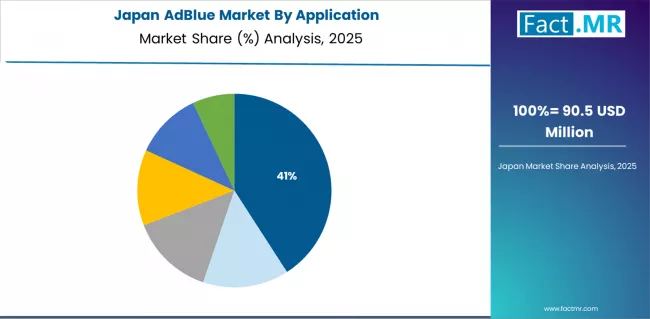
Adblue Market Japan Market Share Analysis By Application | Source: Fact.MR
Japan's market growth benefits from precision transportation demand, including advanced commercial facilities in Tokyo and Osaka, quality integration, and compliance enhancement programs that increasingly incorporate AdBlue solutions for transportation applications. The country maintains a 3.9% growth rate, driven by emission control technology advancement and increasing recognition of precision AdBlue benefits, including accurate NOx reduction and enhanced operational outcomes.
Market dynamics focus on high-precision AdBlue solutions that meet Japanese quality standards and transportation effectiveness requirements important to fleet operators. Advanced emission control technology adoption creates continued demand for sophisticated AdBlue systems in transportation facility infrastructure and operational modernization projects.
Strategic Market Considerations:
- Commercial and precision segments leading growth with focus on advanced AdBlue systems and quality applications
- Quality requirements driving premium product adoption from advanced emission control systems
- Technology integration challenges balanced by strong compliance effectiveness and quality capabilities
- Transportation quality initiatives beginning to influence procurement standards and AdBlue requirements
Europe Market Split by Country
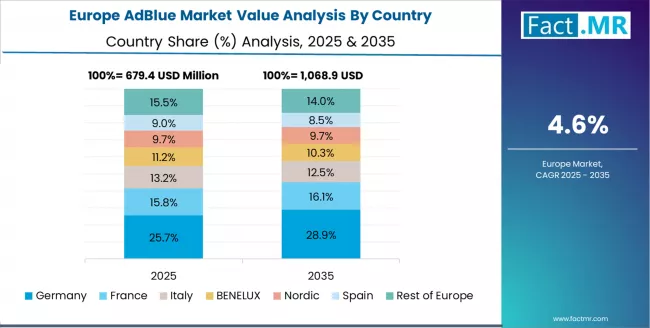
Adblue Market Europe Country Market Share Analysis, 2025 & 2035 | Source: Fact.MR
The European AdBlue market is projected to grow from USD 0.7 billion in 2025 to USD 1.1 billion by 2035, registering a CAGR of 4.7% over the forecast period. Germany is expected to maintain its leadership position with a 31.8% market share in 2025, supported by its advanced transportation infrastructure and major commercial vehicle centers.
UK follows with a 21.4% share in 2025, driven by comprehensive logistics programs and fleet development initiatives. France holds a 17.6% share through specialized commercial applications and regulatory compliance requirements. Italy commands a 13.7% share, while Spain accounts for 9.2% in 2025. The rest of Europe region is anticipated to gain momentum, expanding its collective share from 6.3% to 6.8% by 2035, attributed to increasing AdBlue adoption in Nordic countries and emerging transportation facilities implementing emission modernization programs.
Competitive Landscape of the AdBlue Market
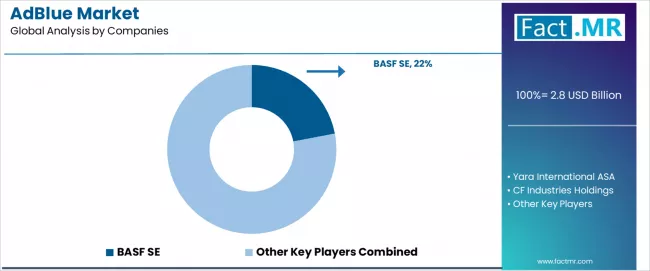
Adblue Market Analysis By Company | Source: Fact.MR
- Leading Company Share: BASF SE: 22% share
- Structure: ~10-12 credible players; top 4-6 hold ~65-70% by revenue.
- Leadership is maintained through: distribution networks, quality assurance, and supply reliability (product consistency + availability + logistics integration).
- What's commoditizing: standard AdBlue formulations and basic supply systems.
- Margin Opportunities: custom supply services, fleet integration, and incorporation into transportation workflows (consumption monitoring, compliance tracking).
| Stakeholder | What they actually control | Typical strengths | Typical blind spots |
|---|---|---|---|
| Global brands | Distribution reach, broad supply networks, brand recognition | Wide availability, proven quality, multi-region support | Product refresh cycles; customer dependency on brand validation |
| Technology innovators | AdBlue R&D; advanced formulation technologies; enhanced quality properties | Latest technologies first; attractive ROI on compliance effectiveness | Service density outside core regions; scaling complexity |
| Regional specialists | Local compliance, fast delivery, nearby customer support | "Close to customer" support; pragmatic pricing; local regulations | Technology gaps; talent retention in customer service |
| Full-service providers | Complete supply programs, fleet integration, consumption monitoring | Lowest operational risk; comprehensive support | Service costs if overpromised; technology obsolescence |
| Niche specialists | Specialized applications, custom formulations, technical services | Win premium applications; flexible configurations | Scalability limitations; narrow market focus |
Source: Fact.MR analysis. Updated Nov 6, 2025
Key Players in the AdBlue Market
- BASF SE
- Yara International ASA
- CF Industries Holdings
- OCI N.V.
- Total Energies SE
- Shell plc
- BP p.l.c.
- Chevron Corporation
- Cummins Inc.
- Bosch
- Continental AG
- Delphi Technologies
Segmentation
Scope of the Report
| Item | Value |
|---|---|
| Quantitative Units | USD 2.8 billion |
| Application | Commercial Vehicles, Construction Equipment, Agricultural Machinery, Marine Applications, Power Generation Systems, Rail Transport |
| End Use | Transportation Companies, Construction Contractors, Agricultural Operators, Marine Fleet Operators, Power Generation Facilities |
| Regions Covered | North America, Latin America, Western Europe, Eastern Europe, Asia Pacific, South Asia, Middle East & Africa |
| Countries Covered | China, India, Germany, Brazil, USA, UK, Japan, Canada, France, Australia, and 25+ additional countries |
| Key Companies Profiled | BASF SE, Yara International ASA, CF Industries Holdings, OCI N.V., Total Energies SE, Shell plc, BP p.l.c. |
| Additional Attributes | Dollar sales by application and end-use categories, regional adoption trends across Asia Pacific, Europe, and North America, competitive landscape with AdBlue suppliers and distribution networks, transportation operator preferences for supply effectiveness and compliance control, integration with fleet platforms and emission management systems, innovations in NOx reduction technology and compliance enhancement, and development of advanced supply solutions with enhanced quality and operational optimization capabilities. |
Source: Fact.MR analysis. Updated Nov 6, 2025
AdBlue Market by Segments
-
Application :
- Commercial Vehicles
- Construction Equipment
- Agricultural Machinery
- Marine Applications
- Power Generation Systems
- Rail Transport
-
End Use :
- Transportation Companies
- Construction Contractors
- Agricultural Operators
- Marine Fleet Operators
- Power Generation Facilities
-
Product :
- Standard AdBlue Solutions
- Premium Formulations
- Specialized Blends
-
Region :
- North America
- USA
- Canada
- Mexico
- Latin America
- Brazil
- Chile
- Rest of Latin America
- Western Europe
- Germany
- UK
- France
- Italy
- Spain
- Nordic
- BENELUX
- Rest of Western Europe
- Eastern Europe
- Russia
- Poland
- Rest of Eastern Europe
- Asia Pacific
- China
- Japan
- South Korea
- India
- Australia & New Zealand
- ASEAN
- Rest of Asia Pacific
- South Asia
- India
- Rest of South Asia
- Middle East & Africa
- Kingdom of Saudi Arabia
- Other GCC Countries
- Turkey
- South Africa
- Other African Union
- Rest of Middle East & Africa
- North America
Frequently Asked Questions
How big is the adblue market in 2025?
What will be the size of adblue market in 2035?
How much will be the adblue market growth between 2025 and 2035?
What are the key product types in the adblue market?
Which end use segment to contribute significant share in the adblue market in 2025?
Who worked on this report


Preview the report firsthand - request a free sample
Free SampleGet the brochure for pricing and purchase details
Download PDF