Additive Manufacturing Generative AI Copilots Market
The Additive Manufacturing Generative AI Copilots Market is analyzed across its key product, application and end-use segments, with regional trends and demand outlook, forecast 2026 to 2036.
By Fact.MR Technology DeskLead analyst:
Ganesh PaiPublished :
Updated :
10 min read
Fact-checked under the Fact.MR editorial process
Additive Manufacturing Generative AI Copilots Market Forecast and Outlook 2026 to 2036
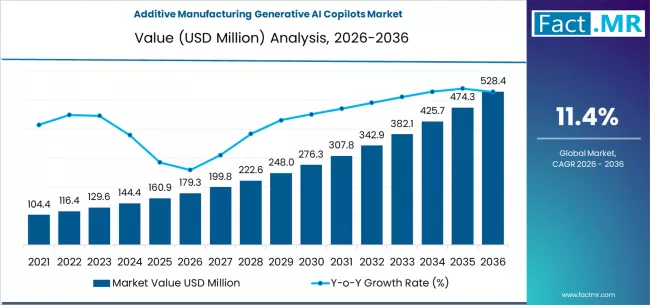
The global market for additive manufacturing generative AI copilots is projected to surge from USD 179.30 million in 2026 to USD 528.43 million by 2036, achieving a high CAGR of 11.4%.
This exceptional growth is fueled by the critical need to overcome the inherent complexities of design for additive manufacturing and to fully unlock the potential of 3D printing for producing lightweight, high-performance parts.
Additive Manufacturing Generative Ai Copilots Market Market Value Analysis | Source: Fact.MR
Summary of Additive Manufacturing Generative AI Copilots Market
Market Snapshot
Global additive manufacturing generative AI copilots market revenue stood at USD 179.30 million in 2026 and is forecast to reach USD 528.43 million by 2036.
At a 11.4% CAGR from 2026 to 2036, this market is set to expand 2.9x in value, adding USD 349.13 million in absolute opportunity.
Growth is being driven by the increasing need to overcome the complexities of design for additive manufacturing (DfAM) and maximize the performance potential of 3D printing technologies.
Generative AI copilots are evolving into intelligent additive manufacturing assistants, enabling automated design generation, simulation guidance, process optimization, and workflow acceleration across industrial 3D printing environments.
Demand and Growth Drivers
Rising adoption of advanced additive manufacturing technologies is accelerating demand for AI-assisted engineering and design optimization tools.
Increasing need for lightweight, high-performance, and geometrically complex components is reinforcing market growth.
Growing focus on reducing design iteration cycles, prototyping costs, and material waste is driving deployment of generative AI copilots.
Expansion of aerospace, automotive, healthcare, and industrial manufacturing applications is supporting broader adoption of AI-enabled additive manufacturing workflows.
Advancements in generative design algorithms, cloud-based AI platforms, and simulation-assisted engineering software are improving operational efficiency and engineering productivity.
Product and Segment View
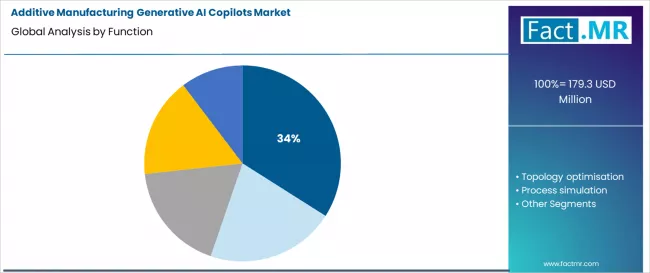
Generative design holds 34% of function segment share in 2026,emergingas the leading segment due to strong demand for topology optimization and lightweight part engineering.
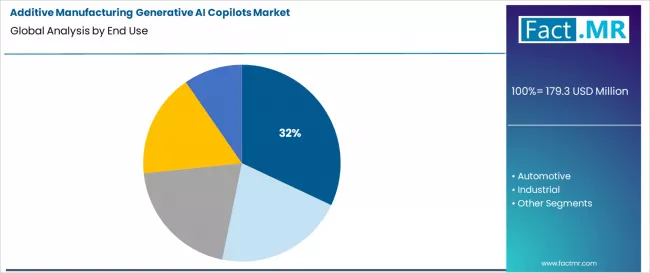
Aerospace accounts for 32% of end-use segment share in 2026, positioning it as the dominant segment driven by demand for lightweight, high-strength components and rapid prototyping.
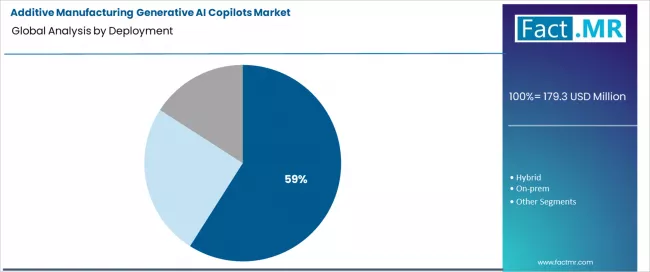
Cloud deployment holds 59% of deployment segment share in 2026, reflecting increasing preference for scalable, collaborative, and AI-enabled engineering environments.
These AI copilots are widely used across:
Topology optimization
Build simulation
Process automation
Engineering workflowassistance
Geography and Competitive Outlook
Growth is supported across North America, Europe, and Asia Pacific, aligned with increasing digital manufacturing adoption and industrial AI integration.
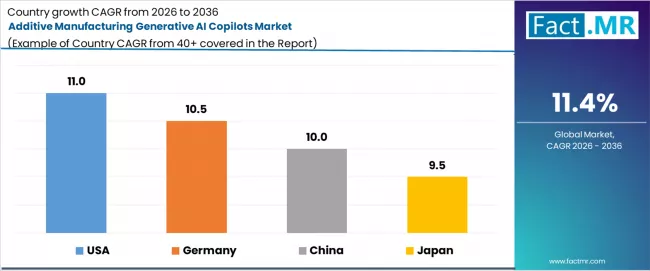
USA (11.00% CAGR), Germany (10.50%), China (10.00%), and Japan (9.50%) are key growth markets.
Market expansion is closely tied to Industry 4.0 adoption, AI-driven engineering transformation, and expansion of industrial additive manufacturing ecosystems.
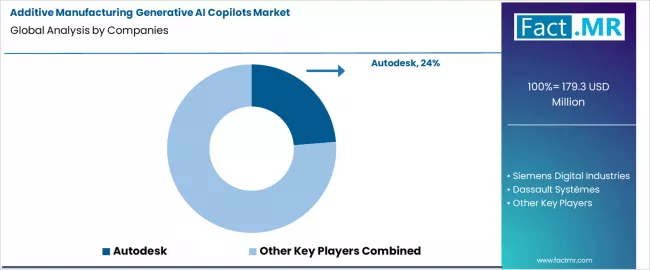
Key companies active in this market include Autodesk, Siemens Digital Industries, Dassault Systèmes, PTC, Ansys, and Hexagon.
Additive Manufacturing Generative AI Copilots Market — At a Glance
Attribute
Details
Market Value 2026
USD 179.30 million
Market Value 2036
USD 528.43 million
Absolute Dollar Opportunity 2026–2036
USD 349.13 million
Total Growth 2026–2036
194.7%
CAGR 2026–2036
11.4%
Growth Multiple
2.9x
Key Demand Theme
Increasing adoption of AI-powered additive manufacturing design and engineering copilots
Leading Segment by Function (2026)
Generative Design
Segment Share (2026)
34%
Leading Segment by End Use (2026)
Aerospace
Segment Share (2026)
32%
Leading Segment by Deployment (2026)
Cloud
Segment Share (2026)
59%
Key Growth Regions
North America, Europe, Asia Pacific
Country CAGRs
USA 11.00%, Germany 10.50%, China 10.00%, Japan 9.50%
Top Companies
Autodesk, Siemens Digital Industries, Dassault Systèmes, PTC, Ansys, Hexagon
North America, Latin America, Western Europe, Eastern Europe, East Asia, South Asia & Pacific, Middle East & Africa
Source: Fact.MR analysis. Updated May 26, 2026
These AI copilots serve as intelligent assistants, guiding engineers through the entire additive manufacturing workflow. The leading functional segment is generative design, commanding a 34% share by automating the creation of optimized geometries. The aerospace sector (32%) is the primary end-user, leveraging AI for critical components, while Cloud-based deployment (59%) dominates due to its scalability. Established software giants in CAD, simulation, and PLM, who are embedding generative AI into their platforms to create seamless, intelligent design-to-print environments, thereby raising the barrier for entry and accelerating industry-wide adoption, define the competitive landscape.
Metric
Metric
Value
Market Value (2026)
USD 179.30 Million
Market Forecast Value (2036)
USD 528.43 Million
Forecast CAGR (2026-2036)
11.4%
Source: Fact.MR analysis. Updated May 26, 2026
Category
Category
Segments
Function
Generative Design, Topology Optimisation, Process Simulation, Cost/Material AI, Qualification Automation
North America, Latin America, Western Europe, Eastern Europe, East Asia, South Asia & Pacific, MEA
Source: Fact.MR analysis. Updated May 26, 2026
Segmental Analysis
By Function, Which AI Capability is Most Transformative?
Additive Manufacturing Generative Ai Copilots Market Analysis By Function | Source: Fact.MR
Generative design leads the functional segment with a 34% share. This technology represents a paradigm shift, moving beyond human-led design to AI-driven creation. Engineers input design goals, constraints, and manufacturing parameters, and the AI explores thousands of permutations to generate optimized, organic geometries that minimize weight and material use while maximizing strength. It is fundamental to exploiting AM's freedom from traditional manufacturing constraints, making it the most impactful initial application of AI copilots.
By End Use, Which Industry Has the Most Stringent Performance Demands?
Additive Manufacturing Generative Ai Copilots Market Analysis By End Use | Source: Fact.MR
The aerospace sector is the dominant end user, accounting for 32% of the market. This industry is driven by an uncompromising need for lightweight, strong, and thermally efficient components to improve fuel efficiency and performance.
The high value of each part and the industry's early adoption of advanced AM for flight-critical components make it a prime market for AI copilots that can ensure optimal design, simulate performance under extreme conditions, and streamline the rigorous qualification processes required for certification.
By Deployment, What Model Offers the Necessary Computational Power?
Additive Manufacturing Generative Ai Copilots Market Analysis By Deployment | Source: Fact.MR
Cloud-based deployment is the leading model, holding a 59% share. This preference exists because generative AI and complex simulation tasks are computationally intensive, requiring significant processing power.
Cloud platforms offer scalable, on-demand access to high-performance computing resources without requiring massive upfront investment in local infrastructure. This enables smaller firms to access powerful tools and facilitates collaboration across geographically dispersed engineering teams working on the same AI-generated design iterations.
What Forces are Propelling, Hindering, and Defining the AI Copilot Market for Additive Manufacturing?
The core driver is the immense complexity of designing for additive manufacturing, where AI is essential to navigate trade-offs between weight, strength, thermal management, and printability. A major restraint is the high computational cost and expertise required to train and run sophisticated generative models, alongside challenges in integrating AI tools with legacy design and enterprise systems.
A significant opportunity lies in developing qualification automation AI that can predict and certify part quality and mechanical properties based on design and process parameters, drastically reducing time-to-certification. The dominant trend is the evolution of copilots from single-point tools into comprehensive, context-aware assistants that span the entire digital thread, suggesting materials, simulating build processes, predicting costs, and recommending post-processing steps based on continuous learning from manufacturing data.
Analysis of the Additive Manufacturing Generative AI Copilots Market by Key Countries
Additive Manufacturing Generative Ai Copilots Market Cagr Analysis By Country | Source: Fact.MR
Country
CAGR (2026-2036)
USA
11.00%
Germany
10.50%
China
10.00%
Japan
9.50%
Source: Fact.MR analysis. Updated May 26, 2026
How does the USA's Ecosystem of Innovation and Defense Spending Fuel Growth?
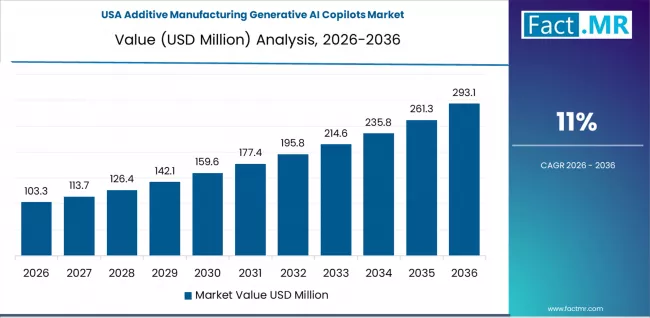
Additive Manufacturing Generative Ai Copilots Market Country Value Analysis | Source: Fact.MR
The USA's leading 11.00% CAGR is driven by its dominant position in both advanced software development and additive manufacturing adoption. Heavy investment from the Department of Defense, such as through America Makes, to accelerate certified AM parts, combined with a vibrant ecosystem of aerospace primes, contract manufacturers, and software startups, creates a powerful demand for AI tools that reduce development risk and time. The market is characterized by rapid integration of AI capabilities into mainstream engineering software used across these industries.
What underpins Germany's Integration of AI with Advanced Industrial Engineering?
Germany's 10.50% growth stems from its world-leading industrial base and its engineering-first approach to manufacturing. The focus is on integrating generative AI copilots into a seamless digital workflow that connects design, simulation, and production on the factory floor.
Growth is driven by the automotive and industrial machinery sectors seeking to produce lighter, more efficient components, with a strong emphasis on solutions that offer deterministic results and integrate with existing PLM and CAD environments.
What Drives China's Strategic Push for Self-Sufficiency in Advanced Design Software?
China's 10.00% CAGR is propelled by national strategies to achieve technological sovereignty in core industrial software, including CAD and CAE. While adopting international platforms, there is significant parallel investment in domestic AI and AM software development.
The massive scale of Chinese manufacturing, particularly in electronics and consumer goods, provides a vast testing ground for applying AI copilots to optimize designs for mass customization and lighter, more material-efficient products.
How is Japan's Focus on Precision and Quality Shaping Its Adoption?
Japan's 9.50% growth is linked to its excellence in high-precision manufacturing and materials science. Japanese industry applies generative AI with a paramount focus on reliability, simulation accuracy, and achieving first-time-right builds in expensive metal AM processes.
The market demand centers on AI tools that excel in multi-physics simulation and that can be rigorously validated to meet the ultra-high-quality standards required in sectors like medical devices and precision instrumentation.
Competitive Landscape of the Additive Manufacturing Generative AI Copilots Market
Additive Manufacturing Generative Ai Copilots Market Analysis By Company | Source: Fact.MR
The competitive landscape is concentrated among the established titans of design, engineering, and manufacturing software. These companies compete by deeply embedding generative AI capabilities into their existing, widely adopted software suites such as CAD, CAE, and PLM, creating a powerful stickiness and integrated user experience.
Competition revolves around the intelligence of the algorithms, the breadth of the supported AM process and material libraries, the depth of simulation fidelity, and the ability to provide an end-to-end workflow from AI-generated concept to printable, qualified build file. Success depends on capturing the early phases of the design process and becoming the indispensable copilot within an engineer's primary digital environment.
Key Players and Product Portfolio Focus
Company
Product Portfolio Focus in AM AI Copilots
Autodesk
Fusion 360 with generative design tools; Netfabb for simulation and process optimization.
Siemens Digital Industries
NX AM and Simcenter integrated with HEEDS AI for topology optimization and process simulation.
Dassault Systèmes
3DEXPERIENCE platform with generative design roles (e.g., on Cloud) and SIMULIA simulation.
PTC
Creo Generative Design powered by Ansys, focused on topology optimization within the CAD environment.
Ansys
Discovery and Granta MI for AI-driven generative exploration, materials intelligence, and high-fidelity simulation.
Hexagon
MSC Apex for generative design and process simulation, leveraging Nexus platform for data integration.
Source: Fact.MR analysis. Updated May 26, 2026
Key Players in the Additive Manufacturing Generative AI Copilots Market
Autodesk
Siemens Digital Industries
Dassault Systèmes
PTC
Ansys
Hexagon
References
Gibson, I., Rosen, D., & Stucker, B. (2024). Additive Manufacturing Technologies: 3D Printing, Rapid Prototyping, and Direct Digital Manufacturing (3rd ed.). Springer.
International Organization for Standardization (ISO). (2024). *ISO/ASTM 52950: Qualification of generative design software for additive manufacturing*. ISO.
Kumar, S., & Wang, J. (2023). Generative Design and AI: Transforming the Future of Product Development. Elsevier.
National Institute of Standards and Technology (NIST). (2024). Measurement Science for Additive Manufacturing: Roadmap for AI/ML Integration. NIST AMS.
Wohlers Associates. (2024). Wohlers Report 2024: 3D Printing and Additive Manufacturing State of the Industry. Wohlers Associates.
Yang, L., & Li, S. (2023). Artificial Intelligence for Smart Manufacturing: Applications in Additive Processes. Journal of Intelligent Manufacturing.
Market Breakdown
Segmentation
Scope of Report
Items
Values
Quantitative Units
USD Million
Function
Generative Design, Topology Optimisation, Process Simulation, Cost/Material AI, Qualification Automation
Autodesk, Siemens Digital Industries, Dassault Systèmes, PTC, Ansys, Hexagon
Additional Analysis
Comparative analysis of AI algorithm outputs vs. traditional design performance; study of data security and IP protection in cloud-based generative platforms; total cost of ownership for AI copilot integration; impact on engineering workforce skills and collaboration; assessment of AI model training data requirements and bias risks for different material/process combinations.
Source: Fact.MR analysis. Updated May 26, 2026
Market by Segments
Function :
Generative Design
Topology Optimisation
Process Simulation
Cost/Material AI
Qualification Automation
End Use :
Aerospace
Automotive
Industrial
Medical
Defense
Deployment :
Cloud
Hybrid
On-prem
Region :
North America
USA
Canada
Latin America
Brazil
Mexico
Argentina
Rest of Latin America
Western Europe
Germany
France
Italy
Spain
UK
Rest of Western Europe
Eastern Europe
Russia
Poland
Czech Republic
Rest of Eastern Europe
East Asia
China
Japan
South Korea
Rest of East Asia
South Asia & Pacific
India
ASEAN
Australia
Rest of South Asia & Pacific
MEA
GCC Countries
South Africa
Turkiye
Rest of MEA
Questions Answered
Frequently Asked Questions
How big is the additive manufacturing generative ai copilots market in 2026?
The global additive manufacturing generative ai copilots market is estimated to be valued at USD 179.3 million in 2026.
What will be the size of additive manufacturing generative ai copilots market in 2036?
The market size for the additive manufacturing generative ai copilots market is projected to reach USD 528.4 million by 2036.
How much will be the additive manufacturing generative ai copilots market growth between 2026 and 2036?
The additive manufacturing generative ai copilots market is expected to grow at a 11.4% CAGR between 2026 and 2036.
What are the key product types in the additive manufacturing generative ai copilots market?
The key product types in additive manufacturing generative ai copilots market are generative design, topology optimisation, process simulation, cost/material ai and qualification automation.
Which end use segment to contribute significant share in the additive manufacturing generative ai copilots market in 2026?
In terms of end use, aerospace segment to command 32.0% share in the additive manufacturing generative ai copilots market in 2026.