- Market Value (2025): USD 660.9 Mn
- Estimated Value (2026): USD 721.7 Mn
- Forecast Value (2036): USD 1740.1 Mn
- CAGR (2026-2036): 9.2%
What is the Advanced Genomics and Transcriptomics Sequencing Services Market forecast to be worth by 2036?
USD 721.7 million in 2026 to USD 1,740.1 million by 2036 at 9.2% CAGR.
- The market crossed a valuation of USD 660.9 million in 2025, supported by outsourced sequencing and interpretation services.
- Demand is projected to increase from USD 721.7 million in 2026 to USD 1,740.1 million by 2036.
- The market is forecast to record a 9.2% CAGR from 2026 to 2036 as research organizations outsource experiment design, library preparation, quality checks, data analysis and scientific reporting.
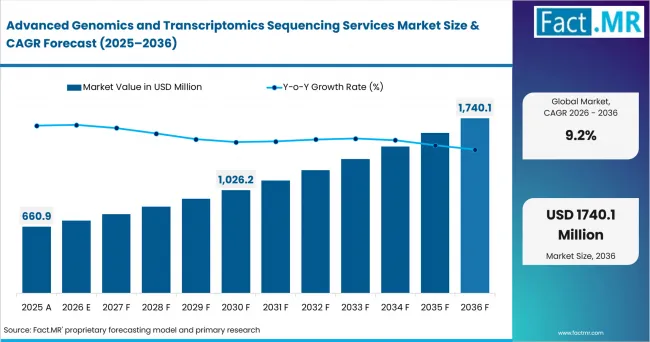
Advanced Genomics And Transcriptomics Sequencing Services Market Value Analysis | Source: Fact.MR
What are the defining numbers behind Advanced Genomics and Transcriptomics Sequencing Services Market growth?
USD 1,018.4 million absolute opportunity is expected by 2036.
- Demand Drivers in the Market
- Large genome programs are expected to increase demand for sample transport and fast whole-genome sequencing. These studies also require reference data that reflects different population groups and secure movement of research files.
- Long-read and full-length RNA testing is projected to grow where standard methods cannot clearly show large DNA changes or repeated regions. These projects also involve gene phasing, splice patterns and methylation analysis.
- Single-cell and spatial studies require careful tissue handling because poor cell condition can weaken the result. Library quality, sample records and data correction also affect how clearly the findings can be read.
- Drug companies are expected to continue outsourcing biomarker work when they compare patient groups and repeat the same testing process across studies. The final results must show how molecular changes relate to clinical trial decisions.
- Key Segments Analyzed
- By Service Type: Whole Genome Sequencing is expected to hold 25.0% share in 2026 supported by broad variant coverage across unresolved rare-disease cases.
- By Technology: Next-Generation Sequencing (NGS) is projected to account for 25.0% share in 2026 owing to its use across genome, exome, panel and transcriptome workflows.
- By Application: Biomarker Discovery is anticipated to represent 25.0% share in 2026 due to its role in linking genomic findings with disease mechanisms and research targets.
- By End User: Pharmaceutical & Biotechnology Companies are forecast to account for 30.0% share in 2026 driven by target discovery, cohort design and trial-support requirements.
- Analyst Opinion at Fact.MR
- Shambhu Nath Jha, Senior Analyst at Fact.MR, states, “Competition in advanced genomics and transcriptomics services now depends more on clear and reliable results than on access to sequencing alone. Providers that plan the study, protect sample quality and carry out the test under one service are likely to gain wider use. Strong data analysis and easy-to-understand scientific reports can also help bring customers back for future projects.”
- Strategic Implications
- Service laboratories set the minimum sample amount and purity before work begins. Storage, transport and damage checks are explained at the same stage.
- Pharmaceutical companies compare the data process, reference databases and price per sample before choosing a provider. The contract also covers how gene changes are described and how long project data is kept.
- Academic research groups use one format for sample details. They also agree on a method for handling differences between collection sites before samples arrive.
- Clinical research programs keep study findings separate from approved diagnostic results. A complete handling record follows every sample from collection to final review.
Germany is projected to record a 12.4% CAGR from 2026 to 2036. Brazil is estimated to post an 11.5% CAGR by 2036. The USA is anticipated to advance at a 10.6% CAGR through 2036. South Korea is forecast to record a 9.7% CAGR from 2026 to 2036. The United Kingdom is projected to post an 8.7% CAGR through 2036 and Japan is estimated to record a 7.8% CAGR by 2036.
How does the Advanced Genomics and Transcriptomics Sequencing Services Market break down by segment?
Whole Genome Sequencing leads at 25.0% by Service Type, Next-Generation Sequencing (NGS) leads at 25.0% by Technology in 2026.
Why does Whole Genome Sequencing lead Service Type?
Whole Genome Sequencing is estimated to hold 25.0% share in 2026.
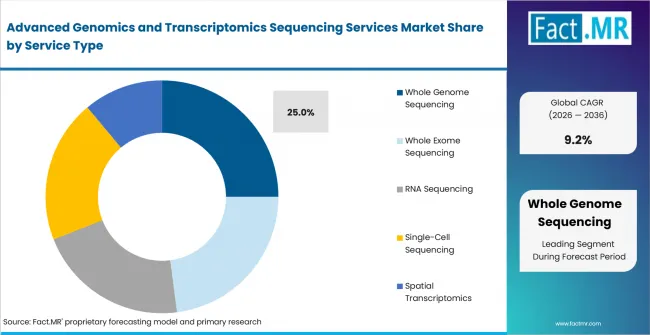
Advanced Genomics And Transcriptomics Sequencing Services Market Analysis By Service Type | Source: Fact.MR
Whole Genome Sequencing is estimated to hold 25.0% of Service Type demand in 2026 because it gives research teams one broad assay for single-nucleotide variants and copy-number changes. Structural variants and population comparisons add to the same service case. National Human Genome Research Institute updated its Human Genome Reference Program page in March 2025 and reported that data and assemblies had been acquired for about 300 additional individuals as of December 2024. That pangenome work makes whole-genome interpretation more useful when projects include ancestry representation and variation that a narrow reference misses.
Why does Next-Generation Sequencing (NGS) lead Technology?
Next-Generation Sequencing (NGS) is projected to account for 25.0% share in 2026.
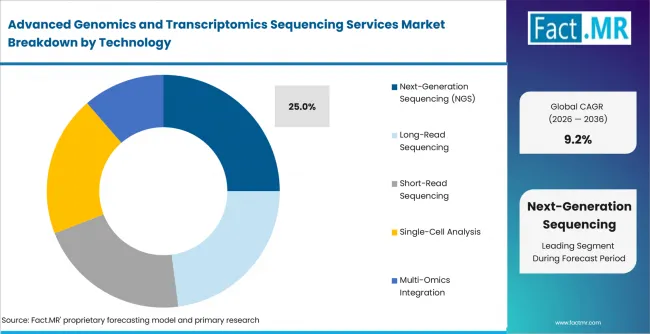
Advanced Genomics And Transcriptomics Sequencing Services Market Analysis By Technology | Source: Fact.MR
Next-Generation Sequencing (NGS) is projected to account for 25.0% of Technology demand in 2026. Its installed workflow base and reagent ecosystem support routine genome and transcriptome service work. The broad assay menu helps sponsors plan repeatable throughput and predictable analysis handoffs.
Why does Biomarker Discovery lead Application?
Biomarker Discovery is anticipated to represent 25.0% share in 2026.
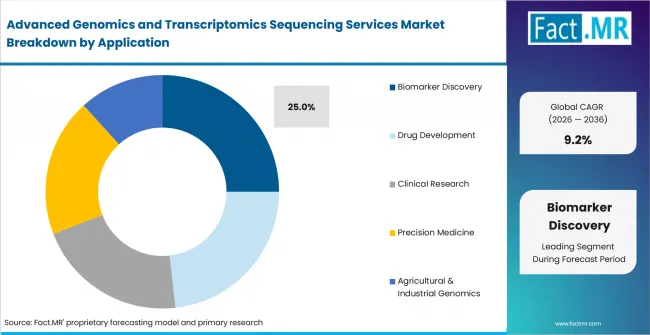
Advanced Genomics And Transcriptomics Sequencing Services Market Analysis By Application | Source: Fact.MR
Biomarker Discovery is anticipated to represent 25.0% of Application demand in 2026. The category draws on genomic and transcriptomic comparisons across disease states and treatment groups. Outsourced providers are expected to support repeat cohorts and orthogonal validation. Clear links between molecular signals and clinical metadata remain necessary.
Why do Pharmaceutical & Biotechnology Companies lead End User?
Pharmaceutical & Biotechnology Companies are forecast to account for 30.0% share in 2026.
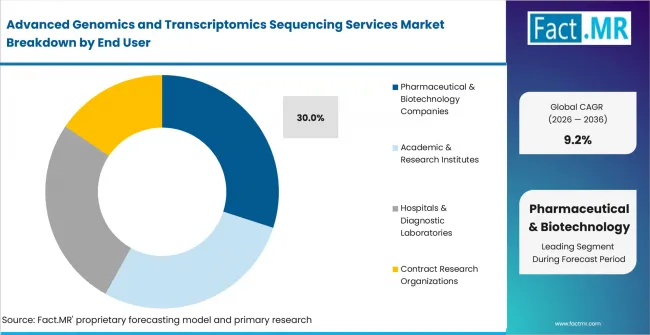
Advanced Genomics And Transcriptomics Sequencing Services Market Analysis By End User | Source: Fact.MR
Pharmaceutical & Biotechnology Companies are forecast to account for 30.0% of End User demand in 2026. These organizations use sequencing across target discovery and translational research. Trial enrichment and pharmacogenomics add demand when sponsors need molecular evidence for cohort design. Companion-biomarker work supports the same service need across drug-development programs. They often outsource when in-house teams need temporary capacity or a specialized platform because independent analysis supports a defined study.
What is accelerating Advanced Genomics and Transcriptomics Sequencing Services Market adoption, and what is holding it back?
Population-scale sequencing is anticipated to expand service demand, while sample quality and reproducibility gaps restrain it.
Drivers Impact Analysis
| DRIVER | (~) % IMPACT ON CAGR | GEOGRAPHIC RELEVANCE | IMPACT TIMELINE |
|---|---|---|---|
| Population-scale whole-genome reference programs | +1.6% | Germany and multinational initiatives | Long term (>=4 years) |
| Long-read structural and isoform resolution | +1.3% | Brazil and long-read deployments | Medium term (2-4 years) |
| Single-cell and spatial transcriptomic mapping | +1.0% | USA and reference-building centers | Medium term (2-4 years) |
| Multi-omics integration and reproducibility standards | +0.7% | South Korea and research networks | Medium term (2-4 years) |
| Pharmaceutical biomarker and drug-development demand | +0.5% | U.K. and pharmaceutical purchasers | Short term (<=2 years) |
Source: Fact.MR analysis. Updated Jul 20, 2026
- Population-scale genome programs: Cohort expansion is expected to create recurring service demand because every collection round involves sample handling and metadata checks. Reference updates and reanalysis extend the work after sequencing is complete.
- Long-read resolution: Structural variants and repeat regions are projected to widen demand for providers that manage both laboratory work and interpretation. Phasing and full-length isoforms add specialized analysis needs, with methylation creating another layer of service work.
- Single-cell and spatial mapping: Tissue atlases are anticipated to increase service intensity because specimen quality and dissociation affect the final biological readout. Imaging and library construction require the same care, and normalization affects the final comparison.
- Multi-omics reproducibility: Sponsors are expected to favor providers that record workflow versions and batch controls. Metadata rules and audit trails should remain visible across genomics and transcriptomics because epigenomics adds another traceability need.
- Pharmaceutical biomarker work: Drug developers are estimated to sustain repeat outsourcing where molecular evidence must connect with patient stratification. Response monitoring and trial design create the next layer of demand.
Opportunity Impact Analysis
| OPPORTUNITY | (~) % IMPACT ON CAGR | GEOGRAPHIC RELEVANCE | IMPACT TIMELINE |
|---|---|---|---|
| Multi-omics integration platforms for CROs | +0.5% | South Korea and contract research organizations | Medium term (2-4 years) |
| Federated data interoperability standards adoption | +0.4% | Germany and research networks | Medium term (2-4 years) |
| Precision medicine and pharmacogenomic panels | +0.3% | U.K. and pharmaceutical programs | Long term (>=4 years) |
| Clinical-grade quality system certification | +0.3% | Japan and hospital laboratories | Long term (>=4 years) |
Source: Fact.MR analysis. Updated Jul 20, 2026
- CRO multi-omics platforms: Contract research organizations are expected to create value when one project team handles sample intake and sequencing. Integration and scientific reporting complete the client handoff.
- Federated analysis: Multinational studies are anticipated to need privacy-aware analysis paths where data access and consent remain visible. Software versions and audit logs must be traceable too.
- Precision medicine panels: Pharmacogenomic and biomarker programs are projected to expand where results guide stratification plans and help sponsors decide which cohorts deserve deeper study.
- Clinical-grade certification: Hospital-linked research is estimated to favor providers that maintain chain-of-custody records and validation files. Quality systems suited to controlled research settings strengthen that position.
Restraints Impact Analysis
| RESTRAINT | (~) % IMPACT ON CAGR | GEOGRAPHIC RELEVANCE | IMPACT TIMELINE |
|---|---|---|---|
| Batch effects and computational reproducibility gaps | -0.6% | Global multi-omics workflows | Short term (<=2 years) |
| Sample scarcity and cell-subpopulation representation limits | -0.4% | Global single-cell and spatial programs | Short term (<=2 years) |
| Regulatory review and clinical-grade chain-of-custody burden | -0.3% | Japan and clinically regulated markets | Medium term (2-4 years) |
| Staffing and infrastructure gaps with reimbursement limits | -0.3% | Brazil and mixed delivery systems | Medium term (2-4 years) |
Source: Fact.MR analysis. Updated Jul 20, 2026
- Batch effects: Reproducibility gaps remain a direct commercial risk because a technically successful run does not always support comparison across sites or time points.
- Sample scarcity: Single-cell and spatial projects are anticipated to face limits when tissue is small or degraded. Transit delays and unmatched collection protocols add further risk.
- Chain-of-custody burden: Clinical-grade research is expected to need specimen tracking and consent records. Validation files and data governance raise project cost.
- Staffing and infrastructure gaps: Some regions are projected to depend on outsourced expertise because specialist bioinformatics capacity and high-throughput infrastructure remain uneven.
Which countries are scaling Advanced Genomics and Transcriptomics Sequencing Services Market fastest?
The global growth rate brings together the results of every country covered in the study. Germany, Brazil, the USA and South Korea grow faster than the worldwide rate of 9.2%. The United Kingdom and Japan move at a slower pace. Other countries in the full study help balance these differences. The six markets shown are examples and do not cover the full geographic picture.
- The main difference comes from where demand starts in each country. Every market has its own mix of sequencing work, research programs and laboratory support.
- Germany benefits from large genome studies, university hospitals and research carried out across several countries. These projects require secure data handling and results that reflect different population groups. Brazil follows another path. Its varied population and uneven access to specialist services create demand for laboratories that can handle long-read sequencing and explain the results.
- In the USA, single-cell and spatial RNA studies produce large amounts of data and place greater pressure on sample handling. South Korea relies more on hospital research and projects that combine several types of biological data. Providers are judged by the quality of sample records, the consistency of their work and whether results can be repeated.
- The United Kingdom gains from biomarker research, medical studies and drug-response testing supported by its life-sciences sector. Japan moves through carefully controlled clinical research. Sample tracking, local study results and data rules receive close attention.
Countries with similar growth rates can still offer different business openings. Sample quality, the type of sequencing used, data analysis skills, data rules and access to specialist laboratories all affect when demand develops. The full report covers North America, Latin America, Europe, East Asia, South Asia and Oceania, and the Middle East and Africa.
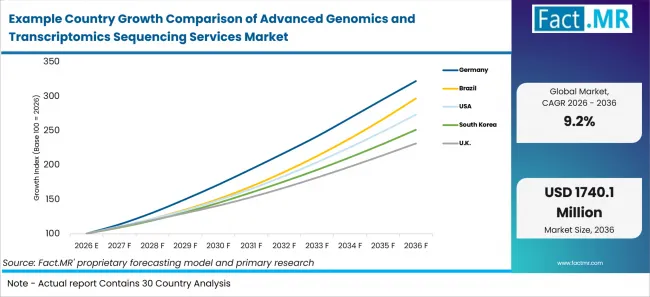
Example Country Growth Comparison Of Advanced Genomics And Transcriptomics Sequencing Services Market | Source: Fact.MR
| COUNTRY | CAGR |
|---|---|
| Germany | 12.4% |
| Brazil | 11.5% |
| USA | 10.6% |
| South Korea | 9.7% |
| U.K. | 8.7% |
| Japan | 7.8% |
Source: Fact.MR analysis. Updated Jul 20, 2026
What is driving Germany’s growth through 2036?
12.4% CAGR, driven by large genome studies and secure data sharing across countries.
Germany’s opportunity comes from university hospitals and genome centers that handle more than sequencing alone. Large population studies also involve sample preparation, analysis that reflects different ancestry groups and secure movement of genomic files between research partners. Demand is projected to record a 12.4% CAGR through 2036 as laboratories combine testing with clear analysis and well-recorded data transfer.
How is Brazil scaling demand?
11.5% CAGR, supported by population diversity and complete long-read testing services.
Brazil’s varied population creates demand for local genetic reference data instead of relying mainly on information from other population groups. The Ministry of Health’s Genomas Brasil program aims to bring genetic and medical information into the public health system. This gives service providers an opening to manage sample preparation, long-read sequencing and result review within one project, supporting an 11.5% CAGR through 2036.
What supports the USA outlook?
10.6% CAGR, backed by large single-cell and tissue-mapping studies.
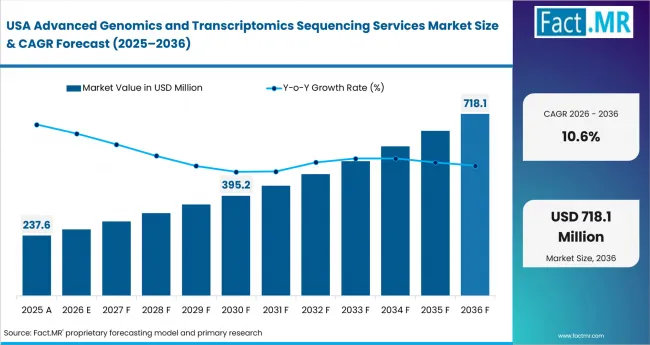
Advanced Genomics And Transcriptomics Sequencing Services Market Country Value Analysis | Source: Fact.MR
In the USA, cell-atlas and tissue-mapping projects create demand for careful sample handling before sequencing starts. Human Cell Atlas data used in the analysis covered more than 66 million cells and over 300 TB of data by June 2025. Work at this scale involves library preparation, sample-record checks, data correction and detailed computer-based review. These requirements support a 10.6% CAGR through 2036.
What underpins South Korea’s growth?
9.7% CAGR, led by hospital research and consistent study methods.
South Korea benefits from major hospitals that bring genetic, RNA and patient information into the same research program. Providers are judged on whether sample records, batch checks and software versions stay consistent throughout the study. The market is forecast to expand at a 9.7% CAGR through 2036 as biotechnology programs compare results across patient groups and different collection periods.
How is the U.K. developing demand?
8.7% CAGR, supported by national genetic testing systems and medical research.
The U.K. has an established whole-genome testing route through Genomics England and the NHS Genomic Medicine Service. Researchers can also use linked genetic and medical information for disease studies and biomarker work. Demand is projected to grow at an 8.7% CAGR through 2036 as laboratories provide sample processing, data review and clear scientific reports for research linked to patient care.
What shapes Japan’s outlook?
7.8% CAGR, tied to careful research rules and full sample tracking.
Japan’s market is shaped by studies that give close attention to local testing, patient consent and the movement of each sample through the laboratory. Providers have to record sample identity, test performance and data access before findings can support hospital research. This careful approach is expected to support a 7.8% CAGR through 2036 and favor companies with strong sample tracking and quality controls.
Who leads the Advanced Genomics and Transcriptomics Sequencing Services Market?
Illumina and PacBio lead platform influence, while Oxford Nanopore and Novogene strengthen specialized service and workflow coverage.
Illumina provides short-read sequencing systems and data tools. Research laboratories use its platforms when they have to process many samples and study gene changes and methylation within the same project.
PacBio focuses on highly accurate long-read sequencing. Its systems help study larger DNA changes, inherited gene patterns and repeated regions that short-read methods may miss. These projects often create extra demand for outside data review.
Oxford Nanopore Technologies offers real-time sequencing and direct DNA and RNA analysis. Its systems range from portable devices to high-output laboratory platforms. This makes them useful for fast rare-disease studies that examine larger DNA changes and methylation in one run.
Novogene and Azenta Life Sciences provide sequencing services and project support. Their laboratory networks help research sponsors move samples locally and receive data analysis support throughout the study.
Which companies are the key providers?
Key companies include Illumina, Inc.; Eurofins Scientific SE; Revvity Inc.; PacBio; Oxford Nanopore Technologies plc; Azenta Life Sciences; BGI Genomics Co. Ltd.; and Novogene Co. Ltd.
- Illumina, Inc.
- Eurofins Scientific SE
- Revvity, Inc.
- PacBio
- Oxford Nanopore Technologies plc
- Azenta Life Sciences
- BGI Genomics Co., Ltd.
- Novogene Co., Ltd.
Bibliography
- All of Us Research Program. (2025, February 24). All of Us adds data from 50% more participants in largest data expansion to date. National Institutes of Health.
- Human Cell Atlas. (2025, June 24). HCA data now freely available on AWS.
- National Human Genome Research Institute. (2025, March 31). Human Genome Reference Program.
- Oxford Nanopore Technologies plc. (2025). Oxford Nanopore launches a 24-hour whole genome sequencing workflow for rare disease research.
- PacBio. (2025, October 14). PacBio announces major advances for Revio and Vega to lower genome cost and expand multiomic capabilities.
This Report Addresses
- The report provides strategic intelligence on Advanced Genomics and Transcriptomics Sequencing Services across Service Type and Technology choices that shape outsourced research workflows.
- Segment analysis covers Whole Genome Sequencing and Next-Generation Sequencing (NGS) as the share leaders within the 2026 market structure.
- Regional outlook evaluates Germany and Brazil alongside the USA and South Korea, while the United Kingdom, Japan and additional countries complete the growth comparison.
- Competitive analysis profiles Illumina and Eurofins Scientific alongside Revvity and Pacific Biosciences of California, followed by four additional active sequencing and service providers.
- Technology assessment covers Next-Generation Sequencing (NGS) and Long-Read Sequencing across projects that require different read lengths, throughput levels and analysis methods.
- Use-case assessment covers Biomarker Discovery and Drug Development alongside Clinical Research, Precision Medicine and Agricultural & Industrial Genomics.
What does the Advanced Genomics and Transcriptomics Sequencing Services Market cover?
Whole Genome Sequencing, Whole Exome Sequencing, RNA Sequencing, Single-Cell Sequencing and Spatial Transcriptomics services used across research projects.
The advanced genomics and transcriptomics sequencing services market covers outsourced laboratory and data-analysis work used to move genomic and transcriptomic projects from sample intake to usable research findings. Coverage includes genome, exome and RNA sequencing alongside single-cell and spatial transcriptomic services.
The market differs from sequencing equipment sales because commercial value comes from study planning, sample preparation, assay execution, data review and scientific reporting. Instruments and standalone reagents remain outside the boundary unless they are supplied as part of a purchased sequencing service.
What is included in the scope?
Genomics and transcriptomics services used across pharmaceutical, academic, hospital and contract research programs.
The scope includes Whole Genome Sequencing and Whole Exome Sequencing alongside RNA Sequencing, Single-Cell Sequencing and Spatial Transcriptomics. Coverage spans Next-Generation Sequencing, Long-Read Sequencing and Short-Read Sequencing, with Single-Cell Analysis and Multi-Omics Integration included when they form part of the purchased workflow.
Biomarker Discovery and Drug Development are included alongside Clinical Research and Precision Medicine. Agricultural & Industrial Genomics is covered when the provider delivers sequencing, analysis and reporting as one coordinated service. Sample intake, nucleic-acid quality checks, library preparation, primary processing, secondary analysis, annotation and data delivery are also included.
What is excluded from the scope?
Standalone sequencing instruments, independent reagent sales and unrelated testing services are outside the scope.
The scope excludes sequencing systems sold without an associated service contract. Standalone library-preparation kits, and sequencing reagents are excluded when they are not part of a managed project. Consumer ancestry testing and routine PCR services remain outside the boundary. Unsupported diagnostic claims and general laboratory work without genomics or transcriptomics relevance are also excluded.
How Was the Analysis Built?
The analysis draws on 120+ sources, 35+ company portfolios, 25+ countries, and more than 20 industry interviews.
- Primary Research: Primary research includes discussions with manufacturers, service providers, technology developers, distributors, end users, procurement teams, and subject-matter experts. These conversations examine purchasing priorities, product adoption, operational challenges, approval requirements, competitive positioning, and the factors that influence wider market acceptance.
- Desk Research: Desk research covers government statistics, regulatory publications, company filings, trade data, technical studies, industry associations, standards, public policy, and other authoritative sources. Every source used in the analysis is documented in the bibliography.
- Market Sizing and Forecasting: Market estimates combine historical performance, demand indicators, pricing and volume trends, segment shares, company participation, country-level growth, adoption patterns, investment activity, and barriers to market expansion.
- Data Validation and Update Cycle: Findings are validated by comparing primary interviews with public data, company activity, regulatory changes, trade patterns, and industry developments. Regular updates review new product launches, capacity changes, partnerships, approvals, procurement trends, and shifts in commercial adoption.
Segmentation
What is the report’s scope and coverage?
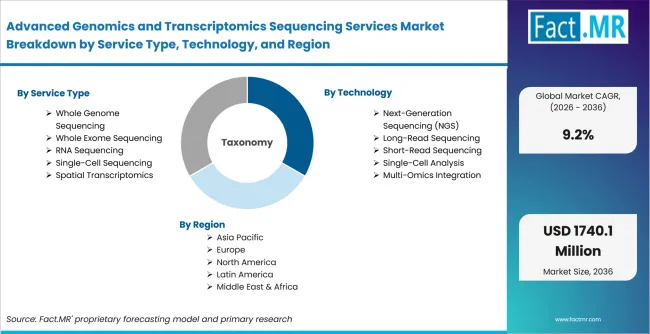
Advanced Genomics And Transcriptomics Sequencing Services Market Breakdown By Service Type, Technology, And Region | Source: Fact.MR
| Attribute | Details |
|---|---|
| Quantitative Units | USD Million in 2026 to USD Million by 2036 at CAGR |
| Market Definition | Outsourced genomics and transcriptomics services covering study planning, sample intake, nucleic-acid quality checks, library preparation, sequencing, data analysis, annotation and scientific reporting |
| Service Type | Whole Genome Sequencing; Whole Exome Sequencing; RNA Sequencing; Single-Cell Sequencing; Spatial Transcriptomics |
| Technology | Next-Generation Sequencing (NGS); Long-Read Sequencing; Short-Read Sequencing; Single-Cell Analysis; Multi-Omics Integration |
| Application | Biomarker Discovery; Drug Development; Clinical Research; Precision Medicine; Agricultural & Industrial Genomics |
| End User | Pharmaceutical & Biotechnology Companies; Academic & Research Institutes; Hospitals & Diagnostic Laboratories; Contract Research Organizations |
| Regions Covered | North America; Latin America; Europe; East Asia; South Asia & Oceania; Middle East & Africa |
| Countries Covered | USA; Canada; Brazil; Mexico; Germany; United Kingdom; France; Italy; Spain; South Korea; Japan; Australia & New Zealand; GCC Countries; South Africa |
| Key Companies Profiled | Illumina, Inc.; Eurofins Scientific SE; Revvity, Inc.; Pacific Biosciences of California, Inc.; Oxford Nanopore Technologies plc; Azenta, Inc.; BGI Genomics Co., Ltd.; Novogene Co., Ltd. |
| Forecast Period | 2026 to 2036 |
| Approach | Hybrid top-down and bottom-up approach using outsourced sequencing volumes; genome, exome and transcriptome project mix; sample-preparation and library-construction demand; long-read and short-read platform use; single-cell and spatial project activity; bioinformatics workload; contract values; outsourcing rates; regional research capacity and company participation |
Source: Fact.MR analysis. Updated Jul 20, 2026
How is the market segmented?
-
By Service Type
- Whole Genome Sequencing
- Whole Exome Sequencing
- RNA Sequencing
- Single-Cell Sequencing
- Spatial Transcriptomics
-
By Technology
- Next-Generation Sequencing (NGS)
- Long-Read Sequencing
- Short-Read Sequencing
- Single-Cell Analysis
- Multi-Omics Integration
-
By Application
- Biomarker Discovery
- Drug Development
- Clinical Research
- Precision Medicine
- Agricultural & Industrial Genomics
-
By End User
- Pharmaceutical & Biotechnology Companies
- Academic & Research Institutes
- Hospitals & Diagnostic Laboratories
- Contract Research Organizations
-
By Region
- North America
- USA
- Canada
- Latin America
- Brazil
- Mexico
- Rest of Latin America
- Europe
- Germany
- U.K.
- France
- Italy
- Spain
- Rest of Europe
- East Asia
- South Korea
- Japan
- South Asia & Oceania
- India
- Australia & New Zealand
- Rest of South Asia & Oceania
- Middle East & Africa
- GCC Countries
- South Africa
- Rest of Middle East & Africa
- North America
Frequently Asked Questions
Which Service Type leads the Advanced Genomics and Transcriptomics Sequencing Services Market?
Which Technology leads the Advanced Genomics and Transcriptomics Sequencing Services Market?
Which Application leads the Advanced Genomics and Transcriptomics Sequencing Services Market?
Which End User leads the Advanced Genomics and Transcriptomics Sequencing Services Market?
Which country records the highest CAGR in the Advanced Genomics and Transcriptomics Sequencing Services Market?
How does Brazil perform in the Advanced Genomics and Transcriptomics Sequencing Services Market?
How does the USA perform in the Advanced Genomics and Transcriptomics Sequencing Services Market?
How does South Korea perform in the Advanced Genomics and Transcriptomics Sequencing Services Market?
What is the primary driver in the Advanced Genomics and Transcriptomics Sequencing Services Market?
What is the main restraint in the Advanced Genomics and Transcriptomics Sequencing Services Market?
Why is Whole Genome Sequencing important?
Who worked on this report


Preview the report firsthand - request a free sample
Free SampleGet the brochure for pricing and purchase details
Download PDF