- Base Value(2026): 1.46 Bn
- Forecast Value (2036): 2.28 Bn
- CAGR (2036): 5.0%
Aerial Firefighting Market Forecast and Outlook 2026 to 2036
In 2025, the global aerial firefighting market was valued at approximately USD 1.36 billion, adjusted modestly from baseline estimates. Based on Fact.MR analysis, demand for aerial firefighting solutions is estimated to reach around USD 1.46 billion in 2026 and expand to nearly USD 2.28 billion by 2036, reflecting a CAGR of 5.0% during the forecast period. Market progression reflects rising wildfire intensity, extended fire seasons, and increased reliance on contracted aerial fleets. As Jim Hirsch, President and CEO of Air Tractor, Inc., stated,“Overall, the market demand is still strong. Demand is exceeding our capacity. These are high-class problems that we're fortunate to have.” [1] Fact.MR analysis interprets this as indicative of constrained fleet supply relative to operational demand, particularly for large airtankers and heavy helicopters.
The market is projected to add roughly USD 0.92 billion in incremental value over the forecast window, reflecting steady compounding supported by fleet modernization and UAV integration. Early-period growth is supported by procurement of fixed-wing airtankers and heavy-lift helicopters. Mid-period expansion aligns with adoption of surveillance drones and fire mapping systems to enhance detection accuracy. In later years, value realization is increasingly shaped by multi-role aircraft utilization, logistics support services, and industrial protection contracts rather than pure suppression sorties.
China leads growth at 6.8% CAGR, supported by expanded wildfire monitoring and emergency response programs. India follows at 6.3%, driven by forest protection initiatives and disaster response modernization. Germany posts 5.8%, reflecting enhanced EU-level fire coordination frameworks. The United Kingdom grows at 4.8%, supported by contracted aerial services, while the United States at 4.3% remains influenced by federal and state wildfire budgets and fleet replacement cycles.
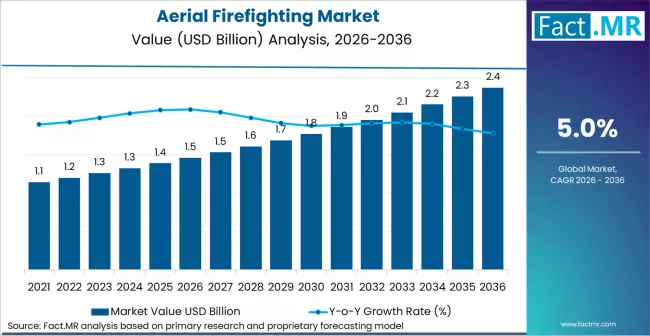
Aerial Firefighting Market Market Value Analysis | Source: Fact.MR
Aerial Firefighting Market
| Metric | Value |
|---|---|
| Market Value (2026) | USD 1.46 billion |
| Forecast Value (2036) | USD 2.28 billion |
| Forecast CAGR (2026-2036) | 5.0% |
Source: Fact.MR analysis. Updated Feb 27, 2026
Summary of Aerial Firefighting Market
- Market Definition
- The aerial firefighting market covers fixed-wing aircraft, helicopters, and unmanned aerial systems deployed for wildfire suppression, aerial surveillance, retardant delivery, and logistical support under regulated aviation and wildfire response frameworks.
- Demand Drivers
- Rising wildfire frequency and longer fire seasons increase reliance on contracted aerial fleets for rapid suppression and containment support.
- Government procurement models and multi-year service contracts provide revenue visibility for operators maintaining ready-to-deploy aircraft fleets.
- Integration of surveillance drones and mapping systems strengthens detection accuracy and supports coordinated air-ground firefighting operations.
- Key Segments Analyzed
- Type: Fixed-wing aircraft account for the leading share due to higher payload capacity and extended operational range for large-scale retardant deployment.
- Service: Firefighting operations, including water and retardant drops, represent the dominant service segment given direct involvement in active wildfire suppression.
- Geography: Asia Pacific shows the fastest growth, supported by expanding government wildfire response programs in China and India.
- Analyst Opinion at Fact.MR
- Shambhu Nath Jha, Principal Consultant at Fact.MR, opines, ‘CXOs will find this report useful for understanding how fleet readiness, aircraft modernization, contract structures, and mission capability influence long-term value creation in aerial firefighting operations.’
- Strategic Implications / Executive Takeaways
- Operators should prioritize fleet modernization and payload optimization to secure multi-season government contracts.
- Investment in UAV integration and real-time mapping systems can enhance mission coordination and service differentiation.
- Expansion strategies should focus on regions with rising wildfire risk and structured public funding for emergency aviation capacity.
- Methodology
- Market sizing is based on fleet deployment data, government contract volumes, wildfire incident statistics, and aircraft utilization rates.
- Regulatory and operational references were validated.
Aerial Firefighting Market Definition
The aerial firefighting market covers aircraft, helicopters, and related systems used to suppress wildfires and support ground fire control operations. These aircraft deliver water, fire retardant, or suppressant chemicals to affected areas and assist with reconnaissance and crew transport. Platforms include fixed wing air tankers, scoopers, and rotary wing helicopters equipped with buckets or tanks. Operational standards, aviation safety, and wildfire response coordination are governed by authorities such as the US Federal Aviation Administration and wildfire management frameworks managed by the US Forest Service.[2]
Aerial Firefighting Market Inclusions
The report provides global and regional market size estimates in volume and value with a forecast from 2026 to 2036. Segmentation includes aircraft type such as fixed wing and rotary wing platforms, payload capacity, application across wildfire suppression and emergency response, and end use by government agencies and contracted service providers. Regional deployment patterns and procurement trends are included.
Aerial Firefighting Market Exclusions
The scope excludes ground firefighting vehicles, handheld equipment, and structural firefighting systems used in urban settings. Fire detection satellites, drones not configured for retardant delivery, and surveillance aircraft without suppression capability are not included. Firefighting training services, maintenance contracts, and aircraft manufacturing unrelated to firefighting conversion are excluded.
Aerial Firefighting Market Research Methodology
- Primary Research: Interviews were conducted with aerial firefighting operators, aviation maintenance providers, fire management officials, and aircraft conversion specialists.
- Desk Research: Desk research reviewed aviation safety regulations issued by the US Federal Aviation Administration and wildfire management and procurement documentation from the US Forest Service, along with fleet registry and contract award records.
- Market Sizing and Forecasting: Estimates were developed using fleet size data, government contract volumes, wildfire incident statistics, and aircraft utilization rates.
- Data Validation and Update Cycle: Data was cross checked against aviation registries, public procurement disclosures, wildfire response reports, and operator financial filings before updates were finalized.
Segmental Analysis
Aerial Firefighting Market Analysis by Type
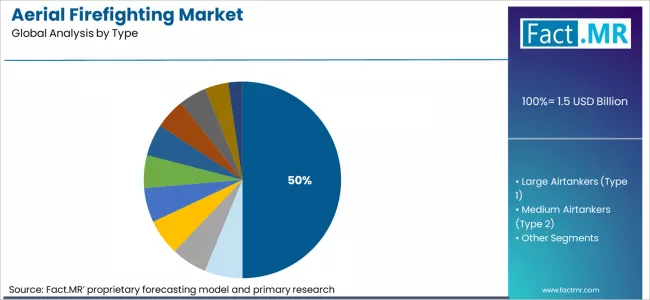
Aerial Firefighting Market Analysis By Type | Source: Fact.MR
Based on Fact.MR analysis, consumption of fixed wing aircraft is estimated to hold 50% share of the global aerial firefighting market. Fact.MR analysts note fixed wing platforms lead due to higher payload capacity, extended range, and suitability for large scale retardant deployment. As per Fact.MR, this type addresses wildfire management needs for rapid response, sustained sortie operations, and coverage across expansive forest and grassland regions worldwide today supporting coordinated firefighting strategies during peak wildfire seasons across high risk geographies globally.
- Operational oversight: Aerial firefighting aircraft operate under national aviation and wildfire management regulations.[3]
- Payload advantage: Fact.MR analysts note large airtankers carry higher retardant volumes per sortie.
- Range capability: Fixed wing aircraft cover wider operational areas compared with rotary platforms.
Aerial Firefighting Market Analysis by Service
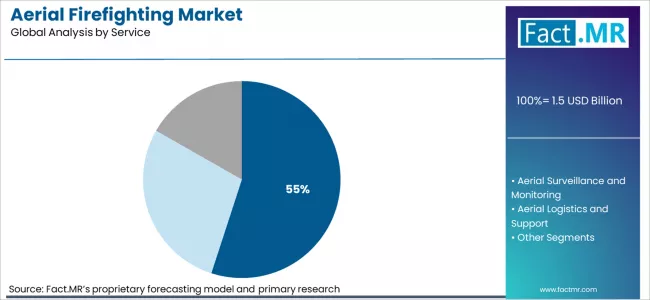
Aerial Firefighting Market Analysis By Service | Source: Fact.MR
Based on Fact.MR analysis, consumption of aerial firefighting operations services is estimated to hold 55% share of the global market. Fact.MR analysts note firefighting operations lead due to demand for water, retardant, and foam drops during active wildfire suppression. As per Fact.MR, this service category addresses emergency response requirements, interagency coordination, and rapid containment efforts across forested, rural, and peri urban areas worldwide today supporting government wildfire mitigation programs and seasonal preparedness planning across multiple regions globally.
- Wildfire framework: National wildfire response programs coordinate aerial suppression resources during fire events.[4]
- Suppression demand: Fact.MR analysts note retardant drops are central to containment strategies.
- Interagency coordination: Aerial services integrate with ground firefighting units.
Aerial Firefighting Market Drivers, Restraints, And Opportunities
Fact.MR analysis indicates that the aerial firefighting market exists as a specialised aerospace and emergency response segment focused on the use of aircraft and rotorcraft to suppress wildfires and protect life, property, and critical infrastructure. As per Fact.MR assessment, protocols and performance expectations for aerial firefighting operations are shaped by civil aviation safety and airspace management standards such as those outlined by the U.S. Federal Aviation Administration (FAA) for aircraft operations in special use airspace, which include provisions related to flight safety, aerial operations coordination, and emergency response support.[5] Fact.MR analysts observe that the current market scale is supported by increasing wildfire frequency and intensity in forested and wildland-urban interface zones, driven by climate variability, expanded human activity near fire-prone areas, and heightened public safety expectations for rapid response capability.
Fact.MR is of the opinion that current market dynamics reflect a transition in operational technologies and fleet capabilities as agencies and service providers seek higher performance, interoperability, and efficiency in fighting large-scale wildfires. Based on Fact.MR assessment, traditional fixed-wing airtankers and rotary aircraft equipped with basic water or retardant delivery systems continue to be used due to established fleets and operational familiarity, but growth is occurring in segments where advanced aircraft with precision drop systems, real-time fire behaviour integration, and multi-mission flexibility are specified. Advanced aerial firefighting platforms that offer improved payload capacity, rapid deployment, and integrated sensor packages generally command higher per-unit pricing because of aircraft modification costs, avionics integration, and mission certification requirements, meaning realised market value can rise even where basic fleet expansion grows at a measured pace. Fact.MR analysis suggests that this combination of evolving performance requirements and premium fleet capabilities will shape near-term market progression.
- Regulated aviation and emergency operations: Fact.MR analysts note that frameworks such as the U.S. FAA special aerial firefighting operations guidance influence aircraft operation standards, coordination procedures, and safety expectations for aerial firefighting missions.
- Shift to high-performance platforms: Based on Fact.MR assessment, demand is increasing for aircraft and rotorcraft with enhanced payload, precision retardant delivery, and integrated mission systems that support complex wildfire suppression scenarios.
- Global wildfire risk growth: Fact.MR opines that rising wildfire incidence and severity in regions such as North America, Europe, Australia, and parts of Asia Pacific sustain demand for aerial firefighting capabilities and fleet modernisation across government and contracted service providers.
Regional Analysis
Based on regional assessment, the aerial firefighting sector is analyzed across North America, Europe, East Asia, South Asia, and other wildfire-prone regions, spanning more than 40 countries. Regional performance varies according to wildfire frequency, government investment in emergency response infrastructure, modernization of firefighting aircraft fleets, and adoption of aerial surveillance and suppression technologies.
Aerial Firefighting Market CAGR Analysis by Country (2026-2036)
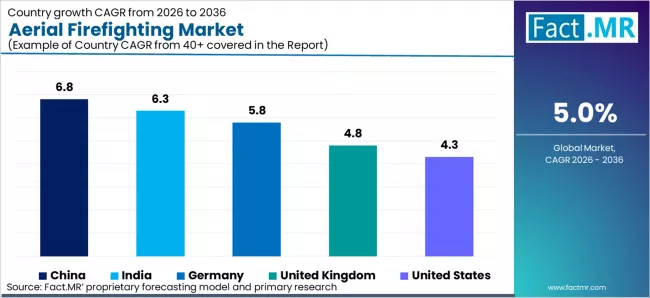
Aerial Firefighting Market Cagr Analysis By Country | Source: Fact.MR
| Country | CAGR |
|---|---|
| China | 6.8% |
| India | 6.3% |
| Germany | 5.8% |
| United Kingdom | 4.8% |
| United States | 4.3% |
Source: Fact.MR analysis. Updated Feb 27, 2026
Source: Fact.MR analysis, based on proprietary forecasting models and primary research.
Outlook On Aerial Firefighting Demand in Asia Pacific
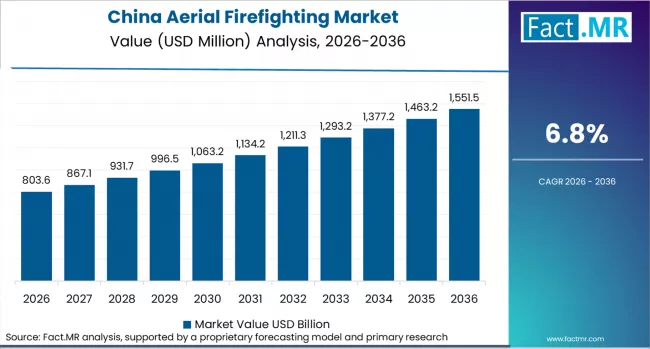
Aerial Firefighting Market Country Value Analysis | Source: Fact.MR
Asia Pacific reflects expanding demand for aerial firefighting services supported by rising wildfire incidents forest management programs and disaster response planning. Adoption is shaped by government procurement seasonal leasing and integration with national emergency response agencies. China and India anchor regional activity through deployment of fixed wing aircraft helicopters and surveillance platforms. Procurement emphasizes response time payload capacity and coordination with ground units. Market growth reflects budget allocation climate related risk management and modernization of aerial response fleets regionwide.
- China: Demand for aerial firefighting services in China is projected to rise at 6.8% CAGR through 2036. Growth reflects increased wildfire response activity and government procurement of aircraft and helicopter fleets, as per Fact.MR.
- India: Demand for aerial firefighting services in India is projected to rise at 6.3% CAGR through 2036. Usage reflects expansion of forest fire response programs and seasonal leasing of aerial assets, according to Fact.MR.
Fact.MR’s analysis of the Aerial Firefighting Market in Asia Pacific consists of country-wise assessment that includes China and India. Readers can find fleet deployment and emergency response investment insights.
Analysis On Aerial Firefighting Sales in Europe
Europe demonstrates regulated aerial firefighting demand shaped by cross border cooperation wildfire preparedness and public sector contracts. Sales are linked to leasing agreements aircraft modernization and integration with civil protection agencies. Germany and the United Kingdom contribute through limited domestic fleets and participation in regional response frameworks. Procurement emphasizes compliance safety certification and interoperability. Market growth reflects climate variability replacement of aging aircraft and structured funding for emergency aviation capabilities across European civil protection systems regionwide.
- Germany: Demand for aerial firefighting services in Germany is projected to rise at 5.8% CAGR through 2036. Adoption reflects federal disaster response planning and structured procurement of aerial assets, as per Fact.MR.
- United Kingdom: Demand for aerial firefighting services in the United Kingdom is projected to rise at 4.8% CAGR through 2036. Usage reflects seasonal wildfire response contracts and coordination with civil protection agencies, according to Fact.MR.
Fact.MR’s analysis of the Aerial Firefighting Market in Europe consists of country-wise assessment that includes Germany and the United Kingdom. Readers can find public sector contract trends and fleet modernization insights.
Demand for Aerial Firefighting Services in North America
North America shows structured demand for aerial firefighting services supported by recurring wildfire seasons state federal contracts and dedicated aviation fleets. Sales are driven by long term service agreements modernization of airtankers and integration with emergency management systems. The United States anchors regional volume through federal and state procurement. Market growth reflects fleet replacement expansion of aerial surveillance and continued budget allocation for wildfire mitigation and rapid response operations nationwide.
- United States: Demand for aerial firefighting services in the United States is projected to rise at 4.3% CAGR through 2036. Usage reflects federal and state wildfire response contracts and modernization of aerial firefighting fleets, as per Fact.MR.
Fact.MR’s analysis of the Aerial Firefighting Market in North America consists of country-wise assessment that includes the United States. Readers can find procurement models and wildfire response investment insights.
Competitive Landscape of Aerial Firefighting Market
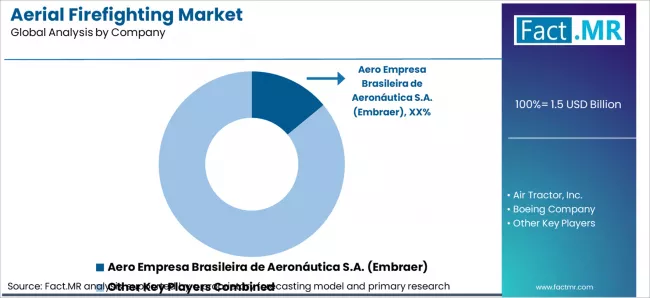
Aerial Firefighting Market Analysis By Company | Source: Fact.MR
As per Fact.MR analysis, the 2026 aerial firefighting market is defined by validated aircraft performance, payload capacity, and operational reliability, which determine competitive advantage. Embraer and Air Tractor, Inc. lead with specialized fixed-wing airtankers certified for water and retardant delivery, which strengthens adoption among government firefighting agencies. Boeing Company and Bombardier Inc. focus on large-capacity converted jets with verified drop precision, which improves efficiency for large-scale wildfire suppression. Airbus Defence and Space and Canadair Regional Jet (Mitsubishi Heavy Industries) provide multi-role platforms with documented operational reliability, which enhances adoption in multi-national firefighting programs. Conair Group Inc. and Coulson Aviation emphasize modular tank systems and rotorcraft integration, which supports versatile deployment across remote and rugged terrains. Bridger Aerospace, Dauntless Air, Erickson Incorporated, and K-MAX Helicopters deliver validated heavy-lift and rotary-wing capabilities, which improve precision and reduce response times. Aerovironment (UAVs), 10 Tanker Air Carrier, Aero-Flite, Aero Union, Neptune Aviation Services, Minden Air Corporation, Lockheed Martin, and Northrop Grumman offer specialized UAVs, multi-role platforms, and support services with verified reliability, which strengthens firefighting efficiency and expands adoption across government and private contracts. Across the market, validated aircraft performance, payload efficiency, and operational reliability form enduring competitive moats, reducing reliance on pricing or isolated equipment claims.
Recent Industry Development
- Launch of the 767FF "Game-Changer" Mega-Tanker Platform: In early 2026, Israel Aerospace Industries (IAI) and Fire Free Forests (3F) signed a strategic agreement to co-develop the 767FF, a converted Boeing 767BDSF. This aircraft is designed to carry a massive 40 tons (approx. 10,000 gallons) of retardant. Beyond its capacity, the development is notable for introducing a subscription-based service model for governments and reinsurers, treating aerial firefighting as a shared "climate insurance" asset rather than a simple equipment purchase.[6]
- Canada’s $316 Million Federal Fleet Modernization: The Government of Canada announced an investment of $316.7 million in February 2026 to bolster provincial and territorial aerial firefighting capacity. This funding, managed by the Canadian Interagency Forest Fire Centre (CIFFC), focuses on a centralized leasing model to ensure a "Pan-Canadian" surge capacity. The RFP (Request for Proposals) launched this month specifically targets modernized aircraft for the 2026 wildfire season to address the increasing frequency of mega-fires. [7]
Key Players in Aerial Firefighting Market
- Aero Empresa Brasileira de Aeronáutica S.A. (Embraer)
- Air Tractor, Inc.
- Boeing Company
- Bombardier Inc.
- Airbus Defence and Space
- Canadair Regional Jet (Mitsubishi Heavy Industries)
- Conair Group Inc.
- Coulson Aviation (Coulson Group)
- Bridger Aerospace Group Holdings, LLC
- Dauntless Air, Inc.
- Erickson Incorporated
- Aerovironment, Inc. (UAVs)
- 10 Tanker Air Carrier, LLC
- Aero-Flite, Inc.
- Aero Union Corporation
- Neptune Aviation Services
- Minden Air Corporation
- K-MAX Helicopters (Kaman Corporation)
- Lockheed Martin Corporation
- Northrop Grumman Corporation
Bibliography
- [1] Air Tractor, Inc. (2025). Air Tractor charts steady course amid global challenges with strong firefighting aircraft demand [Corporate announcement]. Air Tractor, Inc.
- [2] U.S. Federal Aviation Administration. (2024). Aircraft Rescue and Fire Fighting (ARFF) requirements and operational policies. U.S. Department of Transportation, Federal Aviation Administration.
- [3] U.S. Federal Aviation Administration. (2024). Aircraft certification and operations guidance for aerial firefighting and special use operations. U.S. Department of Transportation, Federal Aviation Administration.
- [4] National Interagency Fire Center. (2024). Fire information: Wildland fire statistics and interagency coordination. National Interagency Fire Center.
- [5] U.S. Forest Service. (2024). Wildland fire management and policy overview. U.S. Department of Agriculture, Forest Service.
- [6] Government of Canada. (2026). Government of Canada invests in bolstering pan-Canadian aerial wildfire firefighting capacity. Public Safety Canada.
This Report Addresses
- Market intelligence to enable structured strategic decision-making across mature and emerging aerial firefighting markets
- Market size estimation and 10-year revenue forecasts from 2026 to 2036, supported by validated wildfire incidence data and government procurement records
- Growth opportunity mapping across types, services, and end users, with emphasis on aircraft platforms and core firefighting operations
- Segment and regional revenue forecasts covering major aircraft categories, UAV systems, and key geographic markets
- Competition strategy assessment including aircraft payload capability, operational reliability, fleet readiness, and service integration benchmarking
- Technology roadmap tracking including UAV integration, precision retardant delivery systems, real-time fire mapping, and night operations capability
- Regulatory impact analysis covering aviation safety standards under the Federal Aviation Administration and wildfire response frameworks managed by the U.S. Forest Service
- Market report delivery in PDF, Excel, PPT, and interactive dashboard formats for executive and operational use
Segmentation
Scope of the Report
| Metric | Value |
|---|---|
| Quantitative Units | USD 1.46 billion (2026) to USD 2.28 billion (2036), CAGR 5.0% |
| Market Definition | The aerial firefighting market covers aircraft, helicopters, and UAVs used for wildfire suppression and emergency response. Platforms deliver water, retardant, or foam and support aerial surveillance, fire mapping, hotspot identification, and logistics such as personnel and equipment transport. Operations follow aviation safety standards and wildfire management protocols set by authorities such as the US Federal Aviation Administration (FAA) and US Forest Service. |
| Type Segmentation | Aircraft (Fixed-wing), Large Airtankers (Type 1), Medium Airtankers (Type 2), Small Airtankers (Type 3), Amphibious Aircraft, Helicopter (Light, Medium, Heavy), Fixed-wing Specialized Aircraft, Unmanned Aerial Vehicles (Surveillance & Suppression Drones) |
| Service Segmentation | Firefighting Operations (Water Drops, Retardant Drops, Foam Applications), Aerial Surveillance and Monitoring (Fire Detection, Mapping, Hotspot Identification), Aerial Logistics and Support (Personnel Transport, Equipment Delivery, Communication Relay) |
| End User Segmentation | Government Agencies (Federal, State, Municipal), Private Firefighting Contractors, Wildfire Suppression Services, Industrial Protection (Oil & Gas, Mining, Timber) |
| Regions Covered | Asia Pacific, Europe, North America, Latin America, Middle East & Africa |
| Countries Covered | China, India, Japan, South Korea, Indonesia, Australia & New Zealand, Germany, Italy, France, United Kingdom, Spain, Benelux, Nordics, Central & Eastern Europe, United States, Canada, Mexico, Brazil, Argentina, Chile, Kingdom of Saudi Arabia, United Arab Emirates, South Africa, Turkey |
| Key Companies Profiled | Embraer, Air Tractor, Inc., Boeing Company, Bombardier Inc., Airbus Defence and Space, Canadair Regional Jet (Mitsubishi Heavy Industries), Conair Group Inc., Coulson Aviation, Bridger Aerospace, Dauntless Air, Erickson Inc., Aerovironment Inc. (UAVs), 10 Tanker Air Carrier, Aero-Flite, Aero Union, Neptune Aviation, Minden Air Corp., K-MAX Helicopters, Lockheed Martin, Northrop Grumman |
| Forecast Period | 2026 to 2036 |
| Approach | Market sizing and forecasting based on wildfire frequency, fleet inventory, government procurement, UAV adoption, and operational utilization rates. Data validated via interviews with operators, fire management officials, aviation authorities, and contract disclosures. |
Source: Fact.MR analysis. Updated Feb 27, 2026
Aerial Firefighting Market Analysis by Segments
-
Type :
- Aircraft (Fixed-wing)
- Large Airtankers (Type 1)
- Medium Airtankers (Type 2)
- Small Airtankers (Type 3)
- Amphibious Aircraft
- Helicopter
- Light Helicopters (Type 3)
- Medium Helicopters (Type 2)
- Heavy Helicopters (Type 1)
- Fixed-wing Aircraft (Specialized)
- Unmanned Aerial Vehicles (UAVs)
- Surveillance Drones
- Suppression Drones
-
Service :
- Firefighting Operations
- Water Drops
- Retardant Drops
- Foam Applications
- Aerial Surveillance and Monitoring
- Fire Detection
- Fire Mapping
- Hotspot Identification
- Aerial Logistics and Support
- Personnel Transport
- Equipment Delivery
- Communication Relay
- Firefighting Operations
-
End User :
- Government
- Federal/National Agencies
- State/Provincial Agencies
- Local/Municipal Agencies
- Private Firefighting Contractors
- Wildfire Suppression Services
- Industrial Protection
- Industrial Companies
- Oil and Gas Facilities
- Mining Operations
- Timber Companies
- Government
-
Region :
- Asia Pacific
- India
- China
- Japan
- South Korea
- Indonesia
- Australia & New Zealand
- ASEAN
- Rest of Asia Pacific
- Europe
- Germany
- Italy
- France
- United Kingdom
- Spain
- Benelux
- Nordics
- Central & Eastern Europe
- Rest of Europe
- North America
- United States
- Canada
- Mexico
- Latin America
- Brazil
- Argentina
- Chile
- Rest of Latin America
- Middle East & Africa
- Kingdom of Saudi Arabia
- United Arab Emirates
- South Africa
- Turkey
- Rest of Middle East & Africa
- Asia Pacific
Frequently Asked Questions
How large is the aerial firefighting market in 2026?
What will the aerial firefighting market size be by 2036?
What is the expected CAGR of the aerial firefighting market during 2026–2036?
How much incremental value will the aerial firefighting market add during the forecast window?
What structural factors are governing the aerial firefighting market?
Why does aircraft availability matter more than annual fire season variability?
Which aircraft type holds the leading share in the aerial firefighting market?
Why do fixed-wing aircraft dominate aerial firefighting deployments?
Which service segment accounts for the largest share of the market?
Why do firefighting operations dominate service demand?
Which country shows the fastest growth in the aerial firefighting market?
How fast is the aerial firefighting market expected to grow in India?
What is the growth outlook for aerial firefighting services in Germany?
How is the United Kingdom performing in the aerial firefighting market?
What is the projected growth rate for the United States aerial firefighting market?
What is driving early-period market growth?
What supports mid-period expansion in the aerial firefighting market?
What factors influence later-stage value realization in the market?
Why is fleet modernization important in this market?
What defines long-term value creation in the aerial firefighting market?
Who worked on this report


Preview the report firsthand - request a free sample
Free SampleGet the brochure for pricing and purchase details
Download PDF