- Market Value (2025): USD 3.7 Bn
- Estimated Value (2026): USD 4.2 Bn
- Forecast Value (2036): USD 15.4 Bn
- CAGR (2026-2036): 13.9%
What is the Aero-Conformal ESA Antennas Market forecast to be worth by 2036?
USD 4.2 billion in 2026 to USD 15.4 billion by 2036 at a 13.9% CAGR.
- The Aero-Conformal ESA Antennas Market reached USD 3.7 billion in 2025.
- Demand is projected to increase from USD 4.2 billion in 2026 to USD 15.4 billion by 2036.
- The market is forecast to record 13.9% CAGR from 2026 to 2036.
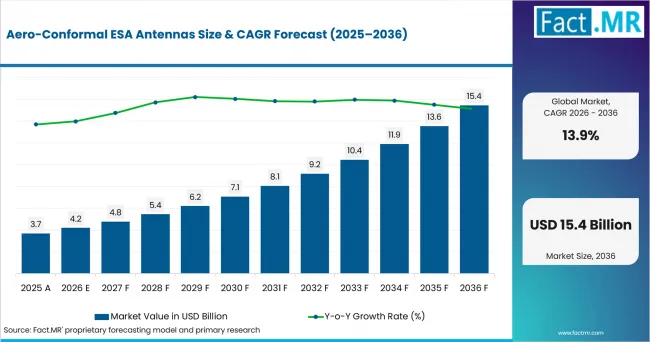
Aero Conformal Esa Antennas Value Analysis | Source: Fact.MR
What are the defining numbers behind Aero-Conformal ESA Antennas Market growth?
An absolute opportunity of USD 11.2 billion is expected between 2026 and 2036.
- Demand Drivers in the Market
- Fighter program teams need antenna panels that follow aircraft contours and protect radar signature discipline. The GCAP Agency awarded Edgewing a GBP 4.6 billion contract in July 2026, jointly funded by the UK, Italy and Japan, to complete the advanced concept and assessment phase and advance detailed aircraft design and development.
- Radar engineers need low-profile arrays that preserve sensor range within tight aircraft spaces. AESA conformal panels reduce exposed structures and give mission teams more freedom around nose, wing and fuselage packaging.
- SATCOM integrators need electronically steered apertures for aircraft that switch across orbit types. Low-profile ESA antennas support communication continuity on crewed aircraft, uncrewed platforms and high-speed air vehicles.
- Electronic warfare teams need distributed sensing surfaces that feed radar warning and signal-processing functions. Conformal arrays help designers place receiving apertures where threat direction and aircraft coverage need better balance.
- Test teams need repeatable RF performance before flight release. Curved apertures change beam behavior, so antenna suppliers must prove gain, thermal stability and electromagnetic compatibility before aircraft installation.
- Key Segments Analyzed
- By Array Type: AESA conformal panels are expected to hold 37.0% share in 2026 supported by their fit with fighter radar and low-profile sensing needs.
- By Platform: Fighter aircraft are projected to account for 31.0% share in 2026 due to radar refresh cycles and next-generation aircraft programs.
- By Band: X-band is anticipated to capture 29.0% share in 2026 owing to its role in fire-control radar and airborne surveillance.
- By Function: Radar is forecast to represent 36.0% share in 2026 shaped by detection, tracking and terrain-mapping requirements.
- Analyst Opinion at Fact.MR
- Shambhu Nath Jha, Principal Consultant at Fact.MR, states, “Aero-conformal ESA antennas are drawing attention as antenna geometry now affects aircraft shape, thermal routing and mission electronics at the same time. The market is expected to reward suppliers that can link array design with flight qualification and mission-system integration. A stronger commercial position belongs to teams that combine RF engineering, airframe packaging and export-ready documentation.”
- Strategic Implications
- Airframe manufacturers should freeze aperture zones early so structural loads and electromagnetic coverage advance through qualification together.
- Radar suppliers should document power density and cooling behavior by platform class so engineering teams can compare panel options during design reviews.
- EW system teams should plan sensor-fusion interfaces early. Dstl reported in December 2025 that Project SIREN moved from concept to demonstration in just 15 months. Dstl said the collaborative model accelerated development toward exploitation, providing a useful example of rapid integration for networked sensing capabilities.
Israel leads at 15.0% CAGR through defense-export depth and fighter-electronics specialization. Italy follows at 14.5% CAGR as GCAP design work strengthens domestic air-combat engineering. The USA reaches 14.1% CAGR through next-generation aircraft investment. The UK posts 13.7% CAGR through Typhoon radar work and GCAP participation. France records 13.4% CAGR as Rafale modernization and airborne electronic intelligence programs support antenna integration demand.
How does the Aero-Conformal ESA Antennas Market break down by segment?
AESA conformal panels lead at 37.0%; radar leads at 36.0%.
Which Array Type dominates?
AESA conformal panels are expected to hold 37.0% share in 2026.
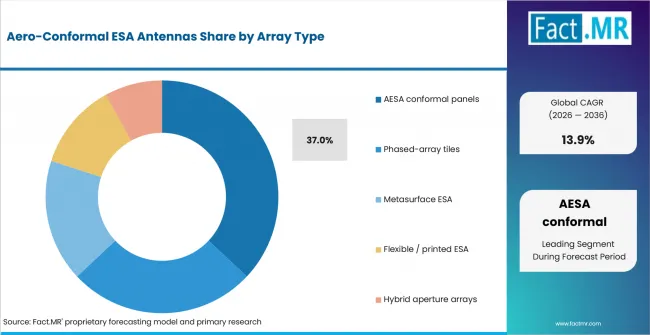
Aero Conformal Esa Antennas Analysis By Array Type | Source: Fact.MR
AESA conformal panels lead where aircraft teams need beam steering inside curved or low-profile surfaces. The antenna must steer beams electronically while following curved or low-profile aircraft surfaces. Phased-array tiles remain relevant for modular installations and easier replacement. Metasurface ESA concepts serve thinner structures where weight and depth are tightly managed. Northrop Grumman describes SABR APG-83 as an AESA radar for F-16 platforms that fits existing structural, power and cooling limits.
What leads the Platform segment?
Fighter aircraft are projected to account for 31.0% share in 2026.
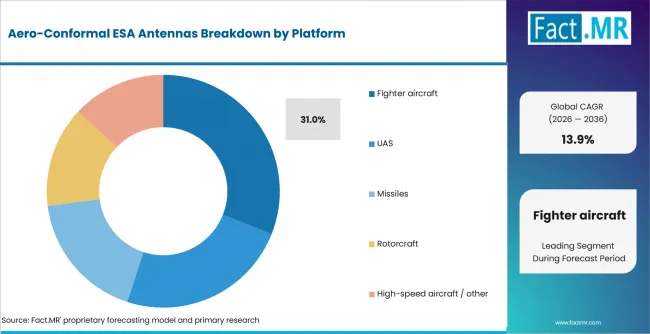
Aero Conformal Esa Antennas Analysis By Platform | Source: Fact.MR
Fighter aircraft lead the platform segment since radar, electronic warfare and data-link functions are highly concentrated on combat aircraft. UAS platforms follow where smaller airframes need compact antennas with lower drag. Missiles use conformal apertures where exposed antennas affect speed and survivability. Rotorcraft demand is more selective where installation space varies across mission kits. Fighter programs therefore remain the clearest route for qualified conformal ESA volume.
How does Band shape demand?
X-band is anticipated to capture 29.0% share in 2026.
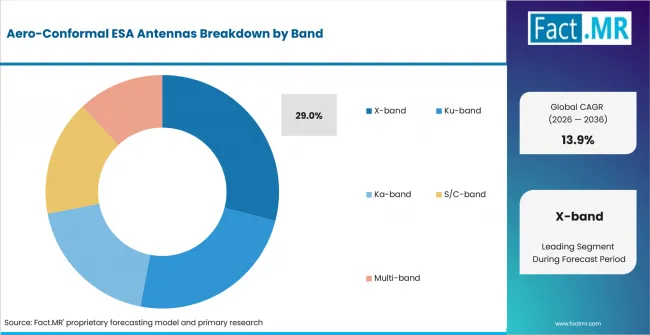
Aero Conformal Esa Antennas Analysis By Band | Source: Fact.MR
X-band leads where airborne fire-control radar and surveillance applications rely on beam control, target resolution and weather-tolerant performance. Ku-band and Ka-band are stronger in SATCOM and high-throughput data links. S/C-band remains useful for navigation and wider-area communication roles. Multi-band designs gain interest where one aperture must support several mission functions. Band choice is therefore tied to platform role before antenna shape is finalized.
What supports Radar within Function?
Radar is forecast to represent 36.0% share in 2026.
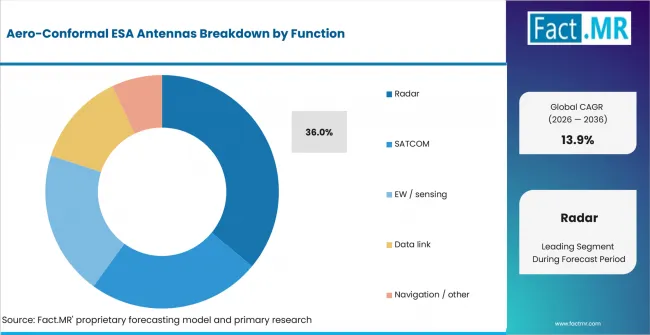
Aero Conformal Esa Antennas Analysis By Function | Source: Fact.MR
Radar leads the function segment since detection and tracking performance depends directly on antenna aperture quality. SATCOM follows where aircraft need resilient connectivity across long missions. EW and sensing functions are gaining attention as aircraft use more distributed receivers. Data-link and navigation applications add steady demand for smaller conformal antennas. L3Harris reported in September 2026 that it had completed production of the first 35 Viper Shield electronic warfare systems for the global F-16 fleet.
What is accelerating Aero-Conformal ESA Antennas Market adoption, and what is holding it back?
Fighter modernization drives it; qualification burden restrains it.
Drivers Impact Analysis
| DRIVER | (~) % IMPACT ON CAGR | GEOGRAPHIC RELEVANCE | IMPACT TIMELINE |
|---|---|---|---|
| Fighter aircraft embedded sensing packages | +1.8% | USA, UK, Italy, France, Israel | Short term (<= 2 years) |
| Low-profile SATCOM and data-link apertures | +1.5% | Global | Medium term (2-4 years) |
| UAS and collaborative aircraft radar integration | +1.3% | USA, Israel, Western Europe | Medium term (2-4 years) |
| RF qualification for curved arrays | +0.8% | North America, Europe | Long term (>= 4 years) |
Opportunity Impact Analysis
| OPPORTUNITY | (~) % IMPACT ON CAGR | GEOGRAPHIC RELEVANCE | IMPACT TIMELINE |
|---|---|---|---|
| Conformal panels for sixth-generation aircraft | +1.4% | USA, UK, Italy, France | Medium term (2-4 years) |
| UAS and light combat aircraft retrofit packages | +1.0% | USA, Israel, East Asia | Short term (<= 2 years) |
| EW and networked sensing packages | +0.9% | Europe, North America | Medium term (2-4 years) |
Restraints Impact Analysis
| RESTRAINT | (~) % IMPACT ON CAGR | GEOGRAPHIC RELEVANCE | IMPACT TIMELINE |
|---|---|---|---|
| Aircraft skin integration and thermal burden | -0.8% | Global | Short term (<= 2 years) |
| Export-control and frequency-clearance complexity | -0.6% | USA, Europe, Israel | Medium term (2-4 years) |
| Flight qualification cycle length | -0.5% | Global | Long term (>= 4 years) |
Which countries are scaling the Aero-Conformal ESA Antennas Market through 2036?
- The country comparison spans 1.6 percentage points and forms two practical growth bands across the forecast period.
- Israel remains 0.5 percentage point above Italy through defense-export depth and fighter-electronics specialization.
- Italy remains 0.4 percentage point above the USA as GCAP design work strengthens domestic air-combat engineering.
- The USA remains 0.4 percentage point above the UK through next-generation aircraft investment.
- The UK remains 0.3 percentage point above France through Typhoon radar work and GCAP participation.
- France closes the displayed range as Rafale modernization and airborne electronic intelligence programs support antenna integration demand.
Comparable CAGRs can create different entry conditions due to aircraft program timing, antenna qualification depth, export reviews and domestic avionics capability. Full report coverage includes North America, Latin America, Western Europe, Eastern Europe, East Asia, South Asia & Pacific, Middle East & Africa.
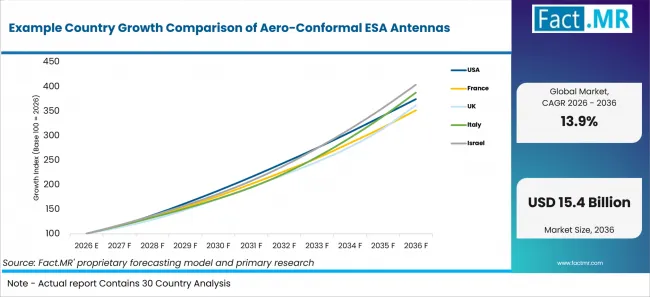
Example Country Growth Comparison Of Aero Conformal Esa Antennas | Source: Fact.MR
| Country | CAGR (2026-2036) |
|---|---|
| Israel | 15.0% |
| Italy | 14.5% |
| United States | 14.1% |
| United Kingdom | 13.7% |
| France | 13.4% |
What supports Israel adoption?
15.0% CAGR, supported by defense-export depth and fighter-electronics specialization.
Israel is projected to lead the displayed group at 15.0% CAGR through 2036. The Israel Ministry of Defense reported in June 2026 that defense exports reached USD 19.2 billion in 2025. Export depth gives local radar and EW suppliers a wider base for compact ESA work across allied aircraft programs.
How is Italy scaling demand?
14.5% CAGR, driven by GCAP design work air-combat engineering.
Italy is forecast to record 14.5% CAGR through 2036 as participation in GCAP design work strengthens demand for advanced air-combat engineering capabilities. Collaborative fighter development supports requirements for integrated sensing, mission systems, electronic warfare, avionics and aircraft-level engineering expertise and skills.
What supports USA adoption?
14.1% CAGR, backed by next-generation aircraft investment.
The USA is anticipated to post 14.1% CAGR through 2036. The U.S. Department of Defense stated in June 2025 that the FY2026 budget included USD 3.5 billion for the F-47 fighter platform. Next-generation aircraft funding keeps embedded antenna design connected to radar, EW and SATCOM architecture choices.
What supports the United Kingdom’s growth?
13.7% CAGR, supported by Typhoon radar work and GCAP participation.
The United Kingdom is expected to reach 13.7% CAGR through 2036. The UK Ministry of Defence signed a GBP 205 million Typhoon support extension in January 2026 that included engineering work for ECRS Mk2 radar. Radar-upgrade activity gives antenna suppliers a route into qualified fighter electronics work.
How does France perform?
13.4% CAGR, led by Rafale modernization and airborne electronic intelligence.
France is estimated to record 13.4% CAGR through 2036. The Direction générale de l’armement reported in July 2025 that first-half 2025 defense orders reached EUR 4.0 billion. Rafale F5, Syracuse SATCOM and airborne intelligence activity support demand for compact antenna and data-link integration.
Who leads the Aero-Conformal ESA Antennas Market?
BAE Systems and Northrop Grumman lead direct AESA radar coverage, while L3Harris and ThinKom strengthen EW and SATCOM capability.
Northrop Grumman adds depth through the APG-83 SABR and F-16 radar modernization. Northrop Grumman states that APG-83 integrates within the F-16's existing structural, power and cooling constraints without Group A aircraft modification.
L3Harris strengthens the electronic-warfare segment through Viper Shield. Saab adds fighter-focused EW capability through its Arexis suite, which incorporates GaN AESA technology.
Across these suppliers, relevant differentiators include qualification and flight-test evidence, compact RF and thermal packaging, and integration with aircraft mission systems.
Which companies are the key providers?
Key companies include L3Harris; Northrop Grumman; Saab; BAE Systems; ThinKom.
- BAE Systems
- Northrop Grumman
- L3Harris
- ThinKom
- Saab
Bibliography
- Defence Science and Technology Laboratory. (2025, December 15). Project SIREN: Advancing networked sensing through collaboration. GOV.UK.
- Direction générale de l’armement. (2025, July 3). Le ministère des armées totalise 4 milliards d’euros de nouvelles commandes. Ministère des Armées et des Anciens combattants.
- Israel Ministry of Defense. (2026, June 2). All-time defense export record: Israel crosses the $19 billion threshold.
- Italian Ministry of Defence. (2025, July 7). Global Combat Air Programme joint statement.
- L3Harris Technologies. (2026, September 3). L3Harris completes production of first F-16 Viper Shield electronic warfare systems.
- Ministry of Defence. (2026a, January 19). Britain's fighter jet fleet strengthened in £205 million boost for British jobs. GOV.UK.
- Ministry of Defence. (2026b, July 3). Over £4 billion invested in next-generation fighter jet with new international contract. GOV.UK.
- Saab. (2025, November 14). Saab receives orders for Arexis system for German Eurofighter.
- U.S. Department of Defense. (2025, June 26). Background briefing on FY 2026 defense budget [Transcript].
This Report Answers
- The report explains where aero-conformal ESA antennas are used across array type and platform. It also covers band and function.
- Segment analysis identifies AESA conformal panels and fighter aircraft as the main reference points for commercial planning.
- Country analysis examines Israel, Italy, the United States, the United Kingdom and France across program timing and antenna qualification routes.
- Competitive analysis reviews BAE Systems, Northrop Grumman, L3Harris, ThinKom, and Saab across radar, SATCOM and EW capability.
- Application analysis assesses how radar, SATCOM, EW, data-link and navigation functions influence aircraft antenna decisions.
- The forecast is supported by interviews, provider checks and official program review across defense aviation and aerospace electronics.
What does the Aero-Conformal ESA Antennas Market cover?
AESA conformal panels, phased-array tiles, metasurface ESA and flexible ESA antennas used for aircraft sensing and communication.
The Aero-Conformal ESA Antennas Market covers electronically steered antennas shaped for aircraft surfaces and low-profile airborne installation. It includes panels and tiles that support radar, SATCOM, EW sensing, data-link and navigation functions.
The assessment differs from broader airborne radar and military antenna coverage since the core focus is the antenna form factor and aircraft fit. General ground antennas, naval arrays and standalone RF components fall outside this scope unless they are sold as part of an aircraft ESA package.
What is included in the scope?
Aero-conformal ESA antenna systems used on crewed and uncrewed aircraft platforms.
The scope includes AESA conformal panels, phased-array tiles, metasurface ESA, flexible or printed ESA and hybrid aperture arrays. It covers fighter aircraft, UAS, missiles, rotorcraft and high-speed aircraft across X-band, Ku-band, Ka-band, S/C-band and multi-band designs. Adjacent coverage on military antenna systems supports the broader defense antenna context, while satellite communication systems helps frame SATCOM-related antenna demand.
What is excluded from the scope?
Ground antenna systems and standalone RF components are outside the scope.
The scope excludes ground-based radar arrays, naval antennas, consumer wireless antennas and general radio hardware sold outside an aircraft integration package. It also excludes aircraft radomes, wiring harnesses and passive structures when they are supplied without an electronically steered antenna function.
How Was the Analysis Built?
120+ records, 35+ company portfolios, 25+ countries and more than 20 industry interviews.
- Primary Research: Primary research includes discussions with aircraft integrators, radar engineers, antenna manufacturers, defense electronics teams, test labs and aerospace program specialists. These conversations examine platform fit, qualification burden, thermal needs, band selection, supplier screening and the factors that influence wider market acceptance.
- Desk Research: Desk research covers government program updates, defense budgets, company releases, product pages, technical studies, standards, regulatory records and other authoritative materials. The review focuses on post-2024 evidence where it supports market direction or country-level reasoning.
- Market Sizing and Forecasting: Market estimates combine historical platform activity, aircraft modernization cycles, antenna content per aircraft, frequency-band mix, function split, country-level program timing, qualification intensity and provider participation.
- Data Validation and Update Cycle: Findings are validated by comparing interview input with public records, company activity, program changes, product launches, contract awards and shifts in aircraft electronics adoption. Regular updates review new development activity and supplier-position changes.
What is the report’s scope and coverage?
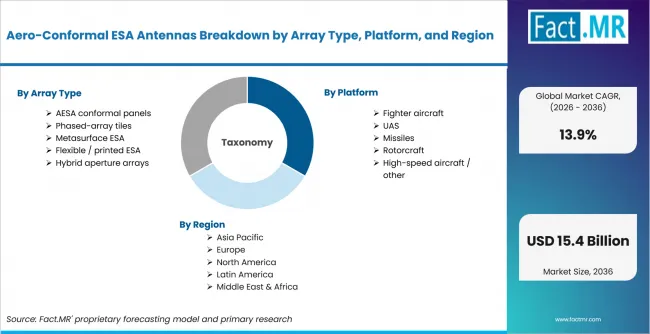
Aero Conformal Esa Antennas Breakdown By Array Type, Platform, And Region | Source: Fact.MR
| Attribute | Details |
|---|---|
| Quantitative Units | USD billion in 2026 to USD billion by 2036 at a CAGR |
| Market Definition | Electronically steered antenna systems shaped for aircraft surfaces and low-profile aerospace installation, including AESA conformal panels, phased-array tiles, metasurface ESA and flexible or printed ESA formats. |
| Array Type | AESA conformal panels; Phased-array tiles; Metasurface ESA; Flexible or printed ESA; Hybrid aperture arrays |
| Platform | Fighter aircraft; UAS; Missiles; Rotorcraft; High-speed aircraft or other |
| Band | X-band; Ku-band; Ka-band; S/C-band; Multi-band |
| Function | Radar; SATCOM; EW or sensing; Data link; Navigation or other |
| Regions Covered | North America; Latin America; Western Europe; Eastern Europe; East Asia; South Asia & Pacific; Middle East & Africa |
| Countries Covered | Israel; Italy; United States; United Kingdom; France |
| Key Companies Profiled | BAE Systems; Northrop Grumman; L3Harris; ThinKom; Saab |
| Forecast Period | 2026 to 2036 |
| Approach | Hybrid top-down and bottom-up approach using aircraft platform programs, antenna integration intensity, band mix, function split, country-level program timing and provider portfolio review. |
How is the market segmented?
-
By Array Type
- AESA conformal panels
- Phased-array tiles
- Metasurface ESA
- Flexible or printed ESA
- Hybrid aperture arrays
-
By Platform
- Fighter aircraft
- UAS
- Missiles
- Rotorcraft
- High-speed aircraft or other
-
By Band
- X-band
- Ku-band
- Ka-band
- S/C-band
- Multi-band
-
By Function
- Radar
- SATCOM
- EW or sensing
- Data link
- Navigation or other
-
By Region
- North America
- Latin America
- Western Europe
- Eastern Europe
- East Asia
- South Asia & Pacific
- Middle East & Africa