Aerospace and Defense Fuel Market Size, Share, Growth and Forecast (2026 - 2036)

The Aerospace and Defense Fuel Market is segmented by Fuel Type, Application, Platform, End User, Distribution Channel and Region. Forecast for 2026 to 2036.

Aerospace and Defense Fuel Market Forecast and Outlook by Fact.MR

  • In 2025, the aerospace and defense fuel market was valued at USD 16 billion.
  • Based on Fact.MR analysis, demand for aerospace and defense fuel is estimated to grow to USD 17 billion in 2026 and USD 31 billion by 2036.
  • Fact.MR projects a CAGR of 6.2% during the forecast period.
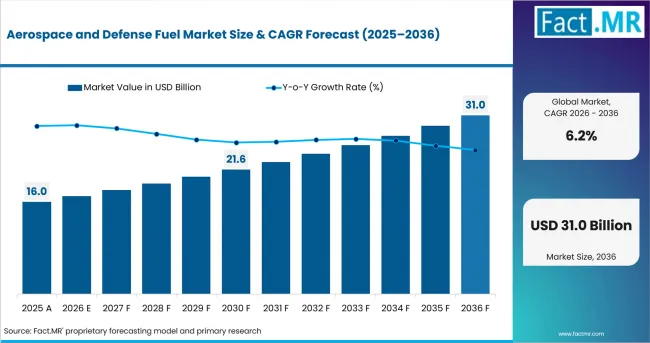
Aerospace And Defense Fuel Market Value Analysis

Metric Value
Estimated Value in 2026 USD 17 Billion
Forecast Value in 2036 USD 31 Billion
Forecast CAGR (2026 to 2036) 6.2%

Summary of the Aerospace and Defense Fuel Market

  • Demand Drivers
    • Commercial air travel is increasing across major aviation markets. Flight frequency expansion supports fuel consumption.
    • Defense organizations are increasing operational readiness activity. Military aviation missions strengthen fuel demand.
    • Airport infrastructure investment is improving aviation capacity. Fleet expansion supports long-term fuel utilization.
  • Key Segments Analyzed
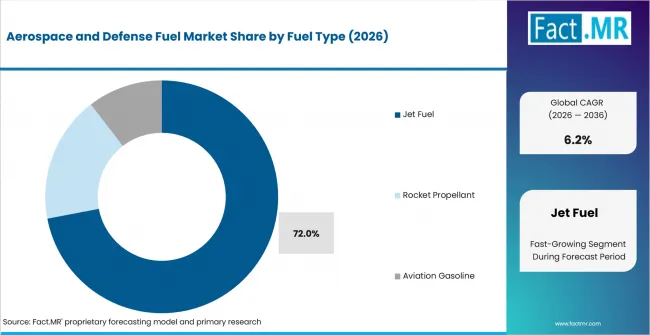
    • By Fuel Type: Jet Fuel accounts for 72.0% share in 2026 due to extensive use across commercial and military aircraft fleets.
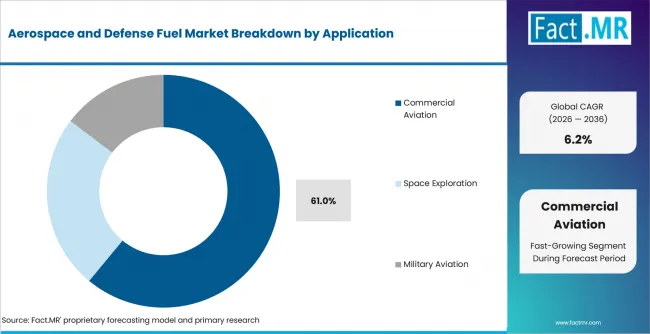
    • By Application: Commercial Aviation contributes 61.0% share in 2026 supported by high aircraft utilization rates.
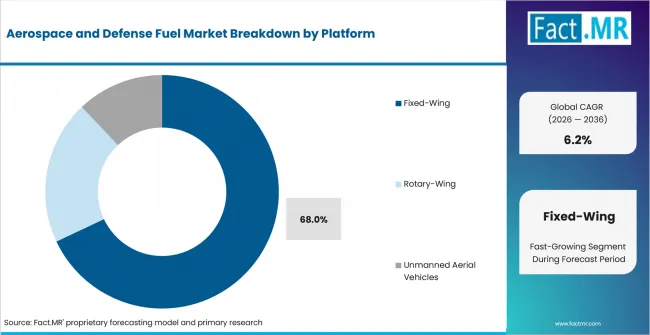
    • By Platform: Fixed-Wing represents 68.0% share in 2026 due to concentration of passenger and cargo operations.
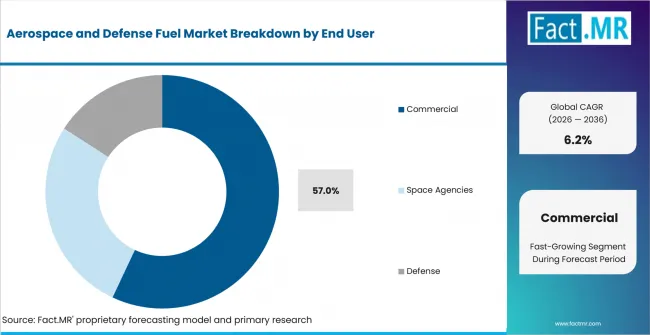
    • By End User: Commercial generates 57.0% share in 2026 supported by airline and cargo carrier fuel demand.
    • By Distribution Channel: Direct Supply Contracts capture 63.0% share in 2026 due to long-term airline fuel agreements.
    • By Geography: India is projected to record 7.8% CAGR through 2036 supported by airport infrastructure expansion.
  • Analyst Opinion at Fact.MR
    • Shambhu Nath Jha, Principal Consultant at Fact.MR, opines, "Growth opportunities are concentrated in commercial aviation expansion and aviation infrastructure development. Organizations with strong supply agreements and airport access are expected to strengthen market positioning."
  • Strategic Implications
    • Fuel suppliers should expand long-term airline supply agreements. Stable contract coverage improves revenue visibility.
    • Airport operators should strengthen fueling infrastructure capacity. Rising flight activity supports utilization growth.
    • Aviation fuel distributors should improve storage and logistics networks. Distribution efficiency supports commercial competitiveness.

The market is projected to generate approximately USD 14 billion in additional revenue between 2026 and 2036. Expansion is supported by rising air passenger traffic and increasing military flight operations. Growth benefits from aircraft fleet expansion and airport infrastructure investment. Fuel efficiency improvements moderate volume growth across developed aviation markets.

Commercial aviation activity remains the primary source of fuel demand. Defense aviation programs are increasing operational readiness requirements. Space launch activity is creating additional demand for specialized propellants across government and private aerospace programs.

India is expected to record 7.8% CAGR supported by airport expansion and airline fleet growth. China is projected to grow at 7.4% CAGR due to domestic aviation development and rising passenger volumes. The United Arab Emirates is forecast to expand at 6.9% CAGR driven by international aviation hub investment. Saudi Arabia is estimated to witness 6.7% CAGR supported by airline development programs. The United States is likely to register 5.8% CAGR due to a large installed aircraft base. Germany is expected to expand at 5.4% CAGR reflecting stable commercial aviation demand and fuel efficiency improvements.

Segmental Analysis

Aerospace and Defense Fuel Market Analysis by Fuel Type
Aerospace And Defense Fuel Market Analysis By Fuel Type

Jet Fuel is estimated to hold 72.0% share in 2026. Commercial airlines and military aircraft rely on jet fuel for daily operations. Large fleet sizes and long-distance aviation activity support segment concentration. FedEx announced the purchase of more than three million gallons of blended Sustainable Aviation Fuel (SAF) from Neste for use at Los Angeles International Airport. The deal represents the largest SAF purchase by a U.S. cargo airline at LAX and highlights growing demand for alternative aviation fuels. [1]

  • Commercial Aviation: Passenger airlines consume substantial jet fuel volumes each year. Fleet expansion supports long-term fuel demand.
  • Defense Operations: Military aircraft rely on jet fuel for training and deployment missions. Operational activity strengthens segment utilization.
  • Supply Investment: Energy suppliers are expanding aviation fuel distribution capacity. Infrastructure investment improves supply reliability.

Aerospace and Defense Fuel Market Analysis by Application
Aerospace And Defense Fuel Market Analysis By Application

Based on Fact.MR's aerospace and defense fuel market report, Commercial Aviation is estimated to account for 61.0% share in 2026. Passenger traffic growth continues to support aircraft utilization across global markets. Neste signed an agreement to supply 7,500 metric tons of SAF to Amazon Air operations at San Francisco and Ontario International Airports through 2025. Amazon became the first company to purchase and use SAF at Ontario International Airport. [2]

  • Passenger Growth: Air travel demand supports higher flight frequencies. Increased aircraft movement drives fuel consumption.
  • Fleet Expansion: Airlines are adding aircraft to address traffic growth. Additional capacity increases fuel requirements.
  • Route Development: International route expansion supports aviation fuel demand. Network growth strengthens market activity.

Aerospace and Defense Fuel Market Analysis by Platform
Aerospace And Defense Fuel Market Analysis By Platform

Fixed-Wing platforms are estimated to contribute 68.0% share in 2026. Commercial aircraft and military transport fleets account for substantial fuel consumption. Long-range operations require higher fuel volumes than alternative platforms. Singapore Airlines Group signed agreements with Neste and World Energy to acquire sustainable aviation fuel and SAF certificates as part of its decarbonization strategy. The deals expand SAF usage in airline operations and support growth of the aviation fuel supply market. [3]

  • Aircraft Utilization: Fixed-wing fleets operate across passenger and cargo networks. Flight activity supports fuel demand concentration.
  • Cargo Operations: Air freight services require continuous aircraft deployment. Logistics activity strengthens consumption levels.
  • Fleet Deliveries: Aircraft production supports future fuel demand. Expanding fleets increase long-term consumption potential.

Aerospace and Defense Fuel Market Analysis by End User
Aerospace And Defense Fuel Market Analysis By End User

Commercial operators are estimated to capture 57.0% share in 2026. Airline companies require large fuel volumes to support passenger and cargo transportation. Rising travel demand supports fuel purchasing activity. Neste began sustainable aviation fuel production at its modified Rotterdam refinery, increasing its global SAF production capacity to 1.5 million tons annually. The expansion supports growing aviation fuel demand under European SAF mandates. [4]

  • Airline Demand: Commercial carriers represent a substantial portion of fuel consumption. Passenger transport activity supports segment leadership.
  • Cargo Movement: Air cargo operators require recurring fuel supply agreements. Logistics demand strengthens fuel utilization.
  • Fleet Growth: Aircraft additions increase fuel requirements across aviation networks. Capacity expansion supports segment growth.

Aerospace and Defense Fuel Market Analysis by Distribution Channel
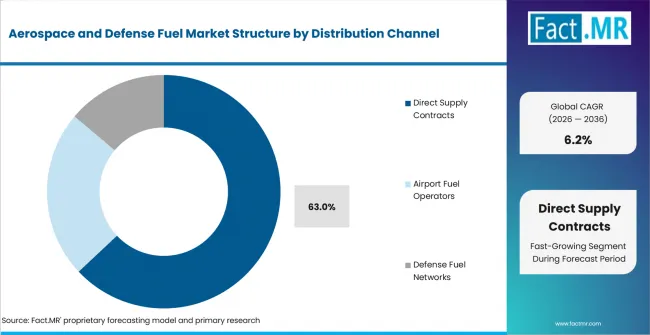
Aerospace And Defense Fuel Market Analysis By Distribution Channel

Direct Supply Contracts are estimated to hold 63.0% share in 2026. Airlines and defense organizations prefer long-term supply arrangements to improve fuel availability. Contract-based purchasing supports pricing visibility and supply security.

  • Supply Security: Long-term agreements improve fuel availability across aviation operations. Contract structures reduce supply disruption risk.
  • Pricing Visibility: Contract arrangements improve budgeting and planning efficiency. Fuel purchasers benefit from predictable supply conditions.
  • Airport Access: Fuel suppliers are strengthening airport network coverage. Distribution expansion improves service capability.

Drivers, Restraints, and Opportunities

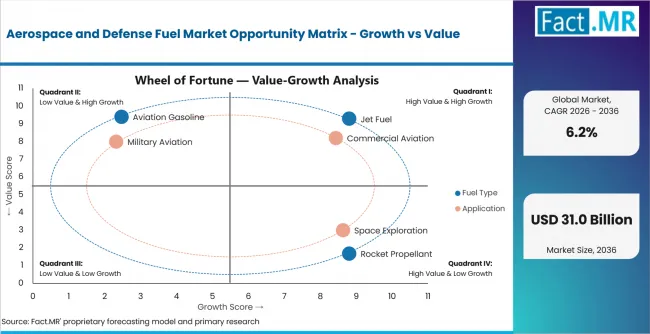
Aerospace And Defense Fuel Market Opportunity Matrix Growth Vs Value

Aerospace and defense fuel demand is linked to global aviation activity and defense readiness requirements. Commercial aviation remains the primary source of fuel consumption. Defense operations and space launch programs provide an additional demand layer. Market value reflects aircraft utilization levels and airport traffic growth across major regions. Airbus, Safran, Technip Energies and Tereos announced plans to create a joint venture to produce sustainable aviation fuel at scale in France. The project aims to strengthen long-term aviation fuel supply security and accelerate SAF adoption. [5]

Fuel demand is shifting toward more efficient aircraft fleets. Airlines are replacing older aircraft with fuel-efficient models to reduce operating costs. This trend moderates fuel consumption per aircraft. Rising flight volumes offset part of this efficiency gain and support overall market expansion.

  • Aviation Traffic Growth: Passenger traffic is increasing across Asia and the Middle East. Airline fleet expansion is strengthening aviation fuel demand across commercial routes.
  • Defense Flight Activity: Military modernization programs are increasing aircraft deployment levels. Operational readiness requirements support recurring fuel consumption.
  • Efficiency Pressure: Adoption is constrained by fuel-efficient aircraft technologies. Lower fuel burn rates reduce consumption growth across developed aviation markets.

Regional Analysis

The aerospace and defense fuel market is assessed across North America, Europe, Asia Pacific, and the Middle East. The study evaluates aviation traffic growth, defense flight activity, airport infrastructure investment, airline fleet expansion, and aerospace sector development across major countries.

Top Country Growth Comparison Aerospace And Defense Fuel Market Cagr (2026 2036)

Country CAGR
India 7.8%
China 7.4%
United Arab Emirates 6.9%
Saudi Arabia 6.7%
United States 5.8%
Germany 5.4%

Source: Fact.MR analysis based on aviation activity, airport expansion programs, fuel demand trends, and industry interviews.
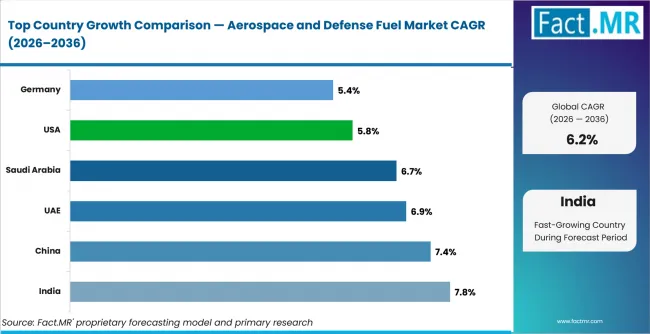
Aerospace And Defense Fuel Market Cagr Analysis By Country

Sales Analysis of Aerospace and Defense Fuel Market in India

India is projected to expand at 7.8% CAGR due to airport expansion and airline fleet growth. The Government of India continued airport modernization activity during 2025 under aviation infrastructure development programs.

  • Airport expansion supports fuel consumption.
  • Airline fleet growth increases fuel demand.
  • Passenger traffic strengthens market opportunity.

Demand Outlook for Aerospace and Defense Fuel Market in China

Supported by domestic aviation development, China is expected to witness 7.4% CAGR through 2036. Civil aviation authorities reported continued passenger traffic growth during 2025. Chinese airlines expanded route networks to strengthen regional connectivity. Demand reflects fleet utilization growth and aviation infrastructure investment.

  • Domestic aviation supports fuel demand.
  • Route expansion increases flight activity.
  • Infrastructure investment strengthens utilization.

Opportunity Analysis of Aerospace and Defense Fuel Market in United Arab Emirates

The United Arab Emirates is forecast to grow at 6.9% CAGR by 2036 as aviation hub investment increases fuel demand. Emirates expanded international flight operations during 2025. Dubai International Airport continued capacity enhancement initiatives across passenger terminals. Growth is supported by airline expansion and aviation infrastructure development.

  • Airline expansion supports fuel utilization.
  • Airport investment increases aviation activity.
  • International routes strengthen demand.

Demand Assessment of Aerospace and Defense Fuel Market in Saudi Arabia

Saudi Arabia is projected to expand at 6.7% CAGR supported by national aviation development programs. Riyadh Air accelerated fleet planning initiatives during 2025. Government aviation investment is increasing airport capacity across major cities. Growth reflects airline expansion and transport sector development.

  • Fleet planning supports fuel demand.
  • Airport projects increase aircraft movement.
  • Aviation investment strengthens market growth.

In-depth Analysis of Aerospace and Defense Fuel Market in United States

Aerospace And Defense Fuel Market Country Value Analysis

The United States is projected to register 5.8% CAGR through 2036 supported by a large installed aircraft base. Commercial aviation activity remains among the strongest globally. Defense aviation programs maintain recurring fuel demand across military operations. Growth reflects aircraft utilization and defense readiness activity.

  • Commercial aviation supports fuel consumption.
  • Defense operations strengthen demand.
  • Fleet utilization sustains market expansion.

Demand Outlook for Aerospace and Defense Fuel Market in Germany

Germany reflects stable demand and is expected to expand at 5.4% CAGR by 2036. Lufthansa continued fleet modernization programs during 2025. Aviation fuel demand benefits from strong regional connectivity and established airport infrastructure. Growth is attributable to commercial aviation activity and passenger transport demand.

  • Fleet modernization supports fuel demand.
  • Regional connectivity increases aircraft movement.
  • Passenger travel sustains market activity.

Competitive Aligners for Market Players

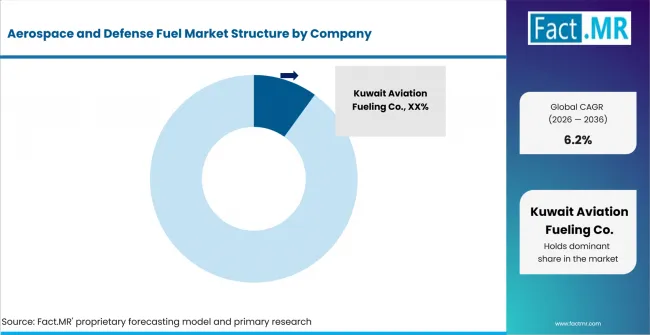
Aerospace And Defense Fuel Market Analysis By Company

The aerospace and defense fuel market reflects a moderately consolidated structure. Global energy companies account for a significant share of industry revenue. Supply reliability and airport access influence competitive positioning across major regions. Established suppliers benefit from extensive aviation fueling infrastructure and long-standing industry relationships.

Integrated fuel suppliers benefit from refining capacity and established distribution networks. Long-term supply agreements strengthen relationships with airlines and defense organizations. Geographic presence improves supply continuity during periods of traffic growth. Storage infrastructure further strengthens supplier positioning across key aviation hubs. Airlines and defense agencies prioritize fuel availability and pricing stability. Long-term contracts influence sourcing decisions and operational planning. Pricing discipline remains linked to crude oil movements and aviation fuel demand. Suppliers with diversified sourcing capabilities are better positioned to manage market volatility.

Commercial positioning is increasingly linked to distribution reach and airport infrastructure access. Organizations that strengthen logistics capabilities improve penetration across high-traffic aviation corridors. Expansion of fueling services at major airports supports customer retention and contract renewal activity. Competitive activity is also influenced by investment in sustainable aviation fuel supply chains. Energy companies are increasing partnerships with airlines and airport operators. These initiatives support customer engagement and strengthen participation in evolving aviation fuel requirements.

Market participants are focusing on operational efficiency and supply reliability. Network expansion remains a strategic priority. Growth opportunities are concentrated in expanding aviation markets. Airline fleet development and airport modernization programs are creating additional demand. Rising aircraft utilization also supports long-term market expansion.

Key Players

  • Kuwait Aviation Fueling Co.
  • Chennai Petroleum Corporation Ltd.
  • Shell plc
  • Reliance Industries Limited
  • Nayara Energy Limited
  • Hindustan Petroleum Corporation Limited

Bibliography

  • [1] FedEx Corporation. (2025, May 20). FedEx takes delivery of sustainable aviation fuel (SAF) from Neste at LAX.
  • [2] Neste Oyj. (2025, June 17). Neste extends sustainable aviation fuel (SAF) supply to Ontario International Airport through deal with Amazon Air.
  • [3] Singapore Airlines. (2025, May 9). Singapore Airlines Group continues progress on decarbonisation journey with Neste and World Energy agreements.
  • [4] Neste Oyj. (2025, April 9). Neste started producing sustainable aviation fuel (SAF) at its renewables refinery in Rotterdam, the Netherlands.
  • [5] Airbus SE. (2026, June 9). Technip Energies, Airbus, Safran and Tereos join forces to develop a Sustainable Aviation Fuel production project in France.

This Report Addresses

  • Analysis of aerospace and defense fuel demand across aviation and space operations.
  • Market forecast from USD 17 Billion in 2026 to USD 31 Billion by 2036 at 6.2% CAGR.
  • Opportunity assessment across commercial aviation and defense flight applications.
  • Segment forecasts covering fuel type, application, platform, end user, and distribution channel demand.
  • Competitive assessment of aviation fuel suppliers and distribution organizations.
  • Evaluation of airline expansion and airport infrastructure investment trends.
  • Country-level analysis across India, China, United Arab Emirates, Saudi Arabia, United States, and Germany.
  • Report delivery through PDF and Excel formats supported by primary interviews and industry analysis.

Aerospace and Defense Fuel Market Definition

Aerospace and defense fuel includes energy products used to power commercial aircraft, military aircraft, helicopters, unmanned aerial vehicle, and spacecraft. The market primarily consists of jet fuel, aviation gasoline, and rocket propellants. These fuels support passenger transport, cargo operations, defense missions, and space launch activities. Demand is concentrated within aviation operators, defense organizations, airport fueling networks, and space agencies. Market activity reflects aircraft utilization, flight frequency, fuel pricing trends, and aerospace sector expansion.

Aerospace and Defense Fuel Market Inclusions

The study covers global and regional forecasts from 2026 to 2036 by fuel type, application, platform, end user, and distribution channel. It includes aviation fuel consumption across commercial aviation, military aviation, and space programs. The report evaluates fuel demand, aviation activity, fleet growth, distribution networks, and aerospace sector developments across major countries.

Aerospace and Defense Fuel Market Exclusions

The study excludes marine fuels, automotive fuels, industrial lubricants, and non-aviation energy products. It omits commercial aircraft manufacturing revenue and aerospace equipment sales. The report focuses exclusively on aerospace and defense fuel consumption and related distribution activity linked to aviation and space operations.

Aerospace and Defense Fuel Market Research Methodology

  • Primary Research
    • Interviews were conducted with fuel suppliers, airline executives, airport operators, defense fuel specialists, distributors, and aerospace industry consultants.
  • Desk Research
    • Analysis included company disclosures, aviation authority publications, airport traffic statistics, defense expenditure reports, regulatory updates, and aerospace industry developments published during 2024 through 2026.
  • Market-Sizing and Forecasting
    • Hybrid top-down and bottom-up model using aviation fuel consumption estimates, aircraft utilization data, passenger traffic trends, and aerospace sector revenue analysis.
  • Data Validation and Update Cycle
    • Forecast was validated through distributor interviews, company disclosures, aviation traffic assessments, and fuel consumption analysis.

Scope of Report

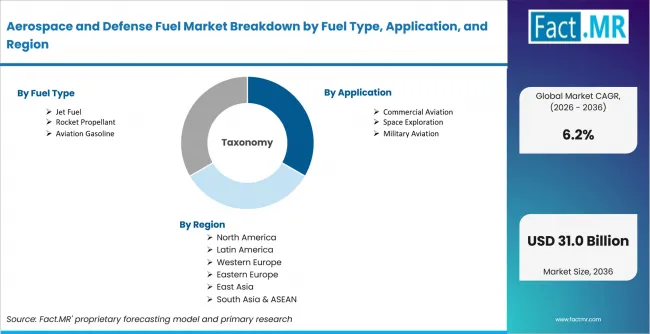
Aerospace And Defense Fuel Market Breakdown By Fuel Type, Application, And Region

Attribute Details
Quantitative Units USD 17 Billion (2026) to USD 31 Billion (2036) at a CAGR of 6.2%
Market Definition Covers aviation and aerospace fuels used across commercial, defense, and space operations.
Fuel Type Segmentation Aviation Gasoline, Jet Fuel, Rocket Propellant
Application Segmentation Military Aviation, Commercial Aviation, Space Exploration
Platform Segmentation Fixed-Wing, Rotary-Wing, Unmanned Aerial Vehicles, Spacecraft
End User Segmentation Defense, Commercial, Space Agencies
Distribution Channel Segmentation Direct Supply Contracts, Airport Fuel Operators, Defense Fuel Networks, Independent Distributors
Regions Covered North America, Europe, Asia Pacific, Middle East
Countries Covered India, China, United Arab Emirates, Saudi Arabia, United States, Germany
Key Companies Profiled Kuwait Aviation Fueling Co., Chennai Petroleum Corporation Ltd., Shell plc, Reliance Industries Limited, Nayara Energy Limited, Hindustan Petroleum Corporation Limited
Forecast Period 2026 to 2036
Approach Hybrid top-down and bottom-up model using aviation activity and fuel consumption analysis

Aerospace and Defense Fuel Market by Segment

  • By Fuel Type

    • Aviation Gasoline
    • Jet Fuel
    • Rocket Propellant
  • By Application

    • Military Aviation
    • Commercial Aviation
    • Space Exploration
  • By Platform

    • Fixed-Wing
    • Rotary-Wing
    • Unmanned Aerial Vehicles
    • Spacecraft
  • By End User

    • Defense
    • Commercial
    • Space Agencies
  • By Distribution Channel

    • Direct Supply Contracts
    • Airport Fuel Operators
    • Defense Fuel Networks
    • Independent Distributors
  • By Region

    • North America
      • United States
      • Canada
      • Mexico
    • Latin America
      • Brazil
      • Argentina
      • Rest of Latin America
    • Europe
      • Germany
      • United Kingdom
      • France
      • Italy
      • Spain
      • Rest of Europe
    • Asia Pacific
      • China
      • India
      • Japan
      • South Korea
      • ASEAN
    • Middle East & Africa
      • GCC Countries
      • South Africa
      • UAE
      • Rest of Middle East & Africa

- Frequently Asked Questions -

How large is the global aerospace and defense fuel market in 2025?

The global aerospace and defense fuel market is estimated at USD 16 Billion in 2025 based on Fact.MR analysis.

What will the aerospace and defense fuel market size be in 2026?

Based on Fact.MR analysis, demand for aerospace and defense fuel is estimated to reach USD 17 Billion in 2026.

What is the projected aerospace and defense fuel market size by 2036?

The market is projected to reach USD 31 Billion by 2036 supported by aviation traffic growth and defense flight activity.

What is the expected CAGR for the aerospace and defense fuel market from 2026 to 2036?

Fact.MR projects the global aerospace and defense fuel market to expand at a CAGR of 6.2% during the forecast period.

Which fuel type segment is poised to lead market demand?

Jet Fuel leads the market with 72.0% share in 2026 due to extensive utilization across commercial and military aviation fleets.

Which country records the strongest growth in the market?

India records 7.8% CAGR through 2036 supported by airport expansion programs and rising airline fleet deployment.

Table of Content

  1. Executive Summary
    • Global Market Outlook
    • Demand to side Trends
    • Supply to side Trends
    • Technology Roadmap Analysis
    • Analysis and Recommendations
  2. Market Overview
    • Market Coverage / Taxonomy
    • Market Definition / Scope / Limitations
  3. Research Methodology
    • Chapter Orientation
    • Analytical Lens and Working Hypotheses
      • Market Structure, Signals, and Trend Drivers
      • Benchmarking and Cross-market Comparability
      • Market Sizing, Forecasting, and Opportunity Mapping
    • Research Design and Evidence Framework
      • Desk Research Programme (Secondary Evidence)
        • Company Annual and Sustainability Reports
        • Peer-reviewed Journals and Academic Literature
        • Corporate Websites, Product Literature, and Technical Notes
        • Earnings Decks and Investor Briefings
        • Statutory Filings and Regulatory Disclosures
        • Technical White Papers and Standards Notes
        • Trade Journals, Industry Magazines, and Analyst Briefs
        • Conference Proceedings, Webinars, and Seminar Materials
        • Government Statistics Portals and Public Data Releases
        • Press Releases and Reputable Media Coverage
        • Specialist Newsletters and Curated Briefings
        • Sector Databases and Reference Repositories
        • Fact.MR Internal Proprietary Databases and Historical Market Datasets
        • Subscription Datasets and Paid Sources
        • Social Channels, Communities, and Digital Listening Inputs
        • Additional Desk Sources
      • Expert Input and Fieldwork (Primary Evidence)
        • Primary Modes
          • Qualitative Interviews and Expert Elicitation
          • Quantitative Surveys and Structured Data Capture
          • Blended Approach
        • Why Primary Evidence is Used
        • Field Techniques
          • Interviews
          • Surveys
          • Focus Groups
          • Observational and In-context Research
          • Social and Community Interactions
        • Stakeholder Universe Engaged
          • C-suite Leaders
          • Board Members
          • Presidents and Vice Presidents
          • R&D and Innovation Heads
          • Technical Specialists
          • Domain Subject-matter Experts
          • Scientists
          • Physicians and Other Healthcare Professionals
        • Governance, Ethics, and Data Stewardship
          • Research Ethics
          • Data Integrity and Handling
      • Tooling, Models, and Reference Databases
    • Data Engineering and Model Build
      • Data Acquisition and Ingestion
      • Cleaning, Normalisation, and Verification
      • Synthesis, Triangulation, and Analysis
    • Quality Assurance and Audit Trail
  4. Market Background
    • Market Dynamics
      • Drivers
      • Restraints
      • Opportunity
      • Trends
    • Scenario Forecast
      • Demand in Optimistic Scenario
      • Demand in Likely Scenario
      • Demand in Conservative Scenario
    • Opportunity Map Analysis
    • Product Life Cycle Analysis
    • Supply Chain Analysis
    • Investment Feasibility Matrix
    • Value Chain Analysis
    • PESTLE and Porter’s Analysis
    • Regulatory Landscape
    • Regional Parent Market Outlook
    • Production and Consumption Statistics
    • Import and Export Statistics
  5. Global Market Analysis 2021 to 2025 and Forecast, 2026 to 2036
    • Historical Market Size Value (USD Million) Analysis, 2021 to 2025
    • Current and Future Market Size Value (USD Million) Projections, 2026 to 2036
      • Y to o to Y Growth Trend Analysis
      • Absolute $ Opportunity Analysis
  6. Global Market Pricing Analysis 2021 to 2025 and Forecast 2026 to 2036
  7. Global Market Analysis 2021 to 2025 and Forecast 2026 to 2036, By Fuel Type
    • Introduction / Key Findings
    • Historical Market Size Value (USD Million) Analysis By Fuel Type , 2021 to 2025
    • Current and Future Market Size Value (USD Million) Analysis and Forecast By Fuel Type , 2026 to 2036
      • Jet Fuel
      • Rocket Propellant
      • Aviation Gasoline
    • Y to o to Y Growth Trend Analysis By Fuel Type , 2021 to 2025
    • Absolute $ Opportunity Analysis By Fuel Type , 2026 to 2036
  8. Global Market Analysis 2021 to 2025 and Forecast 2026 to 2036, By Application
    • Introduction / Key Findings
    • Historical Market Size Value (USD Million) Analysis By Application, 2021 to 2025
    • Current and Future Market Size Value (USD Million) Analysis and Forecast By Application, 2026 to 2036
      • Commercial Aviation
      • Space Exploration
      • Military Aviation
    • Y to o to Y Growth Trend Analysis By Application, 2021 to 2025
    • Absolute $ Opportunity Analysis By Application, 2026 to 2036
  9. Global Market Analysis 2021 to 2025 and Forecast 2026 to 2036, By Platform
    • Introduction / Key Findings
    • Historical Market Size Value (USD Million) Analysis By Platform, 2021 to 2025
    • Current and Future Market Size Value (USD Million) Analysis and Forecast By Platform, 2026 to 2036
      • Fixed-Wing
      • Rotary-Wing
      • Unmanned Aerial Vehicles
      • Spacecraft
    • Y to o to Y Growth Trend Analysis By Platform, 2021 to 2025
    • Absolute $ Opportunity Analysis By Platform, 2026 to 2036
  10. Global Market Analysis 2021 to 2025 and Forecast 2026 to 2036, By End User
    • Introduction / Key Findings
    • Historical Market Size Value (USD Million) Analysis By End User, 2021 to 2025
    • Current and Future Market Size Value (USD Million) Analysis and Forecast By End User, 2026 to 2036
      • Commercial
      • Space Agencies
      • Defense
    • Y to o to Y Growth Trend Analysis By End User, 2021 to 2025
    • Absolute $ Opportunity Analysis By End User, 2026 to 2036
  11. Global Market Analysis 2021 to 2025 and Forecast 2026 to 2036, By Distribution Channel
    • Introduction / Key Findings
    • Historical Market Size Value (USD Million) Analysis By Distribution Channel, 2021 to 2025
    • Current and Future Market Size Value (USD Million) Analysis and Forecast By Distribution Channel, 2026 to 2036
      • Direct Supply Contracts
      • Airport Fuel Operators
      • Defense Fuel Networks
      • Independent Distributors
    • Y to o to Y Growth Trend Analysis By Distribution Channel, 2021 to 2025
    • Absolute $ Opportunity Analysis By Distribution Channel, 2026 to 2036
  12. Global Market Analysis 2021 to 2025 and Forecast 2026 to 2036, By Region
    • Introduction
    • Historical Market Size Value (USD Million) Analysis By Region, 2021 to 2025
    • Current Market Size Value (USD Million) Analysis and Forecast By Region, 2026 to 2036
      • North America
      • Latin America
      • Western Europe
      • Eastern Europe
      • East Asia
      • South Asia and Pacific
      • Middle East & Africa
    • Market Attractiveness Analysis By Region
  13. North America Market Analysis 2021 to 2025 and Forecast 2026 to 2036, By Country
    • Historical Market Size Value (USD Million) Trend Analysis By Market Taxonomy, 2021 to 2025
    • Market Size Value (USD Million) Forecast By Market Taxonomy, 2026 to 2036
      • By Country
        • USA
        • Canada
        • Mexico
      • By Fuel Type
      • By Application
      • By Platform
      • By End User
      • By Distribution Channel
    • Market Attractiveness Analysis
      • By Country
      • By Fuel Type
      • By Application
      • By Platform
      • By End User
      • By Distribution Channel
    • Key Takeaways
  14. Latin America Market Analysis 2021 to 2025 and Forecast 2026 to 2036, By Country
    • Historical Market Size Value (USD Million) Trend Analysis By Market Taxonomy, 2021 to 2025
    • Market Size Value (USD Million) Forecast By Market Taxonomy, 2026 to 2036
      • By Country
        • Brazil
        • Chile
        • Rest of Latin America
      • By Fuel Type
      • By Application
      • By Platform
      • By End User
      • By Distribution Channel
    • Market Attractiveness Analysis
      • By Country
      • By Fuel Type
      • By Application
      • By Platform
      • By End User
      • By Distribution Channel
    • Key Takeaways
  15. Western Europe Market Analysis 2021 to 2025 and Forecast 2026 to 2036, By Country
    • Historical Market Size Value (USD Million) Trend Analysis By Market Taxonomy, 2021 to 2025
    • Market Size Value (USD Million) Forecast By Market Taxonomy, 2026 to 2036
      • By Country
        • Germany
        • UK
        • Italy
        • Spain
        • France
        • Nordic
        • BENELUX
        • Rest of Western Europe
      • By Fuel Type
      • By Application
      • By Platform
      • By End User
      • By Distribution Channel
    • Market Attractiveness Analysis
      • By Country
      • By Fuel Type
      • By Application
      • By Platform
      • By End User
      • By Distribution Channel
    • Key Takeaways
  16. Eastern Europe Market Analysis 2021 to 2025 and Forecast 2026 to 2036, By Country
    • Historical Market Size Value (USD Million) Trend Analysis By Market Taxonomy, 2021 to 2025
    • Market Size Value (USD Million) Forecast By Market Taxonomy, 2026 to 2036
      • By Country
        • Russia
        • Poland
        • Hungary
        • Balkan & Baltic
        • Rest of Eastern Europe
      • By Fuel Type
      • By Application
      • By Platform
      • By End User
      • By Distribution Channel
    • Market Attractiveness Analysis
      • By Country
      • By Fuel Type
      • By Application
      • By Platform
      • By End User
      • By Distribution Channel
    • Key Takeaways
  17. East Asia Market Analysis 2021 to 2025 and Forecast 2026 to 2036, By Country
    • Historical Market Size Value (USD Million) Trend Analysis By Market Taxonomy, 2021 to 2025
    • Market Size Value (USD Million) Forecast By Market Taxonomy, 2026 to 2036
      • By Country
        • China
        • Japan
        • South Korea
      • By Fuel Type
      • By Application
      • By Platform
      • By End User
      • By Distribution Channel
    • Market Attractiveness Analysis
      • By Country
      • By Fuel Type
      • By Application
      • By Platform
      • By End User
      • By Distribution Channel
    • Key Takeaways
  18. South Asia and Pacific Market Analysis 2021 to 2025 and Forecast 2026 to 2036, By Country
    • Historical Market Size Value (USD Million) Trend Analysis By Market Taxonomy, 2021 to 2025
    • Market Size Value (USD Million) Forecast By Market Taxonomy, 2026 to 2036
      • By Country
        • India
        • ASEAN
        • Australia & New Zealand
        • Rest of South Asia and Pacific
      • By Fuel Type
      • By Application
      • By Platform
      • By End User
      • By Distribution Channel
    • Market Attractiveness Analysis
      • By Country
      • By Fuel Type
      • By Application
      • By Platform
      • By End User
      • By Distribution Channel
    • Key Takeaways
  19. Middle East & Africa Market Analysis 2021 to 2025 and Forecast 2026 to 2036, By Country
    • Historical Market Size Value (USD Million) Trend Analysis By Market Taxonomy, 2021 to 2025
    • Market Size Value (USD Million) Forecast By Market Taxonomy, 2026 to 2036
      • By Country
        • Kingdom of Saudi Arabia
        • Other GCC Countries
        • Turkiye
        • South Africa
        • Other African Union
        • Rest of Middle East & Africa
      • By Fuel Type
      • By Application
      • By Platform
      • By End User
      • By Distribution Channel
    • Market Attractiveness Analysis
      • By Country
      • By Fuel Type
      • By Application
      • By Platform
      • By End User
      • By Distribution Channel
    • Key Takeaways
  20. Key Countries Market Analysis
    • USA
      • Pricing Analysis
      • Market Share Analysis, 2025
        • By Fuel Type
        • By Application
        • By Platform
        • By End User
        • By Distribution Channel
    • Canada
      • Pricing Analysis
      • Market Share Analysis, 2025
        • By Fuel Type
        • By Application
        • By Platform
        • By End User
        • By Distribution Channel
    • Mexico
      • Pricing Analysis
      • Market Share Analysis, 2025
        • By Fuel Type
        • By Application
        • By Platform
        • By End User
        • By Distribution Channel
    • Brazil
      • Pricing Analysis
      • Market Share Analysis, 2025
        • By Fuel Type
        • By Application
        • By Platform
        • By End User
        • By Distribution Channel
    • Chile
      • Pricing Analysis
      • Market Share Analysis, 2025
        • By Fuel Type
        • By Application
        • By Platform
        • By End User
        • By Distribution Channel
    • Germany
      • Pricing Analysis
      • Market Share Analysis, 2025
        • By Fuel Type
        • By Application
        • By Platform
        • By End User
        • By Distribution Channel
    • UK
      • Pricing Analysis
      • Market Share Analysis, 2025
        • By Fuel Type
        • By Application
        • By Platform
        • By End User
        • By Distribution Channel
    • Italy
      • Pricing Analysis
      • Market Share Analysis, 2025
        • By Fuel Type
        • By Application
        • By Platform
        • By End User
        • By Distribution Channel
    • Spain
      • Pricing Analysis
      • Market Share Analysis, 2025
        • By Fuel Type
        • By Application
        • By Platform
        • By End User
        • By Distribution Channel
    • France
      • Pricing Analysis
      • Market Share Analysis, 2025
        • By Fuel Type
        • By Application
        • By Platform
        • By End User
        • By Distribution Channel
    • India
      • Pricing Analysis
      • Market Share Analysis, 2025
        • By Fuel Type
        • By Application
        • By Platform
        • By End User
        • By Distribution Channel
    • ASEAN
      • Pricing Analysis
      • Market Share Analysis, 2025
        • By Fuel Type
        • By Application
        • By Platform
        • By End User
        • By Distribution Channel
    • Australia & New Zealand
      • Pricing Analysis
      • Market Share Analysis, 2025
        • By Fuel Type
        • By Application
        • By Platform
        • By End User
        • By Distribution Channel
    • China
      • Pricing Analysis
      • Market Share Analysis, 2025
        • By Fuel Type
        • By Application
        • By Platform
        • By End User
        • By Distribution Channel
    • Japan
      • Pricing Analysis
      • Market Share Analysis, 2025
        • By Fuel Type
        • By Application
        • By Platform
        • By End User
        • By Distribution Channel
    • South Korea
      • Pricing Analysis
      • Market Share Analysis, 2025
        • By Fuel Type
        • By Application
        • By Platform
        • By End User
        • By Distribution Channel
    • Russia
      • Pricing Analysis
      • Market Share Analysis, 2025
        • By Fuel Type
        • By Application
        • By Platform
        • By End User
        • By Distribution Channel
    • Poland
      • Pricing Analysis
      • Market Share Analysis, 2025
        • By Fuel Type
        • By Application
        • By Platform
        • By End User
        • By Distribution Channel
    • Hungary
      • Pricing Analysis
      • Market Share Analysis, 2025
        • By Fuel Type
        • By Application
        • By Platform
        • By End User
        • By Distribution Channel
    • Kingdom of Saudi Arabia
      • Pricing Analysis
      • Market Share Analysis, 2025
        • By Fuel Type
        • By Application
        • By Platform
        • By End User
        • By Distribution Channel
    • Turkiye
      • Pricing Analysis
      • Market Share Analysis, 2025
        • By Fuel Type
        • By Application
        • By Platform
        • By End User
        • By Distribution Channel
    • South Africa
      • Pricing Analysis
      • Market Share Analysis, 2025
        • By Fuel Type
        • By Application
        • By Platform
        • By End User
        • By Distribution Channel
  21. Market Structure Analysis
    • Competition Dashboard
    • Competition Benchmarking
    • Market Share Analysis of Top Players
      • By Regional
      • By Fuel Type
      • By Application
      • By Platform
      • By End User
      • By Distribution Channel
  22. Competition Analysis
    • Competition Deep Dive
      • Kuwait Aviation Fueling Co.
        • Overview
        • Product Portfolio
        • Profitability by Market Segments (Product/Age /Sales Channel/Region)
        • Sales Footprint
        • Strategy Overview
          • Marketing Strategy
          • Product Strategy
          • Channel Strategy
      • Chennai Petroleum Corporation Ltd.
      • Shell plc
      • Reliance Industries Limited
      • Nayara Energy Limited
      • Hindustan Petroleum Corporation Limited
  23. Assumptions & Acronyms Used

List Of Table

  • Table 1: Global Market Value (USD Million) Forecast by Region, 2021 to 2036
  • Table 2: Global Market Value (USD Million) Forecast by Fuel Type, 2021 to 2036
  • Table 3: Global Market Value (USD Million) Forecast by Application, 2021 to 2036
  • Table 4: Global Market Value (USD Million) Forecast by Platform, 2021 to 2036
  • Table 5: Global Market Value (USD Million) Forecast by End User, 2021 to 2036
  • Table 6: Global Market Value (USD Million) Forecast by Distribution Channel, 2021 to 2036
  • Table 7: North America Market Value (USD Million) Forecast by Country, 2021 to 2036
  • Table 8: North America Market Value (USD Million) Forecast by Fuel Type, 2021 to 2036
  • Table 9: North America Market Value (USD Million) Forecast by Application, 2021 to 2036
  • Table 10: North America Market Value (USD Million) Forecast by Platform, 2021 to 2036
  • Table 11: North America Market Value (USD Million) Forecast by End User, 2021 to 2036
  • Table 12: North America Market Value (USD Million) Forecast by Distribution Channel, 2021 to 2036
  • Table 13: Latin America Market Value (USD Million) Forecast by Country, 2021 to 2036
  • Table 14: Latin America Market Value (USD Million) Forecast by Fuel Type, 2021 to 2036
  • Table 15: Latin America Market Value (USD Million) Forecast by Application, 2021 to 2036
  • Table 16: Latin America Market Value (USD Million) Forecast by Platform, 2021 to 2036
  • Table 17: Latin America Market Value (USD Million) Forecast by End User, 2021 to 2036
  • Table 18: Latin America Market Value (USD Million) Forecast by Distribution Channel, 2021 to 2036
  • Table 19: Western Europe Market Value (USD Million) Forecast by Country, 2021 to 2036
  • Table 20: Western Europe Market Value (USD Million) Forecast by Fuel Type, 2021 to 2036
  • Table 21: Western Europe Market Value (USD Million) Forecast by Application, 2021 to 2036
  • Table 22: Western Europe Market Value (USD Million) Forecast by Platform, 2021 to 2036
  • Table 23: Western Europe Market Value (USD Million) Forecast by End User, 2021 to 2036
  • Table 24: Western Europe Market Value (USD Million) Forecast by Distribution Channel, 2021 to 2036
  • Table 25: Eastern Europe Market Value (USD Million) Forecast by Country, 2021 to 2036
  • Table 26: Eastern Europe Market Value (USD Million) Forecast by Fuel Type, 2021 to 2036
  • Table 27: Eastern Europe Market Value (USD Million) Forecast by Application, 2021 to 2036
  • Table 28: Eastern Europe Market Value (USD Million) Forecast by Platform, 2021 to 2036
  • Table 29: Eastern Europe Market Value (USD Million) Forecast by End User, 2021 to 2036
  • Table 30: Eastern Europe Market Value (USD Million) Forecast by Distribution Channel, 2021 to 2036
  • Table 31: East Asia Market Value (USD Million) Forecast by Country, 2021 to 2036
  • Table 32: East Asia Market Value (USD Million) Forecast by Fuel Type, 2021 to 2036
  • Table 33: East Asia Market Value (USD Million) Forecast by Application, 2021 to 2036
  • Table 34: East Asia Market Value (USD Million) Forecast by Platform, 2021 to 2036
  • Table 35: East Asia Market Value (USD Million) Forecast by End User, 2021 to 2036
  • Table 36: East Asia Market Value (USD Million) Forecast by Distribution Channel, 2021 to 2036
  • Table 37: South Asia and Pacific Market Value (USD Million) Forecast by Country, 2021 to 2036
  • Table 38: South Asia and Pacific Market Value (USD Million) Forecast by Fuel Type, 2021 to 2036
  • Table 39: South Asia and Pacific Market Value (USD Million) Forecast by Application, 2021 to 2036
  • Table 40: South Asia and Pacific Market Value (USD Million) Forecast by Platform, 2021 to 2036
  • Table 41: South Asia and Pacific Market Value (USD Million) Forecast by End User, 2021 to 2036
  • Table 42: South Asia and Pacific Market Value (USD Million) Forecast by Distribution Channel, 2021 to 2036
  • Table 43: Middle East & Africa Market Value (USD Million) Forecast by Country, 2021 to 2036
  • Table 44: Middle East & Africa Market Value (USD Million) Forecast by Fuel Type, 2021 to 2036
  • Table 45: Middle East & Africa Market Value (USD Million) Forecast by Application, 2021 to 2036
  • Table 46: Middle East & Africa Market Value (USD Million) Forecast by Platform, 2021 to 2036
  • Table 47: Middle East & Africa Market Value (USD Million) Forecast by End User, 2021 to 2036
  • Table 48: Middle East & Africa Market Value (USD Million) Forecast by Distribution Channel, 2021 to 2036

List Of Figures

  • Figure 1: Global Market Pricing Analysis
  • Figure 2: Global Market Value (USD Million) Forecast 2021-2036
  • Figure 3: Global Market Value Share and BPS Analysis by Fuel Type, 2026 and 2036
  • Figure 4: Global Market Y-o-Y Growth Comparison by Fuel Type, 2026 to 2036
  • Figure 5: Global Market Attractiveness Analysis by Fuel Type
  • Figure 6: Global Market Value Share and BPS Analysis by Application, 2026 and 2036
  • Figure 7: Global Market Y-o-Y Growth Comparison by Application, 2026 to 2036
  • Figure 8: Global Market Attractiveness Analysis by Application
  • Figure 9: Global Market Value Share and BPS Analysis by Platform, 2026 and 2036
  • Figure 10: Global Market Y-o-Y Growth Comparison by Platform, 2026 to 2036
  • Figure 11: Global Market Attractiveness Analysis by Platform
  • Figure 12: Global Market Value Share and BPS Analysis by End User, 2026 and 2036
  • Figure 13: Global Market Y-o-Y Growth Comparison by End User, 2026 to 2036
  • Figure 14: Global Market Attractiveness Analysis by End User
  • Figure 15: Global Market Value Share and BPS Analysis by Distribution Channel, 2026 and 2036
  • Figure 16: Global Market Y-o-Y Growth Comparison by Distribution Channel, 2026 to 2036
  • Figure 17: Global Market Attractiveness Analysis by Distribution Channel
  • Figure 18: Global Market Value (USD Million) Share and BPS Analysis by Region, 2026 and 2036
  • Figure 19: Global Market Y-o-Y Growth Comparison by Region, 2026 to 2036
  • Figure 20: Global Market Attractiveness Analysis by Region
  • Figure 21: North America Market Incremental Dollar Opportunity, 2026 to 2036
  • Figure 22: Latin America Market Incremental Dollar Opportunity, 2026 to 2036
  • Figure 23: Western Europe Market Incremental Dollar Opportunity, 2026 to 2036
  • Figure 24: Eastern Europe Market Incremental Dollar Opportunity, 2026 to 2036
  • Figure 25: East Asia Market Incremental Dollar Opportunity, 2026 to 2036
  • Figure 26: South Asia and Pacific Market Incremental Dollar Opportunity, 2026 to 2036
  • Figure 27: Middle East & Africa Market Incremental Dollar Opportunity, 2026 to 2036
  • Figure 28: North America Market Value Share and BPS Analysis by Country, 2026 and 2036
  • Figure 29: North America Market Value Share and BPS Analysis by Fuel Type, 2026 and 2036
  • Figure 30: North America Market Y-o-Y Growth Comparison by Fuel Type, 2026 to 2036
  • Figure 31: North America Market Attractiveness Analysis by Fuel Type
  • Figure 32: North America Market Value Share and BPS Analysis by Application, 2026 and 2036
  • Figure 33: North America Market Y-o-Y Growth Comparison by Application, 2026 to 2036
  • Figure 34: North America Market Attractiveness Analysis by Application
  • Figure 35: North America Market Value Share and BPS Analysis by Platform, 2026 and 2036
  • Figure 36: North America Market Y-o-Y Growth Comparison by Platform, 2026 to 2036
  • Figure 37: North America Market Attractiveness Analysis by Platform
  • Figure 38: North America Market Value Share and BPS Analysis by End User, 2026 and 2036
  • Figure 39: North America Market Y-o-Y Growth Comparison by End User, 2026 to 2036
  • Figure 40: North America Market Attractiveness Analysis by End User
  • Figure 41: North America Market Value Share and BPS Analysis by Distribution Channel, 2026 and 2036
  • Figure 42: North America Market Y-o-Y Growth Comparison by Distribution Channel, 2026 to 2036
  • Figure 43: North America Market Attractiveness Analysis by Distribution Channel
  • Figure 44: Latin America Market Value Share and BPS Analysis by Country, 2026 and 2036
  • Figure 45: Latin America Market Value Share and BPS Analysis by Fuel Type, 2026 and 2036
  • Figure 46: Latin America Market Y-o-Y Growth Comparison by Fuel Type, 2026 to 2036
  • Figure 47: Latin America Market Attractiveness Analysis by Fuel Type
  • Figure 48: Latin America Market Value Share and BPS Analysis by Application, 2026 and 2036
  • Figure 49: Latin America Market Y-o-Y Growth Comparison by Application, 2026 to 2036
  • Figure 50: Latin America Market Attractiveness Analysis by Application
  • Figure 51: Latin America Market Value Share and BPS Analysis by Platform, 2026 and 2036
  • Figure 52: Latin America Market Y-o-Y Growth Comparison by Platform, 2026 to 2036
  • Figure 53: Latin America Market Attractiveness Analysis by Platform
  • Figure 54: Latin America Market Value Share and BPS Analysis by End User, 2026 and 2036
  • Figure 55: Latin America Market Y-o-Y Growth Comparison by End User, 2026 to 2036
  • Figure 56: Latin America Market Attractiveness Analysis by End User
  • Figure 57: Latin America Market Value Share and BPS Analysis by Distribution Channel, 2026 and 2036
  • Figure 58: Latin America Market Y-o-Y Growth Comparison by Distribution Channel, 2026 to 2036
  • Figure 59: Latin America Market Attractiveness Analysis by Distribution Channel
  • Figure 60: Western Europe Market Value Share and BPS Analysis by Country, 2026 and 2036
  • Figure 61: Western Europe Market Value Share and BPS Analysis by Fuel Type, 2026 and 2036
  • Figure 62: Western Europe Market Y-o-Y Growth Comparison by Fuel Type, 2026 to 2036
  • Figure 63: Western Europe Market Attractiveness Analysis by Fuel Type
  • Figure 64: Western Europe Market Value Share and BPS Analysis by Application, 2026 and 2036
  • Figure 65: Western Europe Market Y-o-Y Growth Comparison by Application, 2026 to 2036
  • Figure 66: Western Europe Market Attractiveness Analysis by Application
  • Figure 67: Western Europe Market Value Share and BPS Analysis by Platform, 2026 and 2036
  • Figure 68: Western Europe Market Y-o-Y Growth Comparison by Platform, 2026 to 2036
  • Figure 69: Western Europe Market Attractiveness Analysis by Platform
  • Figure 70: Western Europe Market Value Share and BPS Analysis by End User, 2026 and 2036
  • Figure 71: Western Europe Market Y-o-Y Growth Comparison by End User, 2026 to 2036
  • Figure 72: Western Europe Market Attractiveness Analysis by End User
  • Figure 73: Western Europe Market Value Share and BPS Analysis by Distribution Channel, 2026 and 2036
  • Figure 74: Western Europe Market Y-o-Y Growth Comparison by Distribution Channel, 2026 to 2036
  • Figure 75: Western Europe Market Attractiveness Analysis by Distribution Channel
  • Figure 76: Eastern Europe Market Value Share and BPS Analysis by Country, 2026 and 2036
  • Figure 77: Eastern Europe Market Value Share and BPS Analysis by Fuel Type, 2026 and 2036
  • Figure 78: Eastern Europe Market Y-o-Y Growth Comparison by Fuel Type, 2026 to 2036
  • Figure 79: Eastern Europe Market Attractiveness Analysis by Fuel Type
  • Figure 80: Eastern Europe Market Value Share and BPS Analysis by Application, 2026 and 2036
  • Figure 81: Eastern Europe Market Y-o-Y Growth Comparison by Application, 2026 to 2036
  • Figure 82: Eastern Europe Market Attractiveness Analysis by Application
  • Figure 83: Eastern Europe Market Value Share and BPS Analysis by Platform, 2026 and 2036
  • Figure 84: Eastern Europe Market Y-o-Y Growth Comparison by Platform, 2026 to 2036
  • Figure 85: Eastern Europe Market Attractiveness Analysis by Platform
  • Figure 86: Eastern Europe Market Value Share and BPS Analysis by End User, 2026 and 2036
  • Figure 87: Eastern Europe Market Y-o-Y Growth Comparison by End User, 2026 to 2036
  • Figure 88: Eastern Europe Market Attractiveness Analysis by End User
  • Figure 89: Eastern Europe Market Value Share and BPS Analysis by Distribution Channel, 2026 and 2036
  • Figure 90: Eastern Europe Market Y-o-Y Growth Comparison by Distribution Channel, 2026 to 2036
  • Figure 91: Eastern Europe Market Attractiveness Analysis by Distribution Channel
  • Figure 92: East Asia Market Value Share and BPS Analysis by Country, 2026 and 2036
  • Figure 93: East Asia Market Value Share and BPS Analysis by Fuel Type, 2026 and 2036
  • Figure 94: East Asia Market Y-o-Y Growth Comparison by Fuel Type, 2026 to 2036
  • Figure 95: East Asia Market Attractiveness Analysis by Fuel Type
  • Figure 96: East Asia Market Value Share and BPS Analysis by Application, 2026 and 2036
  • Figure 97: East Asia Market Y-o-Y Growth Comparison by Application, 2026 to 2036
  • Figure 98: East Asia Market Attractiveness Analysis by Application
  • Figure 99: East Asia Market Value Share and BPS Analysis by Platform, 2026 and 2036
  • Figure 100: East Asia Market Y-o-Y Growth Comparison by Platform, 2026 to 2036
  • Figure 101: East Asia Market Attractiveness Analysis by Platform
  • Figure 102: East Asia Market Value Share and BPS Analysis by End User, 2026 and 2036
  • Figure 103: East Asia Market Y-o-Y Growth Comparison by End User, 2026 to 2036
  • Figure 104: East Asia Market Attractiveness Analysis by End User
  • Figure 105: East Asia Market Value Share and BPS Analysis by Distribution Channel, 2026 and 2036
  • Figure 106: East Asia Market Y-o-Y Growth Comparison by Distribution Channel, 2026 to 2036
  • Figure 107: East Asia Market Attractiveness Analysis by Distribution Channel
  • Figure 108: South Asia and Pacific Market Value Share and BPS Analysis by Country, 2026 and 2036
  • Figure 109: South Asia and Pacific Market Value Share and BPS Analysis by Fuel Type, 2026 and 2036
  • Figure 110: South Asia and Pacific Market Y-o-Y Growth Comparison by Fuel Type, 2026 to 2036
  • Figure 111: South Asia and Pacific Market Attractiveness Analysis by Fuel Type
  • Figure 112: South Asia and Pacific Market Value Share and BPS Analysis by Application, 2026 and 2036
  • Figure 113: South Asia and Pacific Market Y-o-Y Growth Comparison by Application, 2026 to 2036
  • Figure 114: South Asia and Pacific Market Attractiveness Analysis by Application
  • Figure 115: South Asia and Pacific Market Value Share and BPS Analysis by Platform, 2026 and 2036
  • Figure 116: South Asia and Pacific Market Y-o-Y Growth Comparison by Platform, 2026 to 2036
  • Figure 117: South Asia and Pacific Market Attractiveness Analysis by Platform
  • Figure 118: South Asia and Pacific Market Value Share and BPS Analysis by End User, 2026 and 2036
  • Figure 119: South Asia and Pacific Market Y-o-Y Growth Comparison by End User, 2026 to 2036
  • Figure 120: South Asia and Pacific Market Attractiveness Analysis by End User
  • Figure 121: South Asia and Pacific Market Value Share and BPS Analysis by Distribution Channel, 2026 and 2036
  • Figure 122: South Asia and Pacific Market Y-o-Y Growth Comparison by Distribution Channel, 2026 to 2036
  • Figure 123: South Asia and Pacific Market Attractiveness Analysis by Distribution Channel
  • Figure 124: Middle East & Africa Market Value Share and BPS Analysis by Country, 2026 and 2036
  • Figure 125: Middle East & Africa Market Value Share and BPS Analysis by Fuel Type, 2026 and 2036
  • Figure 126: Middle East & Africa Market Y-o-Y Growth Comparison by Fuel Type, 2026 to 2036
  • Figure 127: Middle East & Africa Market Attractiveness Analysis by Fuel Type
  • Figure 128: Middle East & Africa Market Value Share and BPS Analysis by Application, 2026 and 2036
  • Figure 129: Middle East & Africa Market Y-o-Y Growth Comparison by Application, 2026 to 2036
  • Figure 130: Middle East & Africa Market Attractiveness Analysis by Application
  • Figure 131: Middle East & Africa Market Value Share and BPS Analysis by Platform, 2026 and 2036
  • Figure 132: Middle East & Africa Market Y-o-Y Growth Comparison by Platform, 2026 to 2036
  • Figure 133: Middle East & Africa Market Attractiveness Analysis by Platform
  • Figure 134: Middle East & Africa Market Value Share and BPS Analysis by End User, 2026 and 2036
  • Figure 135: Middle East & Africa Market Y-o-Y Growth Comparison by End User, 2026 to 2036
  • Figure 136: Middle East & Africa Market Attractiveness Analysis by End User
  • Figure 137: Middle East & Africa Market Value Share and BPS Analysis by Distribution Channel, 2026 and 2036
  • Figure 138: Middle East & Africa Market Y-o-Y Growth Comparison by Distribution Channel, 2026 to 2036
  • Figure 139: Middle East & Africa Market Attractiveness Analysis by Distribution Channel
  • Figure 140: Global Market - Tier Structure Analysis
  • Figure 141: Global Market - Company Share Analysis

Aerospace and Defense Fuel Market

Buy Report Now