Aerospace Forging Market Size, Share, Growth and Forecast (2026 - 2036)
The Aerospace Forging Market is segmented by Material, Forging Process, Application, End User, and Region. Forecast for 2026 to 2036.
Aerospace Forging Market Forecast and Outlook by Fact.MR
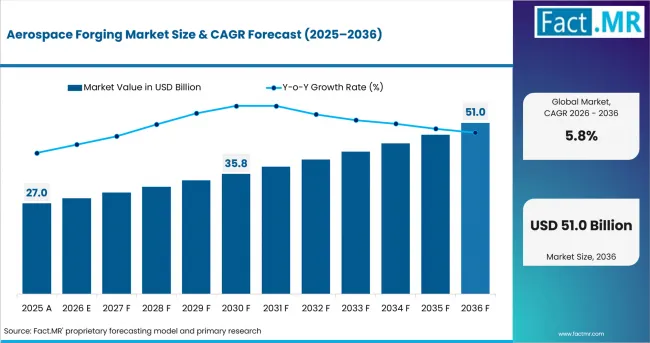
- According to Fact.MR, the aerospace forging market was valued at approximately USD 27 billion in 2025 and is expected to reach USD 29 billion in 2026.
- The market is forecast to expand to USD 51 billion by 2036, registering a CAGR of 5.8% during the 2026–2036 period and generating an incremental opportunity of USD 22 billion.
- Growth reflects aircraft production expansion and rising demand for high-strength structural components. Adoption is supported by commercial aircraft deliveries and defense modernization programs.
- Growth is constrained by long qualification cycles and limited forging capacity for aerospace-grade materials.
Summary of Aerospace Forging Market
- Demand Drivers
- Aircraft production growth is increasing demand for forged aerospace components. Manufacturing activity supports market expansion.
- Fleet modernization programs are strengthening replacement demand. Aircraft upgrades increase forged component consumption.
- Defense investment is increasing demand for certified structural parts. Military aircraft programs support revenue growth.
- Key Segments Analyzed
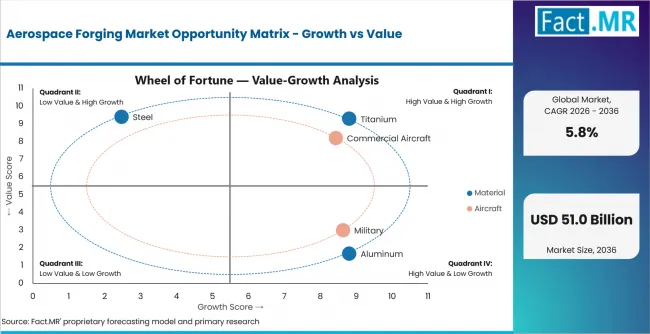
- By Material: Titanium accounts for 38.0% share in 2026 due to extensive use across structural and engine applications.
- By Aircraft: Commercial Aircraft contribute 56.0% share in 2026 supported by aircraft production concentration.
- By Forging Process: Closed Die Forging represents 48.0% share due to dimensional accuracy requirements.
- By Application: Engine Components generate 34.0% share in 2026 due to demanding operating conditions.
- By End User: OEMs contribute 61.0% share supported by direct integration during aircraft production.
- By Geography: India is projected to record 7.2% CAGR through 2036 supported by aerospace manufacturing expansion.
- Analyst Opinion at Fact.MR
- Shambhu Nath Jha, Principal Consultant at Fact.MR, opines, "Demand will be linked to aircraft delivery schedules and forging capacity availability. Suppliers with aerospace certifications and production scale are positioned to strengthen commercial opportunities."
- Strategic Implications
- Forging manufacturers should expand aerospace certified production capacity. Aircraft delivery growth supports demand visibility.
- Component suppliers should strengthen relationships with aircraft manufacturers. Program participation improves revenue stability.
- Aerospace distributors should improve inventory availability. Faster delivery capability strengthens commercial positioning.
| Metric | Value |
|---|---|
| Estimated Value in 2026 | USD 29 Billion |
| Forecast Value in 2036 | USD 51 Billion |
| Forecast CAGR (2026 to 2036) | 5.8% |
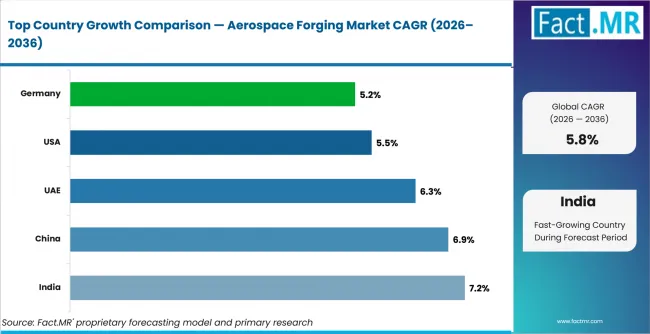
India is expected to record 7.2% CAGR supported by aerospace manufacturing investment and aircraft component production growth. China is projected to grow at 6.9% CAGR due to domestic aircraft development activity. The United Arab Emirates is forecast to expand at 6.3% CAGR supported by aviation infrastructure investment. The United States is estimated to witness 5.5% CAGR due to military aircraft manufacturing activity and defense spending. Germany is projected to register 5.2% CAGR driven by aerospace engineering capability. France is expected to expand at 5.0% CAGR supported by commercial aircraft production programs.
Segmental Analysis
Aerospace Forging Market Analysis by Material
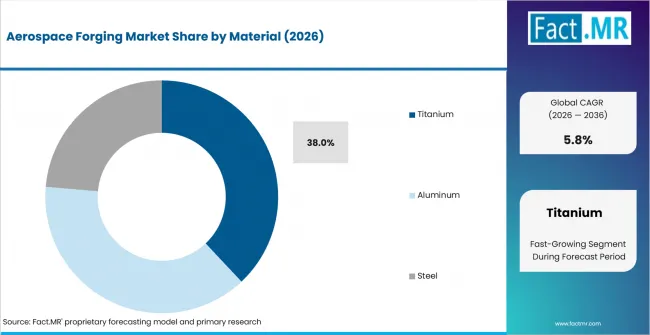
Titanium is estimated to hold 38.0% share in 2026. Titanium offers a high strength-to-weight ratio and strong corrosion resistance. Aircraft manufacturers utilize titanium forgings across engines and structural assemblies. RTX's Pratt & Whitney announced that Avolon selected GTF engines to power up to 160 Airbus A320neo family aircraft. The order supports future demand for forged engine and structural components used across narrowbody aircraft programs. [1]
- Weight Reduction: Titanium supports lighter aircraft structures. Fuel efficiency targets strengthen material demand.
- Engine Utilization: Aircraft engines require high-performance forged materials. Operating conditions support titanium adoption.
- Capacity Expansion: Aerospace material suppliers are increasing production capabilities. Manufacturing investment improves supply availability.
Aerospace Forging Market Analysis by Aircraft
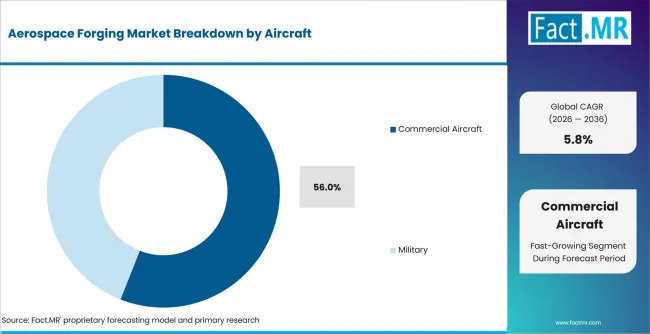
Commercial Aircraft are estimated to contribute 56.0% share in 2026. Aircraft delivery activity drives substantial forged component demand. Commercial aviation programs consume greater forging volumes than alternative aircraft segments. ATI announced the extension and expansion of its long-term titanium products agreement with Boeing across commercial aircraft programs. The agreement strengthens demand for aerospace-grade titanium forgings used in aircraft structures and critical components. [2]
- Aircraft Deliveries: Commercial production schedules increase component demand. Manufacturing activity supports revenue growth.
- Fleet Expansion: Airline operators are expanding aircraft fleets. Additional aircraft increase forging requirements.
- Aftermarket Demand: Fleet operation creates replacement component demand. Maintenance activity supports consumption.
Aerospace Forging Market Analysis by Forging Process
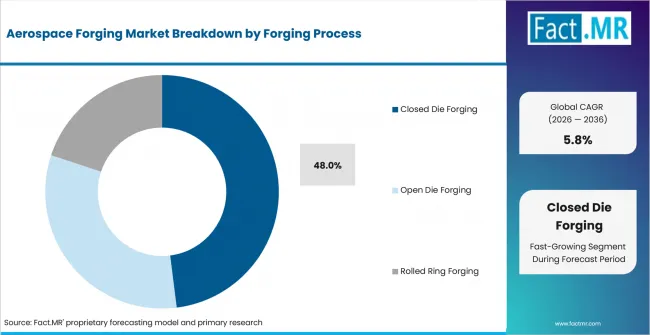
Closed Die Forging is estimated to account for 48.0% share in 2026. The process delivers high dimensional accuracy and consistent mechanical properties. Aerospace manufacturers utilize closed die forgings across critical aircraft systems. Bharat Forge signed a contract with Pratt & Whitney Canada to establish a dedicated aerospace ring mill facility scheduled to begin operations by 2026. The project will manufacture high-performance forged rings and components for aerospace applications. [3]
- Dimensional Accuracy: Aerospace applications require precise component specifications. Closed die processes support performance requirements.
- Production Consistency: Manufacturing repeatability improves product quality. Aerospace standards support segment demand.
- Industrial Investment: Forging suppliers are expanding production assets. Capacity additions improve output capability.
Aerospace Forging Market Analysis by Application
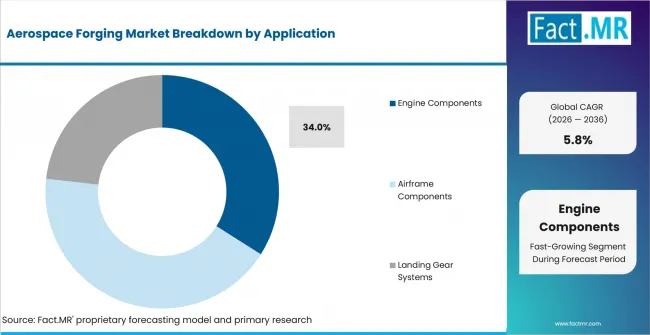
Engine Components are projected to generate 34.0% share in 2026. Aerospace engines require forged materials capable of operating under demanding conditions. Safety requirements support utilization of certified forged components. Howmet Aerospace agreed to acquire Consolidated Aerospace Manufacturing (CAM) for approximately $1.8 billion. The acquisition expands Howmet’s aerospace components portfolio and strengthens its exposure to aircraft structural and engineered component supply chains. [4]
- Performance Requirements: Engine systems require high-strength forged materials. Operating conditions support demand.
- Certification Standards: Aerospace regulations require qualified components. Compliance requirements strengthen utilization.
- Production Growth: Aircraft engine output increases forging consumption. Manufacturing activity supports market expansion.
Aerospace Forging Market Analysis by End User
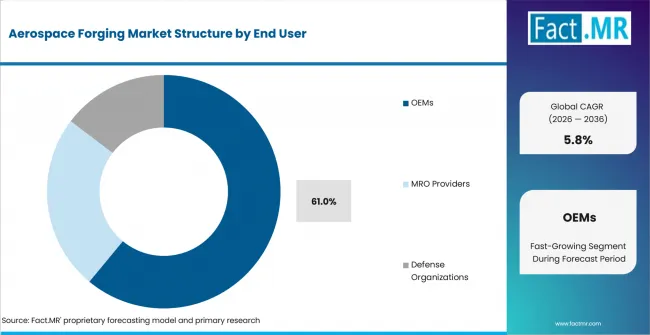
OEMs are estimated to hold 61.0% share in 2026. Aircraft manufacturers integrate forged components during assembly and production processes. Direct sourcing relationships support concentration within OEM channels.
- Direct Integration: Aircraft manufacturers require forged components during production. Assembly activity supports demand concentration.
- Program Participation: Long-term aerospace programs strengthen sourcing visibility. Production schedules support consumption.
- Supply Agreements: Manufacturing partnerships improve component availability. Contract activity supports segment growth.
Drivers, Restraints, and Opportunities

The aerospace forging market is driven by aircraft production activity and fleet replacement programs. Forged components remain essential across engines, landing gear systems, and structural assemblies. The market maintains a substantial valuation due to strict aerospace performance requirements and long product qualification cycles. GE Aerospace announced an additional $1 billion investment in manufacturing facilities and suppliers to increase jet-engine output and component production. The expansion is expected to boost demand for forged engine parts used in commercial and defense aircraft programs. [5]
Demand is shifting toward lightweight forged titanium and aluminum components. Aircraft manufacturers are reducing structural weight to improve fuel efficiency and operational performance. Advanced forging technologies are improving component precision and material utilization. Capacity constraints for aerospace-grade materials are influencing delivery schedules across major aerospace programs.
- Aircraft Production Expansion: Commercial aircraft manufacturers are increasing output to address delivery backlogs. Rising production volumes are strengthening demand for forged structural and engine components.
- Defense Modernization Activity: Military aircraft programs are increasing utilization of high-performance forged components. Defense investment supports recurring demand across aerospace supply chains.
- Qualification Pressure: Adoption is constrained by lengthy aerospace certification requirements. Approval timelines influence supplier participation and manufacturing expansion.
Regional Analysis
The aerospace forging market is assessed across North America, Europe, Asia Pacific, and the Middle East. The study evaluates aircraft production activity, aerospace manufacturing capability, forging capacity expansion, defense aviation investment, and structural component demand across major countries.
.webp)
| Country | CAGR |
|---|---|
| India | 7.2% |
| China | 6.9% |
| United Arab Emirates | 6.3% |
| United States | 5.5% |
| Germany | 5.2% |
Source: Fact.MR analysis based on aerospace manufacturing activity, aircraft production trends, and industry interviews.
Sales Analysis of Aerospace Forging Market in India
India is projected to expand at 7.2% CAGR due to aerospace manufacturing investment and aircraft component production growth. Growth is attributable to component production expansion and aerospace supply chain development.
- Aerospace manufacturing supports forging demand.
- Component production increases utilization.
- Export activity strengthens opportunity.
Demand Outlook for Aerospace Forging Market in China
Supported by domestic aircraft development activity, China is expected to witness 6.9% CAGR through 2036. Aircraft manufacturing programs are increasing demand for forged structural components. Local aerospace investment is improving production capability. Demand reflects aircraft output growth and industrial expansion.
- Aircraft programs support forging demand.
- Manufacturing investment improves capacity.
- Industrial growth strengthens utilization.
Opportunity Analysis of Aerospace Forging Market in United Arab Emirates
The United Arab Emirates is forecast to grow at 6.3% CAGR by 2036 as aviation infrastructure investment increases aerospace activity. Aircraft maintenance and engineering operations are expanding across major aviation hubs. Forged component demand benefits from aviation service growth. Growth is supported by aerospace investment and maintenance activity.
- Aviation investment supports demand.
- Service activity increases utilization.
- Engineering expansion strengthens growth.
Demand Assessment of Aerospace Forging Market in United States

The United States is projected to expand at 5.5% CAGR supported by aircraft production leadership and defense aviation spending. Aerospace manufacturers are increasing production activity across commercial and military programs. Growth reflects manufacturing strength and defense investment.
- Aircraft production supports demand.
- Defense activity increases consumption.
- Supply agreements strengthen growth.
In-depth Analysis of Aerospace Forging Market in Germany
Germany is projected to register 5.2% CAGR through 2036 supported by aerospace engineering capability and export manufacturing activity. Aerospace suppliers benefit from established aircraft production networks. Demand reflects participation across European aerospace programs. Growth is attributable to engineering expertise and export demand.
- Engineering expertise supports demand.
- Export activity increases utilization.
- Aerospace production strengthens growth.
Demand Outlook for Aerospace Forging Market in France
France reflects stable aerospace demand and is expected to expand at 5.0% CAGR by 2036. Commercial aircraft manufacturing creates recurring demand for forged components. Aerospace investment supports production capability across supplier networks. Growth reflects aircraft output and industrial participation.
- Aircraft production supports demand.
- Supplier activity increases utilization.
- Industrial investment sustains growth.
Competitive Aligners for Market Players

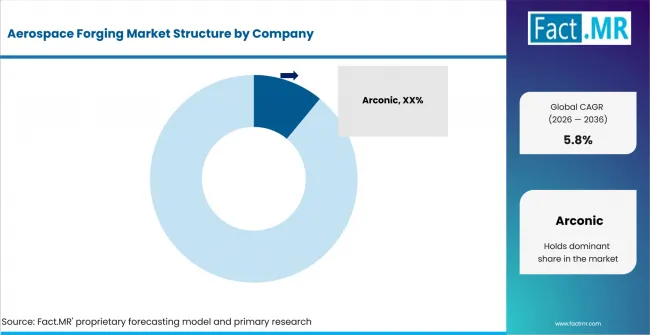
The aerospace forging market reflects a moderately consolidated structure. Large forging manufacturers account for a substantial portion of certified aerospace production. Product quality and aerospace approvals influence competitive positioning across aircraft programs.
Manufacturers with aerospace certifications benefit from stronger access to aircraft production contracts. Long-term relationships with aircraft manufacturers improve visibility into future demand. Production scale strengthens supplier positioning across commercial and defense applications. Aircraft manufacturers prioritize supply reliability and component consistency. Qualification requirements influence supplier selection decisions. Commercial success is linked to certification depth and manufacturing capability.
Competitive positioning is increasingly associated with forging capacity and material expertise. Suppliers that improve production efficiency strengthen participation across aerospace programs. Growth opportunities are concentrated in aircraft production expansion and fleet modernization activity.
Key Players
- Arconic
- ATI
- Bharat Forge
- ELLWOOD Group Inc.
- Howmet Aerospace Inc.
Bibliography
- [1] RTX. (2024, July 23). Avolon selects RTX’s Pratt & Whitney GTF™ engines to power up to 160 Airbus A320neo family aircraft.
- [2] ATI Inc. (2025, July 31). ATI and Boeing extend and expand titanium supply long-term agreement.
- [3] Bharat Forge Limited. (2025, July 30). Bharat Forge to establish state-of-the-art ring mill for aerospace applications.
- [4] Howmet Aerospace Inc. (2025, December 22). Howmet Aerospace to acquire Consolidated Aerospace Manufacturing from Stanley Black & Decker for approximately USD 1.8 billion.
- [5] GE Aerospace. (2026, March 9). GE Aerospace to invest another USD 1B in U.S. manufacturing.
This Report Addresses
- Analysis of aerospace forging demand across aircraft manufacturing and defense applications.
- Market forecast from USD 29 Billion in 2026 to USD 51 Billion by 2036 at 5.8% CAGR.
- Opportunity assessment across aerospace manufacturing and fleet modernization programs.
- Segment forecasts covering material, aircraft, forging process, application, and end user demand.
- Competitive assessment of aerospace forging manufacturers and component suppliers.
- Evaluation of aircraft production trends and aerospace manufacturing activity.
- Country-level analysis across India, China, United Arab Emirates, United States, Germany, and France.
- Report delivery through PDF and Excel formats supported by primary interviews and aerospace industry analysis.
Aerospace Forging Market Definition
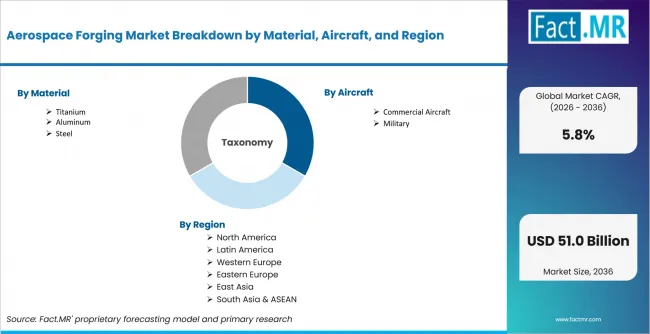
The aerospace forging market covers forged metal components used across commercial aircraft, military aircraft, helicopters, and aerospace systems. Forging is a manufacturing process that shapes metal under compressive force to improve strength and structural integrity. Aerospace manufacturers utilize forged parts in engines, landing gear systems, airframes, and transmission assemblies. Titanium, aluminum, and steel remain widely used materials due to their performance characteristics.
Aerospace Forging Market Inclusions
The study covers global and regional forecasts from 2026 to 2036 by material, aircraft, forging process, application, and end user. It includes aerospace forgings utilized across commercial aviation and defense aviation programs. The report evaluates manufacturing activity, component demand, pricing developments, capacity utilization, and supplier positioning.
Aerospace Forging Market Exclusions
The study excludes cast aerospace components, fabricated sheet metal assemblies, aerospace fasteners, and composite structural parts. It omits finished aircraft revenue and broader aerospace hardware sales. The report focuses exclusively on forged aerospace components and immediate aerospace manufacturing applications.
Aerospace Forging Market Research Methodology
- Primary Research
- Interviews were conducted with forging manufacturers, aerospace component suppliers, aircraft manufacturers, distributors, maintenance organizations, and industry consultants.
- Desk Research
- Analysis included company disclosures, aerospace publications, aircraft production reports, government releases, and manufacturing announcements published during 2024 and 2025.
- Market-Sizing and Forecasting
- Hybrid top-down and bottom-up model using aircraft production data, forging consumption rates, aerospace manufacturing activity, and supplier revenue benchmarks.
- Data Validation and Update Cycle
- Forecast was validated through manufacturer interviews, distributor feedback, company disclosures, and aerospace component demand assessments.
Scope of Report

| Attribute | Details |
|---|---|
| Quantitative Units | USD 29 Billion (2026) to USD 51 Billion (2036) at a CAGR of 5.8% |
| Market Definition | Covers forged aerospace components used across aircraft and defense systems. |
| Material Segmentation | Aluminum, Steel, Titanium, Others |
| Aircraft Segmentation | Commercial, Military, Others |
| Forging Process Segmentation | Closed Die Forging, Open Die Forging, Rolled Ring Forging, Precision Forging |
| Application Segmentation | Engine Components, Airframe Components, Landing Gear Systems, Transmission Components |
| End User Segmentation | OEMs, MRO Providers, Defense Organizations |
| Regions Covered | North America, Europe, Asia Pacific, Middle East |
| Countries Covered | India, China, United Arab Emirates, United States, Germany, France |
| Key Companies Profiled | Arconic, ATI, Bharat Forge, ELLWOOD Group, Howmet Aerospace Inc. |
| Forecast Period | 2026 to 2036 |
| Approach | Hybrid top-down and bottom-up model using aircraft production and forging demand analysis. |
Aerospace Forging Market by Segment
-
By Material:
- Aluminum
- Steel
- Titanium
-
By Aircraft:
- Commercial
- Military
-
By Forging Process:
- Closed Die Forging
- Open Die Forging
- Rolled Ring Forging
- Precision Forging
-
By Application:
- Engine Components
- Airframe Components
- Landing Gear Systems
- Transmission Components
-
By End User:
- OEMs
- MRO Providers
- Defense Organizations
-
By Region:
- North America
- United States
- Canada
- Mexico
- Latin America
- Brazil
- Argentina
- Rest of Latin America
- Europe
- Germany
- United Kingdom
- France
- Italy
- Spain
- Rest of Europe
- Asia Pacific
- China
- India
- Japan
- South Korea
- ASEAN
- Middle East & Africa
- GCC Countries
- South Africa
- UAE
- Rest of Middle East & Africa
- North America
- Frequently Asked Questions -
How large is the global aerospace forging market in 2025?
The global aerospace forging market was valued at USD 27 Billion in 2025 based on Fact.MR analysis.
What will the aerospace forging market size be in 2026?
Based on Fact.MR analysis, demand for aerospace forgings is estimated to reach USD 29 Billion in 2026.
What is the projected aerospace forging market size by 2036?
The market is projected to reach USD 51 Billion by 2036 supported by aircraft production growth and aerospace manufacturing investment.
What is the expected CAGR for the aerospace forging market from 2026 to 2036?
Fact.MR projects the global aerospace forging market to expand at a CAGR of 5.8% during the forecast period.
Which material segment is expected to contribute prominent demand?
Titanium contributes 38.0% share in 2026 due to extensive utilization across aerospace structural and engine applications.
Which aircraft segment generates substantial market demand?
Commercial aircraft contribute 56.0% share in 2026 supported by aircraft production concentration and forged component requirements.
Table of Content
- Executive Summary
- Global Market Outlook
- Demand to side Trends
- Supply to side Trends
- Technology Roadmap Analysis
- Analysis and Recommendations
- Market Overview
- Market Coverage / Taxonomy
- Market Definition / Scope / Limitations
- Research Methodology
- Chapter Orientation
- Analytical Lens and Working Hypotheses
- Market Structure, Signals, and Trend Drivers
- Benchmarking and Cross-market Comparability
- Market Sizing, Forecasting, and Opportunity Mapping
- Research Design and Evidence Framework
- Desk Research Programme (Secondary Evidence)
- Company Annual and Sustainability Reports
- Peer-reviewed Journals and Academic Literature
- Corporate Websites, Product Literature, and Technical Notes
- Earnings Decks and Investor Briefings
- Statutory Filings and Regulatory Disclosures
- Technical White Papers and Standards Notes
- Trade Journals, Industry Magazines, and Analyst Briefs
- Conference Proceedings, Webinars, and Seminar Materials
- Government Statistics Portals and Public Data Releases
- Press Releases and Reputable Media Coverage
- Specialist Newsletters and Curated Briefings
- Sector Databases and Reference Repositories
- Fact.MR Internal Proprietary Databases and Historical Market Datasets
- Subscription Datasets and Paid Sources
- Social Channels, Communities, and Digital Listening Inputs
- Additional Desk Sources
- Expert Input and Fieldwork (Primary Evidence)
- Primary Modes
- Qualitative Interviews and Expert Elicitation
- Quantitative Surveys and Structured Data Capture
- Blended Approach
- Why Primary Evidence is Used
- Field Techniques
- Interviews
- Surveys
- Focus Groups
- Observational and In-context Research
- Social and Community Interactions
- Stakeholder Universe Engaged
- C-suite Leaders
- Board Members
- Presidents and Vice Presidents
- R&D and Innovation Heads
- Technical Specialists
- Domain Subject-matter Experts
- Scientists
- Physicians and Other Healthcare Professionals
- Governance, Ethics, and Data Stewardship
- Research Ethics
- Data Integrity and Handling
- Primary Modes
- Tooling, Models, and Reference Databases
- Desk Research Programme (Secondary Evidence)
- Data Engineering and Model Build
- Data Acquisition and Ingestion
- Cleaning, Normalisation, and Verification
- Synthesis, Triangulation, and Analysis
- Quality Assurance and Audit Trail
- Market Background
- Market Dynamics
- Drivers
- Restraints
- Opportunity
- Trends
- Scenario Forecast
- Demand in Optimistic Scenario
- Demand in Likely Scenario
- Demand in Conservative Scenario
- Opportunity Map Analysis
- Product Life Cycle Analysis
- Supply Chain Analysis
- Investment Feasibility Matrix
- Value Chain Analysis
- PESTLE and Porter’s Analysis
- Regulatory Landscape
- Regional Parent Market Outlook
- Production and Consumption Statistics
- Import and Export Statistics
- Market Dynamics
- Global Market Analysis 2021 to 2025 and Forecast, 2026 to 2036
- Historical Market Size Value (USD Million) Analysis, 2021 to 2025
- Current and Future Market Size Value (USD Million) Projections, 2026 to 2036
- Y to o to Y Growth Trend Analysis
- Absolute $ Opportunity Analysis
- Global Market Pricing Analysis 2021 to 2025 and Forecast 2026 to 2036
- Global Market Analysis 2021 to 2025 and Forecast 2026 to 2036, By Material
- Introduction / Key Findings
- Historical Market Size Value (USD Million) Analysis By Material , 2021 to 2025
- Current and Future Market Size Value (USD Million) Analysis and Forecast By Material , 2026 to 2036
- Titanium
- Aluminum
- Steel
- Titanium
- Y to o to Y Growth Trend Analysis By Material , 2021 to 2025
- Absolute $ Opportunity Analysis By Material , 2026 to 2036
- Global Market Analysis 2021 to 2025 and Forecast 2026 to 2036, By Aircraft
- Introduction / Key Findings
- Historical Market Size Value (USD Million) Analysis By Aircraft, 2021 to 2025
- Current and Future Market Size Value (USD Million) Analysis and Forecast By Aircraft, 2026 to 2036
- Commercial Aircraft
- Military
- Commercial Aircraft
- Y to o to Y Growth Trend Analysis By Aircraft, 2021 to 2025
- Absolute $ Opportunity Analysis By Aircraft, 2026 to 2036
- Global Market Analysis 2021 to 2025 and Forecast 2026 to 2036, By Forging Process
- Introduction / Key Findings
- Historical Market Size Value (USD Million) Analysis By Forging Process, 2021 to 2025
- Current and Future Market Size Value (USD Million) Analysis and Forecast By Forging Process, 2026 to 2036
- Closed Die Forging
- Open Die Forging
- Rolled Ring Forging
- Precision Forging
- Closed Die Forging
- Y to o to Y Growth Trend Analysis By Forging Process, 2021 to 2025
- Absolute $ Opportunity Analysis By Forging Process, 2026 to 2036
- Global Market Analysis 2021 to 2025 and Forecast 2026 to 2036, By Application
- Introduction / Key Findings
- Historical Market Size Value (USD Million) Analysis By Application, 2021 to 2025
- Current and Future Market Size Value (USD Million) Analysis and Forecast By Application, 2026 to 2036
- Engine Components
- Airframe Components
- Landing Gear Systems
- Transmission Components
- Engine Components
- Y to o to Y Growth Trend Analysis By Application, 2021 to 2025
- Absolute $ Opportunity Analysis By Application, 2026 to 2036
- Global Market Analysis 2021 to 2025 and Forecast 2026 to 2036, By End User
- Introduction / Key Findings
- Historical Market Size Value (USD Million) Analysis By End User, 2021 to 2025
- Current and Future Market Size Value (USD Million) Analysis and Forecast By End User, 2026 to 2036
- OEMs
- MRO Providers
- Defense Organizations
- OEMs
- Y to o to Y Growth Trend Analysis By End User, 2021 to 2025
- Absolute $ Opportunity Analysis By End User, 2026 to 2036
- Global Market Analysis 2021 to 2025 and Forecast 2026 to 2036, By Region
- Introduction
- Historical Market Size Value (USD Million) Analysis By Region, 2021 to 2025
- Current Market Size Value (USD Million) Analysis and Forecast By Region, 2026 to 2036
- North America
- Latin America
- Western Europe
- Eastern Europe
- East Asia
- South Asia and Pacific
- Middle East & Africa
- Market Attractiveness Analysis By Region
- North America Market Analysis 2021 to 2025 and Forecast 2026 to 2036, By Country
- Historical Market Size Value (USD Million) Trend Analysis By Market Taxonomy, 2021 to 2025
- Market Size Value (USD Million) Forecast By Market Taxonomy, 2026 to 2036
- By Country
- USA
- Canada
- Mexico
- By Material
- By Aircraft
- By Forging Process
- By Application
- By End User
- By Country
- Market Attractiveness Analysis
- By Country
- By Material
- By Aircraft
- By Forging Process
- By Application
- By End User
- Key Takeaways
- Latin America Market Analysis 2021 to 2025 and Forecast 2026 to 2036, By Country
- Historical Market Size Value (USD Million) Trend Analysis By Market Taxonomy, 2021 to 2025
- Market Size Value (USD Million) Forecast By Market Taxonomy, 2026 to 2036
- By Country
- Brazil
- Chile
- Rest of Latin America
- By Material
- By Aircraft
- By Forging Process
- By Application
- By End User
- By Country
- Market Attractiveness Analysis
- By Country
- By Material
- By Aircraft
- By Forging Process
- By Application
- By End User
- Key Takeaways
- Western Europe Market Analysis 2021 to 2025 and Forecast 2026 to 2036, By Country
- Historical Market Size Value (USD Million) Trend Analysis By Market Taxonomy, 2021 to 2025
- Market Size Value (USD Million) Forecast By Market Taxonomy, 2026 to 2036
- By Country
- Germany
- UK
- Italy
- Spain
- France
- Nordic
- BENELUX
- Rest of Western Europe
- By Material
- By Aircraft
- By Forging Process
- By Application
- By End User
- By Country
- Market Attractiveness Analysis
- By Country
- By Material
- By Aircraft
- By Forging Process
- By Application
- By End User
- Key Takeaways
- Eastern Europe Market Analysis 2021 to 2025 and Forecast 2026 to 2036, By Country
- Historical Market Size Value (USD Million) Trend Analysis By Market Taxonomy, 2021 to 2025
- Market Size Value (USD Million) Forecast By Market Taxonomy, 2026 to 2036
- By Country
- Russia
- Poland
- Hungary
- Balkan & Baltic
- Rest of Eastern Europe
- By Material
- By Aircraft
- By Forging Process
- By Application
- By End User
- By Country
- Market Attractiveness Analysis
- By Country
- By Material
- By Aircraft
- By Forging Process
- By Application
- By End User
- Key Takeaways
- East Asia Market Analysis 2021 to 2025 and Forecast 2026 to 2036, By Country
- Historical Market Size Value (USD Million) Trend Analysis By Market Taxonomy, 2021 to 2025
- Market Size Value (USD Million) Forecast By Market Taxonomy, 2026 to 2036
- By Country
- China
- Japan
- South Korea
- By Material
- By Aircraft
- By Forging Process
- By Application
- By End User
- By Country
- Market Attractiveness Analysis
- By Country
- By Material
- By Aircraft
- By Forging Process
- By Application
- By End User
- Key Takeaways
- South Asia and Pacific Market Analysis 2021 to 2025 and Forecast 2026 to 2036, By Country
- Historical Market Size Value (USD Million) Trend Analysis By Market Taxonomy, 2021 to 2025
- Market Size Value (USD Million) Forecast By Market Taxonomy, 2026 to 2036
- By Country
- India
- ASEAN
- Australia & New Zealand
- Rest of South Asia and Pacific
- By Material
- By Aircraft
- By Forging Process
- By Application
- By End User
- By Country
- Market Attractiveness Analysis
- By Country
- By Material
- By Aircraft
- By Forging Process
- By Application
- By End User
- Key Takeaways
- Middle East & Africa Market Analysis 2021 to 2025 and Forecast 2026 to 2036, By Country
- Historical Market Size Value (USD Million) Trend Analysis By Market Taxonomy, 2021 to 2025
- Market Size Value (USD Million) Forecast By Market Taxonomy, 2026 to 2036
- By Country
- Kingdom of Saudi Arabia
- Other GCC Countries
- Turkiye
- South Africa
- Other African Union
- Rest of Middle East & Africa
- By Material
- By Aircraft
- By Forging Process
- By Application
- By End User
- By Country
- Market Attractiveness Analysis
- By Country
- By Material
- By Aircraft
- By Forging Process
- By Application
- By End User
- Key Takeaways
- Key Countries Market Analysis
- USA
- Pricing Analysis
- Market Share Analysis, 2025
- By Material
- By Aircraft
- By Forging Process
- By Application
- By End User
- Canada
- Pricing Analysis
- Market Share Analysis, 2025
- By Material
- By Aircraft
- By Forging Process
- By Application
- By End User
- Mexico
- Pricing Analysis
- Market Share Analysis, 2025
- By Material
- By Aircraft
- By Forging Process
- By Application
- By End User
- Brazil
- Pricing Analysis
- Market Share Analysis, 2025
- By Material
- By Aircraft
- By Forging Process
- By Application
- By End User
- Chile
- Pricing Analysis
- Market Share Analysis, 2025
- By Material
- By Aircraft
- By Forging Process
- By Application
- By End User
- Germany
- Pricing Analysis
- Market Share Analysis, 2025
- By Material
- By Aircraft
- By Forging Process
- By Application
- By End User
- UK
- Pricing Analysis
- Market Share Analysis, 2025
- By Material
- By Aircraft
- By Forging Process
- By Application
- By End User
- Italy
- Pricing Analysis
- Market Share Analysis, 2025
- By Material
- By Aircraft
- By Forging Process
- By Application
- By End User
- Spain
- Pricing Analysis
- Market Share Analysis, 2025
- By Material
- By Aircraft
- By Forging Process
- By Application
- By End User
- France
- Pricing Analysis
- Market Share Analysis, 2025
- By Material
- By Aircraft
- By Forging Process
- By Application
- By End User
- India
- Pricing Analysis
- Market Share Analysis, 2025
- By Material
- By Aircraft
- By Forging Process
- By Application
- By End User
- ASEAN
- Pricing Analysis
- Market Share Analysis, 2025
- By Material
- By Aircraft
- By Forging Process
- By Application
- By End User
- Australia & New Zealand
- Pricing Analysis
- Market Share Analysis, 2025
- By Material
- By Aircraft
- By Forging Process
- By Application
- By End User
- China
- Pricing Analysis
- Market Share Analysis, 2025
- By Material
- By Aircraft
- By Forging Process
- By Application
- By End User
- Japan
- Pricing Analysis
- Market Share Analysis, 2025
- By Material
- By Aircraft
- By Forging Process
- By Application
- By End User
- South Korea
- Pricing Analysis
- Market Share Analysis, 2025
- By Material
- By Aircraft
- By Forging Process
- By Application
- By End User
- Russia
- Pricing Analysis
- Market Share Analysis, 2025
- By Material
- By Aircraft
- By Forging Process
- By Application
- By End User
- Poland
- Pricing Analysis
- Market Share Analysis, 2025
- By Material
- By Aircraft
- By Forging Process
- By Application
- By End User
- Hungary
- Pricing Analysis
- Market Share Analysis, 2025
- By Material
- By Aircraft
- By Forging Process
- By Application
- By End User
- Kingdom of Saudi Arabia
- Pricing Analysis
- Market Share Analysis, 2025
- By Material
- By Aircraft
- By Forging Process
- By Application
- By End User
- Turkiye
- Pricing Analysis
- Market Share Analysis, 2025
- By Material
- By Aircraft
- By Forging Process
- By Application
- By End User
- South Africa
- Pricing Analysis
- Market Share Analysis, 2025
- By Material
- By Aircraft
- By Forging Process
- By Application
- By End User
- USA
- Market Structure Analysis
- Competition Dashboard
- Competition Benchmarking
- Market Share Analysis of Top Players
- By Regional
- By Material
- By Aircraft
- By Forging Process
- By Application
- By End User
- Competition Analysis
- Competition Deep Dive
- Arconic
- Overview
- Product Portfolio
- Profitability by Market Segments (Product/Age /Sales Channel/Region)
- Sales Footprint
- Strategy Overview
- Marketing Strategy
- Product Strategy
- Channel Strategy
- ATI
- Bharat Forge
- ELLWOOD Group Inc.
- Howmet Aerospace Inc.
- Arconic
- Competition Deep Dive
- Assumptions & Acronyms Used
List Of Table
- Table 1: Global Market Value (USD Million) Forecast by Region, 2021 to 2036
- Table 2: Global Market Value (USD Million) Forecast by Material , 2021 to 2036
- Table 3: Global Market Value (USD Million) Forecast by Aircraft, 2021 to 2036
- Table 4: Global Market Value (USD Million) Forecast by Forging Process, 2021 to 2036
- Table 5: Global Market Value (USD Million) Forecast by Application, 2021 to 2036
- Table 6: Global Market Value (USD Million) Forecast by End User, 2021 to 2036
- Table 7: North America Market Value (USD Million) Forecast by Country, 2021 to 2036
- Table 8: North America Market Value (USD Million) Forecast by Material , 2021 to 2036
- Table 9: North America Market Value (USD Million) Forecast by Aircraft, 2021 to 2036
- Table 10: North America Market Value (USD Million) Forecast by Forging Process, 2021 to 2036
- Table 11: North America Market Value (USD Million) Forecast by Application, 2021 to 2036
- Table 12: North America Market Value (USD Million) Forecast by End User, 2021 to 2036
- Table 13: Latin America Market Value (USD Million) Forecast by Country, 2021 to 2036
- Table 14: Latin America Market Value (USD Million) Forecast by Material , 2021 to 2036
- Table 15: Latin America Market Value (USD Million) Forecast by Aircraft, 2021 to 2036
- Table 16: Latin America Market Value (USD Million) Forecast by Forging Process, 2021 to 2036
- Table 17: Latin America Market Value (USD Million) Forecast by Application, 2021 to 2036
- Table 18: Latin America Market Value (USD Million) Forecast by End User, 2021 to 2036
- Table 19: Western Europe Market Value (USD Million) Forecast by Country, 2021 to 2036
- Table 20: Western Europe Market Value (USD Million) Forecast by Material , 2021 to 2036
- Table 21: Western Europe Market Value (USD Million) Forecast by Aircraft, 2021 to 2036
- Table 22: Western Europe Market Value (USD Million) Forecast by Forging Process, 2021 to 2036
- Table 23: Western Europe Market Value (USD Million) Forecast by Application, 2021 to 2036
- Table 24: Western Europe Market Value (USD Million) Forecast by End User, 2021 to 2036
- Table 25: Eastern Europe Market Value (USD Million) Forecast by Country, 2021 to 2036
- Table 26: Eastern Europe Market Value (USD Million) Forecast by Material , 2021 to 2036
- Table 27: Eastern Europe Market Value (USD Million) Forecast by Aircraft, 2021 to 2036
- Table 28: Eastern Europe Market Value (USD Million) Forecast by Forging Process, 2021 to 2036
- Table 29: Eastern Europe Market Value (USD Million) Forecast by Application, 2021 to 2036
- Table 30: Eastern Europe Market Value (USD Million) Forecast by End User, 2021 to 2036
- Table 31: East Asia Market Value (USD Million) Forecast by Country, 2021 to 2036
- Table 32: East Asia Market Value (USD Million) Forecast by Material , 2021 to 2036
- Table 33: East Asia Market Value (USD Million) Forecast by Aircraft, 2021 to 2036
- Table 34: East Asia Market Value (USD Million) Forecast by Forging Process, 2021 to 2036
- Table 35: East Asia Market Value (USD Million) Forecast by Application, 2021 to 2036
- Table 36: East Asia Market Value (USD Million) Forecast by End User, 2021 to 2036
- Table 37: South Asia and Pacific Market Value (USD Million) Forecast by Country, 2021 to 2036
- Table 38: South Asia and Pacific Market Value (USD Million) Forecast by Material , 2021 to 2036
- Table 39: South Asia and Pacific Market Value (USD Million) Forecast by Aircraft, 2021 to 2036
- Table 40: South Asia and Pacific Market Value (USD Million) Forecast by Forging Process, 2021 to 2036
- Table 41: South Asia and Pacific Market Value (USD Million) Forecast by Application, 2021 to 2036
- Table 42: South Asia and Pacific Market Value (USD Million) Forecast by End User, 2021 to 2036
- Table 43: Middle East & Africa Market Value (USD Million) Forecast by Country, 2021 to 2036
- Table 44: Middle East & Africa Market Value (USD Million) Forecast by Material , 2021 to 2036
- Table 45: Middle East & Africa Market Value (USD Million) Forecast by Aircraft, 2021 to 2036
- Table 46: Middle East & Africa Market Value (USD Million) Forecast by Forging Process, 2021 to 2036
- Table 47: Middle East & Africa Market Value (USD Million) Forecast by Application, 2021 to 2036
- Table 48: Middle East & Africa Market Value (USD Million) Forecast by End User, 2021 to 2036
List Of Figures
- Figure 1: Global Market Pricing Analysis
- Figure 2: Global Market Value (USD Million) Forecast 2021-2036
- Figure 3: Global Market Value Share and BPS Analysis by Material , 2026 and 2036
- Figure 4: Global Market Y-o-Y Growth Comparison by Material , 2026-2036
- Figure 5: Global Market Attractiveness Analysis by Material
- Figure 6: Global Market Value Share and BPS Analysis by Aircraft, 2026 and 2036
- Figure 7: Global Market Y-o-Y Growth Comparison by Aircraft, 2026-2036
- Figure 8: Global Market Attractiveness Analysis by Aircraft
- Figure 9: Global Market Value Share and BPS Analysis by Forging Process, 2026 and 2036
- Figure 10: Global Market Y-o-Y Growth Comparison by Forging Process, 2026-2036
- Figure 11: Global Market Attractiveness Analysis by Forging Process
- Figure 12: Global Market Value Share and BPS Analysis by Application, 2026 and 2036
- Figure 13: Global Market Y-o-Y Growth Comparison by Application, 2026-2036
- Figure 14: Global Market Attractiveness Analysis by Application
- Figure 15: Global Market Value Share and BPS Analysis by End User, 2026 and 2036
- Figure 16: Global Market Y-o-Y Growth Comparison by End User, 2026-2036
- Figure 17: Global Market Attractiveness Analysis by End User
- Figure 18: Global Market Value (USD Million) Share and BPS Analysis by Region, 2026 and 2036
- Figure 19: Global Market Y-o-Y Growth Comparison by Region, 2026-2036
- Figure 20: Global Market Attractiveness Analysis by Region
- Figure 21: North America Market Incremental Dollar Opportunity, 2026-2036
- Figure 22: Latin America Market Incremental Dollar Opportunity, 2026-2036
- Figure 23: Western Europe Market Incremental Dollar Opportunity, 2026-2036
- Figure 24: Eastern Europe Market Incremental Dollar Opportunity, 2026-2036
- Figure 25: East Asia Market Incremental Dollar Opportunity, 2026-2036
- Figure 26: South Asia and Pacific Market Incremental Dollar Opportunity, 2026-2036
- Figure 27: Middle East & Africa Market Incremental Dollar Opportunity, 2026-2036
- Figure 28: North America Market Value Share and BPS Analysis by Country, 2026 and 2036
- Figure 29: North America Market Value Share and BPS Analysis by Material , 2026 and 2036
- Figure 30: North America Market Y-o-Y Growth Comparison by Material , 2026-2036
- Figure 31: North America Market Attractiveness Analysis by Material
- Figure 32: North America Market Value Share and BPS Analysis by Aircraft, 2026 and 2036
- Figure 33: North America Market Y-o-Y Growth Comparison by Aircraft, 2026-2036
- Figure 34: North America Market Attractiveness Analysis by Aircraft
- Figure 35: North America Market Value Share and BPS Analysis by Forging Process, 2026 and 2036
- Figure 36: North America Market Y-o-Y Growth Comparison by Forging Process, 2026-2036
- Figure 37: North America Market Attractiveness Analysis by Forging Process
- Figure 38: North America Market Value Share and BPS Analysis by Application, 2026 and 2036
- Figure 39: North America Market Y-o-Y Growth Comparison by Application, 2026-2036
- Figure 40: North America Market Attractiveness Analysis by Application
- Figure 41: North America Market Value Share and BPS Analysis by End User, 2026 and 2036
- Figure 42: North America Market Y-o-Y Growth Comparison by End User, 2026-2036
- Figure 43: North America Market Attractiveness Analysis by End User
- Figure 44: Latin America Market Value Share and BPS Analysis by Country, 2026 and 2036
- Figure 45: Latin America Market Value Share and BPS Analysis by Material , 2026 and 2036
- Figure 46: Latin America Market Y-o-Y Growth Comparison by Material , 2026-2036
- Figure 47: Latin America Market Attractiveness Analysis by Material
- Figure 48: Latin America Market Value Share and BPS Analysis by Aircraft, 2026 and 2036
- Figure 49: Latin America Market Y-o-Y Growth Comparison by Aircraft, 2026-2036
- Figure 50: Latin America Market Attractiveness Analysis by Aircraft
- Figure 51: Latin America Market Value Share and BPS Analysis by Forging Process, 2026 and 2036
- Figure 52: Latin America Market Y-o-Y Growth Comparison by Forging Process, 2026-2036
- Figure 53: Latin America Market Attractiveness Analysis by Forging Process
- Figure 54: Latin America Market Value Share and BPS Analysis by Application, 2026 and 2036
- Figure 55: Latin America Market Y-o-Y Growth Comparison by Application, 2026-2036
- Figure 56: Latin America Market Attractiveness Analysis by Application
- Figure 57: Latin America Market Value Share and BPS Analysis by End User, 2026 and 2036
- Figure 58: Latin America Market Y-o-Y Growth Comparison by End User, 2026-2036
- Figure 59: Latin America Market Attractiveness Analysis by End User
- Figure 60: Western Europe Market Value Share and BPS Analysis by Country, 2026 and 2036
- Figure 61: Western Europe Market Value Share and BPS Analysis by Material , 2026 and 2036
- Figure 62: Western Europe Market Y-o-Y Growth Comparison by Material , 2026-2036
- Figure 63: Western Europe Market Attractiveness Analysis by Material
- Figure 64: Western Europe Market Value Share and BPS Analysis by Aircraft, 2026 and 2036
- Figure 65: Western Europe Market Y-o-Y Growth Comparison by Aircraft, 2026-2036
- Figure 66: Western Europe Market Attractiveness Analysis by Aircraft
- Figure 67: Western Europe Market Value Share and BPS Analysis by Forging Process, 2026 and 2036
- Figure 68: Western Europe Market Y-o-Y Growth Comparison by Forging Process, 2026-2036
- Figure 69: Western Europe Market Attractiveness Analysis by Forging Process
- Figure 70: Western Europe Market Value Share and BPS Analysis by Application, 2026 and 2036
- Figure 71: Western Europe Market Y-o-Y Growth Comparison by Application, 2026-2036
- Figure 72: Western Europe Market Attractiveness Analysis by Application
- Figure 73: Western Europe Market Value Share and BPS Analysis by End User, 2026 and 2036
- Figure 74: Western Europe Market Y-o-Y Growth Comparison by End User, 2026-2036
- Figure 75: Western Europe Market Attractiveness Analysis by End User
- Figure 76: Eastern Europe Market Value Share and BPS Analysis by Country, 2026 and 2036
- Figure 77: Eastern Europe Market Value Share and BPS Analysis by Material , 2026 and 2036
- Figure 78: Eastern Europe Market Y-o-Y Growth Comparison by Material , 2026-2036
- Figure 79: Eastern Europe Market Attractiveness Analysis by Material
- Figure 80: Eastern Europe Market Value Share and BPS Analysis by Aircraft, 2026 and 2036
- Figure 81: Eastern Europe Market Y-o-Y Growth Comparison by Aircraft, 2026-2036
- Figure 82: Eastern Europe Market Attractiveness Analysis by Aircraft
- Figure 83: Eastern Europe Market Value Share and BPS Analysis by Forging Process, 2026 and 2036
- Figure 84: Eastern Europe Market Y-o-Y Growth Comparison by Forging Process, 2026-2036
- Figure 85: Eastern Europe Market Attractiveness Analysis by Forging Process
- Figure 86: Eastern Europe Market Value Share and BPS Analysis by Application, 2026 and 2036
- Figure 87: Eastern Europe Market Y-o-Y Growth Comparison by Application, 2026-2036
- Figure 88: Eastern Europe Market Attractiveness Analysis by Application
- Figure 89: Eastern Europe Market Value Share and BPS Analysis by End User, 2026 and 2036
- Figure 90: Eastern Europe Market Y-o-Y Growth Comparison by End User, 2026-2036
- Figure 91: Eastern Europe Market Attractiveness Analysis by End User
- Figure 92: East Asia Market Value Share and BPS Analysis by Country, 2026 and 2036
- Figure 93: East Asia Market Value Share and BPS Analysis by Material , 2026 and 2036
- Figure 94: East Asia Market Y-o-Y Growth Comparison by Material , 2026-2036
- Figure 95: East Asia Market Attractiveness Analysis by Material
- Figure 96: East Asia Market Value Share and BPS Analysis by Aircraft, 2026 and 2036
- Figure 97: East Asia Market Y-o-Y Growth Comparison by Aircraft, 2026-2036
- Figure 98: East Asia Market Attractiveness Analysis by Aircraft
- Figure 99: East Asia Market Value Share and BPS Analysis by Forging Process, 2026 and 2036
- Figure 100: East Asia Market Y-o-Y Growth Comparison by Forging Process, 2026-2036
- Figure 101: East Asia Market Attractiveness Analysis by Forging Process
- Figure 102: East Asia Market Value Share and BPS Analysis by Application, 2026 and 2036
- Figure 103: East Asia Market Y-o-Y Growth Comparison by Application, 2026-2036
- Figure 104: East Asia Market Attractiveness Analysis by Application
- Figure 105: East Asia Market Value Share and BPS Analysis by End User, 2026 and 2036
- Figure 106: East Asia Market Y-o-Y Growth Comparison by End User, 2026-2036
- Figure 107: East Asia Market Attractiveness Analysis by End User
- Figure 108: South Asia and Pacific Market Value Share and BPS Analysis by Country, 2026 and 2036
- Figure 109: South Asia and Pacific Market Value Share and BPS Analysis by Material , 2026 and 2036
- Figure 110: South Asia and Pacific Market Y-o-Y Growth Comparison by Material , 2026-2036
- Figure 111: South Asia and Pacific Market Attractiveness Analysis by Material
- Figure 112: South Asia and Pacific Market Value Share and BPS Analysis by Aircraft, 2026 and 2036
- Figure 113: South Asia and Pacific Market Y-o-Y Growth Comparison by Aircraft, 2026-2036
- Figure 114: South Asia and Pacific Market Attractiveness Analysis by Aircraft
- Figure 115: South Asia and Pacific Market Value Share and BPS Analysis by Forging Process, 2026 and 2036
- Figure 116: South Asia and Pacific Market Y-o-Y Growth Comparison by Forging Process, 2026-2036
- Figure 117: South Asia and Pacific Market Attractiveness Analysis by Forging Process
- Figure 118: South Asia and Pacific Market Value Share and BPS Analysis by Application, 2026 and 2036
- Figure 119: South Asia and Pacific Market Y-o-Y Growth Comparison by Application, 2026-2036
- Figure 120: South Asia and Pacific Market Attractiveness Analysis by Application
- Figure 121: South Asia and Pacific Market Value Share and BPS Analysis by End User, 2026 and 2036
- Figure 122: South Asia and Pacific Market Y-o-Y Growth Comparison by End User, 2026-2036
- Figure 123: South Asia and Pacific Market Attractiveness Analysis by End User
- Figure 124: Middle East & Africa Market Value Share and BPS Analysis by Country, 2026 and 2036
- Figure 125: Middle East & Africa Market Value Share and BPS Analysis by Material , 2026 and 2036
- Figure 126: Middle East & Africa Market Y-o-Y Growth Comparison by Material , 2026-2036
- Figure 127: Middle East & Africa Market Attractiveness Analysis by Material
- Figure 128: Middle East & Africa Market Value Share and BPS Analysis by Aircraft, 2026 and 2036
- Figure 129: Middle East & Africa Market Y-o-Y Growth Comparison by Aircraft, 2026-2036
- Figure 130: Middle East & Africa Market Attractiveness Analysis by Aircraft
- Figure 131: Middle East & Africa Market Value Share and BPS Analysis by Forging Process, 2026 and 2036
- Figure 132: Middle East & Africa Market Y-o-Y Growth Comparison by Forging Process, 2026-2036
- Figure 133: Middle East & Africa Market Attractiveness Analysis by Forging Process
- Figure 134: Middle East & Africa Market Value Share and BPS Analysis by Application, 2026 and 2036
- Figure 135: Middle East & Africa Market Y-o-Y Growth Comparison by Application, 2026-2036
- Figure 136: Middle East & Africa Market Attractiveness Analysis by Application
- Figure 137: Middle East & Africa Market Value Share and BPS Analysis by End User, 2026 and 2036
- Figure 138: Middle East & Africa Market Y-o-Y Growth Comparison by End User, 2026-2036
- Figure 139: Middle East & Africa Market Attractiveness Analysis by End User
- Figure 140: Global Market - Tier Structure Analysis
- Figure 141: Global Market - Company Share Analysis