- Market Value (2025): USD 359.2 Mn
- Estimated Value (2026): USD 371.4 Mn
- Forecast Value (2036): USD 520.4 Mn
- CAGR (2026-2036): 3.4%
What is the Aerrane Market forecast to be worth by 2036?
USD 371.4 million in 2026 to USD 520.4 million by 2036, at a 3.4% CAGR.
- The Aerrane market reached USD 359.2 million in 2025.
- Sales are projected to rise from USD 371.4 million in 2026 to USD 520.4 million by 2036 across clinical anesthesia settings.
- The 2026 to 2036 outlook carries a 3.4% CAGR as hospitals continue to purchase volatile anesthetics for eligible procedures.
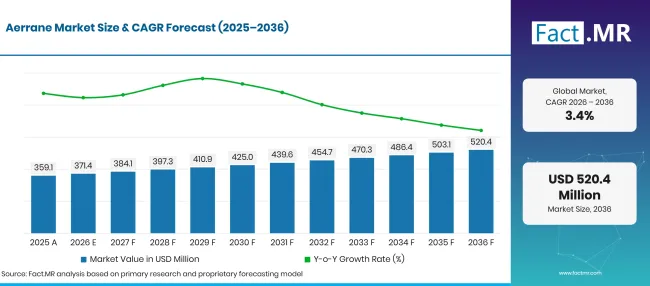
Aerrane Market Forecast Global | Source: Fact.MR
| Year | Basis | Market Value (USD million) |
|---|---|---|
| 2025 | Actual | 359.2 |
| 2026 | Estimate | 371.4 |
| 2036 | Forecast | 520.4 |
| CAGR 2026 to 2036 | Forecast period | 3.4% |
Source: Fact.MR analysis. Updated Oct 24, 2026
What are the defining numbers behind Aerrane Market growth?
USD 149.0 million in additional market value by 2036, with surgery and hospital use shaping the outlook.
- Demand Drivers in the Market
- Surgical teams require a steady supply of approved inhalation anesthetic agents that fit established vaporizers and anesthesia workflows. Aerrane contains isoflurane and is indicated for general inhalation anesthesia in its official medicine record [1].
- Hospital anesthetists value predictable agent delivery and the option to adjust anesthetic depth during an operation. Choosing isoflurane remains a clinical decision based on the patient, the procedure and applicable product labeling.
- Higher surgical throughput creates a continuing need for operating-room anesthesia supplies.
- Hospital pharmacy teams review bottle handling, stock continuity and local authorization when contracting for volatile anesthetics. Maintaining medicine supply across clinical sites is especially relevant where operating schedules are tightly planned.
- Key Segments Analyzed
- By Product Type: Inhalation Anesthetics account for 62.5% of 2026 market value, reflecting the product’s vapor-delivered clinical use.
- By Application: Surgery represents 68.7% of 2026 value as anesthetic maintenance is closely tied to operations under general anesthesia.
- By End-User: Hospitals represent 58.4% of 2026 spending because operating rooms routinely manage anesthetic drug inventories.
- Analyst Opinion at Fact.MR
- Shambhu Nath Jha, Principal Consultant at Fact.MR, states, “For hospitals, familiarity with isoflurane and preference for a particular brand are separate decisions. Pharmacy teams assess product registration, supply reliability and compatibility with installed anesthesia equipment. These practical factors influence which approved presentation remains on a hospital formulary.”
- Strategic Implications
- Hospital pharmacy teams should plan stocks against scheduled operating lists and retain suitable arrangements for urgent cases.
- Medicine distributors need clear batch identification and reliable delivery practices to meet the needs of surgical facilities.
- Clinical teams should apply current product labeling and local anesthesia protocols when selecting an inhaled agent.
- Commercial teams can compare site-level anesthetic requirements with surgical activity while avoiding assumptions that every procedure uses isoflurane.
Germany is projected to record 4.4% CAGR through 2036 as hospital surgical activity sustains anesthetic purchasing. The United Kingdom follows at 4.0%, while Brazil advances at 3.3%. Japan is forecast at 3.0%, and the United States at 2.6%, reflecting different treatment settings and drug-selection practices.
How does the Aerrane Market break down by segment?
Inhalation Anesthetics account for 62.5%; Surgery represents 68.7%; Hospitals hold 58.4% of 2026 value.
Which Product Type dominates?
Inhalation Anesthetics represent 62.5% share in 2026.
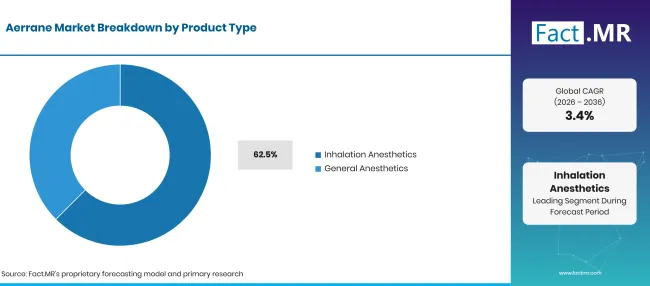
Aerrane Market Breakdown Product Type | Source: Fact.MR
| Product Type | Share (2026) |
|---|---|
| Inhalation Anesthetics (Leading segment) | 62.5% |
| Other segments combined | 37.5% |
| Total | 100.0% |
Source: Fact.MR analysis. Updated Oct 24, 2026
Aerrane is an isoflurane liquid used by inhalation, so operating-room use sits naturally within the inhalation anesthetic category. Its administration requires specialist staff and suitable anesthesia equipment. The broader general-anesthesia category also includes inhaled medicines, so these reporting categories need careful interpretation. Clinical choice is shaped by patient needs and the intended procedure, making this a comparison of purchasing categories rather than interchangeable branded products. The official Singapore drug listing identifies Aerrane as a prescription inhalation anesthetic.
What leads the Application segment?
Surgery accounts for 68.7% share in 2026.
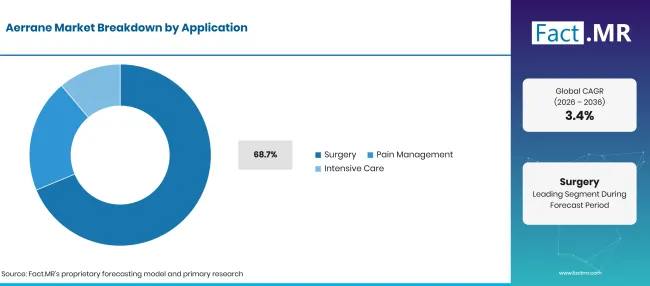
Aerrane Market Breakdown Application | Source: Fact.MR
| Application | Share (2026) |
|---|---|
| Surgery (Leading segment) | 68.7% |
| Other applications combined | 31.3% |
| Total | 100.0% |
Source: Fact.MR analysis. Updated Oct 24, 2026
Surgery is the central use setting because volatile anesthetics are administered as part of general anesthesia for selected operations. The agent is chosen by clinicians after reviewing the patient and the planned procedure. Pain Management, Ambulatory Surgical Centers and Intensive Care appear in the wider application taxonomy, although ambulatory centers are also care settings. They should be interpreted as reporting categories rather than proof of specific Aerrane indications. In England, 38.6% of admitted hospital episodes were day cases during 2025–26 [4]. Day-case activity offers context for anesthesia planning without identifying which drugs were used.
How does End-User shape purchasing?
Hospitals capture 58.4% share in 2026.
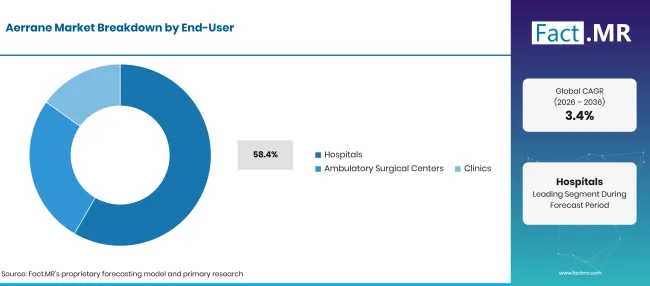
Aerrane Market Breakdown End User | Source: Fact.MR
| End-User | Share (2026) |
|---|---|
| Hospitals (Leading segment) | 58.4% |
| Other end-users combined | 41.6% |
| Total | 100.0% |
Source: Fact.MR analysis. Updated Oct 24, 2026
Hospitals purchase inhaled anesthetics through medicine supply arrangements linked to operating theaters and clinical pharmacy controls. Pharmacy teams must consider approved local presentations and their safe storage requirements. Clinics and ambulatory surgical facilities account for the remainder of the reported end-user framework. Where facilities use several anesthesia agents, purchasing decisions may depend on the types of procedures conducted and the existing anesthesia workstations. The hospital share describes commercial allocation, not an estimate of patients treated or bottles consumed.
What is accelerating Aerrane Market adoption, and what is holding it back?
Surgical utilization supports anesthetic purchasing; clinical selection and supply requirements limit substitution.
Drivers Impact Analysis
| DRIVER | (~) % IMPACT ON CAGR | GEOGRAPHIC RELEVANCE | IMPACT TIMELINE |
|---|---|---|---|
| Hospital operating-room activity | +1.0% | Global | Short term (<= 2 years) |
| Continuity of isoflurane supply | +0.8% | Global | Short term (<= 2 years) |
| Established clinical use of inhalation agents | +0.7% | Mature surgical systems | Medium term (2–4 years) |
| Hospital pharmacy inventory cycles | +0.5% | Global | Medium term (2–4 years) |
| Surgical services in public hospitals | +0.4% | Brazil and Europe | Long term (>= 4 years) |
Source: Fact.MR analysis. Updated Oct 24, 2026
Opportunity Impact Analysis
| OPPORTUNITY | (~) % IMPACT ON CAGR | GEOGRAPHIC RELEVANCE | IMPACT TIMELINE |
|---|---|---|---|
| Reliable hospital supply programs | +0.8% | Global | Short term (<= 2 years) |
| Ambulatory facility drug planning | +0.6% | United States and Europe | Medium term (2–4 years) |
| Hospital formulary reviews | +0.5% | Global | Medium term (2–4 years) |
| Surgical system expansion | +0.4% | Brazil and Asia | Long term (>= 4 years) |
Source: Fact.MR analysis. Updated Oct 24, 2026
Restraints Impact Analysis
| RESTRAINT | (~) % IMPACT ON CAGR | GEOGRAPHIC RELEVANCE | IMPACT TIMELINE |
|---|---|---|---|
| Clinical substitution among agents | -0.8% | Global | Short term (<= 2 years) |
| Restricted specialist administration | -0.6% | Global | Short term (<= 2 years) |
| Hospital cost and formulary review | -0.5% | Global | Medium term (2–4 years) |
| Regulatory and environmental oversight | -0.4% | Europe and North America | Long term (>= 4 years) |
Source: Fact.MR analysis. Updated Oct 24, 2026
Which countries are scaling the Aerrane Market through 2036?
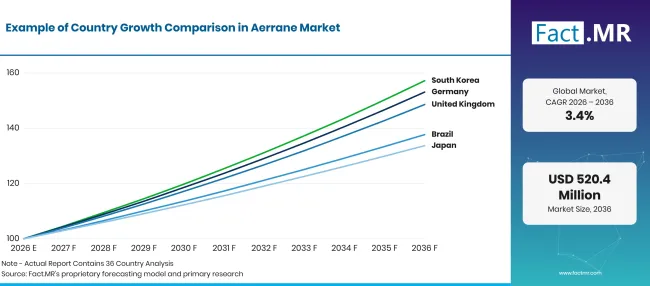
Factmr Aerrane Market Growth Index | Source: Fact.MR
| Country | CAGR (2026 to 2036) |
|---|---|
| Germany | 4.4% |
| United Kingdom | 4.0% |
| Brazil | 3.3% |
| Japan | 3.0% |
| United States | 2.6% |
Source: Fact.MR analysis. Updated Oct 24, 2026
What supports Germany’s adoption?
4.4% CAGR, linked to established hospital surgery and anesthetic supply planning.
Germany’s Federal Statistical Office reported in November 2025 that inpatient hospital treatments rose 2.0% during 2024 [6]. The change describes the wider hospital setting where anesthetic medicines are used. For Aerrane, orders depend on the agent selected for individual procedures and the stock held by each hospital.
How is the United Kingdom developing demand?
4.0% CAGR, supported by hospital activity and structured medicine supply.
NHS England reported in September 2026 that its 2025–26 hospital activity data recorded 18.5 million finished admission episodes [2]. This measure describes admitted care and the broader setting for anesthesia use. The volume provides clinical context while Aerrane purchases depend on a smaller group of relevant anesthetic decisions.
What is shaping Brazil’s Aerrane sales?
3.3% CAGR, reflecting elective surgery programs and hospital supply needs.
Brazil’s Ministry of Health reported in August 2026 that 14.9 million elective surgeries had been performed in 2025 [5]. The figure describes the broad surgical service base. Operating-room activity creates a reason for hospitals to maintain anesthesia medicines, while each facility determines its product requirements separately.
How does Japan use inhalation anesthetics?
3.0% CAGR, influenced by established hospital practice and controlled medicine choice.
The Ministry of Health, Labour and Welfare published its 2025 hospital report in September 2026, recording an average of 45,126 new hospital admissions a day [7]. That figure describes hospital admissions across the country. Surgical teams draw from the relevant anesthesia medicines when procedures require general anesthesia.
What affects United States purchasing?
2.6% CAGR, tied to site-level clinical selection and ambulatory care.
The Centers for Medicare & Medicaid Services updated its ambulatory surgical center payment-system utilization resource in July 2026 [8]. This administrative source supports analysis of outpatient care activity and billing patterns. It provides context for clinical services while individual medicine purchases are determined at the facility level.
Who leads the Aerrane Market?
Baxter is the manufacturer or marketing company identified in official Aerrane product records.
The national formulary in Singapore lists Baxter Healthcare Corporation as manufacturer, while Australia’s Therapeutic Goods Administration records Baxter Healthcare Pty Ltd as sponsor [3]. The wider general-anesthesia industry includes manufacturers of competing agents and related pharmaceutical products. Their participation in anesthesia does not automatically make them direct sellers of Aerrane. Competition centers on approved drug offerings, reliable distribution and hospital pharmacy acceptance.
Which companies are the key providers?
Key companies include Baxter International Inc.; Abbott Laboratories; Fresenius Kabi AG; Piramal Critical Care; and Halocarbon / Halocarbon Life Sciences, LLC.
- Baxter International Inc.
- Abbott Laboratories
- Fresenius Kabi AG
- Piramal Critical Care
- Halocarbon / Halocarbon Life Sciences, LLC
Bibliography
- [1] Baxter Healthcare. (n.d.). AERRANE (isoflurane): Product information.
- [2] NHS England. (2026, September 24). Hospital Admitted Patient Care Activity, 2025–26
- [3] Singapore National Drug Formulary. (n.d.). AERRANE inhalation anaesthetic (SIN08670P).
- [4] NHS England. (2026, September 24). Summary report - Episodes. In Hospital Admitted Patient Care Activity, 2025–26
- [5] Ministério da Saúde. (2026, August 29). Pacientes do SUS serão atendidos por hospitais particulares para a realização de 600 mil cirurgias e exames.
- [6] Statistisches Bundesamt (Destatis). (2025, November 6). 2,0 % mehr stationäre Krankenhausbehandlungen im Jahr 2024
- [7] Ministry of Health, Labour and Welfare. (2026, September 29). [Overview of the 2025 Medical Facilities Survey and Hospital Report]
- [8] Centers for Medicare & Medicaid Services. (n.d.). Ambulatory Surgical Center (ASC) Payment System.
This Report Answers
- The market value in 2025, 2026 and 2036 and the forecast growth rate.
- The segments that account for the reported product, application and end-user shares.
- Clinical and purchasing conditions relevant to isoflurane within general anesthesia.
- Country outlooks for Germany, Brazil, the United States, the United Kingdom and Japan.
- The distinction between the Aerrane brand and wider anesthesia-product competition.
What does the Aerrane Market cover?
Aerrane is a branded preparation of isoflurane for inhalation general anesthesia. The market discussion covers its role in hospital anesthesia purchasing together with the stated product and care-setting categories. Official product registration is used to distinguish the branded medicine from the broader family of inhalation anesthetics.
What is included in the scope?
The commercial framework includes approved Aerrane inhalation presentations, relevant hospital inventory processes and the use of isoflurane for suitable general-anesthesia cases.
Coverage extends across the geographic markets listed in the country outlook. Segment values are forecast market allocations and rarely represent treatment guidelines.
What is excluded from the scope?
Unrelated medical gases, surgical instruments and anesthesia machines are outside the medicine-revenue boundary.
Revenue attributed to competing anesthetic brands is not described as Aerrane sales. Individual surgery totals and hospital admission counts serve only as context for the operating environment.
How Was the Analysis Built?
The analysis draws on 120+ sources, 35+ company portfolios, 25+ countries, and more than 20 industry interviews.
- Primary Research: Primary research includes discussions with manufacturers, service providers, technology developers, distributors, end users, and subject-matter experts. These conversations examine purchasing priorities, product adoption, operational challenges, approval requirements, competitive positioning, and the factors that influence wider market acceptance.
- Desk Research: Desk research covers government statistics, regulatory publications, company filings, trade data, technical studies, industry associations, standards, public policy, and other authoritative sources. Every source used in the analysis is documented in the bibliography.
- Market Sizing and Forecasting: Market estimates combine historical performance, demand indicators, pricing and volume trends, segment shares, company participation, country-level growth, adoption patterns, investment activity, and barriers to market expansion.
- Data Validation and Update Cycle: Findings are validated by comparing primary interviews with public data, company activity, regulatory changes, trade patterns, and industry developments. Regular updates review new product launches, capacity changes, partnerships, approvals, and shifts in commercial adoption.
Segmentation
What is the report’s scope and coverage?
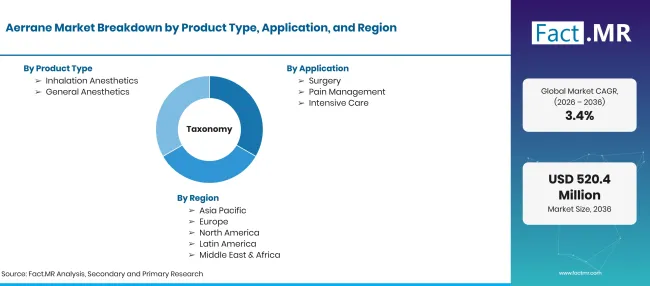
Aerrane Market Taxonomy | Source: Fact.MR
| Attribute | Details |
|---|---|
| Quantitative Units | USD million |
| Market Definition | Aerrane-branded isoflurane used for inhalation general anesthesia, covering its commercial role in hospital anesthesia purchasing and relevant clinical settings. |
| Product Type | Inhalation Anesthetics; General Anesthetics |
| Application | Surgery; Pain Management; Ambulatory Surgical Centers; Intensive Care |
| End-User | Hospitals; Clinics |
| Regions Covered | North America; Latin America; Western Europe; Eastern Europe; East Asia; South Asia & Pacific; Middle East & Africa |
| Countries Covered | Germany; United Kingdom; Brazil; Japan; United States |
| Companies Profiled | Baxter International Inc.; Abbott Laboratories; Fresenius Kabi AG; Piramal Critical Care; Halocarbon / Halocarbon Life Sciences, LLC |
| Forecast Period | 2026 to 2036 |
| Approach | Assessment of Aerrane product authorization, hospital surgical activity, inhalation-anesthetic use, clinical purchasing conditions, company participation, and market forecast indicators. |
Source: Fact.MR analysis. Updated Oct 24, 2026
How is the market segmented?
-
By Product Type
- Inhalation Anesthetics
- General Anesthetics
-
By Application
- Surgery
- Pain Management
- Ambulatory Surgical Centers
- Intensive Care
-
By End-User
- Hospitals
- Clinics
-
By Region
- North America
- Latin America
- Western Europe
- Eastern Europe
- East Asia
- South Asia & Pacific
- Middle East & Africa
Frequently Asked Questions
How big is the Aerrane market in 2026?
What is the CAGR of the Aerrane market?
Which product type leads the market?
Which application leads the market?
Who are the main companies in the aerrane market?
Who worked on this report


Preview the report firsthand - request a free sample
Free SampleGet the brochure for pricing and purchase details
Download PDF