- Market Value (2025): USD 3.2 Bn
- Estimated Value (2026): USD 3.9 Bn
- Forecast Value (2036): USD 24.6 Bn
- CAGR (2026-2036): 20.2%
What is the Healthcare Agentic Artificial Intelligence Market forecast to be worth by 2036?
USD 3.9 billion in 2026 to USD 24.6 billion by 2036 at 20.2% CAGR.
- The Healthcare Agentic Artificial Intelligence market reached USD 3.2 billion in 2025 as healthcare IT teams expanded controlled pilots around clinical and administrative workflows.
- Demand is projected to increase from USD 3.9 billion in 2026 to USD 24.6 billion by 2036.
- The market is forecast to record 20.2% CAGR from 2026 to 2036.
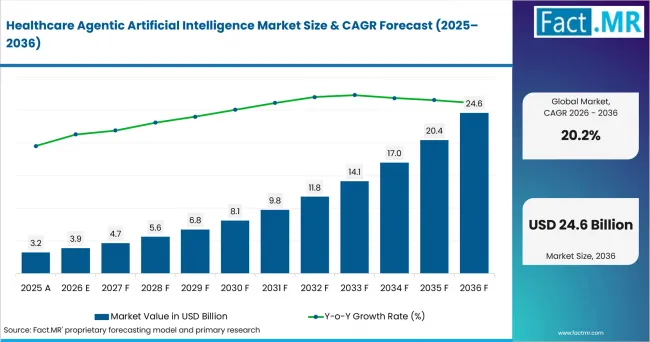
Healthcare Agentic Artificial Intelligence Market Value Analysis | Source: Fact.MR
What are the defining numbers behind Healthcare Agentic Artificial Intelligence Market growth?
USD 20.7 billion absolute opportunity by 2036.
- Demand Drivers in the Market
- Healthcare providers need AI agents that reduce repetitive work around documentation and care coordination without forcing clinicians into separate systems.
- Clinical teams favor agents that retrieve approved record context and present next-step options inside existing workflows. In September 2025, the Office of the Assistant Secretary for Technology Policy reported that 71% of U.S. non-federal acute care hospitals used predictive AI integrated with the EHR in 2024, up from 66% in 2023.
- Cloud platforms can support adoption through scalable model access and secure integration with healthcare data systems.
- Hospitals and payers can test agentic AI where labor pressure and administrative load make automation easier to justify.
- Key Segments Analyzed
- By Agent Type: Clinical Decision Agents are expected to hold 44.0% share in 2026 since clinical teams need guided reasoning before automated recommendations enter care pathways.
- By Application: Clinical Decision Support is projected to account for 38.0% share in 2026 as providers prioritize tools that convert patient context into usable next steps.
- By End User: Hospitals are anticipated to capture 42.0% share in 2026 because they manage the broadest mix of clinical and reimbursement workflows.
- By Deployment Model: Cloud-based Deployment is estimated to represent 61.0% share in 2026 due to scalable model hosting and central governance needs.
- By Core Technology: Large Language Models are forecast to hold 49.0% share in 2026 as natural-language interaction supports agent prompts and summaries.
- Analyst Opinion at Fact.MR
- Shambhu Nath Jha, Sr. Consultant at Fact.MR, opines: "Healthcare agentic AI should be assessed against a defined clinical or administrative workflow, a clear human-review point, and the quality of the underlying data. Buyers need traceability before an agent can move from pilot use into routine care operations."
- Strategic Implications
- Healthcare AI vendors should build agents around EHR, imaging, coding, and patient-engagement workflows before promising broad automation.
- Hospitals should test agentic AI in controlled workflows where review responsibility and escalation rules are clear from the start.
- Cloud and platform providers can strengthen adoption by showing that security and model monitoring work in regulated care settings.
The USA is projected to expand at 21.5% CAGR from 2026 to 2036. China is projected at 20.8%, followed by the UK at 20.1%, Germany at 19.4%, Japan at 18.7%, Canada at 18.0%, and Singapore at 17.3%.
How does the Healthcare Agentic Artificial Intelligence Market break down by segment?
Clinical Decision Agents are expected to lead Agent Type at 44.0% share in 2026. Clinical Decision Support is projected to lead Application at 38.0% share in 2026.
Which agent type dominates?
Clinical Decision Agents are projected to account for 44.0% share in 2026.
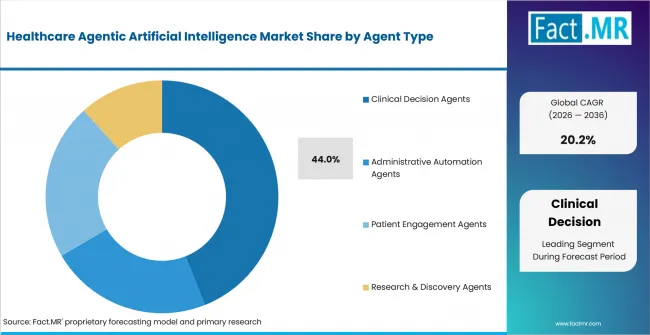
Healthcare Agentic Artificial Intelligence Market Analysis By Agent Type | Source: Fact.MR
Clinical Decision Agents lead by helping care teams review patient information before taking action. They support faster context retrieval and guided comparison with approved clinical guidance. This role makes them valuable where decisions require consistent evidence review and careful clinical judgment.
What leads the Application segment?
Clinical Decision Support is expected to hold 38.0% share in 2026.
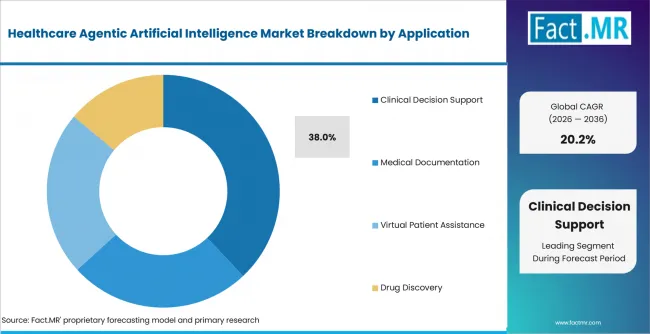
Healthcare Agentic Artificial Intelligence Market Analysis By Application | Source: Fact.MR
Clinical Decision Support benefits from a direct buyer problem. Hospitals need records and care protocols converted into usable guidance. Agentic tools add value when they summarize context without replacing clinician responsibility. Digital transformation in healthcare reinforces the move toward decision-ready systems.
What supports Hospitals within End User?
Hospitals are anticipated to lead with 42.0% share in 2026.
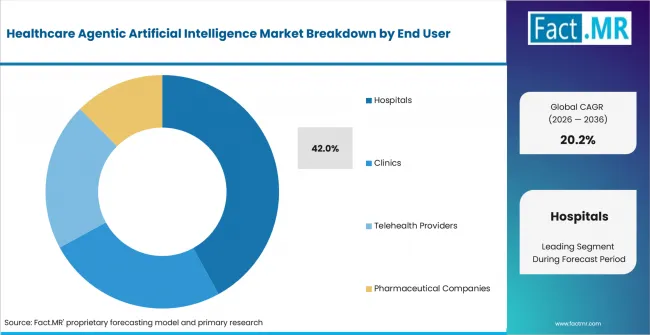
Healthcare Agentic Artificial Intelligence Market Analysis By End User | Source: Fact.MR
Hospitals hold the largest share because they combine clinical complexity with heavy administrative workload. Agentic AI can support documentation and care coordination inside one operating environment. Demand from patient monitoring systems supports hospital interest in tools that route signals to care teams. The same September 2025 ASTP data brief found that 86% of system-affiliated U.S. hospitals used predictive AI in 2024, compared with 37% of independent hospitals, which supports larger provider networks as early testing sites.
Why does Cloud-based Deployment lead Deployment Model?
Cloud-based Deployment is estimated to represent 61.0% share in 2026.
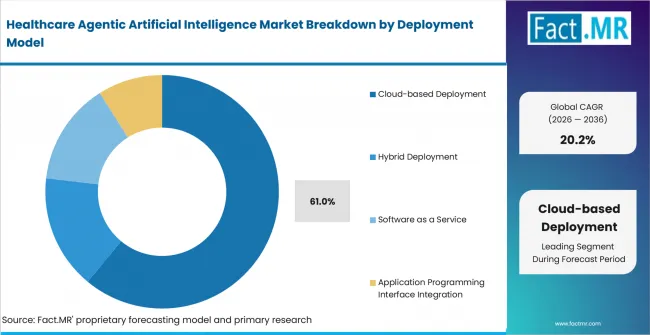
Healthcare Agentic Artificial Intelligence Market Analysis By Deployment Model | Source: Fact.MR
Cloud-based Deployment leads because healthcare agents need model updates and security monitoring across several data environments. Large providers are expected to prefer platforms that scale across departments with central governance. The deployment pattern connects with electronic health records because agent performance depends on structured patient context. In March 2026, AWS launched Amazon Connect Health, a purpose-built agentic AI solution for EHR and contact-center workflows. The platform automates administrative tasks across five specialized healthcare AI agents, including Patient Verification and Ambient Documentation, alongside Appointment Management, Patient Insights, and Medical Coding capabilities available in preview.
How do Large Language Models shape demand?
Large Language Models are forecast to hold 49.0% share in 2026.
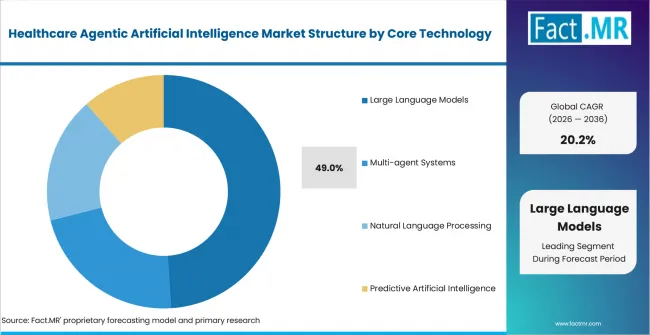
Healthcare Agentic Artificial Intelligence Market Analysis By Core Technology | Source: Fact.MR
Large Language Models lead Core Technology because healthcare agents rely on natural-language interaction and multi-step reasoning. Smaller models and knowledge graphs remain important for validation and control. In imaging-heavy settings, AI in diagnostic imaging shows how model choice changes by use case.
What is accelerating Healthcare Agentic Artificial Intelligence Market adoption, and what is holding it back?
Demand can increase through clinical workflow automation and scalable cloud deployment. Data access, clinical governance, and integration requirements remain important constraints.
Drivers Impact Analysis
| Driver | Relative Impact | Geographic Relevance | Impact Timeline |
|---|---|---|---|
| Clinical workflow automation | High | USA, UK, Canada | Short term |
| Cloud and model infrastructure | High | North America, Europe, Asia Pacific | Short term |
| EHR and data integration | Medium | Hospitals and payer systems | Medium term |
| Decision-support governance | Medium | Regulated healthcare markets | Medium term |
| Care coordination pressure | Medium | Aging-care and chronic-care systems | Long term |
Source: Fact.MR analysis. Updated Aug 10, 2026
- Clinical workflow automation: Agentic AI can gain priority where repetitive tasks reduce time for direct care.
- Cloud and model infrastructure: Enterprise platforms can lower deployment friction through compute and security controls.
- EHR and data integration: Agents become more useful when approved patient context returns inside the workflow.
Opportunity Impact Analysis
| Opportunity | Relative Impact | Geographic Relevance | Impact Timeline |
|---|---|---|---|
| Specialty clinical agents | Medium | USA, Germany, Japan | Medium term |
| Revenue-cycle and coding agents | Medium | USA and Canada | Medium term |
| Patient-engagement agents | Medium | UK, Singapore, China | Long term |
| Research and trial workflow agents | Medium | Life sciences clusters | Long term |
Source: Fact.MR analysis. Updated Aug 10, 2026
- Specialty clinical agents: Teams can use narrow, high-context support in selected clinical workflows.
- Revenue-cycle and coding agents: Hospitals and payers can test agents that reduce manual review time.
- Patient-engagement agents: Digital front-door use cases can expand around scheduling and follow-up.
Restraints Impact Analysis
| Restraint | Relative Impact | Geographic Relevance | Impact Timeline |
|---|---|---|---|
| Clinical trust and liability | High | Global | Short term |
| Health data access limits | High | Regulated healthcare markets | Short term |
| Integration cost and workflow disruption | Medium | Hospitals and payers | Medium term |
| Skill and governance gaps | Medium | Developing and mid-sized markets | Long term |
Source: Fact.MR analysis. Updated Aug 10, 2026
- Clinical trust and liability: Providers can slow deployment when recommendations and escalation rules are unclear.
- Health data access limits: Permission gaps can restrict automation when agents cannot reach approved records.
- Integration cost and workflow disruption: Buyers may delay projects when agents require major changes to clinical routines.
Which countries are scaling Healthcare Agentic Artificial Intelligence Market fastest?
- The country comparison covers a 4.2 percentage point range between the USA at 21.5% and Singapore at 17.3% CAGR from 2026 to 2036.
- USA, China, the UK, and Germany form the higher-growth group in the comparison.
- Japan, Canada, and Singapore form the next group, with projected CAGRs from 18.7% to 17.3%.
Comparable CAGRs create different entry conditions because health-system structure and EHR maturity vary by country. Full report coverage includes North America, Latin America, Europe, Asia Pacific, and Middle East and Africa.
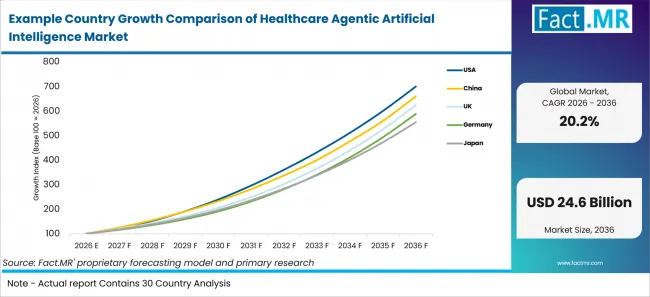
Example Country Growth Comparison Of Healthcare Agentic Artificial Intelligence Market | Source: Fact.MR
| Country | CAGR (2026-2036) |
|---|---|
| USA | 21.5% |
| China | 20.8% |
| UK | 20.1% |
| Germany | 19.4% |
| Japan | 18.7% |
| Canada | 18.0% |
| Singapore | 17.3% |
Source: Fact.MR analysis. Updated Aug 10, 2026
What supports USA adoption?
USA is projected to expand at 21.5% CAGR from 2026 to 2036.
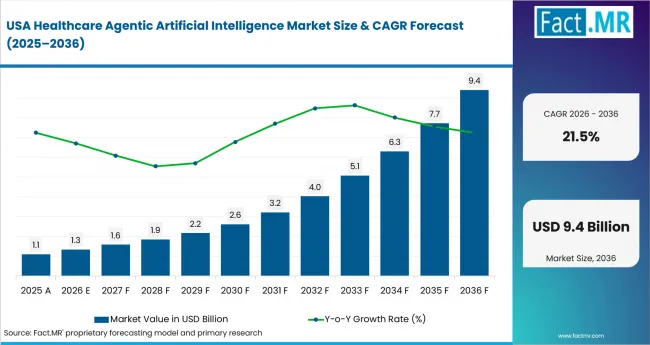
Healthcare Agentic Artificial Intelligence Market Country Value Analysis | Source: Fact.MR
Hospitals and payers in the USA can test agentic AI across clinical and administrative workflows. Buyers look for platforms with clear review paths before wider deployment.
How is China scaling demand?
China is projected to expand at 20.8% CAGR from 2026 to 2036.
China's large hospital networks can create demand for scalable digital tools. Local-language capability and implementation support can influence vendor selection.
What is driving the UK's growth from 2026 to 2036?
UK is projected to expand at 20.1% CAGR from 2026 to 2036.
The UK offers a setting for system-wide workflow pilots. Adoption can center on patient access and documentation support. In July 2026, NHS England said its AI triage tool in the NHS App was due to reach more than 200,000 patients within the next 12 months, while an initial Sussex trial reduced phone queues by 29%.
How is Germany developing demand?
Germany is projected to expand at 19.4% CAGR from 2026 to 2036.
Germany's hospital digitization and strict data-protection requirements make accountable deployment models important to vendor selection.
How does Japan perform?
Japan is projected to expand at 18.7% CAGR from 2026 to 2036.
Japan's providers may value agents that reduce documentation burden and support older-patient follow-up.
What supports Canada's growth?
Canada is projected to expand at 18.0% CAGR from 2026 to 2036.
Provider interest in access and care coordination across distributed health systems can shape project timing. Privacy fit and integration depth remain important considerations.
How does Singapore build demand?
Singapore is projected to expand at 17.3% CAGR from 2026 to 2036.
Singapore's digital healthcare infrastructure can support controlled cloud deployments and patient-flow workflows.
Who leads the Healthcare Agentic Artificial Intelligence Market?
Microsoft Corporation, Google LLC, Oracle Corporation, NVIDIA Corporation, Salesforce, Inc., Amazon Web Services, Inc., IBM Corporation, and Cognizant Technology Solutions Corporation form the listed provider set.
Competition centers on workflow fit and integration depth. Vendors differentiate through clinical-assistant design and agent governance. Predictive telehealth platforms and healthcare automation support the wider care-operations context.
Which companies are the key providers?
Key companies include Microsoft Corporation, Google LLC, Oracle Corporation, NVIDIA Corporation, Salesforce, Inc., Amazon Web Services, Inc., IBM Corporation, Cognizant Technology Solutions Corporation.
- Microsoft Corporation
- Google LLC
- Oracle Corporation
- NVIDIA Corporation
- Salesforce, Inc.
- Amazon Web Services, Inc.
- IBM Corporation
- Cognizant Technology Solutions Corporation
Bibliography
- Amazon Web Services. (2026, March 5). Introducing Amazon Connect Health, agentic AI built for healthcare.
- Microsoft Corporation. (2025, March 3). Microsoft Dragon Copilot provides the healthcare industry’s first unified voice AI assistant that enables clinicians to streamline clinical documentation, surface information and automate tasks.
- NVIDIA Corporation. (2025, January 13). NVIDIA partners with industry leaders to advance genomics, drug discovery and healthcare.
- Oracle Corporation. (2025, March 4). Oracle Health Clinical AI Agent reduces physician documentation time by 30%.
- PathAI. (2025, June 30). PathAI receives FDA clearance for AISight® Dx platform for primary diagnosis.
- Salesforce. (2025, February 28). Salesforce prescribes Agentforce for Health to speed time to treatment and improve outcomes with digital labor.
- U.S. Food and Drug Administration. (2025, January 6). FDA issues comprehensive draft guidance for developers of artificial intelligence-enabled medical devices.
- NHS England. (2026, July 4). NHS accelerates artificial intelligence rollout to cut waiting times and improve care for millions.
- Chang, W., Owusu-Mensah, P., Everson, J., & Richwine, C. (2025, September). Hospital trends in the use, evaluation, and governance of predictive AI, 2023–2024 (Data Brief No. 80). Office of the Assistant Secretary for Technology Policy.
This Report Answers
- The report provides strategic intelligence on Healthcare Agentic Artificial Intelligence segments.
- Segment analysis covers Clinical Decision Agents and Clinical Decision Support as the share leaders within the 2026 market.
- Country outlook evaluates the USA, China, UK, Germany, Japan, Canada, and Singapore.
- Competitive analysis profiles Microsoft Corporation, Google LLC, Oracle Corporation, NVIDIA Corporation, Salesforce, AWS, IBM, and Cognizant.
- Technology assessment covers Large Language Models, Multi-agent Systems, Natural Language Processing, and Predictive Artificial Intelligence.
What does the Healthcare Agentic Artificial Intelligence Market cover?
Healthcare agentic AI systems coordinate tasks and interpret approved data across clinical and administrative workflows.
The Healthcare Agentic Artificial Intelligence Market covers AI agents used for clinical decision support, documentation, patient assistance, drug discovery, and workflow coordination.
What is included in the scope?
Agentic AI systems are included when they support healthcare workflows through planning, retrieval, recommendations, or controlled automation.
Coverage includes Clinical Decision Agents, Administrative Automation Agents, Patient Engagement Agents, and Research & Discovery Agents. Applications include Clinical Decision Support, Medical Documentation, Virtual Patient Assistance, and Drug Discovery. End-user, deployment-model, core-technology, and regional coverage follow the defined market taxonomy.
What is excluded from the scope?
General AI tools without a defined healthcare workflow role remain outside the scope of this market.
The scope excludes generic chatbots and stand-alone analytics tools. Consumer wellness apps are excluded unless they support a defined healthcare workflow. Company AI revenue is excluded when it has no clear connection to healthcare agentic AI use.
How Was the Analysis Built?
The analysis considers published healthcare-system, regulatory, company, technology, and industry material relevant to the defined market.
- Market context: Healthcare workflow needs, governance requirements, and data-integration conditions are considered across the forecast period.
- Service coverage: The review considers clinical, administrative, patient-engagement, and research-oriented agent use cases.
- Provider landscape: The company review focuses on organizations with directly relevant healthcare agent, cloud, data, or implementation capabilities.
- Regional perspective: The assessment considers the defined regional structure and country-level healthcare operating environments.
Segmentation
What is the report’s scope and coverage?
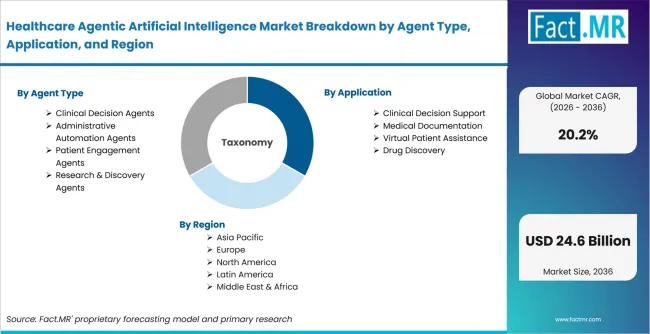
Healthcare Agentic Artificial Intelligence Market Breakdown By Agent Type, Application, And Region | Source: Fact.MR
| Attribute | Details |
|---|---|
| Quantitative Units | USD 3.9 billion in 2026 to USD 24.6 billion by 2036 at 20.2% CAGR |
| Market Definition | Autonomous and semi-autonomous AI agents used to support clinical decisions, documentation, coding, patient engagement, and workflow coordination |
| Agent Type | Clinical Decision Agents; Administrative Automation Agents; Patient Engagement Agents; Research & Discovery Agents |
| Application | Clinical Decision Support; Medical Documentation; Virtual Patient Assistance; Drug Discovery |
| End User | Hospitals; Clinics; Telehealth Providers; Pharmaceutical Companies |
| Deployment Model | Cloud-based Deployment; Hybrid Deployment; Software as a Service; Application Programming Interface Integration |
| Core Technology | Large Language Models; Multi-agent Systems; Natural Language Processing; Predictive Artificial Intelligence |
| Regions Covered | North America; Latin America; Europe; Asia Pacific; Middle East & Africa |
| Countries Covered | USA; China; UK; Germany; Japan; Canada; Singapore |
| Key Companies Profiled | Microsoft Corporation; Google LLC; Oracle Corporation; NVIDIA Corporation; Salesforce, Inc.; Amazon Web Services, Inc.; IBM Corporation; Cognizant Technology Solutions Corporation |
| Forecast Period | 2026-2036 |
| Approach | Market assessment considers publicly available healthcare-system, regulatory, company, industry, and technology material relevant to the defined segments, regions, and forecast period. |
Source: Fact.MR analysis. Updated Aug 10, 2026
How is the market segmented?
-
By Agent Type
- Clinical Decision Agents
- Diagnostic Assistance Agents
- Treatment Recommendation Agents
- Administrative Automation Agents
- Clinical Documentation Agents
- Revenue Cycle Agents
- Patient Engagement Agents
- Virtual Health Assistants
- Care Navigation Agents
- Research & Discovery Agents
- Clinical Trial Agents
- Medical Research Agents
- Clinical Decision Agents
-
By Application
- Clinical Decision Support
- Disease Diagnosis
- Treatment Planning
- Medical Documentation
- Revenue Cycle Management
- Prior Authorization Processing
- Virtual Patient Assistance
- Remote Patient Monitoring
- Medication Adherence
- Drug Discovery
- Patient Recruitment
- Real-world Evidence Generation
- Clinical Decision Support
-
By End User
- Hospitals
- Academic Medical Centers
- Specialty Hospitals
- Clinics
- Diagnostic Laboratories
- Ambulatory Surgical Centers
- Telehealth Providers
- Digital Health Companies
- Health Insurance Providers
- Pharmaceutical Companies
- Biotechnology Companies
- Contract Research Organizations
- Hospitals
-
By Deployment Model
- Cloud-based Deployment
- Public Cloud
- Private Cloud
- Hybrid Deployment
- On-premises Deployment
- Edge-enabled Infrastructure
- Software as a Service
- Managed Services
- Multi-tenant Platform
- Application Programming Interface Integration
- Low-code Integration
- Enterprise System Integration
- Cloud-based Deployment
-
By Core Technology
- Large Language Models
- Generative Artificial Intelligence
- Retrieval-augmented Generation
- Multi-agent Systems
- Autonomous Workflow Orchestration
- Reinforcement Learning
- Natural Language Processing
- Context-aware Reasoning
- Knowledge Graph Integration
- Predictive Artificial Intelligence
- Foundation Model Optimization
- Agentic Workflow Automation
- Large Language Models
-
By Region
- North America
- Latin America
- Western Europe
- Eastern Europe
- East Asia
- South Asia and Pacific
- Middle East & Africa
Frequently Asked Questions
How big is the healthcare agentic artificial intelligence market in 2026?
What is the CAGR of the healthcare agentic artificial intelligence market from 2026 to 2036?
Which agent type leads the healthcare agentic artificial intelligence market?
Which application leads the healthcare agentic artificial intelligence market?
Who are the leading companies in the healthcare agentic artificial intelligence market?
Who worked on this report


Preview the report firsthand - request a free sample
Free SampleGet the brochure for pricing and purchase details
Download PDF