- Market Value (2025): USD 2.1 Bn
- Estimated Value (2026): USD 2.3 Bn
- Forecast Value (2036): USD 6.7 Bn
- CAGR (2026-2036): 11.3%
What is the Healthcare Computerized Maintenance Management System Market forecast to be worth by 2036?
USD 2.3 billion in 2026 to USD 6.7 billion by 2036 at 11.3% CAGR.
- The Healthcare Computerized Maintenance Management System market reached USD 2.1 billion in 2025.
- Demand is projected to increase from USD 2.3 billion in 2026 to USD 6.7 billion by 2036.
- The market is forecast to record 11.3% CAGR from 2026 to 2036 owing to higher uptime needs and stronger maintenance documentation.
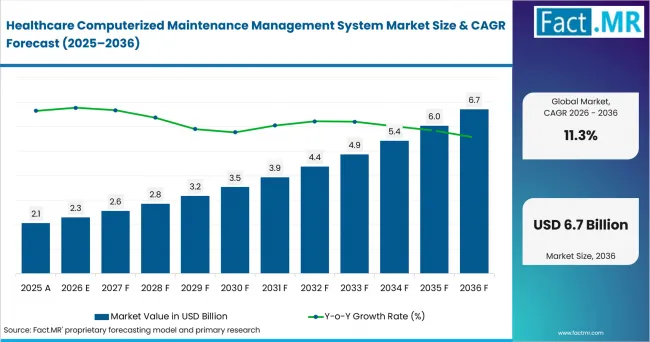
Healthcare Computerized Maintenance Management System Market Value Analysis | Source: Fact.MR
What are the defining numbers behind Healthcare Computerized Maintenance Management System Market growth?
USD 4.5 billion absolute opportunity by 2036.
- Demand Drivers in the Market
- Large hospital equipment fleets require auditable maintenance histories so service teams can track repairs and inspection readiness. CMS reported in June 2026 that U.S. hospital expenditures grew 8.9% to USD 1,634.7 billion in 2024, keeping maintenance documentation tied to a large operating base.
- Asset registers are expected to gain priority as hospital asset management moves from basic inventory control to lifecycle planning. FDA CDRH reported in its 2025 annual report that it regulated 264,670 medical devices, which makes accurate asset records more important as equipment portfolios change.
- Cloud-based platforms are anticipated to support multi-site systems that need shared access for biomedical engineers and facility teams.
- Predictive modules are projected to benefit from IoT-enabled equipment maintenance solutions when hospitals want earlier fault signals before downtime affects clinical schedules.
- Key Segments Analyzed
- By Software Module: Asset Management is expected to hold 43.0% share in 2026 because asset records form the core maintenance file.
- By Application: Medical Equipment Maintenance is projected to hold 41.0% share in 2026 due to its direct role in uptime and service logs.
- By End User: Hospitals are anticipated to capture 46.0% share in 2026 as they operate broad equipment and facility asset bases.
- By Deployment Model: Cloud-based Deployment is estimated to represent 59.0% share in 2026 because multi-location access reduces local IT burden.
- By Technology Platform: Artificial Intelligence-enabled Predictive Maintenance is forecast to hold 44.0% share in 2026 as service teams seek earlier fault detection.
- Analyst Opinion at Fact.MR
- Shambhu Nath Jha, Principal Consultant at Fact.MR, states, “Healthcare CMMS adoption is moving beyond work order tracking. Hospitals want systems that connect asset histories with preventive maintenance. Audit evidence must stay easy to review. Providers that simplify these workflows without weakening control are expected to gain stronger acceptance.”
- Strategic Implications
- Hospitals should build one asset register before expanding predictive maintenance so data quality supports later automation.
- CMMS providers should refine healthcare templates for work orders and biomedical equipment records. Inspection tasks and compliance evidence must remain easy to retrieve.
- Investors should separate general enterprise asset management exposure from platforms with clear hospital workflow depth.
The USA leads at 12.2% CAGR through health-system scale and mature healthcare IT procurement. Germany follows at 11.8% because hospital engineering discipline supports structured maintenance systems. The UK reaches 11.4% through public-provider asset visibility needs. Canada records 11.0% as hospital networks modernize maintenance records. Australia posts 10.5%. Japan reaches 10.1% through equipment reliability focus. Singapore closes the displayed group at 9.7% through private hospital depth and regional healthcare operations.
How does the Healthcare Computerized Maintenance Management System Market break down by segment?
Asset Management is expected to lead Software Module at 43.0% share in 2026. Medical Equipment Maintenance is projected to lead Application at 41.0% share in 2026.
Why does Asset Management lead Software Module?
With 43.0% share in 2026, Asset Management is anticipated to lead Software Module because a CMMS normally begins with a dependable asset file.
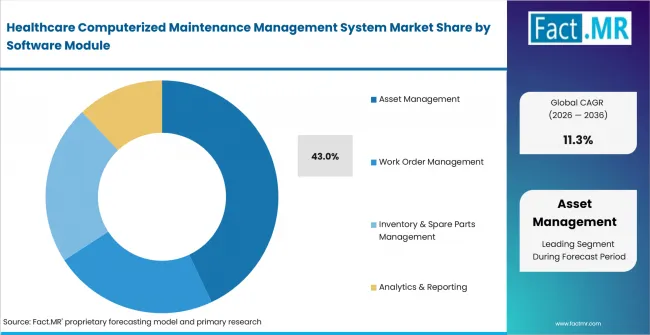
Healthcare Computerized Maintenance Management System Market Analysis By Software Module | Source: Fact.MR
Hospitals need one record for each device and facility asset. The module helps teams track serial numbers and service history. Warranty details and spare-parts records support asset performance management when maintenance leaders compare asset condition against service cost.
Why does Medical Equipment Maintenance lead Application?
By Application, Medical Equipment Maintenance is projected to lead with 41.0% share in 2026 because clinical assets carry direct downtime risk.
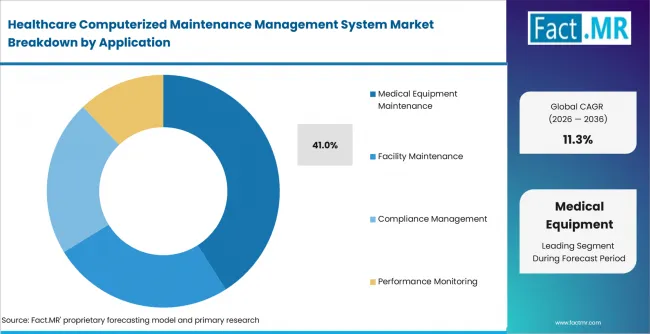
Healthcare Computerized Maintenance Management System Market Analysis By Application | Source: Fact.MR
Equipment downtime can disrupt imaging and monitoring. It can affect surgery support and therapy schedules as well. CMMS records help biomedical teams assign tasks and confirm service completion. Demand is expected to remain close to adjacent needs such as medical equipment cooling where reliability depends on proper servicing.
Why does Hospitals lead End User?
Hospital operating scale is expected to place Hospitals at 46.0% share in 2026.
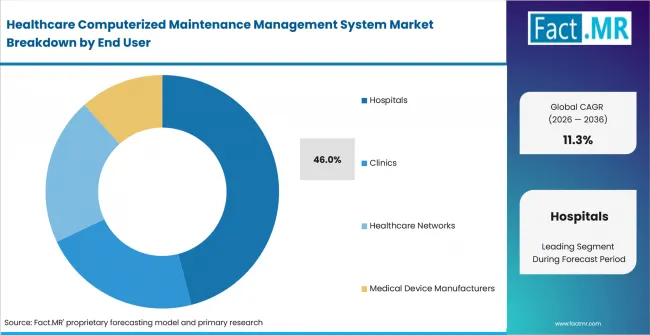
Healthcare Computerized Maintenance Management System Market Analysis By End User | Source: Fact.MR
Hospitals manage a wide mix of clinical devices and facility systems. Service contracts and compliance records add another layer of maintenance work. Many facilities need one maintenance view across departments. The same operating pressure supports wider digital transformation in healthcare as paper-based work orders become harder to audit.
Why does Cloud-based Deployment lead Deployment Model?
A 59.0% share is estimated for Cloud-based Deployment in 2026 because distributed teams need shared work access.
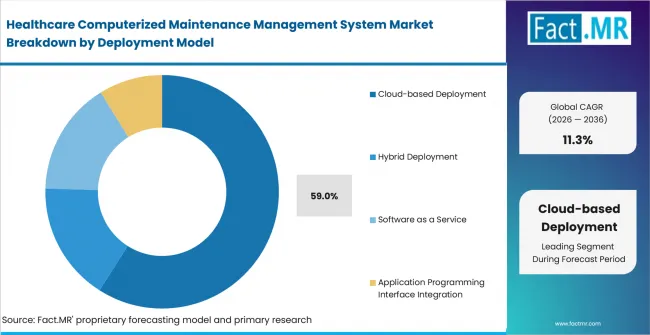
Healthcare Computerized Maintenance Management System Market Analysis By Deployment Model | Source: Fact.MR
Hospital systems often manage assets across several campuses. Cloud platforms reduce dependence on separate local servers and manual updates. The approach aligns with managed infrastructure services when providers want central access control and simpler system maintenance.
Why does Artificial Intelligence-enabled Predictive Maintenance lead Technology Platform?
Condition-based service planning is forecast to place Artificial Intelligence-enabled Predictive Maintenance at 44.0% share in 2026.
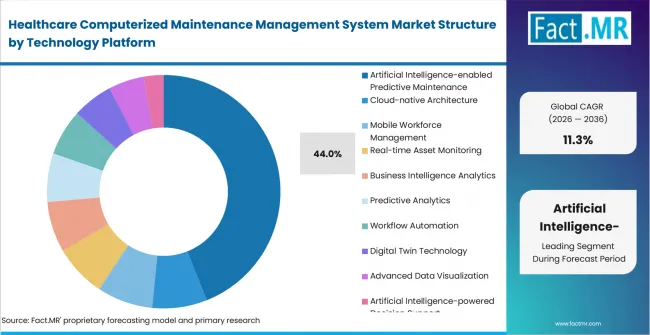
Healthcare Computerized Maintenance Management System Market Analysis By Technology Platform | Source: Fact.MR
Service teams want earlier signals from asset condition and work order history. Failure patterns can guide repair planning before downtime risk becomes visible in clinical schedules. The same data can improve equipment-level analytics used in healthcare business intelligence.
What is accelerating Healthcare Computerized Maintenance Management System Market adoption, and what is holding it back?
Demand is expected to rise as hospitals replace fragmented maintenance logs with auditable systems. Growth may be limited by data migration work and uneven technician readiness.
Drivers Impact Analysis
| DRIVER | (~) % IMPACT ON CAGR | GEOGRAPHIC RELEVANCE | IMPACT TIMELINE |
|---|---|---|---|
| Asset record consolidation | +2.8% | Global | Long term (>= 4 years) |
| Preventive maintenance compliance | +2.3% | North America, Europe | Medium term (2-4 years) |
| Multi-site hospital deployment | +2.6% | Asia Pacific, MEA | Long term (>= 4 years) |
| Technician workflow efficiency | +1.7% | Global | Medium term (2-4 years) |
| Predictive maintenance readiness | +2.1% | Advanced hospital systems | Long term (>= 4 years) |
Source: Fact.MR analysis. Updated Aug 10, 2026
- Asset record consolidation is expected to increase CMMS value because clinical and facility assets need complete service histories.
- Preventive maintenance compliance is anticipated to influence purchasing when facilities need reliable evidence for inspection and internal audits.
- Multi-site deployment is projected to favor platforms that keep technician work queues visible across hospital networks.
Opportunity Impact Analysis
| OPPORTUNITY | (~) % IMPACT ON CAGR | GEOGRAPHIC RELEVANCE | IMPACT TIMELINE |
|---|---|---|---|
| Healthcare-specific workflow templates | +1.4% | North America and Europe | Medium term (2-4 years) |
| Mobile technician execution | +0.9% | Global | Long term (>= 4 years) |
| Predictive service scheduling | +1.2% | Large hospital groups | Long term (>= 4 years) |
| Compliance documentation automation | +0.8% | Accreditation-heavy markets | Long term (>= 4 years) |
Source: Fact.MR analysis. Updated Aug 10, 2026
- Healthcare-specific workflow templates are expected to shorten implementation by matching hospital work orders and inspection needs.
- Mobile execution is anticipated to help technicians close tasks at the asset location and reduce later data entry.
- Compliance documentation automation is expected to connect maintenance work with audit files. This makes CMMS adoption relevant to accountable care solutions that depend on documented operating quality.
Restraints Impact Analysis
| RESTRAINT | (~) % IMPACT ON CAGR | GEOGRAPHIC RELEVANCE | IMPACT TIMELINE |
|---|---|---|---|
| Data migration and asset hierarchy cleanup | -1.2% | Global | Short term (<= 2 years) |
| Legacy maintenance processes | -0.9% | Developing markets | Medium term (2-4 years) |
| Technician training gaps | -0.6% | Africa, Latin America | Long term (>= 4 years) |
| Integration with clinical and finance systems | -0.8% | Large health systems | Long term (>= 4 years) |
Source: Fact.MR analysis. Updated Aug 10, 2026
- Data migration can delay implementation when asset names and service codes differ across facilities.
- Legacy processes are expected to slow change where teams still depend on spreadsheets or paper work orders.
- Integration work may raise project effort when CMMS data must connect with procurement and finance systems. Clinical operations may need maintenance visibility through electronic health records only where asset status affects care operations.
Which countries are scaling the Healthcare Computerized Maintenance Management System Market fastest?
- The displayed country range spans 2.5 percentage points and separates the USA and Germany from the mid-range group led by the UK and Canada.
- The USA remains 0.4 percentage point above Germany through health-system scale and mature healthcare IT procurement.
- Germany remains 0.4 percentage point above the UK because hospital engineering discipline supports structured maintenance systems.
- The UK remains 0.4 percentage point above Canada through public-provider asset visibility needs and maintenance planning pressure.
- Canada remains 0.5 percentage point above Australia as hospital network modernization supports CMMS upgrades.
- Australia remains 0.4 percentage point above Japan through private and public hospital maintenance requirements.
- Japan remains 0.4 percentage point above Singapore through equipment reliability focus and careful documentation.
- Singapore closes the displayed range through private hospital depth and regional healthcare operations.
Comparable CAGRs can create different entry conditions. Hospital scale and technician workflow maturity change the adoption path. Coverage includes North America; Latin America; Europe; East Asia; South Asia and Pacific; Middle East and Africa.
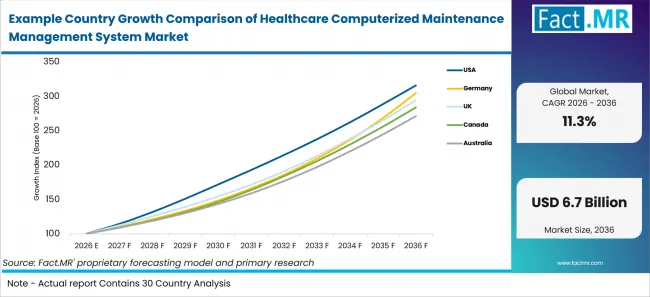
Example Country Growth Comparison Of Healthcare Computerized Maintenance Management System Market | Source: Fact.MR
| Country | CAGR (2026-2036) |
|---|---|
| USA | 12.2% |
| Germany | 11.8% |
| UK | 11.4% |
| Canada | 11.0% |
| Australia | 10.5% |
| Japan | 10.1% |
| Singapore | 9.7% |
Source: Fact.MR analysis. Updated Aug 10, 2026
What supports USA adoption?
12.2% CAGR, supported by hospital scale and mature healthcare IT procurement.
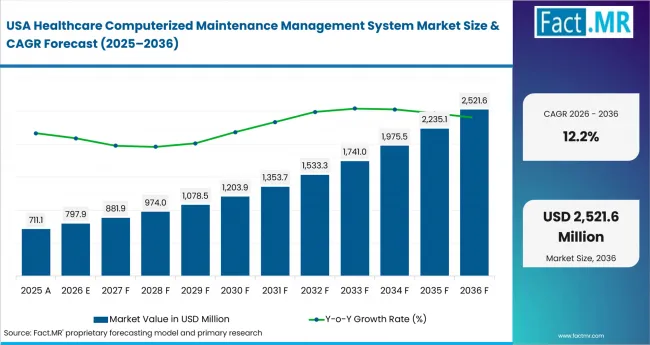
Healthcare Computerized Maintenance Management System Market Country Value Analysis | Source: Fact.MR
Large health systems in the USA evaluate CMMS tools through uptime proof and audit readiness. Purchasing is expected to favor systems that support reporting and mobile execution.
What supports Germany adoption?
11.8% CAGR, supported by hospital engineering discipline and structured maintenance needs.
Germany’s hospital engineering culture favors documented service quality and careful maintenance planning. Hospitals are expected to use CMMS tools for equipment records and preventive tasks.
How is the UK scaling demand?
11.4% CAGR, supported by public-provider asset visibility and maintenance planning pressure.
Public-provider maintenance pressure is expected to make asset visibility more important in the UK. CMMS adoption should replace disconnected spreadsheets with centralized records. According to the 2024/25 Estates Returns Information Collection (ERIC) published by NHS England, the maintenance backlog has reached £15.9 billion, a figure that underscores the critical need for centralized asset visibility to manage these escalating liabilities
How is Canada developing demand?
11.0% CAGR, supported by hospital network modernization and service documentation needs.
Canada’s hospital networks are expected to modernize maintenance records as equipment fleets become harder to manage manually. Adoption is likely to favor platforms that simplify preventive schedules.
What supports Australia adoption?
10.5% CAGR, supported by public and private hospital maintenance requirements.
Regional care coverage gives Australia a practical reason to favor shared maintenance systems. Cloud deployment should remain useful where hospital groups manage assets across several locations. AIHW reported that 674 public hospitals provided admitted patient care services in 2024-25, making shared maintenance records practical for public systems with many sites.
How does Japan perform?
10.1% CAGR, supported by equipment reliability focus and careful service documentation.
Japan’s buyer environment places high value on maintenance precision and asset reliability. Demand should remain strongest where facilities need consistent records for high-value equipment fleets.
What supports Singapore adoption?
9.7% CAGR, supported by private hospital depth and regional healthcare operations.
Singapore’s compact private hospital base supports selective demand for organized asset records and fast technician coordination. Buyers are expected to prefer systems that shorten task routing.
Who leads the Healthcare Computerized Maintenance Management System Market?
IBM Corporation; Accruent, LLC; and Brightly Software, Inc. have the clearest relationship to healthcare CMMS and asset maintenance workflows. IBM announced Maximo Application Suite 9.1 as generally available on June 24, 2025, adding asset investment planning, maintenance cost insights, and broader facilities coverage.
eMaint (Fluke Reliability) and Fiix by Rockwell Automation add cloud maintenance-management depth. IFS AB; UpKeep Technologies, Inc.; and Limble CMMS extend the provider base. Competition centers on asset hierarchy setup and preventive scheduling. Mobile execution and compliance documentation are expected to influence buyer shortlisting.
Which companies are the key providers?
Companies include IBM Corporation; Accruent, LLC; Brightly Software, Inc.; eMaint (Fluke Reliability); Fiix by Rockwell Automation; IFS AB; UpKeep Technologies, Inc.; and Limble CMMS.
- IBM Corporation
- Accruent, LLC
- Brightly Software, Inc.
- eMaint (Fluke Reliability)
- Fiix by Rockwell Automation
- IFS AB
- UpKeep Technologies, Inc.
- Limble CMMS
Bibliography
- Accruent. (2026, January 8). Accruent TMS 25.12.3 release notes.
- Brightly Software. (2025, April 21). POV: TheWorxHub makes hospital compliance easier than ever.
- Centers for Medicare & Medicaid Services. (2026, June 24). NHE fact sheet.
- Fiix Documentation Team. (2026, February 17). About your Fiix CMMS.
- Australian Institute of Health and Welfare. (2026, May 29). Admitted patient care.
- Canadian Institute for Health Information. (2025, November 26). Health expenditure data in brief.
- NHS England Digital. (2025, October 16). Estates Returns Information Collection, summary page and dataset for ERIC 2024/25.
- Center for Devices and Radiological Health. (2026). CDRH annual report 2025. U.S. Food and Drug Administration.
- Woodbury, K. (2025, June 24). Maximo Application Suite 9.1 - generally available today June 24th! IBM Community.
This Report Answers
- The report provides strategic intelligence on the Healthcare Computerized Maintenance Management System Market.
- Segment analysis covers Asset Management and Medical Equipment Maintenance as the share leaders within the 2026 market.
- Country outlook evaluates the USA and Germany alongside the UK and Canada. Australia and Japan complete the comparison alongside Singapore.
- Competitive analysis profiles IBM Corporation and Accruent, LLC. Brightly Software, Inc. appears alongside them. The remaining providers complete the CMMS vendor set.
- Technology assessment covers Artificial Intelligence-enabled Predictive Maintenance and IoT-integrated CMMS.
What does the Healthcare Computerized Maintenance Management System Market cover?
Healthcare CMMS software is used to manage maintenance work for medical equipment and facility assets. Profiled systems support work orders and preventive schedules. Spare-parts records and audit documentation are covered when they support maintenance control.
The market covers software demand across hospitals and other healthcare facilities. Coverage includes asset records and maintenance execution. Compliance reporting is included when the software helps teams prove that service work was completed.
What is included in the scope?
Healthcare CMMS platforms are used across hospitals and ambulatory surgical centers. Specialty clinics and diagnostic centers are included. Long-term care facilities are covered as well.
The scope includes Software Module and Application. End User and Deployment Model complete most of the segmentation view. Technology Platform is included separately. Coverage spans asset management and work order management. Preventive scheduling and compliance reporting are included where maintenance teams use the system to manage service evidence. Cloud-based and on-premise deployment are both covered.
What is excluded from the scope?
Hardware-only maintenance equipment and unrelated hospital administration software remain outside the scope of this market.
The scope excludes standalone clinical systems and medical device manufacturing software. General enterprise software is excluded unless it supports healthcare maintenance workflows. Company market shares are not included.
How Was the Analysis Built?
The analysis draws on 120+ sources, 35+ company portfolios, 25+ countries, and more than 20 interviews.
- Primary Research: Interviews with manufacturers, retailers, salon operators, and experts examine purchase priorities, adoption, approval requirements, and competitive positioning.
- Desk Research: Desk research covers government statistics, regulatory publications, company filings, trade data, technical studies, industry associations, standards, and public policy.
- Market Sizing and Forecasting: Estimates combine historical performance, demand indicators, pricing, segment shares, company participation, country growth, adoption patterns, and barriers to expansion.
- Data Validation and Update Cycle: Findings are validated against public data, company activity, regulatory changes, product launches, recalls, and adoption shifts.
Segmentation
What is the report’s scope and coverage?
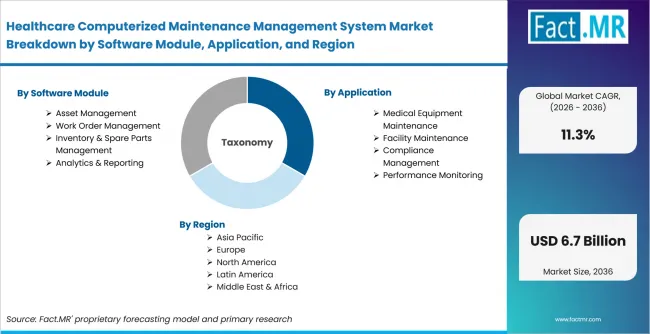
Healthcare Computerized Maintenance Management System Market Breakdown By Software Module, Application, And Region | Source: Fact.MR
| Attribute | Details |
|---|---|
| Quantitative Units | USD billion in 2026 to USD billion by 2036 at CAGR |
| Market Definition | Healthcare CMMS software used to plan, record, assign, and audit maintenance for medical equipment, facility assets, spare parts, and technician workflows |
| Software Module | Asset Management; Work Order Management; Preventive Maintenance Scheduling; Inventory and Spare Parts Management; Compliance and Reporting |
| Application | Medical Equipment Maintenance; Facility Maintenance; Preventive Maintenance; Compliance Management; Asset Lifecycle Management |
| End User | Hospitals; Ambulatory Surgical Centers; Specialty Clinics; Diagnostic Centers; Long-term Care Facilities |
| Deployment Model | Cloud-based Deployment; On-premise Deployment; Hybrid Deployment |
| Technology Platform | Artificial Intelligence-enabled Predictive Maintenance; IoT-integrated CMMS; Mobile CMMS; Analytics-enabled CMMS; Standard CMMS |
| Regions Covered | North America; Latin America; Europe; East Asia; South Asia and Pacific; Middle East and Africa |
| Countries Covered | USA; Germany; UK; Canada; Australia; Japan; Singapore |
| Key Companies Profiled | IBM Corporation; Accruent, LLC; Brightly Software, Inc.; eMaint (Fluke Reliability); Fiix by Rockwell Automation; IFS AB; UpKeep Technologies, Inc.; Limble CMMS |
| Forecast Period | 2026 to 2036 |
| Approach | Hybrid top-down and bottom-up approach using healthcare CMMS demand signals; hospital maintenance workflows; asset register needs; deployment preferences; segment shares; country adoption patterns; source review and company portfolio review |
Source: Fact.MR analysis. Updated Aug 10, 2026
How is the market segmented?
-
By Software Module
- Asset Management
- Equipment Asset Tracking
- Asset Lifecycle Management
- Work Order Management
- Preventive Maintenance Workflows
- Corrective Maintenance Management
- Inventory & Spare Parts Management
- Spare Parts Inventory
- Procurement Management
- Analytics & Reporting
- Dashboard & Reporting
- Predictive Maintenance Analytics
- Asset Management
-
By Application
- Medical Equipment Maintenance
- Preventive Maintenance Scheduling
- Biomedical Equipment Management
- Facility Maintenance
- Hospital Infrastructure Maintenance
- Critical Equipment Repairs
- Compliance Management
- Regulatory Compliance Tracking
- Audit Documentation
- Performance Monitoring
- Key Performance Indicator Tracking
- Equipment Utilization Analysis
- Medical Equipment Maintenance
-
By End User
- Hospitals
- Multi-specialty Hospitals
- Academic Medical Centers
- Clinics
- Diagnostic Centers
- Ambulatory Surgical Centers
- Healthcare Networks
- Long-term Care Facilities
- Public Healthcare Organizations
- Medical Device Manufacturers
- Biomedical Engineering Service Providers
- Healthcare Facility Management Companies
- Hospitals
-
By Deployment Model
- Cloud-based Deployment
- Public Cloud
- Private Cloud
- Hybrid Deployment
- On-premises Deployment
- Edge-enabled Infrastructure
- Software as a Service
- Managed Services
- Multi-tenant Platform
- Application Programming Interface Integration
- Low-code Integration
- Enterprise System Integration
- Cloud-based Deployment
-
By Technology Platform
- Artificial Intelligence-enabled Predictive Maintenance
- Internet of Things Integration
- Machine Learning Analytics
- Cloud-native Architecture
- Mobile Workforce Management
- Real-time Asset Monitoring
- Business Intelligence Analytics
- Predictive Analytics
- Workflow Automation
- Digital Twin Technology
- Advanced Data Visualization
- Artificial Intelligence-powered Decision Support
- Artificial Intelligence-enabled Predictive Maintenance
-
By Region
- North America
- Latin America
- Western Europe
- Eastern Europe
- East Asia
- South Asia and Pacific
- Middle East & Africa
Frequently Asked Questions
How big is the healthcare computerized maintenance management system market in 2026?
What is the CAGR of the healthcare computerized maintenance management system market from 2026 to 2036?
Which software module leads the healthcare computerized maintenance management system market?
Which application leads the healthcare computerized maintenance management system market?
Who are the leading companies in the healthcare computerized maintenance management system market?
Who worked on this report


Preview the report firsthand - request a free sample
Free SampleGet the brochure for pricing and purchase details
Download PDF