
- Market Value (2025): USD 600.0 Mn
- Estimated Value (2026): USD 639.0 Mn
- Forecast Value (2036): USD 1233.7 Mn
- CAGR (2026-2036): 6.8%
Agricultural Grade Zinc Sulfate Monohydrate Market Forecast and Outlook 2026 to 2036
The global agricultural grade zinc sulfate monohydrate market was USD 600.0 million in 2025 and reached USD 639.0 million in 2026. The market is projected to reach USD 1,233.7 million by 2036, expanding at a CAGR of 6.8% during the 2026 to 2036 assessment period.
Soil testing is bringing zinc correction into sharper focus as farmers address micronutrient shortages before they affect crop performance. India's Ministry of Agriculture reported in March 2026 that zinc deficiency is particularly prevalent in Bihar, Uttar Pradesh and Odisha. ICAR's 2025 Kharif advisory recommends 25 kg/ha of zinc sulphate containing 21% zinc or a 0.5% foliar spray on deficient soils. Such crop-specific recommendations reinforce the role of zinc sulfate monohydrate in soil treatment and foliar nutrition (Indian Council of Agricultural Research [ICAR], 2025; Ministry of Agriculture & Farmers Welfare, 2026).
Key Takeaways from the Agricultural Grade Zinc Sulfate Monohydrate Market
- Sales of agricultural grade zinc sulfate monohydrate stood at USD 600.0 million in 2025.
- Agricultural Grade Zinc Sulfate Monohydrate Market Value (2026): USD 639.0 million.
- Agricultural Grade Zinc Sulfate Monohydrate Market Forecast Value (2036): USD 1,233.7 million.
- Agricultural Grade Zinc Sulfate Monohydrate Market Forecast CAGR (2026 to 2036): 6.8%.
- Leading Form: Granular (41.0%).
- Key Market Participants: Yara International, The Mosaic Company, ICL Group, Coromandel International and Zinc Nacional.
- Key Growth Countries: India, Brazil, Pakistan, South Korea and Japan.
India's fertilizer policy is creating a stronger route for zinc-enriched products. The additional subsidy of ₹500 per metric tonne for eligible zinc-fortified or coated phosphatic and potassic fertilizers encourages manufacturers to incorporate micronutrients into compound blends. This approach makes zinc application more convenient for farmers who already purchase blended fertilizers. Greater attention to soil health and grain nutrition further strengthens the market for granular zinc sulfate monohydrate.
Agricultural Grade Zinc Sulfate Monohydrate Market
| Metric | Value |
|---|---|
| Market Value (2025) | USD 598.3 million |
| Market Value (2026) | USD 639.0 million |
| Forecast Value (2036) | USD 1,233.7 million |
| CAGR (2026 to 2036) | 6.8% |
Source: Fact.MR analysis. Updated Nov 26, 2026
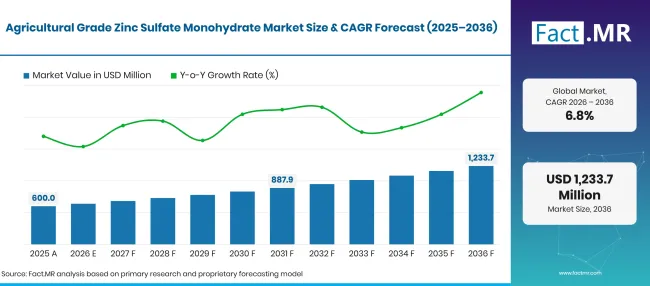
Agricultural Grade Zinc Sulfate Monohydrate Market Forecast Global | Source: Fact.MR
Category
| Category | Segments |
|---|---|
| Form | Granular, Powder, Fine crystalline, Prilled and coated |
| Application Method | Blended fertiliser manufacturing, Direct soil application, Foliar spray, Fertigation, Seed treatment |
| Crop | Cereals and grains, Fruits and vegetables, Oilseeds and pulses, Plantation crops, Turf and other crops |
| Sales Channel | Fertiliser manufacturers, Distributors and retailers, Government and cooperative programmes, Online and direct farm sales |
| Region | North America, Latin America, Europe, Asia Pacific, Middle East & Africa |
Source: Fact.MR analysis. Updated Nov 26, 2026
Segmental Analysis
What makes granular the leading form segment in the Agricultural Grade Zinc Sulfate Monohydrate Market?
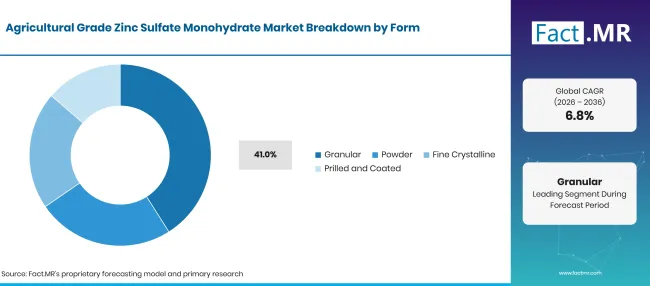
Agricultural Grade Zinc Sulfate Monohydrate Market Breakdown Form | Source: Fact.MR
Granular zinc sulfate monohydrate captures 41.0% of market revenue in 2026, equivalent to USD 262.0 million. Its free-flowing structure makes it convenient for bulk fertilizer blending, storage and mechanical field application. Powdered and fine crystalline grades also find use in foliar sprays and fertigation. ICAR's December 2025 publication on zinc application in Uttarakhand rice cultivation highlights the importance of zinc-based nutrient management, reinforcing the role of these fertilizers in crop production (ICAR, 2025).
Which factors support blended fertiliser manufacturing as the largest application method segment in the Agricultural Grade Zinc Sulfate Monohydrate Market?
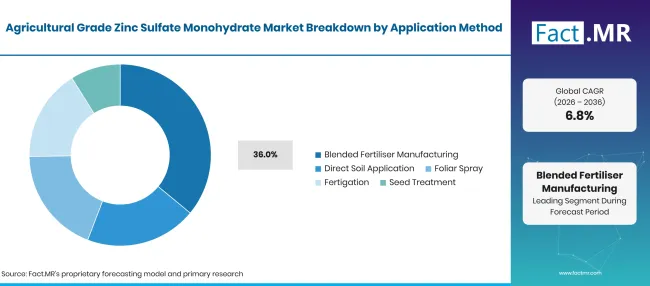
Agricultural Grade Zinc Sulfate Monohydrate Market Breakdown Application Method | Source: Fact.MR
Blended fertiliser manufacturing contributes 36.0% of market revenue in 2026, equivalent to USD 230.0 million. Fertilizer producers incorporate zinc into NPK formulations before distribution, allowing farmers to apply micronutrients alongside primary nutrients. Direct soil application remains important in fields with identified zinc shortages, while foliar treatment attracts growers seeking faster nutrient correction. India's fertilizer subsidy framework also encourages the inclusion of zinc in eligible fortified fertilizer grades.
What makes cereals and grains the leading crop segment in the Agricultural Grade Zinc Sulfate Monohydrate Market?
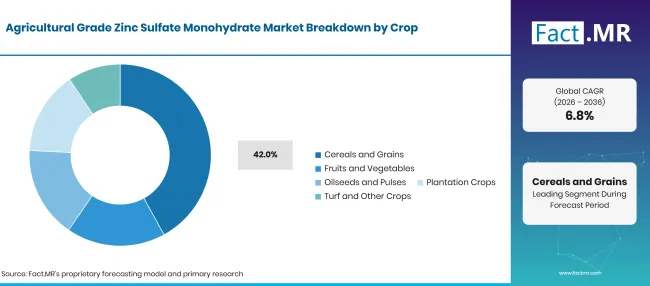
Agricultural Grade Zinc Sulfate Monohydrate Market Breakdown Crop | Source: Fact.MR
Rice, wheat and maize cultivation places cereals and grains at the forefront, with this segment capturing 42.0% of market revenue in 2026, equivalent to USD 268.4 million. Zinc shortages in cereal-growing soils make micronutrient correction important for crop productivity and grain nutrition. Pulses and oilseeds also offer growth opportunities as growers improve nutrient management across crop rotations. An ICAR-published study in December 2025 found that rice yields in Uttarakhand increased by 45% under balanced NPK plus zinc treatment compared with NPK alone (ICAR, 2025).
Which factors support fertiliser manufacturers as the largest sales channel segment in the Agricultural Grade Zinc Sulfate Monohydrate Market?
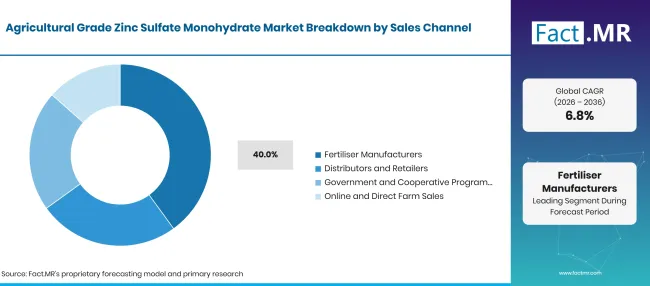
Agricultural Grade Zinc Sulfate Monohydrate Market Breakdown Sales Channel | Source: Fact.MR
Fertiliser manufacturers generate 40.0% of market revenue in 2026, equivalent to USD 255.6 million. Their bulk purchasing requirements stem from the incorporation of zinc sulfate into branded micronutrient mixtures and fortified NPK products. Agricultural distributors and cooperative networks also play an important role by reaching farmers in smaller agricultural markets. The Government of India reported that 38,190 Primary Agricultural Credit Societies were functioning as Pradhan Mantri Kisan Samriddhi Kendras as of November 27, 2025, strengthening the rural fertilizer distribution network (Ministry of Cooperation, 2025).
Agricultural Grade Zinc Sulfate Monohydrate Market: Drivers, Restraints & Trends
Drivers: Growing Need to Correct Zinc Deficiency in Farmland
Farmers are paying closer attention to zinc shortages as poor soil nutrition affects crop growth and grain quality. The issue is particularly visible across cereal-growing regions, where repeated cultivation can deplete essential micronutrients. In March 2026, India's Ministry of Agriculture highlighted zinc deficiency in Bihar, Uttar Pradesh and Odisha. This is strengthening the case for zinc sulfate monohydrate as a practical input for correcting soil nutrient imbalances (Ministry of Agriculture & Farmers Welfare, 2026).
Restraints: Farmer Price Concerns and Competition from Alternatives
Many farmers hesitate to spend more on micronutrients when improvements in crop yields are not immediately visible. Limited soil-testing awareness further slows adoption in smaller farming communities. Chelated zinc and other zinc-based formulations also compete with conventional zinc sulfate, particularly in specialty crop cultivation where growers have different nutrient management preferences.
Trend: Zinc-Enriched Fertilizer Blends
Fertilizer manufacturers are incorporating zinc into compound fertilizers so farmers can apply micronutrients alongside their regular NPK inputs. India's additional subsidy of ₹500 per metric tonne for eligible zinc-fortified and coated fertilizers encourages this approach. Wider adoption of enriched blends creates opportunities for zinc sulfate monohydrate manufacturers to serve large-scale fertilizer production.
Trend: Greater Attention to Zinc-Rich Staple Crops
Improving the nutritional quality of rice, wheat and other staple grains is bringing micronutrient management into agricultural planning. Farmers are using soil application and foliar treatment to address zinc shortages at different crop stages. India's Soil Health Card programme tested 92.87 lakh soil samples during FY 2025–26, strengthening the basis for field-specific fertilizer recommendations and creating opportunities for zinc-based soil nutrition (Press Information Bureau, 2026).
Agricultural Grade Zinc Sulfate Monohydrate Market Analysis by Key Country
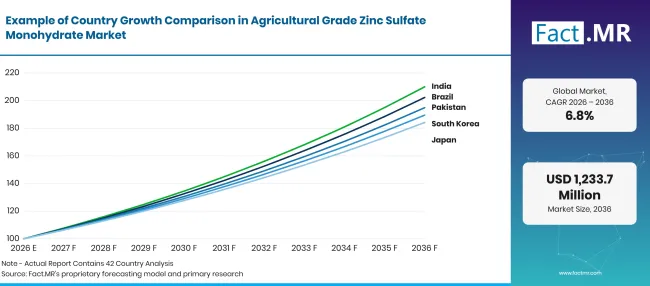
Agricultural Grade Zinc Sulfate Monohydrate Market Growth Index | Source: Fact.MR
| Country | CAGR (2026–2036) |
|---|---|
| India | 7.7% |
| Brazil | 7.3% |
| Pakistan | 6.9% |
| South Korea | 6.6% |
| Japan | 6.3% |
Source: Fact.MR analysis. Updated Nov 26, 2026
Why is India the fastest-growing market for agricultural grade zinc sulfate monohydrate?
Zinc-deficient farmland is creating a strong case for micronutrient fertilizers, particularly across cereal-producing states. In March 2026, India's Ministry of Agriculture identified Bihar, Uttar Pradesh and Odisha among the major zinc-deficient regions.
The Soil Health Card programme also tested 92.87 lakh soil samples during FY 2025–26. These findings are encouraging farmers to consider zinc correction as part of routine soil management. Wider fertilizer distribution and government-backed nutrient awareness programmes are further opening sales opportunities for agricultural-grade zinc sulfate monohydrate (Ministry of Agriculture & Farmers Welfare, 2026; Press Information Bureau, 2026).
What is shaping agricultural grade zinc sulfate monohydrate demand in Brazil?
Brazil's extensive soybean, maize and other grain cultivation creates a sizeable market for agricultural micronutrients.
Fertilizer deliveries reached 49.12 million tonnes in 2025, representing a 7.7% increase over 2024, according to the National Association for Fertilizer Diffusion (ANDA). Mato Grosso alone received 11.405 million tonnes during the year. Large commercial farms and continued fertilizer consumption create opportunities for zinc sulfate monohydrate through micronutrient-enriched blends and direct soil applications (ANDA, 2026).
How is demand for agricultural grade zinc sulfate monohydrate developing in Pakistan?
Wheat, rice, cotton and maize cultivation creates a sizeable requirement for balanced crop nutrition.
Pakistan's Economic Survey 2024–25 reported fertilizer nutrient offtake of 3.4 million tonnes during July to March FY 2025, reflecting the importance of fertilizer inputs across major crops. Domestic fertilizer production and established agricultural distribution networks create opportunities for micronutrient additions. Greater attention to soil fertility and crop-specific nutrient management could encourage wider use of zinc sulfate monohydrate (Finance Division, Government of Pakistan, 2025).
What is driving agricultural grade zinc sulfate monohydrate demand in South Korea?
Rice cultivation and the need to maintain productivity across limited agricultural land create opportunities for targeted soil nutrition.
South Korea's Ministry of Agriculture reported final rice production of 3.539 million tonnes in November 2025, with average yield reaching 522 kg per 10 ares. Maintaining productivity across established rice-growing areas keeps balanced fertilizer application relevant. Greater attention to soil nutrient management and crop quality creates additional opportunities for zinc sulfate monohydrate in agricultural fertilizer formulations (Ministry of Agriculture, Food and Rural Affairs, 2025).
Why is growth slower for agricultural grade zinc sulfate monohydrate in Japan?
Precision nutrient management is shaping Japan's agricultural input market, with soil testing and efficient fertilizer application gaining importance.
The Ministry of Agriculture, Forestry and Fisheries emphasizes soil diagnosis and fertilizer planning based on field conditions in its agricultural management guidelines. These practices encourage targeted nutrient correction rather than indiscriminate fertilizer use. Although this creates opportunities for zinc sulfate monohydrate in rice-growing and other crop systems, careful input management contributes to a more measured growth outlook (Ministry of Agriculture, Forestry and Fisheries, 2026).
Competitive Landscape for Agricultural Grade Zinc Sulfate Monohydrate Market
Competition in the agricultural grade zinc sulfate monohydrate market centres on zinc concentration, product consistency, granule quality, pricing and access to fertilizer manufacturers. Established fertilizer groups compete through their crop nutrition portfolios and distribution networks, while specialist zinc producers focus on manufacturing grades suitable for agricultural blending and field application. Coromandel International and ICL Group have an established presence in specialty plant nutrition, while Zinc Nacional operates in zinc-based materials. Product availability, reliable bulk shipments and suitability for different fertilizer formulations remain important competitive considerations.
Recent Developments
- On May 12, 2025, a long-term partnership was announced with PepsiCo to supply crop nutrition products and precision farming services to potato growers in Mexico, Colombia, Chile and Argentina.
- On May 6, 2025, a new biostimulant product, Neptunion, was launched in China to help crops withstand drought, salinity and heat stress.
- On March 18, 2026, a new specialty fertilizer manufacturing facility was inaugurated in Maharashtra, India, to expand local production of water-soluble fertilizers and strengthen regional supply.
- On June 8, 2026, a memorandum of understanding was signed with Samunnati to improve agricultural input distribution and strengthen access to crop nutrition products for Farmer Producer Organisations across India.
- On October 7, 2026, a new MaxEdge refiner was commissioned at a paperboard mill in Mexico under a long-standing technology partnership, expanding the collaboration in recycled-fibre processing.
Key Players in Agricultural Grade Zinc Sulfate Monohydrate Market
Key companies operating in the market include Yara International, The Mosaic Company, ICL Group, Coromandel International, and Zinc Nacional.
- Yara International
- The Mosaic Company
- ICL Group
- Coromandel International
- Zinc Nacional
Agricultural Grade Zinc Sulfate Monohydrate Market by Segments
-
Form
- Granular
- Powder
- Fine crystalline
- Prilled and coated
-
Application Method
- Blended fertiliser manufacturing
- Direct soil application
- Foliar spray
- Fertigation
- Seed treatment
-
Crop
- Cereals and grains
- Fruits and vegetables
- Oilseeds and pulses
- Plantation crops
- Turf and other crops
-
Sales Channel
- Fertiliser manufacturers
- Distributors and retailers
- Government and cooperative programmes
- Online and direct farm sales
-
Region
- North America
- United States
- Canada
- Mexico
- Europe
- Germany
- United Kingdom
- France
- Italy
- Spain
- Rest of Europe
- Asia Pacific
- China
- India
- Japan
- South Korea
- Australia and New Zealand
- Pakistan
- Rest of Asia Pacific
- Latin America
- Brazil
- Argentina
- Rest of Latin America
- Middle East & Africa
- GCC Countries
- South Africa
- Rest of Middle East & Africa
- North America
Bibliography
- Associação Nacional para Difusão de Adubos. (2026). Principais indicadores do setor de fertilizantes: 2025.
- Finance Division, Government of Pakistan. (2025). Pakistan economic survey 2024–25: Agriculture.
- Indian Council of Agricultural Research. (2025). ICAR Kharif agro-advisories for farmers 2025.
- Indian Council of Agricultural Research. (2025). Zinc application boosts rice productivity in Tarai region of Uttarakhand. Indian Farming, 75(12), 37–40.
- Ministry of Agriculture & Farmers Welfare. (2026, March 13). Status of soil health indicators. Press Information Bureau, Government of India.
- Ministry of Agriculture, Food and Rural Affairs. (2025, November 13). 2025 rice final production decreased by 35,000 tonnes from the previous estimate. Government of the Republic of Korea.
- Ministry of Agriculture, Forestry and Fisheries. (2026). International GAP guidelines: Instruction manual. Government of Japan.
- Ministry of Cooperation. (2025). PACS as Pradhan Mantri Kisan Samriddhi Kendras. Government of India.
- Press Information Bureau. (2026, May 9). National Mission for Sustainable Agriculture: Building climate-resilient farming in India. Government of India.
Segmentation
Scope of Report
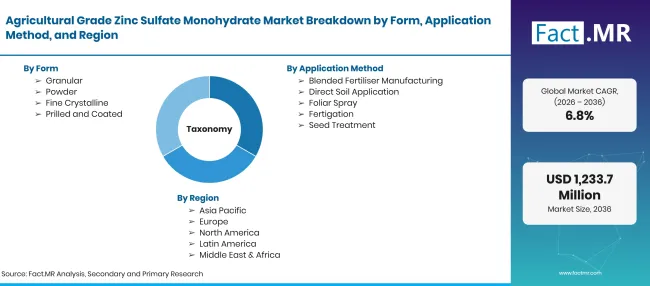
Agricultural Grade Zinc Sulfate Monohydrate Market Taxonomy | Source: Fact.MR
| Items | Values |
|---|---|
| Quantitative Units (2026) | USD 639.0 million |
| Form | Granular, Powder, Fine crystalline, Prilled and coated |
| Application Method | Blended fertiliser manufacturing, Direct soil application, Foliar spray, Fertigation, Seed treatment |
| Crop | Cereals and grains, Fruits and vegetables, Oilseeds and pulses, Plantation crops, Turf and other crops |
| Sales Channel | Fertiliser manufacturers, Distributors and retailers, Government and cooperative programmes, Online and direct farm sales |
| Regions Covered | North America, Latin America, Europe, Asia Pacific, Middle East & Africa |
| Countries Covered | India, Brazil, Pakistan, South Korea, Japan and other countries |
| Key Companies Profiled | Yara International, The Mosaic Company, ICL Group, Coromandel International, Zinc Nacional |
| Additional Attributes | Dollar revenue in the Agricultural Grade Zinc Sulfate Monohydrate Market is segmented by form, application method, crop, sales channel and region. |
Source: Fact.MR analysis. Updated Nov 26, 2026
Table of Contents
Key Takeaways
- Market Size and CAGR
- Top Growth Driver
- Fastest Growing Segment
- Leading Region
- Key Companies
- Emerging Opportunities

