
- Market Value (2025): USD 2.3 Bn
- Estimated Value (2026): USD 2.46 Bn
- Forecast Value (2036): USD 5.07 Bn
- CAGR (2026-2036): 7.5%
Microemulsions Market Forecast and Outlook 2026 to 2036
As per the Fact.MR analysis, the microemulsion market crossed a valuation of USD 2.3 billion in 2025 and is projected to grow from USD 2.46 billion in 2026 to USD 5.07 billion by 2036. Demand for microemulsions is likely to grow at a CAGR of 7.5% over the forecast period.
Demand for microemulsions is rising as agrochemical, oilfield, cleaning, personal-care and pharmaceutical users need clear, stable formulations that carry oils and active ingredients in water, or water in oil, with fine droplets. The key players are offering oil-in-water, water-in-oil and bicontinuous systems built on non-ionic, anionic and bio-based surfactants.
Key Takeaways from the Microemulsions Market
- Microemulsions Market Value (2025): USD 2.3 billion
- Microemulsions Market Value (2026): USD 2.46 billion
- Microemulsions Market Forecast Value (2036): USD 5.07 billion
- Microemulsions Market Forecast CAGR (2026-2036): 7.5%
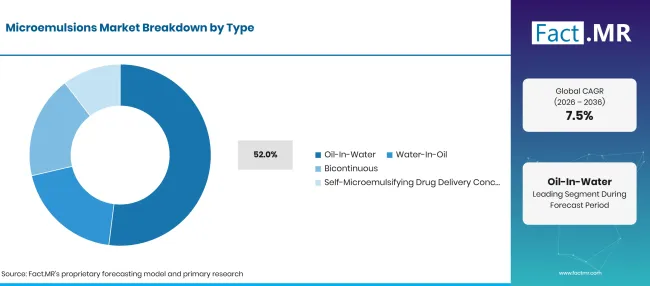
- Leading Type: Oil-in-water (52.0%)
- Key Market Participants: BASF, Croda International, Evonik Industries, Clariant, Stepan Company
- Key Growth Countries: India, China, Brazil, South Korea, United States
Demand for efficient crop-protection formulations, enhanced oil recovery chemistry and milder, bio-based surfactants is expected to support growth, while pharmaceutical drug-delivery uses add higher-value applications.
Microemulsions Market
| Metric | Value |
|---|---|
| Estimated Value in (2026) | USD 2.46 billion |
| Forecast Value in (2036) | USD 5.07 billion |
| Forecast CAGR (2026 to 2036) | 7.5% |
Source: Fact.MR analysis.
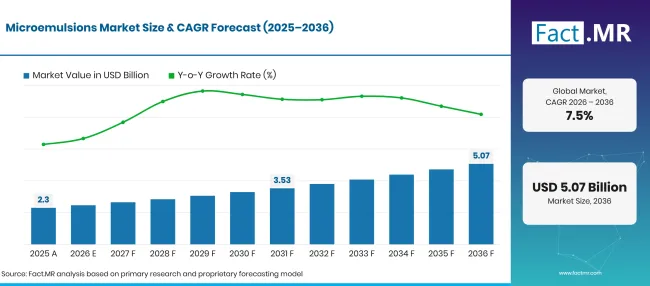
Microemulsions Market Forecast Global | Source: Fact.MR
Category
| Category | Segments |
|---|---|
| Type | Oil-in-water, Water-in-oil, Bicontinuous, Self-microemulsifying drug delivery concentrates |
| Application | Agrochemicals, Oil and gas well stimulation, Home and industrial cleaning, Personal care and cosmetics, Pharmaceuticals and drug delivery |
| Surfactant System | Non-ionic, Anionic, Bio-based and sugar-based surfactants, Cationic, Amphoteric |
| Form | Concentrates, Ready-to-use, Gel and thickened, Powder-based pre-concentrates |
| Region | India; China; Brazil; South Korea; United States |
Source: Fact.MR analysis.
Segmental Analysis
WHAT is driving oil-in-water formulations to lead the Microemulsions Market?
Microemulsions Market Breakdown Type | Source: Fact.MR
Demand for oil-in-water microemulsions is supported by their ability to disperse oil-based active ingredients in aqueous formulations, making them suitable for agrochemicals, personal care, cleaning products and pharmaceutical applications. The segment accounts for 52.0% of market revenue in 2026, about USD 1.28 billion. India's Department of Chemicals and Petrochemicals reported that the chemical and petrochemical sector contributed 8.1% of manufacturing GVA in FY 2023–24, according to the Economic Survey 2025–26. Expanding chemical manufacturing creates opportunities for formulation technologies offering stability, efficient dilution and reduced dependence on conventional solvent-heavy systems.
Which agricultural developments are strengthening agrochemical applications in the Microemulsions Market?
Microemulsions Market Breakdown Application | Source: Fact.MR
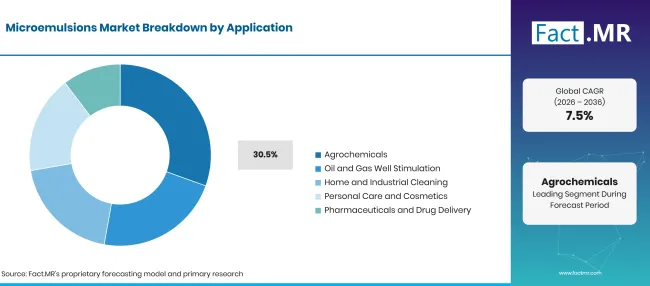
Sales of agrochemical microemulsions benefit from demand for stable, easily diluted crop-protection formulations that improve the distribution of active ingredients. The agrochemicals segment holds 30.5% of market revenue in 2026, about USD 750.3 million. India's Department of Chemicals and Petrochemicals reported that domestic agrochemical production reached 261,099 metric tonnes up to February 2026, against estimated demand of 74,266 metric tonnes. The government also highlighted integrated pest management, precision advisory and sustainable crop-protection practices. These developments create opportunities for formulation suppliers offering efficient concentrates and improved active-ingredient dispersion.
How are formulation stability requirements influencing non-ionic surfactant adoption?
Microemulsions Market Breakdown Surfactant System | Source: Fact.MR
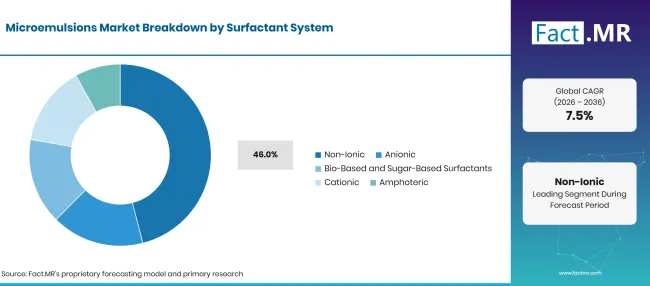
Adoption of non-ionic surfactant systems is supported by their compatibility with different oils, active ingredients and formulation conditions, making them suitable for agricultural, pharmaceutical and industrial cleaning applications. This segment represents 46.0% of market revenue in 2026, about USD 1.13 billion. India's Reserve Bank of India reported that the manufacturing production index for chemicals and chemical products reached 109.6 in FY 2025–26, while basic pharmaceutical products and preparations reached 120.8, against a 2022–23 base of 100. Expansion across these manufacturing industries supports demand for versatile surfactant systems used in formulated chemical products.
WHAT is encouraging manufacturers to supply concentrated microemulsion formulations?
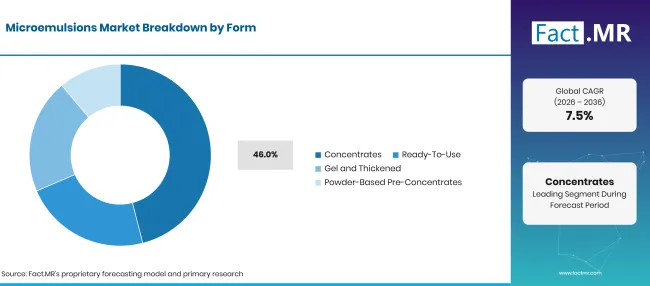
Microemulsions Market Breakdown Form | Source: Fact.MR
Demand for concentrated microemulsions is supported by manufacturers seeking formulations that can be transported efficiently, stored before use and diluted according to application requirements. Concentrates account for 46.0% of market revenue in 2026, about USD 1.13 billion. India's Annual Survey of Industries 2024–25, released by MoSPI in September 2026, reported 9.59% growth in manufacturing gross value added and 10.54% growth in fixed capital. The survey also identified chemicals and chemical products and pharmaceuticals among the five largest contributors to manufacturing GVA. Expanding industrial capacity supports opportunities for concentrated formulation technologies across agricultural, pharmaceutical and cleaning applications.
Microemulsions Market-Drivers, Restraints & Trends
Drivers:
Shift Towards Water-Based and Efficient Formulations -: Demand for microemulsions is gaining support from the broader expansion of India's chemical manufacturing industry and the increasing need for efficient formulations across agriculture, pharmaceuticals and industrial applications. According to the Government of India's Economic Survey 2025-26, major chemical and petrochemical production reached 58.617 million tonnes in FY 2024-25, compared with 45.638 million tonnes in FY 2015-16. The chemical sector also contributed 8.1% of manufacturing gross value added in FY 2023-24. Expanding chemical production creates opportunities for formulation technologies that improve active-ingredient delivery, stability and product performance.
Restraints: Formulation Complexity and Surfactant Requirements -:
Demand is constrained by formulation complexity, the high surfactant levels needed to form stable systems and sensitivity to temperature and salinity that can limit performance. Microemulsion development faces technical and commercial challenges because achieving a stable formulation requires careful selection of oil phases, surfactants, co-surfactants and water proportions. High surfactant concentrations can increase formulation costs, while changes in temperature, salinity and ingredient compatibility may affect performance. India's Department of Chemicals and Petrochemicals introduced mandatory collection of monthly and annual chemical-industry statistics through the ChemIndia portal in August 2025, reflecting the importance of systematic monitoring of chemical production and industry operations.
Opportunity: Development of Bio-Based Surfactant Systems
Formulators are testing sugar-based and other renewable surfactants to meet environmental and consumer expectations. The shift towards sustainable chemical manufacturing creates opportunities for microemulsion formulators to explore sugar-based, plant-derived and other renewable surfactant systems. India's BioE3 Policy, highlighted by the Department of Biotechnology in August 2026, identifies bio-based chemicals, bioplastics and enzymes as priority areas for biomanufacturing development. The Government reported that more than 600 beneficiaries had accessed BioE3 facilities and that the initiative had attracted ₹602.09 crore in private-sector investment commitments. These developments support research, pilot-scale production and commercialization of renewable chemical ingredients, creating opportunities for manufacturers developing bio-based microemulsion formulations.
Trend: Expanding Oilfield and Agricultural Applications
Microemulsion-related technologies are finding opportunities in agricultural formulations and enhanced oil recovery applications, where surfactants help improve the delivery and performance of active ingredients. India's Ministry of Agriculture reported that agrochemical production reached 261,099 metric tonnes during FY 2025-26 up to February 2026, demonstrating substantial activity in the crop-protection industry. Separately, a Lok Sabha response dated August 2026 confirmed that ONGC had undertaken more than 22 enhanced oil recovery pilot and commercial projects, including alkaline-surfactant-polymer flooding. These developments support opportunities for advanced surfactant formulations in agricultural and petroleum applications.
Microemulsions Market Analysis by Key Country
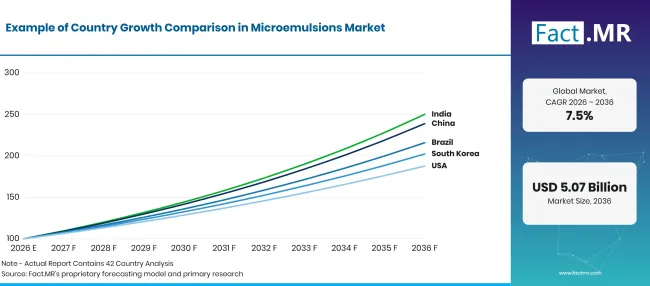
Microemulsions Market Growth Index | Source: Fact.MR
| Country | CAGR (2026-2036) |
|---|---|
| India | 9.6% |
| China | 9.1% |
| Brazil | 8.0% |
| South Korea | 7.3% |
| United States | 6.5% |
Source: Fact.MR analysis.
What is positioning India as the fastest-growing market for microemulsions?
Demand for microemulsions in India is projected to increase at a 9.6% CAGR through 2036, the fastest among the five countries.
Expanding agrochemical production, personal-care manufacturing and specialty-chemical investments are creating opportunities for advanced formulation technologies. The Ministry of Chemicals and Fertilizers reported that Indian agrochemical production reached 261,099 metric tonnes during FY 2025–26 up to February 2026, against estimated domestic demand of 74,266 metric tonnes. Additionally, the Economic Survey 2025–26 reported that chemicals contributed 8.1% of manufacturing gross value added in FY 2023–24. These developments support demand for stable, easily dilutable microemulsion formulations.
Which manufacturing developments are strengthening China's microemulsions market?
Sales of microemulsion formulations in China are forecast to grow at a 9.1% CAGR through 2036, exceeding the global rate of 7.5%.
A substantial chemical manufacturing base, agricultural input production and industrial cleaning applications support demand for formulation technologies that improve active-ingredient dispersion. China's National Bureau of Statistics reported that manufacturing value added increased by 5.7% during January–August 2026, while production of raw chemical materials and chemical products increased by 3.7% over the same period. This industrial expansion supports opportunities for oil-in-water formulations and non-ionic surfactant systems across agrochemical, pharmaceutical and industrial applications.
How is Brazil's agricultural expansion creating opportunities for microemulsion suppliers?
Demand for microemulsions in Brazil is projected to advance at an 8.0% CAGR through 2036, above the global rate of 7.5%.
Large-scale soybean, corn and other commercial crop production supports consumption of crop-protection formulations, including products requiring stable active-ingredient dispersion and efficient dilution. Brazil's national statistics agency, IBGE, estimated that agricultural production of cereals, legumes and oilseeds would reach 347.4 million tonnes in 2026, representing a 0.4% increase over 2025. Soybean production alone was estimated at 174.8 million tonnes. This extensive agricultural base creates opportunities for microemulsion-based herbicides, insecticides and fungicide formulations.
WHAT is driving demand for high-performance microemulsions in South Korea?
Demand for microemulsions in South Korea is estimated to increase at a 7.3% CAGR through 2036, slightly below the global rate of 7.5%.
Cosmetics, pharmaceutical manufacturing and advanced industrial chemicals support demand for formulations offering stability, controlled ingredient dispersion and compatibility with different active compounds. South Korea's Ministry of SMEs and Startups reported that cosmetics exports reached USD 12.4 billion during January–October 2026, already exceeding the previous full-year record of USD 11.4 billion in 2025. Pharmaceutical exports also benefited from biosimilar demand and contract manufacturing. These developments create opportunities for specialized microemulsion systems used in personal care and pharmaceutical formulations.
Which factors are moderating microemulsions market growth in the United States?
Sales of microemulsions in the United States are projected to grow at a 6.5% CAGR through 2036, the slowest among the five countries.
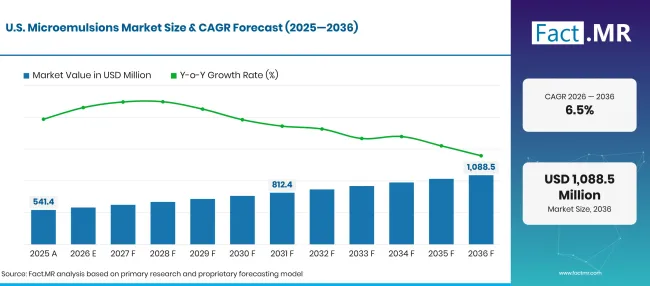
Microemulsions Market Forecast Usa | Source: Fact.MR
Established chemical manufacturing capacity, existing formulation technologies and competition from conventional emulsions moderate the pace of additional adoption. Nevertheless, agrochemicals, pharmaceuticals, personal care and oilfield applications sustain demand for advanced delivery systems. The US Census Bureau reported in March 2026 that chemical manufacturing establishments increased 10.2% between 2017 and 2022, while industry value of shipments rose 22.4% to approximately USD 901.0 billion. This established industrial base provides opportunities for microemulsion suppliers targeting specialized formulations and improved delivery performance.
Competitive Landscape for Microemulsions Market
The microemulsion market is moderately concentrated, with BASF, Croda International, Evonik Industries, Clariant and Stepan Company together hold about 50% of 2026 revenue, based on Fact.MR estimates. Competition centers on surfactant performance, formulation know-how, regulatory compliance and application support. Large specialty-chemical groups supply surfactants and systems to formulators, while oilfield service companies sell ready-made fluids.
Recent Developments
- In March 2026, Evonik expanded its personal-care formulation portfolio with symbio pure G3E1 MB emulsifier and symbio pure G3C2 MB solubilizer. Based on polyglyceryl ester technology, these ingredients support gentle makeup removal and advanced cosmetic formulation development.
- In June 2026, BASF launched Emulgade Verde PE, a ready-to-use emulsifier that enables niosome formation for improved delivery of hydrophilic active ingredients. The technology supports stable, mild and biodegradable formulations for skincare, body-care and hair-care applications.
- In March 2026, Clariant showcased Plantasens Emulsifier HP 49, an oil-in-water emulsifier designed to create highly stable cosmetic formulations containing up to 30% oil phase. Its formulation technology also supports skin moisturisation, barrier protection and improved product texture.
Key Players in Microemulsions Market
Key companies operating in the market include BASF, Croda International, Evonik Industries, Clariant, and Stepan Company.
- BASF
- Croda International
- Evonik Industries
- Clariant
- Stepan Company
Bibliography
- Department of Chemicals and Petrochemicals. (2025, August 5). Notification for collection of statistics on chemicals and petrochemicals under the Collection of Statistics Act, 2008.
- Department of Chemicals and Petrochemicals. (2025, December 22). Chemical and petrochemical statistics at a glance 2025.
- Department of Chemicals and Petrochemicals. (2026, January 30). Economic Survey 2025–26 highlights steady growth of chemicals and petrochemicals sector.
- Ministry of Science and Technology. (2026, August 6). Contribution of BioE3 Policy.
- Press Information Bureau. (2026, February 4). Union Budget FY 2026–2027: Chemical Parks.
- Ministry of Statistics and Programme Implementation. (2026, September 30). Release of the Annual Survey of Industries (2024–25) results.
Segmentation
Scope of Report
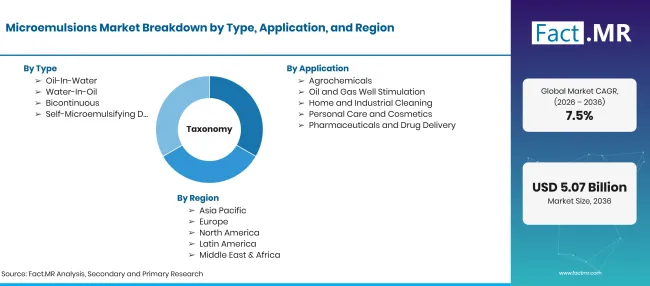
Microemulsions Market Taxonomy | Source: Fact.MR
| Items | Values |
|---|---|
| Quantitative Units (2026) | USD 2.46 Billion |
| Type | Oil-in-water, Water-in-oil, Bicontinuous, Self-microemulsifying drug delivery concentrates |
| Application | Agrochemicals, Oil and gas well stimulation, Home and industrial cleaning, Personal care and cosmetics, Pharmaceuticals and drug delivery |
| Surfactant System | Non-ionic, Anionic, Bio-based and sugar-based surfactants, Cationic, Amphoteric |
| Form | Concentrates, Ready-to-use, Gel and thickened, Powder-based pre-concentrates |
| Regions Covered | North America, Latin America, Europe, Asia Pacific, Middle East & Africa |
| Countries Covered | India, China, Brazil, South Korea, United States, and other countries |
| Key Companies Profiled | BASF, Croda International, Evonik Industries, Clariant, Stepan Company |
| Additional Attributes | Dollar revenue in the Microemulsions Market is segmented by type, application, surfactant system and form and region. |
Source: Fact.MR analysis.
Microemulsions Market by Segments
-
Type
- Oil-in-water
- Water-in-oil
- Bicontinuous
- Self-microemulsifying drug delivery concentrates
-
Application
- Agrochemicals
- Oil and gas well stimulation
- Home and industrial cleaning
- Personal care and cosmetics
- Pharmaceuticals and drug delivery
-
Surfactant System
- Non-ionic
- Anionic
- Bio-based and sugar-based surfactants
- Cationic
- Amphoteric
-
Form
- Concentrates
- Ready-to-use
- Gel and thickened
- Powder-based pre-concentrates
-
Region:
- North America
- United States
- Canada
- Mexico
- Europe
- Germany
- United Kingdom
- France
- Italy
- Spain
- Rest of Europe
- Asia Pacific
- China
- India
- Japan
- South Korea
- Australia and New Zealand
- Rest of Asia Pacific
- Latin America
- Brazil
- Argentina
- Rest of Latin America
- Middle East & Africa
- GCC Countries
- South Africa
- Rest of Middle East & Africa
- North America
Table of Contents
Key Takeaways
- Market Size and CAGR
- Top Growth Driver
- Fastest Growing Segment
- Leading Region
- Key Companies
- Emerging Opportunities

