- Market Value (2025): USD 190.9 Mn
- Estimated Value (2026): USD 231.6 Mn
- Forecast Value (2036): USD 1597.2 Mn
- CAGR (2026-2036): 21.3%
What is the AI-Based Weather Modelling Market forecast to be worth by 2036?
USD 231.6 million in 2026 to USD 1,597.2 million by 2036, at 21.3% CAGR.
- The AI-based weather modelling market crossed a valuation of USD 190.9 million in 2025 after broader operational testing across public forecasting and commercial risk workflows.
- Demand is projected to increase from USD 231.6 million in 2026 to USD 1,597.2 million by 2036 as forecast production becomes more computationally accessible.
- The market is forecast to record a 21.3% CAGR from 2026 to 2036 as insurers and government weather agencies expand probabilistic forecasting workflows.
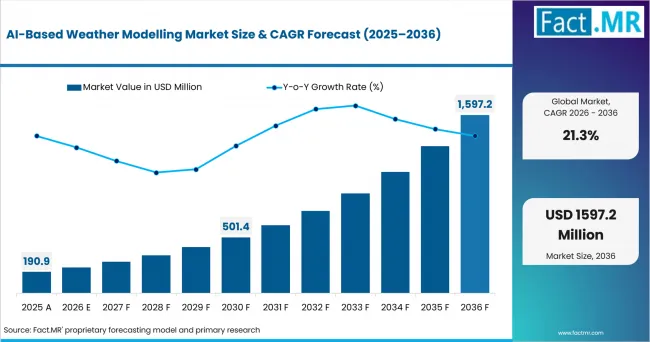
Ai Based Weather Modelling Market Market Value Analysis | Source: Fact.MR
What are the defining numbers behind AI-Based Weather Modelling Market growth?
USD 1,365.6 million absolute opportunity by 2036, led by Software and Cloud deployment alongside BFSI users.
- Demand Drivers in the Market
- Government weather agencies need faster ensemble generation because operational forecast windows leave limited time for repeated physics-based simulation and manual review.
- Insurance risk teams need calibrated hazard probabilities supported by location-level signals that connect forecast uncertainty with portfolio exposure and claims operations.
- Retail planning teams need weather-sensitive demand forecasts shaped by local temperature and precipitation changes that alter inventory movement across stores and fulfillment networks.
- Manufacturing operations teams need API-ready alerts owing to weather disruptions that affect plant continuity and inbound material schedules across distributed production networks.
- Key Segments Analyzed
- By Component: Software is expected to account for 32.4% share in 2026, driven by model development and inference orchestration inside operational forecast pipelines.
- By Deployment: Cloud is projected to garner 41.4% share in 2026, supported by elastic inference capacity and managed access to large atmospheric datasets.
- By Organization Size: SME is anticipated to record 40.7% share in 2026, attributable to API access and subscription delivery that reduce infrastructure requirements.
- By Application: Workflow automation is forecast to capture 40.8% share in 2026, reinforced by automated forecast delivery and recurring operational alert workflows.
- By End Use: BFSI is forecast to capture 25.6% share in 2026, reinforced by catastrophe analytics and weather-sensitive underwriting decisions.
- Analyst Opinion at Fact.MR
- Shambhu Nath Jha, Senior Analyst at Fact.MR states, “The commercial bottleneck is proving calibration during rare events and carrying uncertainty into decisions that already have approval rules. Adoption is expected to favor providers that show local performance and clear failure thresholds before integration. Providers seeking enterprise adoption should combine forecast skill with transparent model lineage and practical workflow integration support.”
- Strategic Implications
- Model developers should benchmark rare-event performance against operational baselines before presenting average forecast scores to insurance or government users.
- Cloud platform teams should preserve retraining records and model lineage so enterprise accounts retain traceability across changing production forecast releases.
- Insurance analytics teams should test probabilistic outputs against actual portfolio thresholds before embedding forecast triggers inside underwriting and claims workflows.
- Government weather agencies should maintain hybrid validation routes that compare machine-learned outputs with physics guidance during high-impact warning operations.
Competition in weather intelligence is shifting toward customizable AI models that support regional forecasting needs and organization-specific applications. NVIDIA launched the Earth-2 family of open weather models in January 2026 for observation processing and nowcasting workflows. The broader model set shifts provider competition toward local validation and customization for agency or enterprise workflows.
India is projected to record 23.1% CAGR during the forecast period, driven by forecast modernization and wider observation coverage. China is estimated to post 22.4% CAGR by 2036, supported by domestic model development and operational experimentation. Australia is anticipated to achieve 21.1% CAGR over the assessment period, attributable to local validation and weather-service modernization. The United Kingdom is forecast to record 20.8% CAGR between 2026 and 2036, owing to cloud computing access and model integration. The United States is expected to register 20.6% CAGR across the forecast horizon, reinforced by public model operations and enterprise risk demand.
How does the AI-Based Weather Modelling Market break down by segment?
Software is projected to account for 32.4% share; Cloud is estimated to garner 41.4% share.
Which Component dominates?
Software is predicted to garner around 32.4% share in 2026
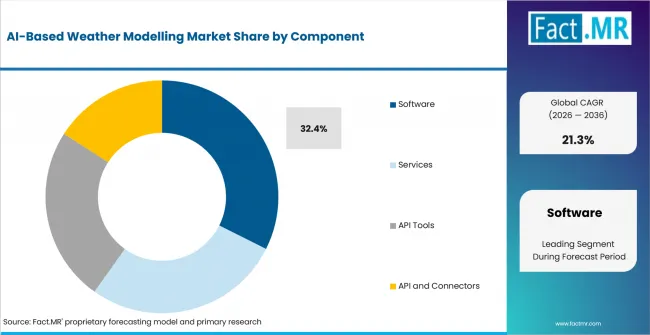
Ai Based Weather Modelling Market Analysis By Component | Source: Fact.MR
Operational software is forecast to capture 32.4% share in 2026, because users need model training and inference controls inside one production chain. Services remain relevant during local calibration work and controlled migration from existing physics-based forecast systems. API tools and connectors support downstream applications that consume model outputs without hosting the full inference layer. ECMWF reported in February 2025 that its operational AIFS improved tropical cyclone track predictions by about 20%. The result gives predictive analytics software teams a concrete benchmark for weather-model evaluation before deployment.
What leads the Deployment segment?
Cloud is estimated to garner 41.4% share in 2026
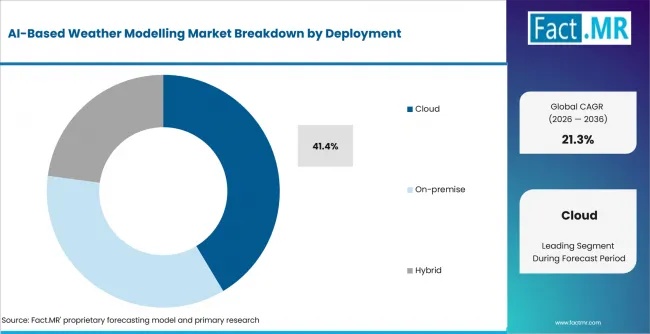
Ai Based Weather Modelling Market Analysis By Deployment | Source: Fact.MR
Elastic cloud delivery is anticipated to represent 41.4% share in 2026, due to burst compute requirements during retraining and ensemble generation. On-premise deployment remains relevant for agencies that control sensitive infrastructure and regulated data flows inside protected operational networks. Hybrid architectures connect protected observation systems with scalable inference resources while keeping selected production controls inside agency environments. Google DeepMind introduced WeatherNext 2 in November 2025 and stated that the model generates hundreds of forecast scenarios in under one minute on a single TPU. Faster inference raises the value of orchestration and distribution because users still need reliable delivery into operational decision systems.
How does Organization Size shape demand?
SME is anticipated to record 40.7% share in 2026
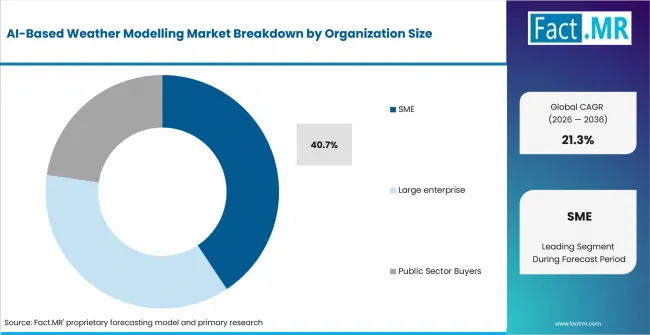
Ai Based Weather Modelling Market Analysis By Organization Size | Source: Fact.MR
SME accounts are expected to represent 40.7% share in 2026, supported by subscription access that reduces dedicated infrastructure needs. Large enterprises support private integration teams that connect weather models with insurance systems and retail planning platforms across multiple business units. Public sector buyers use contracted services where agencies need model evaluation without maintaining commercial forecasting stacks. Tomorrow.io partnered with Philippine public agencies in June 2025 to apply AI-driven forecasts to farm decisions. The partnership shows how smaller application teams use model outputs without operating full forecast systems.
Which application area is forecast to secure the leading share?
Workflow automation is forecast to capture 40.8% share in 2026
Workflow automation is forecast to capture 40.8% share in 2026, supported by forecast release routines and automated weather-risk alerts. Analytics follows as risk teams compare forecast uncertainty with claims and operational exposure. Governance tools support model lineage and audit controls across regulated forecast decisions. Integration systems connect forecast outputs with insurance and retail planning platforms. NOAA deployed a new generation of AI-driven global weather models in December 2025 for operational forecast production.
Which End Use records the broadest share?
BFSI is forecast to capture 25.6% share in 2026
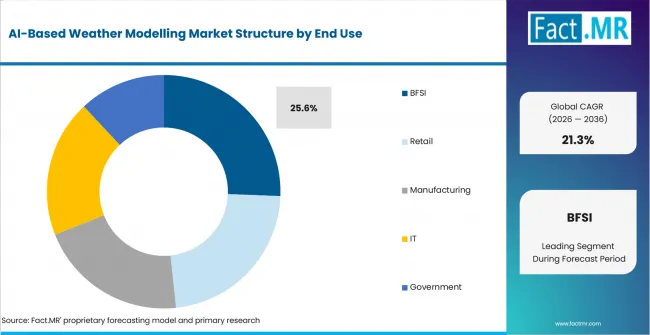
Ai Based Weather Modelling Market Analysis By End Use | Source: Fact.MR
BFSI teams are estimated to represent 25.6% share in 2026, attributable to weather probabilities used in asset exposure and claims planning. Retail teams use short-range forecasts inside retail demand forecasting and inventory decisions across stores exposed to local weather shifts. Manufacturing and IT operations use weather signals for facility continuity and workload planning while government teams apply them to warning workflows. In January 2025, NOAA reported 27 separate billion-dollar weather and climate disasters in the United States during 2024. That event burden keeps weather intelligence tied to recurring risk decisions across several end-use groups.
What is accelerating AI-Based Weather Modelling Market adoption, and what is holding it back?
Operational AI deployment drives it; observation quality and rare-event calibration restrain it.
Drivers Impact Analysis
| Driver | (~) % Impact on CAGR | Geographic Relevance | Impact Timeline |
|---|---|---|---|
| Operational AI model deployment | +2.8% | Global public weather services | Medium term (2-4 years) |
| Extreme-weather risk exposure | +2.3% | North America and Asia Pacific | Short term (<= 2 years) |
| Cloud inference and API access | +1.8% | Global enterprise accounts | Medium term (2-4 years) |
| Denser observation data flows | +1.5% | Asia Pacific and North America | Medium term (2-4 years) |
| Early warning modernization | +1.2% | India and China alongside Europe | Long term (>= 4 years) |
Source: Fact.MR analysis. Updated Jul 9, 2026
- Operational AI deployment: National weather services are placing machine-learned models beside physics guidance after years of research comparison. NOAA deployed a new generation of AI-driven global models in December 2025 for operational forecast production. Adoption is expected to expand where agencies publish verification results and preserve forecaster review during high-impact events.
- Extreme-weather risk exposure: Weather risk teams need probabilities that support action before losses are certain. In March 2025, WMO reported that 2024 global temperature was about 1.55 degrees Celsius above the pre-industrial average. Demand is projected to deepen where insurers and public agencies connect forecast distributions with location-specific exposure and warning thresholds.
- Cloud inference economics: AI models lower the marginal cost of producing large forecast ensembles after training is complete. ECMWF reported in November 2025 that its AIFS ensemble uses up to 1,000 times less energy than traditional physics-based forecasting. Commercial deployment is anticipated to widen as organizations redirect compute budgets toward calibration and delivery workflows.
- Observation data density: Forecast quality still depends on timely initial conditions and reliable measurement streams before model inference begins. India reported weather-data assimilation of about 500 GB per day in February 2026 after a major expansion of national observing capacity. Providers are estimated to gain where ingestion pipelines detect gaps before unreliable inputs enter production models.
- Early warning modernization: Government programs increasingly treat forecast speed and warning reach as linked infrastructure problems. WMO reported in November 2025 that 119 countries had reported multi-hazard early warning systems across their national warning frameworks. Deployment is forecast to broaden where AI models support faster scenario generation without weakening local warning governance.
Opportunity Impact Analysis
| Opportunity | (~) % Impact on CAGR | Geographic Relevance | Impact Timeline |
|---|---|---|---|
| Probabilistic ensemble AI | +1.9% | Global BFSI and government | Medium term (2-4 years) |
| Hybrid NWP and AI orchestration | +1.6% | Europe and North America | Medium term (2-4 years) |
| Sector workflow APIh | +1.4% | Global SME accounts | Medium term (2-4 years) |
| Local nowcasting and downscaling | +1.1% | Asia Pacific | Short term (<= 2 years) |
Source: Fact.MR analysis. Updated Jul 9, 2026
- Probabilistic ensemble AI: Insurers and government warning teams need distributions that show plausible outcomes beyond one deterministic forecast path. In June 2025, NOAA’s AI weather modelling workshop attracted 577 registered participants across public and research communities. Opportunity is expected to concentrate on calibrated ensembles that retain uncertainty information after forecasts enter operational decision systems.
- Hybrid NWP and AI orchestration: Public agencies rarely replace an operational physics system in one step because warning continuity carries institutional risk. Australia’s Bureau of Meteorology reported in February 2026 that post-processed AIFS consistently outperformed post-processed HRES across key rainfall metrics. Adoption is projected to favor workflow layers that compare model families before forecast release across public warning and enterprise operations.
- Sector workflow APIs: Commercial accounts increasingly purchase forecast delivery and decision triggers instead of standalone model files. Enterprise APIs distribute probabilistic weather outputs into agriculture and operational planning systems without moving full model stacks. Providers are anticipated to gain where APIs preserve uncertainty metadata and support retraining without breaking downstream applications.
- Local nowcasting and downscaling: Global models create room for specialized layers that resolve local rainfall and storm behavior at shorter horizons. NOAA expanded HRRR-Cast in November 2025 with ensemble capability for regional AI forecasting across high-resolution operational research workflows. Opportunity is estimated to grow around calibrated local products that are tested against regional radar and surface observations.
Restraints Impact Analysis
| Restraint | (~) % Impact on CAGR | Geographic Relevance | Impact Timeline |
|---|---|---|---|
| Observation-data quality gaps | -1.8% | Emerging and sparse-data regions | Medium term (2-4 years) |
| Rare-event calibration risk | -1.5% | Global BFSI and government | Medium term (2-4 years) |
| Training and integration burdeh | -1.2% | Global SME accounts | Medium term (2-4 years) |
| Governance and workflow friction | -0.9% | Regulated end users | Long term (>= 4 years) |
Source: Fact.MR analysis. Updated Jul 9, 2026
- Observation-data quality gaps: AI forecast systems inherit gaps and biases from the measurements used for initialization and training. In November 2025, WMO reported multi-hazard warning coverage of only 43% among small island developing states. Adoption is forecast to remain selective where sparse observations make local calibration difficult to defend during high-impact decisions.
- Rare-event calibration risk: Average benchmark gains do not guarantee reliable performance during record-setting heat or storm behavior outside familiar training distributions. Operational users therefore need event-specific backtesting and uncertainty checks before automated triggers are approved for production use. Procurement is expected to slow where providers do not show failure modes and escalation routes for forecast outliers.
- Training and integration burden: A pre-trained model does not remove the work required for local data mapping and system monitoring. SME teams struggle when each customer needs a different observation feed or alert schema inside the delivery workflow. Adoption is projected to favor managed services that separate reusable forecast infrastructure from customer-specific decision logic.
- Governance and workflow friction: Regulated users need version control and documented approval when model outputs influence financial or public-safety decisions. Frequent model updates create review work when validation evidence does not travel with a release. Deployment is anticipated to move more slowly where governance teams cannot compare changes against a stable operational baseline.
Which countries are scaling AI-Based Weather Modelling Market fastest?
India 23.1%; China 22.4%; Australia 21.1%; United Kingdom 20.8%; United States 20.6%.
AI-Based Weather Modelling Market is segmented into North America, Europe, Asia Pacific, Latin America, and Middle East & Africa.
| Country | CAGR |
|---|---|
| India | 23.1% |
| China | 22.4% |
| Australia | 21.1% |
| United Kingdom | 20.8% |
| United States | 20.6% |
| Germany | 20.3% |
| Japan | 20.0% |
Source: Fact.MR analysis. Updated Jul 9, 2026
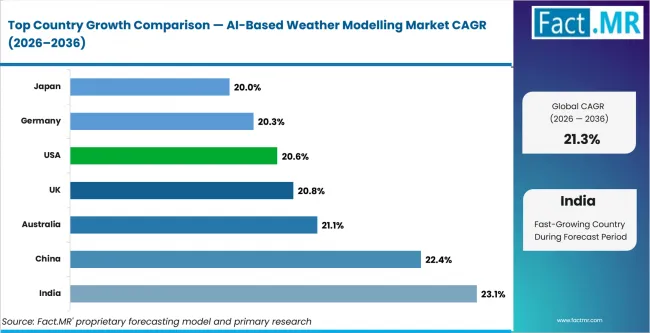
Ai Based Weather Modelling Market Cagr Analysis By Country | Source: Fact.MR
What is powering India's expansion?
23.1% CAGR, driven by forecast-resolution gains and observing-system expansion.
India is moving national forecast production toward higher-resolution guidance and machine-learning support across warning services. In May 2025, BharatFS became operational at 6 km resolution as the country expanded local forecast detail. Demand is projected to record 23.1% CAGR during the forecast period, because denser observations give model teams stronger calibration inputs through automated weather observing systems.
How is China scaling AI weather modelling demand?
22.4% CAGR, supported by domestic model development and open forecast experimentation.
China is expanding domestic testing of machine-learning weather prediction while regional forecast services move closer to operational use. In February 2025, the Fengqing V1.5 update added 6-hour accumulated precipitation forecasts, with verification showing comparable threat scores within a 10-day period. Demand is estimated to post 22.4% CAGR by 2036, supported by local model teams connecting national observation assets with operational inference pipelines.
What supports Australia's outlook?
21.1% CAGR, attributable to local model testing and public forecast modernization.
Australia is testing how AI forecasts fit daily operations while continuing model evaluation and post-processing research. In September 2025, a Bureau of Meteorology training forum examined AI forecasts alongside satellite-derived soundings. Demand is anticipated to achieve 21.1% CAGR over the assessment period, attributable to local testing and weather-service modernization.
What underpins the United Kingdom outlook?
20.8% CAGR, owing to cloud supercomputing and AI integration within national forecasting strategy.
The United Kingdom is combining national weather science with cloud computing that shortens model testing and operational release cycles. In May 2025, the Met Office completed its transition to a new cloud supercomputer for operational weather and climate intelligence. Demand is forecast to expand at 20.8% CAGR between 2026 and 2036, owing to flexible compute access and AI integration.
How is the United States expanding operational use?
20.6% CAGR, reinforced by operational AI model deployment and enterprise weather-risk demand.
The United States combines federal model operations with a broad private weather intelligence ecosystem serving finance and logistics accounts. In January 2026, NOAA Global Systems Laboratory said AIGFS used up to 99.7% fewer computing resources than its traditional counterpart. Demand is expected to register 20.6% CAGR across the forecast horizon, reinforced by operational model access and enterprise weather-risk demand.
Who leads the AI-Based Weather Modelling Market?
The Weather Company is positioned strongly through operational forecast platforms, enterprise weather intelligence, and JEDI-enabled GRAF workflows.
Google DeepMind broadened model evaluation through the Weather Lab public preview launched in June 2025 for shared AI forecasts and experimental cyclone predictions. NVIDIA introduced FourCastNet 3 in July 2025 to support faster large-ensemble weather modelling across global forecast applications. The Weather Company implemented JEDI in GRAF operations during March 2025 to improve assimilation of varied observation types. Competition turns on forecast skill and deployment flexibility while enterprise accounts test local calibration before production use.
Tomorrow.io expanded sector delivery in March 2026 when Lufthansa deployed Altitude across its network. DTN integrated NVIDIA Earth-2 into its forecasting engine in September 2025 to enhance real-time weather intelligence. StormGeo documented operational AI weather forecasting for energy clients in May 2025 while Climavision expanded Horizon AI HIRES work in July 2025. Competition is expected to center on verified local performance and accountable workflow integration across recurring operational decisions.
Which companies are the key providers?
- The Weather Company
- Tomorrow.io
- DTN
- StormGeo
- Climavision
- NVIDIA
- Google DeepMind
Bibliography
- Bureau of Meteorology. (2026, February 9). 2025 Regional Focus Group meetings (124–130). Bureau of Meteorology.
- Bureau of Meteorology. (2026, February). Machine-learned forecasting and post-processing: Probabilistic calibration of AIFS forecasts with RainForests. Bureau of Meteorology.
- Climavision. (2025, July 10). Climavision selected by IRCAI and AWS for 2025 Compute for Climate Fellowship. Climavision.
- DTN. (2025, September 22). DTN advances real-time weather intelligence with NVIDIA Earth-2 on AWS. DTN.
- Earth Prediction Innovation Center. (2025, June 27). Artificial Intelligence in Weather Modeling Workshop. National Oceanic and Atmospheric Administration.
- European Centre for Medium-Range Weather Forecasts. (2025, February 25). ECMWF’s AI forecasts become operational. ECMWF.
- European Centre for Medium-Range Weather Forecasts. (2025, November 24). Simplifying AI for weather forecasting with the European Weather Cloud. ECMWF.
- Google DeepMind. (2025, November 17). WeatherNext 2: Our most advanced weather forecasting model. Google DeepMind.
- Met Office. (2025, May 19). Better forecasts ahead as Met Office transitions to a supercomputer in Azure cloud. Met Office.
- National Centers for Environmental Information. (2025, January 10). Assessing the U.S. climate in 2024. National Oceanic and Atmospheric Administration.
- National Oceanic and Atmospheric Administration, Global Systems Laboratory. (2025, November 24). New upgrades to HRRR-Cast: The experimental AI-powered regional model. NOAA Global Systems Laboratory.
- National Oceanic and Atmospheric Administration. (2025, December 17). NOAA deploys new generation of AI-driven global weather models. NOAA.
- NVIDIA. (2025, July 29). FourCastNet 3 enables fast and accurate large ensemble weather forecasting with scalable geometric ML. NVIDIA Technical Blog.
- NVIDIA. (2026, January 26). NVIDIA launches Earth-2 family of open models. NVIDIA.
- Press Information Bureau. (2026, February 11). Parliament question: Accurate weather forecasting. Ministry of Earth Sciences, Government of India.
- The Weather Company. (2025, March 20). The Weather Company advances global weather forecasting with first operational implementation of JEDI system. The Weather Company.
- Tomorrow.io. (2025, June 3). Tomorrow.io to bring AI-powered weather forecasting to Filipino farmers. Tomorrow.io.
- Tomorrow.io. (2026, March 26). Lufthansa deploys Tomorrow.io’s Altitude across its network, setting a new standard for aviation weather intelligence. Tomorrow.io.
- World Meteorological Centre Beijing. (2025, February 28). Fengqing model update information. China Meteorological Administration.
- World Meteorological Organization. (2025, March 19). State of the Global Climate 2024. WMO.
- World Meteorological Organization. (2025, November 12). Global Status of Multi-Hazard Early Warning Systems 2025. WMO.
This Report Addresses
- The report provides strategic intelligence on AI-based weather modelling across Component and Deployment choices that shape production forecast systems and commercial delivery routes.
- Regional outlook evaluates India and China alongside Australia while the United Kingdom and United States complete the country growth comparison.
- Competitive analysis profiles The Weather Company and Tomorrow.io alongside DTN and StormGeo while Climavision and NVIDIA expand the provider set. Google DeepMind completes the reviewed company group with direct AI weather-model coverage and public forecast research.
- Component assessment covers Software and Services while API Tools and the API and Connectors category support model access and downstream integration requirements.
- Application assessment covers Workflow Automation and Analytics while Governance and Integration address control and system connection requirements.
What does the AI-Based Weather Modelling Market cover?
Software and Services are covered alongside API Tools and the API and Connectors category for operational AI-based weather forecasting.
The AI-Based Weather Modelling Market covers machine-learning systems that generate forecasts or improve the operational use of forecast outputs. Coverage includes global or regional models and machine-learned post-processing systems that calibrate weather variables before operational release.
The market differs from general cloud infrastructure because commercial value must be tied directly to weather modelling or model-backed intelligence. Observation hardware remains adjacent unless its sale includes separately priced modelling software or forecast services. Physics-only systems remain outside the boundary while advertising-funded consumer applications are excluded without separately identifiable AI service revenue.
What is included in the scope?
AI weather-model software and operational services support forecast production as well as risk analysis and automated weather workflows.
Included revenue covers model licenses and subscription software used to generate global or local weather forecasts. The scope also includes services for calibration and deployment when those services directly support AI-based weather models. API access is included when pricing reflects forecast output or model-backed weather intelligence delivered into an operational application workflow. Post-processing systems are counted where machine learning changes forecast probabilities or corrects systematic model bias before use.
What is excluded from the scope?
General-purpose AI platforms and standalone weather sensors remain outside scope alongside physics-only operational forecast systems.
General cloud infrastructure is excluded when revenue cannot be tied directly to weather modelling or a weather intelligence service. Weather stations and radar hardware remain outside scope because their value belongs to observation equipment markets. Physics-only forecast software and advertising-funded consumer weather applications are excluded unless AI modules create separately identifiable commercial revenue.
How was the analysis built?
120+ sources, 40+ company portfolios, 25+ countries, 20+ interviews.
- Primary Research
- Primary research includes interviews with meteorological agencies, weather forecasting providers, climate analytics specialists and atmospheric data scientists. It also includes input from AI developers, cloud platform providers, environmental researchers and enterprise users deploying AI-based weather modelling solutions.
- Desk Research
- Desk research reviews official weather and climate datasets, meteorological agency publications, AI platform portfolios, climate technology reports and company product announcements. Research papers, forecasting model documentation, satellite data initiatives and environmental monitoring developments are also assessed to evaluate market trends and competitive positioning.
- Market-Sizing and Forecasting
- Forecasting uses weather intelligence adoption trends, climate risk assessment activity, AI and machine learning investments, satellite and sensor data utilization and demand for advanced forecasting solutions across major regions. Models consider cloud-based analytics deployment, predictive modelling requirements, disaster preparedness initiatives and industry-specific weather intelligence applications.
- Data Validation and Update Cycle
- Forecasts are validated through provider checks and industry interviews that test assumptions on forecasting demand, AI adoption and climate analytics deployment. Portfolio mapping, regional weather technology assessment and stakeholder feedback help confirm market direction, while ongoing reviews of technology developments, environmental policies and product launches support forecast updates.
Segmentation
What is the report’s scope and coverage?
| Attribute | Details |
|---|---|
| Quantitative Units | USD Million |
| Market Definition | Machine-learning models and operational software that generate or apply weather forecasts from atmospheric observations and numerical datasets. |
| Component | Software; Services; API Tools; API and Connectors |
| Deployment | Cloud; On-premise; Hybrid |
| Organization Size | SME; Large Enterprise; Public Sector Buyers |
| Application | Workflow Automation; Analytics; Governance; Integration |
| End Use | BFSI; Retail; Manufacturing; IT; Government |
| Regions Covered | North America; Europe; Asia Pacific; Latin America; Middle East and Africa |
| Countries Covered | United States; Canada; United Kingdom; Germany; France; Italy; Spain; India; China; Japan; Australia; South Korea; Brazil; Mexico; Argentina; Chile; UAE; Saudi Arabia; South Africa |
| Key Companies Profiled | The Weather Company; Tomorrow.io; DTN; StormGeo; Climavision; NVIDIA; Google DeepMind |
| Forecast Period | 2026 to 2036 |
| Approach | Hybrid top-down and bottom-up approach using operational deployments; observation infrastructure; API usage patterns; deployment mix; application workflows and provider validation. |
Source: Fact.MR analysis. Updated Jul 9, 2026
How is the market segmented?
-
By Component
- Software
- Services
- API Tools
- API and Connectors
-
By Deployment
- Cloud
- On-premise
- Hybrid
-
By Organization Size
- SME
- Large Enterprise
- Public Sector Buyers
-
By Application
- Workflow Automation
- Analytics
- Governance
- Integration
-
By End Use
- BFSI
- Retail
- Manufacturing
- IT
- Government
-
By Region
- North America
- United States
- Canada
- Europe
- United Kingdom
- Germany
- France
- Italy
- Spain
- Asia Pacific
- India
- China
- Japan
- Australia
- South Korea
- Latin America
- Brazil
- Mexico
- Argentina
- Chile
- Middle East & Africa
- UAE
- Saudi Arabia
- South Africa
- North America
Frequently Asked Questions
Why is the software category expected to lead in 2026?
How is cloud positioned across deployment demand?
What share are SMEs expected to record in 2026?
What share is BFSI forecast to capture in 2026?
How quickly is India expected to expand?
What supports China’s market outlook?
What supports Australia’s projected expansion?
How is cloud computing supporting the United Kingdom outlook?
What underpins operational demand in the United States?
What operational shift is driving market adoption?
Which technical issue restrains operational deployment?
What should enterprise accounts test before procurement?
Who worked on this report


Preview the report firsthand - request a free sample
Free SampleGet the brochure for pricing and purchase details
Download PDF