- Market Value (2025): USD 439.3 Mn
- Estimated Value (2026): USD 535.5 Mn
- Forecast Value (2036): USD 3879.7 Mn
- CAGR (2026-2036): 21.9%
What is the AI-Based Climate Modelling Market forecast to be worth by 2036?
USD 535.5 million in 2026 to USD 3,879.7 million by 2036, at 21.9% CAGR.
- The AI-Based Climate Modelling Market crossed a valuation of USD 439.3 million in 2025 while climate analytics moved closer to operating workflows.
- Demand is projected to increase from USD 535.5 million in 2026 to USD 3,879.7 million by 2036.
- The market is forecast to record a 21.9% CAGR from 2026 to 2036 because risk teams and weather agencies need faster localized scenario updates.
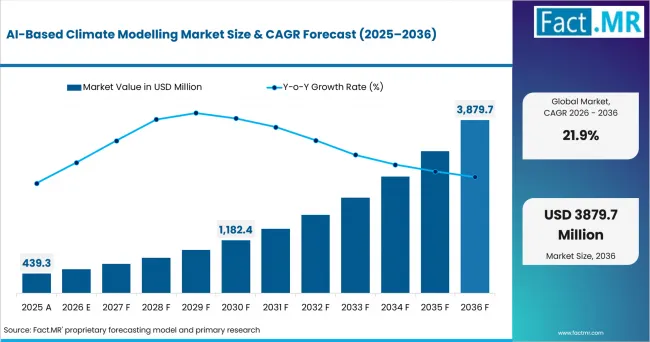
Ai Based Climate Modelling Market Market Value Analysis | Source: Fact.MR
What are the defining numbers behind AI-Based Climate Modelling Market growth?
USD 3,344.2 million absolute opportunity by 2036, led by Software, Cloud deployment and BFSI demand.
- Demand Drivers in the Market
- Climate-risk teams need traceable hazard scenarios because portfolio decisions depend on location-level exposure and repeatable assumptions.
- Public weather agencies need faster forecast cycles supported by models that combine observations with physics-based baselines and local calibration.
- Utility planners need probabilistic weather outlooks owing to renewable output swings and the operational cost of forecast error.
- Enterprise operations teams need interoperable climate data shaped by APIs that move model outputs directly into planning and alert workflows.
- Key Segments Analyzed
- By Component: Software is expected to account for 29.9% share in 2026, driven by recurring model execution and workflow integration needs.
- By Deployment: Cloud is projected to garner 40.5% share in 2026, supported by short periods of heavy computing demand and large observation archives.
- By Organization Size: SMEs are anticipated to record 48.0% share in 2026, owing to API access that reduces internal modelling infrastructure requirements.
- By Application: Workflow Automation is estimated to hold 33.2% share in 2026, attributable to recurring forecast refresh and alert routing tasks.
- By End Use: BFSI is forecast to capture 46.9% share in 2026, reinforced by asset exposure screening and catastrophe-risk decision support.
- Analyst Opinion at Fact.MR
- Shambhu Nath Jha, Senior Analyst at Fact.MR states, “The commercial bottleneck is proving performance under rare events while maintaining transparent records of model inputs and changes. Adoption is expected to favor providers that prove forecast skill across local hazards and document model updates clearly for enterprise review. Commercial credibility depends on combining forecast science with validation records and practical workflow integration across recurring risk decisions.”
- Strategic Implications
- Climate analytics developers should publish event-level validation results before asking enterprise accounts to replace established forecast inputs.
- Bank risk teams should separate short-horizon weather signals from long-horizon climate scenarios before embedding outputs in credit processes.
- Public weather agencies should test AI forecasts beside operational baselines before extending them into public warning or resource planning workflows.
- Cloud platform teams should place observation data near model execution because repeated data movement raises latency and operating cost.
Growing demand for higher-frequency weather intelligence is driving investments in next-generation observation systems and AI-enabled forecasting capabilities. Tomorrow.io announced DeepSky in January 2026, a space-based weather-sensing constellation designed for operational users across civilian weather agencies and severe-weather forecasting centers. The network combines proprietary satellite observations with AI-native weather modelling and a higher observation cadence for frequent forecast refresh. The development narrows the gap between observation collection and forecast delivery because model teams receive fresher atmospheric inputs beside a commercial forecasting platform.
India is projected to record 23.7% CAGR during the forecast period, driven by monsoon sensitivity and demand for localized planning tools. China is estimated to post 23.0% CAGR between 2026 and 2036, supported by national observation systems and industrial weather exposure. Australia is anticipated to achieve 21.7% CAGR by 2036, owing to utility planning and catastrophe-risk use cases. The United Kingdom is forecast to register 21.4% CAGR over the assessment period, reinforced by climate-service depth and insurance analytics. The United States is expected to record 21.2% CAGR across the forecast horizon, shaped by cloud access and enterprise physical-risk workflows.
How does the AI-Based Climate Modelling Market break down by segment?
Software is projected to account for 29.9% share; Cloud is estimated to garner 40.5% share.
Which Component dominates?
By component, software is expected to lead with 29.9% share in 2026
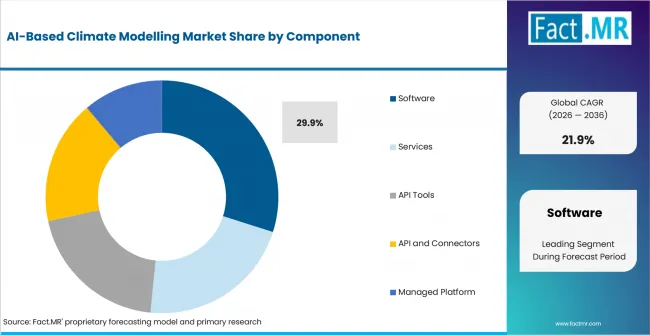
Ai Based Climate Modelling Market Analysis By Component | Source: Fact.MR
Software is forecast to capture 29.9% share in 2026 because enterprise teams need repeatable model runs inside risk and operations systems. Services support model calibration and validation for enterprise accounts where internal climate science teams remain small or focused on specific hazards. API Tools expose forecasts to applications while API and Connectors packages route model outputs into data platforms and alert workflows. Managed Platform offers combine hosting and operating support for organizations seeking less infrastructure ownership and fewer internal maintenance tasks. Microsoft reported in May 2025 that Aurora was trained on more than one million hours of atmospheric data before wider developer release.
How does Deployment shape demand?
Cloud is estimated to garner 40.5% share in 2026
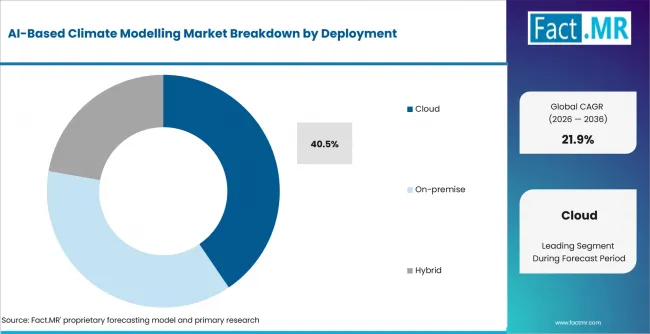
Ai Based Climate Modelling Market Analysis By Deployment | Source: Fact.MR
Cloud is expected to represent 40.5% share in 2026 owing to variable training loads and repeated forecast runs across many locations. On-premise deployment remains relevant for controlled data environments and public agencies with strict operating rules. Hybrid deployment connects internal systems to scalable cloud computing when training or high-resolution forecast workloads exceed available local capacity. NASA reported in March 2025 that its Earth science data archive had surpassed 123 petabytes by the end of 2024. That archive scale supports cloud processing for Earth observation systems and repeated climate model workflows across many locations.
What supports SME demand within Organization Size?
SMEs are anticipated to record 48.0% share in 2026
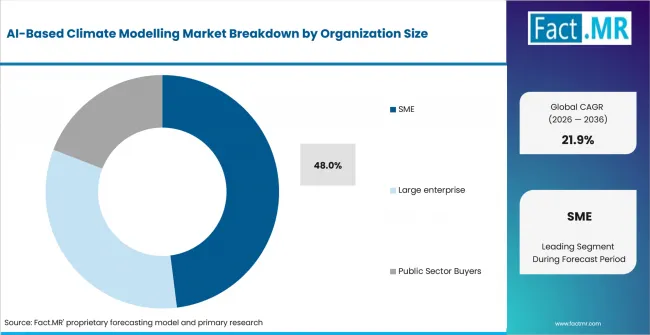
Ai Based Climate Modelling Market Analysis By Organization Size | Source: Fact.MR
SME accounts are projected to hold 48.0% share in 2026, supported by hosted access and narrow use cases that avoid full climate-science teams. Large enterprises need broader governance and integration across portfolios that span many assets and require consistent model controls across business units. Public Sector Buyers require audit trails and operational validation before model outputs enter service delivery. Open model tools also lower the entry barrier for smaller providers that specialize by hazard or industry. In February 2025, ECMWF described Anemoi as an open-source framework that supplies building blocks for training machine-learning weather models and running them operationally.
Which Application category carries the primary share?
Workflow Automation is forecast to capture 33.2% share in 2026
Workflow Automation is estimated to account for 33.2% share in 2026 because climate signals gain value after they reach operating decisions. Analytics supports deeper scenario comparison across hazards while Governance records model versions and assumptions for internal review and audit trails. Integration connects forecast outputs to asset systems while Compliance supports disclosure workflows and control evidence for regulated enterprise accounts. ECMWF moved its AI Forecasting System into operations in February 2025 and reported gains of up to 20% for tropical cyclone tracks. Operational forecast progress strengthens demand for automated geospatial solutions that connect hazard outputs to place-based planning and response actions.
How is BFSI positioned within End Use?
BFSI is expected to represent 46.9% share in 2026
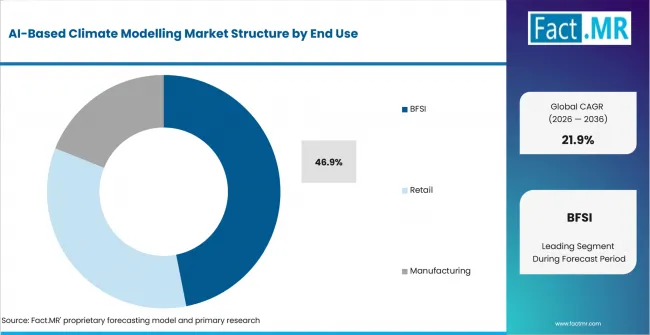
Ai Based Climate Modelling Market Analysis By End Use | Source: Fact.MR
BFSI is anticipated to garner 46.9% share in 2026 due to repeated exposure screening across loans and insured assets. Retail operations teams use localized weather signals for demand planning and network continuity across store footprints exposed to regional disruption. Manufacturing teams apply climate scenarios to production sites and supply routes where heat or flood disruptions create material continuity risk. In January 2025, NOAA identified 27 separate billion-dollar weather and climate disasters in the United States during 2024. More frequent event review expands the commercial role of physical climate risk adaptation advisory services and model-backed risk tools.
What is accelerating AI-Based Climate Modelling Market adoption, and what is holding it back?
Faster operational forecasting drives adoption across workflows; validation under unseen extremes restrains wider enterprise deployment.
Drivers Impact Analysis
| Driver | (~) % Impact on CAGR | Geographic Relevance | Impact Timeline |
|---|---|---|---|
| Extreme-weather decision lead time | +3.2% | Global | Short term (<= 2 years) |
| Operational AI forecast performance | +2.8% | North America and Europe | Medium term (2-4 years) |
| Earth observation data expansion | +2.3% | North America and Asia Pacific | Medium term (2-4 years) |
| Climate-risk governance workflows | +1.9% | North America, Europe and Asia Pacific | Medium term (2-4 years) |
| Weather-sensitive infrastructure planning | +1.5% | China, India and Australia | Long term (>= 4 years) |
Source: Fact.MR analysis. Updated Jul 9, 2026
- Extreme-weather decision lead time: Risk teams are shortening the path from forecast refresh to operational action because events shift asset exposure and response priorities quickly. In January 2025, WMO confirmed that the 2024 global average surface temperature was about 1.55°C above the 1850–1900 reference period. Faster climate analytics is expected to gain use where decisions depend on local thresholds and event timing. Providers still need event-level validation records before enterprise risk teams automate high-impact actions across exposed assets and operating networks.
- Operational AI forecast performance: AI forecast systems are moving from research tests into supported operations beside physics-based models. ECMWF reported in November 2025 that its ensemble AI system used up to 1,000 times less energy than traditional physics-based models. Lower execution cost is projected to expand forecast frequency and scenario breadth across enterprise accounts that review many exposed locations. Commercial users still compare forecast stability across different hazards before changing core risk processes or established operational decision thresholds.
- Earth observation data expansion: New satellite and sensor feeds are enlarging the raw material available for model training and assimilation. In February 2026, NASA estimated that NISAR L-band products would generate about 30 petabytes of data each year. Demand is anticipated to rise for systems that ingest these feeds without repeated manual data work. Providers that maintain traceable input records and consistent data preparation are likely to shorten validation cycles and reduce disputes about model input quality.
- Climate-risk governance workflows: Financial institutions and asset owners increasingly need repeatable assumptions across scenario runs and exposure updates. The model output alone is insufficient when teams cannot trace input versions or explain changes. Demand is estimated to favor software that records scenario lineage and validation evidence beside every forecast cycle. Governance capability becomes a practical sales requirement for regulated accounts that need repeatable model records and documented review paths.
- Weather-sensitive infrastructure planning: Utilities and infrastructure operators need localized forecasts because heat and rainfall changes affect demand and asset stress. In May 2025, WMO estimated a 70% chance that the 2025–2029 five-year average would exceed 1.5°C above the pre-industrial baseline. Planning use is forecast to broaden across grid operations and maintenance scheduling where weather uncertainty affects load and asset access. Local calibration remains necessary before model outputs enter dispatch decisions or other workflows where forecast error creates immediate operating consequences.
Opportunity Impact Analysis
| Opportunity | (~) % Impact on CAGR | Geographic Relevance | Impact Timeline |
|---|---|---|---|
| Probabilistic ensemble forecasting | +2.4% | Global weather services and BFSI | Short term (<= 2 years) |
| Hyperlocal downscaling | +1.9% | Australia, India and United States | Medium term (2-4 years) |
| Multi-sensor data assimilation | +1.5% | North America and Asia Pacific | Medium term (2-4 years) |
| Sector-specific workflow models | +1.2% | BFSI, retail and manufacturing | Long term (>= 4 years) |
Source: Fact.MR analysis. Updated Jul 9, 2026
- Probabilistic ensemble forecasting: Enterprise risk decisions need distributions of possible outcomes instead of one deterministic forecast. ECMWF placed AIFS ENS into operations in July 2025 as a 51-member collection of forecasts. Ensemble use is expected to expand where risk teams need confidence ranges and event alternatives. Commercial value rises when forecast probabilities map directly to asset thresholds and response playbooks that operations teams already understand and use.
- Hyperlocal downscaling: Regional climate outputs often remain too coarse for plant sites and urban assets. Climavision described Horizon AI Point in November 2025 as an asset-level forecasting product with hourly updates across a 15-day horizon. Localized modelling services are projected to attract enterprise accounts that need risk layers for facilities spread across varied terrain. Validation against local observations remains the deciding step before location-level outputs enter procurement decisions or operational response workflows.
- Multi-sensor data assimilation: Forecast quality depends on a credible estimate of the current atmosphere before prediction begins. In April 2026, The Weather Company licensed MITRE's Weather 1K AI training dataset to support national forecast accuracy work. Data-assimilation services are anticipated to gain value owing to demand for fresher starting states and clearer handling of sparse observations. Clear source records separate useful assimilation systems from mixed feeds that enterprise teams cannot reproduce during technical review.
- Sector-specific workflow models: Generic forecasts require translation before an airline or utility uses them inside planning and response decisions. DTN launched Weather Hub in July 2025 for hyperlocal forecasting and risk modelling across aviation and utilities alongside logistics workflows. Sector-specific packages are estimated to expand where model outputs connect directly to operating thresholds and response procedures. Industry calibration is central to renewal decisions after pilots because enterprise accounts judge whether forecasts improve a defined operating action.
Restraints Impact Analysis
| Restraint | (~) % Impact on CAGR | Geographic Relevance | Impact Timeline |
|---|---|---|---|
| Validation under unseen extremes | -1.8% | Global | Medium term (2-4 years) |
| Observation data continuity and traceability | -1.4% | Global public and enterprise users | Medium term (2-4 years) |
| Compute and recurring forecast cost | -1.0% | SME and public sector accounts | Short term (<= 2 years) |
| Model governance and reviewability | -0.8% | BFSI and regulated industries | Long term (>= 4 years) |
Source: Fact.MR analysis. Updated Jul 9, 2026
- Validation under unseen extremes: Climate models are judged most severely during rare events that are poorly represented in training history. In June 2025, Google DeepMind stated that Weather Lab remained a research tool and not an official warning service. Adoption is projected to remain selective for safety-critical workflows when independent verification and event-level benchmark evidence remain incomplete. Providers need broad event archives and transparent benchmark methods to reduce qualification friction across weather agencies and enterprise risk teams.
- Observation data continuity and traceability: Model output quality deteriorates when sensor feeds change without documented handling rules. Agencies and enterprise teams also need records explaining how missing observations were filled and how feed changes affected the model state. Adoption is anticipated to slow where providers cannot reproduce the data path behind a result. Clear traceability controls shorten technical review and reduce disputes after model updates change exposure scores or localized forecast results.
- Compute and recurring forecast cost: Training remains resource-intensive even when routine forecast runs become cheaper than full numerical simulation. Small providers still face cost pressure when they retrain often or serve many high-resolution locations. Demand is forecast to favor modular systems that separate expensive model training from routine forecast runs across recurring location-level services. Cloud architecture choices need to match forecast frequency and spatial detail so recurring computing costs remain aligned with commercial account value.
- Model governance and reviewability: Regulated teams need evidence that forecasts were produced under approved model versions and tested assumptions. Opaque model outputs create review delays when risk teams cannot explain why exposure ratings changed after a forecast or model update. Adoption is expected to favor systems that store benchmark results and model-version records beside outputs. Governance features therefore influence contract expansion after technical pilots because enterprise accounts need reproducible outputs before wider operational deployment.
Which countries are scaling AI-Based Climate Modelling Market fastest?
India 23.7%; China 23.0%; Australia 21.7%; United Kingdom 21.4%; United States 21.2%; Germany 20.9; Japan 20.6%.
AI-Based Climate Modelling Market is segmented into North America, Europe, Asia Pacific, Latin America, and the Middle East & Africa.
| Country | CAGR |
|---|---|
| India | 23.7% |
| China | 23.0% |
| Australia | 21.7% |
| United Kingdom | 21.4% |
| United States | 21.2% |
| Germany | 20.9% |
| Japan | 20.6% |
Source: Fact.MR analysis. Updated Jul 9, 2026
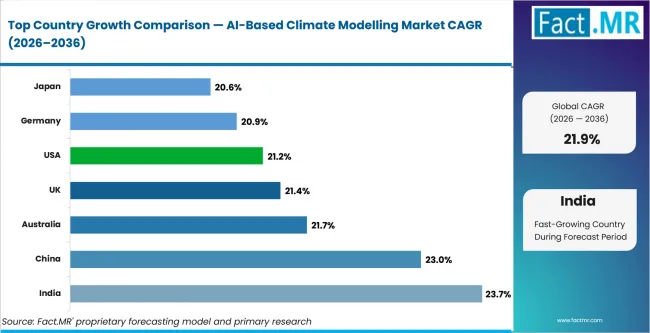
Ai Based Climate Modelling Market Cagr Analysis By Country | Source: Fact.MR
What is powering India's expansion?
23.7% CAGR, driven by monsoon sensitivity and localized planning requirements.
India needs climate models that resolve monsoon timing and regional heat because national averages hide operational differences across states. The market is projected to record 23.7% CAGR during the forecast period owing to demand for shorter update cycles across agriculture and infrastructure planning. In January 2026, the India Meteorological Department reported 2025 land temperature 0.28°C above the 1991–2020 average and reinforced the need for regional detail.
How is China scaling climate analytics demand?
23.0% CAGR, supported by observation scale and industry-specific weather exposure.
China combines extensive public weather infrastructure with manufacturing and energy systems exposed to local climate variability. The China Meteorological Administration released its Climate Bulletin 2025 in January 2026 to assess climate conditions and industry impacts. Demand is estimated to post 23.0% CAGR by 2036 owing to enterprise teams connecting national data resources with operational risk workflows.
What supports the Australia outlook?
21.7% CAGR, owing to catastrophe risk and weather-sensitive infrastructure planning.
Australia presents a clear use case for localized hazard modelling across utilities and insurance portfolios exposed to heat and rainfall extremes. Demand is anticipated to grow at a 21.7% CAGR over the assessment period due to demand for faster location-level scenario refresh. In February 2026, the Bureau of Meteorology reported the 2025 national average temperature 1.23°C above the 1961–1990 baseline and reinforced localized planning needs.
What underpins United Kingdom growth?
21.4% CAGR, reinforced by climate-service depth and insurance analytics.
The United Kingdom has established climate-service expertise and a dense insurance sector that reviews physical risk across asset portfolios. Met Office analysis in July 2025 found the 2015–2024 decade was 1.24°C warmer than the 1961–1990 baseline. The market is forecast to register 21.4% CAGR between 2026 and 2036 because model outputs are moving deeper into underwriting and infrastructure planning.
How is the United States building demand?
21.2% CAGR, shaped by cloud access and enterprise physical-risk workflows.
The United States combines hyperscale compute access with climate-tech development and a wide enterprise market for physical-risk analysis. Industry is expected to record 21.2% CAGR across the forecast horizon while operations teams embed localized hazard signals into asset review. In January 2025, NOAA reported the 2024 contiguous U.S. temperature 3.5°F above the twentieth-century average and reinforced routine scenario updates across asset portfolios.
Who leads the AI-Based Climate Modelling Market?
The Weather Company and Microsoft lead direct AI weather and climate model coverage, while Google DeepMind and Tomorrow.io strengthen probabilistic forecasting and operational weather intelligence.
The Weather Company described AI-supported decision recommendations and super-resolution forecasting in March 2026 for enterprise weather users. Microsoft opened a collaborative phase for Aurora in November 2025 to broaden weather and climate research across research communities. Google DeepMind released WeatherNext 2 in November 2025 through cloud-accessible data and inference channels for broader operational testing. These providers compete on forecast skill and deployment access while enterprise accounts compare integration depth and event-level validation evidence.
Tomorrow.io added AI-augmented workflows and the FOCUS model in July 2025 for operational decision support across weather-sensitive enterprise operations. Climavision extended AI-enhanced forecasts into energy-market workflows through Enverus in October 2025 for trading and operational planning teams. DTN integrated Earth-2 models into its forecast engine in September 2025 for sector-specific weather intelligence and recurring operating decisions. ECMWF added AIFS inputs to CEMS flood forecasting in September 2025 to support earlier flood-risk assessment across operational forecasting workflows. Competition is expected to center on event validation and traceable model records across recurring enterprise qualification and renewal decisions. Providers that connect climate outputs to automated weather observing systems and operating workflows gain a clearer renewal path.
Which companies are the key providers?
- The Weather Company
- Microsoft Corporation / Aurora
- Google DeepMind
- Tomorrow.io
- Climavision
- DTN
Bibliography
- Bureau of Meteorology. (2026, February 9). Annual climate statement 2025. Australian Government Bureau of Meteorology.
- Climavision. (2025, October 23). Energy traders gain access to hyper-local, AI-enhanced weather forecasts through Enverus—powered by Climavision. Climavision.
- DTN. (2025, September 22). DTN advances real-time weather intelligence with NVIDIA Earth-2 on AWS. DTN.
- European Centre for Medium-Range Weather Forecasts. (2025, February 25). ECMWF’s AI forecasts become operational. ECMWF.
- European Centre for Medium-Range Weather Forecasts. (2025, July 1). ECMWF’s ensemble AI forecasts become operational. ECMWF.
- European Centre for Medium-Range Weather Forecasts. (2025, October). AI takes CEMS flood forecasting into a new era. ECMWF.
- European Centre for Medium-Range Weather Forecasts. (2025, November 24). Simplifying AI for weather forecasting with the European Weather Cloud. ECMWF.
- Google DeepMind. (2025, November 17). WeatherNext 2: Our most advanced weather forecasting model. Google DeepMind.
- India Meteorological Department. (2026, January 1). Statement on the climate of India during 2025. Ministry of Earth Sciences, Government of India.
- Met Office. (2025, July 13). Annual climate stocktake shows weather records and extremes now the norm in UK climate. Met Office.
- Microsoft. (2025, May 21). From sea to sky: Microsoft’s Aurora AI foundation model goes beyond weather forecasting. Microsoft.
- Microsoft. (2025, November 13). The next phase of Aurora: Open and collaborative AI for weather and climate forecasting. Microsoft.
- National Aeronautics and Space Administration. (2025, March 5). Looking back on 2024: Highlights from NASA’s Earth Data Systems Program. NASA Earthdata.
- National Aeronautics and Space Administration. (2026, February 17). ROSES issues call for NISAR Earth observations research proposals. NASA Earthdata.
- National Centers for Environmental Information. (2025, January 10). Assessing the U.S. climate in 2024. National Oceanic and Atmospheric Administration.
- The Weather Company. (2026, March 20). AI in weather forecasting, prediction, and decision making. The Weather Company.
- Tomorrow.io. (2025, July 15). Supercharge your weather intelligence with agentic weather AI and Tomorrow.io’s FOCUS model. Tomorrow.io.
- World Meteorological Organization. (2025, January 10). WMO confirms 2024 as warmest year on record at about 1.55°C above pre-industrial level. WMO.
- World Meteorological Organization. (2025, May 28). Global climate predictions show temperatures expected to remain at or near record levels in coming 5 years. WMO.
- World Meteorological Organization. (2026, January 30). China Climate Bulletin 2025 rolled out. WMO.
This Report Addresses
- The report provides strategic intelligence on Component and Deployment choices that shape climate modelling procurement and operating architecture.
- Regional outlook evaluates India and China alongside Australia while the United Kingdom and United States complete the country comparison.
- Competitive analysis profiles The Weather Company and Microsoft beside Google DeepMind and Tomorrow.io while Climavision and DTN are also assessed. ECMWF completes the verified provider set through its operational deterministic and ensemble AI forecasting systems.
- Component assessment covers Software and Services while API Tools support programmatic access across enterprise forecast workflows. API and Connectors packages complete the delivery stack beside Managed Platform options for teams that need integration support and managed operations.
- Application assessment covers Workflow Automation and Analytics while Governance supports model control across enterprise review processes. Integration and Compliance define additional use cases for teams connecting climate outputs to operational systems and regulatory workflows.
What does the AI-Based Climate Modelling Market cover?
Software and Services beside API Tools, API and Connectors packages, and Managed Platforms used for climate forecasting and operational risk decisions.
The AI-Based Climate Modelling Market covers software and services that apply machine learning to weather and climate data for forecasting and scenario analysis. Coverage includes model execution and downscaling together with data assimilation and workflow delivery for enterprise risk teams and weather operations groups.
The market differs from the broader climate software category because value must come from modelled physical conditions or related hazard outputs. Carbon accounting platforms and generic ESG reporting tools remain outside the boundary unless they include a defined climate modelling engine used for risk analysis.
What is included in the scope?
AI-Based Climate Modelling systems used for forecasting and hazard analysis across climate-risk workflows and recurring operational planning decisions.
Scope includes Software and Services beside API Tools that support programmatic access across commercial climate modelling workflows. API and Connectors packages are covered when they move model outputs directly into enterprise operating systems and alert workflows. Managed Platforms are included when they execute or deliver climate model outputs as a commercial service. Deployment coverage includes Cloud and On-premise systems together with Hybrid architectures that bridge controlled environments and scalable cloud computing resources. Organization analysis covers SME accounts and Large Enterprises while Public Sector Buyers represent agencies and public operators. Application coverage includes Workflow Automation and Analytics beside Governance workflows while Integration and Compliance complete the defined application categories. End-use analysis focuses on BFSI and Retail while Manufacturing completes the commercial demand framework.
What is excluded from the scope?
Generic ESG reporting software and carbon accounting platforms remain outside the defined AI-based climate modelling market scope.
Generic reporting systems without a climate modelling engine are excluded even when they display climate-related disclosure fields. Standalone weather data feeds are also excluded unless the commercial product adds modelled forecasts or scenario outputs used for climate-risk decisions.
How was the analysis built?
120+ sources, 40+ company portfolios, 25+ countries, 20+ interviews.
- Primary Research
- Primary research includes interviews with climate modelling specialists, meteorological agencies, environmental researchers and AI solution providers. It also includes input from climate scientists, data engineers, cloud platform experts and public-sector stakeholders involved in climate forecasting, environmental risk assessment and sustainability planning.
- Desk Research
- Desk research reviews climate research publications, meteorological datasets, environmental policy frameworks, AI modelling platforms and company product portfolios. Government reports, scientific studies, climate monitoring initiatives and provider announcements are also assessed to evaluate market trends and competitive positioning.
- Market-Sizing and Forecasting
- Forecasting uses climate analytics adoption trends, investments in environmental monitoring, AI and high-performance computing deployment, climate risk management initiatives and demand for predictive modelling solutions across major regions. Models consider advances in machine learning, weather and climate forecasting requirements, sustainability programs and the growing need for climate intelligence across public and private sectors.
- Data Validation and Update Cycle
- Forecasts are validated through provider checks and industry interviews that test assumptions on technology adoption, climate analytics demand and modelling deployment trends. Portfolio mapping, regional climate technology assessment and stakeholder feedback help confirm market direction, while ongoing reviews of research developments, policy updates and product launches support forecast updates.
Segmentation
What is the report’s scope and coverage?
| Attribute | Details |
|---|---|
| Quantitative Units | USD Million |
| Market Definition | AI-based software and services that use machine learning to forecast weather or climate conditions and translate Earth-system data into operational risk decisions. |
| Component | Software; Services; API Tools; API and Connectors; Managed Platform |
| Deployment | Cloud; On-premise; Hybrid |
| Organization Size | SME; Large Enterprise; Public Sector Buyers |
| Application | Workflow Automation; Analytics; Governance; Integration; Compliance |
| End Use | BFSI; Retail; Manufacturing |
| Regions Covered | North America; Europe; Asia Pacific; Latin America; Middle East & Africa |
| Countries Covered | United States; Canada; United Kingdom; Germany; France; Netherlands; Spain; India; China; Japan; South Korea; Australia; Brazil; Mexico; Argentina; Chile; UAE; Saudi Arabia; South Africa |
| Key Companies Profiled | The Weather Company; Microsoft Corporation / Aurora; Google DeepMind; Tomorrow.io; Climavision; DTN |
| Forecast Period | 2026 to 2036 |
| Approach | Hybrid top-down and bottom-up approach using Earth observation data volumes; public weather-service AI deployment; cloud adoption mix; API penetration; workflow automation use; validation cycles and provider capability mapping |
Source: Fact.MR analysis. Updated Jul 9, 2026
How is the market segmented?
-
By Component
- Software
- Services
- API Tools
- API and Connectors
- Managed Platform
-
By Deployment
- Cloud
- On-premise
- Hybrid
-
By Organization Size
- SME
- Large Enterprise
- Public Sector Buyers
-
By Application
- Workflow Automation
- Analytics
- Governance
- Integration
- Compliance
-
By End Use
- BFSI
- Retail
- Manufacturing
-
By Region
- North America
- United States
- Canada
- Europe
- United Kingdom
- Germany
- France
- Netherlands
- Spain
- Asia Pacific
- India
- China
- Japan
- South Korea
- Australia
- Latin America
- Brazil
- Mexico
- Argentina
- Chile
- Middle East & Africa
- UAE
- Saudi Arabia
- South Africa
- North America
Frequently Asked Questions
Which Component leads the AI-Based Climate Modelling Market?
How is Cloud positioned in the AI-Based Climate Modelling Market?
Which Organization Size leads the AI-Based Climate Modelling Market?
Which Application leads the AI-Based Climate Modelling Market?
Which End-use Industry leads the AI-Based Climate Modelling Market?
Which country records the highest CAGR in the AI-Based Climate Modelling Market?
How does China perform in the AI-Based Climate Modelling Market?
How does Australia perform in the AI-Based Climate Modelling Market?
How does the United Kingdom perform in the AI-Based Climate Modelling Market?
How does the United States perform in the AI-Based Climate Modelling Market?
What is the primary driver in the AI-Based Climate Modelling Market?
Why is Software important in the AI-Based Climate Modelling Market?
Why do BFSI organizations dominate demand in the AI-Based Climate Modelling Market?
Who worked on this report


Preview the report firsthand - request a free sample
Free SampleGet the brochure for pricing and purchase details
Download PDF