- Market Value (2025): USD 421.9 Mn
- Estimated Value (2026): USD 540.0 Mn
- Forecast Value (2036): USD 6375.0 Mn
- CAGR (2026-2036): 28.0%
What is the AI Formulation Assistants Market forecast to be worth by 2036?
USD 540.0 million in 2026 to USD 6,375.0 million by 2036 at a 28.0% CAGR.
- The AI formulation assistants market reached USD 421.9 million in 2025.
- Demand is projected to increase from USD 540.0 million in 2026 to USD 6,375.0 million by 2036.
- The market is forecast to record a 28.0% CAGR from 2026 to 2036 as formulation scientists and product teams use governed assistants for recipe design and laboratory prioritization.
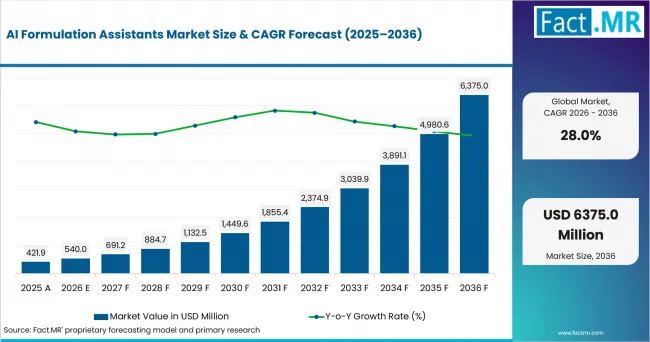
Ai Formulation Assistants Market Value Analysis | Source: Fact.MR
What are the defining numbers behind AI Formulation Assistants Market growth?
An absolute opportunity of USD 5,835.0 million is expected between 2026 and 2036.
- Demand Drivers in the Market
- Formulation scientists need shorter experiment cycles. NCSES reported in May 2026 that U.S. businesses invested USD 65 billion in AI R&D during 2023, indicating a substantial business base for AI research and development.
- Chemical R&D leaders need assistants tied to active production categories. The U.S. Census Bureau reported in March 2026 that chemical manufacturing had 14,961 establishments in 2022.
- R&D data teams need structured formula histories because assistant quality depends on clean ingredient, process and test records.
- Product managers need faster comparison of substitutions when cost, availability or customer specification limits change during development.
- IT owners need permission-aware assistant workflows that protect recipe libraries and customer briefs across distributed research groups.
- Key Segments Analyzed
- By Offering: Software platform is expected to hold 46.0% share in 2026 because scientific users need one workbench for data search, experiment design and formula review.
- By Deployment: Cloud is projected to account for 48.0% share in 2026, supported by multi-site R&D access and easier model updates.
- By Capability: Forecasting is anticipated to capture 37.0% share in 2026 since formulation teams need predicted performance before ordering the next test.
- By Customer: Large enterprise is estimated to represent 36.0% share in 2026 owing to larger formula libraries and dedicated digital R&D teams.
- Analyst Opinion at Fact.MR
- Shambhu Nath Jha, Principal Consultant at Fact.MR, states, “The commercial test for formulation assistants is trust in the experiment record. A platform is expected to gain budget when it shows why a recipe was recommended and how prior test data shaped the answer. Suppliers should combine recipe data models, permission control and explainable experiment planning so scientists can use AI while preserving scientific judgment.”
- Strategic Implications
- Platform vendors should make data migration part of rollout planning. Benchling said in May 2025 that its Moderna collaboration covers system consolidation, workflow automation and AI-ready data.
- Materials AI vendors should show how a predicted formula moves from recommendation to a recorded laboratory experiment.
- R&D leaders should standardize ingredient dictionaries before assistant deployment, since mismatched names can weaken search and forecasting results.
- IT teams should define role-based access before connecting assistants to shared R&D stores and contract-specific formula records.
South Korea is projected to record 35.6% CAGR through 2036, supported by AI compute expansion and industrial AI funding. The USA is expected to post 34.4% CAGR due to chemical R&D depth and enterprise software readiness. Japan is forecast to reach 32.9% CAGR, backed by AI infrastructure policy and scientific data programs. Germany is anticipated to advance at 25.5% CAGR as industrial AI cloud capacity expands. The UK is estimated to record 24.9% CAGR with public compute investment and research spending support.
How does the AI Formulation Assistants Market break down by segment?
Software platform leads Offering at 46.0%; Cloud leads Deployment at 48.0%.
Which Offering dominates?
Software platform is expected to hold 46.0% share in 2026.
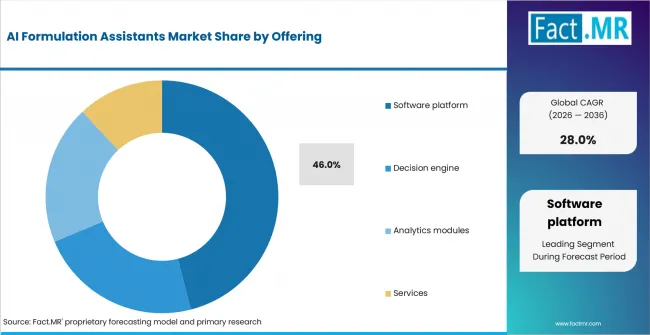
Ai Formulation Assistants Market Analysis By Offering | Source: Fact.MR
Software platforms lead because formulation teams want assistants inside the same environment that stores ingredient data, test results and project context. Citrine Informatics launched Catalyst and Apex in July 2026 to help materials and chemistry product-development teams move from product goals to suggested experiments in minutes. The company reported that 550 AI models are deployed and 70,000 experiment suggestions are generated each month, demonstrating substantial platform usage across AI-assisted materials and chemistry development.
What leads the Deployment segment?
Cloud is projected to account for 48.0% share in 2026.
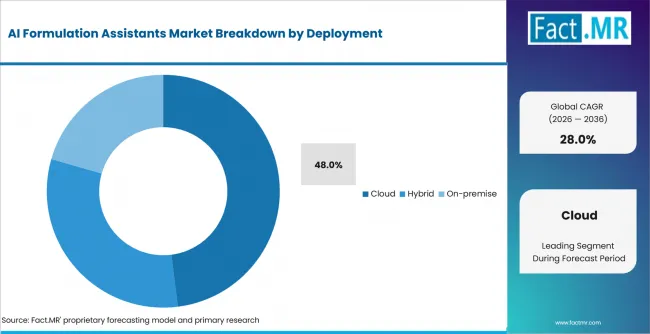
Ai Formulation Assistants Market Analysis By Deployment | Source: Fact.MR
Cloud deployment leads because multinational R&D groups need controlled access across locations and lower local model-stack work. Benchling AI launched in October 2025 as a command center for scientific AI within the Benchling platform, bringing agents, models and scientific data into connected R&D workflows. Its capabilities include data retrieval, experimental documentation and access to scientific AI models within an administratively controlled platform, making it applicable to R&D teams seeking governed AI-assisted workflows.
How does Capability shape demand?
Forecasting is anticipated to capture 37.0% share in 2026.
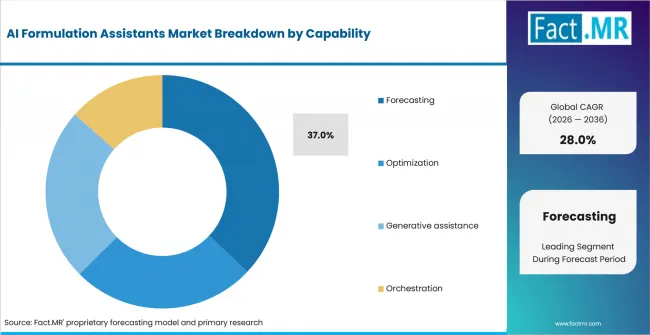
Ai Formulation Assistants Market Analysis By Capability | Source: Fact.MR
Forecasting leads because formulation teams use assistants to narrow the test queue before materials are ordered or pilot runs are scheduled. Predicted stability, texture, viscosity or performance outcomes help scientists compare options earlier. Assistants gain credibility when recommendations can be traced to prior experiments and when proposed formulas remain inside approved ingredient limits.
What supports Large enterprise within Customer?
Large enterprise is estimated to represent 36.0% share in 2026.
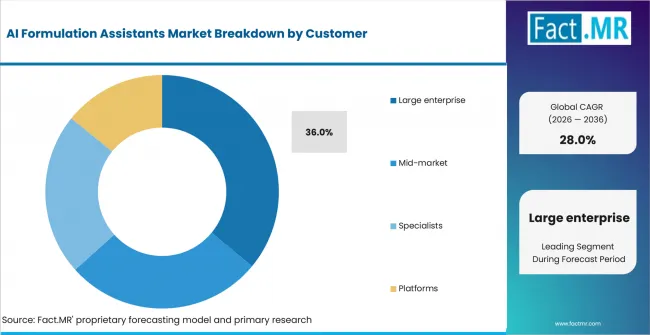
Ai Formulation Assistants Market Analysis By Customer | Source: Fact.MR
Large enterprises lead because they hold wider formula libraries and run R&D across many product lines. Albert Invent announced an AI transformation partnership with AkzoNobel in July 2026. The program covers a coatings research network of more than 2,000 R&D professionals across 70 laboratories in over 20 countries, providing a large-scale use case for connected laboratory workflows, structured scientific data and shared R&D knowledge.
What is accelerating AI Formulation Assistants Market adoption, and what is holding it back?
Demand is expected to rise through AI-ready R&D data, cloud collaboration and forecast-led experiment planning. Adoption is constrained by data cleanup, IP controls and validation workload.
Drivers Impact Analysis
| DRIVER | (~) % IMPACT ON CAGR | GEOGRAPHIC RELEVANCE | IMPACT TIMELINE |
|---|---|---|---|
| AI-ready formulation data migration | +2.5% | North America, Europe, East Asia | Short term (<= 2 years) |
| Cloud-based multi-site R&D collaboration | +1.9% | Global | Medium term (2-4 years) |
| Forecast-led experiment planning | +1.6% | Global | Short term (<= 2 years) |
| Enterprise scientific AI governance | +1.1% | North America, Western Europe | Long term (>= 4 years) |
- AI-ready formulation data migration: Older experiment records become more valuable when they are normalized into searchable formula and test-result fields.
- Cloud-based multi-site R&D collaboration: Distributed research teams can share assistant access across product groups while keeping permissions tied to formula ownership.
- Forecast-led experiment planning: Predictive ranking helps scientists reduce low-value tests and focus laboratory time on recipes with higher expected performance.
- Enterprise scientific AI governance: Clear audit trails increase buyer comfort where recommendations influence regulated products or customer-specific formulations.
Opportunity Impact Analysis
| OPPORTUNITY | (~) % IMPACT ON CAGR | GEOGRAPHIC RELEVANCE | IMPACT TIMELINE |
|---|---|---|---|
| Generative assistance for formulation search | +1.7% | North America, East Asia | Short term (<= 2 years) |
| Specialty chemicals and coatings workflow expansion | +1.2% | Global | Medium term (2-4 years) |
| Laboratory workflow connectors | +0.8% | Europe, North America | Long term (>= 4 years) |
- Generative assistance for formulation search: Albert launched Ask Albert in August 2026 to surface scientific knowledge and execute chemistry R&D tasks inside enterprise data boundaries.
- Specialty chemicals and coatings workflow expansion: Formula-heavy product categories give assistants a repeatable role in substitution review, performance forecasting and claim support.
- Laboratory workflow connectors: Assistants are expected to gain share when they move instructions and results between ELN, LIMS and project systems with fewer manual steps.
Restraints Impact Analysis
| RESTRAINT | (~) % IMPACT ON CAGR | GEOGRAPHIC RELEVANCE | IMPACT TIMELINE |
|---|---|---|---|
| Fragmented historical laboratory records | -0.9% | Global | Short term (<= 2 years) |
| Restricted formulation IP and data residency | -0.6% | Europe, North America, Japan | Medium term (2-4 years) |
| Validation workload for recommended formulas | -0.5% | Global | Long term (>= 4 years) |
- Fragmented historical laboratory records: Legacy notebooks, spreadsheets and instrument exports require cleanup before assistants can search them reliably.
- Restricted formulation IP and data residency: Proprietary recipes and customer-specific briefs require permission controls before broad assistant access is approved.
- Validation workload for recommended formulas: Scientists still need wet-lab confirmation, stability checks and quality review before AI-ranked recipes move toward launch.
Which countries are scaling the AI Formulation Assistants Market through 2036?
- The country comparison spans 10.7 percentage points between South Korea and the UK across the forecast period.
- South Korea remains 1.2 percentage points above the USA due to AI compute expansion and industrial AI budget support.
- The USA remains 1.5 percentage points above Japan as chemical R&D, software spending and enterprise data assets support formulation assistants.
- Japan remains 7.4 percentage points above Germany because AI infrastructure policy and government generative AI use improve institutional readiness.
- Germany remains 0.6 percentage point above the UK as industrial AI infrastructure and R&D expenditure support controlled deployment.
Comparable CAGRs create different entry conditions due to compute availability, formulation data quality, laboratory workflow maturity and enterprise AI governance. Full report coverage includes North America, Latin America, Western Europe, Eastern Europe, East Asia, South Asia & Pacific, Middle East & Africa.
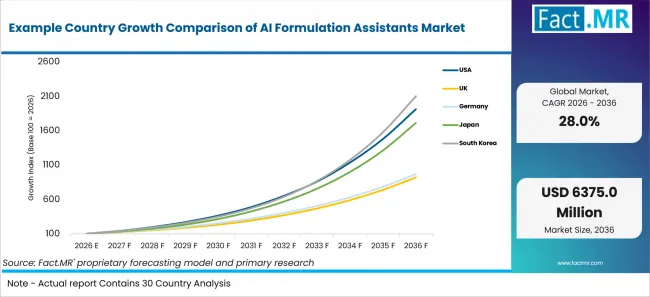
Example Country Growth Comparison Of Ai Formulation Assistants Market | Source: Fact.MR
| Country | CAGR (2026-2036) |
|---|---|
| South Korea | 35.6% |
| USA | 34.4% |
| Japan | 32.9% |
| Germany | 25.5% |
| UK | 24.9% |
What supports South Korea adoption?
35.6% CAGR, supported by AI compute expansion and industrial AI funding.
South Korea is building the compute base needed for model-assisted industrial R&D. MSIT announced in February 2025 that the government aimed to secure 18,000 high-performance GPUs by the first half of 2026. Korea.net reported in November 2025 that the proposed 2026 budget allocated KRW 10.1 trillion toward AI transformation, including KRW 2.6 trillion for AI adoption across industry, daily life and public services and KRW 7.5 trillion for talent development and infrastructure. Formulation assistants are expected to benefit where chemicals, coatings and beauty manufacturers connect proprietary laboratory records with secure assistant workflows.
What supports USA adoption?
34.4% CAGR, backed by chemical R&D depth and enterprise software readiness.
The USA has large industrial and software-oriented R&D pools for formulation assistants. The U.S. Census Bureau reported in March 2026 that chemical manufacturing value of shipments reached USD 901.0 billion in 2022. NCSES reported in May 2026 that chemicals manufacturing accounted for 19% of U.S. business R&D in 2023.
How is Japan scaling demand?
32.9% CAGR, led by AI infrastructure support and public-sector generative AI use.
Japan is pairing AI infrastructure policy with public-sector experimentation. METI’s webpage on the AI and Semiconductor Industry Foundation Strengthening Framework, last updated in May 2026, states that Japan will provide more than JPY 10 trillion in public support for the AI and semiconductor sectors through fiscal 2030. Japan’s Digital Agency stated in May 2026 that the Government AI GENAI pilot would be accessible to approximately 100,000 government employees starting May 29, 2026.
What supports Germany adoption?
25.5% CAGR, supported by industrial AI infrastructure and R&D intensity.
Germany’s adoption path is tied to industrial AI and high research spending. Destatis reported in March 2026 that German business R&D spending reached EUR 92.5 billion in 2024. Formulation assistants are expected to find demand among chemical and materials producers that require experiment traceability, secure data access and repeatable model review.
What supports the UK outlook?
24.9% CAGR, shaped by public compute expansion and R&D investment.
The UK is improving access to the computing and research base needed for scientific assistants. ONS reported in August 2026 that UK gross domestic R&D expenditure reached GBP 79.4 billion in 2024. The UK Compute Roadmap commits up to GBP 2 billion by 2030, including an expansion of the AI Research Resource by 20x. Formulation teams in chemicals, cosmetics, food ingredients and life sciences are expected to use assistants for faster review of older experiments and customer briefs.
Who leads the AI Formulation Assistants Market?
Uncountable is an active provider through an R&D data platform that connects formulation records, product development workflows and AI assistance. Bodie strengthens its position because the assistant works inside the company’s existing product data environment and supports scientist-facing tasks such as data search, experiment planning and visualization.
Citrine Informatics competes through materials and chemicals AI built around product targets and experiment suggestions. Albert Invent focuses on chemistry-native AI and enterprise R&D operating systems. Benchling extends scientific AI into life science workflows, while Dassault Systèmes and Siemens AG bring industrial AI orchestration into broader engineering and product lifecycle settings. Siemens AG launched Intelligence Center X in June 2026 to connect industrial data, workflows and AI agents within a governed enterprise system.
Which companies are the key providers?
Key companies include Uncountable; Citrine Informatics; Albert Invent; Dassault Systèmes; Siemens AG; and Benchling.
- Uncountable
- Citrine Informatics
- Albert Invent
- Dassault Systèmes
- Siemens AG
- Benchling
Bibliography
- Albert Invent. (2026, July 9). AkzoNobel accelerates R&D innovation with Albert Invent.
- Albert Invent. (2026, August 19). Albert launches first chemistry-native AI built for enterprise R&D.
- Benchling. (2025, May 6). Benchling and Moderna collaborate on AI-driven research.
- Benchling. (2025, October 7). Introducing Benchling AI.
- Citrine Informatics. (2026, July 7). Citrine launches Catalyst and Apex to make AI easier for materials and chemicals experts to use and trust.
- Department for Science, Innovation and Technology, & UK Research and Innovation. (2025, July 17). UK Compute Roadmap. GOV.UK.
- Digital Agency. (2026, May 28). Launch of Large-Scale Pilot Project for “Government AI GENAI” Targeting 180,000 Employees Across All Ministries and Agencies.
- Statistisches Bundesamt. (2026, March 27). 3,8 % mehr Ausgaben für Forschung und Entwicklung im Jahr 2024 [3.8% more expenditure on research and development in 2024].
- Ministry of Science and ICT. (2025, February 20). Korea to expand AI computing infrastructure to strengthen national AI capabilities and achieve global leadership.
- National Science Board. (2026, May 4). The State of U.S. Science and Engineering 2026. National Center for Science and Engineering Statistics, U.S. National Science Foundation.
- Office for National Statistics. (2026, August 7). Gross domestic expenditure on research and development, UK: 2024.
- Siemens. (2026, June 1). Siemens powers the next phase of industrial AI with Intelligence Center X.
- Uncountable. (2026, June 22). Uncountable launches Bodie, an AI assistant that changes how scientists work.
This Report Answers
- The report explains where formulation assistants are used across Offering and Deployment. It also covers Capability and Customer, together with regional coverage.
- Segment analysis identifies the leading subsegments and the operational reasons scientific teams prioritize them.
- Country analysis examines the listed markets and the infrastructure or R&D mechanisms supporting AI-assisted formulation work.
- Competitive analysis reviews current providers across formulation platforms, materials AI, scientific AI and industrial AI orchestration.
- Application analysis assesses how forecasting, optimization and generative assistance influence recipe screening and experiment planning.
What does the AI Formulation Assistants Market cover?
The AI Formulation Assistants Market covers software that helps scientific teams turn formulation records into searchable knowledge and suggested experiments. It overlaps with materials informatics when predictive models guide chemistry or materials targets.
The assessment covers assistants used in chemical and coatings workflows. It also covers cosmetic, food ingredient and life science formulation work. Related data-management categories include enterprise laboratory informatics when the buying need centers on lab records and controlled experiment data.
What is included in the scope?
The scope includes licensed or subscription formulation-assistant software, commercial platforms built around chemistry and materials data, and cloud services where AI recommendation is a core function. Cosmetic use cases connect with cosmetic chemicals when brands screen ingredients for texture, stability and performance.
It includes forecasting, optimization, generative assistance and orchestration tools used by product developers and R&D teams. Manufacturing-related adoption has a link with cosmetic manufacturing when development teams connect laboratory decisions with repeatable production needs.
What is excluded from the scope?
The scope excludes general chatbots, base-model development and raw cloud compute sold as infrastructure alone. Knowledge retrieval functions are covered when they support formula decisions, while broader knowledge management categories remain outside the core market.
Generic content ingestion tools are excluded when they organize documents outside experiment and formulation workflows. Related content analytics discovery software is adjacent when it structures unprocessed R&D documents.
How Was the Analysis Built?
The analysis draws on 120+ information inputs and 35+ company portfolio checks. It also reviews 25+ countries and more than 20 industry interviews.
- Primary Research: Primary research includes discussions with software vendors and R&D leaders. It also covers formulation scientists, product developers, IT teams and procurement teams. These conversations examine purchasing priorities and workflow needs. They also review approval requirements, competitive positioning and factors that influence wider adoption.
- Desk Research: Desk research reviews government statistics and regulatory publications. It also covers company filings, technical studies, industry associations, standards, public policy and company announcements. Every item used in the analysis is listed in the bibliography.
- Market Sizing and Forecasting: Market estimates combine historical performance and software adoption. They also review R&D spending indicators, segment shares, country-level growth, deployment patterns and provider activity.
- Data Validation and Update Cycle: Findings are validated by comparing interviews with public data, company activity, regulatory changes and industry developments. Regular updates review product launches, platform expansions, partnerships, procurement trends and shifts in commercial use.
What is the report’s scope and coverage?
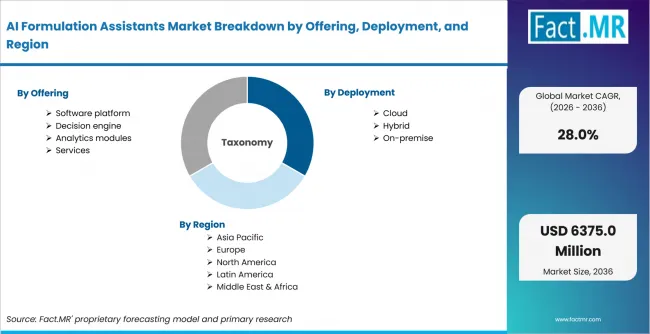
Ai Formulation Assistants Market Breakdown By Offering, Deployment, And Region | Source: Fact.MR
| Attribute | Details |
|---|---|
| Quantitative Units | USD million |
| Market Definition | Software used to support formulation work by searching experiment records, forecasting recipe performance, recommending experiments and guiding scientific decisions inside governed R&D workflows. |
| Offering | Software platform; Decision engine; Analytics modules; Services |
| Deployment | Cloud; Hybrid; On-premise |
| Capability | Forecasting; Optimization; Generative assistance; Orchestration |
| Customer | Large enterprise; Mid-market; Specialists |
| Regions Covered | North America; Latin America; Western Europe; Eastern Europe; East Asia; South Asia & Pacific; Middle East & Africa |
| Countries Covered | United States; United Kingdom; Germany; Japan; South Korea |
| Key Companies Profiled | Uncountable; Citrine Informatics; Albert Invent; Dassault Systèmes; Siemens AG; Benchling |
| Forecast Period | 2026 to 2036 |
| Approach | Hybrid top-down and bottom-up approach using scientific software adoption, R&D data readiness, deployment mix, capability use, country adoption and provider portfolio review. |
How is the market segmented?
-
By Offering:
- Software platform
- Decision engine
- Analytics modules
- Services
-
By Deployment:
- Cloud
- Hybrid
- On-premise
-
By Capability:
- Forecasting
- Optimization
- Generative assistance
- Orchestration
-
By Customer:
- Large enterprise
- Mid-market
- Specialists
-
By Region:
- North America
- Latin America
- Western Europe
- Eastern Europe
- East Asia
- South Asia & Pacific
- Middle East & Africa