- Market Value (2025): USD 1.1 Bn
- Estimated Value (2026): USD 1.2 Bn
- Forecast Value (2036): USD 2.1 Bn
- CAGR (2026-2036): 5.8%
What is the Air Dry Clay Market forecast to be worth by 2036?
USD 1.2 billion in 2026 to USD 2.1 billion by 2036 at 5.8% CAGR.
- The air dry clay market reached USD 1.1 billion in 2025 as no-kiln formats kept the category accessible for homes and classrooms.
- Demand is projected to increase from USD 1.2 billion in 2026 to USD 2.1 billion by 2036.
- The market is forecast to record 5.8% CAGR from 2026 to 2036 owing to repeat craft use and school supply replenishment.
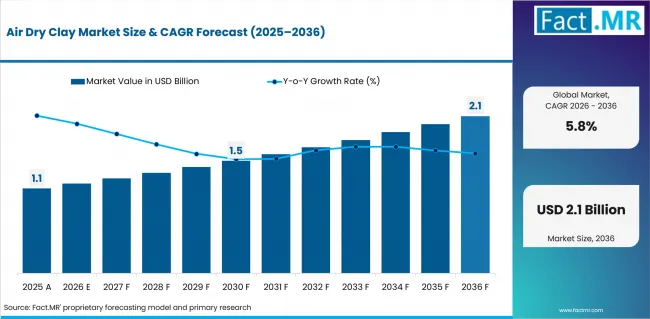
Air Dry Clay Market Value Analysis | Source: Fact.MR
What are the defining numbers behind Air Dry Clay Market growth?
USD 0.9 billion absolute opportunity by 2036, led by Natural Air Dry Clay and Arts & Crafts alongside Educational Institutions and Offline Retail Stores.
- Demand Drivers in the Market
- No-kiln hardening is expected to keep Natural Air Dry Clay attractive for homes and classrooms. Users can finish projects without pottery equipment, which lowers the first-use barrier.
- Arts & Crafts applications are projected to benefit from repeat-use occasions in school projects and home decor. Brands with easy texture and resealable packs are expected to gain better shelf movement.
- Offline Retail Stores are expected to remain important when clay purchases depend on touch and quick replacement. Retailers can improve conversion through clear labels and project examples.
- Educational Institutions are anticipated to support steady volume when pack sizes match class activities and clean-up needs. Procurement review is expected to favor clear age guidance and drying instructions.
- Key Segments Analyzed
- By Product Type: Natural Air Dry Clay is projected to hold 37.0% share in 2026 because it removes kiln access as a purchase barrier. Stone Clay remains in use where users want a heavier material feel.
- By Application: Arts & Crafts is expected to account for 30.5% share in 2026 as the segment pairs classroom work with home hobby projects. DIY Projects support smaller pack demand.
- By End User: Educational Institutions are anticipated to hold 29.9% share in 2026 through recurring classroom use. Schools and Colleges require pack formats that fit lesson timing.
- By Distribution Channel: Offline Retail Stores are estimated to capture 30.3% share in 2026 due to in-store product comparison. Art Supply Stores support replenishment purchases.
- By Packaging Type: Individual Packs are forecast to hold 37.5% share in 2026 because single-pack formats lower trial risk. Small Packs remain useful for repeat hobby users.
- Analyst Opinion at Fact.MR
- Shambhu Nath Jha, Senior Analyst at Fact.MR, states, “Air dry clay companies must make the first project easier to complete. Demand is expected to depend on clear labeling, pack convenience and repeat-use occasions inside schools and homes.”
- Strategic Implications
- Retailers should place Natural Air Dry Clay near project-based art supplies so customers can build a full basket. Product education should explain drying time and storage clearly.
- Manufacturers can strengthen selection by aligning pack size with classroom and hobby use cases. Clear age guidance is expected to matter when parents and schools compare similar clay products.
- Investors should read the USA and Japan spread through channel execution instead of product novelty. Revenue quality is expected to improve where brands prove repeat purchase and reliable handling.
The U.S. Census Bureau reported in July 2026 that U.S. retail and food services sales reached USD 768.6 billion in June 2026. The figure supports channel-focused analysis because craft products depend on visible shelf placement before household customers compare small items.
The USA is expected to record a 7.5% CAGR from 2026 to 2036 through retail depth and repeat-use demand. Japan is projected to record a 6.9% CAGR as compact pack formats support Arts & Crafts use. Germany is anticipated to grow at 6.4% through institutional review and art-material standards. The UK is estimated to post a 5.8% CAGR through retail comparison and school-use purchases. Canada is forecast at 5.2% through service coverage across dispersed customers. Australia is projected to reach 4.6% through dependable supply and compact store formats. Brazil is estimated to record 4.0% CAGR through regional distributor availability and price sensitivity.
How does the Air Dry Clay Market break down by segment?
Natural Air Dry Clay is expected to lead Product Type at 37.0% share in 2026. Arts & Crafts is projected to lead Application at 30.5% share in 2026.
Why does Natural Air Dry Clay lead Product Type?
Natural Air Dry Clay holds 37.0% share in 2026.
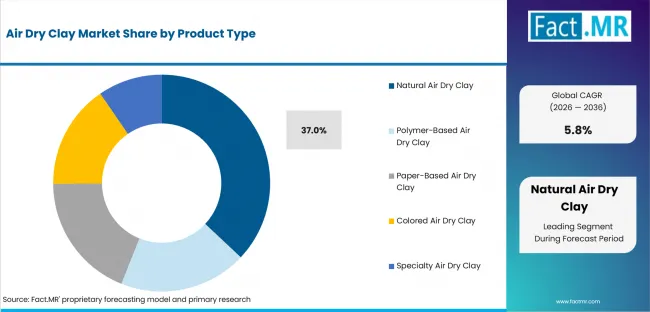
Air Dry Clay Market Analysis By Product Type | Source: Fact.MR
Natural Air Dry Clay gains preference through easy shaping and natural drying. Users can complete craft projects without kilns or pottery tools, making the material suitable for beginners and casual hobbyists. Stone Clay and Pottery Clay remain relevant for buyers seeking denser textures, firmer forms, or more traditional finishes.
What makes Arts & Crafts the leading Application?
Arts & Crafts lead with 30.5% share in 2026.
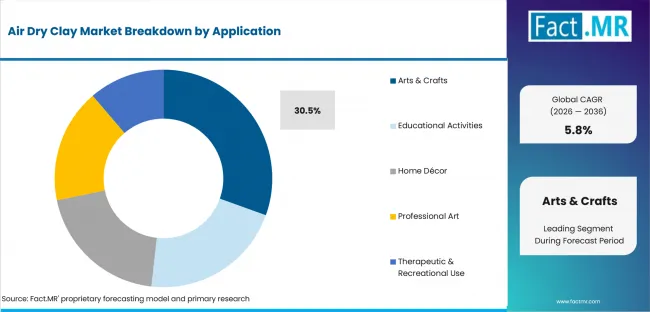
Air Dry Clay Market Analysis By Application | Source: Fact.MR
Arts & Crafts hold the largest share as the clay supports decorative pieces, handmade gifts, school assignments, and hobby work. Its flexible use across many project types broadens demand. DIY Projects also contribute through compact kits, guided activities, and simple formats designed for convenient use at home.
How do Educational Institutions dominate End User?
Educational Institutions account for 29.9% share in 2026.
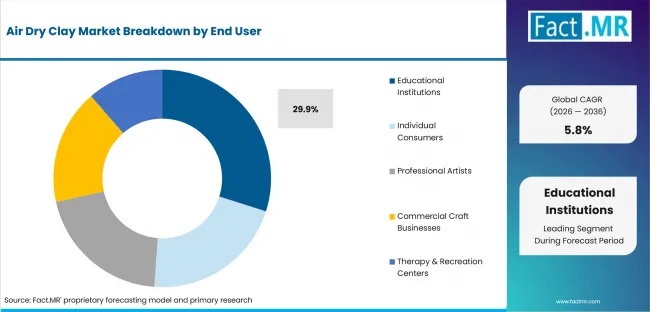
Air Dry Clay Market Analysis By End User | Source: Fact.MR
Educational Institutions generate regular demand since clay is commonly used in art lessons, workshops, and group activities. Schools often purchase planned quantities for several students, creating repeat orders. Colleges add further use through model making, design practice, creative clubs, and project-based learning across different courses.
What keeps Offline Retail Stores ahead in Distribution Channel?
Offline Retail Stores are projected to account for 30.3% share in 2026.
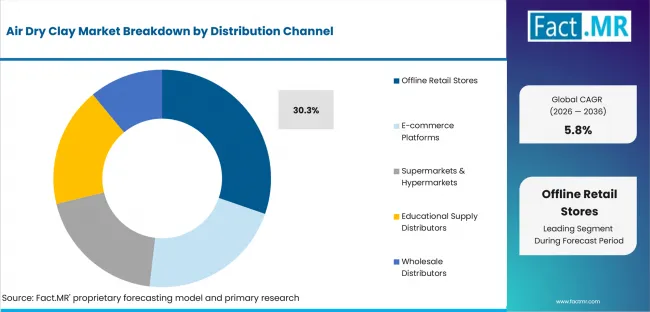
Air Dry Clay Market Analysis By Distribution Channel | Source: Fact.MR
Offline Retail Stores remain ahead due to the opportunity to inspect softness, texture, color, and pack size before buying. Immediate availability also supports urgent school or home projects. Art Supply Stores strengthen this channel by offering specialist products, staff guidance, and convenient access to replacement packs.
Why are Individual Packs preferred in Packaging Type?
Individual Packs hold 37.5% share in 2026.
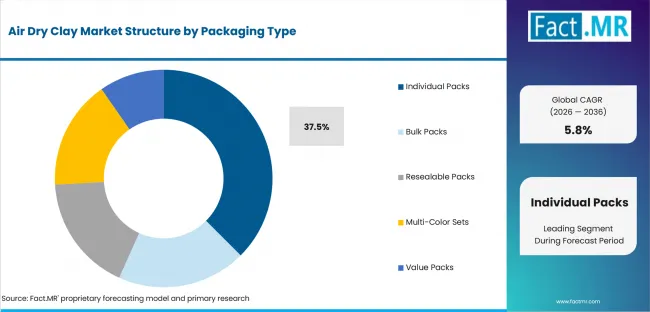
Air Dry Clay Market Analysis By Packaging Type | Source: Fact.MR
Individual Packs attract buyers by keeping purchase costs low and matching small project requirements. Their compact size supports easy storage and allows first-time users to test the product. Medium Packs and Bulk Packs continue to serve schools, frequent crafters, workshops, and users handling larger or repeated activities.
What is accelerating Air Dry Clay Market adoption, and what is holding it back?
Natural air dry clay specification pull is expected to remain the main demand force because product simplicity supports school and home use. Adoption is anticipated to face restraint from private-label competition and changing discretionary spending.
Drivers Impact Analysis
| DRIVER | QUALITATIVE RELEVANCE | GEOGRAPHIC RELEVANCE | IMPACT TIMELINE |
|---|---|---|---|
| Natural air dry clay specification pull | High | USA | Short term (<= 2 years) |
| Arts & crafts repeat-use occasion | High | Japan | Short term (<= 2 years) |
| USA route-to-market activity | Moderate | USA | Medium term (2-4 years) |
| Educational institutions packaging and shelf conversion | Selective | UK | Medium term (2-4 years) |
Source: Fact.MR analysis. Updated Jul 28, 2026
- Natural air dry clay specification pull: Demand depends on whether brands explain material feel and drying behavior clearly. Products with simple instructions are expected to move faster through classrooms and beginner craft use.
- Arts & crafts repeat-use occasion: Demand is expected to improve when clay packs match seasonal projects and school assignments. Repeat use becomes easier when the material is forgiving for beginners.
- USA route-to-market activity: Retail execution matters where customers expect fast replacement and clear shelf comparison. Brands are expected to benefit when stores present clay with tools and finishing supplies.
- Educational institutions packaging and shelf conversion: Classroom demand is expected to favor packs that reduce waste and simplify storage. Clear front-pack instructions help teachers and parents select the right format faster.
Opportunity Impact Analysis
| OPPORTUNITY | QUALITATIVE RELEVANCE | GEOGRAPHIC RELEVANCE | IMPACT TIMELINE |
|---|---|---|---|
| Arts & crafts occasion-led assortments | High | USA | Medium term (2-4 years) |
| Private-label partnerships | Moderate | Japan | Medium term (2-4 years) |
| Natural air dry clay bundle formats | Selective | Germany | Medium term (2-4 years) |
Source: Fact.MR analysis. Updated Jul 28, 2026
- Arts & crafts occasion-led assortments: Retailers can build stronger baskets by grouping clay with paints and cutters. This route is expected to work best where customers buy for a defined project.
- Private-label partnerships: Store brands can widen access when they keep quality predictable and instructions simple. The opening is strongest where price-sensitive customers still need dependable drying.
- Natural air dry clay bundle formats: Companies can package clay with starter tools or lesson-ready project prompts. Bundles are expected to lower hesitation for first-time customers and institutional purchasers.
Restraints Impact Analysis
| RESTRAINT | QUALITATIVE RELEVANCE | GEOGRAPHIC RELEVANCE | IMPACT TIMELINE |
|---|---|---|---|
| Private-label competition and changing discretionary spending for natural air dry clay | High | USA | Short term (<= 2 years) |
| Price sensitivity around arts & crafts | Moderate | Japan | Medium term (2-4 years) |
| Slow conversion where natural air dry clay lacks customer-side validation | Selective | Germany | Medium term (2-4 years) |
Source: Fact.MR analysis. Updated Jul 28, 2026
- Private-label competition and changing discretionary spending for natural air dry clay: The barrier is sharper when customers compare mainly on price. Brands need clearer use proof to defend repeat purchases.
- Price sensitivity around arts & crafts: Smaller brands face pressure when customers expect lower prices without losing material consistency. Packaging clarity and channel service are therefore important during retail review.
- Slow conversion where natural air dry clay lacks customer-side validation: Conversion slows when teachers or parents cannot compare drying time and finish quality. This gap is expected to delay switching from familiar craft materials.
Which countries are scaling Air Dry Clay Market fastest?
The country comparison is defined by a narrow spread between markets. The total range between the USA and Brazil is 0.8 percentage points. The USA and Japan form the upper pair. Germany and the UK remain close to the global figure. Canada and Australia follow through dependable supply conditions. Brazil stands lower because price pressure and distributor availability limit faster conversion.
- The USA shows the strongest listed position because retail access and classroom craft use increase repeat purchase chances.
- Japan remains close to the USA in CAGR terms through compact home-use formats and steady quality expectations.
- Germany tracks the global figure where institutional review and art-material standards shape product selection.
- The UK stays near Germany because retail comparison and school-use purchases support steady category movement.
- Canada and Australia follow through distribution coverage where distance and replenishment reliability affect purchase planning.
- Brazil stands below the main cluster because affordable pack formats and regional distributor depth decide conversion speed.
Comparable CAGRs can still produce different entry conditions across these countries. Deployment timing depends on packaging clarity and retail support. Commercial readiness reflects dependable replenishment across education and hobby channels.
The full report provides country-level CAGR analysis across North America; Latin America; Europe; East Asia; South Asia; Oceania; and the Middle East and Africa.
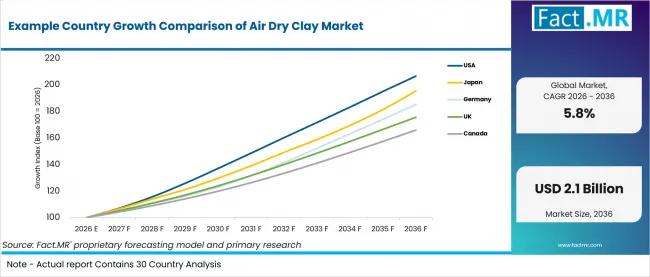
Example Country Growth Comparison Of Air Dry Clay Market | Source: Fact.MR
| Country | CAGR (2026-2036) |
|---|---|
| USA | 7.5% |
| Japan | 6.9% |
| Germany | 6.4% |
| UK | 5.8% |
| Canada | 5.2% |
| Australia | 4.6% |
| Brazil | 4.0% |
Source: Fact.MR analysis. Updated Jul 28, 2026
What keeps the USA ahead in adoption?
7.5% CAGR, supported by retail depth and classroom craft use.
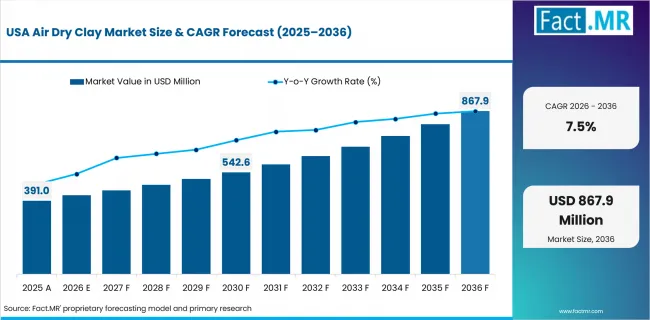
Air Dry Clay Market Country Value Analysis | Source: Fact.MR
The USA benefits from wide retail access and regular classroom demand. Parents and teachers often prefer products that work without kilns or special tools. Clear instructions, visible shelf placement, and resealable packs can strengthen repeat purchases across craft stores, supermarkets, and online channels.
Why is Japan gaining steady demand?
6.9% CAGR, driven by quality expectations and compact home-use formats.
Japan’s market is shaped by small living spaces and close attention to product consistency. Compact packs fit household storage needs, while reliable texture and drying performance support repeat use. Brands that maintain uniform quality are better placed to attract hobby users and families.
What shapes Germany’s growth through 2036?
6.4% CAGR, backed by institutional review and art-material standards.
Germany’s expansion depends on careful product assessment by schools and organized craft buyers. Safety labels, handling guidance, and consistent material performance carry strong weight during supplier selection. Companies that provide clear documentation can gain wider acceptance in education and specialist retail channels.
Where is UK demand coming from?
5.8% CAGR, driven by retail comparison and school-use purchases.
UK customers often compare pack value, size, and ease of use across physical and online stores. Schools also influence demand through repeated classroom purchases. Products that are simple to reorder, easy to divide, and less likely to create waste can secure stronger retailer support.
What defines Canada’s market performance?
5.2% CAGR, led by service coverage and dependable replenishment.
Canada’s dispersed customer base makes steady stock availability especially important. Durable packaging helps products move across longer distribution routes without damage. Brands supported by reliable distributors can serve schools, hobby stores, and smaller communities more effectively, particularly where local product choice remains limited.
How is Australia building market momentum?
4.6% CAGR, backed by dependable supply and compact store formats.
Australia’s large distances place extra pressure on storage and replenishment. Retailers therefore value packs that travel well, remain usable after opening, and explain drying time clearly. Strong channel coordination can help suppliers reduce stock gaps across school, craft, and regional store networks.
Why does Brazil show moderate growth?
4.0% CAGR, shaped by distributor availability and price sensitivity.
Brazilian demand centers on affordable pack sizes and dependable local access. Regional distributors play a major role in reaching customers beyond large cities. Straightforward product information, competitive pricing, and practical formats can improve conversion among families, schools, and first-time craft buyers.
Who leads the Air Dry Clay Market?
Crayola LLC and AMACO Brent are key market players. JOVI, S.A. and FIMO strengthen the market with ready-to-use modeling clay products.
Crayola LLC has a strong presence in school and children’s craft products. AMACO Brent serves classroom and art users. JOVI, S.A. offers easy modeling clay for school and home projects. FIMO adds well-known modeling materials. DAS, Activa Products and Mont Marte expand the range through retail and craft-focused products.
From 2026 to 2036, competition will focus on reliable drying, smooth texture and convenient packs. Schools and retailers are likely to prefer products that are easy to store, simple to use and supported by clear instructions.
Which companies are the key providers?
Key companies include Crayola LLC; AMACO Brent; JOVI, S.A.; STAEDTLER SE; F.I.L.A. Group; Activa Products; and Mont Marte.
- Crayola LLC
- AMACO Brent
- JOVI, S.A.
- STAEDTLER SE
- F.I.L.A. Group
- Activa Products
- Mont Marte
Bibliography
- U.S. Census Bureau. (2026, July 16). Advance Monthly Sales for Retail and Food Services.
- National Center for Education Statistics. (2025, January 22). More than a quarter of public schools now offer all students free school meals through state or local initiatives. U.S. Department of Education.
- U.S. Census Bureau. (2026, May 18). Quarterly retail e-commerce sales: First quarter 2026.
- Office for National Statistics. (2026, January 23). Retail sales, Great Britain: December 2025.
- Mont Marte. (2025, April 8). Air dry clay trinket dish DIY.
This Report Answers
- The report provides strategic intelligence on the Air Dry Clay Market across Product Type and Application choices that shape classroom and hobby use.
- Segment analysis covers Natural Air Dry Clay and Arts & Crafts as the share leaders within the 2026 market structure.
- Country outlook evaluates the USA and Japan alongside Germany and the UK. Canada, Australia and Brazil complete the growth comparison across the profiled markets.
- Competitive analysis profiles Crayola LLC and AMACO Brent alongside JOVI, S.A. and STAEDTLER SE. Activa Products and Mont Marte complete the provider set.
- Packaging type assessment covers Individual Packs and Small Packs. Medium Packs and Bulk Packs complete the packaging view alongside classroom and studio formats.
What does the Air Dry Clay Market cover?
Air Dry Clay covers air-hardening modeling clay used for classroom projects and hobby activities. It covers home decor and small craft work when customers buy clay that hardens without a kiln.
The Air Dry Clay Market includes Natural Air Dry Clay and adjacent product formats sold through retail, institutional and online channels. Coverage extends to classroom packs and individual packs where customers buy clay for defined projects. Spending outside direct air dry clay products remains outside the boundary.
The market differs from kiln-fired ceramic clay because commercial value comes from no-bake use and simple storage. Pottery studio equipment remains outside the scope. General craft spending is excluded unless the purchase decision directly involves air dry clay.
What is included in the scope?
Air dry clay products are used across educational institutions and individual consumers. Professional artists, craft businesses and recreation centers are part of the scope when air dry clay is used for craft work.
The scope includes Product Type and Application alongside End User, Distribution Channel and Packaging Type. Coverage spans Natural Air Dry Clay and Stone Clay. DIY Projects and Hobby Modeling follow the same use-based rule. Offline Retail Stores and E-commerce Platforms are included when sales involve air dry clay products.
What is excluded from the scope?
Kiln-fired ceramic clay and unrelated pottery equipment remain outside the scope of this market.
The scope excludes materials that do not harden in air or do not serve modeling and craft use. Standalone pottery wheels and kilns are excluded. General stationery and unrelated craft kits are excluded unless demand depends on air dry clay purchase decisions. Company revenue without a clear role in air dry clay use is excluded.
How Was the Analysis Built?
The analysis draws on 120+ sources, 35+ company portfolios, 25+ countries, and more than 20 industry interviews.
- Primary Research: Primary research includes discussions with manufacturers, service providers, technology developers, distributors, end users, procurement teams, and subject-matter experts. These conversations examine purchasing priorities, product adoption, operational challenges, approval requirements, competitive positioning, and the factors that influence wider market acceptance.
- Desk Research: Desk research covers government statistics, regulatory publications, company filings, trade data, technical studies, industry associations, standards, public policy, and other authoritative sources. Every source used in the analysis is documented in the bibliography.
- Market Sizing and Forecasting: Market estimates combine historical performance, demand indicators, pricing and volume trends, segment shares, company participation, country-level growth, adoption patterns, investment activity, and barriers to market expansion.
- Data Validation and Update Cycle: Findings are validated by comparing primary interviews with public data, company activity, regulatory changes, trade patterns, and industry developments. Regular updates review new product launches, capacity changes, partnerships, approvals, procurement trends, and shifts in commercial adoption.
Segmentation
What is the report’s scope and coverage?
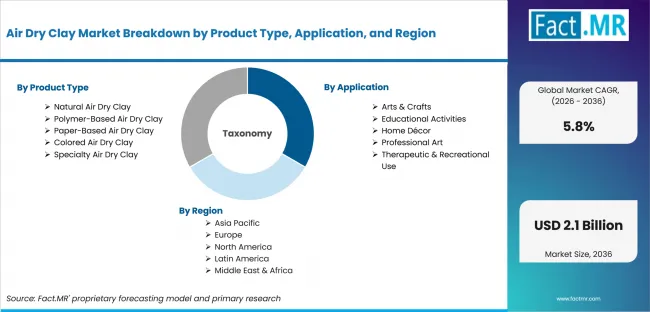
Air Dry Clay Market Breakdown By Product Type, Application, And Region | Source: Fact.MR
| Attribute | Details |
|---|---|
| Quantitative Units | USD billion in 2026 to USD billion by 2036 at a CAGR |
| Market Definition | Air Dry Clay covers commercial buying and production of air-hardening modeling clay. It is used in classrooms and hobby activities. It covers home decor and small craft projects. |
| Product Type | Natural Air Dry Clay; Stone Clay; Pottery Clay; Polymer-Based Air Dry Clay; Lightweight Clay; Flexible Clay; Paper-Based Air Dry Clay; Recycled Paper Clay; Fiber Reinforced Clay; Colored Air Dry Clay; Pre-Colored Clay; Glitter Clay; Specialty Air Dry Clay; Modeling Clay; Sculpting Clay |
| Application | Arts & Crafts; DIY Projects; Hobby Modeling; Educational Activities; School Projects; STEM Learning; Home Decor; Decorative Sculptures; Ornaments; Professional Art; Sculpture Making; Prototype Modeling; Therapeutic & Recreational Use; Art Therapy; Recreational Workshops |
| End User | Educational Institutions; Schools; Colleges; Individual Consumers; Hobbyists; DIY Enthusiasts; Professional Artists; Sculptors; Craft Designers; Commercial Craft Businesses; Art Studios; Craft Manufacturers; Therapy & Recreation Centers; Rehabilitation Centers; Community Art Centers |
| Distribution Channel | Offline Retail Stores; Art Supply Stores; Stationery Stores; E-commerce Platforms; Company Websites; Online Marketplaces; Supermarkets & Hypermarkets; Hypermarkets; Department Stores; Educational Supply Distributors; School Supply Vendors; Institutional Distributors; Wholesale Distributors; Regional Distributors; Bulk Distributors |
| Packaging Type | Individual Packs; Small Packs; Medium Packs; Bulk Packs; Classroom Packs; Studio Packs; Resealable Packs; Zip Lock Packs; Airtight Containers; Multi-Color Sets; Beginner Sets; Premium Sets; Value Packs; Family Packs; Assorted Craft Kits |
| Regions Covered | North America; Latin America; Europe; East Asia; South Asia and Oceania; Middle East and Africa |
| Countries Covered | USA; Japan; Germany; UK; Canada; Australia; Brazil |
| Key Companies Profiled | Crayola LLC; AMACO Brent; JOVI, S.A.; STAEDTLER SE; F.I.L.A. Group; Activa Products; Mont Marte |
| Forecast Period | 2026 to 2036 |
| Approach | Hybrid top-down and bottom-up approach using category demand; product mix; classroom and hobby use requirements; channel reach; packaging formats; country adoption patterns; buyer approval conditions and company portfolio review |
Source: Fact.MR analysis. Updated Jul 28, 2026
How is the market segmented?
-
By Product Type:
- Natural Air Dry Clay
- Stone Clay
- Pottery Clay
- Polymer-Based Air Dry Clay
- Lightweight Clay
- Flexible Clay
- Paper-Based Air Dry Clay
- Recycled Paper Clay
- Fiber Reinforced Clay
- Colored Air Dry Clay
- Pre-Colored Clay
- Glitter Clay
- Specialty Air Dry Clay
- Modeling Clay
- Sculpting Clay
-
By Application:
- Arts & Crafts
- DIY Projects
- Hobby Modeling
- Educational Activities
- School Projects
- STEM Learning
- Home Decor
- Decorative Sculptures
- Ornaments
- Professional Art
- Sculpture Making
- Prototype Modeling
- Therapeutic & Recreational Use
- Art Therapy
- Recreational Workshops
-
By End User:
- Educational Institutions
- Schools
- Colleges
- Individual Consumers
- Hobbyists
- DIY Enthusiasts
- Professional Artists
- Sculptors
- Craft Designers
- Commercial Craft Businesses
- Art Studios
- Craft Manufacturers
- Therapy & Recreation Centers
- Rehabilitation Centers
- Community Art Centers
-
By Distribution Channel:
- Offline Retail Stores
- Art Supply Stores
- Stationery Stores
- E-commerce Platforms
- Company Websites
- Online Marketplaces
- Supermarkets & Hypermarkets
- Hypermarkets
- Department Stores
- Educational Supply Distributors
- School Supply Vendors
- Institutional Distributors
- Wholesale Distributors
- Regional Distributors
- Bulk Distributors
- By Packaging Type
- Individual Packs
- Small Packs
- Medium Packs
- Bulk Packs
- Classroom Packs
- Studio Packs
- Resealable Packs
- Zip Lock Packs
- Airtight Containers
- Multi-Color Sets
- Beginner Sets
- Premium Sets
- Value Packs
- Family Packs
- Assorted Craft Kits
-
By Region:
- North America
- Latin America
- Europe
- East Asia
- South Asia & Oceania
- Middle East and Africa
Frequently Asked Questions
Which Product Type leads the market?
Which Application leads the market?
Which End User leads the market?
Which Distribution Channel leads the market?
Which Packaging Type leads the market?
Which country records the highest listed CAGR?
What is the primary driver in this market?
What is the main restraint?
Why do Educational Institutions lead demand?
Who worked on this report


Preview the report firsthand - request a free sample
Free SampleGet the brochure for pricing and purchase details
Download PDF