- Base Value(2025): 6.0 Bn
- Estimated Value(2026): 6.6 Bn
- Forecast Value (2036): 19.8 Bn
- CAGR (2026 - 2036): 7.0%
Enterprise Laboratory Informatics Market Forecast and Outlook By Fact.MR
In 2025, the enterprise laboratory informatics market was valued at USD 6.0 billion. Based on Fact.MR analysis, demand for enterprise laboratory informatics is estimated to grow to USD 6.6 billion in 2026 and USD 19.8 billion by 2036. FACT.MR projects a CAGR of 7.0% during the forecast period.
The market is set to generate an additional USD 13.2 billion over the forecast period, reflecting steady expansion. Growth is supported by increasing drug development activity and stricter regulatory focus on digital record-keeping. Laboratories are also adopting advanced tools to streamline workflows and improve data accuracy. At the same time, some barriers remain. Cloud adoption is slowed by high validation and compliance costs in regulated environments. Many organizations continue to rely on legacy systems. Lengthy approval and procurement processes further delay new system implementation.
China leads country growth at 10.2% CAGR through 2036, driven by NMPA pharmaceutical electronic records requirements and domestic CRO and biotech expansion. India follows at 10.0% CAGR, supported by CDSCO digital records mandates and expanding generic pharma R&D capacity. Germany at 9.4% benefits from EU Annex 11 compliance demand and major pharma site upgrades. Australia at 8.5% reflects TGA digital records adoption and mining and food laboratory modernisation. The USA at 8.9% drives premium cloud LIMS procurement through FDA Computer Software Assurance guidance. Japan at 8.2% is a mature market generating steady replacement demand constrained by PMDA legacy validation cycles and cautious IT adoption at domestic pharma manufacturers.
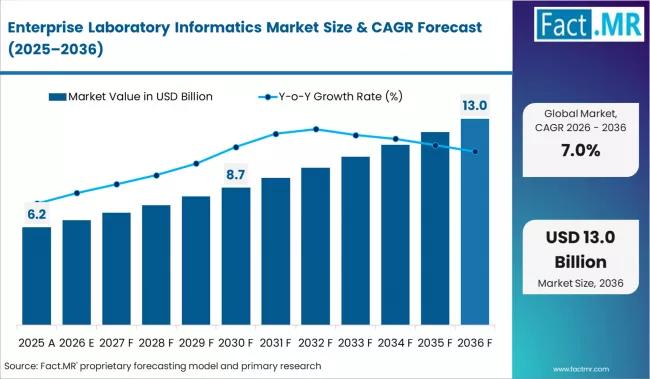
Enterprise Laboratory Informatics Market Market Value Analysis | Source: Fact.MR
| Metric | Value |
|---|---|
| Estimated Value in 2026 | USD 6.6 billion |
| Forecast Value in 2036 | USD 19.8 billion |
| Forecast CAGR (2026 to 2036) | 7.0% |
Source: Fact.MR analysis. Updated Mar 23, 2026
Enterprise Laboratory Informatics Market Definition
The enterprise laboratory informatics market covers software platforms and services used to manage and digitise laboratory workflows and scientific data. It includes systems such as LIMS, ELN, CDS, EDC, CDMS, LES, ECM, and SDMS used across pharma, biotech, CRO, chemical, food, and industrial laboratories.
Enterprise Laboratory Informatics Market Inclusions
The market includes global forecasts from 2026 to 2036 across type, component, delivery mode, and industry. It covers software licences, SaaS subscriptions, and implementation services. Both cloud and on-premise deployments are included, spanning pharma, biotech, CRO, CMO, chemical, agriculture, and other laboratory sectors.
Enterprise Laboratory Informatics Market Exclusions
The scope excludes ERP systems without lab-specific functionality, laboratory instruments and hardware, and CTMS unless integrated with EDC or CDMS. It also excludes hospital systems that do not include dedicated laboratory informatics modules.
Enterprise Laboratory Informatics Market Research Methodology
- Primary Research: Primary research includes interviews with lab IT directors, validation specialists, procurement managers, and pharma and biotech informatics leaders across North America, Europe, India, and Asia Pacific.
- Desk Research: Desk research is based on regulatory guidelines such as FDA 21 CFR Part 11 and EU Annex 11, along with vendor reports, investor filings, and global compliance data sources.
- Market Sizing and Forecasting: Market sizing uses a hybrid top-down and bottom-up approach, based on software licence revenue, SaaS adoption rates, and laboratory site counts. The data is validated using vendor financial disclosures.
- Data Validation and Update Cycle: Forecasts are validated using revenue data from key companies such as Thermo Fisher, Agilent, LabVantage, and LabWare, supported by FDA and EMA publications and expert interviews.
Summary Of Enterprise Laboratory Informatics Market
- Market Definition
- The market covers LIMS, ELN, CDS, SDMS, LES, EDC, CDMS, and ECM platforms used to automate lab workflows, enforce data integrity, and maintain electronic records compliance across pharma, biotech, CRO, CMO, chemical, and industrial laboratory settings.
- Demand Drivers
- FDA Computer Software Assurance (2025) is easing validation and accelerating cloud LIMS adoption
- China NMPA rules are driving shift from paper to LIMS and ELN systems
- Thermo Fisher acquisitions are expanding LIMS use and increasing cross-sell revenue
- Key Segments Analyzed
- By Type: LIMS holds 20% share in 2026 as the core data platform
- By Component: Software leads with 65% share, driven by SaaS and licences
- By Geography: China leads at 10.2% CAGR, followed by India at 10.0%
- Analyst Opinion at FACT.MR
- Shambhu Nath Jha, Principal Consultant at Fact.MR, opines that CXOs will find this report essential for navigating the cloud LIMS migration decision, understanding how FDA's Computer Software Assurance guidance is reducing validation costs for cloud adoption, and identifying which industry verticals are generating the fastest enterprise informatics procurement cycles through 2036.
- Strategic Implications
- Vendors should offer pre-validated cloud LIMS with built-in FDA and EU compliance to reduce validation cost and speed adoption
- Providers should invest in AI-based features like anomaly detection and predictive maintenance to stay competitive
- Companies targeting India and China should build local data infrastructure and partnerships to meet regulatory requirements
- Methodology
- Market sizing is based on LIMS licence and SaaS revenue, validated with vendor financial data
- Regulatory inputs include FDA CSA, EU Annex 11, NMPA China, and CDSCO India guidelines
- Forecasts consider cloud adoption, AI integration, pharma R&D growth, and expert interviews
Segmental Analysis
Enterprise Laboratory Informatics Market Analysis by Type
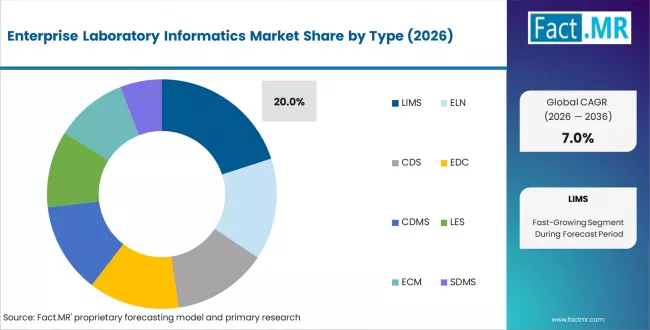
Enterprise Laboratory Informatics Market Analysis By Type | Source: Fact.MR
Based on FACT.MR analysis, LIMS holds 20% share in 2026. It remains the core system for sample tracking, compliance, and data management. Most labs adopt LIMS before adding ELN or SDMS modules.
- LabVantage 8.9 LIMS Launch: LabVantage 8.9 added AI features and better compliance tools. It supports integration with ELN and SDMS modules. The platform also expanded into forensic labs through partnerships [1].
- LabWare ASSURE SaaS Launch: LabWare launched ASSURE as a cloud LIMS for mid-sized labs. It targets biotech firms needing compliance without high complexity. This reflects growing SaaS adoption in the market [2].
- ELN and SDMS Adoption Growth Trend: ELN adoption is rising in biotech and research labs. Cloud platforms like Benchling reduce deployment time significantly. Regulatory scope expansion is also increasing ELN demand [3].
Enterprise Laboratory Informatics Market Analysis by Component
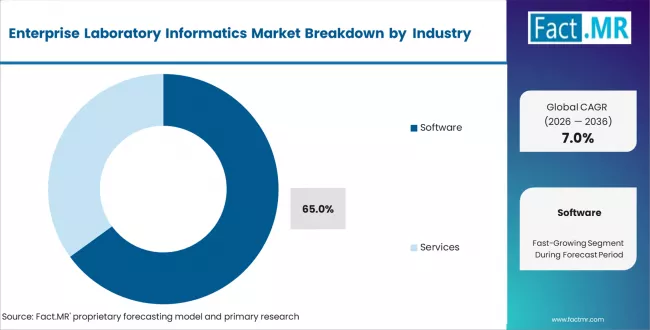
Enterprise Laboratory Informatics Market Analysis By Component | Source: Fact.MR
Software is expected to hold 65% share in 2026. Growth is driven by SaaS subscriptions and recurring licence revenue. Buyers prefer ongoing software updates and AI features over one-time services.
- Thermo Fisher Olink and Solventum Acquisitions: Thermo Fisher expanded SampleManager through major acquisitions. This increased its reach in proteomics and infection-control labs. It also strengthened cross-sell opportunities and customer lock-in [4].
- Agilent OpenLab Genohm Acquisition: Agilent extended OpenLab into genomics data management. The platform now includes AI-based analytics and workflow tools. This improves its position in biotech and research labs [5].
- Cloud Software Migration Trend: Hybrid cloud is becoming the standard model. Sensitive data stays on-premise while analytics move to cloud. FDA CSA guidance is reducing validation barriers and accelerating adoption [6].
Drivers, Restraints, and Opportunities
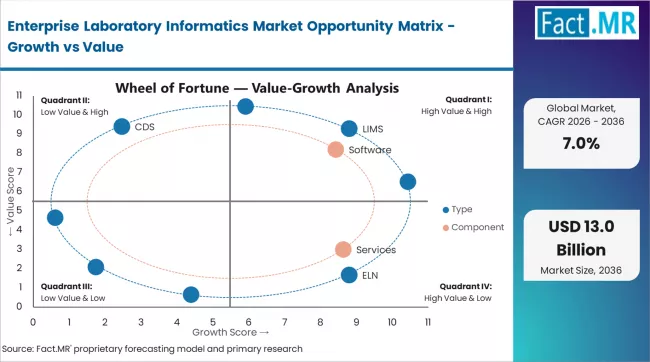
Enterprise Laboratory Informatics Market Opportunity Matrix Growth Vs Value | Source: Fact.MR
FACT.MR analysts observe that the enterprise laboratory informatics market has evolved from compliance-driven adoption since FDA 21 CFR Part 11. The current USD 6.0 billion market reflects long-term pharma and biotech demand. A new growth phase is emerging with cloud migration, AI workflows, and regulatory expansion in China and India. This is creating a second adoption wave in new markets.
The key tension is between legacy systems and cloud efficiency. Large pharma still relies on validated on-premise LIMS with high switching costs. Cloud-native platforms offer faster deployment and lower costs. Startups prefer SaaS solutions, while big enterprises remain locked into long validation cycles.
- FDA Computer Software Assurance Guidance: FDA’s 2025 CSA guidance supports risk-based validation and reduces workload. It addresses the 61% validation burden reported by pharma firms. This lowers barriers for cloud LIMS adoption globally.
- China NMPA Electronic Records Expansion: China’s 2024 GMP updates mandate electronic records and audit trails. This is driving first-time LIMS and ELN adoption across 4,500+ pharma firms. Both domestic and global vendors are competing for deployments.
- AI-Powered LIMS Integration: AI features like predictive maintenance and anomaly detection are being added. LabVantage 8.9 and Agilent upgrades reflect this trend. AI is improving workflows and increasing platform value.
Regional Analysis
The enterprise laboratory informatics market is analysed across North America, Europe, Asia Pacific, Latin America, and Middle East and Africa, covering 40+ country-level demand shaped by pharmaceutical regulatory compliance frameworks, R&D investment levels, CRO sector size, and national electronic records mandates. The full report offers market attractiveness analysis based on validated site counts, pharma R&D spend, and cloud adoption benchmarks.
.webp "Top Country Growth Comparison Enterprise Laboratory Informatics Market Cagr (2026 2036)")
Top Country Growth Comparison Enterprise Laboratory Informatics Market Cagr (2026 2036) | Source: Fact.MR
| Country | CAGR (2026 to 2036) |
|---|---|
| China | 10.2% |
| India | 10.0% |
| USA | 8.9% |
| Germany | 9.4% |
| Australia | 8.5% |
Source: Fact.MR analysis. Updated Mar 23, 2026
Source: Fact.MR (FACT.MR) analysis, based on proprietary forecasting model and primary research
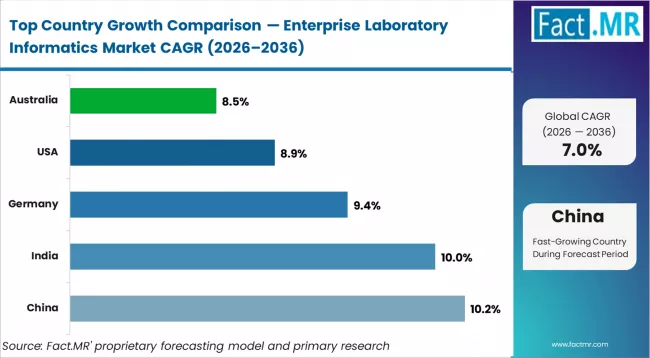
Enterprise Laboratory Informatics Market Cagr Analysis By Country | Source: Fact.MR
Asia Pacific Enterprise Laboratory Informatics Market Analysis
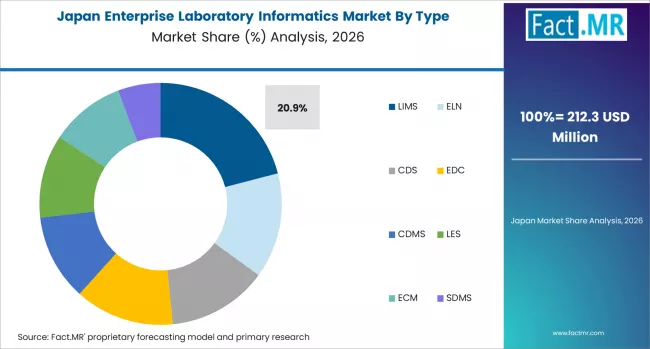
Enterprise Laboratory Informatics Market Japan Market Share Analysis By Type | Source: Fact.MR
Asia Pacific is the fastest-growing region for laboratory informatics. Growth is supported by stricter compliance rules in China and India, along with rising biotech and CRO activity. Global vendors compete with local suppliers, while Australia remains a smaller but high-value market.
- China: China is leading regional growth with a CAGR of 10.2% through 2036. Updated NMPA rules are pushing pharma companies and CROs to adopt validated LIMS and ELN systems. The country’s large CRO base is increasing demand for multi-module platforms. International vendors such as Thermo Fisher and LabVantage are active, alongside local providers. Rising biotech investment is also expanding the market.
- India: India is showing strong growth at a CAGR of 10.0% through 2036. Updated Schedule M rules are driving LIMS and ELN adoption across pharma manufacturing sites. Large domestic pharma companies and CROs are upgrading informatics systems to support compliance. Government biotech initiatives are also funding new lab infrastructure. This is creating steady demand for enterprise platforms.
FACT.MR's analysis of the enterprise laboratory informatics market in Asia Pacific consists of country-wise assessment including China, India, Japan, South Korea, Australia and New Zealand, and ASEAN. Readers can find NMPA and CDSCO compliance demand data, CRO sector informatics adoption benchmarks, AI LIMS investment trends, and country-level CAGR forecasts by type and delivery mode.
North America Enterprise Laboratory Informatics Market Analysis
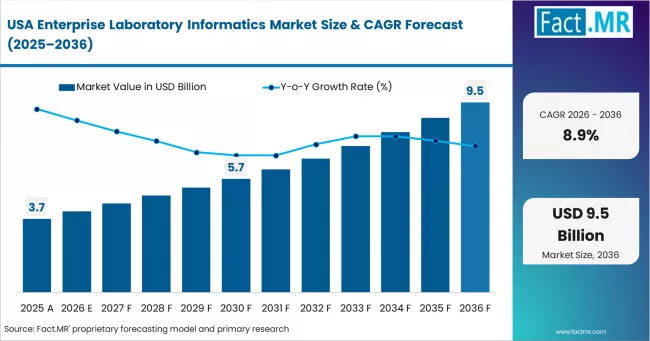
Enterprise Laboratory Informatics Market Country Value Analysis | Source: Fact.MR
North America is the largest market for enterprise laboratory informatics. It is supported by strict FDA compliance requirements and a large base of pharma, biotech, and CRO labs. Established vendors lead in enterprise accounts, while cloud-native platforms are gaining traction in biotech.
- USA: The United States remains a major market with a CAGR of 8.9% through 2036. FDA guidance is reducing validation burden and supporting cloud migration. Updated Part 11 rules are also expanding compliance needs across ELN, EDC, and CDMS systems. Vendors are launching SaaS solutions to meet mid-sized lab demand. Recent acquisitions are also broadening informatics use beyond traditional pharma.
FACT.MR's analysis of the enterprise laboratory informatics market in North America consists of country-wise assessment including the United States, Canada, and Mexico. Readers can find FDA compliance policy impact data, cloud LIMS adoption benchmarks, CRO procurement trends, and country-level CAGR forecasts by type and industry vertical.
Europe Enterprise Laboratory Informatics Market Analysis
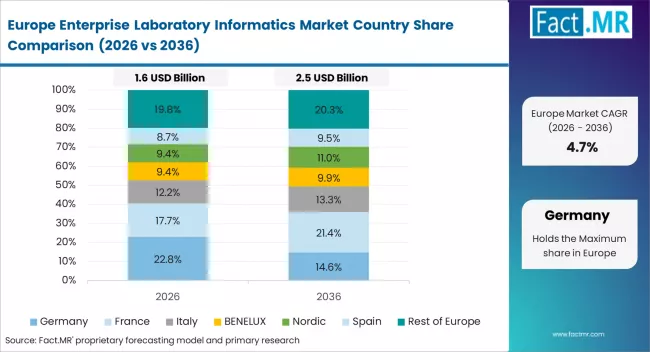
Enterprise Laboratory Informatics Market Europe Country Market Share Analysis, 2026 & 2036 | Source: Fact.MR
Europe is a compliance-led market for laboratory informatics. EU Annex 11 and EMA data integrity rules continue to shape software upgrades across the region. Germany is the largest market, while Australia is discussed here as a niche compliance-driven growth area.
- Germany: Germany is a key European market with a CAGR of 9.4% through 2036. Pharma companies are upgrading legacy LIMS and ELN systems to meet Annex 11 requirements. Chemical and testing labs are also increasing adoption due to ISO and REACH digitalisation needs. Large companies are investing in lab modernisation as part of broader efficiency programmes. Regulatory pressure will continue to support demand.
- Australia: Australia is growing at a CAGR of 8.5% through 2036. Updated TGA guidance is increasing demand for validated electronic lab records. Mining and food testing labs are also expanding informatics use for traceability and quality control. Research institutes are adopting cloud ELN platforms for collaboration. This is widening demand beyond pharma.
FACT.MR's analysis of the enterprise laboratory informatics market in Europe consists of country-wise assessment including Germany, France, the United Kingdom, Italy, Spain, Nordic countries, and BENELUX. Readers can find EU Annex 11 compliance benchmarks, pharma site upgrade trends, cloud LIMS adoption rates, and country-level CAGR forecasts.
Competitive Aligners for Market Players
Enterprise Laboratory Informatics Market Analysis By Company | Source: Fact.MR
The enterprise laboratory informatics market is moderately concentrated, with a few major vendors controlling a large share of revenue. Companies like Thermo Fisher Scientific, LabWare, and LabVantage dominate core LIMS and ELN segments, while Agilent and PerkinElmer are strong in analytical informatics. Competition today is less about standalone tools and more about offering integrated platforms that combine multiple modules in a single compliant environment. Vendors that can deliver this integration tend to retain customers longer and generate higher revenue per account.
Thermo Fisher has a strong edge because its SampleManager platform is closely tied to its own laboratory instruments, making it difficult for customers to switch. LabWare is known for its high level of customisation and long-standing presence in large pharma companies. LabVantage competes with a flexible, cloud-ready platform and strong presence across healthcare, forensic, and CRO environments.
Large pharma companies usually work with multiple vendors to reduce dependency and meet different lab needs. This limits pricing power but still allows vendors to expand through cross-selling. In contrast, biotech startups are more open to newer cloud-based platforms, where players like Benchling and Dotmatics compete on speed, ease of use, and faster deployment.
Key Players
- LabWare
- LabVantage Solutions, Inc.
- Agilent Technologies, Inc.
- Waters Corporation
- LabLynx, Inc.
- Dassault Systèmes SE
- LABWORKS LLC
- Autoscribe Informatics
- PerkinElmer, Inc.
- Accelerated Technology Laboratories
Bibliography
- [1] LabVantage Solutions Inc. Press Release: LabVantage Launches Version 8.9 LIMS with AI-Driven Productivity Enhancements and Partnership with Netherlands Forensic Institute for Forensic Laboratory Digitalisation. March 2025 and December 2024.
- [2] LabWare Inc. Press Release: LabWare Launches LabWare ASSURE SaaS Cloud LIMS for Mid-Sized Pharmaceutical and Biotech Laboratories Requiring FDA 21 CFR Part 11-Compliant Electronic Records. March 2025.
- [3] US Food and Drug Administration. Guidance for Industry: Part 11, Electronic Records and Signatures in Clinical Investigations Q&A, Clarification on ELN and EDC Scope, and Wearable Device Data Ingestion Compliance Boundaries. October 2024.
- [4] Thermo Fisher Scientific Inc. Annual Report and Press Releases: Acquisition of Olink Proteomics USD 3.1 Billion Completed July 2024, Acquisition of Solventum USD 4.1 Billion Completed February 2025, SampleManager LIMS Portfolio Expansion.
- [5] Agilent Technologies Inc. Press Release: Acquisition of Genohm to Expand OpenLab Informatics Software into Next-Generation Sequencing Data Management for Genomics and Biotech Laboratory Customers. April 2025.
- [6] FDA / CodePhusion. Computer Software Assurance Final Guidance: Risk-Based Least-Burdensome Software Testing for Cloud LIMS and ELN. September 2025. fda.gov/csa-guidance and 2024 State of Validation Report: 61% of Pharma Organisations Report Increased Validation Workload.
This Report Addresses
- Strategic intelligence on FDA Computer Software Assurance guidance, EU GMP Annex 11 requirements, China NMPA electronic records mandates, India CDSCO Schedule M GMP compliance deadlines, and Australia TGA digital records alignment driving enterprise laboratory informatics procurement through 2036.
- Market forecast projecting growth from USD 6.6 billion in 2026 to USD 19.8 billion by 2036 at a 7.0% CAGR, segmented by type, component, delivery mode, industry vertical, and region.
- Growth opportunity mapping across China's NMPA compliance first-time LIMS adoption wave, India's Schedule M implementation procurement, US FDA CSA-enabled cloud migration acceleration, Germany's EU Annex 11 upgrade cycle, and Australia's TGA and mining laboratory modernisation.
- Country CAGR outlook highlighting China 10.2%, India 10.0%, Germany 9.4%, Australia 8.5%, USA 8.9%, and Japan 8.2%, supported by pharma R&D spend data, validated site counts, and regulatory compliance timeline benchmarks.
- Competitive landscape analysis covering Thermo Fisher, LabWare, LabVantage, Agilent, PerkinElmer, Waters, Dassault Systèmes, Autoscribe, and cloud challengers Benchling and Dotmatics, focusing on platform integration, AI module roadmaps, and acquisition impact.
- Technology tracking including AI-powered anomaly detection in LIMS, cloud-native ELN deployment, hybrid on-premise and cloud informatics architectures, FAIR data principles implementation, and blockchain-secured audit trail adoption for GxP laboratories.
- Regulatory analysis covering FDA 21 CFR Part 11, Computer Software Assurance guidance, EU GMP Annex 11, PIC/S data integrity guidelines, NMPA China electronic records GMP requirements, India CDSCO Schedule M, and Australia TGA PIC/S alignment.
- Report deliverables include PDF report, Excel datasets, PowerPoint summary, and dashboards supported by Thermo Fisher, Agilent, LabVantage, and PerkinElmer financial disclosures, FDA regulatory publications, and primary research interviews.
Segmentation
Scope of Report
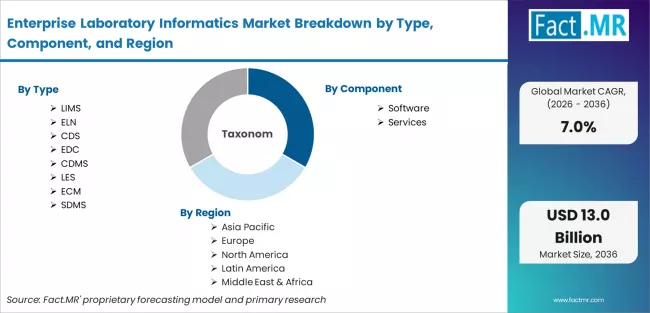
Enterprise Laboratory Informatics Market Breakdown By Type, Component, And Region | Source: Fact.MR
| Attribute | Details |
|---|---|
| Quantitative Units | USD 6.6 billion (2026) to USD 19.8 billion (2036), at a CAGR of 7.0% |
| Market Definition | Software platforms and services for laboratory workflow automation, electronic records management, and data integrity compliance across pharma, biotech, CRO, CMO, chemical, agriculture, oil and gas, and industrial laboratory sectors. |
| Type Segmentation | LIMS, ELN, CDS, EDC, CDMS, LES, ECM, SDMS |
| Component Segmentation | Software, Services |
| Delivery Segmentation | On-Premise, Cloud |
| Industry Segmentation | CRO, CMO, Pharma, Biotech, Chemical, Agriculture, Oil & Gas, Others |
| Regions Covered | North America, Europe, Asia Pacific, Latin America, Middle East and Africa |
| Countries Covered | USA, Canada, Mexico, UK, Germany, France, Italy, Spain, Nordic, BENELUX, Japan, South Korea, China, India, Australia and New Zealand, ASEAN, Brazil, Argentina, Chile, Saudi Arabia, GCC, Turkey, South Africa, Rest of MEA |
| Key Companies Profiled | LabWare, LabVantage Solutions, Agilent Technologies, Waters Corporation, LabLynx, Dassault Systèmes, LABWORKS LLC, Autoscribe Informatics, PerkinElmer, Accelerated Technology Laboratories |
| Forecast Period | 2026 to 2036 |
| Approach | Hybrid top-down and bottom-up model using LIMS software revenue by type and industry, SaaS adoption rates, pharma R&D spend, government compliance programme timelines, and primary interviews with lab informatics procurement and validation specialists. |
Source: Fact.MR analysis. Updated Mar 23, 2026
Enterprise Laboratory Informatics Market by Segments
-
By Type :
- LIMS
- ELN
- CDS
- EDC
- CDMS
- LES
- ECM
- SDMS
-
By Component :
- Software
- Services
-
By Delivery :
- On-Premise
- Cloud
-
By Industry :
- CRO
- CMO
- Pharma
- Biotech
- Chemical
- Agriculture
- Oil & Gas
- Others
-
By Region :
- North America
- United States
- Canada
- Mexico
- Latin America
- Brazil
- Mexico
- Argentina
- Chile
- Rest of Latin America
- Western Europe
- Germany
- United Kingdom
- France
- Italy
- Spain
- Nordic Countries
- BENELUX
- Rest of Western Europe
- Eastern Europe
- Russia
- Poland
- Hungary
- Balkan and Baltic
- Rest of Eastern Europe
- East Asia
- China
- Japan
- South Korea
- South Asia and Pacific
- India
- ASEAN
- Australia and New Zealand
- Rest of South Asia and Pacific
- Middle East and Africa
- Kingdom of Saudi Arabia
- Other GCC Countries
- Turkey
- South Africa
- Rest of Middle East and Africa
- North America
Frequently Asked Questions
How large is the enterprise laboratory informatics market in 2025?
What will the market size be in 2026?
What is the projected market size by 2036?
What is the expected CAGR?
Which type segment leads the enterprise laboratory informatics market?
Which component segment dominates?
Which country shows the fastest growth?
What is enterprise laboratory informatics?
Why is LIMS important in laboratories?
What is driving cloud adoption in this market?
Which industries use laboratory informatics the most?
What is the role of ELN in laboratories?
What is a key market trend?
Why are regulations important in this market?
Who worked on this report


Preview the report firsthand - request a free sample
Free SampleGet the brochure for pricing and purchase details
Download PDF