- Base Value(2026): 0.4 Bn
- Estimated Value(2026): 0.4 Bn
- Forecast Value (2036): 1.7 Bn
- CAGR (2026 - 2036): 15.6%
AI Vision QC with Correction Market Forecast and Outlook 2026 to 2036
Adoption of AI vision QC with correction systems is projected to grow from USD 0.4 billion in 2026 to USD 1.7 billion by 2036, depicting a compound annual growth rate (CAGR) of 15.6% between 2026 and 2036.
Key Takeaways from AI Vision QC with Correction Market
- AI Vision QC with Correction Market Value (2026): USD 0.4 billion
- AI Vision QC with Correction Market Forecast Value (2036): USD 1.7 billion
- AI Vision QC with Correction Market Forecast CAGR: 15.6%
- Leading Device Category in AI Vision QC with Correction Market: Fixed Mount Systems (58.4%)
- Key Growth Regions in AI Vision QC with Correction Market: Asia Pacific, North America, Europe
- Key Players in AI Vision QC with Correction Market: Cognex Corporation, Keyence Corporation, Omron Corporation, Basler AG, Teledyne DALSA
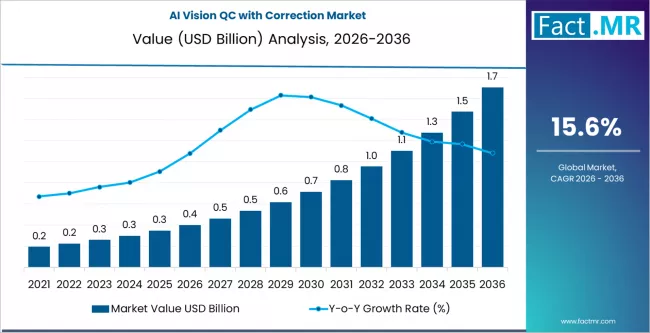
Ai Vision Qc With Correction Market Market Value Analysis | Source: Fact.MR
Demand for AI vision QC with correction systems is moving beyond pilot adoption into scaled deployment across automotive, electronics, pharmaceuticals, and food processing operations. Current demand reflects high-single-digit growth in the overall quality control category, while AI-enabled correction systems are capturing a faster share of new installations due to their ability to detect defects, classify irregularities, and implement real-time corrections. Near-term spending outlook remains positive as manufacturers prioritize automation projects with clear defect reduction and operational efficiency benefits.
Capital allocation is focused on brownfield upgrades, where AI vision and automated correction mechanisms are layered onto existing production lines to improve quality without major layout redesigns. Budget cycles for 2025-2027 show sustained funding for intelligent quality control cells, driven by persistent quality requirements, rising labor costs, and service-level pressure from precision manufacturing models. Purchasing decisions increasingly emphasize payback periods under three years, with AI correction functionality viewed as essential for operational resilience and long-term scalability rather than experimental automation.
What enterprise spending patterns are expected over the next 12 to 24 months?
Enterprise spending over the next 12 to 24 months is expected to concentrate on scaling proven quality control initiatives rather than exploratory technology pilots. Capital allocation is shifting toward AI-enabled correction systems that deliver measurable defect reduction, operational efficiency, and quality resilience within short payback periods. In manufacturing and processing, budgets increasingly favor modular quality upgrades, including intelligent inspection cells, correction systems, and software retrofits that enhance existing assets. Decision makers are prioritizing investments that reduce defect rates, stabilize output quality under production variability, and support higher product complexity.
Spending approval processes are becoming more disciplined, with stronger emphasis on total cost of ownership, integration speed, and service support availability. While overall quality control and automation budgets are rising modestly, discretionary innovation spend remains selective, reinforcing preference for deployments tied directly to defect reduction and production-level improvement.
What adoption horizon and timing milestones are being indicated by current deployments?
Several proof points and deployment signals indicate that AI vision QC with correction systems have moved beyond pilot-stage experimentation into repeatable operational use. Increasing volumes of follow-on orders from existing customers suggest confidence in performance consistency and economic returns. Enterprises are extending deployments across multiple production lines, signaling standardization rather than isolated trials. Integration of AI vision correction systems into core manufacturing execution software reflects their inclusion in baseline operating workflows.
Long-term service, maintenance, and software update contracts are being signed alongside hardware purchases, indicating multi-year operational intent. Procurement teams are applying formal capital approval criteria, including documented defect reduction metrics, throughput gains, and quality improvement benchmarks. System integrators report shorter sales cycles and fewer proof-of-concept requirements, while vendors are referencing live installations with sustained utilization rates.
Segmental Analysis
By Resolution Capacity, Which Segment Holds the Dominant Share in the AI Vision QC with Correction Market?
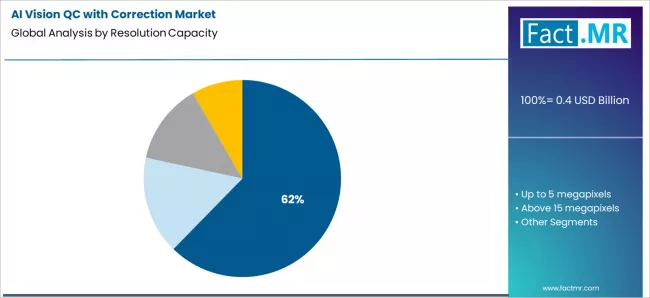
Ai Vision Qc With Correction Market Analysis By Resolution Capacity | Source: Fact.MR
In terms of resolution capacity, the 5 to 15 megapixel segment leads the market with 62.3% share. Quality control professionals and automation specialists increasingly utilize 5 to 15 megapixel AI vision QC with correction systems for their superior detection control properties and operational efficiency characteristics.
- Manufacturing investments in advanced inspection technology and production infrastructure continue to strengthen adoption among performance-focused processing facilities.
- With quality professionals prioritizing equipment system performance and operational validation, 5 to 15 megapixel modules align with both efficiency objectives and operational requirements, making them the central component of comprehensive commercial quality control strategies.
By End Use, Which Segment Registers the Highest Share in the AI Vision QC with Correction Market?
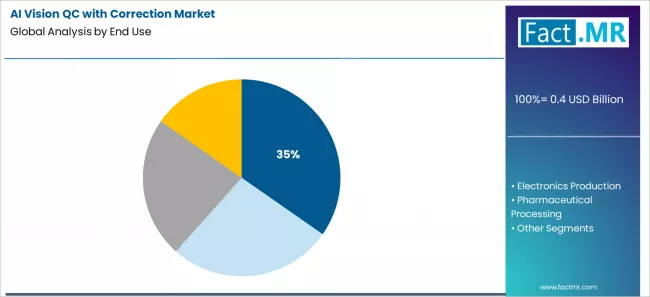
Ai Vision Qc With Correction Market Analysis By End Use | Source: Fact.MR
By end use, automotive manufacturing segment dominates with 34.7% share, underscoring its critical role as the primary application category for commercial facilities seeking superior inspection capabilities and enhanced operational compliance credentials. Quality control engineers and facility operators prefer AI vision QC with correction systems for automotive manufacturing facilities due to their established performance validation requirements.
- Commercial facilities are optimizing equipment selections to support application-specific requirements and comprehensive operational control strategies.
- As inspection technology continues to advance and operators seek efficient commercial management methods, automotive manufacturing facilities applications will continue to drive market growth while supporting operational performance optimization and compliance cost reduction strategies.
What are the Drivers, Restraints, and Key Trends of the AI Vision QC with Correction Market?
- Drivers: Commercial operator demand for enhanced quality control performance and advanced defect detection management initiatives drive mandatory adoption of high-performance AI vision QC with correction solutions across commercial facilities.
- Restraint: High equipment costs and technical complexity of integrating specialized inspection protocols into existing commercial management processes limit market penetration.
- Trend 1: Shift toward automated quality control configurations that minimize operational requirements and reduce deployment costs for commercial management.
- Trend 2: Development of specialized multi-parameter compatibility systems supporting multiple commercial applications and operational condition compatibility.
Analysis of the AI Vision QC with Correction Market by Key Country
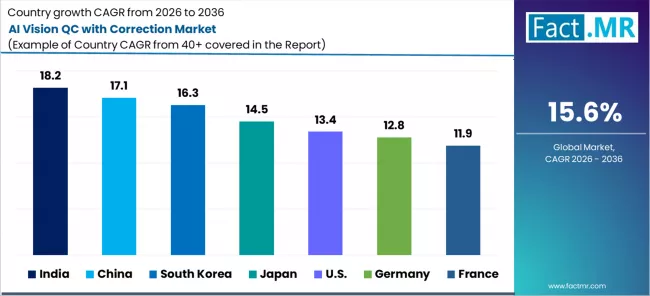
Ai Vision Qc With Correction Market Cagr Analysis By Country | Source: Fact.MR
| Country | CAGR (2026-2036) |
|---|---|
| India | 18.2% |
| China | 17.1% |
| Japan | 14.5% |
| Germany | 12.8% |
| U.S. | 13.4% |
| South Korea | 16.3% |
| France | 11.9% |
Source: Fact.MR analysis. Updated Jan 16, 2026
The report covers an in-depth analysis of 40+ countries; top-performing countries are highlighted below.
What Opportunities Can AI Vision QC with Correction Manufacturers Expect in India?
Revenue from AI vision QC with correction consumption and sales in India is projected to exhibit exceptional growth with a CAGR of 18.2% through 2036, driven by the country's rapidly expanding manufacturing infrastructure, regulatory frameworks promoting quality control efficiency initiatives, and initiatives supporting advanced inspection technologies across major commercial regions.
- Established manufacturing infrastructure and expanding operational consciousness are driving demand for AI vision QC with correction solutions across commercial facilities, automation developments, and comprehensive performance systems throughout Indian commercial markets.
- Strong regulatory development and technology initiatives are supporting the rapid adoption of premium quality control services among precision-focused operators seeking to meet evolving operational standards and performance requirements.
What is the Chinese AI Vision QC with Correction Market Size?
Revenue from AI vision QC with correction products in China is projected to expand at a CAGR of 17.1%, supported by rising manufacturing investment, growing operational consciousness, and expanding technology service capabilities. The country's developing infrastructure and increasing investment in quality control management technologies are driving demand for AI vision QC with correction solutions across both traditional and modern commercial applications.
- Rising infrastructure development and expanding performance capabilities are creating opportunities for quality control adoption across commercial management monitoring projects.
- Growing operational awareness initiatives and inspection technology advancement are driving the adoption of specialized performance equipment and services among commercial users.
What is the Japanese AI Vision QC with Correction Market Size?
Revenue from AI vision QC with correction products in Japan is projected to expand at a CAGR of 14.5%, supported by rising manufacturing investment, growing operational consciousness, and expanding technology service capabilities. The country's developing infrastructure and increasing investment in quality control management technologies are driving demand for AI vision QC with correction solutions across both traditional and modern commercial applications.
- Rising infrastructure development and expanding performance capabilities are creating opportunities for quality control adoption across commercial management monitoring projects.
- Growing operational awareness initiatives and inspection technology advancement are driving the adoption of specialized performance equipment and services among commercial users.
What Opportunities Can AI Vision QC with Correction Manufacturers Expect in Germany?
Revenue from AI vision QC with correction products in Germany is projected to grow at a CAGR of 12.8% through 2036, supported by the country's emphasis on analytical precision, technology excellence, and advanced commercial system integration requiring efficient inspection solutions. German commercial system operators and technology-focused establishments prioritize precision performance and operational control, making specialized AI vision QC with correction services essential components for both traditional and modern commercial applications.
- Advanced precision technology capabilities and growing commercial applications are driving demand for quality control services across specialty performance applications.
- Strong focus on analytical precision and technology excellence is encouraging users and service providers to adopt AI vision QC with correction solutions that support operational objectives.
What is the U.S. AI Vision QC with Correction Market Size?
Revenue from AI vision QC with correction products in the U.S. is projected to grow at a CAGR of 13.4% through 2036, supported by the country's emphasis on operational precision, quality control excellence, and advanced technology integration requiring efficient inspection solutions. American commercial operators and performance-focused establishments prioritize performance monitoring and cost efficiency precision, making specialized AI vision QC with correction services essential components for both traditional and modern commercial applications.
- Advanced precision quality control technology capabilities and growing commercial applications are driving demand for AI vision QC with correction services across specialty performance applications.
- Strong focus on operational precision and quality control excellence is encouraging users and service providers to adopt inspection solutions.
How are Top AI Vision QC with Correction Companies Planning to Keep Ahead?
Leading quality control and inspection suppliers are expected to shift from positioning AI vision QC with correction systems as optional add-ons to offering them as standardized, pre-configured solutions within their quality control portfolios. Companies such as Cognex Corporation, Keyence Corporation, Omron Corporation, Basler AG, and Teledyne DALSA are expected to expand AI vision algorithms, automated correction mechanisms, and software-defined inspection templates as default features rather than pilot-only capabilities. These players are likely to prioritize faster deployment kits, reduced commissioning times, and tighter integration with manufacturing and quality execution systems.
Multi-site framework agreements with large manufacturers and processing operators are anticipated, replacing single-line trials. Vendors are also expected to scale service offerings, including remote monitoring, algorithm updates, and performance optimization contracts, signaling long-term operational use. Strategic partnerships with system integrators and inspection software providers are likely to deepen, reinforcing repeatable deployment and enterprise-wide standardization.
Key Players in the AI Vision QC with Correction Market
- Cognex Corporation
- Keyence Corporation
- Omron Corporation
- Basler AG
- Teledyne DALSA
- Sick AG
- Banner Engineering
- Datalogic
- Vitronic
- Matrox Imaging
Bibliography
- International Quality Control Technology Association Research Committee. (2023). Quality control technologies and performance optimization in commercial inspection systems. International Quality Control Technology Association.
- International Organization for Standardization. (2023). Commercial quality management: Assessment of inspection technology, operational efficiency, and quality control of AI vision QC with correction systems (ISO Technical Report). ISO.
- European Committee for Standardization. (2022). Commercial quality management: Evaluation of quality control processing, defect detection, and operational compliance in commercial facilities (EN Technical Report). CEN.
- Journal of Commercial Quality Control Technology Editorial Board. (2024). Quality control processing, defect detection, and performance optimization in modern commercial facilities. Journal of Commercial Quality Control Technology, 147(3), 189-204.
- Quality Control Technology Agency, Technical Committee. (2023). Advances in quality control processing and defect detection technologies for commercial and manufacturing applications. Quality Control Technology Agency.
Segmentation
Scope of the Report
| Items | Values |
|---|---|
| Quantitative Units (2026) | USD 0.4 Billion |
| System Type | Fixed Mount Systems, Portable Inspection Units, Inline Vision Systems, Other |
| End Use | Automotive Manufacturing, Electronics Production, Pharmaceutical Processing, Other |
| Resolution Capacity | Up to 5 megapixels, 5 to 15 megapixels, Above 15 megapixels, Other |
| Sales Channel | System Integrators, Direct OEM Sales, Quality Control Contractors, Other |
| Regions Covered | North America, Europe, Asia Pacific, Latin America, Middle East & Africa |
| Countries Covered | India, China, Japan, Germany, U.S., South Korea, and other countries |
| Key Companies Profiled | Cognex Corporation, Keyence Corporation, Omron Corporation, Basler AG, Teledyne DALSA, and other leading inspection companies |
| Additional Attributes | Dollar revenue by system type, end use, resolution capacity, sales channel, and region; regional demand trends, competitive landscape, technological advancements in quality control technology, operational performance optimization initiatives, commercial enhancement programs, and premium inspection development strategies |
Source: Fact.MR analysis. Updated Jan 16, 2026
AI Vision QC with Correction Market by Segments
-
System Type :
- Fixed Mount Systems
- Portable Inspection Units
- Inline Vision Systems
- Other
-
End Use :
- Automotive Manufacturing
- Electronics Production
- Pharmaceutical Processing
- Other
-
Resolution Capacity :
- Up to 5 megapixels
- 5 to 15 megapixels
- Above 15 megapixels
- Other
-
Sales Channel :
- System Integrators
- Direct OEM Sales
- Quality Control Contractors
- Other
-
Region :
- North America
- U.S.
- Canada
- Mexico
- Europe
- Germany
- UK
- France
- Italy
- Spain
- Nordic Countries
- BENELUX
- Rest of Europe
- Asia Pacific
- China
- Japan
- South Korea
- India
- Australia
- Rest of Asia Pacific
- Latin America
- Brazil
- Argentina
- Rest of Latin America
- Middle East and Africa
- Kingdom of Saudi Arabia
- United Arab Emirates
- South Africa
- Rest of Middle East and Africa
- Other Regions
- Oceania
- Central Asia
- Other Markets
- North America
Frequently Asked Questions
How big is the ai vision qc with correction market in 2026?
What will be the size of ai vision qc with correction market in 2036?
How much will be the ai vision qc with correction market growth between 2026 and 2036?
What are the key product types in the ai vision qc with correction market?
Which end use segment to contribute significant share in the ai vision qc with correction market in 2026?
Who worked on this report


Preview the report firsthand - request a free sample
Free SampleGet the brochure for pricing and purchase details
Download PDF