- Market Value (2025): USD 19.8 Bn
- Estimated Value (2026): USD 21.1 Bn
- Forecast Value (2036): USD 39.0 Bn
- CAGR (2026-2036): 6.3%
What is the Airside Services Market forecast to be worth by 2036?
USD 21.1 billion in 2026 to USD 39.0 billion by 2036 at a 6.3% CAGR.
- As per Fact.MR analysis, the airside services market reached USD 19.8 billion in 2025.
- Demand will increase from USD 21.1 billion in 2026 to USD 39.0 billion by 2036.
- The airside services market will record a 6.3% CAGR from 2026 to 2036.
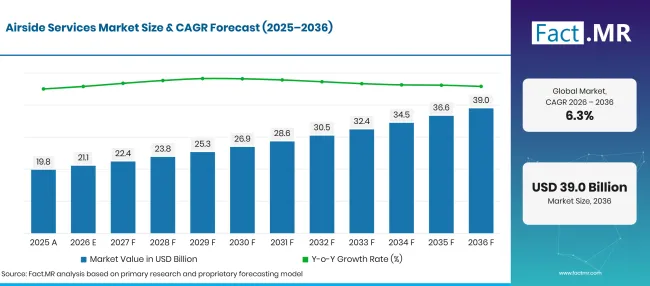
Factmr Airside Services Market Forecast Global | Source: Fact.MR
| Year | Basis | Market value (USD Billion) |
|---|---|---|
| 2025 | Actual | 19.85 |
| 2026 | Estimate | 21.10 |
| 2036 | Forecast | 39.00 |
| CAGR 2026 to 2036 | Forecast period | 6.3% |
Source: Fact.MR analysis. Updated Oct 14, 2026
What are the defining numbers behind Airside Services Market growth?
An absolute opportunity of USD 17.9 billion will be created between 2026 and 2036, as demand for aircraft ground operations, ramp handling, fueling, maintenance, and supporting equipment services expands.
- Demand Drivers in the Market
- Increasing air traffic and airport utilization: Growing passenger and cargo movements can increase demand for ramp handling, aircraft turnaround support, and other essential airside services. Airports and airlines will need reliable service capacity to accommodate changing flight schedules.
- Focus on faster aircraft turnaround: Airlines seek to reduce ground time while maintaining safety and service standards. Efficient baggage handling, aircraft positioning, ground support equipment deployment, and coordination among airside teams will remain important purchasing considerations.
- Operational efficiency and cost control: Airlines and airport operators face pressure to manage operating expenses while maintaining service reliability. Outsourced airside services can provide access to specialized personnel, equipment, and operational expertise.
- Modernization of ground support equipment: Equipment upgrades and more efficient operating processes can improve service consistency, equipment availability, and resource utilization. Providers that invest in suitable equipment and workforce capabilities will be better positioned to serve complex airport operations.
- Expansion of specialized airside services: Aircraft fueling, maintenance support, and other specialized services will remain important as airports accommodate diverse aircraft types, operating schedules, and customer requirements.
- Key Segments Analyzed
- By Service Type: Ramp Handling will hold a 32.5% share in 2026, supported by its essential role in aircraft turnaround operations, including baggage handling, loading, and ground support.
- By Application: Commercial Airports will account for 78.4% of the market in 2026, driven by high passenger traffic and the extensive ground-handling requirements of commercial aviation.
- By End-User: Airlines will capture a 54.3% share in 2026, reflecting their reliance on ground-handling services to maintain operational efficiency and timely aircraft turnaround.
- Analyst Opinion
- Shambhu Nath Jha, Principal Consultant at Fact.MR, states, “Airside services providers will need to balance operational reliability, turnaround efficiency, and cost management as airport activity expands. Companies with broad service portfolios, established airport relationships, and the ability to coordinate ramp handling, fueling, maintenance, and equipment support will be positioned to compete for airline and airport operator contracts.”
- Strategic Implications
- Providers serving commercial airports should develop scalable operating models that accommodate changing flight volumes, airline schedules, and aircraft turnaround requirements.
- Companies should invest in equipment maintenance, fleet availability, employee training, and standardized operating procedures to support service reliability.
- Service providers should strengthen relationships with airlines and airport operators through consistent performance, transparent service standards, and flexible operating arrangements.
- Companies offering multiple airside services should assess opportunities to combine ramp handling, fueling, maintenance, and ground support equipment capabilities where customer requirements support integrated contracts.
Germany will lead the listed country markets at a 7.8% CAGR from 2026 to 2036. Brazil will follow at 7.1%, supported by opportunities associated with airport activity and aviation operations. The United States will record a 6.5% CAGR, while the United Kingdom will grow at 5.8%. Japan will register a 5.1% CAGR over the same period.
How does the Airside Services Market break down by segment?
Ramp Handling will lead Service Type at 32.5%; Commercial Airports will lead Application at 78.4%; Airlines will lead End-User at 54.3%.
Which Service Type dominates?
Ramp Handling will hold a 32.5% share in 2026.
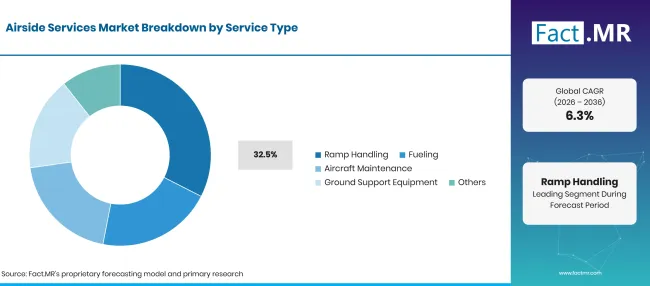
Factmr Airside Services Market Breakdown Service Type | Source: Fact.MR
| Segment type | Share (2026) |
|---|---|
| Service Type | |
| Ramp Handling (Leading segment) | 32.5% |
| Other segments combined | 67.5% |
| Total | 100.0% |
Source: Fact.MR analysis. Updated Oct 14, 2026
Ramp handling lead this segment. These services support aircraft turnaround operations and can include aircraft positioning, baggage and cargo handling, loading and unloading coordination, and related ground activities, depending on the provider's contracted scope. Efficient ramp operations are important because delays in ground handling can affect aircraft departure schedules and subsequent flight operations.
Fueling services support aircraft departures by providing the required fuel within established operating and safety procedures. Aircraft maintenance services support the inspection, servicing, and technical requirements included within a provider's service offering. Ground support equipment services cover equipment used to assist aircraft and ground operations.
What supports Commercial Airports within Application?
Commercial Airports will account for 78.4% of the market in 2026.
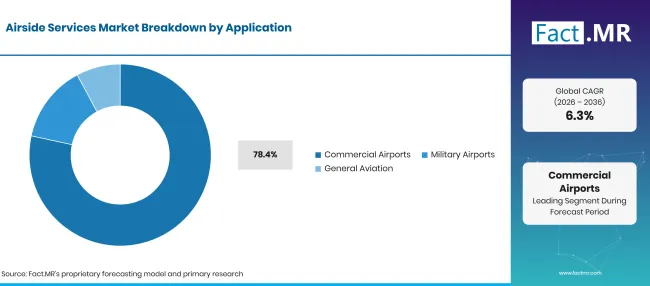
Factmr Airside Services Market Breakdown Application | Source: Fact.MR
| Segment type | Share (2026) |
|---|---|
| Application | |
| Commercial Airports (Leading segment) | 78.4% |
| Other segments combined | 21.6% |
| Total | 100.0% |
Source: Fact.MR analysis. Updated Oct 14, 2026
Commercial airports will lead the application segment. Their operations require coordinated support for scheduled passenger services, cargo movements, aircraft turnaround activities, and airport-side operational requirements.
Service providers operating at commercial airports must coordinate with airlines, airport management teams, ground operations personnel, and other service partners. Flight schedules, aircraft movements, service-level requirements, and equipment availability influence the operational demands placed on airside service providers.
What leads the End-User segment?
Airlines will capture a 54.3% share in 2026.
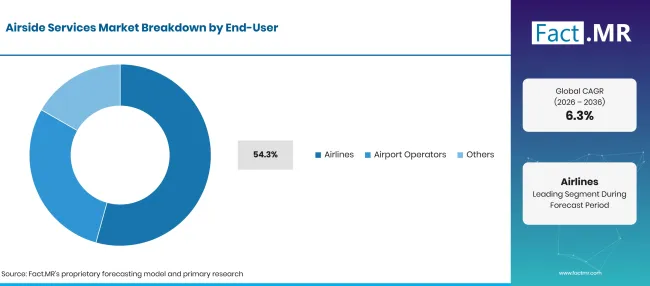
Factmr Airside Services Market Breakdown End User | Source: Fact.MR
| Segment type | Share (2026) |
|---|---|
| END-USER | |
| Airlines (Leading segment) | 54.3% |
| Other segments combined | 45.7% |
| Total | 100.0% |
Source: Fact.MR analysis. Updated Oct 14, 2026
Airlines will lead the end-user segment because airside services form an important part of aircraft turnaround and flight operations. Airlines depend on service providers to coordinate ground activities, support departure schedules, and maintain the availability of essential handling services.
Service consistency, turnaround performance, safety procedures, and cost control can influence airline purchasing decisions. Providers that demonstrate reliable execution and the ability to meet contracted operational requirements may be better positioned to maintain airline relationships.
Airport operators also require airside services to support airport operations and coordinate activities across airport facilities. Other end users contribute to demand where their operating models require specialized airside support. Their individual market shares were not provided.
What is accelerating Airside Services Market adoption, and what is holding it back?
Demand will be supported by airport activity, the need for efficient aircraft turnaround, and the ongoing requirement for dependable ground operations. Growth may be constrained by operating costs, workforce requirements, equipment investment, and the operational complexity of serving multiple airlines and airport facilities.
Drivers Impact Analysis
| DRIVER | (~) % IMPACT ON CAGR | GEOGRAPHIC RELEVANCE | IMPACT TIMELINE |
|---|---|---|---|
| Rising air passenger and cargo traffic increases demand for ramp handling, fueling, and ground support services | +2.0% | Global | Short term (≤ 2 years) |
| Airline focus on reducing aircraft turnaround times and improving operational efficiency | +1.6% | Global | Medium term (2–4 years) |
| Airport infrastructure expansion and capacity upgrades increase demand for specialized airside services | +1.2% | Germany, USA, Brazil | Short term (≤ 2 years) |
| Growing adoption of modern ground support equipment to improve workforce productivity and service reliability | +0.8% | Europe, North America, East Asia | Long term (≥ 4 years) |
Source: Fact.MR analysis. Updated Oct 14, 2026
Opportunity Impact Analysis
| OPPORTUNITY | (~) % IMPACT ON CAGR | GEOGRAPHIC RELEVANCE | IMPACT TIMELINE |
|---|---|---|---|
| Electrification of ground support equipment to reduce operating costs and airport emissions | +1.2% | Europe, North America, Japan | Medium term (2–4 years) |
| Digital airside coordination systems to improve resource allocation and aircraft turnaround planning | +0.9% | Germany, USA, UK | Long term (≥ 4 years) |
| Outsourcing of airside operations to specialized service providers to improve cost efficiency and service consistency | +0.6% | Brazil, USA, Germany | Medium term (2–4 years) |
| Expansion of airport capacity and development of new aviation infrastructure | +0.4% | Brazil, Germany, Japan | Short term (≤ 2 years) |
Source: Fact.MR analysis. Updated Oct 14, 2026
Restraints Impact Analysis
| RESTRAINT | (~) % IMPACT ON CAGR | GEOGRAPHIC RELEVANCE | IMPACT TIMELINE |
|---|---|---|---|
| High capital investment requirements for ground support equipment, maintenance infrastructure, and fleet modernization | −0.8% | Global | Short term (≤ 2 years) |
| Shortage of trained airside personnel and rising labor costs increase operational complexity | −0.6% | Europe, North America, Japan | Medium term (2–4 years) |
| Strict airside safety requirements and airport access regulations increase compliance and training costs | −0.4% | Global | Long term (≥ 4 years) |
Source: Fact.MR analysis. Updated Oct 14, 2026
Which countries are scaling the Airside Services Market through 2036?
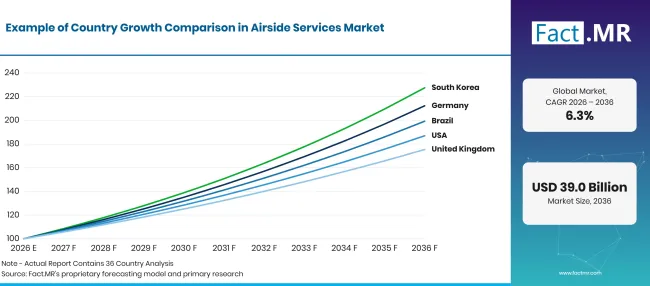
Factmr Airside Services Market Growth Index | Source: Fact.MR
| Country | CAGR (2026–2036) |
|---|---|
| Germany | 7.8% |
| Brazil | 7.1% |
| United States | 6.5% |
| United Kingdom | 5.8% |
| Japan | 5.1% |
Source: Fact.MR analysis. Updated Oct 14, 2026
What supports Germany's adoption?
7.8% CAGR, the highest among the listed country markets.
Germany is projected to record the fastest growth among the five countries. Its airside services market will require providers to support airport operations, aircraft turnaround activities, and the operational needs of airlines and airport operators.
Service providers seeking growth in Germany should assess customer contract requirements, staffing needs, equipment availability, and opportunities to deliver multiple services.
How is Brazil scaling demand?
7.1% CAGR, supported by the forecast growth assigned to the Brazilian market.
Brazil is projected to record the second-highest CAGR among the listed countries. Airside service providers can assess opportunities associated with commercial airport operations, airline service requirements, and the coordination of ramp handling and related activities.
What supports United States adoption?
6.5% CAGR, reflecting the forecast for the United States.
The United States is projected to record a 6.5% CAGR between 2026 and 2036. The market provides opportunities for providers serving commercial airports, airlines, and other airport users with airside service requirements.
Operational reliability, equipment availability, labor management, and the ability to meet customer service requirements will be important competitive considerations.
How is the United Kingdom developing demand?
5.8% CAGR, driven by handling operation for airline and airport operation requirements.
The United Kingdom is projected to grow at a 5.8% CAGR over the forecast period. Providers will need to respond to airline and airport operator requirements while maintaining reliable handling operations and efficient deployment of personnel and ground support equipment.
What is supporting Japan's adoption?
5.1% CAGR, the lowest among the five listed country markets.
Japan is projected to record a 5.1% CAGR from 2026 to 2036. Demand will continue to depend on the operational requirements of commercial airports, airlines, and other airside service users. Service providers should evaluate opportunities to improve equipment utilization, service coordination, and operational reliability.
Who leads the Airside Services Market?
Competition falls into two groups. Broad groups compete on network coverage and bundled programs: Swissport International Ltd. offers passenger, ramp, cargo, and lounge services, Menzies Aviation provides ground handling, cargo, and into-plane fueling.
Celebi Aviation Holding offers ground and cargo handling, SATS Ltd. combines ground handling, cargo, and catering, and Aviapartner provides passenger, ramp, and cargo handling. Specialized providers compete on defined activities and airport relationships: Air General Inc. offers ground handling and fuelling, PrimeFlight Aviation Services provides ramp and passenger assistance, Jet Aviation AG serves business aviation with handling, FBO, and maintenance, and BBA Aviation plc offers FBO and ground support. Swissport has a reported 11% share; other companies’ shares were not provided, so no ranking is supported. Contract retention and service consistency will decide competition through 2036.
Which companies are the key providers?
Key companies identified in the airside services market include:
- Swissport International Ltd.
- Menzies Aviation
- Celebi Aviation Holding
- SATS Ltd.
- Aviapartner
- Air General Inc.
- PrimeFlight Aviation Services
Bibliography
- [1] Airports Council International. (2026, January 28). ACI World releases global airport traffic forecasts as long-term demand growth continues to reshape aviation.
- [2] International Air Transport Association. (2025, June). Global outlook for air transport: June 2025.
- [3] European Commission. (2025). Commission Delegated Regulation (EU) 2025/20 of 19 December 2024 supplementing Regulation (EU) 2018/1139 of the European Parliament and of the Council by laying down requirements for the safe provision of ground handling services and for organisations providing them. Official Journal of the European Union.
- [4]European Union Aviation Safety Agency. (2025, November 5). Easy access rules for ground handling (Regulations (EU) 2025/23 and 2025/20).
- [5] Swissport International AG. (2026). 2025 company report.
- [6]International Air Transport Association. (2026, July 16). IATA releases 2025 World Air Transport Statistics.
This Report Answers
- The report explains how the airside services market is structured by service type, application, and end-user.
- Segment analysis identifies Ramp Handling, Commercial Airports, and Airlines as the leading categories in their respective 2026 breakdowns.
- Country analysis compares the five listed markets using CAGRs through 2036.
- Market forecasting presents annual values from 2021 to 2036, including the increase from USD 21.1 billion in 2026 to USD 39.0 billion in 2036.
- Strategic analysis outlines the potential demand drivers, growth opportunities, operational restraints, and competitive considerations affecting airside services.
What does the Airside Services Market cover?
The Airside Services Market covers services that support aircraft operations within airport airside environments. These services include ramp handling, aircraft fueling, aircraft maintenance, ground support equipment services, and other related activities.
The assessment considers demand from commercial airports, military airports, and general aviation operations. It also evaluates end-user requirements from airlines, airport operators, and other customers that procure airside services.
What is included in the scope?
The scope includes ramp handling, fueling, aircraft maintenance, ground support equipment, and other airside services identified in the market segmentation.
It covers services delivered to commercial airports, military airports, and general aviation facilities, as well as services purchased by airlines, airport operators, and other end users.
What is excluded from the scope?
For analytical consistency, the scope should be restricted to the service categories and end-user applications explicitly identified in the dataset.
Services outside those categories should not be added to the market estimate unless the underlying market definition confirms their inclusion. Individual airport infrastructure construction projects, aircraft manufacturing, and other activities should not automatically be counted as airside services market revenue without confirmation that they fall within the underlying market definition.
How Was the Analysis Built?
The analysis draws on 120+ sources, 35+ company portfolios, 25+ countries, and more than 20 industry interviews.
- Primary Research: Primary research includes discussions with manufacturers, service providers, technology developers, distributors, end users, and subject-matter experts. These conversations examine purchasing priorities, product adoption, operational challenges, approval requirements, competitive positioning, and the factors that influence wider market acceptance.
- Desk Research: Desk research covers government statistics, regulatory publications, company filings, trade data, technical studies, industry associations, standards, public policy, and other authoritative sources. Every source used in the analysis is documented in the bibliography.
- Market Sizing and Forecasting: Market estimates combine historical performance, demand indicators, pricing and volume trends, segment shares, company participation, country-level growth, adoption patterns, investment activity, and barriers to market expansion.
- Data Validation and Update Cycle: Findings are validated by comparing primary interviews with public data, company activity, regulatory changes, trade patterns, and industry developments. Regular updates review new product launches, capacity changes, partnerships, approvals, and shifts in commercial adoption.
Segmentation
What is the report's scope and coverage?
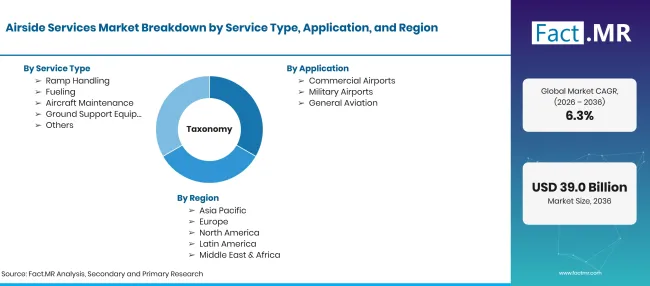
Factmr Airside Services Market Taxonomy | Source: Fact.MR
| Attribute | Details |
|---|---|
| Quantitative Units | USD billion |
| Market Definition | Airside services supporting aircraft and airport ground operations, including ramp handling, fueling, aircraft maintenance, ground support equipment, and other related services |
| Service Type | Ramp Handling; Fueling; Aircraft Maintenance; Ground Support Equipment; Others |
| Application | Commercial Airports; Military Airports; General Aviation |
| End-User | Airlines; Airport Operators; Others |
| Regions Covered | North America; Latin America; Western Europe; Eastern Europe; East Asia; South Asia & Pacific; Middle East & Africa |
| Countries Covered | Germany; Brazil; United States; United Kingdom; Japan |
| Key Companies Profiled | Swissport International Ltd.; Menzies Aviation; Celebi Aviation Holding; SATS Ltd.; Aviapartner; Air General Inc.; PrimeFlight Aviation Services |
| Forecast Period | 2026 to 2036 |
| Historical and Forecast Data | Annual market values from 2021 to 2036 |
| Approach | Analysis based on the market forecast, country CAGRs, segment shares, company share, and competitor list. The underlying forecasting methodology was not provided. |
Source: Fact.MR analysis. Updated Oct 14, 2026
How is the market segmented?
-
By Service Type
- Ramp Handling
- Fueling
- Aircraft Maintenance
- Ground Support Equipment
- Others
-
By Application
- Commercial Airports
- Military Airports
- General Aviation
- By End-User
- Airlines
- Airport Operators
- Others
-
By Region
- North America
- Latin America
- Western Europe
- Eastern Europe
- East Asia
- South Asia & Pacific
- Middle East & Africa
Frequently Asked Questions
How big is the Airside Services Market in 2026?
What is the CAGR of the Airside Services Market from 2026 to 2036?
Which service type leads the Airside Services Market?
Which application leads the Airside Services Market?
Which end-user segment leads the Airside Services Market?
Which country will grow the most in the Airside Services Market?
Who are the main companies in the Airside Services Market?
What is the absolute growth opportunity in the Airside Services Market?
Who worked on this report


Preview the report firsthand - request a free sample
Free SampleGet the brochure for pricing and purchase details
Download PDF