- Market Value (2025): USD 2.0 Bn
- Estimated Value (2026): USD 2.2 Bn
- Forecast Value (2036): USD 7.0 Bn
- CAGR (2026-2036): 12.3%
What is the Circular Material Scale-Up Services Market forecast to be worth by 2036?
USD 2.2 billion in 2026 to USD 7.0 billion by 2036 at a 12.3% CAGR.
- The Circular Material Scale-Up Services Market reached USD 2.0 billion in 2025.
- Demand is expected to increase from USD 2.2 billion in 2026 to USD 7.0 billion by 2036.
- The market is expected to record a 12.3% CAGR from 2026 to 2036 as process teams and plant teams move qualified circular formulas toward stable plant settings.
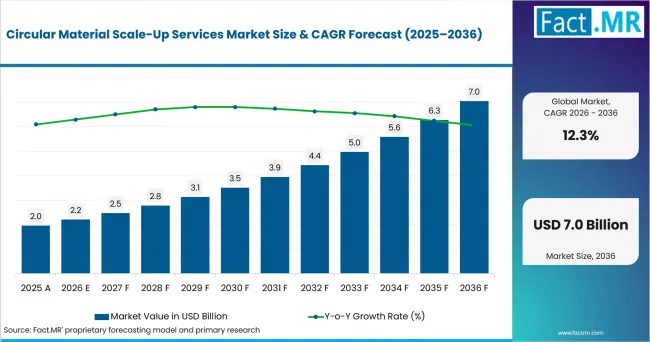
Circular Material Scale Up Services Market Value Analysis | Source: Fact.MR
What are the defining numbers behind Circular Material Scale-Up Services Market growth?
An absolute opportunity of USD 4.8 billion is expected between 2026 and 2036.
- Demand Drivers in the Market
- Process teams need lab-to-pilot programs that expose feedstock variation before larger process equipment is selected. Work on circular polymers depends on stable process windows that can be matched beyond lab gear.
- Recycling teams need process packages that link feed quality with stable run settings before plant transfer. On January 15, 2025, the U.S. Department of Energy announced up to USD 100 million for pilot-scale carbon-conversion technologies. DOE said the funding will advance pilot-scale testing of carbon-conversion technologies with high technology-readiness levels.
- Battery and electronic-process teams need test batches that match intended plant routes before full-scale equipment choices are fixed. Related lithium-ion battery recycling programs can require controlled mixing and separation trials before larger plant choices are fixed.
- Plant teams need debottlenecking and plant-transfer support when a reuse process enters an existing line. Adjacent plastic processing equipment decisions become easier when pilot data maps clearly to plant line limits.
- Key Segments Analyzed
- By Service Stage: Lab-to-pilot is expected to hold 39.0% share in 2026 because early scale transfer is where process instability first becomes visible outside lab gear.
- By Material: Recycled polymers are expected to account for 37.0% share in 2026 as variable waste-derived feedstocks require stable run windows before plant use.
- By Scale Asset: Extrusion pilot is expected to capture 33.0% share in 2026 owing to its fit with polymer compounding, reactive processing and steady mixing trials.
- By Commercial Output: Process package is expected to hold 31.0% share in 2026 because teams need defined run ranges and equipment needs before transferring a reuse process to plant.
- Analyst Opinion at Fact.MR
- Shambhu Nath Jha, Principal Consultant at Fact.MR, states, “The difficult step in circular materials is often the move from a successful formula to a stable process. Scale-up programs are expected to gain value where they match plant settings and generate proof that plant teams can use. Providers that combine flexible pilot assets with feed checks and practical transfer records are better aligned with that decision point.”
- Strategic Implications
- Process teams should define the scale question and target plant outcome before booking pilot time begins. Projects involving bioplastics need clear feedstock ranges and plant quality targets before process settings are transferred.
- Recycling teams should preserve trial data in a format that plant teams can convert into line settings and quality limits at the receiving plant.
- Plant owners should use test batches to test downstream conversion before final process settings are fixed, keeping later process changes focused on measurable transfer gaps.
France is expected to record 13.3% CAGR through 2036 as plant R&D supports scale transfer. The UK is projected at 13.0% as business R&D sustains pilot work. Japan is expected to post 11.8% through research-intensive production. The USA is estimated at 11.5% as scale-up programs move research toward plant use. Germany is forecast at 11.2% through its strong process-design base.
How does the Circular Material Scale-Up Services Market break down by segment?
Lab-to-pilot leads Service Stage at 39.0%. recycled polymers lead Material at 37.0%.
Which Service Stage dominates?
Lab-to-pilot is expected to hold 39.0% share in 2026.
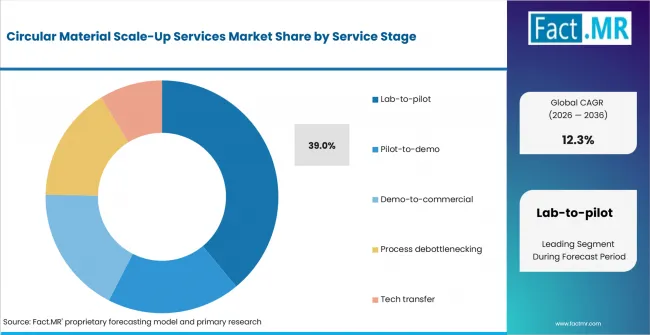
Circular Material Scale Up Services Market Analysis By Service Stage | Source: Fact.MR
Lab-to-pilot work leads because it is the first controlled step where a material must behave outside small lab gear. Teams use this stage to establish feed response, residence time and stable run windows before spending on larger demo runs. Pilot-to-demo work follows after teams establish a stable process window and stable quality at smaller scale. Demo-to-commercial work becomes more valuable once downstream quality needs and receiving-plant limits are clearly defined. Process debottlenecking and tech transfer support later decisions when a route must fit existing assets or a new plant line.
Pilot-to-demo work becomes useful after a stable run window has been set and the team needs to test higher throughput. The broader extrusion aids value chain shows how line response and run settings can influence transfer from trial equipment toward plant settings.
What leads the Material segment?
Recycled polymers are expected to account for 37.0% share in 2026.
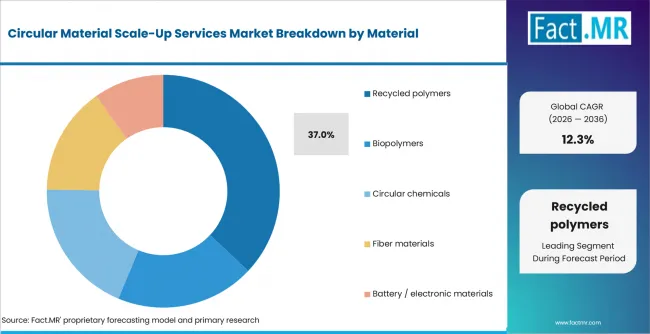
Circular Material Scale Up Services Market Analysis By Material | Source: Fact.MR
Recovered feedstocks can vary between lots, so scale-up work checks whether filtration and compounding stay stable as feed quality shifts. The same transfer need appears in recycled polyolefin work when recovered inputs must meet stable plant settings.
In July 2025, Coperion reported that two recently commissioned chemical plastics recycling lines could each process up to 6,000 kg/h. Its Recycling Innovation Center allows customers to test recycled materials and complete recycling-process configurations under realistic production conditions, with results that can be scaled up to production level and used to support equipment and plant-system design.
How does Scale Asset shape demand?
Extrusion pilot is expected to capture 33.0% share in 2026.
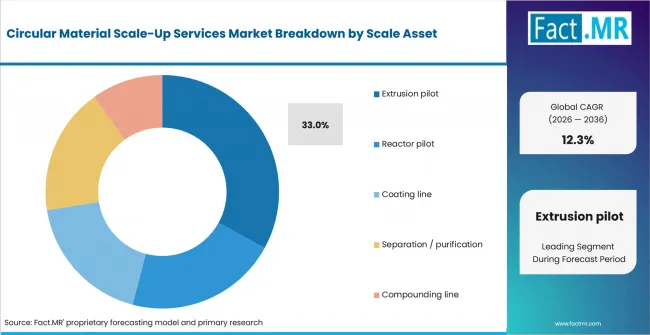
Circular Material Scale Up Services Market Analysis By Scale Asset | Source: Fact.MR
Extrusion pilot assets hold the largest share because continuous mixing and compounding are common scale questions for polymer-based circular feeds. Pilot equipment helps engineers control shear and residence time with less feed than a plant line. Adjacent reactive extrusion lines show why screw configuration and run windows become central during scale transfer.
Reactor pilots support circular chemicals where reaction response governs scale and must stay stable at higher throughput. Coating lines support surface checks while separation systems handle recovered streams under controlled conditions before transfer. Compounding lines help formula teams test additive integration and mixing behavior before plant transfer at larger batch size.
What supports Process Package within Commercial Output?
Process package is expected to hold 31.0% share in 2026.
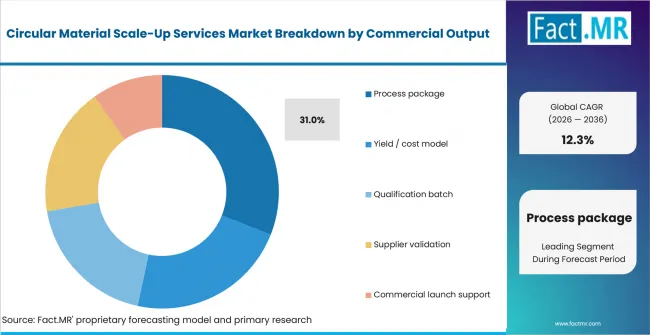
Circular Material Scale Up Services Market Analysis By Commercial Output | Source: Fact.MR
A process package leads plant output because a successful trial has limited value unless plant teams can match it. The process package converts pilot findings into equipment needs and defined run ranges for the receiving plant. Related plastic chemical recycling catalysts programs can require the same transfer discipline when reaction and recovery steps move beyond laboratory scale.
Yield and cost models test whether the route remains workable when throughput rises toward plant scale. Test batches provide material for downstream checks. At the same time, supplier testing and launch support focus on transfer readiness after the main pilot question has been resolved.
What is accelerating Circular Material Scale-Up Services Market adoption, and what is holding it back?
Scale-risk reduction drives adoption. feed changes and capital discipline restrain it.
Drivers Impact Analysis
| DRIVER | (~) % IMPACT ON CAGR | GEOGRAPHIC RELEVANCE | IMPACT TIMELINE |
|---|---|---|---|
| Need to prove process transfer before plant investment | +2.0% | Global | Short term (<= 2 years) |
| Recycled-feed changes | +1.6% | North America, Europe, East Asia | Short term (<= 2 years) |
| Circular-content and recycling policy pressure | +1.3% | Europe, Japan, UK | Medium term (2-4 years) |
| Battery and electronics material qualification | +1.0% | USA, Europe, Japan | Medium term (2-4 years) |
| Brownfield debottlenecking and line conversion | +0.7% | Global | Long term (>= 4 years) |
Source: Fact.MR analysis. Updated Sep 24, 2026
Opportunity Impact Analysis
| OPPORTUNITY | (~) % IMPACT ON CAGR | GEOGRAPHIC RELEVANCE | IMPACT TIMELINE |
|---|---|---|---|
| Integrated trial-to-transfer service packages | +1.4% | Global | Short term (<= 2 years) |
| Chemical and polymer recycling scale-up | +1.1% | Europe, USA, Japan | Medium term (2-4 years) |
| Battery-material pilot processing | +0.9% | UK, USA, Japan, Germany | Medium term (2-4 years) |
| Separation and purification test services | +0.6% | Global | Long term (>= 4 years) |
Source: Fact.MR analysis. Updated Sep 24, 2026
Restraints Impact Analysis
| RESTRAINT | (~) % IMPACT ON CAGR | GEOGRAPHIC RELEVANCE | IMPACT TIMELINE |
|---|---|---|---|
| Feedstock inconsistency between trial batches | -0.8% | Global | Short term (<= 2 years) |
| Limited availability of representative material | -0.6% | Emerging circular routes | Short term (<= 2 years) |
| Capital review before demo scale | -0.5% | Global | Medium term (2-4 years) |
| Weak transferability between unlike equipment | -0.4% | Global | Long term (>= 4 years) |
Source: Fact.MR analysis. Updated Sep 24, 2026
Which countries are scaling the Circular Material Scale-Up Services Market through 2036?
- The five-country comparison spans 2.1 points from France at 13.3% to Germany at 11.2% through 2036.
- France remains 0.3 point above the UK as plastics circularity policy and plant R&D support scale-up needs.
- The UK remains 1.2 points above Japan as recycled-content rules and business R&D create several routes into pilot work.
- Japan remains 0.3 point above the USA as circular-design programs add test work to a high-R&D plant base.
- The USA remains 0.3 point above Germany while federal pilot funding supports scale transfer for carbon-conversion technologies.
- Germany closes the displayed range with a mature process design base and continuing reuse work that still requires feed and line testing.
Similar CAGRs can produce different service demand because each country combines distinct research systems, waste rules and plant assets. The comparison therefore treats scale-up as a process service need that differs from national recycling volume.
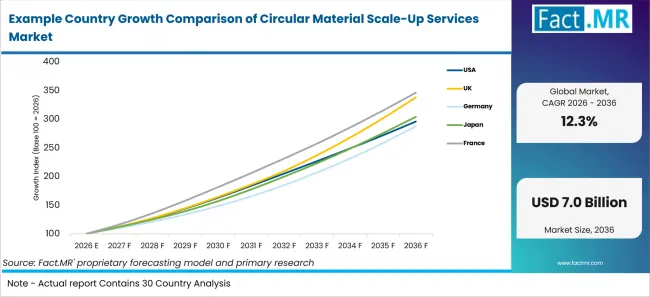
Example Country Growth Comparison Of Circular Material Scale Up Services Market | Source: Fact.MR
| Country | CAGR (2026-2036) |
|---|---|
| France | 13.3% |
| United Kingdom | 13.0% |
| Japan | 11.8% |
| United States | 11.5% |
| Germany | 11.2% |
Source: Fact.MR analysis. Updated Sep 24, 2026
What supports France adoption?
13.3% CAGR, supported by plant R&D and circular-material process work.
France combines materials research with a large chemicals and plastics base, so scale-up programs often focus on proving repeat use before plant transfer. The Ministry of Higher Education and Research reported in April 2026 that business R&D expenditure increased 1.0% in volume in 2024. That research flow supports pilot work where process windows must be defined on plant-scale equipment. Demand is also connected to circular plastics programs that require stable conversion and test before plant output.
How is the United Kingdom scaling demand?
13.0% CAGR, shaped by business R&D and scale-up infrastructure.
The United Kingdom has a broad business research base and dedicated scale-up facilities that move new processes beyond lab trials. On November 28 2025, the Office for National Statistics reported that UK businesses performed GBP 55.6 billion of R&D in 2024. Pilot services can translate that work into stable process settings before larger plant choices are made. Projects involving foodgrade recycled polymers can require the same link between feed quality and plant-ready settings.
How does Japan perform?
11.8% CAGR, supported by research-intensive plant and test needs.
Japan’s plant base places a high value on process repeat use before new feeds enter set plant lines. In its January 2026 News Bulletin, Japan’s Statistics Bureau reported that science and technology R&D expenditure totaled JPY 23.79 trillion in FY2024. Scale-up services help teams test whether mixing and separation settings remain stable as batch size increases. That testing can also support lithium-ion battery recycling routes that use recovered battery materials and need stable settings before plant transfer.
What supports USA adoption?
11.5% CAGR, supported by a large research base and plant scale transfer.
The United States has a large pipeline of trial work that can move into pilot and demo work. On February 27 2026, the National Center for Science and Engineering Statistics estimated U.S. R&D performance at USD 993 billion in 2024. Service providers can turn that research work into plant-ready settings for compounding and separation programs. Related recycled plastic resins programs can require the same plant-scale tests before routine plant use.
What is supporting Germany adoption?
11.2% CAGR, reinforced by R&D spending and strong process design.
Germany combines research spending with established extrusion and separation design, giving scale-up teams a direct route from pilot equipment toward plant machinery. On March 27 2026, Destatis reported German R&D spending of EUR 137.1 billion in 2024. That environment supports test programs that must prove stable run windows before transfer. Related twin screw extruder applications are especially useful where continuous mixing must be matched at higher throughput.
Who leads the Circular Material Scale-Up Services Market?
Sulzer, Coperion, Clextral, and Gneuss form the profiled provider group for circular-material scale-up services. Their relevance sits within a market that moves processes from laboratory work into pilot, demonstration, and plant use through controlled trials, scale transfer, debottlenecking, and plant-readiness support.
Coperion has a particularly clear fit with recycling scale-up work. Its Recycling Innovation Center enables customers to test recycled materials and complete recycling-process configurations under production-oriented conditions, helping engineering teams translate trial results into equipment and plant-system decisions. Sulzer, Clextral, and Gneuss broaden the competitive set across process-development and scale-up requirements covered by the report. The market spans extrusion pilots, reactor pilots, coating lines, separation and purification systems, and compounding lines, giving providers several routes to support circular polymers, chemicals, and other recovered-material programs.
Which companies are the key providers?
Key companies include Sulzer, Coperion, Clextral, and Gneuss.
- Sulzer
- Coperion
- Clextral
- Gneuss
Bibliography
- Hydrocarbons and Geothermal Energy Office. (2025, January 15). DOE announces $100 million for pilot-scale carbon conversion. U.S. Department of Energy.
- Coperion. (2025, July 15). Coperion at K 2025: Innovative interplay of plastics recycling technologies.
- Ministère de l’Enseignement supérieur, de la Recherche et de l’Espace. (2026, April). Les dépenses de R&D des entreprises en 2024 (données provisoires).
- Office for National Statistics. (2025, November 28). Business enterprise research and development, UK: 2024.
- Statistics Bureau of Japan. (2025, December 12). Summary of the results of the 2025 Survey of Research and Development.
- National Center for Science and Engineering Statistics. (2026, February 27). U.S. R&D totaled $937 billion in 2023; estimate for 2024 indicates further increase to $993 billion (NSF 26-314). U.S. National Science Foundation.
- Statistisches Bundesamt (Destatis). (2026, March 27). 3,8 % mehr Ausgaben für Forschung und Entwicklung im Jahr 2024 [3.8% more expenditure on research and development in 2024].
This Report Answers
- The report explains where circular-material scale-up services are used across service stage and material type. It also covers the pilot assets and commercial outputs that plant teams use during process transfer.
- Segment review identifies the leading subsegments and explains why the supplied shares favor lab-to-pilot work and recycled polymers. The same review explains the role of extrusion pilots and process packages within the supplied segment shares.
- Country review compares the supplied CAGRs for France and the United Kingdom with Japan’s forecast path. It also covers the United States and Germany using current official R&D evidence.
- Competitive review checks the six named providers across extrusion and mixing services that fit the market scope. It also covers separation and process-work skills while keeping company market shares outside the review.
- Application review considers how feed changes and pilot fit affect scale-up work before a plant decision is made. It also covers how test batches and transfer records support the final move into plant use.
What does the Circular Material Scale-Up Services Market cover?
The Circular Material Scale-Up Services Market covers process and test services that move circular processes from lab proof into pilot and plant use. It includes material trials and scale transfer where extrusion aids or other run factors must be tested under plant-scale settings.
Coverage extends to pilot coating and surface-test work when a circular feed requires controlled line trials. Roll-to-roll pilot coating systems can bridge trial quantities with production-oriented processing before a route moves into plant use.
What is included in the scope?
The scope includes lab-to-pilot translation and pilot-to-demo work across circular material programs. It also covers process debottlenecking and plant transfer where a route needs further scale testing. Covered trial types include extrusion and reaction work alongside coating at pilot scale. Separation and compounding trials are included when they form part of scaling a circular material route.
Commercial outputs include process packages and yield or cost models that come directly from a scale-up engagement. The scope also covers qualification batches and supplier validation when they support commercial launch work.
What is excluded from the scope?
Routine plant-equipment sales fall outside the scope when the transaction covers equipment only and excludes scale-up services. Commodity material sales and waste collection remain outside the market boundary unless they form part of a defined scale-up engagement.
Finished-product plant revenue falls outside the service valuation because the review focuses on process work performed between lab proof and stable plant transfer.
How Was the Analysis Built?
The analysis draws on 120+ sources, 35+ company portfolios, 25+ countries, and more than 20 industry interviews.
- Primary Research: Primary research includes discussions with manufacturers, service providers, technology developers, distributors, end users, and subject-matter experts. These conversations examine purchasing priorities, product adoption, operational challenges, approval requirements, competitive positioning, and the factors that influence wider market acceptance.
- Desk Research: Desk research covers government statistics, regulatory publications, company filings, trade data, technical studies, industry associations, standards, public policy, and other authoritative sources. Every source used in the analysis is documented in the bibliography.
- Market Sizing and Forecasting: Market estimates combine historical performance, demand indicators, pricing and volume trends, segment shares, company participation, country-level growth, adoption patterns, investment activity, and barriers to market expansion.
- Data Validation and Update Cycle: Findings are validated by comparing primary interviews with public data, company activity, regulatory changes, trade patterns, and industry developments. Regular updates review new product launches, capacity changes, partnerships, approvals, and shifts in commercial adoption.
Segmentation
What is the report’s scope and coverage?
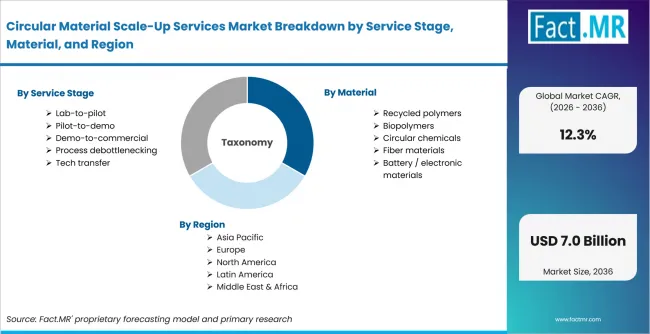
Circular Material Scale Up Services Market Breakdown By Service Stage, Material, And Region | Source: Fact.MR
| Attribute | Details |
|---|---|
| Quantitative Units | USD billion |
| Market Definition | Services that move circular material processes from laboratory work into pilot, demo and plant use. Coverage includes process trials, scale transfer, debottlenecking, plant transfer and plant-readiness outputs. |
| Service Stage | Lab-to-pilot; Pilot-to-demo; Demo-to-commercial; Process debottlenecking; Tech transfer |
| Material | Recycled polymers; Biopolymers; Circular chemicals; Fiber materials; Battery / electronic materials |
| Scale Asset | Extrusion pilot; Reactor pilot; Coating line; Separation / purification; Compounding line |
| Commercial Output | Process package; Yield / cost model; Qualification batch; Supplier testing; Commercial launch support |
| Regions Covered | North America; Latin America; Western Europe; Eastern Europe; East Asia; South Asia & Pacific; Middle East & Africa |
| Countries Covered | United States; United Kingdom; Germany; Japan; France |
| Key Companies Profiled | Sulzer; Coperion; Clextral; Gneuss |
| Forecast Period | 2026 to 2036 |
| Approach | Hybrid top-down and bottom-up approach using pilot-service activity, equipment-center capabilities, circular-material process requirements, country evidence and provider portfolio review. |
Source: Fact.MR analysis. Updated Sep 24, 2026
How is the market segmented?
-
By Service Stage:
- Lab-to-pilot
- Pilot-to-demo
- Demo-to-commercial
- Process debottlenecking
- Tech transfer
-
By Material:
- Recycled polymers
- Biopolymers
- Circular chemicals
- Fiber materials
- Battery / electronic materials
-
By Scale Asset:
- Extrusion pilot
- Reactor pilot
- Coating line
- Separation / purification
- Compounding line
-
By Commercial Output:
- Process package
- Yield / cost model
- Qualification batch
- Supplier validation
- Commercial launch support
-
By Region:
- North America
- Latin America
- Western Europe
- Eastern Europe
- East Asia
- South Asia & Pacific
- Middle East & Africa
Frequently Asked Questions
How big is the circular material scale-up services market in 2026?
What is the CAGR of the circular material scale-up services market from 2026 to 2036?
Which service stage leads the circular material scale-up services market?
Which material leads the circular material scale-up services market?
Who are the key companies in the circular material scale-up services market?
Who worked on this report


Preview the report firsthand - request a free sample
Free SampleGet the brochure for pricing and purchase details
Download PDF