- Market Value (2025): USD 2.5 Bn
- Estimated Value (2026): USD 2.7 Bn
- Forecast Value (2036): USD 7.6 Bn
- CAGR (2026-2036): 10.8%
What is the Probiotic Formulation Support Services Market forecast to be worth by 2036?
USD 2.7 billion in 2026 to USD 7.6 billion by 2036 at a 10.8% CAGR.
- The Probiotic Formulation Support Services Market reached USD 2.5 billion in 2025.
- Demand is forecast to increase from USD 2.7 billion in 2026 to USD 7.6 billion by 2036.
- The market is forecast to record 10.8% CAGR from 2026 to 2036 as supplement brands, food developers, and beverage product teams seek expert help for live-culture products.
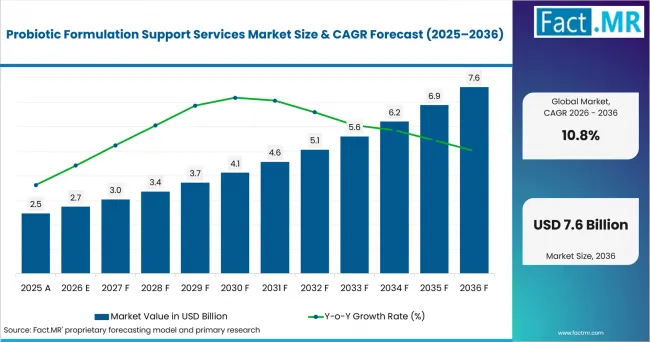
Probiotic Formulation Support Services Market Value Analysis | Source: Fact.MR
What are the defining numbers behind Probiotic Formulation Support Services Market growth?
An absolute opportunity of USD 4.9 billion is expected between 2026 and 2036.
- Demand Drivers in the Market
- Supplement developers need a strain that fits the intended health position and final format. The NIH Office of Dietary Supplements notes that probiotic products can contain one or many strains. Many supplements contain 1 billion to 10 billion CFU per dose, while some contain 50 billion CFU or more.
- Product teams need viable counts to remain reliable through shelf life. Moisture, oxygen, heat, and acidic matrices can reduce culture survival. This raises the value of protective excipients, overage planning, package choice, and stability studies before scale-up.
- Food and beverage brands need expert support when probiotic cultures move beyond standard capsules. Kerry reports that its BC30 spore-forming probiotic can tolerate heat-treated and shelf-stable formats, widening the design space for functional foods and beverages.
- Regulatory teams need claims and label support that keeps product language aligned with local rules. Brands benefit when evidence check starts before label wording and dosage-form choices are fixed.
- Key Segments Analyzed
- By Support Module: Strain selection is expected to hold 37.0% share in 2026 because product results starts with strain identity, recorded benefit, target dose, and fit with the intended delivery system.
- By Dosage Form: Capsules are forecast to account for 33.0% share in 2026 as they protect dry probiotic powders and allow precise dose loading with relatively simple scale-up.
- By Stability Challenge: Moisture is expected to capture 29.0% share in 2026 owing to the sensitivity of live cultures to water activity during manufacturing, storage, and repeated pack opening.
- By Client Stage: Concept is expected to represent 36.0% share in 2026 because strain choice, dosage form, claims pathway, and target shelf life are most efficiently aligned before prototype work begins.
- Analyst Opinion at Fact.MR
- Shambhu Nath Jha, Principal Consultant at Fact.MR, states, “The commercial bottleneck is often the handoff between microbiology and finished product design. A strain can have strong evidence and still fail if the dosage form exposes it to moisture, oxygen, heat, or an unsuitable matrix. Demand is expected to favor partners that connect strain science with stability testing, sensory work, rule review, and scale-up evidence in one development path.”
- Strategic Implications
- Product labs should screen water activity and oxygen exposure early, before pilot production begins. This can stop a weak prototype from moving into a costly pilot batch.
- Regulatory teams should align strain evidence and claim language before label artwork is locked for country launches. The review should happen while the product brief is still flexible so claims and dosage form can be adjusted together.
- Contract developers should connect prototype data with full-scale process conditions so scale-up preserves viability and sensory performance. The same review should cover mixing time, humidity, filling conditions, and final packaging before the full-scale run is approved.
Japan is forecast to record 10.5% CAGR through 2036 as functional-food filing rules keep records and formulation support central to launches. The USA is forecast to post 10.2% as supplement use supports a broad client base. Germany is expected to reach 9.9% as evidence scrutiny remains high. France is estimated at 9.6% as food-supplement oversight shapes claims. The UK is forecast at 9.1% as brands balance format innovation with food-law compliance.
How does the Probiotic Formulation Support Services Market break down by segment?
Strain selection leads Support Module at 37.0%; Concept leads Client Stage at 36.0%.
Which Support Module dominates?
Strain selection is expected to hold 37.0% share in 2026.
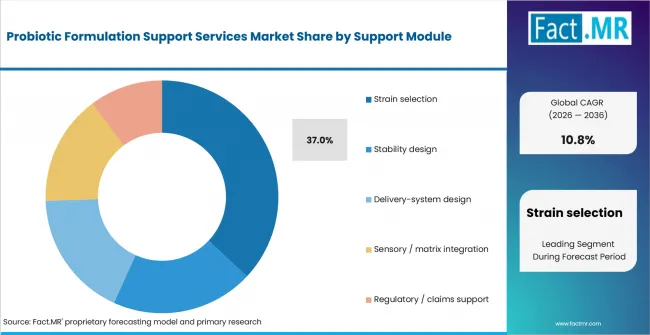
Probiotic Formulation Support Services Market Analysis By Support Module | Source: Fact.MR
Strain selection leads because benefits are strain-specific and a commercial formulation must connect identity, dose, evidence, and format. Stability design follows when developers need to protect viability during processing and shelf life. Delivery-system design becomes more important as brands move into gummies, beverages, and food matrices. Sensory or matrix integration supports formats where acidity, flavor, or texture can affect acceptability.
The NIH Office of Dietary Supplements updated its probiotic fact sheet in March 2025 and notes that probiotic supplements can contain single or multiple strains, with substantial variation in strains, doses, and formulations. NIH also notes that it can be difficult to determine which commercial products are supported by evidence and highlights the importance of considering the specific strain, dose, and formulation.
What leads the Dosage Form segment?
Capsules are forecast to account for 33.0% share in 2026.
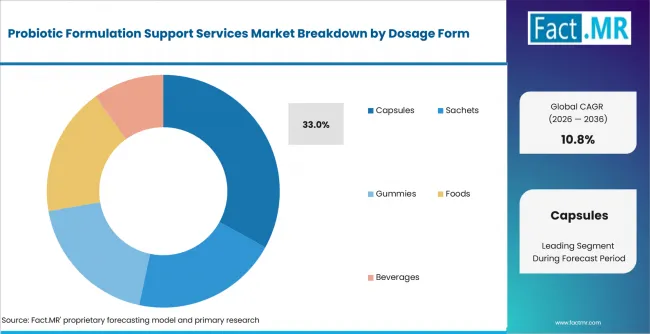
Probiotic Formulation Support Services Market Analysis By Dosage Form | Source: Fact.MR
Capsules lead because dry fill supports dose precision and limits exposure to water during production. Sachets provide flexibility for powders and higher serving weights. Gummies add consumer convenience but place cultures into a higher-moisture system that requires tighter process control. Foods and beverages expand usage occasions, although temperature, acidity, oxygen, and distribution conditions can narrow the strain set.
The UK Food Standards Agency published new food-supplement guidance in January 2026 that lists tablets, capsules, gummies, powders, and liquids among common dose forms. Food supplements are also subject to specific labelling requirements, including recommended dosage, ingredients, storage instructions, and mandatory warnings.
How does Stability Challenge shape demand?
Moisture is expected to lead with 29.0% share in 2026.
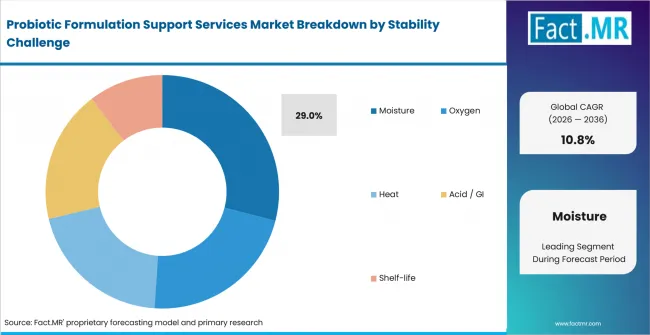
Probiotic Formulation Support Services Market Analysis By Stability Challenge | Source: Fact.MR
Moisture leads because higher water activity can accelerate viability loss during storage. Oxygen is a second design constraint for oxygen-sensitive strains and often shifts attention toward barrier packaging. Heat becomes central in baked, extruded, or hot-filled products. Acid or gastrointestinal exposure influences strain and coating choices, while shelf-life planning combines all four risks into a release specification that can be defended at expiry.
What supports Concept within Client Stage?
Concept is expected to represent 36.0% share in 2026.
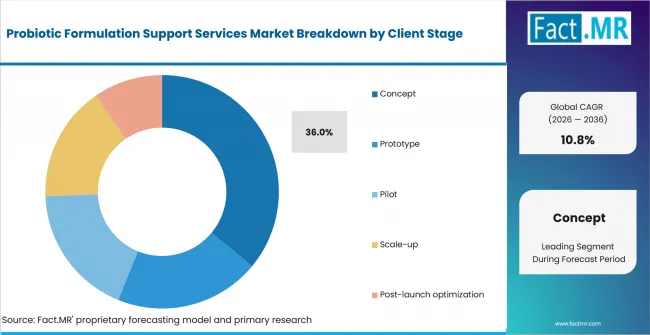
Probiotic Formulation Support Services Market Analysis By Client Stage | Source: Fact.MR
Concept-stage work leads because the earliest decisions set the strain, target claim, dose, format, and expected shelf life. Prototype support then tests whether the initial design survives real ingredients and process conditions. Pilot work checks transferability to factory equipment. Scale-up support manages process changes that can affect viability. Post-launch improvement becomes relevant when full-scale batches, packaging behavior, or user feedback expose new constraints.
dsm-firmenich states that its application and technical services include co-development, trends-led prototype development, stability studies, sensory capabilities, troubleshooting, and downstream technologies. This service range shows why client-stage support can extend from early concept through market launch.
What is accelerating Probiotic Formulation Support Services Market adoption, and what is holding it back?
Format expansion and shelf-life risk drive adoption; evidence gaps and process sensitivity restrain it.
Drivers Impact Analysis
| DRIVER | (~) % IMPACT ON CAGR | GEOGRAPHIC RELEVANCE | IMPACT TIMELINE |
|---|---|---|---|
| Expansion into gummies, foods, and beverages | +1.8% | Global | Short term (<= 2 years) |
| Shelf-life and viable-count requirements | +1.5% | Global | Short term (<= 2 years) |
| Strain-specific evidence and claims review | +1.2% | North America, Europe, East Asia | Medium term (2-4 years) |
| Need for faster concept-to-scale transfer | +0.9% | Global | Medium term (2-4 years) |
Source: Fact.MR analysis. Updated Sep 25, 2026
Opportunity Impact Analysis
| OPPORTUNITY | (~) % IMPACT ON CAGR | GEOGRAPHIC RELEVANCE | IMPACT TIMELINE |
|---|---|---|---|
| Gummy and shelf-stable probiotic design | +1.3% | North America, Europe, East Asia | Medium term (2-4 years) |
| Multi-strain and synbiotic formulation support | +1.0% | Global | Medium term (2-4 years) |
| Regional claims and launch adaptation | +0.7% | Europe, East Asia | Long term (>= 4 years) |
Source: Fact.MR analysis. Updated Sep 25, 2026
Restraints Impact Analysis
| RESTRAINT | (~) % IMPACT ON CAGR | GEOGRAPHIC RELEVANCE | IMPACT TIMELINE |
|---|---|---|---|
| Loss of viability during processing or storage | -0.8% | Global | Short term (<= 2 years) |
| Limited clinical support for some strain-use combinations | -0.6% | Europe, North America | Medium term (2-4 years) |
| Longer validation cycles for complex formats | -0.4% | Global | Medium term (2-4 years) |
Source: Fact.MR analysis. Updated Sep 25, 2026
Which countries are scaling the Probiotic Formulation Support Services Market through 2036?
- The five-country comparison spans 1.4 percentage points across the forecast period.
- Japan stands 0.3 percentage point above the USA, reflecting structured functional-food filing and format development.
- The USA remains 0.3 percentage point above Germany, supported by a broad supplement user base and recurring product design work.
- Germany stays 0.3 percentage point above France, with strain evidence and supplement oversight shaping record needs.
- France remains 0.5 percentage point above the UK, where supplement oversight and food uses shape product design.
Comparable CAGRs can still create different entry conditions. Probiotic services depend on supplement use, claim rules, strain evidence, dosage-form choice, and local filing rules. Full report coverage includes North America, Latin America, Western Europe, Eastern Europe, East Asia, South Asia & Pacific, and Middle East & Africa.
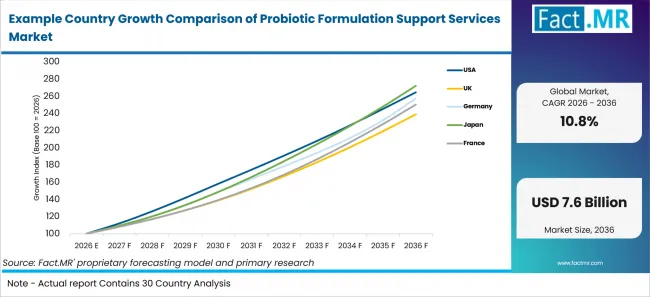
Example Country Growth Comparison Of Probiotic Formulation Support Services Market | Source: Fact.MR
| Country | CAGR (2026-2036) |
|---|---|
| United States | 10.2% |
| United Kingdom | 9.1% |
| Germany | 9.9% |
| Japan | 10.5% |
| France | 9.6% |
Source: Fact.MR analysis. Updated Sep 25, 2026
What supports USA adoption?
10.2% CAGR, supported by supplement use and formula complexity.
U.S. supplement brands are expected to place strain identity and shelf-life proof early in development because the finished dose must remain viable through distribution. The National Center for Health Statistics reported in May 2026 that 60.2% of U.S. adults age 20 and older used a dietary supplement in the past 30 days during the August 2021–August 2023 survey period. That broad user base gives brands room to extend probiotic concepts across capsules and other formats.
What supports the United Kingdom’s growth?
9.1% CAGR, backed by format variety and food-supplement compliance.
UK developers are expected to use outside formulation support when probiotic concepts move into foods and supplements with different process conditions. The Office for National Statistics reported in July 2026 that food represented 22.9% of UK manufacturers’ product sales in 2025. That food-production base gives live-culture projects several routes beyond standard capsules.
What is supporting Germany’s adoption?
9.9% CAGR, shaped by strain evidence and supplement oversight.
German projects are expected to place greater weight on strain-specific evidence because product positioning depends on what is recorded for the exact organism and use case. The Federal Institute for Risk Assessment reported in February 2026 that, as of December 2025, infant and follow-on formulas marketed in Germany included L. fermentum CECT 5716, L. reuteri DSM 17938, and B. lactis BB-12. That diversity reinforces the need to match strain choice with safety review and finished product conditions.
How does Japan perform?
10.5% CAGR, led by functional-food records and format development.
Japan’s product developers are expected to combine technical work with structured filing planning as probiotic concepts move into functional foods and supplements. The Consumer Affairs Agency renewed its Foods with Function Claims notification database on April 1, 2025. Agency guidance states that safety information and scientific support for the functional claim must be submitted before launch. This process raises the value of early coordination between strain evidence and final-format design.
What supports France adoption?
9.6% CAGR, supported by food manufacturing and supplement oversight.
French brands are expected to draw on formulation partners when probiotic concepts move between supplements and food matrices that place different demands on culture survival. INSEE reported in July 2026 that French food, beverage, and tobacco manufacturing produced EUR 207 billion in value during 2025. The scale of that production base creates a broad setting for product work around capsules, foods, and beverages.
Who leads the Probiotic Formulation Support Services Market?
Kerry Group and dsm-firmenich maintain direct probiotic portfolios together with product-development support. Kerry offers BC30 for food and beverage applications and Sporevia for supplement applications, supported by probiotic formulation and application expertise. dsm-firmenich combines Humiome Pro- and Postbiotics with application and technical services covering co-development, stability studies, sensory work, troubleshooting, targeted delivery, and dosage-form development.
IFF participates through HOWARU probiotic strains and blends developed for defined health applications and supported by recommended daily doses.
Lallemand Health Solutions and Probi participate in the wider formulation ecosystem through fibres, sweeteners, texturants, and other food and nutrition ingredients used to manage digestive-health positioning, texture, sweetness, and product performance. In April 2025, dsm-firmenich announced that its Vitafoods Europe program would showcase Humiome Pro- and Postbiotics alongside its broader gut-health solutions and product-development expertise.
Across these suppliers, relevant capabilities include probiotic strain selection, documented dose levels, processing and shelf-life stability, dosage-form experience, sensory support, targeted delivery, and formulation expertise. Supplier portfolios range from direct probiotic strains and blends to supporting ingredients and application services used to develop finished food, beverage, and supplement products.
Which companies are the key providers?
Key companies include Kerry Group; Novonesis; IFF; Lallemand Health Solutions; Probi; and dsm-firmenich.
- Kerry Group
- Novonesis
- IFF
- Lallemand Health Solutions
- Probi
- dsm-firmenich
Bibliography
- Stierman, B., Couch, C. A., Gahche, J. J., & Mishra, S. (2026, May 21). Dietary supplement use: United States, August 2021–August 2023 (NCHS Data Brief No. 561). National Center for Health Statistics.
- National Institutes of Health, Office of Dietary Supplements. (2025, March 25). Probiotics: Fact sheet for health professionals.
- Office for National Statistics. (2026, July 24). UK manufacturers’ sales by product: 2025.
- Food Standards Agency. (2026, June 25). Food supplements guidance. GOV.UK.
- Bundesinstitut für Risikobewertung. (2025, June 17). BfR2GO, Ausgabe 1/2025, Schwerpunkt: Nahrungsergänzungsmittel [BfR2GO, issue 1/2025: Focus on food supplements].
- Bundesinstitut für Risikobewertung. (2026, February 3). Gesundheitlicher Nutzen von Säuglingsnahrung mit Zusatz von „Probiotika“ wissenschaftlich weiterhin nicht belegt [Health benefits of infant formula with added “probiotics” remain scientifically unproven] (Stellungnahme Nr. 005/2026).
- Statistics Bureau of Japan. (2026, February 6). 2025 yearly average [Family Income and Expenditure Survey].
- Institut national de la statistique et des études économiques. (2026, July 21). Indicateurs macroéconomiques de l’industrie manufacturière : Données annuelles de 2010 à 2025.
- Ministère de l’Économie, des Finances et de la Souveraineté industrielle et numérique. (2025, July 15). Compléments alimentaires : ce qu’il faut savoir.
- Millette, M. (2025, September 12). How BC30™ supports gut health in Chinese adults. Kerry.
- dsm-firmenich. (2025, April 14). From cellular aging to gut microbiome: dsm-firmenich highlights solutions to advance nutrition at Vitafoods 2025.
- dsm-firmenich. (2025, July 2). New science: Synbiotic-butyrate capsule supplement opens new doors for IBS symptom management.
This Report Answers
- The report explains where probiotic formulation support is used across support module and dosage form. It also covers stability challenge and client stage.
- Segment analysis identifies the leading subsegments and the formulation reasons brands prioritize them.
- Country analysis examines the listed markets and the consumer, regulatory, and product-development conditions that shape service demand.
- Competitive analysis reviews direct probiotic providers and broader formulation partners across strain science, stability, sensory work, and regulatory support.
- Application analysis assesses how moisture, oxygen, heat, acid exposure, and shelf-life targets influence provider selection.
What does the Probiotic Formulation Support Services Market cover?
The Probiotic Formulation Support Services Market covers technical and regulatory work used to move live-culture concepts from strain selection into stable finished products. It overlaps with probiotics product development when brands need outside help with dose design, viable-count protection, and commercial transfer.
The assessment considers functional food applications when live cultures are built into foods. It also covers functional beverage development where beverage processing adds separate stability and sensory requirements.
What is included in the scope?
The scope includes strain screening, dose design, stability planning, delivery-system selection, matrix integration, sensory troubleshooting, claims review, pilot transfer, and post-launch optimization. Projects linked to dietary supplement formats often need the same support across capsules, sachets, gummies, and powders.
Services may extend into nutraceutical formulation when probiotic development is part of a broader wellness formulation. Personalized nutrition programs create a related need for tailored dose and delivery decisions.
What is excluded from the scope?
The scope excludes finished-product sales when no separate formulation-support service is involved. Routine ingredient distribution and manufacturing without a defined service element fall outside the boundary, while protein-derived postbiotics are treated as an adjacent biotics category.
Clinical manufacturing covered by microbiome CDMO services is treated separately when work centers on therapeutic development. The competitive view still considers health and wellness foods and immune health supplements where consumer wellness positioning creates comparable formulation needs.
How Was the Analysis Built?
The analysis draws on 120+ sources, 35+ company portfolios, 25+ countries, and more than 20 industry interviews.
- Primary Research: Primary research includes discussions with manufacturers, service providers, technology developers, distributors, end users, and subject-matter experts. These conversations examine purchasing priorities, product adoption, operational challenges, approval requirements, competitive positioning, and the factors that influence wider market acceptance.
- Desk Research: Desk research covers government statistics, regulatory publications, company filings, trade data, technical studies, industry associations, standards, public policy, and other authoritative sources. Every source used in the analysis is documented in the bibliography.
- Market Sizing and Forecasting: Market estimates combine historical performance, demand indicators, pricing and volume trends, segment shares, company participation, country-level growth, adoption patterns, investment activity, and barriers to market expansion.
- Data Validation and Update Cycle: Findings are validated by comparing primary interviews with public data, company activity, regulatory changes, trade patterns, and industry developments. Regular updates review new product launches, capacity changes, partnerships, approvals, and shifts in commercial adoption.
Segmentation
What is the report’s scope and coverage?
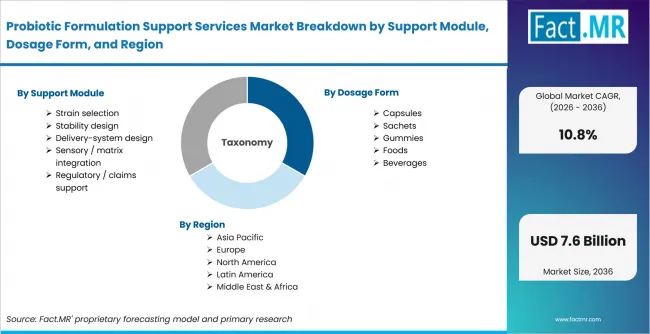
Probiotic Formulation Support Services Market Breakdown By Support Module, Dosage Form, And Region | Source: Fact.MR
| Attribute | Details |
|---|---|
| Quantitative Units | USD billion |
| Market Definition | Services that support the design, stability, regulatory readiness, and scale-up of probiotic supplements, foods, and beverages. Coverage includes strain selection, stability design, delivery-system design, sensory or matrix integration, and regulatory or claims support. |
| Support Module | Strain selection; Stability design; Delivery-system design; Sensory / matrix integration; Regulatory / claims support |
| Dosage Form | Capsules; Sachets; Gummies; Foods; Beverages |
| Stability Challenge | Moisture; Oxygen; Heat; Acid / GI; Shelf-life |
| Client Stage | Concept; Prototype; Pilot; Scale-up; Post-launch optimization |
| Regions Covered | North America; Latin America; Western Europe; Eastern Europe; East Asia; South Asia & Pacific; Middle East & Africa |
| Countries Covered | United States; United Kingdom; Germany; Japan; France |
| Key Companies Profiled | Kerry Group; Novonesis; IFF; Lallemand Health Solutions; Probi; dsm-firmenich |
| Forecast Period | 2026 to 2036 |
| Approach | Hybrid top-down and bottom-up approach using formulation project intensity; probiotic product development activity; dosage-form complexity; stability requirements; country regulation; and provider portfolio review. |
Source: Fact.MR analysis. Updated Sep 25, 2026
How is the market segmented?
-
By Support Module:
- Strain selection
- Stability design
- Delivery-system design
- Sensory / matrix integration
- Regulatory / claims support
-
By Dosage Form:
- Capsules
- Sachets
- Gummies
- Foods
- Beverages
-
By Stability Challenge:
- Moisture
- Oxygen
- Heat
- Acid / GI
- Shelf-life
-
By Client Stage:
- Concept
- Prototype
- Pilot
- Scale-up
- Post-launch optimization
-
By Region:
- North America
- Latin America
- Western Europe
- Eastern Europe
- East Asia
- South Asia & Pacific
- Middle East & Africa
Frequently Asked Questions
How big is the probiotic formulation support services market in 2026?
What is the CAGR of the probiotic formulation support services market from 2026 to 2036?
Which support module leads the probiotic formulation support services market?
Which dosage form leads the probiotic formulation support services market?
Who are the leading companies in the probiotic formulation support services market?
Who worked on this report


Preview the report firsthand - request a free sample
Free SampleGet the brochure for pricing and purchase details
Download PDF