- Estimated Value(2026): 5.50 Bn
- Forecast Value (2036): 9.10 Bn
- CAGR (2026 - 2036): 5.1%
Alimentary Tract Implant Market Forecast and Outlook 2026 to 2036
In 2025, the alimentary tract implant market was valued at approximately USD 5.25 billion. Based on Fact.MR analysis, demand for alimentary tract implants is estimated to reach around USD 5.50 billion in 2026 and nearly USD 9.10 billion by 2036. Fact.MR projects a CAGR of 5.1% during the forecast period. Market progression reflects rising procedural volumes in bariatric and gastrointestinal interventions, along with broader clinical acceptance of implant based therapies for chronic digestive and continence related conditions.
The market adds close to USD 3.9 billion in value over the forecast window, indicating steady compounding tied to disease prevalence rather than episodic technology shifts. Early period growth is supported by increasing endoscopic and laparoscopic bariatric procedures, particularly balloon based and neuromodulation implants. Mid period performance aligns with wider clinical use of GI stents and endoluminal scaffolds for obstruction and leak management. In later years, value growth is increasingly shaped by continence restoration implants and repeat interventions, where follow up procedures and therapy durability support recurring device demand.
China leads growth at 6.3% CAGR, supported by expanding bariatric surgery volumes and advanced endoscopy capacity. Brazil follows at 5.9% driven by obesity treatment uptake and private hospital investment. The United States and the United Kingdom each post 4.8%, reflecting steady procedural growth within established reimbursement structures. Germany records 4.7% as adoption advances within regulated clinical pathways, while South Korea at 4.3% and Japan at 3.6% remain more measured, constrained by conservative surgical eligibility criteria and longer clinical evaluation cycles.
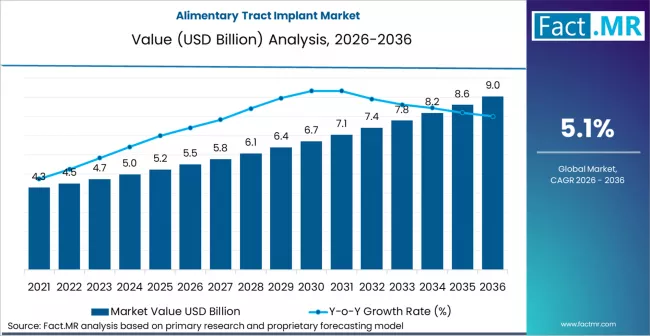
Alimentary Tract Implant Market Market Value Analysis | Source: Fact.MR
Alimentary Tract Implant Market Definition
The alimentary tract implant market covers medical implants designed to support, repair, or restore function within the gastrointestinal tract. These implants are placed surgically or endoscopically in organs such as the esophagus, stomach, intestines, and colon to manage conditions including obstruction, strictures, reflux, or structural defects. Products include stents, meshes, bands, and implantable devices intended for long term internal use. Device classification, safety, and clinical use are regulated by authorities such as the US Food and Drug Administration and global medical device frameworks issued by the World Health Organization.[1]
Alimentary Tract Implant Market Inclusions
The report covers global and regional market size estimates in volume and value terms with a forecast period from 2026 to 2036. Segmentation includes implant type such as gastrointestinal stents, meshes, and bands, application by anatomical site, and end use across hospitals and specialized surgical centers. The scope also includes regional demand patterns, pricing benchmarks, and international trade flows for regulated implantable medical devices.
Alimentary Tract Implant Market Exclusions
The scope excludes external gastrointestinal devices, disposable endoscopic tools, and non-implantable surgical instruments. Pharmaceutical therapies, biologic treatments, and nutritional products are not included. Robotic surgical platforms, imaging systems, and diagnostic equipment are excluded unless sold as implantable components. Experimental implants without regulatory clearance, laboratory research tools, veterinary implants, and surgical procedures and services are also outside the scope.
Alimentary Tract Implant Market Research Methodology
- Primary Research: Primary research involved interviews with implant manufacturers, gastrointestinal surgeons, hospital procurement managers, and clinical engineering staff.
- Desk Research: Desk research used medical device classification databases, post market surveillance records, and clinical guidance issued by the US Food and Drug Administration and the World Health Organization, along with national procedure statistics and company regulatory filings.
- Market Sizing and Forecasting: Market sizing applied a hybrid top down and bottom up model using procedure volumes, implant utilization rates by indication, and replacement or revision frequency.
- Data Validation and Update Cycle: Outputs were cross checked against regulatory approval databases, hospital purchasing records, trade statistics, and public healthcare expenditure data, with updates applied when verified public sources issue revisions.
Summary of alimentary tract implant market
-
Market Definition
- The alimentary tract implant market covers implantable medical devices placed endoscopically or surgically within the gastrointestinal tract to restore, support, or regulate digestive and continence functions in chronic and structural GI conditions.
-
Demand Drivers
- Expansion of bariatric and metabolic procedure eligibility increases use of gastric balloons and restriction implants within structured obesity treatment pathways.
- Rising clinical reliance on minimally invasive endoscopic and laparoscopic approaches supports adoption of stents, scaffolds, and neuromodulation implants that reduce hospital stay and recovery time.
- Long term management of obesity, motility disorders, and fecal incontinence sustains repeat and revision procedures under reimbursed care models, as guided by public health recognition of obesity as a chronic disease. [2]
-
Key Segments Analyzed
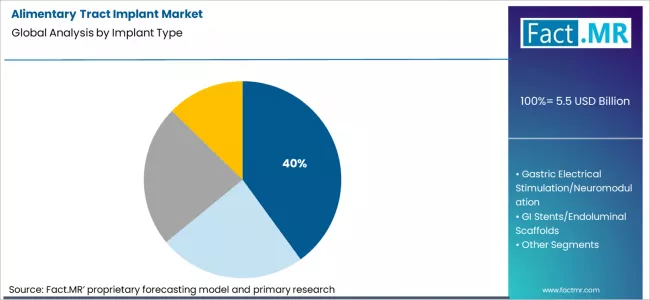
- Implant type: Bariatric restriction devices and gastric balloons lead with about 40% share due to reversibility and outpatient endoscopic placement.
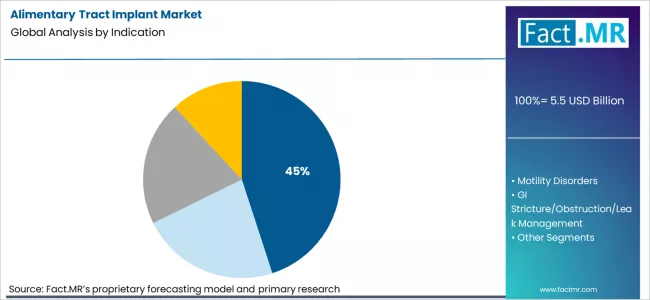
- Indication: Obesity and metabolic control account for roughly 45% share, reflecting rising interventional management beyond pharmacotherapy.
- Procedure approach and geography: Endoscopic and laparoscopic procedures dominate in China, Brazil, the United States, and Western Europe where hospital capacity and reimbursement are established.
-
Analyst Opinion at Fact.MR
- Shambhu Nath Jha, Principal Consultant at Fact.MR, opines, ‘CXOs will find this report useful for understanding how procedure eligibility expansion, minimally invasive access, and reimbursement alignment are shaping long term demand patterns for alimentary tract implants across bariatric and gastrointestinal care pathways.’
-
Strategic Implications / Executive Takeaways
- Align product portfolios with endoscopic and laparoscopic delivery to match hospital workflow preferences.
- Focus clinical evidence generation on long term outcomes and repeat intervention rates to support reimbursement decisions.
- Prioritize regulatory readiness across major markets under medical device frameworks. [3]
-
Methodology
- Market sizing based on verified procedure volumes, implant utilization rates, and revision frequency.
- Validation through regulatory approval databases, hospital purchasing records, and public healthcare expenditure data.
- Forecasts extended using reproducible top down and bottom up models grounded in verified clinical and regulatory benchmarks.
Segmental Analysis
Alimentary Tract Implant Market Analysis by Implant Type
Alimentary Tract Implant Market Analysis By Implant Type | Source: Fact.MR
Based on Fact.MR analysis, consumption of bariatric restriction devices and gastric balloons is estimated to hold 40% share of the global alimentary tract implant market. Fact.MR analysts note that this implant type leads due to minimally invasive placement, reversibility, and shorter recovery periods compared with surgical bypass procedures. As per Fact.MR, these implants address clinical needs for temporary volume restriction and appetite control, particularly for patients requiring non-surgical or bridge-to-surgery obesity interventions under monitored treatment pathways across hospital and specialty clinic settings worldwide.
- Regulatory oversight: Implantable bariatric devices are regulated as medical devices requiring premarket authorization and post-market surveillance.[4]
- Clinical preference: Fact.MR analysts note gastric balloons are often selected for patients not eligible for permanent surgical implants.
- Procedure setting: These implants are commonly placed endoscopically in outpatient or short-stay hospital environments.
Alimentary Tract Implant Market Analysis by Indication
Alimentary Tract Implant Market Analysis By Indication | Source: Fact.MR
Based on Fact.MR analysis, consumption of alimentary tract implants for obesity and metabolic control is estimated to hold 45% share of the global market. Fact.MR opines that this indication leads due to rising prevalence of obesity-related conditions requiring interventional management beyond pharmacological therapy. As per Fact.MR, implants used for metabolic control address clinical goals related to weight reduction, glycemic improvement, and appetite regulation, supporting structured treatment programs delivered through bariatric centers and multidisciplinary care models globally.
- Public health context: Government health agencies recognize obesity as a chronic disease requiring medical and interventional treatment options. [5]
- Treatment pathways: Fact.MR analysts note implants are used alongside dietary and behavioral management programs.
- Care delivery: Obesity-focused implant procedures are concentrated in specialized bariatric and metabolic clinics.
Alimentary Tract Implant Market Drivers, Restraints, And Opportunities
Fact.MR analysis indicates that the alimentary tract implant market exists as a specialised medical device segment serving surgical restoration and support of the gastrointestinal tract following trauma, disease, or congenital anomalies. As per Fact.MR assessment, alimentary tract implants include mesh, stents, and prosthetic structures used to reinforce tissue, maintain lumen patency, or replace damaged anatomy; these devices are regulated through established medical device frameworks such as the U.S. Food and Drug Administration (FDA) Class II/III premarket pathways that govern design controls, clinical evidence, and post-marketing surveillance for implants. Fact.MR analysts observe that the current market size is driven by rising surgical volumes, adoption of minimally invasive techniques, and clinical guidelines that recommend device-assisted repair for conditions such as hernias and strictures.
Fact.MR is of the opinion that current market dynamics reflect a transition toward advanced implant materials and delivery mechanisms that improve biocompatibility and procedural efficiency. Based on Fact.MR assessment, conventional sutured repairs without implant support continue to be used in select cases because of cost and surgeon preference, but growth is occurring in segments where implantable meshes and stents provide measurable reductions in recurrence rates and procedural morbidity. Advanced alimentary tract implant products that incorporate novel polymers, anti-adhesive coatings, or resorbable elements typically carry higher per-unit pricing because of material complexity and regulatory testing requirements, meaning realised market value can increase even where shipment volumes grow at a measured pace. Fact.MR analysis suggests this balance between moderate volume growth and premium device placement defines near-term market trends.
- Regulatory medical device frameworks: Fact.MR analysts note that medical device regulation under the U.S. Food and Drug Administration (FDA) influences development, testing, and approval requirements for alimentary tract implants, affecting market entry timelines and product positioning.
- Shift to advanced materials: Based on Fact.MR assessment, demand is increasing for implantable meshes and stents that offer improved biocompatibility, reduced adhesion risks, and enhanced structural performance compared with conventional options.
- Asia Pacific surgical infrastructure growth: Fact.MR opines that expansion of surgical facilities and minimally invasive procedure adoption in China, India, and Southeast Asia supports regional uptake of alimentary tract implants as part of gastrointestinal surgical care.
Regional Analysis
Based on regional assessment, the alimentary tract implant sector is analyzed across North America, Europe, East Asia, Latin America, and other major healthcare markets, spanning more than 40 countries. Regional performance varies according to surgical procedure volumes, access to advanced gastrointestinal treatments, healthcare infrastructure quality, and adoption of implant-based therapeutic interventions. The analysis also presents a comparative market attractiveness evaluation grounded in region-specific demand trends.
Alimentary Tract Implant Market CAGR Analysis by Country (2026-2036)
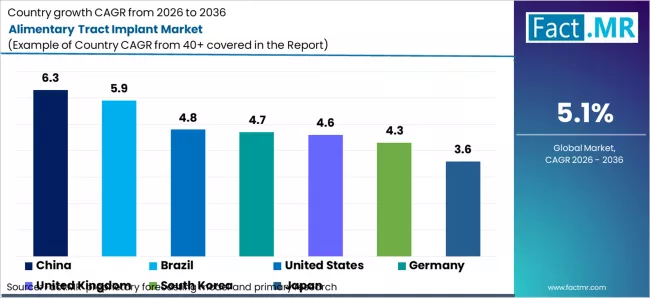
Alimentary Tract Implant Market Cagr Analysis By Country | Source: Fact.MR
| Country | CAGR |
|---|---|
| China | 6.3% |
| Brazil | 5.9% |
| United States | 4.8% |
| Germany | 4.7% |
| United Kingdom | 4.6% |
| South Korea | 4.3% |
| Japan | 3.6% |
Source: Fact.MR analysis. Updated Feb 21, 2026
Source: Fact.MR analysis, based on proprietary forecasting models and primary research.
Asia Pacific Alimentary Tract Implant Market Analysis
Asia Pacific operates as a procedure volume driven alimentary tract implant region supported by expanding hospital capacity rising gastrointestinal disease burden and improving access to minimally invasive surgery. Demand is shaped by national medical device regulations reimbursement coverage and public hospital procurement systems. Adoption is concentrated in tertiary hospitals where endoscopic and surgical implants are integrated into colorectal bariatric and esophageal procedures. Regional growth reflects investment in surgical infrastructure clinician training programs and gradual expansion of insurance coverage across systems.
- China: Demand for alimentary tract implants in China is projected to rise at 6.3% CAGR through 2036. Usage is supported by high procedural volumes in public hospitals and adoption of minimally invasive gastrointestinal surgeries, as per Fact.MR.
- South Korea: Demand for alimentary tract implants in South Korea is projected to rise at 4.3% CAGR through 2036. Adoption is driven by advanced hospital infrastructure and widespread use of endoscopic and surgical gastrointestinal procedures, according to Fact.MR.
- Japan: Demand for alimentary tract implants in Japan is projected to rise at 3.6% CAGR through 2036. Consumption reflects stable surgical volumes and established reimbursement for gastrointestinal procedures, as per Fact.MR.
Fact.MR’s analysis of the Alimentary Tract Implant Market in Asia Pacific consists of country-wise assessment that includes China, South Korea, and Japan. Readers can find regulatory frameworks, hospital adoption trends, and procedure-driven demand references.
North America Alimentary Tract Implant Market Analysis
North America functions as a reimbursement and regulation led alimentary tract implant region characterized by established surgical standards and high procedure penetration. Demand is governed by FDA device approvals coding structures and hospital purchasing protocols. Adoption is concentrated within large hospital networks and ambulatory surgical centers where implants are used in bariatric colorectal and gastrointestinal oncology procedures. Market activity reflects replacement cycles clinical guideline adherence and stable funding through public and private payer systems supporting predictable procurement volumes nationwide annually.
- United States: Demand for alimentary tract implants in the United States is projected to rise at 4.8% CAGR through 2036. Usage is supported by high adoption of bariatric and colorectal procedures and stable reimbursement coverage across hospital systems, as per Fact.MR.
Fact.MR’s analysis of the Alimentary Tract Implant Market in North America consists of country-wise assessment that includes the United States. Readers can find reimbursement structures, hospital procurement practices, and procedure-based demand insights.
Europe Alimentary Tract Implant Market Analysis
Europe operates as a regulation led alimentary tract implant region shaped by harmonized medical device rules and public healthcare funding. Demand is guided by MDR compliance national reimbursement policies and hospital tendering systems. Adoption is centered in publicly funded hospitals where gastrointestinal implants are used in colorectal bariatric and upper digestive surgeries. Market growth reflects procedural demand demographic aging and standardized clinical pathways across Western and Northern European healthcare systems supported by consistent regulatory oversight and cross border procurement frameworks regionwide.
- Germany: Demand for alimentary tract implants in Germany is projected to rise at 4.7% CAGR through 2036. Adoption is driven by high procedural volumes in public hospitals and reimbursement under statutory health insurance systems, according to Fact.MR.
- United Kingdom: Demand for alimentary tract implants in the United Kingdom is projected to rise at 4.6% CAGR through 2036. Usage reflects public hospital procurement under NHS funding and standardized gastrointestinal care pathways, as per Fact.MR.
Fact.MR’s analysis of the Alimentary Tract Implant Market in Europe consists of country-wise assessment that includes Germany and the United Kingdom. Readers can find regulatory compliance requirements, procurement models, and procedure volume trends.
Latin America Alimentary Tract Implant Market Analysis
Latin America functions as an expanding alimentary tract implant region supported by growing surgical access and hospital investment. Demand is influenced by national regulatory approvals reimbursement expansion and public private healthcare procurement. Adoption remains concentrated in urban tertiary hospitals performing gastrointestinal and bariatric procedures. Market development reflects gradual insurance coverage growth increasing procedural volumes and ongoing modernization of surgical infrastructure across major healthcare markets driven by public hospital expansion programs clinician training initiatives and device import approvals regionwide today broadly.
- Brazil: Demand for alimentary tract implants in Brazil is projected to rise at 5.9% CAGR through 2036. Usage is supported by expanding access to bariatric and gastrointestinal surgeries within public and private hospital networks, as per Fact.MR.
Fact.MR’s analysis of the Alimentary Tract Implant Market in Latin America consists of country-wise assessment that includes Brazil. Readers can find healthcare investment trends, regulatory approvals, and procedure-based demand insights.
Competitive Landscape of Alimentary Tract Implant Market
Alimentary Tract Implant Market Analysis By Company | Source: Fact.MR
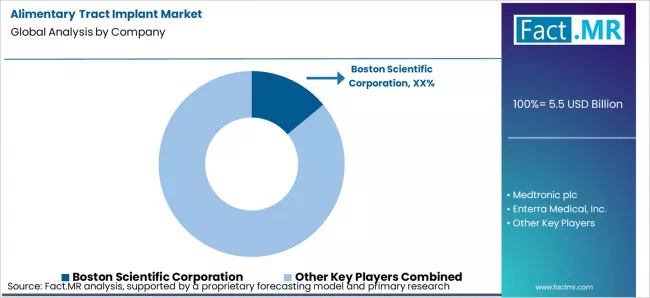
As per Fact.MR analysis, the 2026 alimentary tract implant market is defined by validated clinical efficacy, regulatory compliance, and hospital network adoption, which determine competitive advantage. Boston Scientific Corporation and Medtronic plc lead with fully tested implantable systems and long-term clinical outcomes, which strengthens adoption in gastroenterology and bariatric care programs. Enterra Medical, Inc. and EndoStim, Inc. focus on neuromodulation and gastric electrical stimulation devices with documented procedural efficacy, which improves patient outcomes and repeat utilization. Johnson & Johnson (Ethicon) and Cook Group provide precision-engineered implants with proven biocompatibility and multi-region regulatory approvals, which reduces procedural risk and enhances hospital trust. Coloplast A/S and B. Braun SE offer validated delivery systems and instrumentation, which increases reliability and simplifies surgeon workflow. Micro-Tech Endoscopy and Torax Medical provide innovative minimally invasive solutions with validated deployment mechanisms, which expands adoption in niche and emerging markets. Across the market, clinical validation, regulatory adherence, and integrated hospital support create enduring competitive moats, reducing reliance on price or isolated product claims.
Recent Industry Developments
- Johnson & Johnson (Ethicon): OTTAVA™ Robotic Filing: In January 2026, Johnson & Johnson officially submitted its OTTAVA™ Robotic Surgical System to the FDA for De Novo classification. Specifically designed for "multi-quadrant" surgery, the system is being targeted for complex alimentary tract procedures, including gastric bypass, sleeve gastrectomy, and hiatal hernia repairs. [6]
- Medtronic: Hugo™ Robotics & AI Integration: In February 2026, Medtronic announced the first U.S. surgery using its Hugo™ robotic-assisted surgery system at the Cleveland Clinic. This follows a 2025 study showing the Hugo system's success in hernia repair and GI tract interventions, marking Medtronic's aggressive push to challenge the monopoly in soft-tissue robotic implants. [7]
Key Players in Alimentary Tract Implant Market
- Boston Scientific Corporation
- Medtronic plc
- Enterra Medical, Inc.
- Johnson & Johnson Services, Inc. (Ethicon)
- Coloplast A/S
- Cook Group Incorporated (Cook Medical)
- B. Braun SE
- Micro-Tech Endoscopy (Hangzhou) Co., Ltd.
- EndoStim, Inc.
- Torax Medical, Inc.
Bibliography
- [1] U.S. Food and Drug Administration. (2024). Medical devices: Overview, regulation, and safety. U.S. Department of Health and Human Services; World Health Organization. (2024). Medical devices. World Health Organization.
- [2] Centers for Disease Control and Prevention. (2024). Obesity basics: Causes, health effects, and treatment approaches. U.S. Department of Health and Human Services.
- [3] U.S. Food and Drug Administration. (2024). Medical devices regulatory framework and device classification. U.S. Department of Health and Human Services.
- [4] U.S. Food and Drug Administration. (2024). Weight management medical devices: Gastric balloons and bariatric implants. U.S. Department of Health and Human Services.
- [5] Centers for Disease Control and Prevention. (2024). Adult obesity facts and chronic disease classification. U.S. Department of Health and Human Services.
- [6] Johnson & Johnson Services, Inc. (2026). Johnson & Johnson submits OTTAVA™ robotic surgical system for FDA review. Johnson & Johnson - Investor & Media Relations.
- [7] Medtronic plc. (2026). Medtronic announces first U.S. clinical use of the Hugo™ robotic-assisted surgery system. Medtronic Newsroom.
Segmentation
Scope of the Report
| Metric | Value |
|---|---|
| Quantitative Units | USD 5.50 billion (2026) to USD 9.10 billion (2036), at a CAGR of 5.1% |
| Market Definition | The alimentary tract implant market covers medical implants designed to support, repair, or restore function within the gastrointestinal tract. These implants include stents, meshes, gastric balloons, neuromodulation devices, and continence implants, and are used in surgical or endoscopic procedures to treat obesity, motility disorders, obstruction, and fecal incontinence. |
| Implant Type Segmentation | Bariatric Restriction & Balloons, Gastric Electrical Stimulation/Neuromodulation, GI Stents/Endoluminal Scaffolds, Continence/Anal Sphincter Implants |
| Indication Segmentation | Obesity/Metabolic Control, Motility Disorders, GI Stricture/Obstruction/Leak Management, Fecal Incontinence/Continence Restoration |
| Procedure Approach Segmentation | Endoscopic/Transoral, Laparoscopic Bariatric, Open/Revision Surgery, Colorectal/Perineal Implantation |
| Care Setting Segmentation | Bariatric & Metabolic Centers, GI & Advanced Endoscopy Suites, Colorectal/Pelvic Floor Centers, Hospital OR/Other Acute Care |
| Regions Covered | Asia Pacific, Europe, North America, Latin America, Middle East & Africa |
| Countries Covered | India, China, Japan, South Korea, Indonesia, Australia & New Zealand, ASEAN, Rest of Asia Pacific, Germany, Italy, France, United Kingdom, Spain, Benelux, Nordics, Central & Eastern Europe, Rest of Europe, United States, Canada, Mexico, Brazil, Argentina, Chile, Rest of Latin America, Kingdom of Saudi Arabia, United Arab Emirates, South Africa, Turkey, Rest of Middle East & Africa |
| Key Companies Profiled | Boston Scientific Corporation, Medtronic plc, Enterra Medical, Inc., Johnson & Johnson Services, Inc. (Ethicon), Coloplast A/S, Cook Group Incorporated (Cook Medical), B. Braun SE, Micro-Tech Endoscopy (Hangzhou) Co., Ltd., EndoStim, Inc., Torax Medical, Inc. |
| Forecast Period | 2026 to 2036 |
| Approach | Hybrid top-down and bottom-up modeling validated through primary interviews with implant manufacturers, gastrointestinal surgeons, hospital procurement managers, and clinical engineering staff. Market sizing supported by procedure volumes, implant utilization rates by indication, and revision/replacement frequency, aligned with FDA and WHO medical device frameworks. |
Source: Fact.MR analysis. Updated Feb 21, 2026
Alimentary Tract Implant Market Analysis by Segments
-
Implant Type :
- Bariatric Restriction & Balloons
- Gastric Electrical Stimulation/Neuromodulation
- GI Stents/Endoluminal Scaffolds
- Continence/Anal Sphincter Implants
-
Indication :
- Obesity/Metabolic Control
- Motility Disorders
- GI Stricture/Obstruction/Leak Management
- Fecal Incontinence/Continence Restoration
-
Procedure Approach :
- Endoscopic/Transoral
- Laparoscopic Bariatric
- Open/Revision Surgery
- Colorectal/Perineal Implantation
-
Care Setting :
- Bariatric & Metabolic Centers
- GI & Advanced Endoscopy Suites
- Colorectal/Pelvic Floor Centers
- Hospital OR/Other Acute Care
-
Region :
- Asia Pacific
- India
- China
- Japan
- South Korea
- Indonesia
- Australia & New Zealand
- ASEAN
- Rest of Asia Pacific
- Europe
- Germany
- Italy
- France
- United Kingdom
- Spain
- Benelux
- Nordics
- Central & Eastern Europe
- Rest of Europe
- North America
- United States
- Canada
- Mexico
- Latin America
- Brazil
- Argentina
- Chile
- Rest of Latin America
- Middle East & Africa
- Kingdom of Saudi Arabia
- United Arab Emirates
- South Africa
- Turkey
- Rest of Middle East & Africa
- Asia Pacific
Frequently Asked Questions
How large is the alimentary tract implant market in 2026?
What will the alimentary tract implant market size be by 2036?
What CAGR is expected for the alimentary tract implant market during 2026–2036?
What was the market value of alimentary tract implants in 2025?
How much absolute value is the market expected to add over the forecast period?
Which implant type currently leads the alimentary tract implant market?
Why do bariatric restriction devices and gastric balloons dominate demand?
Which indication accounts for the largest share of alimentary tract implant demand?
What factors are driving growth in obesity-related alimentary tract implants?
Which procedure approach is most influential in market expansion?
Which country is expected to grow the fastest in the alimentary tract implant market?
How fast is the Brazilian alimentary tract implant market expected to grow?
What is the growth outlook for the United States market?
How does the United Kingdom compare in terms of growth rate?
What is Germany’s expected CAGR in the alimentary tract implant market?
How does South Korea’s market growth compare globally?
Why is growth more moderate in Japan compared with other countries?
What supports early-period market growth during the forecast window?
What drives mid-period demand in the alimentary tract implant market?
What factors shape value growth in the later years of the forecast?
Who worked on this report


Preview the report firsthand - request a free sample
Free SampleGet the brochure for pricing and purchase details
Download PDF