- Base Value(2025): 5.7 Bn
- Forecast Value (2035): 16.8 Bn
- CAGR (2035): 11.4%
Nucleic Acid Extraction System Market Outlook (2025 to 2035)
The global nucleic acid extraction system market is projected to increase from USD 5.7 billion in 2025 to USD 16.8 billion by 2035, with a CAGR of 11.4%, driven by the rising demand for molecular diagnostics and infectious disease testing, which require fast and accurate nucleic acid extraction.
Their high precision, speed, and automation make nucleic acid extraction systems ideal for clinical diagnostics, research laboratories, and biotech applications.
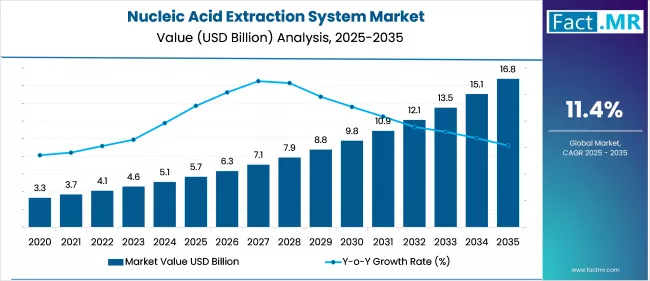
Nucleic Acid Extraction System Market Value Analysis 2025 To 2035 | Source: Fact.MR
What are the Drivers of Nucleic Acid Extraction System Market?
The growth of the nucleic acid extraction system market is driven by the increasing demand for molecular diagnostics, particularly due to the rise in infectious diseases, genetic disorders, and cancer cases worldwide. Molecular testing methods, such as PCR and next-generation sequencing (NGS), require high-quality DNA or RNA extracted from biological samples. As healthcare systems continue to prioritize early disease detection and rapid testing, the demand for automated, accurate, and high-throughput nucleic acid extraction systems remains strong.
The surge in genomics research and the widespread adoption of NGS technologies are major drivers of market growth. Research institutions, academic centers, and pharmaceutical companies are increasingly investing in genome sequencing for disease mapping, drug discovery, and precision medicine. This has created a sustained need for reliable and scalable extraction systems that can handle large sample volumes without compromising quality. The emergence of advanced fields, such as single-cell sequencing, transcriptomics, and metagenomics, further elevates the technical requirements for nucleic acid extraction platforms, particularly in terms of sensitivity, purity, and speed.
Technological advancements and automation are also accelerating market expansion. Laboratories are transitioning to automated extraction systems to enhance efficiency, reduce human error, and streamline workflows. These systems are being integrated with robotics and laboratory information management systems (LIMS) to support high-throughput processing, especially in centralized testing facilities and biobanks. Closed-system cartridges, magnetic bead-based technologies, and compact, point-of-care-compatible systems are gaining traction due to their ease of use, minimal risk of contamination, and reproducibility.
Moreover, the growth of personalized medicine and liquid biopsy applications is fueling demand for efficient nucleic acid extraction. Tailored therapies based on individual genetic profiles require accurate extraction of nucleic acids from small or complex samples, such as circulating tumor DNA (ctDNA) in blood.
Furthermore, the expansion of biobanking initiatives and increased clinical trials worldwide are contributing to the growing need for reliable, high-capacity extraction systems. Backed by increased funding in life sciences from both government bodies and private stakeholders, the nucleic acid extraction system market is poised for sustained growth in the years to come.
What are the Regional Trends of Nucleic Acid Extraction System Market?
The growth of the nucleic acid extraction systems market in North America is driven by a well-established molecular diagnostics infrastructure, a strong presence of major biotech and pharmaceutical companies, and robust funding from government bodies such as the NIH and CDC. The region’s leadership in next-generation sequencing (NGS), precision medicine, and cancer research contributes to the widespread use of advanced extraction systems. Moreover, high adoption of automated and high-throughput platforms in clinical and reference laboratories reinforces North America’s market dominance.
Europe is a growing market due to its increasing genomics programs, such as the UK’s Genomics England and Germany’s genomics initiatives. The region benefits from strong regulatory frameworks, advanced healthcare systems, and a large number of academic research institutions. The demand for nucleic acid extraction systems in Europe is driven by cancer research, infectious disease monitoring, and the increasing applications of personalized medicine.
Asia Pacific region is experiencing the fastest growth in the nucleic acid extraction market, driven by rapid advancements in healthcare infrastructure, increasing awareness of molecular diagnostics, and rising investments in biotechnology. Countries like China, India, Japan, and South Korea are expanding their genomics research capabilities and clinical testing capacities. Government initiatives such as China’s Precision Medicine Plan and India’s Genome India Project are fueling demand for extraction systems.
The Middle East, particularly the UAE and Saudi Arabia, is investing in genomic surveillance and biotechnology as part of national health strategies. Moreover, partnerships with international organizations and diagnostic companies are helping improve access to essential nucleic acid extraction technologies.
What are the Challenges and Restraining Factors of Nucleic Acid Extraction System Market?
One of the major restraints in the market is the high initial cost of automated nucleic acid extraction systems and the recurring expense of reagents and consumables. These cost factors can significantly limit adoption in small laboratories, public health facilities, and institutions in developing countries.
Another critical challenge is the shortage of skilled personnel needed to operate, troubleshoot, and maintain these systems. Nucleic acid extraction, particularly when utilizing semi-automated or complex systems, necessitates specialized technical expertise in molecular biology, sample processing, and instrument calibration. This shortage leads to errors in sample preparation, inconsistent yields, and equipment misuse. This skills gap poses a critical challenge in ensuring standardized and reliable nucleic acid extraction, particularly in decentralized or rural healthcare setups.
Sample quality and variability also present technical hurdles. Different biological materials, such as blood, tissues, or swabs, exhibit varying levels of cellular content, inhibitors, or degradation, which can affect the yield and purity of nucleic acids. Inconsistent or poor-quality samples can negatively impact the reliability of diagnostic tests or sequencing results.
Furthermore, manual handling in non-automated or partially automated systems increases the risk of cross-contamination, especially in high-throughput testing environments or shared laboratory settings. This necessitates careful workflow design and process validation, which adds to the complexity and time required for implementation.
The industry is subject to stringent regulatory requirements and compliance challenges, particularly for clinical-grade extraction systems used in diagnostic applications. Manufacturers must obtain certifications such as FDA approval, CE-IVD marking, and ISO accreditation, which require rigorous testing, thorough documentation, and stringent quality controls. These regulatory processes can delay product launches and increase development costs.
Moreover, evolving guidelines around data privacy, particularly for genomics and personalized medicine, further complicate compliance across international markets. The regulatory and technical challenges present barriers that must be strategically addressed for broader and more equitable market growth.
Country-Wise Outlook
The U.S. Nucleic Acid Extraction System Market sees Growth Driven by Advanced Healthcare Infrastructure
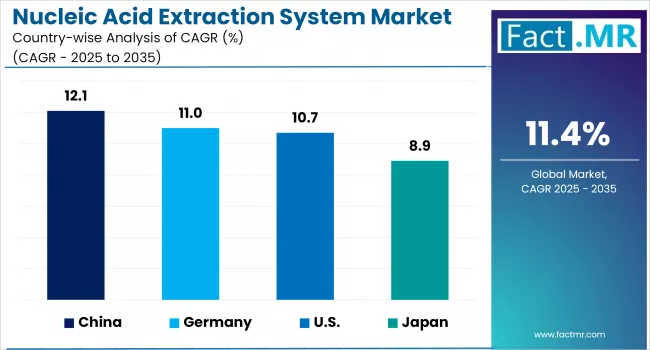
Nucleic Acid Extraction System Market Country Wise Analysis Of CAGR | Source: Fact.MR
The country's advanced healthcare infrastructure, widespread adoption of molecular diagnostics, and its leadership in genomics and biotechnology research drive market growth in the U.S. The U.S. has long been at the forefront of next-generation sequencing (NGS), cancer genomics, and infectious disease testing, all of which heavily depend on efficient and high-quality nucleic acid extraction.
One of the key factors contributing to market expansion is the high volume of clinical testing conducted across hospitals, diagnostic chains, and reference laboratories in the U.S. The demand for automated, high-throughput systems is increasing rapidly, particularly as testing transitions toward precision medicine and liquid biopsy-based diagnostics.
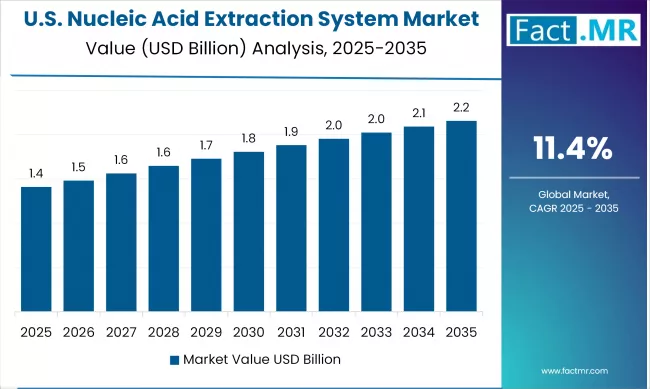
US Nucleic Acid Extraction System Market Value Analysis 2025 To 2035 | Source: Fact.MR
The country also benefits from significant public and private investments in biomedical research. Government agencies such as the National Institutes of Health (NIH) and the Centers for Disease Control and Prevention (CDC) have increased funding for genomics research, pandemic preparedness, and precision medicine initiatives. Programs like the All of Us Research Program aim to collect genetic material from diverse populations, further increasing the need for high-quality nucleic acid extraction systems in biobanking and population genomics.
The FDA’s evolving guidance for in vitro diagnostics (IVDs), lab-developed tests (LDTs), and point-of-care molecular testing is pushing companies to adopt standardized, validated extraction systems. As automation, AI integration, and decentralized testing become more prominent, the U.S. is expected to remain a global leader in the nucleic acid extraction system market.
China witnesses Rapid Market Growth Backed by Growing Biotechnology Industry
China’s strong governmental backing and strategic initiatives, such as the Precision Medicine Plan and national genomics programs, have spurred greater adoption of nucleic acid technologies. Domestic biotech investment also surged, supporting the growth of infrastructure in clinical labs and research institutions.
Technologically, China is increasingly adopting automated and high-throughput extraction systems. Major domestic players, such as MGI Tech and BGI, alongside international companies, are expanding their presence through local production and strategic partnerships. These developments enhance the accessibility and affordability of advanced extraction platforms across clinical and research settings.
China’s expanding network of clinical and public health labs, which support large-scale infectious disease surveillance and expanding NGS workflows, is increasing demand for reliable extraction systems. China’s high CAGR reflects a powerful combination of investment, policy support, technological adoption, and scaling biomedical infrastructure.
Japan sees a Shift Towards Automation in Research and Clinical Labs, fuelling the Growth of the Nucleic Acid Extraction Systems Market
As Japanese research and clinical labs modernize, there's a clear shift toward automation and high-throughput equipment capable of delivering consistent, high-purity nucleic acid extractions. Magnetic bead–based technologies, in particular, are leading the market, driven by the demand for efficient extraction from challenging samples, such as FFPE tissues.
The expanding use of DNA/RNA isolation in biotherapeutics development and academic research also boosts market momentum. With strong government policies backing research, alongside active local and multinational companies such as Takara Bio and Eiken Chemical, Japan’s ecosystem supports both basic research and clinical-grade applications.
Japan is one of the leading countries in areas such as cell and gene therapies, stem cell research, and personalized medicine, driven by supportive regulatory frameworks, including conditional approvals for regenerative medicine trials. This scientific momentum, combined with sustained investment in high-quality sample prep workflows, underpins the strong growth forecast for nucleic acid extraction systems in Japan.
Category-wise Analysis
DNA extraction to Exhibit Leading by Product
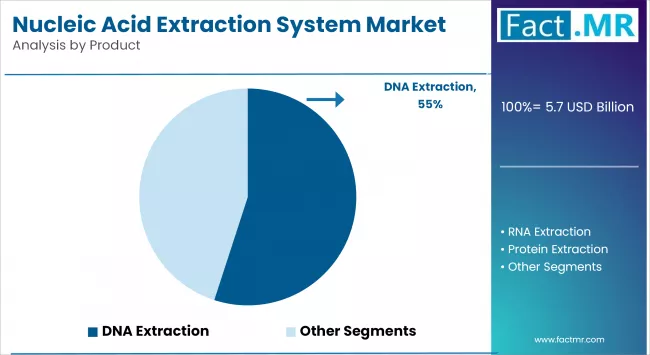
Nucleic Acid Extraction System Market Analysis By Product | Source: Fact.MR
The DNA extraction segment dominates the nucleic acid extraction systems market. This dominance is primarily driven by its widespread applications in clinical diagnostics, forensic testing, cancer genomics, and next-generation sequencing (NGS). DNA-based molecular diagnostics are crucial for identifying genetic mutations, hereditary diseases, and detecting pathogens. The continued expansion of personalized medicine and pharmacogenomics also heavily relies on high-quality DNA samples, further reinforcing demand.
The RNA extraction segment is anticipated to be the fastest-growing product category during the forecast period. This growth is largely driven by increasing use in infectious disease diagnostics, transcriptomics, gene expression profiling, and mRNA-based therapeutics. Beyond diagnostics, rapid development of mRNA vaccines and growing interest in RNA therapeutics, such as siRNA and miRNA, have significantly elevated the need for robust, contamination-free RNA extraction solutions. Innovations in RNA stabilization and preservation, as well as the need for ultra-sensitive detection in oncology and neuroscience, are further accelerating the growth of this segment.
Medical and Clinical Research to Exhibit Leading by Application
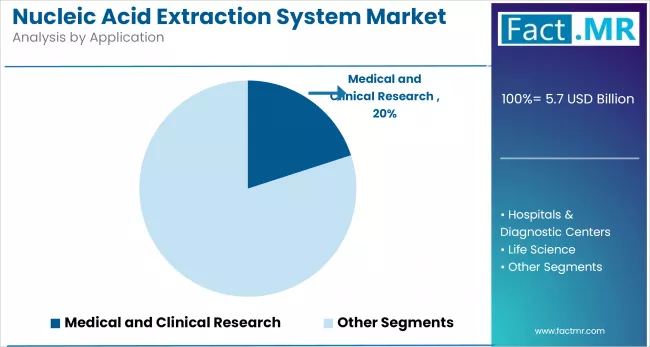
Nucleic Acid Extraction System Market Analysis By Application | Source: Fact.MR
The hospitals & diagnostic centers segment currently dominates the nucleic acid extraction system market, owing to the widespread use of molecular diagnostics in clinical settings. These institutions rely heavily on DNA and RNA extraction for routine diagnostic testing, disease screening, pathogen detection, and personalized treatment planning. The increasing prevalence of infectious diseases, cancer, and genetic disorders has made nucleic acid–based testing an essential component of modern diagnostics.
The medical and clinical research segment is anticipated to be the fastest-growing application area in the nucleic acid extraction system market. The surging investment in genomics, transcriptomics, and precision medicine research drives this growth. As the need for high-quality, contaminant-free nucleic acids grows in drug discovery, biomarker development, and clinical trials, research institutions are adopting more sophisticated extraction platforms.
Competitive Analysis
The global nucleic acid extraction system market is becoming increasingly competitive, with a few dominant players leveraging advanced automation, broad reagent portfolios, and seamless integration with downstream molecular workflows, such as PCR and NGS. This competitive landscape is shaped by innovation in high-throughput extraction technologies, system reliability, and workflow efficiency. Leading companies such as Thermo Fisher Scientific and QIAGEN maintain strong positions through widely adopted platforms like the KingFisher™ series and QIAcube, backed by deep regulatory expertise, robust clinical validation, and extensive global distribution networks.
Market leaders are heavily investing in product innovation, automation, and closed-system designs to meet the growing demand for faster, contamination-free, and high-throughput nucleic acid extraction. Roche’s MagNA Pure and Promega’s Maxwell® RSC platforms, for instance, offer robust solutions for labs seeking scalability and minimal manual intervention.
Regional companies and emerging innovators are gaining traction, particularly in the Asia-Pacific region. Firms like MGI Tech (China) and Nippon Genetics (Japan) are investing in cost-effective, automated systems tailored to local needs. Startups and mid-sized biotech firms are also introducing novel microfluidic and portable extraction devices, aiming to serve point-of-care settings and decentralized labs. These innovations are particularly valuable in emerging markets where infrastructure and trained personnel are limited, driving demand for user-friendly and affordable platforms.
Competitive strategies across the industry include strategic collaborations, acquisitions, and geographic expansion. Key players are partnering with academic institutions and healthcare networks to develop customized solutions for diagnostics and precision medicine. Moreover, many companies are targeting high-growth regions, such as the Asia-Pacific and Latin America, through localized manufacturing, distributor partnerships, and region-specific regulatory strategies.
Key players in the nucleic acid extraction system industry are Thermo Fisher Scientific, Inc., Illumina, Inc., Agilent Technologies, Inc., Tecan Group AG., Sigma Aldrich Corp., Becton Dickinson and Company, QIAGEN, Bio-Rad Laboratories Inc., PerkinElmer, Inc., F. Hoffmann-La Roche; DiaSorin S.p.A, and other players.
Recent Development
- In October 2024, QIAGEN expanded its automated liquid biopsy portfolio to support oncology, prenatal care, and organ transplant diagnostics. The company launched new ccfDNA kits compatible with EZ1 and EZ2 platforms, as well as the QIAsymphony DSP Circulating DNA and Maxi Kits, enabling fully automated extraction of circulating cell-free DNA from larger sample volumes, including new urine protocols.
- In July 2024, Bio-Rad introduced DNA extraction kits specifically designed for single-cell genomics, improving sensitivity and yield to target personalized medicine and cancer research applications.
Segmentation
Segmentation of the Nucleic Acid Extraction System Market
-
By Product :
- DNA Extraction
- RNA Extraction
- Protein Extraction
-
By Application :
- Hospitals & Diagnostic Centers
- Life Science
- Pharmaceuticals
- Academic
- Medical and Clinical Research
-
By Region :
- North America
- Latin America
- Western Europe
- Eastern Europe
- East Asia
- South Asia & Pacific
- Middle East & Africa
Frequently Asked Questions
What is the Global Nucleic Acid Extraction System Market size in 2025?
Who are the Major Players Operating in the Nucleic Acid Extraction System Market?
What is the Estimated Valuation of the Nucleic Acid Extraction System Market by 2035?
What value CAGR did the Nucleic Acid Extraction System Market market exhibit over the last five years?
Who worked on this report


Preview the report firsthand - request a free sample
Free SampleGet the brochure for pricing and purchase details
Download PDF