- Market Value (2025): USD 421.1 Mn
- Estimated Value (2026): USD 441.7 Mn
- Forecast Value (2036): USD 712.7 Mn
- CAGR (2026-2036): 4.9%
What is the Alpha Olefin Sulfonates Market forecast to be worth by 2036?
USD 712.7 million by 2036 at a 4.9% CAGR.
- The market stood at USD 421.1 million in 2025.
- Demand is projected to increase from USD 441.7 million in 2026 to USD 712.7 million by 2036.
- The 2026 to 2036 forecast CAGR is 4.9%.
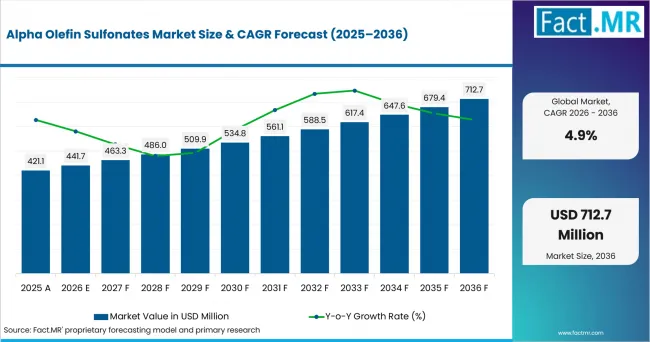
Alpha Olefin Sulfonates Market Value Analysis | Source: Fact.MR
What are the defining numbers behind Alpha Olefin Sulfonates Market growth?
The market is projected to add USD 271.0 million in value between 2026 and 2036.
- Demand Drivers in the Market
- Detergent formulation demand: AOS is used where formulators need flash foam, detergency, and performance across different water conditions. Stepan identifies sodium C14-16 olefin sulfonate for hand soap, shampoo, bath, and detergent applications, while Pilot Chemical positions C12 AOS for high-foam systems in hard or soft water. These performance requirements keep AOS relevant within the broader surfactants market.
- Personal care reformulation: Liquid cleansers and shampoos need surfactants that can build viscosity without sacrificing foam. Stepan reports broad pH stability and improved mildness versus lauryl sulfates for BIO-TERGE AS-40A, supporting use in hair and body cleansing systems where sensory performance and rinse behavior affect repeat purchasing.
- Biodegradability-led ingredient qualification: The U.S. EPA evaluates surfactants in cleaning products using aquatic toxicity, biodegradation rate, and degradation-product criteria. In the EU, Regulation (EU) 2026/405 maintains biodegradability requirements for surfactants used in detergents. This makes environmental-fate data part of supplier qualification rather than a secondary formulation consideration.
- Industrial and oilfield use: AOS can provide high flash foam in electrolyte-rich systems, which matters in industrial cleaning and selected oilfield formulations. Pilot Chemical lists AOS-1245 for industrial, personal care, and oilfield applications, creating demand beyond household products and linking AOS consumption to the oilfield chemicals value chain.
- Key Segments Analyzed
- Sodium Alpha Olefin Sulfonates account for 68.7% of Product in 2026, supported by established sodium-salt processing and broad compatibility with detergent and personal care formulations.
- Household Detergents account for 43.8% of Application in 2026 because laundry and dishwashing products consume AOS as a primary or co-surfactant for foam and soil removal.
- Consumer Goods Manufacturers account for 72.4% of End Use in 2026 as detergent and personal care producers purchase AOS directly for routine high-volume formulation programs.
- Sulfonation Technology accounts for 57.1% of Technology in 2026 because conversion of alpha olefins into sulfonated intermediates is the core reaction step controlling product consistency.
- Liquid Formulations account for 39.6% of Formulation in 2026 because aqueous AOS grades can be dosed directly into liquid detergents, hand washes, shampoos, and industrial cleaners.
- Direct Sales account for 61.3% of Distribution Channel in 2026 because large formulators require specification control, supply assurance, and technical support from surfactant producers.
- Analyst Opinion at Fact.MR
- Shambhu Nath Jha, Principal Consultant, Fact.MR ~ “Alpha olefin sulfonates are positioned around a practical formulation trade-off: they provide high foam, useful electrolyte tolerance, and broad cleansing functionality, while regulatory frameworks are putting more weight on biodegradability and environmental fate. Suppliers that combine consistent sulfonation quality with direct formulation support are better placed to defend detergent and personal care accounts through 2036.”
- Strategic Implications
- Detergent formulators should qualify more than one AOS grade where possible, because active concentration, free-oil content, and electrolyte response can change processing behavior even within the same broad chemistry.
- AOS suppliers should maintain liquid and concentrated offerings for consumer-product formulators while retaining powder and customized systems for transport-sensitive or process-specific applications. Demand for bio-based surfactants also creates a reference point for specialty AOS development without changing the report’s product taxonomy.
- Direct-sales teams need technical service capability because large buyers evaluate foam, viscosity, pH stability, color, impurity profile, and compatibility before moving to commercial supply.
- Feedstock access matters. Producers connected to C12-C16 alpha-olefin supply can reduce exposure to availability swings and coordinate product specifications from olefin feed through sulfonation and neutralization.
How does the Alpha Olefin Sulfonates Market break down by segment?
The market is segmented by Product, Application, End Use, Technology, Formulation, and Distribution Channel.
Why do Sodium Alpha Olefin Sulfonates lead Product?
Sodium Alpha Olefin Sulfonates account for 68.7% of the Product segment in 2026.
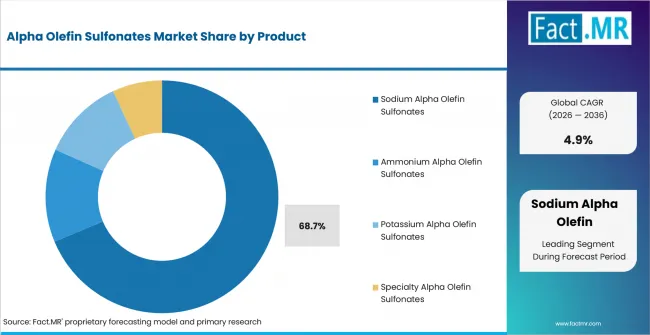
Alpha Olefin Sulfonates Market Analysis By Product | Source: Fact.MR
Sodium AOS leads because sodium neutralization produces a practical anionic surfactant form that is already established in liquid and powder cleansing systems. The chemistry can be supplied at useful active concentrations and blended with other surfactant classes, reducing reformulation burden for manufacturers that operate multiple detergent or personal care lines.
Commercial product data show why this form is widely specified. Stepan markets sodium C14-16 olefin sulfonate as an aqueous surfactant for detergents, hand soaps, shampoos, and bath products. Pilot Chemical also supplies sodium AOS grades for personal care, household, institutional, and oilfield uses. This breadth creates repeat demand from buyers that prefer a common surfactant platform across several formulations.
Why do Household Detergents lead Application?
Household Detergents account for 43.8% of the Application segment in 2026.
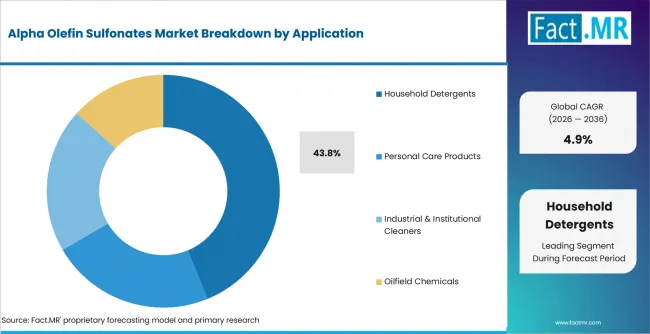
Alpha Olefin Sulfonates Market Analysis By Application | Source: Fact.MR
Household detergents lead because laundry and dishwashing formulations consume surfactants on a recurring basis and require reliable cleaning across variable water hardness, soil loads, and wash temperatures. AOS contributes foam and grease removal while remaining compatible with mixed-surfactant systems.
The application also benefits from the scale of the wider detergent chemicals value chain. Germany, Brazil, the USA, the UK, and Japan all maintain active household-cleaning industries, so AOS suppliers can serve recurring formulation demand rather than one-time project consumption.
Why do Consumer Goods Manufacturers lead End Use?
Consumer Goods Manufacturers account for 72.4% of the End Use segment in 2026.
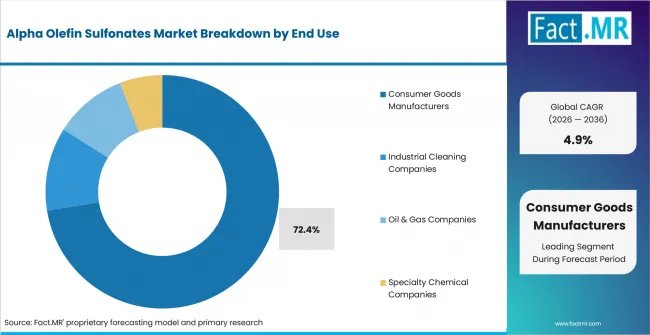
Alpha Olefin Sulfonates Market Analysis By End Use | Source: Fact.MR
Consumer goods manufacturers lead because detergent and personal care brands convert surfactant inputs into finished products at continuous production scale. These buyers purchase against tight specifications for active matter, color, odor, foam profile, viscosity response, and impurity control, which favors established supplier relationships.
Direct access to technical data also shortens formulation work. When the same AOS chemistry can serve hand wash, shampoo, liquid laundry, and dishwashing products, procurement teams can consolidate supplier qualification and simplify raw-material management across multiple plants.
Why does Sulfonation Technology lead Technology?
Sulfonation Technology accounts for 57.1% of the Technology segment in 2026.
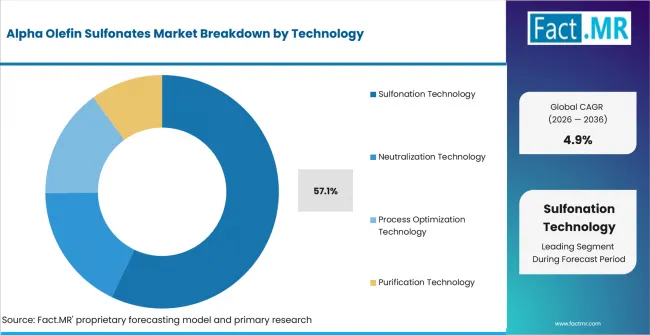
Alpha Olefin Sulfonates Market Analysis By Technology | Source: Fact.MR
Sulfonation technology leads because it is the reaction step that converts alpha olefins into the sulfonated intermediates that become AOS after hydrolysis and neutralization. Reaction control influences conversion, disulfonate formation, color, free oil, and downstream product consistency.
Stepan states that BIO-TERGE AS-40A is produced by continuous sulfonation of alpha olefins using a falling-film process designed to minimize disulfonate formation. For buyers, that process control translates into more predictable formulation behavior, so sulfonation capability remains a central supplier-selection factor.
Why do Liquid Formulations lead Formulation?
Liquid Formulations account for 39.6% of the Formulation segment in 2026.
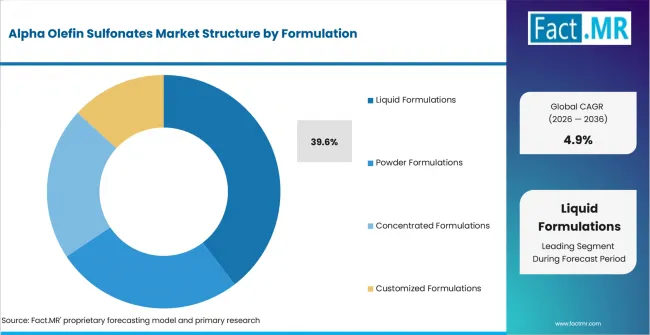
Alpha Olefin Sulfonates Market Analysis By Formulation | Source: Fact.MR
Liquid formulations lead because aqueous AOS can be metered directly into liquid detergent, shampoo, hand wash, and institutional-cleaner production. This reduces dissolution steps and supports automated batching where formulators need rapid mixing and consistent active delivery.
The market includes high-active and low-active liquid systems because different buyers optimize for freight efficiency, viscosity, pumping, and dilution capability. This creates room for concentrated liquid AOS in centralized manufacturing and lower-active systems where handling simplicity is the priority.
Why does Direct Sales lead Distribution Channel?
Direct Sales account for 61.3% of the Distribution Channel segment in 2026.
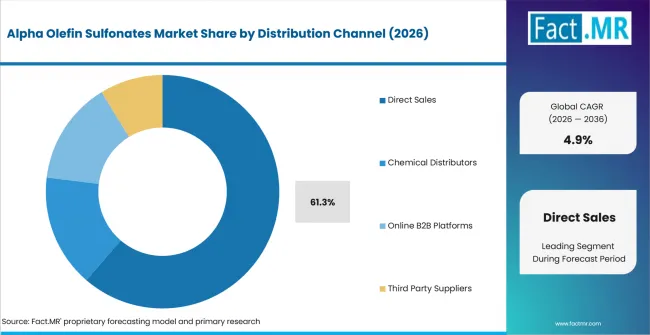
Alpha Olefin Sulfonates Market Analysis By Distribution Channel | Source: Fact.MR
Direct sales lead because large detergent, personal care, and industrial buyers qualify surfactants through plant trials and specification review before committing volume. They also need predictable delivery schedules and technical response when changes in water chemistry, fragrance, salt level, or co-surfactant selection affect finished-product performance.
Producer-to-manufacturer relationships are especially important for high-volume contracts and customized formulations. Distributors remain relevant for regional accounts and smaller lot sizes, but direct supply gives producers greater visibility into demand planning and gives buyers faster access to application support. The same procurement logic appears in industrial cleaning supply, where direct technical support can affect qualification and replenishment decisions.
What is accelerating Alpha Olefin Sulfonates Market adoption, and what is holding it back?
Adoption is being accelerated by recurring detergent demand, liquid personal care formulation, biodegradable-surfactant qualification, and industrial cleaning use. Growth is moderated by alpha-olefin feedstock volatility, competition from alternative anionic and mild surfactants, regulatory testing costs, and formulation-specific viscosity or clarity constraints.
Drivers Impact Analysis
| Factor | (~) % Impact on CAGR | Geographic Relevance | Impact Timeline |
|---|---|---|---|
| Recurring household detergent production | +1.4% | Global; Germany; Brazil; USA; UK; Japan | Near to mid term |
| Personal care use in shampoos and body cleansing | +1.0% | USA; Germany; Japan; Brazil | Near to mid term |
| Biodegradability-led surfactant qualification | +0.8% | Europe; USA; UK | Mid term |
| Industrial and institutional cleaning demand | +0.6% | USA; Germany; Brazil; UK | Mid term |
Source: Fact.MR analysis. Updated Aug 25, 2026
Opportunity Impact Analysis
| Factor | (~) % Impact on CAGR | Geographic Relevance | Impact Timeline |
|---|---|---|---|
| High-active liquid and concentrated AOS systems | +0.7% | Global | Near to mid term |
| Bio-based and customized AOS formulations | +0.5% | Europe; USA; Japan | Mid to long term |
| Oilfield and electrolyte-rich specialty applications | +0.4% | USA; Brazil; selected global basins | Mid term |
| Direct OEM and industrial supply agreements | +0.3% | Global | Near term |
Source: Fact.MR analysis. Updated Aug 25, 2026
Restraints Impact Analysis
| Factor | (~) % Impact on CAGR | Geographic Relevance | Impact Timeline |
|---|---|---|---|
| Alpha-olefin feedstock price and availability swings | -0.7% | Global | Near term |
| Competition from alternative anionic and mild surfactants | -0.5% | Global | Near to mid term |
| Biodegradability, impurity, and regulatory testing burden | -0.4% | Europe; USA; UK | Mid term |
| Viscosity, clarity, or color limits in sensitive formulations | -0.3% | Personal care markets globally | Near to mid term |
Source: Fact.MR analysis. Updated Aug 25, 2026
Which countries are scaling the Alpha Olefin Sulfonates Market through 2036?
- Germany: Germany combines detergent and personal care manufacturing with an EU regulatory environment that keeps surfactant biodegradability and technical documentation central to formulation decisions. IKW reported 5.5% growth in domestic beauty and home care sales in 2025, supporting continued raw-material demand.
- Brazil: Brazil has a volume-oriented cleaning-products industry. ABIPLA reported an 8.2% increase in cleaning-product production in 2024, while consumers shifted toward lower-priced product tiers. This favors surfactants that can deliver reliable foam and detergency without forcing major formulation cost increases.
- USA: The USA has a broad cleaning-product supply chain and active environmental screening of surfactants. The American Cleaning Institute describes a USD 60 billion U.S. cleaning-product supply chain, while EPA Safer Choice criteria make biodegradation and aquatic-toxicity data relevant to ingredient selection.
- UK: The UK combines household and professional cleaning demand with explicit surfactant biodegradability rules. HSE guidance applies detergent and surfactant requirements across household, institutional, and industrial cleaning products, giving suppliers with clear technical files an advantage in qualification.
- Japan: Japan has an established detergent and body-cleansing manufacturing base tracked by the Japan Soap and Detergent Association. The market favors liquid laundry, dishwashing, and personal-cleansing systems where AOS can support foam and viscosity performance, although the mature demand base produces a more measured growth profile.
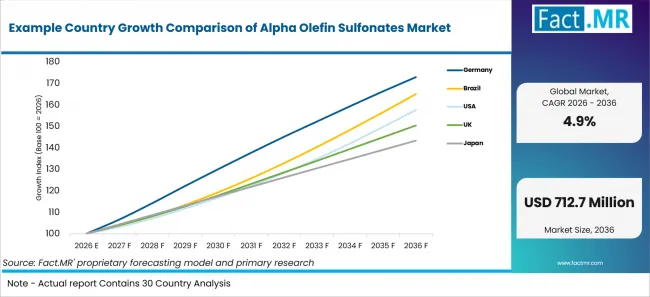
Example Country Growth Comparison Of Alpha Olefin Sulfonates Market | Source: Fact.MR
Country CAGR (2026-2036)
| Country | CAGR (2026-2036) |
|---|---|
| Germany | 5.6% |
| Brazil | 5.1% |
| USA | 4.7% |
| UK | 4.2% |
| Japan | 3.7% |
Source: Fact.MR analysis. Updated Aug 25, 2026
What is driving Germany’s growth through 2036?
Germany is forecast to expand at a 5.6% CAGR from 2026 to 2036.
Germany’s growth is supported by demand from household-care and personal-care formulators that operate under detailed chemical and detergent rules. IKW reported that domestic beauty and home care sales increased by 5.5% in 2025, with laundry detergents, cleaning products, skin care, and hair care remaining everyday product categories.
The regulatory mechanism is also material. Regulation (EU) 2026/405 retains biodegradability requirements for surfactants used in detergents, while ECHA identifies sodium C14-16 olefin sulfonate under CAS 68439-57-6 within the REACH regulatory framework. This pushes buyers to evaluate technical documentation alongside price and performance.
What is driving Brazil’s growth through 2036?
Brazil is forecast to expand at a 5.1% CAGR from 2026 to 2036.
Brazil’s growth is tied to cleaning-product production and a strong need for cost-performance formulations. ABIPLA reported that the sector’s production volume increased in 2024 even as manufacturers faced currency and cost pressure. Higher physical output directly increases demand for detergent surfactants when formulations remain surfactant-intensive.
Consumer movement toward lower-priced cleaning brands also matters. ABIPLA’s 2025 industry reporting describes faster growth for lower-tier brands, which places pressure on formulators to retain foam and cleaning performance at controlled cost. AOS can fit this requirement where it is technically compatible with the builder, fragrance, salt, and co-surfactant system.
What is driving USA’s growth through 2036?
The USA is forecast to expand at a 4.7% CAGR from 2026 to 2036.
Demand is supported by established detergent, personal care, institutional cleaning, and specialty-chemical manufacturing. The American Cleaning Institute describes the U.S. cleaning-product supply chain at approximately USD 60 billion, creating a recurring base of raw-material consumption for surfactants used in household and professional formulations.
Ingredient screening is becoming more data-driven. EPA Safer Choice surfactant criteria combine biodegradation rate with aquatic toxicity and degradation-product considerations. Suppliers able to provide the required environmental-fate data can participate more effectively in cleaning-product programs where safer-ingredient qualification is part of the buying process.
What is driving UK’s growth through 2036?
The UK is forecast to expand at a 4.2% CAGR from 2026 to 2036.
Demand comes from both household and professional cleaning products. UKCPI represents producers of laundry products, dishwashing products, disinfectants, household cleaners, and professional hygiene formulations used in hospitals, schools, care homes, and catering environments. That end-use spread supports several AOS application pathways.
HSE guidance requires surfactants for detergents placed on the Great Britain market to meet biodegradability and documentation obligations. For suppliers, compliance therefore affects market access directly. AOS producers with consistent product specifications and complete test documentation are better positioned to serve manufacturers with formal qualification processes.
What is driving Japan’s growth through 2036?
Japan is forecast to expand at a 3.7% CAGR from 2026 to 2036.
Japan’s growth is supported by a mature but active soap, detergent, and body-cleansing industry. JSDA publishes annual statistics based on manufacturer reporting and METI production data, covering liquid laundry detergents, dishwashing detergents, household cleaners, body-cleansing products, and related categories.
Liquid-formulation requirements are particularly relevant because AOS is available as aqueous sodium C14-16 grades that provide foam, viscosity response, and broad pH stability. Japan’s emphasis on product quality and the detergent industry’s sustainability work, including the 2025 AOSDAC focus on hygiene and environmental protection, supports demand for well-documented surfactant systems rather than undifferentiated commodity supply.
Who Leads the Alpha Olefin Sulfonates Market?
INEOS Group leads the Alpha Olefin Sulfonates Market.
INEOS competes from an upstream position in the AOS value chain. INEOS Oligomers supplies C12-C24 linear alpha olefins used as intermediates in surfactants, detergents, and alpha olefin sulfonates. Feedstock integration can support supply continuity and specification control when AOS producers need defined carbon-chain blends for sulfonation.
Finished-surfactant capability is another competitive factor. Stepan sells BIO-TERGE sodium C14-16 olefin sulfonate grades produced through continuous sulfonation, while Pilot Chemical sells multiple AOS grades across personal care, household, institutional, and oilfield applications. These examples show how product breadth and formulation support can influence customer retention alongside price.
AK ChemTech Co., Ltd. was merged into Aekyung Chemical in November 2021. Current operations associated with the former AK ChemTech business therefore sit within Aekyung Chemical. The remaining companies compete through surfactant portfolios, regional production, technical service, and access to detergent and personal care customers.
Which companies are the key providers?
Key companies profiled include INEOS Group; Aarti Industries Ltd.; AK ChemTech Co., Ltd.; Clariant AG; Godrej Industries Ltd.; Kao Corporation; Nouryon; Pilot Chemical Company; Sinolight Shaoxing Chemicals Co., Ltd.; Solvay S.A.; Stepan Company; and Zanyu Technology Group Co., Ltd.
- INEOS Group
- Aarti Industries Ltd.
- AK ChemTech Co., Ltd.
- Clariant AG
- Godrej Industries Ltd.
- Kao Corporation
- Nouryon
- Pilot Chemical Company
- Sinolight Shaoxing Chemicals Co., Ltd.
- Solvay S.A.
- Stepan Company
- Zanyu Technology Group Co., Ltd.
Bibliography
- U.S. Environmental Protection Agency. (2026). Safer Choice Criteria for Surfactants. U.S. EPA.
- U.S. Environmental Protection Agency. (2026). Safer Choice Standard and Criteria. U.S. EPA.
- European Chemicals Agency. (2026). Substance Information: Sulfonic acids, C14-16-alkane hydroxy and C14-16-alkene, sodium salts. ECHA.
- European Parliament and Council. (2026). Regulation (EU) 2026/405 on detergents and surfactants. Official Journal of the European Union.
- European Commission. (2023). Frequently Asked Questions on the Detergents Regulation. European Commission.
- Health and Safety Executive. (2025). Purpose and scope of the Detergents Regulation. HSE, United Kingdom.
- IKW. (2025). Market Data: Beauty and Home Care Industry. Industrieverband Körperpflege- und Waschmittel e. V.
- ABIPLA. (2025). Cleaning products: migration to lower-priced brands and 2025 industry outlook. Associação Brasileira das Indústrias de Produtos de Higiene, Limpeza e Saneantes.
- UK Cleaning Products Industry Association. (2025). UKCPI Annual Review 2025. UKCPI.
- Japan Soap and Detergent Association. (2026). Statistics on cleaning products and annual product sales. JSDA.
- Japan Soap and Detergent Association. (2025). Report of the 15th Asia Oceania Soap and Detergent Associations Conference. JSDA.
- American Cleaning Institute. (2025). U.S. cleaning products industry and regulatory policy submission. ACI.
- Stepan Company. (2024). BIO-TERGE AS-40A Product Bulletin. Stepan Company.
- Pilot Chemical Company. (n.d.). CALSOFT AOS-1245 Product Data Sheet. Pilot Chemical Company.
- INEOS Oligomers. (2026). Linear Alpha Olefins. INEOS.
- Aekyung Chemical. (2026). Company History. Aekyung Chemical Co., Ltd.
This Report Answers
- Which product chemistries and physical forms are shaping AOS procurement?
- Which downstream applications create recurring surfactant demand?
- How do sulfonation, neutralization, process optimization, and purification affect supplier positioning?
- Why do direct supply relationships matter for major detergent and personal care manufacturers?
- How do environmental and detergent regulations influence surfactant qualification?
- Which country-specific demand mechanisms are relevant through 2036?
- How does competition differ between feedstock-integrated suppliers and finished-surfactant producers?
What does the Alpha Olefin Sulfonates Market cover?
The market covers commercial alpha olefin sulfonate surfactants sold as sodium, ammonium, potassium, and specialty AOS products. Revenue is counted when these surfactants are supplied for use in household detergents, personal care products, industrial and institutional cleaners, and oilfield chemicals. The assessment also differentiates the production technology, formulation form, end-user group, and distribution channel through which AOS reaches buyers.
What is included in the scope?
- Products: Sodium Alpha Olefin Sulfonates, Ammonium Alpha Olefin Sulfonates, Potassium Alpha Olefin Sulfonates, and Specialty Alpha Olefin Sulfonates, including the listed subsegments.
- Applications: Household Detergents, Personal Care Products, Industrial & Institutional Cleaners, and Oilfield Chemicals, including their listed use cases.
- Buyers: Consumer Goods Manufacturers, Industrial Cleaning Companies, Oil & Gas Companies, and Specialty Chemical Companies.
- Technologies and formulations: Sulfonation, neutralization, process optimization, purification, liquid, powder, concentrated, and customized formulation systems exactly as segmented in the report.
- Distribution: Direct Sales, Chemical Distributors, Online B2B Platforms, and Third Party Suppliers.
- Geographic detail: Global market sizing with specific country analysis for Germany, Brazil, USA, UK, and Japan.
What is excluded from the scope?
- Finished detergents, shampoos, hand washes, industrial cleaners, and oilfield fluids are excluded when their revenue reflects the downstream finished product rather than the AOS ingredient.
- Linear alpha olefins sold for polyethylene comonomers, lubricants, paper sizing, or other non-AOS uses are outside the market.
- Other surfactant chemistries such as linear alkylbenzene sulfonates, alcohol sulfates, alcohol ether sulfates, nonionic surfactants, amphoterics, and biosurfactants are excluded unless they are part of a customized AOS formulation whose commercial value is assigned to the AOS product.
- Sulfonation equipment, neutralization equipment, storage systems, dosing equipment, and testing services are excluded as standalone equipment or service revenue.
How Was the Analysis Built?
The analysis combines product-level AOS demand mapping with application, end-use, technology, formulation, channel, and country-level validation. The objective is to link surfactant consumption to the workflows that cause buyers to qualify and purchase AOS rather than treating the market as a generic chemical volume pool.
- Primary Research
- Relevant respondent groups include surfactant producers, sulfonation plant managers, detergent and personal care formulators, industrial-cleaning chemical producers, oilfield chemical formulators, procurement managers, distributors, and technical-service personnel responsible for qualification and plant trials.
- Desk Research
- Desk research uses detergent and chemical regulations, environmental-fate criteria, industry production statistics, technical product bulletins, company product portfolios, and trade-association publications. These sources are used to explain demand mechanisms, formulation requirements, regulatory qualification, and competitive positioning.
- Market Sizing and Forecasting
- Sizing considers AOS consumption across household detergent, personal care, industrial cleaning, and oilfield applications, then cross-checks product mix, formulation form, buyer type, distribution route, and country demand. Forecasting links end-use production and reformulation activity to supplier capability, active concentration, feedstock availability, and regulatory requirements.
- Data Validation and Update Cycle
- Market assumptions are checked against supplier product specifications, application evidence, current detergent and surfactant rules, country industry indicators, and changes in company status. Updates focus on demand shifts that can alter AOS qualification, pricing power, or application mix through the forecast period.
Segmentation
What is the report's scope and coverage?
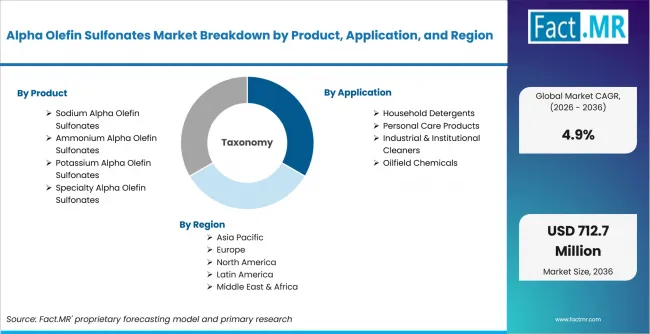
Alpha Olefin Sulfonates Market Breakdown By Product, Application, And Region | Source: Fact.MR
| Attribute | Details |
|---|---|
| Quantitative Units | USD Million |
| Market Definition | Commercial alpha olefin sulfonate surfactants supplied in sodium, ammonium, potassium, and specialty grades for the included downstream applications. |
| Segments Covered | Product; Application; End Use; Technology; Formulation; Distribution Channel |
| Regions Covered | Global analysis with detailed country coverage for the listed markets. |
| Countries Covered | Germany; Brazil; USA; UK; Japan |
| Key Companies Profiled | INEOS Group; Aarti Industries Ltd.; AK ChemTech Co., Ltd.; Clariant AG; Godrej Industries Ltd.; Kao Corporation; Nouryon; Pilot Chemical Company; Sinolight Shaoxing Chemicals Co., Ltd.; Solvay S.A.; Stepan Company; Zanyu Technology Group Co., Ltd. |
| Forecast Period | 2026-2036 |
| Base Year | 2026 |
| Market Value, 2026 | USD 441.7 million |
| Market Value, 2036 | USD 712.7 million |
| CAGR, 2026-2036 | 4.9% |
| Absolute Opportunity | USD 271.0 million |
| Approach | Application-demand mapping combined with product, buyer, process, formulation, channel, country, and supplier validation. |
Source: Fact.MR analysis. Updated Aug 25, 2026
How is the market segmented?
-
By Product:
- Sodium Alpha Olefin Sulfonates
- Powder Sodium AOS
- Liquid Sodium AOS
- Ammonium Alpha Olefin Sulfonates
- Industrial Grade Ammonium AOS
- Specialty Ammonium AOS
- Potassium Alpha Olefin Sulfonates
- Personal Care Grade Potassium AOS
- Industrial Grade Potassium AOS
- Specialty Alpha Olefin Sulfonates
- Bio-Based AOS
- Customized AOS Formulations
- Sodium Alpha Olefin Sulfonates
-
By Application:
- Household Detergents
- Laundry Detergent Applications
- Dishwashing Applications
- Personal Care Products
- Hair Care Applications
- Skin Care Applications
- Industrial & Institutional Cleaners
- Commercial Cleaning Applications
- Industrial Cleaning Applications
- Oilfield Chemicals
- Enhanced Oil Recovery Applications
- Drilling Fluid Applications
- Household Detergents
-
By End Use:
- Consumer Goods Manufacturers
- Detergent Manufacturers
- Personal Care Manufacturers
- Industrial Cleaning Companies
- Commercial Cleaning Product Producers
- Industrial Chemical Producers
- Oil & Gas Companies
- Exploration Companies
- Oilfield Service Providers
- Specialty Chemical Companies
- Surfactant Manufacturers
- Custom Chemical Producers
- Consumer Goods Manufacturers
-
By Technology:
- Sulfonation Technology
- Continuous Sulfonation Systems
- Batch Sulfonation Systems
- Neutralization Technology
- Automated Neutralization Systems
- Batch Neutralization Systems
- Process Optimization Technology
- Energy Efficient Production Systems
- Advanced Process Control Systems
- Purification Technology
- Filtration Systems
- Refining Systems
- Sulfonation Technology
-
By Formulation
- Liquid Formulations
- High Active Liquid Systems
- Low Active Liquid Systems
- Powder Formulations
- Spray Dried Systems
- Granular Systems
- Concentrated Formulations
- Industrial Concentrates
- Personal Care Concentrates
- Customized Formulations
- Application Specific Systems
- Performance Enhanced Systems
- Liquid Formulations
-
By Distribution Channel:
- Direct Sales
- OEM Supply Agreements
- Industrial Supply Contracts
- Chemical Distributors
- Regional Distributors
- Global Distributors
- Online B2B Platforms
- Industrial Procurement Platforms
- Manufacturer Portals
- Third Party Suppliers
- Contract Supply Companies
- Trading Companies
- Direct Sales
Frequently Asked Questions
What is the Alpha Olefin Sulfonates Market value in 2026?
At what CAGR is the market projected to grow?
What is the projected market value by 2036?
Which Product leads the market?
Which Application leads the market?
Which End Use leads the market?
Which Technology leads the market?
Which Formulation leads the market?
Which Distribution Channel leads the market?
Which country is listed at a 5.6% CAGR?
Which company leads the Alpha Olefin Sulfonates Market?
Which companies are included in the market assessment?
Who worked on this report


Preview the report firsthand - request a free sample
Free SampleGet the brochure for pricing and purchase details
Download PDF