- Market Value (2025): USD 1.68 Bn
- Estimated Value (2026): USD 1.77 Bn
- Forecast Value (2036): USD 3.00 Bn
- CAGR (2026-2036): 5.4%
What is the Aluminum Foil Boxes Market forecast to be worth by 2036?
USD 1.77 billion in 2026 to USD 3.00 billion by 2036, at a 5.42% CAGR.
- The Aluminum Foil Boxes Market was valued at USD 1.68 billion in 2025. Demand came primarily from foodservice, catering, ready-to-eat meals, and other applications requiring durable and heat-resistant packaging.
- Market revenue is expected to increase from USD 1.77 billion in 2026 to USD 3.00 billion by 2036. Growing demand for takeaway food, packaged meals, and aluminum packaging with protective coatings is expected to support sales.
- The market is projected to grow at a CAGR of 5.4% between 2026 and 2036. Regular purchases from foodservice businesses will support demand, while aluminum price fluctuations and competition from alternative packaging materials may limit growth.
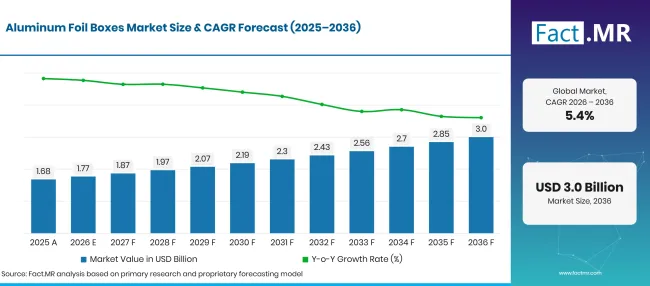
Factmr Aluminum Foil Boxes Market Forecast Global | Source: Fact.MR
| Year | Basis | Market Value (USD billion) |
|---|---|---|
| 2025 | Historical estimate | 1.68 |
| 2026 | Estimate | 1.77 |
| 2036 | Forecast | 3.00 |
| CAGR 2026 to 2036 | Forecast period | 5.4% |
Source: Fact.MR analysis. Updated Oct 21, 2026
What are the defining numbers behind Aluminum Foil Boxes Market growth?
The forecast adds USD 1.23 billion in annual revenue between 2026 and 2036. Standard boxes account for 48.2% of 2026 sales. The practical opportunity is to improve performance within familiar dimensions so customers can adopt a better pack without replacing their handling equipment.
- Demand Drivers in the Market
- The contact surface can determine which meals a supplier is able to serve. Germany's BfR recommends coated aluminum trays for acidic or salty dishes because the food and holding conditions influence metal transfer. [3] A converter with suitable coatings can approach a wider set of recipes. Sales teams should therefore organize the range around intended use and provide clear instructions with the pack.
- Design for recovery is becoming a purchasing requirement with specific engineering consequences. The UK's 2025 assessment applies size and material-composition tests to aluminum packaging. [5] Buyers comparing aluminum trays can examine whether the lid separates cleanly and whether a large catering box can be folded after use. These details make a recovery claim more useful to a customer preparing packaging declarations.
- Material cost is a direct commercial constraint. Reynolds Consumer Products reported that higher aluminum prices adversely affected its 2025 results. It also said most sales contracts lacked contractual raw-material cost pass-through mechanisms. [9] For a box converter this creates a reason to improve forming yield and reduce avoidable metal use. Any reduction in thickness still needs to preserve the loaded pack's strength.
- Packaging specifications are receiving renewed attention in Europe. The Packaging and Packaging Waste Regulation began phased application on 12 August 2026. The Commission identifies further waste-prevention and recyclability measures from 2030. [7] For foodservice packaging buyers this creates scheduled points to review existing formats. Foil-box suppliers need to explain the entire pack's performance and recovery route when competing for those reviews.
- Key Segments Analyzed
- Standard Aluminum Foil Boxes hold 48.2% of 2026 product revenue. Their role is to meet routine handling requirements without the extra material or finishing cost of specialty packs.
- Food Packaging contributes 48.2% of application revenue. Recipe compatibility and the journey from kitchen to customer shape the specification within this group.
- Supermarkets/Hypermarkets represent 39.8% of sales. Pack count and shelf availability matter because buyers often purchase boxes alongside the ingredients they will prepare.
- Commercial customers account for 48.7% of end-user demand. Orders depend on repeat service schedules and the number of different containers a kitchen needs to hold.
- Analyst Opinion at Fact.MR
- Shambhu Nath Jha, Lead Consultant, Fact.MR
- Fact.MR expects the better commercial returns to come from simplifying a customer's packaging operation. A caterer gains little from a nominally stronger box if it requires a second lid size or jams during separation. Suppliers should demonstrate the cost of a usable packed meal across the complete shift. That assessment includes rejected containers and the time needed to close them. A limited range with reliable forming and clear use instructions can earn repeat business even when a competing quote offers a lower price per empty box.
- Strategic Implications
- Focus on container quality and lid compatibility. Food manufacturers prefer aluminum foil boxes that maintain their shape during filling, transportation, and storage. Manufacturers should offer boxes with consistent dimensions and compatible lids to reduce packaging failures. Testing products under actual operating conditions can also help suppliers secure long-term contracts with large food producers.
- Improve production efficiency and control material costs. Aluminum foil box manufacturers depend on the availability and pricing of raw aluminum foil. The wider aluminum foil packaging industry supplies material for several packaging applications. Symetal operates in both foil rolling and packaging conversion. [10] Manufacturers can improve profitability by reducing material wastage, maintaining consistent foil thickness, and selecting coatings based on end-use requirements.
- Expand standard packaging sizes for foodservice customers. Demand for aluminum foil boxes is closely linked to takeaway meals, catering, and on-the-go food packaging. Manufacturers should focus on popular meal and portion sizes that generate regular orders. Offering standard dimensions, matching lids, and reliable product availability can help distributors increase repeat purchases and reduce inventory costs.
- Strengthen compliance for export markets. Manufacturers exporting coated aluminum foil boxes must comply with food-contact material regulations in destination countries. Japan's June 2026 guidance differentiates certain synthetic-resin coatings from coating agents outside the positive-list scope. [4] Suppliers should maintain documentation covering coatings, adhesives, and other food-contact components to meet buyer requirements and reduce the risk of shipment delays.
Germany has the strongest forecast growth among the five assessed countries at 5.98%. Brazil offers a separate route through compliant local conversion. The United States rewards dependable retail replenishment. UK recovery requirements and Japan's coating documentation place greater weight on the details of pack design.
How does the Aluminum Foil Boxes Market break down by segment?
The four segment views describe the same finished-box revenue from different angles. Product type records the pack specification. Application captures its use. Sales channel and end-user describe how it reaches the customer and who consumes it.
Why do standard foil boxes retain the largest product share?
Standard Aluminum Foil Boxes account for 48.2% of estimated 2026 revenue.
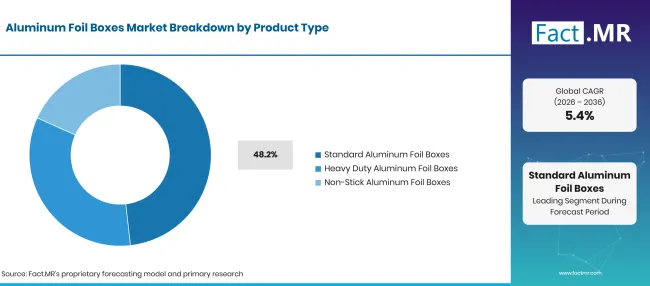
Factmr Aluminum Foil Boxes Market Breakdown Product Type | Source: Fact.MR
| Product Type | Share (2026) |
|---|---|
| Standard Aluminum Foil Boxes | 48.2% |
| Other segments combined | 51.8% |
| Total | 100.0% |
Source: Fact.MR analysis. Updated Oct 21, 2026
Standard packs give distributors a repeatable product for everyday requirements. Buyers can replenish common sizes without taking on the cost of a specialized coating or heavier structure. Heavy-duty formats earn their place where the loaded box needs greater rigidity. Non-stick variants address release performance. The decision should follow the actual preparation and handling task so additional material or finishing produces a benefit the customer can use. Products with several features are assigned to a single principal commercial type. This keeps a coated heavy-duty box from being counted twice. A specialty claim also needs clear instructions because a non-stick surface alone does not establish suitability for every food or heating condition. [3]
How does food packaging shape the technical specification?
Food Packaging represents 48.2% of the market in 2026.
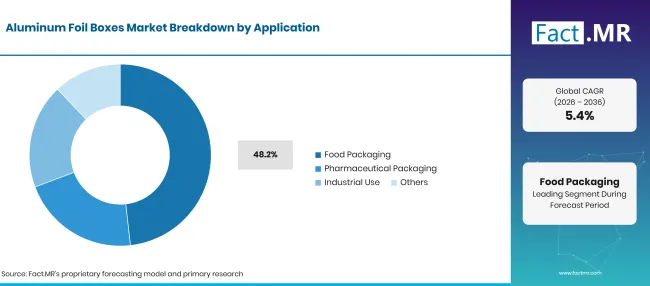
Factmr Aluminum Foil Boxes Market Breakdown Application | Source: Fact.MR
| Application | Share (2026) |
|---|---|
| Food Packaging | 48.2% |
| Other segments combined | 51.8% |
| Total | 100.0% |
Source: Fact.MR analysis. Updated Oct 21, 2026
The food application creates a sequence of requirements across storage and service. A box filled with a dry bakery item faces a different contact environment from a sauced meal. Brazil's metal-contact rules explicitly distinguish uncoated aluminum by contact duration and temperature. [1] That distinction gives converters a practical basis for specifying surfaces and communicating use limits. Pharmaceutical and industrial applications involve separate compatibility and protection requirements. Foodservice approval does not establish suitability for those uses.
Why do supermarkets and hypermarkets lead the sales channel mix?
Supermarkets/Hypermarkets contribute 39.8% of estimated sales in 2026.
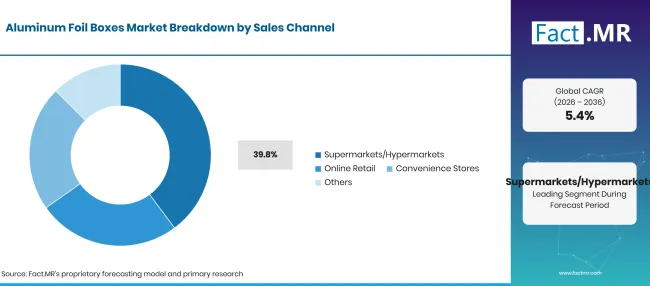
Factmr Aluminum Foil Boxes Market Breakdown Sales Channel | Source: Fact.MR
| Sales Channel | Share (2026) |
|---|---|
| Supermarkets/Hypermarkets | 39.8% |
| Other segments combined | 60.2% |
| Total | 100.0% |
Source: Fact.MR analysis. Updated Oct 21, 2026
The supermarket purchase usually combines immediate availability with a familiar pack size. Retailers need shelf packs that explain capacity and intended use at a glance. Their buying teams also compare case efficiency and promotional availability. Online sellers can carry a wider choice of dimensions but must describe it precisely. Commercial distributors remain relevant where kitchens need larger cases and repeated deliveries. Their services sit within the other-channel total alongside the remaining routes.
What gives commercial users the largest share of demand?
Commercial buyers account for 48.7% of the market in 2026.
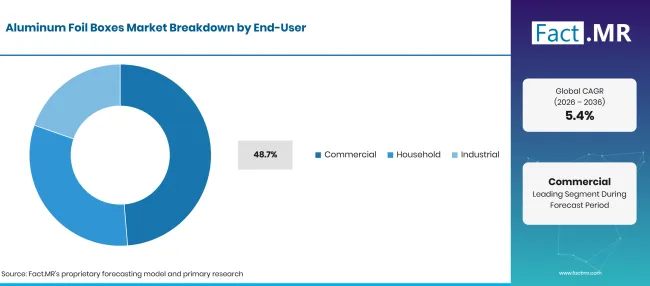
Factmr Aluminum Foil Boxes Market Breakdown End User | Source: Fact.MR
| End-User | Share (2026) |
|---|---|
| Commercial | 48.7% |
| Other segments combined | 51.3% |
| Total | 100.0% |
Source: Fact.MR analysis. Updated Oct 21, 2026
Commercial users buy against a recurring service requirement. A kitchen can standardize portion sizes and reduce the number of lids in storage once it settles on a workable range. That creates repeat orders but also makes a supply interruption expensive. Suppliers should judge account value by reorder frequency and the effort needed to serve each location. Household customers are more sensitive to occasional purchase needs. Industrial users generally require a narrower application specification.
What is accelerating Aluminum Foil Boxes Market adoption, and what is holding it back?
The Aluminum Foil Boxes Market is expected to grow steadily through 2036, supported by rising demand for packaged meals, takeaway food, and catering services. Manufacturers are focusing on coated and heavy-duty aluminum boxes to improve product performance and increase revenue. However, competition from plastic and paper-based packaging and fluctuations in aluminum prices may affect profitability. Companies investing in popular container sizes, efficient production equipment, and long-term customer relationships are expected to remain competitive.
Drivers Impact Analysis
| DRIVER | (~) % IMPACT ON CAGR | GEOGRAPHIC RELEVANCE | IMPACT TIMELINE |
|---|---|---|---|
| Repeat purchases for prepared meal service | +0.9% | North America and Europe | Short term (up to 2 years) |
| Coated formats suited to demanding recipes | +0.6% | Germany and European catering | Medium term (2 to 4 years) |
| Retail availability of standard household sizes | +0.4% | United States and Brazil | Short term (up to 2 years) |
| Oven-to-service handling within compatible formats | +0.7% | Global foodservice markets | Medium term (2 to 4 years) |
| Pack redesign linked to recovery requirements | +0.5% | United Kingdom and European Union | Long term (4 years or more) |
Source: Fact.MR analysis. Updated Oct 21, 2026
Opportunity Impact Analysis
| OPPORTUNITY | (~) % IMPACT ON CAGR | GEOGRAPHIC RELEVANCE | IMPACT TIMELINE |
|---|---|---|---|
| Common lids across several portion capacities | +0.3% | Contract catering and distributors | Short term (up to 2 years) |
| Forming yield improvements that preserve rigidity | +0.8% | Large converting operations | Medium term (2 to 4 years) |
| Documented coating ranges for export customers | +0.5% | Japan and European Union | Medium term (2 to 4 years) |
| Replenishment contracts for regional kitchens | +0.4% | Brazil and United States | Short term (up to 2 years) |
Source: Fact.MR analysis. Updated Oct 21, 2026
Restraints Impact Analysis
| RESTRAINT | (~) % IMPACT ON CAGR | GEOGRAPHIC RELEVANCE | IMPACT TIMELINE |
|---|---|---|---|
| Aluminum cost increases exceeding price recovery | -0.9% | Global | Short term (up to 2 years) |
| Switching to competing food-container materials | -0.6% | Urban takeaway and retail channels | Medium term (2 to 4 years) |
| Incorrect food-contact or heating specification | -0.4% | Institutional catering and exports | Short term (up to 2 years) |
| Recovery limitations for oversized composite packs | -0.3% | United Kingdom and Europe | Long term (4 years or more) |
Source: Fact.MR analysis. Updated Oct 21, 2026
Which countries are scaling the Aluminum Foil Boxes Market through 2036?
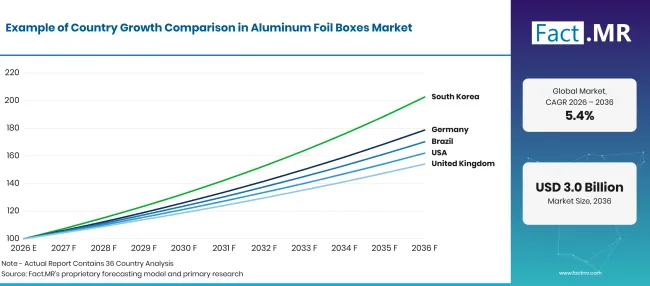
Factmr Aluminum Foil Boxes Market Growth Index | Source: Fact.MR
| Country | CAGR (2026 to 2036) |
|---|---|
| Germany | 5.98% |
| Brazil | 5.46% |
| United States | 4.94% |
| United Kingdom | 4.42% |
| Japan | 3.90% |
Source: Fact.MR analysis. Updated Oct 21, 2026
Why are coated aluminum foil boxes gaining importance in Germany?
Germany is forecast to record a 5.98% CAGR through 2036. Institutional catering and commercial kitchens are important customers for aluminum foil boxes, particularly where meals are prepared in large quantities and held before serving.
The Federal Institute for Risk Assessment (BfR) has identified conditions under which aluminum can transfer into food. The composition of the food and its contact time with aluminum both matter. This creates a stronger commercial case for coated containers in applications involving acidic or salty meals.
German buyers are therefore likely to assess containers against specific menu requirements rather than purchase solely on price. Manufacturers with documented food-contact performance can compete for larger catering contracts. Consistency in coating quality and container dimensions will remain important for repeat orders.
How can Brazilian manufacturers expand their distribution network?
Brazil's aluminum foil boxes market is projected to grow at a 5.46% CAGR between 2026 and 2036. Smaller restaurants, takeaway operators, and regional distributors present opportunities for manufacturers that can supply affordable containers in commonly used sizes.
Brazil's RDC 854 places restrictions on certain food-contact applications of uncoated aluminum. Anvisa's May 2026 guidance also clarifies that packaging generally does not require separate regularization, although applicable material requirements remain in force.
For Brazilian manufacturers, an opportunity lies in making product selection easier for smaller food businesses. Clear Portuguese instructions on suitable food types, storage conditions, and available coatings can reduce purchasing uncertainty. Manufacturers combining this information with competitive pricing and dependable regional supply can build stronger distributor relationships.
Why do seasonal purchases matter in the United States?
The United States market is forecast to expand at a 4.94% CAGR through 2036. Disposable aluminum pans and boxes are purchased throughout the year, although demand for household cooking products increases around major holidays.
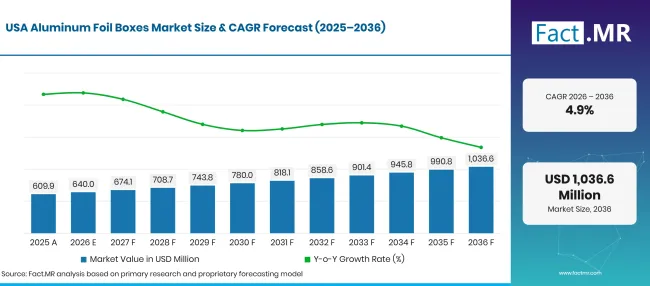
Factmr Aluminum Foil Boxes Market Forecast Usa | Source: Fact.MR
Reynolds Consumer Products identifies the fourth quarter as its strongest selling season for cooking products. This has implications for manufacturers supplying supermarkets, mass retailers, and private-label brands. Production schedules and retail inventories need to account for concentrated seasonal demand.
In the United States, suppliers can improve profitability through production efficiency and better inventory management. Retailers also need consistent availability of popular sizes. Manufacturers that maintain supply during peak selling periods can strengthen their relationships with national retail chains.
How are recycling requirements affecting product development in the United Kingdom?
The United Kingdom aluminum foil boxes market is expected to register a 4.42% CAGR from 2026 to 2036. Takeaway restaurants, caterers, and prepared-meal suppliers remain important users, while recycling requirements are influencing packaging specifications.
The UK's July 2026 guidance identifies foil trays among packaging commonly collected at the kerbside. Larger aluminum components require additional consideration, including whether they can be folded or dismantled to meet the relevant size threshold.
This gives manufacturers a reason to review container dimensions and lid construction, particularly for large catering trays. Removable lids and straightforward material separation may make disposal instructions easier to follow. Buyers are likely to favor packaging that meets operational requirements without creating unnecessary collection difficulties.
Why is coating documentation important for suppliers entering Japan?
Japan's aluminum foil boxes market is projected to grow at a 3.90% CAGR through 2036. The market offers opportunities in prepared meals and commercial food packaging, although suppliers must meet detailed food-contact requirements.
Japan's Consumer Affairs Agency updated its positive-list guidance in June 2026. The guidance addresses polymers used in coating layers and distinguishes them from certain other coating agents. Exporters must therefore establish which requirements apply to the actual coatings used in their containers.
For suppliers entering Japan, accurate material specifications are important during customer approval. Food manufacturers need consistent information about coatings, adhesives, and intended uses. Established exporters with dependable quality control and complete product documentation may be better positioned to secure repeat business.
Who leads the Aluminum Foil Boxes Market?
The competitive field contains finished-pack suppliers and businesses further upstream. Reynolds Consumer Products sells disposable aluminum pans through its Cooking & Baking segment. Pactiv Evergreen became part of Novolex in April 2025. [9] [8] Their commercial strengths involve access to retail or foodservice accounts and the ability to supply a working range of pack formats. Corporate size alone does not establish a finished-box market share.
Symetal supplies plain foil for food containers and operates a separate converting plant. [10] This illustrates the distinction between supplying foil stock and selling a completed box. Rolling groups influence material availability and specification. Finished-container suppliers carry responsibility for the geometry and closure offered to the customer. These roles should remain distinct when buyers build a supplier shortlist.
Account retention will depend on operational details that are easy to overlook in a catalog comparison. A reliable stack separates cleanly during a busy shift. A repeat order arrives with the same lid fit. A question about intended use receives a specific answer. Fact.MR expects those capabilities to matter most where the customer has standardized several outlets around one container family.
Which companies are the key providers?
- Reynolds Consumer Products Inc.
- Pactiv Evergreen / Novolex
- Symetal S.A.
- Amcor plc
- Novelis Inc.
- Hindalco Industries Limited
- Alcoa Corporation
- Norsk Hydro ASA
- Eurofoil Luxembourg S.A.
- Shanghai Metal Corporation
Bibliography
- [1] Agência Nacional de Vigilância Sanitária. (2024, April 4). Resolução da Diretoria Colegiada: RDC nº 854 [Sanitary requirements for metal packaging in contact with food].
- [2] Agência Nacional de Vigilância Sanitária. (2026, May 5). Regularização de matérias primas, ingredientes e embalagens [Regularization of raw materials, ingredients and packaging].
- [3] Bundesinstitut für Risikobewertung. (2020, July 20). FAQs about aluminium in food and products intended for consumers.
- [4] Consumer Affairs Agency. (2026, June 5). Questions & answers of the positive list system for apparatus, containers, and packaging [Administrative notice].
- [5] Department for Environment, Food & Rural Affairs. (2025, September 4). Recyclability assessment methodology: Assessing materials.
- [6] Department for Environment, Food & Rural Affairs, & PackUK. (2026, July 1). Common and limited kerbside collection lists 2026.
- [7] European Commission. (2026, August 11). New EU rules on packaging enter into application.
- [8] Novolex. (2025, April 1). Novolex and Pactiv Evergreen Inc. complete combination, creating a leading manufacturer in food, beverage and specialty packaging.
- [9] Reynolds Consumer Products Inc. (2026). Annual report for the fiscal year ended December 31, 2025 [Form 10-K]. U.S. Securities and Exchange Commission.
- [10] Symetal. (n.d.). About us.
This Report Answers
- Which pack features justify the extra cost of a specialty foil box?
- How do food-contact requirements influence coating selection and customer approval?
- Where do recycling rules change the preferred dimensions or construction of a pack?
- Why do commercial kitchens value common closures and repeatable supply?
- How should converters manage the gap between aluminum purchasing costs and selling prices?
- Which country opportunities depend on retail execution and which depend on technical documentation?
What does the Aluminum Foil Boxes Market cover?
The analysis covers revenue from finished aluminum-foil boxes across the defined product and application groups. A sale appears once within each segmentation view. Material producers are considered where their activities affect container supply. Their wider rolling or primary-metal revenue is outside the finished-box total.
What is included in the scope?
Included products are formed foil boxes supplied to commercial, household and industrial users. Standard and specialty grades remain within scope when supplied as finished containers. A closure supplied as part of the box pack is included in that pack's revenue. Product classification follows the principal commercial specification.
What is excluded from the scope?
Household foil rolls and unformed foil stock are excluded. The market also excludes flexible pouches, blister foil and beverage cans. Permanent metal cookware falls outside the single-use packaging boundary. Standalone coating sales and upstream aluminum revenue are not added to finished-container sales.
How Was the Analysis Built?
The analysis draws on 120+ sources, 35+ company portfolios, 25+ countries, and more than 20 industry interviews.
- Primary Research: Primary research includes discussions with manufacturers, service providers, technology developers, distributors, end users, and subject-matter experts. These conversations examine purchasing priorities, product adoption, operational challenges, approval requirements, competitive positioning, and the factors that influence wider market acceptance.
- Desk Research: Desk research covers government statistics, regulatory publications, company filings, trade data, technical studies, industry associations, standards, public policy, and other authoritative sources. Every source used in the analysis is documented in the bibliography.
- Market Sizing and Forecasting: Market estimates combine historical performance, demand indicators, pricing and volume trends, segment shares, company participation, country-level growth, adoption patterns, investment activity, and barriers to market expansion.
- Data Validation and Update Cycle: Findings are validated by comparing primary interviews with public data, company activity, regulatory changes, trade patterns, and industry developments. Regular updates review new product launches, capacity changes, partnerships, approvals, and shifts in commercial adoption.
Segmentation
What is the report’s scope and coverage?
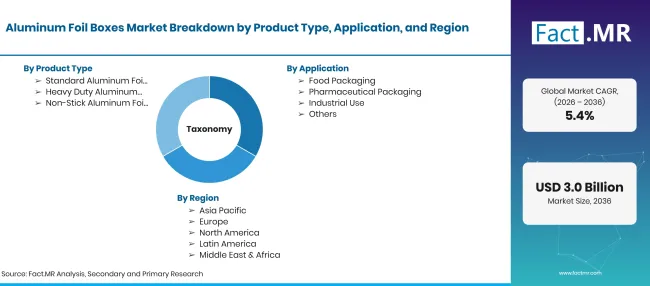
Factmr Aluminum Foil Boxes Market Taxonomy | Source: Fact.MR
| Attribute | Details |
|---|---|
| Quantitative Units | USD billion in 2025, 2026 and 2036; CAGR for 2026 to 2036 |
| Market Definition | Formed aluminum-foil boxes and box-like containers sold as finished packaging. The scope includes standard, heavy-duty and non-stick products across the specified food, pharmaceutical and industrial applications. |
| Product Type | Standard Aluminum Foil Boxes; Heavy Duty Aluminum Foil Boxes; Non-Stick Aluminum Foil Boxes |
| Application | Food Packaging; Pharmaceutical Packaging; Industrial Use; Others |
| Sales Channel | Supermarkets/Hypermarkets; Online Retail; Convenience Stores; Others |
| End-User | Commercial; Household; Industrial |
| Regions Covered | North America; Latin America; Western Europe; Eastern Europe; East Asia; South Asia & Pacific; Middle East & Africa |
| Countries Covered | Germany; Brazil; United States; United Kingdom; Japan |
| Companies Profiled | Reynolds Consumer Products Inc.; Pactiv Evergreen / Novolex; Symetal S.A.; Amcor plc; Novelis Inc.; Hindalco Industries Limited; Alcoa Corporation; Norsk Hydro ASA; Eurofoil Luxembourg S.A.; Shanghai Metal Corporation |
| Forecast Period | 2026 to 2036 |
| Approach | Assessment of finished-container demand and the commercial effects of forming quality, coatings, closure compatibility, route to market and material recovery. |
Source: Fact.MR analysis. Updated Oct 21, 2026
How is the market segmented?
-
By Product Type
- Standard Aluminum Foil Boxes
- Heavy Duty Aluminum Foil Boxes
- Non-Stick Aluminum Foil Boxes
-
By Application
- Food Packaging
- Pharmaceutical Packaging
- Industrial Use
- Others
-
By Sales Channel
- Supermarkets/Hypermarkets
- Online Retail
- Convenience Stores
- Others
-
By End-User
- Commercial
- Household
- Industrial
-
By Region
- North America
- Latin America
- Western Europe
- Eastern Europe
- East Asia
- South Asia & Pacific
- Middle East & Africa
Frequently Asked Questions
How big is the Aluminum Foil Boxes Market in 2026?
What is the forecast CAGR for 2026 to 2036?
Which product type has the largest share?
Which end-user group leads demand?
Can one foil-box specification serve every meal?
Who worked on this report


Preview the report firsthand - request a free sample
Free SampleGet the brochure for pricing and purchase details
Download PDF