- Market Value (2025): USD 1294.7 Mn
- Estimated Value (2026): USD 1450.0 Mn
- Forecast Value (2036): USD 4503.0 Mn
- CAGR (2026-2036): 12.0%
What is the Americas Stevia Extracts Market forecast to be worth by 2036?
USD 1,450.0 million in 2026 to USD 4,503.0 million by 2036 at a 12.0% CAGR.
- The Americas Stevia Extracts Market reached USD 1,294.7 million in 2025.
- Demand is projected to increase from USD 1,450.0 million in 2026 to USD 4,503.0 million by 2036.
- The market is forecast to record 12.0% CAGR from 2026 to 2036 as beverage brands and food processors reformulate high-sugar products with plant-derived sweeteners.
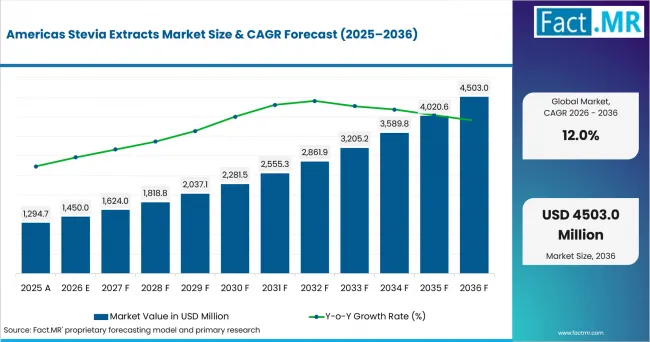
Americas Stevia Extracts Market Value Analysis | Source: Fact.MR
What are the defining numbers behind Americas Stevia Extracts Market growth?
An absolute opportunity of USD 3,053.0 million is expected between 2026 and 2036.
- Demand Drivers in the Market
- Beverage formulators need high-intensity sweetness that lowers added sugar while maintaining taste in soft drinks, flavored waters and powdered beverages.
- U.S. nutrition policy is expected to support sugar-reduction activity. FDA’s January 2026 Human Foods Program priorities include lowering added sugar in processed and prepared foods.
- Mexico’s 2026 sweetened-beverage tax structure applies a lower per-liter rate to flavored beverages with added sweeteners than to those with added sugars.
- Ingredient buyers evaluate Reb M, Reb D and blended glycosides because aftertaste control shapes approval in zero-sugar products.
- Food processors use stevia where heat stability and low-calorie positioning make sugar removal practical in shelf-stable recipes.
- Key Segments Analyzed
- By Type: Rebaudioside A extracts are expected to hold 34.0% share in 2026 because RA familiarity reduces approval friction for mainstream food and beverage teams.
- By Source: Leaf-derived extracts are projected to account for 42.0% share in 2026 due to natural-source expectations and traceability requirements.
- By Function: Sugar reduction is anticipated to represent 36.0% share in 2026 owing to added-sugar labeling and beverage reformulation needs.
- By Application: Food processing is estimated to capture 39.0% share in 2026 supported by beverage, bakery, dairy and packaged-food use.
- Analyst Opinion at Fact.MR
- Shambhu Nath Jha, Principal Consultant at Fact.MR, states, “Stevia extract purchasing now connects nutrition policy with taste economics. Brands are expected to pay more attention to Reb M access, blending support and supply documentation as sugar reduction moves into everyday products. Suppliers that combine clean sweetness, formulation service and audited sourcing are likely to win repeat contracts.”
- Strategic Implications
- Ingredient suppliers should pair stevia extracts with flavor systems that rebuild body and reduce lingering bitterness.
- Beverage brands should test Reb A blends against Reb M or Reb D before locking a national formula.
- Food processors should align stevia selection with front-label rules, nutrient claims and local sweetener limits.
- Procurement teams should request crop, bioconversion and fermentation documentation before adding a supplier to approved lists.
The USA is forecast to record 13.2% CAGR through 2036, supported by sugar-reduction reformulation and beverage policy pressure. Brazil is projected to post 12.6% CAGR as food manufacturing scale and front-label review sustain ingredient trials. Mexico is anticipated to advance at 12.2% CAGR due to soda-tax changes and sweetened-beverage reformulation. Canada is estimated to hold 11.8% CAGR owing to front-of-package labeling and packaged-food processing. Argentina is expected to reach 11.3% CAGR as retail channels keep tabletop sweeteners visible. Colombia is forecast to record 10.8% CAGR because manufacturing recovery supports ingredient access.
How does the Americas Stevia Extracts Market break down by segment?
Rebaudioside A extracts lead Type at 34.0% share in 2026; Food processing leads Application at 39.0% share.
Which Type dominates?
Rebaudioside A extracts are expected to hold 34.0% share in 2026.
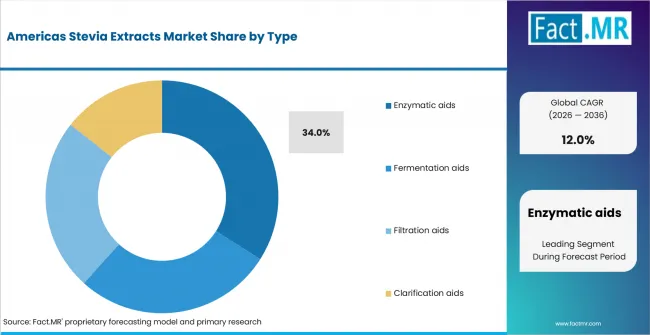
Americas Stevia Extracts Market Analysis By Type | Source: Fact.MR
Rebaudioside A extracts lead because RA is familiar to beverage and packaged-food formulation teams. It is easier to approve than newer glycosides when brands need a known stevia profile. Reb M and Reb D are gaining use where a cleaner finish is needed, but their cost and sourcing route require more evaluation. Cargill stated in September 2025 that EverSweet stevia is approved in multiple markets and is used by major food and beverage brands.
What leads the Source segment?
Leaf-derived extracts are projected to account for 42.0% share in 2026.
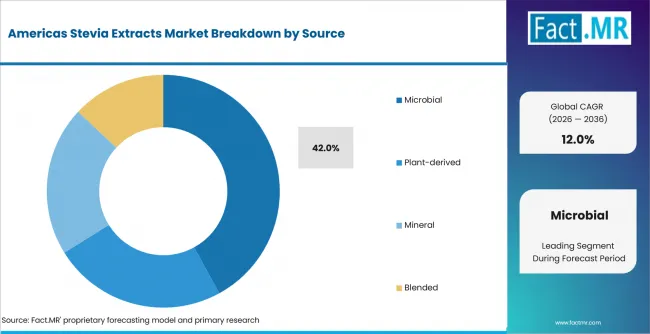
Americas Stevia Extracts Market Analysis By Source | Source: Fact.MR
Leaf-derived extracts lead because stevia still carries a plant-source expectation in consumer-facing foods. Formulators also need a clear audit trail from crop to ingredient when products use natural or botanical claims. Bioconverted glycosides are becoming more relevant for Reb M access, especially where taste needs outweigh a purely leaf-extracted story. PureCircle by Ingredion reported in April 2025 that 100% of its stevia supply chain reached Farm Sustainability Assessment Silver performance level.
How does Function shape demand?
Sugar reduction is anticipated to represent 36.0% share in 2026.
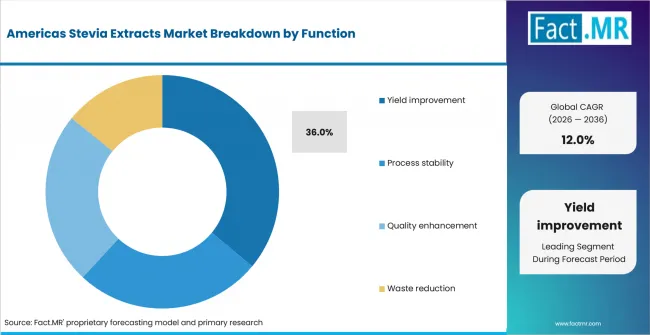
Americas Stevia Extracts Market Analysis By Function | Source: Fact.MR
Sugar reduction leads because stevia’s commercial value comes from replacing sweetness without adding calories. The FDA’s January 2026 Human Foods Program priorities include an added-sugar reduction strategy for processed and prepared foods. Mexico’s October 2025 beverage agreement established a lower tax level for beverages containing added sweeteners than for sugar-containing beverages. This differentiated treatment may support continued interest in stevia among beverage developers pursuing lower-sugar and sugar-free formulations.
What supports Food processing within Application?
Food processing is estimated to capture 39.0% share in 2026.
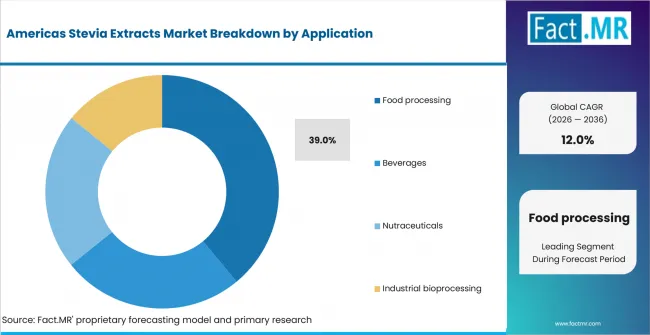
Americas Stevia Extracts Market Analysis By Application | Source: Fact.MR
Food processing leads because stevia extracts are used across beverages, dairy products, bakery mixes and tabletop sweeteners. Product developers must replace both sweetness and some sensory roles of sugar, so single-ingredient substitution often needs texture or flavor support. Statistics Canada reported that food manufacturing sales in current dollars were 1.8% higher in 2025; constant-dollar food manufacturing sales declined 3.0%.
Which countries are scaling the Americas Stevia Extracts Market through 2036?
- The country comparison spans 2.4 percentage points and shows a narrow Americas growth band across the forecast period.
- The USA remains 0.6 percentage point above Brazil as sugar-price pressure and federal nutrition priorities support stevia trials.
- Brazil remains 0.4 percentage point above Mexico due to food manufacturing scale and active label review.
- Canada remains 0.5 percentage point above Argentina since front-of-package nutrition symbols reshape packaged-food labels.
- Argentina remains 0.5 percentage point above Colombia while retail food channels support tabletop and packaged-food sweetening.
Colombia closes the displayed range as manufacturing recovery supports local ingredient testing. Comparable CAGRs create different entry conditions due to sugar policy, beverage habits, food-processing scale and labeling rules. Full report coverage includes North America and Latin America.
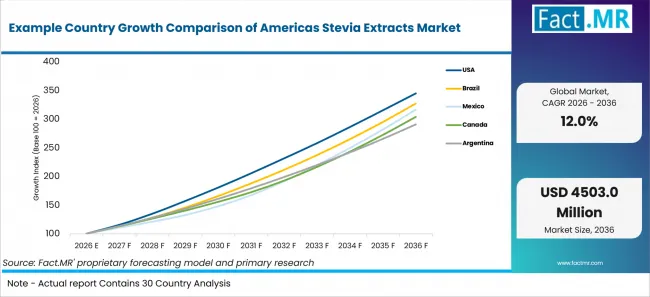
Example Country Growth Comparison Of Americas Stevia Extracts Market | Source: Fact.MR
| Country | CAGR |
|---|---|
| USA | 13.2% |
| Brazil | 12.6% |
| Mexico | 12.2% |
| Canada | 11.8% |
| Argentina | 11.3% |
| Colombia | 10.8% |
What supports USA adoption?
13.2% CAGR through 2036, supported by sugar-price pressure and federal nutrition priorities.
U.S. beverage and tabletop sweetener brands are expected to keep testing stevia extracts as sugar reduction becomes a cost and label issue. The USA is forecast to post 13.2% CAGR through 2036 after BLS reported in August 2026 that sugar and sweets prices were 7.4% higher year over year. FDA’s 2026 Human Foods Program includes an added-sugar reduction strategy and assessment of low- or no-calorie and non-nutritive alternative sweeteners.
How is Brazil scaling demand?
12.6% CAGR through 2036, shaped by food manufacturing scale and label review.
Brazilian food processors are using sugar-reduction work to refresh beverages and packaged foods. The country is projected to record 12.6% CAGR through 2036 after IBGE reported in November 2025 that food products rose 7.1% year over year. Anvisa’s August 2025 sector dialogue addressed proposed revisions to general, nutrition and allergen labelling rules.
How is Mexico scaling stevia extract demand?
12.2% CAGR through 2036, driven by soda-tax pressure and beverage reformulation.
Mexico’s beverage industry is a practical setting for reduced-sugar formulation. Mexico is anticipated to advance at 12.2% CAGR through 2036 after Mexico’s Health Ministry reported in August 2025 that average soda consumption was 166 liters per person per year. The final 2026 IEPS structure applies a lower per-liter rate to flavored beverages with added sweeteners than to those with added sugars.
What supports Canada’s outlook?
11.8% CAGR through 2036, backed by packaged-food labeling and processing depth.
Canada’s packaged-food processors face a clearer label timetable for high-sugar products. Canada is estimated to hold 11.8% CAGR through 2036 after Statistics Canada reported in February 2026 that food, beverage and tobacco wholesale sales rose 6.1% to CAD 187.8 billion in 2025. CFIA’s transition period for front-of-package nutrition labelling ended on December 31, 2025, with the new requirements applying from January 1, 2026 to products imported, manufactured in Canada, or packaged at retail on or after that date.
What underpins Argentina’s growth?
11.3% CAGR through 2036, led by retail food channels and agroindustrial export depth.
Argentina’s sweetener market is shaped by household retail demand and food-chain scale. INDEC reported that January 2026 supermarket sales totaled ARS 2,339,233.3 million at current prices, up 25.1% year over year. Separately, Argentina’s Secretariat of Agriculture reported 74.3 million tonnes of agroindustrial exports in January-July 2026, up 13% year over year.
How does Colombia perform?
10.8% CAGR through 2036, supported by manufacturing recovery and ingredient access.
Colombian beverage and dairy brands are expected to use stevia extracts where sugar reduction fits modern retail labels. Colombia is forecast to record 10.8% CAGR through 2036 after DANE reported in August 2026 that real manufacturing production increased 4.1% year over year in June 2026. DANE also reported in February 2026 that Colombia’s GDP grew 2.6% in 2025, indicating broader expansion in the domestic economy.
Who leads the Americas Stevia Extracts Market?
Ingredion, Tate & Lyle and Cargill lead direct stevia extract coverage, while GLG Life Tech and SweeGen strengthen specialty glycoside supply.
Ingredion participates through PureCircle by Ingredion, which covers stevia sweeteners, flavor modifiers and high-purity Reb M systems. Tate & Lyle and Manus expanded their stevia portfolio in February 2026 with the launch of Yume™ M Stevia Sweetener under The Sweetener Alliance. Cargill competes through EverSweet® and sugar-reduction solutions serving beverage, dairy and confectionery applications.
GLG Life Tech remains active through high-purity stevia extracts and vertically integrated capabilities spanning cultivation, processing and finished-product production. SweeGen competes with Signature Stevia solutions that include Reb M, Reb E and Reb D. Competition is likely to center on taste quality, ingredient traceability, formulation support and the ability to serve product developers across North and Latin America.
Which companies are the key providers?
Key companies include Ingredion Incorporated; Tate & Lyle PLC; Cargill, Incorporated; GLG Life Tech Corporation; and SweeGen, Inc.
- Ingredion Incorporated
- Tate & Lyle PLC
- Cargill, Incorporated
- GLG Life Tech Corporation
- SweeGen, Inc.
Bibliography
- Agência Nacional de Vigilância Sanitária. (2025, August 14). Rotulagem de alimentos: Anvisa disponibiliza gravação do diálogo setorial sobre revisão de normas.
- Brazilian Institute of Geography and Statistics. (2025, November 4). Industrial production changes -0.4% in September. IBGE News Agency.
- Canadian Food Inspection Agency. (2025, November 17). Notice to industry – Compliance and enforcement approach for front-of-package nutrition labelling effective January 1, 2026.
- Cargill, Incorporated. (2025, September 26). Cargill’s EverSweet® stevia sweetener named a finalist in the 2025 Global Good Awards Game Changing Innovation of the Year.
- Departamento Administrativo Nacional de Estadística. (2026, February 16). Producto Interno Bruto (PIB) nacional trimestral [Información cuarto trimestre 2025].
- Departamento Administrativo Nacional de Estadística. (2026, August 14). Encuesta Mensual Manufacturera con Enfoque Territorial (EMMET) [Información junio 2026].
- GLG Life Tech Corporation. (2026, May 22). GLG Life Tech Corporation reports 2026 first quarter financial results.
- Ingredion Incorporated. (2025, April 29). PureCircle by Ingredion first to achieve Farm Sustainability Assessment Silver performance level for 100% of stevia supply.
- Instituto Nacional de Estadística y Censos. (2026, March 20). Encuesta de supermercados: Enero de 2026.
- Procuraduría Federal del Consumidor. (2025, April 25). Estudio de la Profeco advierte sobre bebidas dirigidas a niñas y niños que contienen edulcorantes.
- Secretaría de Agricultura, Ganadería y Pesca. (2026, August 24). Récord de exportaciones agroindustriales: 74 millones de toneladas en siete meses.
- Secretaría de Salud. (2025, August 19). 154. Secretaría de Salud alerta sobre efectos a la salud de la población mexicana por consumo excesivo de refrescos.
- Secretaría de Salud. (2025, October 16). Salud: Se alcanza acuerdo integral para establecer IEPS a bebidas calóricas y endulzadas, en acuerdo con el Congreso y el sector productivo.
- Secretaría de Hacienda y Crédito Público. (2025, December 22). Acuerdo por el que se actualizan las cuotas que se especifican en materia del impuesto especial sobre producción y servicios para 2026.
- Statistics Canada. (2026, February 16). Monthly Survey of Manufacturing, December 2025. The Daily.
- Statistics Canada. (2026, February 17). Wholesale trade, December 2025. The Daily.
- Tate & Lyle PLC. (2026, February 23). Introducing Yume™: A new standard for sweetness.
- U.S. Bureau of Labor Statistics. (2026, August 12). Consumer Price Index—July 2026.
- U.S. Food and Drug Administration. (2026, January 23). FDA releases 2026 deliverables for Human Foods Program.
This Report Answers
- The report explains where stevia extracts are used across Type, Source, Function and Application.
- Segment analysis identifies leading subsegments and reasons formulators prioritize them.
- Country analysis examines the USA, Brazil, Mexico, Canada, Argentina and Colombia.
- Competitive analysis reviews Ingredion, Tate & Lyle, Cargill, GLG Life Tech and SweeGen.
- Application analysis assesses how sugar reduction, taste quality and labels influence purchase decisions.
What does the Americas Stevia Extracts Market cover?
The Americas Stevia Extracts Market covers purified steviol glycosides and commercial stevia extract systems used to sweeten foods and beverages. It includes leaf-derived extracts, bioconverted glycosides and fermentation-derived glycosides when sold into sugar-reduction applications.
The assessment differs from broader sweetener coverage because it centers on stevia-derived systems used by brands and food processors. It treats bulk nutritive sweeteners, crop-only stevia leaf sales and artificial sweeteners as adjacent categories.
What is included in the scope?
The scope includes Rebaudioside A, Reb M, Reb D, total steviol glycosides and blended stevia extracts used by food processors, beverage companies and tabletop sweetener brands.
The assessment aligns stevia extract systems with coverage of steviol glycosides and next generation stevia. Broader sugar-reduction applications are framed through natural sweetener blends where stevia is central to the finished formula.
What is excluded from the scope?
The scope excludes cane sugar, beet sugar and corn sweeteners sold outside stevia extract content.
Artificial sweetener coverage is used only for boundary comparison. Sugar alcohol systems are treated as formulation companions because they provide bulk and mouthfeel in reduced-sugar recipes, while coverage of sugar reduction taste optimization frames adjacent taste-modulation systems.
How Was the Analysis Built?
The analysis draws on 120+ sources, 30+ company portfolios, 20+ countries, and more than 20 industry interviews.
- Primary Research: Primary research includes discussions with ingredient suppliers, beverage formulators, food processors, distributors and regulatory specialists. These conversations examine taste approval and purchasing triggers.
- Desk Research: Desk research covers government statistics, nutrition-label rules, food safety publications, company pages and policy updates. The bibliography below lists the public third-party sources cited directly in this document; additional internal research inputs are not presented as externally verified evidence unless specifically cited.
- Market Sizing and Forecasting: Market estimates combine historical values, sugar-reduction indicators, segment shares, country CAGRs, food-processing activity, beverage policy pressure and provider portfolio mapping.
- Data Validation and Update Cycle: Findings are validated by comparing company claims with official statistics, country rules and product portfolio evidence. Updates review launches, labels and sourcing claims.
What is the report’s scope and coverage?
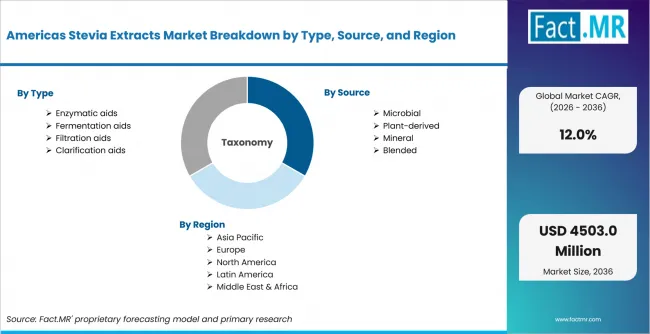
Americas Stevia Extracts Market Breakdown By Type, Source, And Region | Source: Fact.MR
| Attribute | Details |
|---|---|
| Quantitative Units | USD million |
| Market Definition | Stevia extracts used as high-intensity sweeteners in food, beverages, tabletop products, nutraceuticals and related consumer applications. |
| Type | Rebaudioside A; Reb M and Reb D; Total steviol glycosides; Blended extracts |
| Source | Leaf-derived extracts; Bioconverted glycosides; Fermentation-derived glycosides; Blended sources |
| Function | Sugar reduction; Taste modulation; Calorie reduction; Tabletop sweetening |
| Application | Food processing; Beverages; Nutraceuticals; Tabletop sweeteners; Personal care |
| Regions Covered | North America; Latin America |
| Countries Covered | USA; Brazil; Mexico; Canada; Argentina; Colombia |
| Key Companies Profiled | Ingredion Incorporated; Tate & Lyle PLC; Cargill, Incorporated; GLG Life Tech Corporation; SweeGen, Inc. |
| Forecast Period | 2026 to 2036 |
| Approach | Hybrid top-down and bottom-up approach using food-processing indicators, beverage reformulation pressure, country-level labeling rules, segment shares and provider portfolio review. |
How is the market segmented?
-
By Type:
- Rebaudioside A
- Reb M and Reb D
- Total steviol glycosides
- Blended extracts
-
By Source:
- Leaf-derived extracts
- Bioconverted glycosides
- Fermentation-derived glycosides
- Blended sources
-
By Function:
- Sugar reduction
- Taste modulation
- Calorie reduction
- Tabletop sweetening
-
By Application:
- Food processing
- Beverages
- Nutraceuticals
- Tabletop sweeteners
- Personal care
-
By Region:
- North America
- Latin America
- Western Europe
- Eastern Europe
- East Asia
- South Asia and Pacific
- Middle East & Africa