- Market Value (2025): USD 10.0 Bn
- Estimated Value (2026): USD 10.6 Bn
- Forecast Value (2036): USD 19.2 Bn
- CAGR (2026-2036): 6.1%
What is the Dried Fruit Extracts Market forecast to be worth by 2036?
USD 10.6 billion in 2026 to USD 19.2 billion by 2036 at 6.1% CAGR.
- The dried fruit extracts market crossed a valuation of USD 10.0 billion in 2025 as brands kept reformulating snacks and beverages around fruit-derived inputs.
- Demand is projected to increase from USD 10.6 billion in 2026 to USD 19.2 billion by 2036.
- The market is forecast to record a 6.1% CAGR from 2026 to 2036 as food manufacturers and cosmetic formulators require stable fruit notes with traceable sourcing.
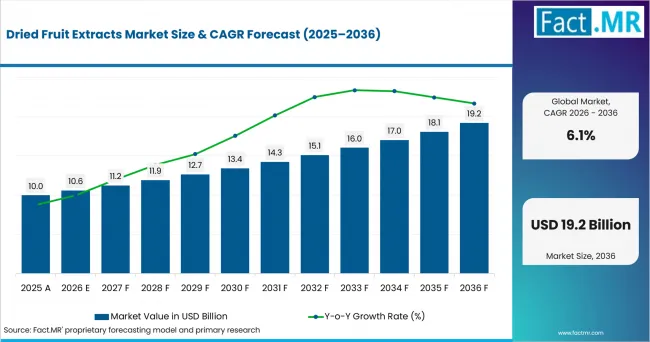
Dried Fruit Extracts Market Value Analysis | Source: Fact.MR
What are the defining numbers behind Dried Fruit Extracts Market growth?
USD 8.6 billion absolute opportunity by 2036, led by Conventional Dried Fruit Extracts and Powder Dried Fruit Extracts alongside Food applications.
- Demand Drivers in the Market
- Food manufacturers need fruit-derived flavor systems that support clean labels and stable fruit taste.
- Beverage formulators use dried fruit extracts where low-water inputs protect instant mixes.
- Nutraceutical brands need repeatable botanical inputs for capsules, powders and gummies.
- Cosmetic teams specify fruit-based inputs for natural-positioned fragrance and ingredient stories.
- Key Segments Analyzed
- By Product: Conventional Dried Fruit Extracts are expected to hold 55.3% share in 2026 due to lower cost.
- By Form: Powder Dried Fruit Extracts are projected to account for 58.7% share in 2026 owing to storage stability.
- By End User: Food is anticipated to capture 33.9% share in 2026 since fruit notes support many recipes.
- By Distribution Channel: Direct Sales are estimated to represent 41.3% share in 2026 where technical files shape orders.
- Analyst Opinion at Fact.MR
- Shambhu Nath Jha, Principal Consultant at Fact.MR, states, “Dried fruit extract buying is shaped by proof of origin and batch behavior. Suppliers are expected to win approvals when flavor performance connects with residue and solubility data.”
- Strategic Implications
- Ingredient makers should keep fruit-origin files ready before sampling.
- Product developers should test solubility before final formula approval.
- Distributors should offer smaller packs for specialty brands.
- Investors should separate whole dried fruit exposure from extract capability.
South Korea is forecast to post 5.7% CAGR through 2036 driven by food exports and beauty-oriented ingredient use. USA is projected to record 5.6% CAGR with fruit supply and online ingredient access. UK is expected to advance at 4.9% CAGR supported by food manufacturing and import flows. Germany is anticipated to reach 4.8% CAGR owing to fruit processing and organic sourcing. France is estimated to record 4.7% CAGR linked to beverages and organic products. Italy is forecast to post 4.5% CAGR with agri-food scale and bakery use. Japan is projected to reach 4.4% CAGR shaped by processed-food exports and strict import review.
How does the Dried Fruit Extracts Market break down by segment?
Conventional Dried Fruit Extracts lead at 55.3%; Powder Dried Fruit Extracts lead at 58.7%.
Which product dominates?
Conventional Dried Fruit Extracts are projected to account for 55.3% share in 2026.
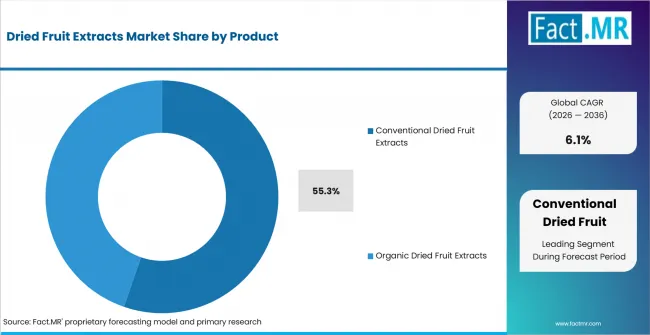
Dried Fruit Extracts Market Analysis By Product | Source: Fact.MR
Conventional dried fruit extracts are expected to lead because most food and beverage brands still value reliable cost, stable supply and flexible flavor use. Berry extracts remain relevant where color and antioxidant positioning are needed. Citrus fruit extracts serve drinks and confectionery because acidity and aroma are easy to recognize. Organic dried fruit extracts are projected to grow where certification is a purchase condition. Adjacent demand in the dried fruit category supports supplier access to fruit streams that can be processed into extract systems.
What leads the Form segment?
Powder Dried Fruit Extracts are expected to hold 58.7% share in 2026.
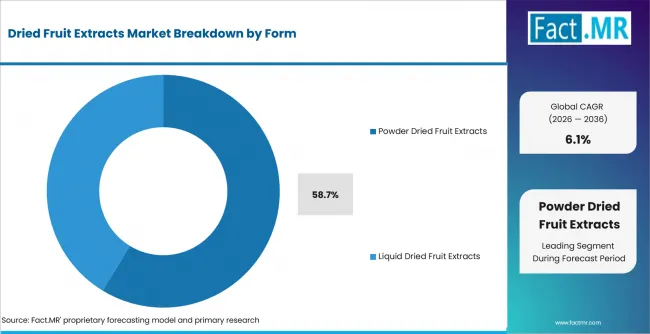
Dried Fruit Extracts Market Analysis By Form | Source: Fact.MR
Powder dried fruit extracts are projected to lead due to shelf stability, easier shipping and compatibility with dry mixes. Spray-dried extracts are widely used when manufacturers need free-flowing ingredients. Freeze-dried extracts serve premium formulas where flavor protection is more valuable than lower cost. Liquid extracts remain useful in beverage bases and cosmetic preparations. The wider fruit and vegetable powder field shows why low-moisture formats fit retail, foodservice and branded formulations.
How does End User shape demand?
Food is anticipated to lead with 33.9% share in 2026.
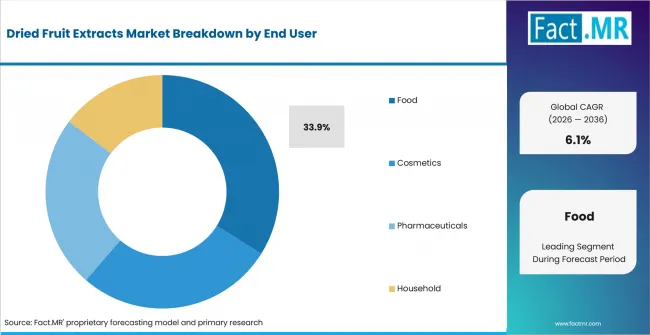
Dried Fruit Extracts Market Analysis By End User | Source: Fact.MR
Food applications are anticipated to lead because bakery, confectionery and snacks need fruit notes that survive processing. Beverage applications follow where concentrates and instant drinks need fruit identity without handling bulky pulp. Cosmetics use berry and citrus extracts for fragrance and label stories. Pharmaceutical and dietary supplement users require tighter documentation around residues and active compounds. Natural food color applications remain adjacent because fruit-based pigments often overlap with flavor and extract sourcing.
What supports Direct Sales within Distribution Channel?
Direct Sales are estimated to represent 41.3% share in 2026.
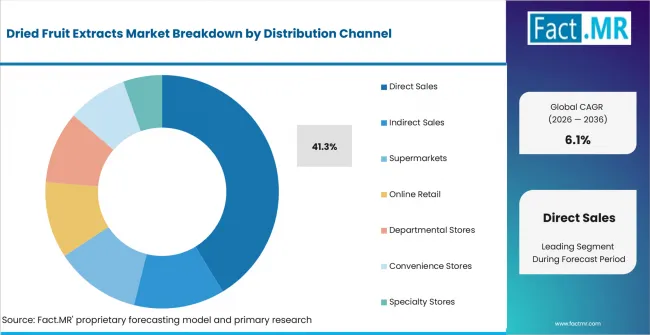
Dried Fruit Extracts Market Analysis By Distribution Channel | Source: Fact.MR
Direct sales are estimated to lead where large brands need technical files, trial batches and recurring supply agreements. Distributors serve smaller brands that need flexible ordering and help with documentation. Supermarkets and departmental stores remain indirect paths for consumer-facing specialty extracts. Online retail helps small formulators compare ingredients and request samples. Fruit concentrate puree demand provides a useful adjacent channel signal because beverage and dairy brands often evaluate fruit systems across several formats.
What is accelerating Dried Fruit Extracts Market adoption, and what is holding it back?
Clean-label formulation drives it; fruit-cost and specification risk restrain it.
Drivers Impact Analysis
| Driver | (~) % Impact on CAGR | Geographic Relevance | Impact Timeline |
|---|---|---|---|
| Clean-label reformulation | +1.7% | USA, UK, Germany | Short term (<= 2 years) |
| Powder-format stability | +1.3% | Global | Short term (<= 2 years) |
| Cosmetic botanical positioning | +1.0% | South Korea, France, Japan | Medium term (2-4 years) |
| Direct B2B documentation | +0.8% | USA, Europe | Medium term (2-4 years) |
| Organic ingredient sourcing | +0.6% | Germany, France, Italy | Long term (>= 4 years) |
Source: Fact.MR analysis. Updated Aug 18, 2026
- Clean-label food reformulation: MFDS reported in May 2026 that South Korea’s food industry production reached KRW 119.7 trillion in 2025. That scale supports fruit-derived inputs.
- Cosmetic botanical positioning: MFDS reported in May 2026 that South Korea’s cosmetics trade surplus reached USD 10.1 billion in 2025. Export brands need cleaner ingredient files.
- Organic ingredient sourcing: Agence BIO reported in 2026 that France’s organic market grew 3.6% in 2025. Certification supports premium fruit extract positioning.
Opportunity Impact Analysis
| Opportunity | (~) % Impact on CAGR | Geographic Relevance | Impact Timeline |
|---|---|---|---|
| Spray-dried fruit systems | +1.1% | USA, Europe | Short term (<= 2 years) |
| Citrus and berry blends | +0.9% | UK, France, Japan | Medium term (2-4 years) |
| Organic freeze-dried inputs | +0.8% | Germany, France, Italy | Medium term (2-4 years) |
| Online sample ordering | +0.6% | USA, UK | Long term (>= 4 years) |
Source: Fact.MR analysis. Updated Aug 18, 2026
- Spray-dried fruit systems: USDA NASS forecast U.S. grape production at 5,590,000 tons in August 2025. Fruit availability supports extract feedstock.
- Citrus and berry blends: Citrus extract and berry extract blends are anticipated to suit applications that need aroma, acidity and color. The adjacent citrus extract category shows how fruit identity can move across food, beverage and personal care formulas. Suppliers need to balance flavor strength with residue files.
- Organic freeze-dried inputs: Premium organic fruit systems require certification, segregation and low-moisture processing controls. Suppliers are expected to gain where powder performance and sourcing documentation can be demonstrated together.
- Online sample ordering: The U.S. Census Bureau reported in May 2026 that Q1 2026 retail e-commerce sales reached USD 326.7 billion. Digital access supports ingredient discovery.
Restraints Impact Analysis
| Restraint | (~) % Impact on CAGR | Geographic Relevance | Impact Timeline |
|---|---|---|---|
| Fruit price volatility | -1.0% | Europe, USA | Short term (<= 2 years) |
| Color and taste drift | -0.8% | Global | Short term (<= 2 years) |
| Residue documentation | -0.6% | USA, Japan, South Korea | Medium term (2-4 years) |
| Premium organic cost | -0.5% | Europe, Japan | Long term (>= 4 years) |
Source: Fact.MR analysis. Updated Aug 18, 2026
- Fruit price volatility: Destatis reported in June 2025 that German fruit prices rose 7.4% year over year in May 2025. Higher input costs can delay premium use.
- Color and taste drift: Natural fruit extracts are projected to face batch-matching work when crop origin and drying method change color.
- Residue documentation: Japan’s Ministry of Health, Labour and Welfare issued its FY 2026 Imported Foods Monitoring Plan in March 2026 to guide safety monitoring of imported foods. Import compliance can affect supplier switching.
- Premium organic cost: BMEL-Statistik reported that fully organic German farms harvested 173,760 tonnes of apples in 2025. Certification and segregation still raise cost.
Which countries are scaling Dried Fruit Extracts Market fastest?
- The country comparison spans 1.3 percentage points and forms three practical growth bands across the forecast period.
- South Korea remains 0.1 percentage point above the USA through food exports, cosmetics demand and beauty-oriented fruit ingredient use.
- The USA remains 0.7 percentage point above the UK as domestic fruit supply and online ingredient access support broader formulation activity.
- The UK remains 0.1 percentage point above Germany through food manufacturing scale and imported ingredient flows.
- Germany remains 0.1 percentage point above France as fruit processing depth and organic ingredient sourcing support extract demand.
- France remains 0.2 percentage point above Italy through beverage production and organic product demand.
- Italy remains 0.1 percentage point above Japan as agri-food scale and bakery applications support fruit-extract use.
- Japan closes the displayed range through processed-food exports, functional-food applications and strict import-documentation requirements.
Comparable CAGRs can create different entry conditions because fruit supply, food-processing scale, organic sourcing requirements and import-compliance standards vary by country. Full report coverage includes North America, Latin America, Europe, East Asia, South Asia and Pacific, Middle East and Africa.
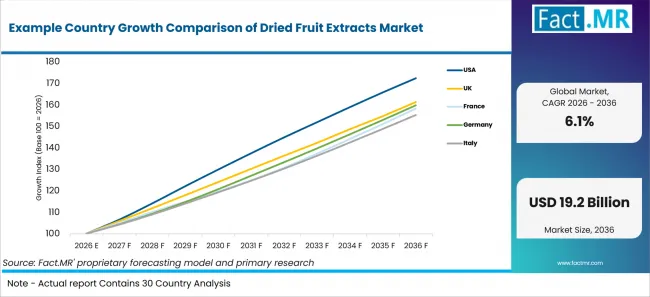
Example Country Growth Comparison Of Dried Fruit Extracts Market | Source: Fact.MR
| Country | CAGR |
|---|---|
| South Korea | 5.7% |
| USA | 5.6% |
| UK | 4.9% |
| Germany | 4.8% |
| France | 4.7% |
| Italy | 4.5% |
| Japan | 4.4% |
Source: Fact.MR analysis. Updated Aug 18, 2026
How is South Korea scaling demand?
5.7% CAGR, driven by food exports and beauty-oriented ingredient use.
South Korea’s growth reflects strong food exports and beauty-oriented ingredient demand. MAFRA reported USD 13.62 billion in K-Food Plus exports in 2025, while MFDS reported about 870,000 food-import cases valued at USD 36.6 billion. Origin documentation, imported-input compliance and premium pricing may restrain wider adoption.
What supports USA adoption?
5.6% CAGR, supported by fruit supply and online ingredient access.
USA growth is supported by domestic fruit availability and strong retail activity. USDA NASS forecast California grape production at 4.98 million tons in August 2025, while the U.S. Census Bureau’s revised estimate placed retail and food services sales at USD 768.1 billion in June 2026. Inspection readiness, natural color variation and premium pricing may limit adoption.
How is the UK developing demand?
4.9% CAGR, shaped by food manufacturing and imported ingredient flows.
UK growth reflects a sizeable food-manufacturing base and strong imported ingredient flows. ONS reported food manufacturing represented 22.9% of manufacturers’ sales in 2025, while Defra recorded GBP 67.8 billion in food, feed and drink imports. Currency exposure, freight changes and premium organic costs may restrain demand.
What underpins Germany’s growth?
4.8% CAGR, supported by fruit processing and organic ingredient demand.
Germany’s growth is supported by fruit processing and a large organic agricultural base. Destatis reported a 1,138,000-tonne apple harvest in 2025 and 1,862,800 hectares of organic arable land and grassland. Higher fruit prices, certification requirements and volatile drying costs may constrain supplier margins.
What supports France adoption?
4.7% CAGR, driven by beverage production and organic product demand.
France’s growth reflects strong beverage manufacturing and expanding organic demand. INSEE reported EUR 25.536 billion in beverage manufacturing production in 2024, while Agence BIO recorded 3.6% organic market growth in 2025. Fresh-food inflation, natural color variation and limited price tolerance may restrict premium extract adoption.
How is Italy building demand?
4.5% CAGR, supported by agri-food scale and bakery applications.
Italy’s growth is supported by a large agri-food economy and broad bakery applications. Istat reported EUR 89 billion in agri-food value added and EUR 37.5 billion in crop production value in 2025. Falling fruit output, regional crop variation and price resistance may constrain premium extract use.
How does Japan perform?
4.4% CAGR through 2036, backed by processed-food exports and strict import controls.
Japan’s growth is supported by processed-food exports and demand for well-documented ingredients. MAFF reported that Japan’s exports of agricultural, forestry and fishery products and food reached JPY 1.7005 trillion in 2025. Functional-food brands support powder extracts, while strict import monitoring, domestic fruit costs and liquid-format handling limits may moderate broader adoption.
Who leads the Dried Fruit Extracts Market?
ADM, Döhler and Kanegrade fit where fruit extract supply connects with natural flavors, fruit powders and beverage systems. Döhler adds direct relevance through its March 2025 acquisition of Premier Juices, which expanded its natural fruit-based portfolio.
Symrise / diana food™ and Van Drunen Farms / FutureCeuticals strengthen the dried fruit ingredient base. Competition is expected to depend on specification control, residue documentation and application support.
Symrise / diana food™ and Van Drunen Farms / FutureCeuticals strengthen the dried fruit ingredient base through processing depth. Monk Fruit Corp., Iprona, Givaudan and Plant Lipids expand the provider set for fruit-derived inputs, botanical sourcing and distribution. Competition is expected to depend on specification control, residue documentation and application support across food, cosmetic and supplement accounts.
Which companies are the key providers?
ADM and Döhler are key providers. Kanegrade and Van Drunen Farms / FutureCeuticals are also profiled. Symrise / diana food™, Givaudan and Plant Lipids complete the core set.
- Archer Daniels Midland (ADM)
- Döhler
- Kanegrade
- Symrise / diana food™
- Van Drunen Farms / FutureCeuticals
- Monk Fruit Corp.
- Iprona
- Givaudan
- Plant Lipids
- Jedwards International
Bibliography
- Döhler. (2025, March 28). Döhler North America expands fruit solutions portfolio with Premier Juices acquisition.
- Federal Statistical Office (Destatis). (2025, December 19). Apfelernte 2025: Mit 1 138 000 Tonnen zweithöchste Ernte der letzten zehn Jahre [Apple harvest 2025: At 1,138,000 tonnes, second-highest harvest of the last ten years].
- Institut national de la statistique et des études économiques. (2026, July 10). In June 2026, consumer prices rose by 1.8% year on year.
- Institut national de la statistique et des études économiques. (2026, July 21). Indicateurs macroéconomiques de l’industrie agroalimentaire : Données annuelles de 2010 à 2024 [Macroeconomic indicators for the agri-food industry: Annual data from 2010 to 2024].
- Istat. (2026, June 12). Economic accounts for agriculture – Year 2025.
- Ministry of Health, Labour and Welfare. (2026, March 31). Imported Foods Monitoring Plan for FY 2026.
- Ministry of Economy, Trade and Industry. (2026, June 30). Current Survey of Production.
- Office for National Statistics. (2026, July 24). UK manufacturers’ sales by product: 2025.
- Department for Environment, Food & Rural Affairs. (2026, July 29). Food statistics in your pocket.
- Department for Environment, Food & Rural Affairs. (2026, April 30). UK trade in Food, Feed and Drink, 2025 provisional.
- U.S. Census Bureau. (2026, May 18). Quarterly retail e-commerce sales, 1st quarter 2026.
- U.S. Department of Agriculture, National Agricultural Statistics Service. (2025, August 12). Crop Production.
This Report Answers
- The report provides strategic intelligence on Product and Form choices that shape ingredient approval.
- Segment analysis covers Conventional Dried Fruit Extracts and Powder Dried Fruit Extracts as 2026 share leaders.
- Country outlook evaluates South Korea, the USA, the UK, Germany, France, Italy and Japan.
- Competitive analysis profiles ADM and Döhler alongside Kanegrade, Symrise / diana food™ and Van Drunen Farms / FutureCeuticals.
- Application assessment covers Food, Beverages and Cosmetics alongside Pharmaceuticals and Household use.
What does the Dried Fruit Extracts Market cover?
Fruit-derived powder and liquid extract ingredients used where flavor, color, solubility and documentation shape purchase approval.
The Dried Fruit Extracts Market covers extracts made from dehydrated fruits for food, beverages, cosmetics, pharmaceuticals and household products. Coverage extends to berry, citrus, tropical and grape extracts. The scope includes conventional and organic extracts across powder and liquid forms. Adjacent citrus peel extract and organic food color references are included only when fruit-derived inputs compete for the same formulation brief.
What is included in the scope?
Products, forms, end users, distribution channels and regions directly linked to dried fruit extract supply.
The scope includes conventional and organic dried fruit extracts. Powder, spray-dried, freeze-dried, concentrated and water-soluble formats are included when dehydrated fruit inputs are converted into extract systems.
What is excluded from the scope?
Fresh fruit, whole dried fruit and unrelated synthetic flavors remain outside the scope.
The scope excludes fresh fruit, whole dried fruit sold without extract processing and visible fruit preparations. Pure juice concentrates are excluded unless they are processed into extract or powder systems.
How Was the Analysis Built?
The analysis draws on 120+ sources, 35+ company portfolios, 25+ countries, and more than 20 industry interviews.
- Primary Research: Interviews cover ingredient makers, fruit processors, distributors, brands, formulators and procurement teams.
- Desk Research: Desk research covers official statistics, regulatory pages, company sites, trade data and associations.
- Market Sizing and Forecasting: Estimates combine historical values, segment shares, country growth and channel activity.
- Data Validation and Update Cycle: Findings are checked against public data, company activity and trade patterns.
Segmentation
What is the report’s scope and coverage?
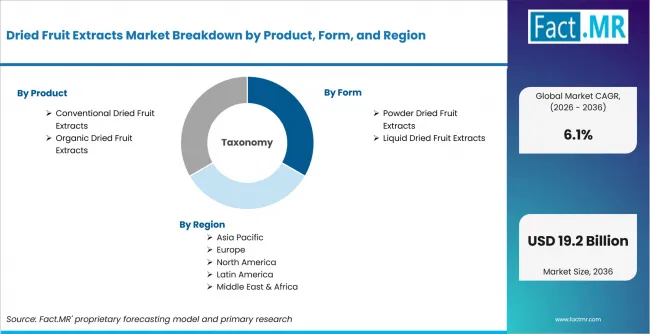
Dried Fruit Extracts Market Breakdown By Product, Form, And Region | Source: Fact.MR
| Attribute | Details |
|---|---|
| Quantitative Units | USD billion; CAGR |
| Market Definition | Powder and liquid ingredients made from dehydrated fruits for food, beverage, cosmetic and supplement use |
| Product | Conventional; Organic; Berry; Citrus; Tropical; Grape |
| Form | Powder; Spray dried; Freeze dried; Liquid; Concentrated; Water soluble |
| End User | Food; Beverages; Cosmetics; Pharmaceuticals; Household |
| Distribution Channel | Direct; Indirect; Supermarkets; Online retail; Specialty stores |
| Regions Covered | North America; Latin America; Europe; East Asia; South Asia and Pacific; Middle East and Africa |
| Countries Covered | USA; UK; France; Germany; Italy; South Korea; Japan |
| Key Companies Profiled | Archer Daniels Midland (ADM); Döhler; Kanegrade; Symrise / diana food™; Van Drunen Farms / FutureCeuticals; Monk Fruit Corp.; Iprona; Givaudan; Plant Lipids; and Jedwards International |
| Forecast Period | 2026 to 2036 |
| Approach | Hybrid sizing using fruit supply, food output, country adoption and company portfolio review |
Source: Fact.MR analysis. Updated Aug 18, 2026
How is the market segmented?
-
By Product:
- Conventional Dried Fruit Extracts
- Berry Extracts
- Citrus Fruit Extracts
- Tropical Fruit Extracts
- Grape Extracts
- Organic Dried Fruit Extracts
- Berry Extracts
- Citrus Fruit Extracts
- Tropical Fruit Extracts
- Grape Extracts
- Conventional Dried Fruit Extracts
-
By Form:
- Food
- Bakery And Confectionery
- Beverages
- Dairy Products
- Snacks
- Cosmetics
- Skin Care
- Hair Care
- Pharmaceuticals
- Dietary Supplements
- Functional Ingredients
- Household
- Household Cleaners
- Air Care Products
- Food
-
By End User:
- Direct Sales
- Business To Business Sales
- Indirect Sales
- Distributors
- Supermarkets
- Hypermarkets
- Traditional Supermarkets
- Online Retail
- E Commerce Platforms
- Brand Owned Websites
- Departmental Stores
- National Chains
- Convenience Stores
- Urban Convenience Stores
- Specialty Stores
- Health Food Stores
- Nutritional Stores
- Direct Sales
-
By Distribution Channel:
- Direct Sales
- Indirect Sales
- Supermarkets
- Online Retail
- Departmental Stores
- Convenience Stores
- Specialty Stores
- Direct Sales
-
By Region:
- North America
- Latin America
- Western Europe
- Eastern Europe
- East Asia
- South Asia and Pacific
- Middle East & Africa
Frequently Asked Questions
How big is the dried fruit extracts market in 2026?
What is the CAGR of the dried fruit extracts market from 2026 to 2036?
Which product leads the dried fruit extracts market?
Which form leads the dried fruit extracts market?
Who are the leading companies in the dried fruit extracts market?
Who worked on this report


Preview the report firsthand - request a free sample
Free SampleGet the brochure for pricing and purchase details
Download PDF