Animal Euthanasia Market

Animal Euthanasia Market Size and Share Forecast Outlook 2025 to 2035

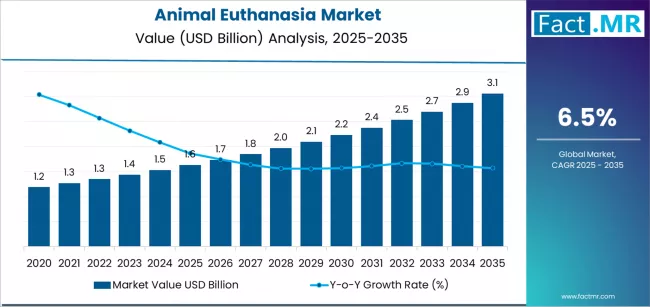
Animal euthanasia market is projected to grow from USD 1.6 billion in 2025 to USD 3.1 billion by 2035, at a CAGR of 6.5%. Pharmaceuticals will dominate with a 62.6% market share, while companion animals will lead the animal segment with a 64.0% share.

Animal Euthanasia Market Forecast and Outlook 2025 to 2035

The global animal euthanasia market is projected to reach USD 3.06 billion by 2035, recording an absolute increase of USD 1.43 billion over the forecast period. The market is valued at USD 1.63 billion in 2025 and is set to rise at a CAGR of 6.5% during the assessment period.

The overall market size is expected to grow by nearly 1.9 times during the same period, supported by increasing pet ownership rates and growing emphasis on humane animal welfare practices, driving demand for pharmaceutical euthanasia agents, companion animal services, and veterinary clinical applications across both developed and emerging markets. Additionally, expanding applications in animal shelters, research facilities, and livestock management programs create opportunities for product innovations and specialized service development.

Quick Stats for Animal Euthanasia Market

  • Animal Euthanasia Market Value (2025): USD 1.63 billion
  • Animal Euthanasia Market Forecast Value (2035): USD 3.06 billion
  • Animal Euthanasia Market Forecast CAGR: 6.5%
  • Leading Product in Animal Euthanasia Market: Pharmaceuticals
  • Key Growth Regions in Animal Euthanasia Market: North America, Europe, and Asia Pacific
  • Top Players in Animal Euthanasia Market: Zoetis Inc., Boehringer Ingelheim GmbH, Merck & Co. Inc., Elanco Animal Health, Vetoquinol SA, Dechra Pharmaceuticals PLC, Virbac, Hikma Pharmaceuticals PLC, Akorn Animal Health Inc., Piramal Critical Care Inc.

Animal Euthanasia Market Market Value Analysis

Rising disposable incomes in developed nations, coupled with expanding veterinary care accessibility across major metropolitan areas, accelerates market penetration across diverse animal populations. The growing emphasis on compassionate end-of-life care, particularly in companion animal ownership communities, generates demand for effective euthanasia solutions that provide painless procedures while maintaining dignity and minimizing distress for both animals and owners.

Clinical evidence demonstrating superior efficacy of barbiturate-based pharmaceuticals, reduced procedural complications, and improved emotional outcomes for pet owners reinforces veterinarian confidence in modern euthanasia protocols, while veterinary industry trends toward in-home euthanasia services expand addressable market opportunities beyond traditional clinic settings into personalized care environments. Veterinary hospitals and mobile veterinary services increasingly incorporate injectable pharmaceuticals, inhalant agents, and combination protocols into companion animal care, livestock management, and shelter operations, creating mainstream service channels that extend beyond emergency situations into planned end-of-life care programs.

However, regulatory complexity surrounding controlled substance management and veterinary licensing requirements may pose challenges to service expansion and product accessibility. Emotional barriers associated with euthanasia decisions and regional variations in animal welfare legislation also influence market development patterns, requiring service providers to develop culturally sensitive approaches catering to specific owner preferences across different geographical markets. Professional training requirements for proper administration techniques and the ethical considerations surrounding euthanasia protocols may limit service availability among smaller veterinary practices in developing regions with constrained access to specialized pharmaceutical agents and professional education programs.

Animal Euthanasia Market Year-over-Year Forecast 2025 to 2035

Between 2025 and 2030, the animal euthanasia market is projected to expand from USD 1.63 billion to USD 2.20 billion, resulting in a value increase of USD 0.57 billion, which represents 39.9% of the total forecast growth for the decade. This phase of development will be shaped by rising demand for humane companion animal care and expanding veterinary service accessibility, product innovation in pharmaceutical formulations and delivery systems, as well as growing integration with mobile veterinary services and at-home euthanasia programs. Companies are establishing competitive positions through investment in controlled substance management systems, veterinarian training programs, and strategic market expansion across companion animal clinics, shelter operations, and livestock management segments.

From 2030 to 2035, the market is forecast to grow from USD 2.20 billion to USD 3.06 billion, adding another USD 0.86 billion, which constitutes 60.1% of the overall ten-year expansion. This period is expected to be characterized by the expansion of specialized service models, including comprehensive end-of-life care packages and grief counseling integration tailored for pet owners, strategic collaborations between pharmaceutical manufacturers and veterinary service networks, and an enhanced focus on regulatory harmonization and professional standards development. The growing emphasis on animal welfare legislation and evidence-based euthanasia protocols will drive demand for validated pharmaceutical solutions across diverse veterinary applications.

Animal Euthanasia Market Key Takeaways

Metric Value
Market Value (2025) USD 1.63 billion
Market Forecast Value (2035) USD 3.06 billion
Forecast CAGR (2025-2035) 6.5%

Why is the Animal Euthanasia Market Experiencing Growth?

The animal euthanasia market grows by enabling veterinarians, animal shelters, and livestock managers to access humane end-of-life solutions that support ethical treatment standards while meeting stakeholder demand for compassionate animal care. Veterinary professionals face mounting pressure to provide peaceful euthanasia procedures with proven efficacy and minimal distress, with pharmaceutical agents typically inducing unconsciousness within 30-60 seconds followed by cardiac arrest, making these products essential for maintaining professional care standards in veterinary practice categories. The animal care industry's need for reliable protocols and regulatory compliance creates demand for approved pharmaceutical formulations that can provide consistent results, maintain safety for personnel, and ensure humane outcomes without compromising procedural integrity or professional liability standards.

Government initiatives promoting animal welfare and humane treatment drive adoption in veterinary clinics, animal shelters, and agricultural operations, where euthanasia protocol selection has a direct impact on animal welfare outcomes and public perception. The veterinary community's growing focus on end-of-life care quality and owner satisfaction further expands market opportunities, with clinical research demonstrating measurable improvements in procedural success rates, reduced complications, and enhanced owner acceptance. However, regulatory complexity during controlled substance procurement and the emotional challenges associated with euthanasia procedures may limit service expansion among general practitioners and developing regions with limited access to specialized pharmaceutical agents and professional support systems.

Segmental Analysis

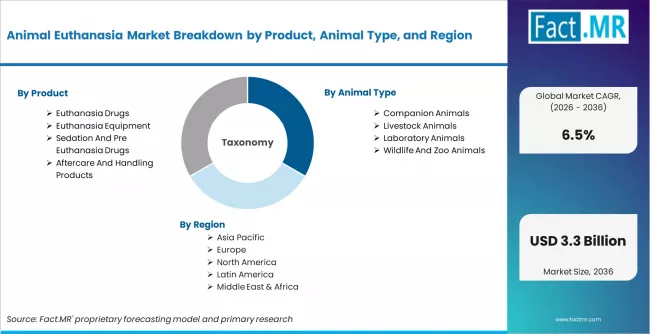
The market is segmented by product, animal, route of administration, end use, and region. By product, the market is divided into pharmaceuticals, inhalants, and others. Based on animal, the market is categorized into companion animals, livestock animals, and others. By route of administration, the market is segmented into injectable, inhalants, and others. By end use, the market is divided into veterinary hospitals & clinics, animal shelters & rescue centers, research labs & universities, and others. Regionally, the market is divided into North America, Europe, Asia Pacific, Latin America, and Middle East & Africa.

What Makes Pharmaceuticals the Dominant Product Segment in the Animal Euthanasia Market?

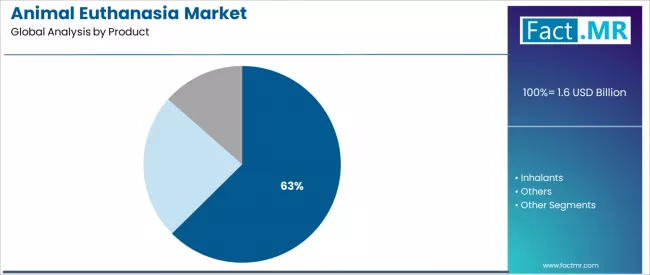
Animal Euthanasia Market Analysis By Product

The pharmaceuticals segment represents the dominant force in the animal euthanasia market, capturing approximately 62.6% of total market share in 2025 with revenues of USD 1.02 billion in 2025. This established product category encompasses barbiturate-based solutions featuring rapid-acting sedative properties, including pentobarbital sodium formulations and combination agents that enable peaceful euthanasia and consistent clinical outcomes across all animal types. The pharmaceuticals segment's market leadership stems from its superior efficacy profile, with products capable of meeting regulatory requirements while maintaining predictable pharmacological effects and operational reliability across all veterinary environments. Within the pharmaceuticals segment, injectable barbiturate formulations account for approximately 78.0% share, driven by rapid onset characteristics and established clinical protocols.

The inhalants segment maintains substantial market presence with approximately 20.2% share and revenues of USD 0.33 billion in 2025, serving veterinarians who require alternative euthanasia methods for specific species or situations where injectable administration presents challenges. These agents offer effective solutions for small animals and laboratory settings while providing sufficient efficacy capabilities to meet humane standards and procedural requirements. The others segment, including combination agents and non-barbiturate alternatives, accounts for approximately 17.2% of the market with revenues of USD 0.28 billion in 2025, serving specialized applications and emerging protocol innovations.

Key advantages driving the pharmaceuticals segment include:

  • Established clinical protocols with proven administration techniques that reduce procedural complexity and ensure consistent outcomes
  • Rapid efficacy characteristics allowing quick loss of consciousness and minimal animal distress across different species
  • Comprehensive regulatory approval, delivering licensed pharmaceutical products while maintaining veterinary practice compliance against alternative methods
  • Broad veterinarian acceptance enabling straightforward protocol implementation and professional liability protection across multiple practice settings

How Does the Companion Animals Segment Lead Animal Market Share?

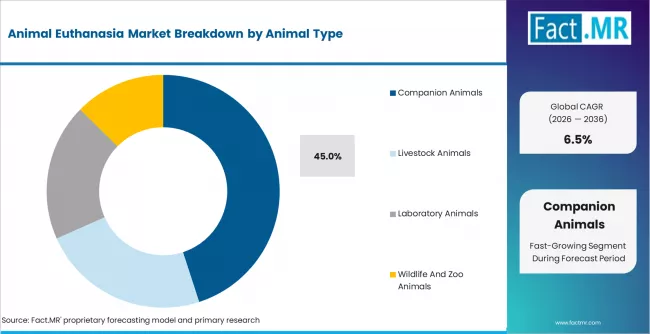
Animal Euthanasia Market Analysis By Animal

Companion animals dominates the animal segment with approximately 64.0% market share in 2025 with revenues of USD 1.05 billion in 2025, reflecting the extensive pet ownership base and emotional attachment driving demand for humane end-of-life care services worldwide. The companion animals segment's market leadership is reinforced by growing pet humanization trends, expanding veterinary service sophistication, and rising expenditure on quality veterinary care for dogs, cats, and other household pets across developed and emerging pet ownership markets. Within the companion animals segment, dogs and cats account for approximately 88.0% share, driven by population size and veterinary care utilization rates.

The livestock animals segment represents a substantial category, capturing approximately 25.8% market share with revenues of USD 0.42 billion in 2025 through agricultural operations, disease control programs, and humane slaughter alternatives. This segment benefits from animal welfare regulations that meet specific livestock management requirements, emergency disease response protocols, and agricultural best practices in commercial farming operations.

Key market dynamics supporting animal segment growth include:

  • Companion animal expansion driven by pet ownership increases and humanization trends, requiring compassionate end-of-life care in urban markets
  • Livestock management modernization trends require humane population control and disease management protocols for agricultural efficiency
  • Integration of exotic and specialty animal care enabling comprehensive service coverage across diverse species
  • Growing emphasis on animal diversity driving demand for species-specific, condition-appropriate euthanasia solutions

Which Route of Administration Category Commands the Largest Market Share?

Animal Euthanasia Market Analysis By Route Of Administration

Injectable dominates the route of administration segment with approximately 56.4% market share in 2025 with revenues of USD 0.92 billion, reflecting the preferred administration method for controlled pharmaceutical delivery and rapid clinical effect across veterinary practices. The injectable segment's market leadership is reinforced by established clinical training, precise dosage control capabilities, and proven efficacy for companion animals, livestock, and laboratory animals across developed and emerging veterinary markets. Within the injectable segment, intravenous administration accounts for approximately 46.2% share in 2025, driven by fastest onset characteristics and most predictable outcomes.

The inhalants segment represents approximately 20.2% market share with revenues of USD 0.33 billion in 2025 through gas-based euthanasia methods used primarily in laboratory and small animal applications. The others category, including oral and subcutaneous routes, captures 23.3% share with revenues of USD 0.38 billion in 2025 through alternative administration methods for specific clinical scenarios.

Key market dynamics supporting route of administration growth include:

  • Injectable dominance driven by veterinary training standards and clinical protocol establishment, requiring controlled substance management
  • Inhalant applications serving laboratory animal research and specific species requiring alternative methods
  • Integration of combination approaches enabling staged procedures and comprehensive animal comfort optimization
  • Growing emphasis on administration diversity driving demand for situation-specific, animal-appropriate delivery solutions

Which End Use Category Shows Dominant Market Position?

Animal Euthanasia Market Analysis By End Use

Veterinary hospitals & clinics dominates the end use segment with approximately 55.0% market share in 2025 with revenues of USD 0.89 billion in 2025, reflecting the primary care setting for companion animal euthanasia procedures and professional veterinary services. The veterinary hospitals & clinics segment's market leadership is reinforced by established infrastructure, professional expertise availability, and client preference for supervised clinical environments across urban and suburban pet ownership markets. Within this segment, private veterinary practices account for approximately 68.0% share, driven by companion animal care relationships and end-of-life decision support.

The animal shelters & rescue centers segment captures approximately 28.2% market share with revenues of USD 0.46 billion in 2025 through population control programs and unadoptable animal management. Research labs & universities represent 11.0% share with revenues of USD 0.18 billion in 2025 through protocol-driven laboratory animal euthanasia.

Key market dynamics supporting end use growth include:

  • Veterinary hospital expansion driven by companion animal healthcare spending and mobile service integration
  • Animal shelter operations requiring humane population management and comprehensive intake program support
  • Research facility compliance with institutional animal care standards and ethical protocol requirements
  • Growing emphasis on end use diversity driving demand for setting-appropriate, professionally administered solutions

What are the Drivers, Restraints, and Key Trends of the Animal Euthanasia Market?

The market is driven by three concrete demand factors tied to pet ownership and welfare standards. First, increasing pet ownership and companion animal population growth create expanding demand for veterinary end-of-life services, with global pet population estimated at over 1 billion animals requiring lifetime care including humane euthanasia, necessitating comprehensive veterinary service infrastructure. Second, rising awareness of animal welfare and humane treatment standards drives adoption of pharmaceutical euthanasia methods, with many jurisdictions implementing regulations requiring veterinary oversight and approved pharmaceutical agents for animal euthanasia procedures. Third, expanding in-home veterinary services and mobile euthanasia offerings enable more personalized end-of-life care that reduces animal stress while improving owner satisfaction and service accessibility.

Market restraints include emotional and cultural barriers surrounding euthanasia decisions that can delay or prevent timely intervention, particularly in regions where animal euthanasia carries social stigma or conflicts with cultural beliefs. Regulatory restrictions on controlled substance access and veterinary licensing requirements pose another significant challenge, as pharmaceutical euthanasia agents require DEA registration and secure handling protocols, potentially limiting availability in smaller practices and rural areas. Cost considerations and economic constraints during veterinary care decisions create additional market challenges, particularly in developing regions where euthanasia services may be perceived as unaffordable luxury rather than necessary welfare intervention.

Key trends indicate accelerated adoption in Asia Pacific markets, particularly China and India, where urbanization and pet ownership growth drive demand for professional veterinary services including humane euthanasia. Service integration trends toward comprehensive end-of-life care packages including grief counseling, memorial services, and aftercare options enable holistic support approaches that address emotional needs alongside clinical procedures. However, the market thesis could face disruption if significant changes in animal welfare policies or major shifts in pet ownership patterns reduce euthanasia service utilization rates.

Analysis of the Animal Euthanasia Market by Key Countries

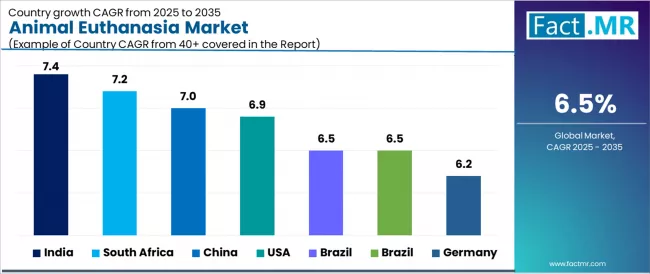
Animal Euthanasia Market Cagr Analysis By Country

Country CAGR (2025-2035)
India 7.4%
South Africa 7.2%
China 7.0%
USA 6.9%
Brazil 6.5%
UK 6.5%
Germany 6.2%

The animal euthanasia market is expanding steadily, with India leading at a 7.4% CAGR through 2035, driven by growing awareness of humane euthanasia practices, policy support through 2025 animal welfare rules, and expanding veterinary service accessibility. South Africa follows at 7.2%, supported by animal overpopulation crisis, shelter capacity constraints, and increasing demand for professional euthanasia services.

China records 7.0%, reflecting urban pet ownership boom, growth of regulated veterinary clinics, and increasing acceptance of professional animal care services. USA posts 6.9%, anchored by high pet ownership rates and expanding in-home euthanasia service providers including CodaPet and similar platforms.

Brazil grows at 6.5%, with expanding training programs in veterinary education and comprehensive livestock management practices. UK advances at 6.5%, emphasizing cost-of-living pressures increasing demand for clinical and at-home euthanasia services, while Germany grows steadily at 6.2%, focusing on rising veterinary costs and shelter overcrowding driving professional service requirements.

USA Demonstrates Market Leadership

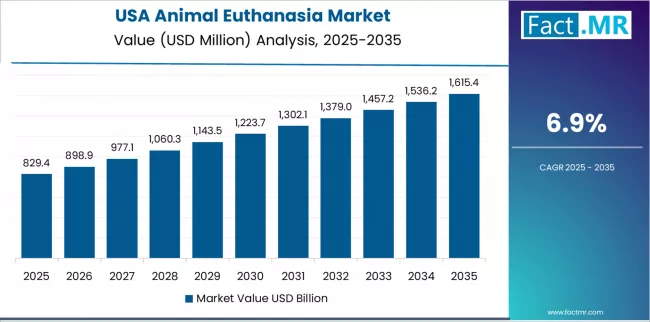
Animal Euthanasia Market Country Value Analysis

USA demonstrates the strongest market position in the animal euthanasia market with a CAGR of 6.9% through 2035. The country's leadership reflects the highest pet ownership rates globally with over 90 million households owning pets, comprehensive veterinary care infrastructure supporting end-of-life services, and rapid expansion of in-home euthanasia providers including CodaPet and Lap of Love networks. Growth is distributed across metropolitan and suburban regions, including California, Texas, Florida, New York, and Pennsylvania, where veterinary hospitals and mobile services implement compassionate euthanasia programs for aging companion animal populations. Distribution channels through veterinary hospital networks, mobile veterinary services, and animal shelter systems expand service delivery across clinical settings and home-based care applications. The country's mature pet care market provides ongoing demand for pharmaceutical agents, including established protocols and veterinary training programs.

Key market factors:

  • Demand distributed across companion animal veterinary practices and specialized end-of-life care services with established protocols
  • Pet humanization trends supporting premium service adoption and willingness to invest in compassionate care
  • Comprehensive veterinary infrastructure ecosystem, including mobile service networks with proven care delivery models
  • Service integration featuring grief counseling, memorial options, and aftercare services supporting holistic care approaches

India Emerges as Fastest-Growing Market

In Mumbai, Delhi, Bangalore, and Hyderabad, the adoption of professional animal euthanasia services is accelerating across veterinary clinics and animal welfare organizations, driven by urbanization and changing attitudes toward animal welfare. The market demonstrates the strongest growth momentum with a CAGR of 7.4% through 2035, linked to growing awareness of humane euthanasia practices among urban pet owners, policy support through 2025 animal welfare regulations providing framework for ethical practices, and expanding veterinary service infrastructure in major metropolitan areas. Indian veterinarians and animal welfare organizations are implementing pharmaceutical euthanasia protocols and professional training programs to address animal suffering while meeting growing expectations in expanding middle-class pet ownership demographics. The country's evolving animal welfare landscape creates persistent demand for education and service development, while increasing emphasis on compassionate care drives adoption of internationally recognized euthanasia standards.

Key development areas:

  • Urban veterinary practices and animal welfare organizations leading service adoption with comprehensive training programs
  • Metropolitan regions providing integrated veterinary services with 48% urban market penetration rates
  • Technology partnerships between international pharmaceutical suppliers and domestic veterinary distributors are expanding market reach
  • Integration of animal welfare education and comprehensive community awareness programs

China Shows Urban Pet Ownership Expansion

China's market expansion is driven by rapid urbanization and growing pet ownership, particularly in first and second-tier cities where companion animals represent important family members. The country demonstrates strong growth potential with a CAGR of 7.0% through 2035, supported by urban pet boom with over 100 million pet dogs and cats, growth of regulated veterinary clinics meeting international standards, and increasing acceptance of professional animal care services including end-of-life care. Chinese pet owners face cultural challenges related to traditional attitudes toward animal death, necessitating educational programs and support from veterinary professionals. However, younger generations' attitudes and expanding disposable incomes create compelling market opportunities, particularly in major cities where pet care spending has direct correlation with veterinary service utilization.

Market characteristics:

  • Urban pet ownership and veterinary clinic segments showing rapid growth with 18% annual increase in service utilization
  • Regional expansion trends focused on tier-one and tier-two cities including Beijing, Shanghai, Guangzhou, and Shenzhen
  • Future projections indicate need for continued veterinary education and cultural sensitivity development programs
  • Growing emphasis on pet welfare standards and comprehensive veterinary care in urban operations

South Africa Demonstrates Welfare Challenge Response

South Africa's market expansion is driven by critical animal overpopulation issues, particularly in townships and rural areas where uncontrolled breeding creates welfare challenges. The country demonstrates solid growth potential with a CAGR of 7.2% through 2035, supported by animal overpopulation crisis requiring large-scale population management interventions, shelter capacity issues driving demand for humane euthanasia services, and increasing professionalization of animal welfare organizations. South African animal welfare groups face implementation challenges related to funding constraints and geographic accessibility, necessitating mobile service development and support from international animal welfare organizations. However, growing recognition of humane treatment importance and expanding volunteer networks create expanding service coverage, particularly in urban areas where organized animal welfare programs have direct impact on community health and safety.

Market characteristics:

  • Animal shelter and welfare organization segments showing strong growth with 14% annual increase in euthanasia procedures
  • Regional expansion trends focused on major urban centers including Johannesburg, Cape Town, and Durban
  • Future projections indicate need for continued funding support and veterinary capacity development programs
  • Growing emphasis on spay-neuter programs and comprehensive population management strategies

UK Shows Economic Pressure Impact

UK's market expansion is driven by economic factors affecting pet ownership sustainability and veterinary care accessibility. The country demonstrates solid growth potential with a CAGR of 6.5% through 2035, supported by cost-of-living pressures affecting pet care affordability and leading to difficult euthanasia decisions, increasing demand for clinical euthanasia services in veterinary practices, and growing acceptance of at-home euthanasia options providing compassionate alternatives. British pet owners face financial challenges related to veterinary costs, necessitating difficult decisions and support from veterinary professionals offering payment options. However, strong animal welfare culture and comprehensive veterinary infrastructure create robust service delivery, particularly in areas where mobile services provide accessible alternatives to traditional clinic-based care.

Market characteristics:

  • Veterinary practice and mobile service segments showing steady growth with 9% annual increase in euthanasia procedures
  • Regional expansion trends focused on major population centers including London, Manchester, Birmingham, and Edinburgh
  • Future projections indicate need for continued affordability programs and accessible service development
  • Growing emphasis on compassionate care and comprehensive owner support during difficult decisions

Brazil Shows Professional Development Growth

Brazil's market expansion is driven by veterinary education advancement and professional practice development across companion animal and livestock sectors. The country demonstrates promising growth potential with a CAGR of 6.5% through 2035, supported by expanding training programs in veterinary schools covering proper euthanasia techniques, growing professionalization of livestock management including humane handling practices, and increasing pet ownership in urban areas requiring veterinary service infrastructure. Brazilian veterinarians implement international protocols and pharmaceutical standards, particularly in regions with established veterinary education and professional oversight ensuring quality care delivery. Distribution channels through veterinary clinics, agricultural cooperatives, and animal welfare organizations expand service coverage across urban companion animal care and rural livestock management operations.

Leading market segments:

  • Veterinary practices and agricultural operations implementing professional euthanasia protocols
  • University veterinary hospitals with training programs, achieving 72% protocol compliance rates
  • Strategic collaborations between pharmaceutical distributors and veterinary associations are expanding market presence
  • Focus on education initiatives and comprehensive professional standards development

Germany Shows Regulatory Compliance Focus

Germany's market expansion is driven by comprehensive animal welfare legislation and established veterinary practice standards ensuring humane treatment across all animal categories. The country demonstrates steady growth potential with a CAGR of 6.2% through 2035, supported by rising veterinary costs affecting service accessibility and utilization patterns, shelter overcrowding issues requiring population management interventions, and strong regulatory framework ensuring professional administration of euthanasia procedures. German veterinarians implement strict protocols following animal welfare legislation and professional ethical guidelines, particularly in regions with established oversight and quality assurance ensuring compliance with legal requirements. Distribution channels through licensed veterinary practices, municipal animal shelters, and agricultural operations expand service delivery across companion animals and livestock applications.

Leading market segments:

  • Veterinary clinics and animal shelters implementing comprehensive welfare protocols
  • Licensed practices with regulatory compliance, achieving 96% documentation standards
  • Strategic partnerships between pharmaceutical suppliers and veterinary distribution networks are expanding market capabilities
  • Focus on professional standards and comprehensive ethical oversight in animal care operations

Europe Market Split by Country

Animal Euthanasia Market Europe Country Market Share Analysis, 2025 & 2035

The animal euthanasia market in Europe is projected to grow from USD 0.40 billion in 2025 to USD 0.75 billion by 2035, registering a CAGR of 6.6% over the forecast period. Germany is expected to maintain its leadership position with a 32.0% market share in 2025, supported by its comprehensive veterinary infrastructure, strong animal welfare legislation, and extensive companion animal population across major urban centers.

UK follows with a 28.5% share in 2025, driven by established veterinary practice networks implementing compassionate end-of-life care services and expanding mobile euthanasia offerings across metropolitan areas. France holds a 20.0% share through ongoing development of veterinary services and animal welfare programs.

Italy commands a 12.0% share, while Spain accounts for 6.5% in 2025. The Rest of Europe region maintains a 1.0% collective share, attributed to increasing veterinary service adoption in Nordic countries and emerging Eastern European markets implementing professional animal care standards. By 2035, Germany is projected to hold 31.5% share, UK 29.0%, France 20.5%, Italy 12.0%, Spain 6.5%, and Rest of Europe 0.5%, reflecting sustained growth momentum across all major European markets.

Competitive Landscape of the Animal Euthanasia Market

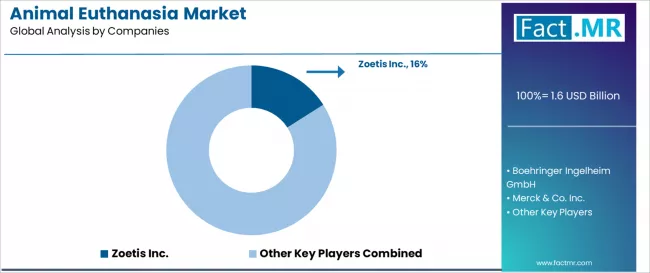
Animal Euthanasia Market Analysis By Company

The animal euthanasia market features approximately 15-20 meaningful players with moderate concentration, where the top four companies control roughly 40-48% of global market share through established pharmaceutical portfolios and extensive veterinary distribution relationships. Competition centers on product efficacy, regulatory compliance, and veterinary professional relationships rather than price competition alone.

Market leaders include Zoetis Inc., Boehringer Ingelheim GmbH, and Merck & Co. Inc., which maintain competitive advantages through comprehensive animal health portfolios, global distribution networks, and deep expertise in the veterinary pharmaceutical and controlled substance sectors, creating strong prescriber loyalty among veterinarians.

These companies leverage established veterinary partnerships and ongoing regulatory compliance programs to defend market positions while expanding into adjacent animal health applications and emerging market opportunities. Zoetis Inc. commands approximately 16.0% market share in 2025 through diverse veterinary pharmaceutical platforms and comprehensive animal health expertise with proven clinical efficacy.

Challengers encompass Elanco Animal Health and Vetoquinol SA, which compete through integrated animal health portfolios and regional market strength in companion animal and livestock segments. Pharmaceutical specialists, including Dechra Pharmaceuticals PLC, Virbac, and Hikma Pharmaceuticals PLC, focus on specific product categories or geographic markets, offering differentiated capabilities in specialty veterinary products, regional distribution excellence, and generic pharmaceutical alternatives.

Regional players and emerging veterinary pharmaceutical companies create competitive pressure through specialized formulations and local regulatory expertise, particularly in high-growth markets including China and India, where domestic manufacturing presence provides advantages in regulatory navigation and veterinary relationship development.

Market dynamics favor companies that combine proven pharmaceutical efficacy with comprehensive regulatory compliance capabilities that address the complete value chain from controlled substance management through veterinary distribution and professional education.

Strategic collaborations between pharmaceutical manufacturers and veterinary service networks accelerate market penetration, while ongoing regulatory requirements ensure quality standards and professional oversight across diverse veterinary applications.

Global Animal Euthanasia Market - Stakeholder Contribution Framework

Animal euthanasia products and services represent critical veterinary care components that enable compassionate end-of-life management and humane treatment standards without causing unnecessary suffering, typically providing rapid loss of consciousness within 30-60 seconds followed by peaceful death while maintaining dignity for both animals and their caregivers.

With the market projected to grow from USD 1.63 billion in 2025 to USD 3.06 billion by 2035 at a 6.5% CAGR, these solutions offer compelling advantages - proven efficacy, minimal distress, and professional oversight - making them essential for companion animal care (dominant segment), veterinary hospital services (primary setting), and diverse animal welfare applications seeking validated humane protocols. Scaling service accessibility and quality standards requires coordinated action across veterinary policy, professional standards, pharmaceutical manufacturers, veterinary practitioners, and animal welfare organizations.

How Governments Could Spur Humane Practice Adoption?

  • Regulatory Framework Development: Include clear guidelines for animal euthanasia in veterinary practice acts, establish licensing requirements for practitioners and facilities, and create oversight mechanisms ensuring compliance with humane standards across all animal care settings.
  • Professional Education Support: Fund veterinary school programs covering proper euthanasia techniques and ethical decision-making, provide continuing education grants for practicing veterinarians, and establish certification standards ensuring competency across the veterinary profession.
  • Animal Welfare Legislation: Implement comprehensive animal welfare laws requiring humane euthanasia methods, prohibit inhumane killing practices, and establish enforcement mechanisms protecting animal welfare while supporting veterinary professionals.
  • Public Awareness Programs: Fund community education initiatives explaining responsible pet ownership and end-of-life planning, invest in animal welfare organization partnerships providing accessible services, and support grief counseling resources helping owners navigate difficult decisions.

How Industry Bodies Could Support Market Development?

  • Clinical Protocol Standards: Define evidence-based euthanasia protocols for different species and situations, establish standardized procedures ensuring consistency and efficacy, and create quality metrics that veterinary practices can implement for outcome optimization.
  • Professional Ethics Guidelines: Lead ethical framework development addressing euthanasia decision-making, emphasizing compassionate care delivery, client communication best practices, and professional responsibility standards compared to historical approaches.
  • Continuing Education Programs: Develop comprehensive training modules covering technical skills, emotional support techniques, and regulatory compliance requirements, ensuring veterinary professionals maintain current knowledge and competent practice capabilities.

How Manufacturers and Service Providers Could Strengthen the Ecosystem?

  • Product Quality Assurance: Maintain rigorous pharmaceutical manufacturing standards ensuring consistent product efficacy, implement comprehensive quality control testing validating potency and sterility, and provide technical documentation supporting regulatory compliance and professional confidence.
  • Veterinary Support Programs: Offer comprehensive training resources integrating proper administration techniques, dosage calculation guidance, and adverse event management protocols, enabling veterinary professionals to maximize procedural success and minimize complications.
  • Service Innovation Development: Develop next-generation service models including mobile euthanasia programs with enhanced accessibility, integrated aftercare options providing comprehensive support, and technology-enabled scheduling systems that improve service efficiency while maintaining compassionate care standards.

Key Players in the Animal Euthanasia Market

  • Zoetis Inc.
  • Boehringer Ingelheim GmbH
  • Merck & Co. Inc.
  • Elanco Animal Health
  • Vetoquinol SA
  • Dechra Pharmaceuticals PLC
  • Virbac
  • Hikma Pharmaceuticals PLC
  • Akorn Animal Health Inc.
  • Piramal Critical Care Inc.

Scope of the Report

Items Values
Quantitative Units USD 1.63 Billion
Product Pharmaceuticals, Inhalants, Others
Animal Companion Animals, Livestock Animals, Others
Route of Administration Injectable, Inhalants, Others
End Use Veterinary Hospitals & Clinics, Animal Shelters & Rescue Centers, Research Labs & Universities, Others
Regions Covered North America, Europe, Asia Pacific, Latin America, Middle East & Africa
Country Covered USA, India, South Africa, China, Brazil, UK, Germany, and 40+ countries
Key Companies Profiled Zoetis Inc., Boehringer Ingelheim GmbH, Merck & Co. Inc., Elanco Animal Health, Vetoquinol SA, Dechra Pharmaceuticals PLC, Virbac, Hikma Pharmaceuticals PLC, Akorn Animal Health Inc., Piramal Critical Care Inc.
Additional Attributes Dollar sales by product, animal, route of administration, and end use categories, regional adoption trends across North America, Europe, and Asia Pacific, competitive landscape with veterinary pharmaceutical manufacturers and specialty service providers, clinical protocol requirements and regulatory specifications, integration with veterinary practice operations and animal welfare programs.

Animal Euthanasia Market by Segments

  • Product :

    • Pharmaceuticals
    • Inhalants
    • Others
  • Animal :

    • Companion Animals
    • Livestock Animals
    • Others
  • Route of Administration:

    • Injectable
    • Inhalants
    • Others
  • End Use :

    • Veterinary Hospitals & Clinics
    • Animal Shelters & Rescue Centers
    • Research Labs & Universities
    • Others
  • Region :

    • North America
      • USA
      • Canada
      • Mexico
    • Europe
      • Germany
      • UK
      • France
      • Italy
      • Spain
      • Nordic
      • Rest of Europe
    • Asia Pacific
      • China
      • Japan
      • South Korea
      • India
      • Australia & New Zealand
      • ASEAN
      • Rest of Asia Pacific
    • Latin America
      • Brazil
      • Argentina
      • Rest of Latin America
    • Middle East & Africa
      • Kingdom of Saudi Arabia
      • Other GCC Countries
      • Turkey
      • South Africa
      • Rest of Middle East & Africa

Table of Content

  1. Executive Summary
    • Global Market Outlook
    • Demand to side Trends
    • Supply to side Trends
    • Technology Roadmap Analysis
    • Analysis and Recommendations
  2. Market Overview
    • Market Coverage / Taxonomy
    • Market Definition / Scope / Limitations
  3. Market Background
    • Market Dynamics
      • Drivers
      • Restraints
      • Opportunity
      • Trends
    • Scenario Forecast
      • Demand in Optimistic Scenario
      • Demand in Likely Scenario
      • Demand in Conservative Scenario
    • Opportunity Map Analysis
    • Product Life Cycle Analysis
    • Supply Chain Analysis
    • Investment Feasibility Matrix
    • Value Chain Analysis
    • PESTLE and Porter’s Analysis
    • Regulatory Landscape
    • Regional Parent Market Outlook
    • Production and Consumption Statistics
    • Import and Export Statistics
  4. Global Market Analysis 2020 to 2024 and Forecast, 2025 to 2035
    • Historical Market Size Value (USD Million) Analysis, 2020 to 2024
    • Current and Future Market Size Value (USD Million) Projections, 2025 to 2035
      • Y to o to Y Growth Trend Analysis
      • Absolute $ Opportunity Analysis
  5. Global Market Pricing Analysis 2020 to 2024 and Forecast 2025 to 2035
  6. Global Market Analysis 2020 to 2024 and Forecast 2025 to 2035, By Product
    • Introduction / Key Findings
    • Historical Market Size Value (USD Million) Analysis By Product, 2020 to 2024
    • Current and Future Market Size Value (USD Million) Analysis and Forecast By Product, 2025 to 2035
      • Pharmaceuticals
      • Inhalants
      • Others
    • Y to o to Y Growth Trend Analysis By Product, 2020 to 2024
    • Absolute $ Opportunity Analysis By Product, 2025 to 2035
  7. Global Market Analysis 2020 to 2024 and Forecast 2025 to 2035, By Animal
    • Introduction / Key Findings
    • Historical Market Size Value (USD Million) Analysis By Animal, 2020 to 2024
    • Current and Future Market Size Value (USD Million) Analysis and Forecast By Animal, 2025 to 2035
      • Companion Animals
      • Livestock Animals
      • Others
    • Y to o to Y Growth Trend Analysis By Animal, 2020 to 2024
    • Absolute $ Opportunity Analysis By Animal, 2025 to 2035
  8. Global Market Analysis 2020 to 2024 and Forecast 2025 to 2035, By Route of Administration
    • Introduction / Key Findings
    • Historical Market Size Value (USD Million) Analysis By Route of Administration, 2020 to 2024
    • Current and Future Market Size Value (USD Million) Analysis and Forecast By Route of Administration, 2025 to 2035
      • Injectable
      • Inhalants
      • Others
    • Y to o to Y Growth Trend Analysis By Route of Administration, 2020 to 2024
    • Absolute $ Opportunity Analysis By Route of Administration, 2025 to 2035
  9. Global Market Analysis 2020 to 2024 and Forecast 2025 to 2035, By End Use
    • Introduction / Key Findings
    • Historical Market Size Value (USD Million) Analysis By End Use, 2020 to 2024
    • Current and Future Market Size Value (USD Million) Analysis and Forecast By End Use, 2025 to 2035
      • Veterinary Hospitals & Clinics
      • Animal Shelters & Rescue Centers
      • Research Labs & Universities
      • Others
    • Y to o to Y Growth Trend Analysis By End Use, 2020 to 2024
    • Absolute $ Opportunity Analysis By End Use, 2025 to 2035
  10. Global Market Analysis 2020 to 2024 and Forecast 2025 to 2035, By Region
    • Introduction
    • Historical Market Size Value (USD Million) Analysis By Region, 2020 to 2024
    • Current Market Size Value (USD Million) Analysis and Forecast By Region, 2025 to 2035
      • North America
      • Latin America
      • Western Europe
      • Eastern Europe
      • East Asia
      • South Asia and Pacific
      • Middle East & Africa
    • Market Attractiveness Analysis By Region
  11. North America Market Analysis 2020 to 2024 and Forecast 2025 to 2035, By Country
    • Historical Market Size Value (USD Million) Trend Analysis By Market Taxonomy, 2020 to 2024
    • Market Size Value (USD Million) Forecast By Market Taxonomy, 2025 to 2035
      • By Country
        • USA
        • Canada
        • Mexico
      • By Product
      • By Animal
      • By Route of Administration
      • By End Use
    • Market Attractiveness Analysis
      • By Country
      • By Product
      • By Animal
      • By Route of Administration
      • By End Use
    • Key Takeaways
  12. Latin America Market Analysis 2020 to 2024 and Forecast 2025 to 2035, By Country
    • Historical Market Size Value (USD Million) Trend Analysis By Market Taxonomy, 2020 to 2024
    • Market Size Value (USD Million) Forecast By Market Taxonomy, 2025 to 2035
      • By Country
        • Brazil
        • Chile
        • Rest of Latin America
      • By Product
      • By Animal
      • By Route of Administration
      • By End Use
    • Market Attractiveness Analysis
      • By Country
      • By Product
      • By Animal
      • By Route of Administration
      • By End Use
    • Key Takeaways
  13. Western Europe Market Analysis 2020 to 2024 and Forecast 2025 to 2035, By Country
    • Historical Market Size Value (USD Million) Trend Analysis By Market Taxonomy, 2020 to 2024
    • Market Size Value (USD Million) Forecast By Market Taxonomy, 2025 to 2035
      • By Country
        • Germany
        • UK
        • Italy
        • Spain
        • France
        • Nordic
        • BENELUX
        • Rest of Western Europe
      • By Product
      • By Animal
      • By Route of Administration
      • By End Use
    • Market Attractiveness Analysis
      • By Country
      • By Product
      • By Animal
      • By Route of Administration
      • By End Use
    • Key Takeaways
  14. Eastern Europe Market Analysis 2020 to 2024 and Forecast 2025 to 2035, By Country
    • Historical Market Size Value (USD Million) Trend Analysis By Market Taxonomy, 2020 to 2024
    • Market Size Value (USD Million) Forecast By Market Taxonomy, 2025 to 2035
      • By Country
        • Russia
        • Poland
        • Hungary
        • Balkan & Baltic
        • Rest of Eastern Europe
      • By Product
      • By Animal
      • By Route of Administration
      • By End Use
    • Market Attractiveness Analysis
      • By Country
      • By Product
      • By Animal
      • By Route of Administration
      • By End Use
    • Key Takeaways
  15. East Asia Market Analysis 2020 to 2024 and Forecast 2025 to 2035, By Country
    • Historical Market Size Value (USD Million) Trend Analysis By Market Taxonomy, 2020 to 2024
    • Market Size Value (USD Million) Forecast By Market Taxonomy, 2025 to 2035
      • By Country
        • China
        • Japan
        • South Korea
      • By Product
      • By Animal
      • By Route of Administration
      • By End Use
    • Market Attractiveness Analysis
      • By Country
      • By Product
      • By Animal
      • By Route of Administration
      • By End Use
    • Key Takeaways
  16. South Asia and Pacific Market Analysis 2020 to 2024 and Forecast 2025 to 2035, By Country
    • Historical Market Size Value (USD Million) Trend Analysis By Market Taxonomy, 2020 to 2024
    • Market Size Value (USD Million) Forecast By Market Taxonomy, 2025 to 2035
      • By Country
        • India
        • ASEAN
        • Australia & New Zealand
        • Rest of South Asia and Pacific
      • By Product
      • By Animal
      • By Route of Administration
      • By End Use
    • Market Attractiveness Analysis
      • By Country
      • By Product
      • By Animal
      • By Route of Administration
      • By End Use
    • Key Takeaways
  17. Middle East & Africa Market Analysis 2020 to 2024 and Forecast 2025 to 2035, By Country
    • Historical Market Size Value (USD Million) Trend Analysis By Market Taxonomy, 2020 to 2024
    • Market Size Value (USD Million) Forecast By Market Taxonomy, 2025 to 2035
      • By Country
        • Kingdom of Saudi Arabia
        • Other GCC Countries
        • Turkiye
        • South Africa
        • Other African Union
        • Rest of Middle East & Africa
      • By Product
      • By Animal
      • By Route of Administration
      • By End Use
    • Market Attractiveness Analysis
      • By Country
      • By Product
      • By Animal
      • By Route of Administration
      • By End Use
    • Key Takeaways
  18. Key Countries Market Analysis
    • USA
      • Pricing Analysis
      • Market Share Analysis, 2024
        • By Product
        • By Animal
        • By Route of Administration
        • By End Use
    • Canada
      • Pricing Analysis
      • Market Share Analysis, 2024
        • By Product
        • By Animal
        • By Route of Administration
        • By End Use
    • Mexico
      • Pricing Analysis
      • Market Share Analysis, 2024
        • By Product
        • By Animal
        • By Route of Administration
        • By End Use
    • Brazil
      • Pricing Analysis
      • Market Share Analysis, 2024
        • By Product
        • By Animal
        • By Route of Administration
        • By End Use
    • Chile
      • Pricing Analysis
      • Market Share Analysis, 2024
        • By Product
        • By Animal
        • By Route of Administration
        • By End Use
    • Germany
      • Pricing Analysis
      • Market Share Analysis, 2024
        • By Product
        • By Animal
        • By Route of Administration
        • By End Use
    • UK
      • Pricing Analysis
      • Market Share Analysis, 2024
        • By Product
        • By Animal
        • By Route of Administration
        • By End Use
    • Italy
      • Pricing Analysis
      • Market Share Analysis, 2024
        • By Product
        • By Animal
        • By Route of Administration
        • By End Use
    • Spain
      • Pricing Analysis
      • Market Share Analysis, 2024
        • By Product
        • By Animal
        • By Route of Administration
        • By End Use
    • France
      • Pricing Analysis
      • Market Share Analysis, 2024
        • By Product
        • By Animal
        • By Route of Administration
        • By End Use
    • India
      • Pricing Analysis
      • Market Share Analysis, 2024
        • By Product
        • By Animal
        • By Route of Administration
        • By End Use
    • ASEAN
      • Pricing Analysis
      • Market Share Analysis, 2024
        • By Product
        • By Animal
        • By Route of Administration
        • By End Use
    • Australia & New Zealand
      • Pricing Analysis
      • Market Share Analysis, 2024
        • By Product
        • By Animal
        • By Route of Administration
        • By End Use
    • China
      • Pricing Analysis
      • Market Share Analysis, 2024
        • By Product
        • By Animal
        • By Route of Administration
        • By End Use
    • Japan
      • Pricing Analysis
      • Market Share Analysis, 2024
        • By Product
        • By Animal
        • By Route of Administration
        • By End Use
    • South Korea
      • Pricing Analysis
      • Market Share Analysis, 2024
        • By Product
        • By Animal
        • By Route of Administration
        • By End Use
    • Russia
      • Pricing Analysis
      • Market Share Analysis, 2024
        • By Product
        • By Animal
        • By Route of Administration
        • By End Use
    • Poland
      • Pricing Analysis
      • Market Share Analysis, 2024
        • By Product
        • By Animal
        • By Route of Administration
        • By End Use
    • Hungary
      • Pricing Analysis
      • Market Share Analysis, 2024
        • By Product
        • By Animal
        • By Route of Administration
        • By End Use
    • Kingdom of Saudi Arabia
      • Pricing Analysis
      • Market Share Analysis, 2024
        • By Product
        • By Animal
        • By Route of Administration
        • By End Use
    • Turkiye
      • Pricing Analysis
      • Market Share Analysis, 2024
        • By Product
        • By Animal
        • By Route of Administration
        • By End Use
    • South Africa
      • Pricing Analysis
      • Market Share Analysis, 2024
        • By Product
        • By Animal
        • By Route of Administration
        • By End Use
  19. Market Structure Analysis
    • Competition Dashboard
    • Competition Benchmarking
    • Market Share Analysis of Top Players
      • By Regional
      • By Product
      • By Animal
      • By Route of Administration
      • By End Use
  20. Competition Analysis
    • Competition Deep Dive
      • Zoetis Inc.
        • Overview
        • Product Portfolio
        • Profitability by Market Segments (Product/Age /Sales Channel/Region)
        • Sales Footprint
        • Strategy Overview
          • Marketing Strategy
          • Product Strategy
          • Channel Strategy
      • Boehringer Ingelheim GmbH
      • Merck & Co. Inc.
      • Elanco Animal Health
      • Vetoquinol SA
      • Dechra Pharmaceuticals PLC
      • Virbac
      • Hikma Pharmaceuticals PLC
      • Akorn Animal Health Inc.
      • Piramal Critical Care Inc.
  21. Assumptions & Acronyms Used
  22. Research Methodology

List Of Table

  • Table 1: Global Market Value (USD Million) Forecast by Region, 2020 to 2035
  • Table 2: Global Market Value (USD Million) Forecast by Product, 2020 to 2035
  • Table 3: Global Market Value (USD Million) Forecast by Animal, 2020 to 2035
  • Table 4: Global Market Value (USD Million) Forecast by Route of Administration, 2020 to 2035
  • Table 5: Global Market Value (USD Million) Forecast by End Use, 2020 to 2035
  • Table 6: North America Market Value (USD Million) Forecast by Country, 2020 to 2035
  • Table 7: North America Market Value (USD Million) Forecast by Product, 2020 to 2035
  • Table 8: North America Market Value (USD Million) Forecast by Animal, 2020 to 2035
  • Table 9: North America Market Value (USD Million) Forecast by Route of Administration, 2020 to 2035
  • Table 10: North America Market Value (USD Million) Forecast by End Use, 2020 to 2035
  • Table 11: Latin America Market Value (USD Million) Forecast by Country, 2020 to 2035
  • Table 12: Latin America Market Value (USD Million) Forecast by Product, 2020 to 2035
  • Table 13: Latin America Market Value (USD Million) Forecast by Animal, 2020 to 2035
  • Table 14: Latin America Market Value (USD Million) Forecast by Route of Administration, 2020 to 2035
  • Table 15: Latin America Market Value (USD Million) Forecast by End Use, 2020 to 2035
  • Table 16: Western Europe Market Value (USD Million) Forecast by Country, 2020 to 2035
  • Table 17: Western Europe Market Value (USD Million) Forecast by Product, 2020 to 2035
  • Table 18: Western Europe Market Value (USD Million) Forecast by Animal, 2020 to 2035
  • Table 19: Western Europe Market Value (USD Million) Forecast by Route of Administration, 2020 to 2035
  • Table 20: Western Europe Market Value (USD Million) Forecast by End Use, 2020 to 2035
  • Table 21: Eastern Europe Market Value (USD Million) Forecast by Country, 2020 to 2035
  • Table 22: Eastern Europe Market Value (USD Million) Forecast by Product, 2020 to 2035
  • Table 23: Eastern Europe Market Value (USD Million) Forecast by Animal, 2020 to 2035
  • Table 24: Eastern Europe Market Value (USD Million) Forecast by Route of Administration, 2020 to 2035
  • Table 25: Eastern Europe Market Value (USD Million) Forecast by End Use, 2020 to 2035
  • Table 26: East Asia Market Value (USD Million) Forecast by Country, 2020 to 2035
  • Table 27: East Asia Market Value (USD Million) Forecast by Product, 2020 to 2035
  • Table 28: East Asia Market Value (USD Million) Forecast by Animal, 2020 to 2035
  • Table 29: East Asia Market Value (USD Million) Forecast by Route of Administration, 2020 to 2035
  • Table 30: East Asia Market Value (USD Million) Forecast by End Use, 2020 to 2035
  • Table 31: South Asia and Pacific Market Value (USD Million) Forecast by Country, 2020 to 2035
  • Table 32: South Asia and Pacific Market Value (USD Million) Forecast by Product, 2020 to 2035
  • Table 33: South Asia and Pacific Market Value (USD Million) Forecast by Animal, 2020 to 2035
  • Table 34: South Asia and Pacific Market Value (USD Million) Forecast by Route of Administration, 2020 to 2035
  • Table 35: South Asia and Pacific Market Value (USD Million) Forecast by End Use, 2020 to 2035
  • Table 36: Middle East & Africa Market Value (USD Million) Forecast by Country, 2020 to 2035
  • Table 37: Middle East & Africa Market Value (USD Million) Forecast by Product, 2020 to 2035
  • Table 38: Middle East & Africa Market Value (USD Million) Forecast by Animal, 2020 to 2035
  • Table 39: Middle East & Africa Market Value (USD Million) Forecast by Route of Administration, 2020 to 2035
  • Table 40: Middle East & Africa Market Value (USD Million) Forecast by End Use, 2020 to 2035

List Of Figures

  • Figure 1: Global Market Pricing Analysis
  • Figure 2: Global Market Value (USD Million) Forecast 2020 to 2035
  • Figure 3: Global Market Value Share and BPS Analysis by Product, 2025 and 2035
  • Figure 4: Global Market Y to o to Y Growth Comparison by Product, 2025 to 2035
  • Figure 5: Global Market Attractiveness Analysis by Product
  • Figure 6: Global Market Value Share and BPS Analysis by Animal, 2025 and 2035
  • Figure 7: Global Market Y to o to Y Growth Comparison by Animal, 2025 to 2035
  • Figure 8: Global Market Attractiveness Analysis by Animal
  • Figure 9: Global Market Value Share and BPS Analysis by Route of Administration, 2025 and 2035
  • Figure 10: Global Market Y to o to Y Growth Comparison by Route of Administration, 2025 to 2035
  • Figure 11: Global Market Attractiveness Analysis by Route of Administration
  • Figure 12: Global Market Value Share and BPS Analysis by End Use, 2025 and 2035
  • Figure 13: Global Market Y to o to Y Growth Comparison by End Use, 2025 to 2035
  • Figure 14: Global Market Attractiveness Analysis by End Use
  • Figure 15: Global Market Value (USD Million) Share and BPS Analysis by Region, 2025 and 2035
  • Figure 16: Global Market Y to o to Y Growth Comparison by Region, 2025 to 2035
  • Figure 17: Global Market Attractiveness Analysis by Region
  • Figure 18: North America Market Incremental Dollar Opportunity, 2025 to 2035
  • Figure 19: Latin America Market Incremental Dollar Opportunity, 2025 to 2035
  • Figure 20: Western Europe Market Incremental Dollar Opportunity, 2025 to 2035
  • Figure 21: Eastern Europe Market Incremental Dollar Opportunity, 2025 to 2035
  • Figure 22: East Asia Market Incremental Dollar Opportunity, 2025 to 2035
  • Figure 23: South Asia and Pacific Market Incremental Dollar Opportunity, 2025 to 2035
  • Figure 24: Middle East & Africa Market Incremental Dollar Opportunity, 2025 to 2035
  • Figure 25: North America Market Value Share and BPS Analysis by Country, 2025 and 2035
  • Figure 26: North America Market Value Share and BPS Analysis by Product, 2025 and 2035
  • Figure 27: North America Market Y to o to Y Growth Comparison by Product, 2025 to 2035
  • Figure 28: North America Market Attractiveness Analysis by Product
  • Figure 29: North America Market Value Share and BPS Analysis by Animal, 2025 and 2035
  • Figure 30: North America Market Y to o to Y Growth Comparison by Animal, 2025 to 2035
  • Figure 31: North America Market Attractiveness Analysis by Animal
  • Figure 32: North America Market Value Share and BPS Analysis by Route of Administration, 2025 and 2035
  • Figure 33: North America Market Y to o to Y Growth Comparison by Route of Administration, 2025 to 2035
  • Figure 34: North America Market Attractiveness Analysis by Route of Administration
  • Figure 35: North America Market Value Share and BPS Analysis by End Use, 2025 and 2035
  • Figure 36: North America Market Y to o to Y Growth Comparison by End Use, 2025 to 2035
  • Figure 37: North America Market Attractiveness Analysis by End Use
  • Figure 38: Latin America Market Value Share and BPS Analysis by Country, 2025 and 2035
  • Figure 39: Latin America Market Value Share and BPS Analysis by Product, 2025 and 2035
  • Figure 40: Latin America Market Y to o to Y Growth Comparison by Product, 2025 to 2035
  • Figure 41: Latin America Market Attractiveness Analysis by Product
  • Figure 42: Latin America Market Value Share and BPS Analysis by Animal, 2025 and 2035
  • Figure 43: Latin America Market Y to o to Y Growth Comparison by Animal, 2025 to 2035
  • Figure 44: Latin America Market Attractiveness Analysis by Animal
  • Figure 45: Latin America Market Value Share and BPS Analysis by Route of Administration, 2025 and 2035
  • Figure 46: Latin America Market Y to o to Y Growth Comparison by Route of Administration, 2025 to 2035
  • Figure 47: Latin America Market Attractiveness Analysis by Route of Administration
  • Figure 48: Latin America Market Value Share and BPS Analysis by End Use, 2025 and 2035
  • Figure 49: Latin America Market Y to o to Y Growth Comparison by End Use, 2025 to 2035
  • Figure 50: Latin America Market Attractiveness Analysis by End Use
  • Figure 51: Western Europe Market Value Share and BPS Analysis by Country, 2025 and 2035
  • Figure 52: Western Europe Market Value Share and BPS Analysis by Product, 2025 and 2035
  • Figure 53: Western Europe Market Y to o to Y Growth Comparison by Product, 2025 to 2035
  • Figure 54: Western Europe Market Attractiveness Analysis by Product
  • Figure 55: Western Europe Market Value Share and BPS Analysis by Animal, 2025 and 2035
  • Figure 56: Western Europe Market Y to o to Y Growth Comparison by Animal, 2025 to 2035
  • Figure 57: Western Europe Market Attractiveness Analysis by Animal
  • Figure 58: Western Europe Market Value Share and BPS Analysis by Route of Administration, 2025 and 2035
  • Figure 59: Western Europe Market Y to o to Y Growth Comparison by Route of Administration, 2025 to 2035
  • Figure 60: Western Europe Market Attractiveness Analysis by Route of Administration
  • Figure 61: Western Europe Market Value Share and BPS Analysis by End Use, 2025 and 2035
  • Figure 62: Western Europe Market Y to o to Y Growth Comparison by End Use, 2025 to 2035
  • Figure 63: Western Europe Market Attractiveness Analysis by End Use
  • Figure 64: Eastern Europe Market Value Share and BPS Analysis by Country, 2025 and 2035
  • Figure 65: Eastern Europe Market Value Share and BPS Analysis by Product, 2025 and 2035
  • Figure 66: Eastern Europe Market Y to o to Y Growth Comparison by Product, 2025 to 2035
  • Figure 67: Eastern Europe Market Attractiveness Analysis by Product
  • Figure 68: Eastern Europe Market Value Share and BPS Analysis by Animal, 2025 and 2035
  • Figure 69: Eastern Europe Market Y to o to Y Growth Comparison by Animal, 2025 to 2035
  • Figure 70: Eastern Europe Market Attractiveness Analysis by Animal
  • Figure 71: Eastern Europe Market Value Share and BPS Analysis by Route of Administration, 2025 and 2035
  • Figure 72: Eastern Europe Market Y to o to Y Growth Comparison by Route of Administration, 2025 to 2035
  • Figure 73: Eastern Europe Market Attractiveness Analysis by Route of Administration
  • Figure 74: Eastern Europe Market Value Share and BPS Analysis by End Use, 2025 and 2035
  • Figure 75: Eastern Europe Market Y to o to Y Growth Comparison by End Use, 2025 to 2035
  • Figure 76: Eastern Europe Market Attractiveness Analysis by End Use
  • Figure 77: East Asia Market Value Share and BPS Analysis by Country, 2025 and 2035
  • Figure 78: East Asia Market Value Share and BPS Analysis by Product, 2025 and 2035
  • Figure 79: East Asia Market Y to o to Y Growth Comparison by Product, 2025 to 2035
  • Figure 80: East Asia Market Attractiveness Analysis by Product
  • Figure 81: East Asia Market Value Share and BPS Analysis by Animal, 2025 and 2035
  • Figure 82: East Asia Market Y to o to Y Growth Comparison by Animal, 2025 to 2035
  • Figure 83: East Asia Market Attractiveness Analysis by Animal
  • Figure 84: East Asia Market Value Share and BPS Analysis by Route of Administration, 2025 and 2035
  • Figure 85: East Asia Market Y to o to Y Growth Comparison by Route of Administration, 2025 to 2035
  • Figure 86: East Asia Market Attractiveness Analysis by Route of Administration
  • Figure 87: East Asia Market Value Share and BPS Analysis by End Use, 2025 and 2035
  • Figure 88: East Asia Market Y to o to Y Growth Comparison by End Use, 2025 to 2035
  • Figure 89: East Asia Market Attractiveness Analysis by End Use
  • Figure 90: South Asia and Pacific Market Value Share and BPS Analysis by Country, 2025 and 2035
  • Figure 91: South Asia and Pacific Market Value Share and BPS Analysis by Product, 2025 and 2035
  • Figure 92: South Asia and Pacific Market Y to o to Y Growth Comparison by Product, 2025 to 2035
  • Figure 93: South Asia and Pacific Market Attractiveness Analysis by Product
  • Figure 94: South Asia and Pacific Market Value Share and BPS Analysis by Animal, 2025 and 2035
  • Figure 95: South Asia and Pacific Market Y to o to Y Growth Comparison by Animal, 2025 to 2035
  • Figure 96: South Asia and Pacific Market Attractiveness Analysis by Animal
  • Figure 97: South Asia and Pacific Market Value Share and BPS Analysis by Route of Administration, 2025 and 2035
  • Figure 98: South Asia and Pacific Market Y to o to Y Growth Comparison by Route of Administration, 2025 to 2035
  • Figure 99: South Asia and Pacific Market Attractiveness Analysis by Route of Administration
  • Figure 100: South Asia and Pacific Market Value Share and BPS Analysis by End Use, 2025 and 2035
  • Figure 101: South Asia and Pacific Market Y to o to Y Growth Comparison by End Use, 2025 to 2035
  • Figure 102: South Asia and Pacific Market Attractiveness Analysis by End Use
  • Figure 103: Middle East & Africa Market Value Share and BPS Analysis by Country, 2025 and 2035
  • Figure 104: Middle East & Africa Market Value Share and BPS Analysis by Product, 2025 and 2035
  • Figure 105: Middle East & Africa Market Y to o to Y Growth Comparison by Product, 2025 to 2035
  • Figure 106: Middle East & Africa Market Attractiveness Analysis by Product
  • Figure 107: Middle East & Africa Market Value Share and BPS Analysis by Animal, 2025 and 2035
  • Figure 108: Middle East & Africa Market Y to o to Y Growth Comparison by Animal, 2025 to 2035
  • Figure 109: Middle East & Africa Market Attractiveness Analysis by Animal
  • Figure 110: Middle East & Africa Market Value Share and BPS Analysis by Route of Administration, 2025 and 2035
  • Figure 111: Middle East & Africa Market Y to o to Y Growth Comparison by Route of Administration, 2025 to 2035
  • Figure 112: Middle East & Africa Market Attractiveness Analysis by Route of Administration
  • Figure 113: Middle East & Africa Market Value Share and BPS Analysis by End Use, 2025 and 2035
  • Figure 114: Middle East & Africa Market Y to o to Y Growth Comparison by End Use, 2025 to 2035
  • Figure 115: Middle East & Africa Market Attractiveness Analysis by End Use
  • Figure 116: Global Market - Tier Structure Analysis
  • Figure 117: Global Market - Company Share Analysis

- FAQs -

How big is the animal euthanasia market in 2025?

The global animal euthanasia market is estimated to be valued at USD 1.6 billion in 2025.

What will be the size of animal euthanasia market in 2035?

The market size for the animal euthanasia market is projected to reach USD 3.1 billion by 2035.

How much will be the animal euthanasia market growth between 2025 and 2035?

The animal euthanasia market is expected to grow at a 6.5% CAGR between 2025 and 2035.

What are the key product types in the animal euthanasia market?

The key product types in animal euthanasia market are pharmaceuticals, inhalants and others.

Which animal segment to contribute significant share in the animal euthanasia market in 2025?

In terms of animal, companion animals segment to command 64.0% share in the animal euthanasia market in 2025.

Animal Euthanasia Market