- Base Value(2026): 3.0 Bn
- Estimated Value(2026): 3.0 Bn
- Forecast Value (2036): 6.1 Bn
- CAGR (2026 - 2036): 7.3%
Dairy Animal Biosecurity Market Forecast and Outlook 2026 to 2036
The global dairy animal biosecurity market is projected to grow from USD 3.03 billion in 2026 to USD 6.11 billion by 2036, progressing at a CAGR of 7.3%. This expansion is fundamentally driven by the relentless intensification of global dairy farming, where higher animal density elevates the risk and economic impact of disease outbreaks.
Key Takeaways from the Dairy Animal Biosecurity Market
- Market Value for 2026: USD 3.03 Billion
- Market Value for 2036: USD 6.11 Billion
- Forecast CAGR 2026 to 2036: 7.3%
- Leading Product Segment (2026): Disinfectants & Sanitizers (34.2%)
- Leading Application Segment (2026): Disease Prevention (51.3%)
- Leading End-User Segment (2026): Large Dairy Farms (45.6%)
- Key Growth Countries: India (8.9% CAGR), China (8.7% CAGR), Brazil (8.5% CAGR), USA (7.4% CAGR), Germany (7.2% CAGR), UK (7.2% CAGR), France (7.1% CAGR)
- Key Players in the Market: Zoetis Inc., Boehringer Ingelheim Animal Health, Elanco Animal Health, Neogen Corporation, Ceva Santé Animale
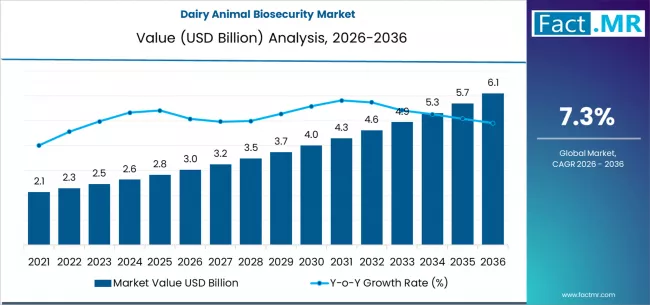
Dairy Animal Biosecurity Market Market Value Analysis | Source: Fact.MR
The rise of zoonotic threats and tightening regulations on antibiotic use are compelling producers to prioritize preventative health measures. The market is no longer just about reaction but about building resilient systems.
Key trends center on technological integration and data-driven management. Biosecurity is evolving from basic disinfectants to integrated systems combining environmental monitoring, animal wearables, and facility access control.
The adoption of IoT sensors for tracking animal movement and air quality represents a significant shift. Consumer and regulatory pressure for transparency is fueling investments in traceability and audit-ready biosecurity protocols, transforming farm management practices.
Metric
| Metric | Value |
|---|---|
| Market Value (2026) | USD 3.03 Billion |
| Market Forecast Value (2036) | USD 6.11 Billion |
| Forecast CAGR 2026 to 2036 | 7.3% |
Source: Fact.MR analysis. Updated Jan 12, 2026
Category
| Category | Segments |
|---|---|
| Product | Disinfectants & Sanitizers, Vaccination Programs, Monitoring & Surveillance Tools, Access Control Systems |
| Application | Disease Prevention, Outbreak Containment, Routine Herd Management |
| End User | Large Dairy Farms, Integrated Dairy Operations, Veterinary Service Providers |
| Region | North America, Latin America, Western Europe, Eastern Europe, East Asia, South Asia & Pacific, Middle East & Africa |
Source: Fact.MR analysis. Updated Jan 12, 2026
Segmental Analysis
By Product, Which Segment Forms the Foundational Layer of All Biosecurity Protocols?
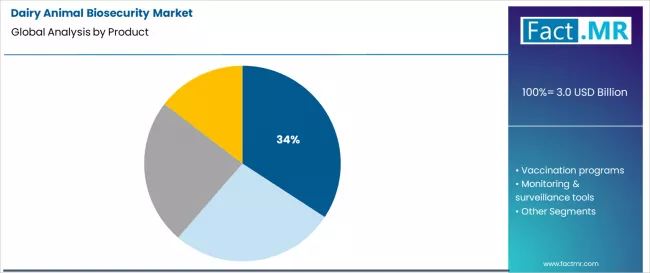
Dairy Animal Biosecurity Market Analysis By Product | Source: Fact.MR
Disinfectants and sanitizers command a leading 34.2% share. This segment represents the essential, non-negotiable first line of defense against pathogens in the dairy animal biosecurity market.
Consistent, high-volume use across every farm, from footbaths and equipment washes to building fogging, ensures a baseline of environmental hygiene. Growth is driven by innovations in longer-lasting, broad-spectrum, and environmentally friendly formulations that meet both efficacy and regulatory standards.
By Application, Which Focus Area Captures the Core Economic Rationale for Investment?
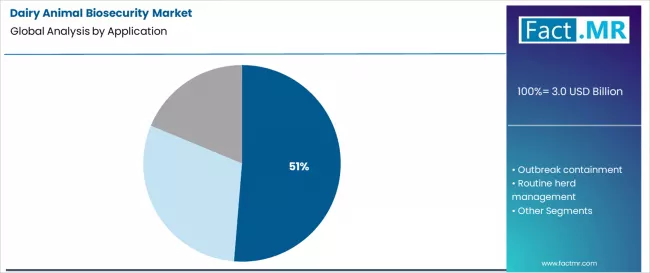
Dairy Animal Biosecurity Market Analysis By Application | Source: Fact.MR
Disease prevention constitutes the dominant application segment at 51.3%. This reflects the core economic driver of the dairy animal biosecurity market, which involves preventing costly outbreaks of diseases like mastitis, BVD, or Johne’s is far more economical than treatment and production loss. Investments here are proactive, encompassing everything from vaccination programs to visitor protocols, directly aimed at safeguarding herd health, milk yield, and farm profitability.
By End User, Which Group Drives Adoption of Systematic and Capital-Intensive Solutions?
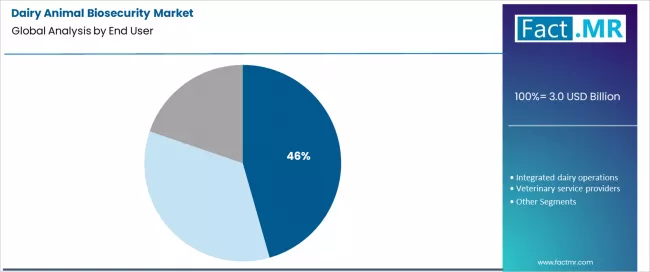
Dairy Animal Biosecurity Market Analysis By End User | Source: Fact.MR
Large dairy farms form the primary end-user segment at 45.6%. These operations manage thousands of animals, where a single disease introduction can cause catastrophic losses. Their scale justifies investment in comprehensive, systematic biosecurity infrastructure, including sophisticated monitoring tools, automated sanitization systems, and dedicated veterinary oversight. They serve as early adopters for integrated solutions that smaller farms may later adopt in simplified forms.
What are the Principal Drivers, Constraints, and Evolving Dynamics Influencing the Dairy Animal Biosecurity Market?
The principal driver for the dairy animal biosecurity market is the global intensification of dairy production, which increases herd density and the potential speed of disease transmission, making robust protocols a financial imperative. A major constraint is the significant operational cost and labor required to maintain stringent biosecurity measures consistently, especially on smaller farms.
A significant opportunity lies in the integration of digital monitoring tools with traditional practices, enabling data-driven risk assessment and predictive alerts. The dominant trend is the professionalization and certification of biosecurity protocols, moving beyond farm-specific checklists to auditable, standardized systems required by milk buyers, insurers, and regulators, creating a market for verification and consultancy services.
Analysis of the Dairy Animal Biosecurity Market by Key Countries
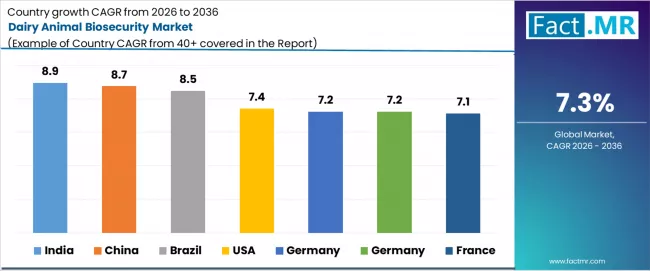
Dairy Animal Biosecurity Market Cagr Analysis By Country | Source: Fact.MR
| Country | CAGR 2026 to 2036 |
|---|---|
| India | 8.9% |
| China | 8.7% |
| Brazil | 8.5% |
| USA | 7.4% |
| Germany | 7.2% |
| UK | 7.2% |
| France | 7.1% |
Source: Fact.MR analysis. Updated Jan 12, 2026
Is the USA's Market Advancement Linked to Consumer-Driven Antibiotic Reduction Pressures?
Consumer and retail demand for milk from cows raised with reduced antibiotics heavily influence the USA’s 7.4% CAGR. This shifts the dairy animal biosecurity market focus squarely onto preventative vaccination programs and advanced environmental management to maintain herd health without reliance on therapeutics, driving adoption of comprehensive on-farm health plans.
Can Brazil's Expansion as a Dairy Exporter Overcome Infrastructure-Driven Biosecurity Hurdles?
Brazil’s 8.5% CAGR is tied to its ambition to become a major global dairy exporter. Growth in the dairy animal biosecurity market is driven by the need to meet stringent international animal health standards for trade. This requires overcoming challenges related to large geographic distances and integrating biosecurity into extensive grazing systems, favoring solutions for perimeter control and transportation hygiene.
Does China's Rapid Consolidation into Mega-Farms Create a Unique Model for Closed-Loop Systems?
China’s 8.7% CAGR is propelled by the state-backed consolidation of dairy production into massive, vertically integrated operations. This scale allows for the implementation of exceptionally strict, closed-loop biosecurity systems where every input and movement is controlled. The dairy animal biosecurity market here focuses on high-throughput disinfection tunnels, centralized veterinary programs, and isolation facilities unmatched in scale elsewhere.
Will India's Market Growth Be Defined by the Dual Challenge of Productivity and Disease Eradication?
The mission to boost milk yield while combating endemic diseases like Foot-and-Mouth fuels India’s leading 8.9% CAGR. The dairy animal biosecurity market is characterized by a push to implement basic, scalable protocols across millions of smallholders through cooperative structures, focusing on affordable disinfectants, widespread vaccination campaigns, and mobile veterinary surveillance.
Is Germany's Precision Agriculture Ethos Extending to Pathogen Mapping and Risk Analytics?
Germany’s 7.2% CAGR reflects a market moving beyond physical products to biosecurity intelligence. The focus is on integrating environmental sensors, animal movement data, and regional disease maps to create predictive risk models for farms. This data-driven approach aims to optimize intervention timing and resource allocation within the dairy animal biosecurity framework.
Does France's Emphasis on Pasture-Based and AOP Cheese Production Forge a Niche for Tailored Protocols?
France’s 7.1% CAGR is closely linked to its pasture-based systems and Protected Designation of Origin (AOP) cheese productions. The dairy animal biosecurity market must adapt to open grazing environments, focusing on wildlife disease vectors, perimeter fencing, and breed-specific health monitoring that aligns with traditional practices while ensuring herd safety.
Is the UK's Post-Brexit Regulatory Independence Reshaping Its Biosecurity Investment Priorities?
The UK’s 7.2% CAGR is influenced by its development of independent biosecurity standards post-Brexit. The dairy animal biosecurity market is prioritizing defenses against specific disease threats now deemed higher risk due to changed trade dynamics, leading to targeted investments in border control technologies and national livestock tracking systems.
Competitive Landscape of the Dairy Animal Biosecurity Market
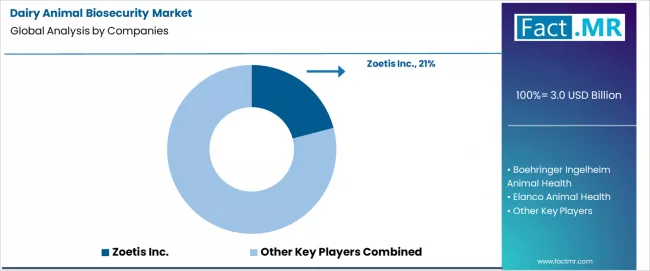
Dairy Animal Biosecurity Market Analysis By Company | Source: Fact.MR
The competitive landscape features a mix of animal health pharmaceutical giants and specialized hygiene and diagnostics companies. Leaders like Zoetis and Boehringer Ingelheim leverage their vast portfolios of vaccines and pharmaceuticals, positioning biosecurity as the essential platform to maximize therapeutic efficacy and prevent disease. Specialists like Neogen compete through advanced diagnostic tests, environmental monitoring tools, and specialized disinfectant chemistries.
Success increasingly depends on providing integrated system solutions rather than individual products. Companies are forming alliances to offer combined packages of vaccines, diagnostics, disinfectants, and data management software. The ability to deliver tailored biosecurity plans with measurable ROI, supported by technical service and training, is becoming the key competitive differentiator in a market moving from commodity purchases to strategic herd health partnerships.
Key Players in the Dairy Animal Biosecurity Market
- Zoetis Inc.
- Boehringer Ingelheim Animal Health
- Elanco Animal Health
- Neogen Corporation
- Ceva Santé Animale
- Others
Bibliography
- Dairy Farmers of America (DFA). (2025). National Dairy FARM Biosecurity Reference Guide.
- Food and Agriculture Organization (FAO). (2024). Biosecurity Guide for Dairy Production Systems. FAO Animal Production and Health Guidelines.
- National Mastitis Council (NMC). (2025). Protocols for Hygiene and Infection Control in Dairy Herds.
- World Organisation for Animal Health (WOAH). (2024). Terrestrial Animal Health Code: Biosecurity Standards for Dairy Farms.
Segmentation
Scope of Report
| Items | Values & Coverage |
|---|---|
| Quantitative Units | USD Billion |
| Product | Disinfectants & Sanitizers, Vaccination Programs, Monitoring & Surveillance Tools, Access Control Systems |
| Application | Disease Prevention, Outbreak Containment, Routine Herd Management |
| End User | Large Dairy Farms, Integrated Dairy Operations, Veterinary Service Providers |
| Key Countries | India, China, Brazil, USA, Germany, France, UK |
| Key Companies | Zoetis, Boehringer Ingelheim, Elanco, Neogen, Ceva, Others |
| Additional Analysis | Cost-benefit analysis of implementing different biosecurity tiers; efficacy testing of disinfectants against emerging pathogens; impact of biosecurity on antibiotic usage metrics; study of insurance and financing products for biosecurity investments. |
Source: Fact.MR analysis. Updated Jan 12, 2026
Market by Segments
-
Product :
- Disinfectants & Sanitizers
- Vaccination Programs
- Monitoring & Surveillance Tools
- Access Control Systems
-
Application :
- Disease Prevention
- Outbreak Containment
- Routine Herd Management
-
End User :
- Large Dairy Farms
- Integrated Dairy Operations
- Veterinary Service Providers
-
Region :
-
North America
- USA
- Canada
-
Latin America
- Brazil
- Mexico
- Argentina
- Rest of Latin America
-
Western Europe
- Germany
- France
- UK
- Italy
- Spain
- BENELUX
- Rest of Western Europe
-
Eastern Europe
- Russia
- Poland
- Czech Republic
- Rest of Eastern Europe
-
East Asia
- China
- Japan
- South Korea
- Rest of East Asia
-
South Asia & Pacific
- India
- ASEAN
- Australia
- Rest of South Asia & Pacific
-
MEA
- GCC Countries
- South Africa
- Turkiye
- Rest of MEA
-
Frequently Asked Questions
How big is the dairy animal biosecurity market in 2026?
What will be the size of dairy animal biosecurity market in 2036?
How much will be the dairy animal biosecurity market growth between 2026 and 2036?
What are the key product types in the dairy animal biosecurity market?
Which application segment to contribute significant share in the dairy animal biosecurity market in 2026?
Who worked on this report


Preview the report firsthand - request a free sample
Free SampleGet the brochure for pricing and purchase details
Download PDF