- Base Value(2025): 4.0 Bn
- Estimated Value(2026): 4.0 Bn
- Forecast Value (2036): 5.6 Bn
- CAGR (2026 - 2036): 3.8%
Anti-Wear Additives Market Forecast 2026 to 2036
In 2025, the anti-wear additives market was valued at USD 4.0 billion. Based on Fact MR's analysis, demand for anti-wear additives is estimated to grow to USD 4.0 billion in 2026 and USD 5.6 billion by 2036. FMR projects a CAGR of 3.8% during the forecast period.
The absolute dollar growth from 2026 to 2036 is USD 1.6 billion. This growth is driven by the increasing demand for high-performance lubricants and additives across industries such as automotive, manufacturing, and heavy equipment. The adoption of anti-wear additives is essential for reducing friction, improving fuel efficiency, and extending the lifespan of machinery. However, the market may face challenges like raw material price volatility and evolving environmental regulations.
China leads with a CAGR of 4.5%, supported by increasing industrial activity and demand for high-performance lubricants. Brazil follows with a 4.2% CAGR, driven by growing industrialization and machinery maintenance needs. South Korea grows at 3.7%, benefiting from its advanced automotive and industrial sectors. The USA shows growth at 3.6%, driven by demand for efficient lubrication solutions in automotive and manufacturing industries. The UK and Europe experience growth rates of 3.3% and 3.5%, respectively, supported by demand for environmentally friendly lubricants and regulatory compliance. Japan experiences slower growth at 2.8%, reflecting a mature market with established demand for anti-wear solutions.
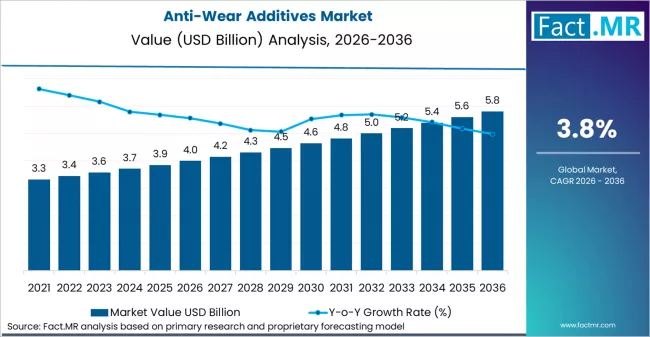
Anti Wear Additives Market Market Value Analysis | Source: Fact.MR
Anti‑Wear Additives Market Definition
The Anti‑Wear Additives Market refers to the production and sale of chemical additives formulated to reduce wear between moving metal surfaces in lubricated systems. These additives form protective films under boundary lubrication conditions to lower friction and delay surface degradation in engines, transmissions, gears, and industrial machinery. Their primary function is to extend component life and improve reliability. Key end uses include automotive engines, industrial gearboxes, metalworking fluids, marine equipment, and hydraulic systems.
Market Inclusions
This report covers global and regional market sizes for anti‑wear additives with a defined forecast period. It includes segment breakdowns by additive type (zinc dialkyldithiophosphate (ZDDP), phosphorus derivatives, sulfur‑based, boron compounds), application (engine oils, gear oils, hydraulic fluids, metalworking), and end user. Pricing trends, raw material supply, and trade flow data are also analyzed to reflect overall market dynamics.
Market Exclusions
The scope excludes unrelated lubricant additives such as detergents, dispersants, viscosity index improvers, and friction modifiers without primary anti‑wear function. Base oils and finished lubricants are not covered. Niche specialty chemistries used solely outside lubrication contexts (for example in coatings or adhesives) are omitted to focus strictly on anti‑wear additive products.
Research Methodology
- Primary Research: Interviews were conducted with additive formulators, lubricant manufacturers, and industry analysts.
- Desk Research: Data was sourced from industry reports, trade associations, and government statistics.
- Market‑Sizing and Forecasting: A hybrid model was used, combining top‑down assessment of lubricant additive demand with bottom‑up shipment and revenue data.
Data Validation and Update Cycle
Findings were validated through expert review and aligned with recent production and trade figures, with periodic updates.
Anti-Wear Additives Market Summary
Anti-Wear Additives Market Definition
The Anti-Wear Additives Market pertains to the production and sale of chemical additives formulated to reduce wear between moving metal surfaces in lubricated systems. These additives form protective films under boundary lubrication conditions, helping reduce friction and delay surface degradation in engines, transmissions, gears, and industrial machinery. Their primary purpose is to extend the life of components and improve overall system reliability. The key applications include automotive engine oils, industrial gearboxes, metalworking fluids, hydraulic systems, and marine equipment.
Demand Drivers in the Market
- Increase in High-Performance Lubricants: As industries like automotive, aerospace, and heavy machinery demand high-performance lubricants, the need for effective anti-wear additives has grown, ensuring durability and efficiency in high-stress environments.
- Stricter Regulatory Standards: With increasing regulations on emissions and fuel efficiency, industries are focusing on lubricants that can improve engine performance while reducing wear, driving demand for advanced anti-wear additives.
- Growth in Automotive and Industrial Manufacturing: The rise in production of complex and high-performance vehicles, coupled with expanding industrial activities, is fueling the need for specialized anti-wear additives that offer superior protection and efficiency.
- Technological Advancements: Modern automotive engines and industrial machinery are subject to higher pressures and temperatures, requiring specialized additives that can meet evolving performance standards for longevity and reliability.
Key Segments Analyzed in the FMR Report
- Chemistry: ZDDP (Zinc Dialkyldithiophosphate) is projected to hold a dominant 51% market share by 2026 due to its proven effectiveness in reducing friction and wear in automotive and industrial lubricants.
- End Industry: The automotive industry is expected to dominate with 49% of the market share by 2026, driven by the growing complexity of modern engines and the need for lubricants that can ensure efficient performance and durability.
- Packaging: Single-Component AW is anticipated to lead the packaging segment as it simplifies the formulation and application of anti-wear additives, ensuring consistency and ease of use in various lubricant systems.
Analyst Opinion at FMR
Fact MR analyst Shambhu Nath Jha predicts, "The anti-wear additives market will continue to grow steadily, driven by the increasing demand for lubricants that ensure the efficient and long-lasting performance of high-performance engines and machinery, especially in the automotive and industrial manufacturing sectors."
Strategic Implications/Executive Takeaways
- Focus on Advanced Additives: Manufacturers should invest in developing innovative anti-wear additives that meet new regulatory standards and the evolving demands of high-performance engines and machinery.
- Regional Opportunities: The rapid industrialization in regions like China and Brazil offers significant growth opportunities for anti-wear additives, especially with the rising demand for lubricants in automotive and industrial applications.
- Sustainability Integration: With increasing environmental concerns, there is an opportunity to focus on developing eco-friendly anti-wear additives that align with sustainability trends in automotive and industrial markets.
Methodology
- Primary Research: Interviews were conducted with lubricant formulators, automotive OEMs, and industry analysts to gather insights into market trends, lubricant requirements, and additive usage.
- Desk Research: Data was sourced from industry reports, trade associations, and government statistics to analyze global and regional trends in the use of anti-wear additives.
- Market Sizing and Forecasting: A hybrid approach combining top-down and bottom-up analysis was used to project market growth, incorporating insights from key industry players and recent production and trade data.
Segmental Analysis
Anti-Wear Additives Market Analysis by Chemistry
- Market Overview: ZDDP (Zinc Dialkyldithiophosphate) is expected to hold 51% of the anti-wear additives market by 2026. ZDDP is widely used for its excellent anti-wear and anti-oxidation properties, particularly in lubricants for automotive and industrial applications. It plays a crucial role in reducing friction and wear in engine components, enhancing their durability and performance.
- Demand Drivers:
- Effectiveness in High-Pressure Applications: ZDDP is highly effective in high-pressure environments, such as engine valves and camshafts, where wear resistance is critical. This makes it a preferred choice for automotive, industrial, and other high-performance machinery.
- Widespread Adoption in Automotive and Industrial Markets: The demand for ZDDP remains high due to its ability to meet stringent lubrication requirements for modern engines, both in passenger vehicles and industrial machinery.
- Regulatory and Formulation Stability: ZDDP remains the standard anti-wear additive despite ongoing shifts toward lower-phosphorus formulations, as it offers reliable performance and cost-effectiveness, which contributes to its continued dominance in the market.
Anti-Wear Additives Market Analysis by End Industry
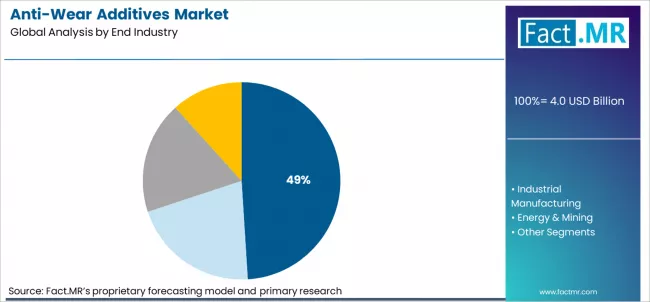
Anti Wear Additives Market Analysis By End Industry | Source: Fact.MR
- Market Overview: The automotive industry is projected to capture 49% of the anti-wear additives market by 2026. Anti-wear additives are critical in automotive lubricants, particularly in engine oils, to ensure the longevity and efficiency of engine components. As automotive technology advances and vehicles become more complex, the demand for high-performance lubricants containing anti-wear additives is growing.
- Demand Drivers:
- Increase in Engine Durability Standards: As engines become more powerful and efficient, there is a higher demand for lubricants that can protect against wear and tear. Anti-wear additives help maintain engine performance, reduce friction, and extend component life, making them essential in the automotive sector.
- Growing Production of Advanced Vehicles: The rising production of vehicles with turbocharged and hybrid engines, which place more stress on engine components, increases the need for lubricants with high-performance anti-wear additives.
- Regulatory Compliance and Performance Enhancements: Automotive manufacturers are increasingly focused on meeting stricter emissions regulations while enhancing fuel efficiency. Anti-wear additives play a critical role in achieving these goals by optimizing engine performance and ensuring smoother operation under varied driving conditions.
Anti Wear Additives Market Drivers, Restraints, and Opportunities
FMR analysts observe that the anti‑wear additives market is a mature, performance‑anchored segment within lubricant formulations, rooted in the fundamental need to reduce metal‑to‑metal contact in engines, transmissions, and industrial gear systems. Historically, zinc dialkyldithiophosphate (ZDDP) and similar chemistries dominated because they delivered reliable wear protection across a wide range of operating conditions. The 2026 valuation reflects this structural reality, where baseline demand remains tied to global fleets, heavy‑duty equipment, and industrial machinery, even as formulation trends shift with new powertrain technologies.
While demand for traditional anti‑wear chemistries in conventional engine oils is declining due to electrification and low‑SAPs (sulfated ash, phosphorus, sulfur) formulation requirements, there is growing uptake of advanced, low‑impact additives designed for hybrid, EV gearbox fluids, and next‑generation industrial lubricants. These advanced additives often carry higher per‑unit prices, contributing to net market value growth despite slower volume expansion. The market exists at its current size because wear protection remains critical across legacy and emerging systems, and regulatory emission and performance standards continue to shape formulation choices.
- Formulation Evolution: Shift from traditional high‑ZDDP additives to advanced, low‑ash anti‑wear chemistries driven by engine and EV gearbox fluid requirements raises average selling prices.
- Regulatory Performance Standards: Emissions and durability standards such as API SP/ILSAC GF‑6 and OEM EV lubricant specifications push formulators toward compliant anti‑wear packages that meet friction and wear limits.
- Regional Powertrain Dynamics: In Europe and North America, hybrid and EV adoption accelerates demand for specialized anti‑wear additives in new fluid categories, while in many Asia‑Pacific markets conventional engine oil additives remain significant due to large ICE fleets.
Regional Analysis
The market analysis covers key global regions, including North America, East Asia, South Korea, Western Europe, Latin America, and Germany. It is segmented geographically, with specific market dynamics for each region. The full report provides a detailed market attractiveness analysis.
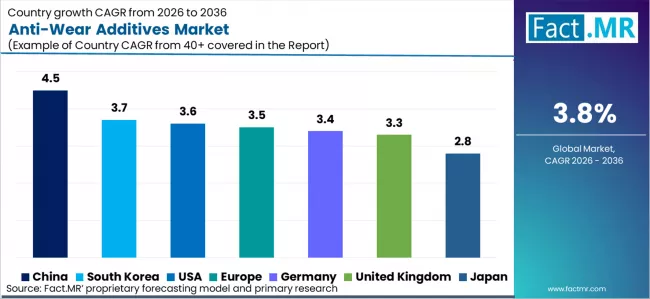
Anti Wear Additives Market Cagr Analysis By Country | Source: Fact.MR
| Country | CAGR (2026-2036) |
|---|---|
| USA | 3.6% |
| Japan | 2.8% |
| South Korea | 3.7% |
| Europe | 3.5% |
| Germany | 3.4% |
| China | 4.5% |
| United Kingdom | 3.3% |
| Brazil | 4.2% |
Source: Fact.MR analysis. Updated Feb 18, 2026
Source: Fact MR (FMR) analysis, based on proprietary forecasting model and primary research.
North America:
The USA remains a "stable market" for anti-wear additives, driven by the growing demand for high-performance lubricants in automotive, industrial, and machinery applications.
- USA: Demand for anti-wear additives in the U.S. is projected to rise at 3.6% CAGR through 2036. The increasing demand for high-performance lubricants and rising industrial activities in sectors such as automotive and machinery are key factors driving market growth.
East Asia:
East Asia, particularly China, is a "key growth region" for anti-wear additives, supported by the rapid expansion of industrial activities and rising demand for lubricants in machinery and automotive sectors.
- China: Demand for anti-wear additives in China is projected to rise at 4.5% CAGR through 2036. China’s industrial growth, coupled with the expansion of the automotive sector, continues to drive the demand for anti-wear additives in lubricants and machinery oils.
- Japan: Demand for anti-wear additives in Japan is projected to rise at 2.8% CAGR through 2036. Japan’s automotive industry and manufacturing growth continue to support the steady demand for high-quality lubricants with anti-wear additives.
South Korea:
South Korea is a "key player in industrial manufacturing," with increasing demand for anti-wear additives in the automotive and machinery industries driving market expansion.
- South Korea: Demand for anti-wear additives in South Korea is projected to rise at 3.7% CAGR through 2036. The growing automotive sector and industrial expansion continue to drive the need for high-performance lubricants in the country.
Western Europe:
Western Europe remains a "mature market" for anti-wear additives, with steady growth driven by regulatory pressures, advanced manufacturing technologies, and demand for high-performance lubricants in various industries.
- Germany: Demand for anti-wear additives in Germany is projected to rise at 3.4% CAGR through 2036. Germany’s industrial sector, including automotive and machinery, along with the demand for high-quality lubricants, continues to support market growth.
- United Kingdom: Demand for anti-wear additives in the UK is projected to rise at 3.3% CAGR through 2036. The UK’s automotive and manufacturing industries continue to drive the demand for anti-wear additives, with a focus on sustainable and high-performance lubricants.
Latin America:
In Latin America, particularly Brazil, the demand for anti-wear additives is growing due to industrial expansion and increasing adoption of high-performance lubricants in automotive and machinery sectors.
- Brazil: Demand for anti-wear additives in Brazil is projected to rise at 4.2% CAGR through 2036. Brazil’s growing industrial and automotive sectors, along with the adoption of advanced lubricants, contribute to market growth.
Fact MR's analysis of the Anti-Wear Additives Market in North America, East Asia, South Korea, Western Europe, Latin America, and Germany consists of country-wise assessments that include the USA, Japan, South Korea, Germany, China, the United Kingdom, and Brazil. Readers can find detailed trends, regulatory updates, and company-specific investments shaping the market’s growth in these countries.
How Are Key Players Competing in the Anti-Wear Additives Market?
The anti-wear additives market is driven by global demand for lubricants that enhance the performance and lifespan of industrial machinery, engines, and automotive systems. The Lubrizol Corporation, Infineum International Limited, and Afton Chemical Corporation lead the market by offering advanced additive solutions that minimize friction and wear, thus improving the longevity and efficiency of engines. Chevron Oronite Company LLC and BASF SE are focusing on creating additives that meet the latest regulatory standards, enhancing fuel efficiency and engine protection. LANXESS AG and Evonik Operations GmbH emphasize high-performance additives for both automotive and industrial applications. RT Vanderbilt Holding Company, Inc. and Dorf Ketal Chemicals India Private Limited cater to niche markets with cost-effective solutions while ensuring compliance with global standards. Sinopec, with its strong presence in the Chinese market, is positioning itself as a key player in the growing demand for anti-wear additives, particularly for automotive and industrial applications in Asia.
Recent Industry Developments
- BASF expanded its NeoSteel Eco product line in January 2024 by launching a new molybdenum disulfide-based solid lubricant designed to provide sustainable, high-performance wear protection across heavy industrial applications.
- In October 2025, Lubrizol launched Lubrizol® AH933ZF, a specialized zinc-free hydraulic additive package that provides advanced anti-wear protection for mining and marine equipment while meeting the strict environmental regulations of North America and Europe.
- BASF is currently completing a major capacity expansion at its Puebla, Mexico site, scheduled for 2026 completion, to significantly increase the production of aminic antioxidants and anti-wear components to meet growing global demand for long-life lubricants.
Key Players of the Anti‑Wear Additives Market
- The Lubrizol Corporation
- Infineum International Limited
- Afton Chemical Corporation
- Chevron Oronite Company LLC
- BASF SE
- LANXESS AG
- Evonik Operations GmbH
- RT Vanderbilt Holding Company, Inc. (Vanderbilt Chemicals)
- Dorf Ketal Chemicals India Private Limited
- China Petroleum & Chemical Corporation (Sinopec)
Report Scope
| Metric | Value |
|---|---|
| Quantitative Units | USD 4.0 billion (2026) to USD 5.6 billion (2036), at a CAGR of 3.8% |
| Market Definition | The Anti-Wear Additives Market includes chemical additives used in lubricants to reduce friction and wear in engine oils, hydraulic fluids, gear oils, and greases, improving the performance and lifespan of machinery. |
| By Chemistry | ZDDP, Ashless Phosphorus-Based, Borate Esters, Molybdenum / Other |
| By Application | Engine Oils, Hydraulic Fluids, Gear Oils, Industrial Greases |
| By End Industry | Automotive, Industrial Manufacturing, Energy & Mining, Marine & Aviation |
| By Packaging | Single-Component AW, Additive Packages, Pre-Blends / Masterbatches, Other |
| Regions Covered | North America, Latin America, Europe, East Asia, South Asia, Oceania, Middle East and Africa |
| Countries Covered | United States, Canada, Mexico, Brazil, Argentina, Germany, France, United Kingdom, Italy, Spain, China, India, Japan, South Korea, Indonesia, Australia, and 40+ countries |
| Key Companies Profiled | The Lubrizol Corporation, Infineum International Limited, Afton Chemical Corporation, Chevron Oronite Company LLC, BASF SE, LANXESS AG, Evonik Operations GmbH, RT Vanderbilt Holding Company, Inc. (Vanderbilt Chemicals), Dorf Ketal Chemicals India Private Limited, China Petroleum & Chemical Corporation (Sinopec) |
| Forecast Period | 2026 to 2036 |
| Approach | Hybrid top-down and bottom-up market modeling validated through primary interviews with manufacturers and supported by trade data benchmarking and market research. |
Source: Fact.MR analysis. Updated Feb 18, 2026
Bibliographies
- BASF Expands NeoSteel Eco Product Line: BASF. (2024, January). BASF expands NeoSteel Eco product line with new molybdenum disulfide-based solid lubricant. BASF.
- Lubrizol Launches Lubrizol® AH933ZF: Lubrizol. (2025, October). Lubrizol launches Lubrizol® AH933ZF hydraulic additive package. Lubrizol.
- BASF Completes Puebla, Mexico Capacity Expansion: BASF. (2025-2026). BASF completing major capacity expansion at Puebla, Mexico site. BASF.
Segmentation
Anti Wear Additives Market Key Segments
-
By Chemistry :
- ZDDP
- Ashless Phosphorus-Based
- Borate Esters
- Molybdenum / Other
-
By Application :
- Engine Oils
- Hydraulic Fluids
- Gear Oils
- Industrial Greases
-
By End Industry :
- Automotive
- Industrial Manufacturing
- Energy & Mining
- Marine & Aviation
-
By Packaging :
- Single-Component AW
- Additive Packages
- Pre-Blends / Masterbatches
- Other
-
Region :
- North America
- USA
- Canada
- Mexico
- Europe
- Germany
- UK
- France
- Italy
- Spain
- Nordic Countries
- BENELUX
- Rest of Europe
- Asia Pacific
- China
- Japan
- South Korea
- India
- Australia
- Rest of Asia Pacific
- Latin America
- Brazil
- Argentina
- Rest of Latin America
- Middle East and Africa
- Kingdom of Saudi Arabia
- United Arab Emirates
- South Africa
- Rest of Middle East and Africa
- Other Regions
- Oceania
- Central Asia
- Other Markets
- North America
Frequently Asked Questions
How large is the demand for Anti-Wear Additives in the global market in 2026?
What will be the market size of Anti-Wear Additives in the global market by 2036?
What is the expected demand growth for Anti-Wear Additives in the global market between 2026 and 2036?
Which chemistry is expected to dominate the market?
Which region is expected to show the highest growth rate for Anti-Wear Additives?
How significant is the growth outlook for Brazil in this market?
What is the growth outlook for the United States in this report?
What is the growth forecast for Japan in the Anti-Wear Additives market?
What is the growth forecast for South Korea in this market?
Which European market is highlighted in this analysis?
Which company is identified as a leading player in the Anti-Wear Additives market?
What are Anti-Wear Additives used for?
What does the Anti-Wear Additives market include in this report?
How is the market forecast developed in this report?
What is meant by the Anti-Wear Additives market in this report?
Who worked on this report


Preview the report firsthand - request a free sample
Free SampleGet the brochure for pricing and purchase details
Download PDF