Antimicrobial Bottle Closures Market
Antimicrobial Bottle Closures Market Size and Share Forecast Outlook 2026 to 2036
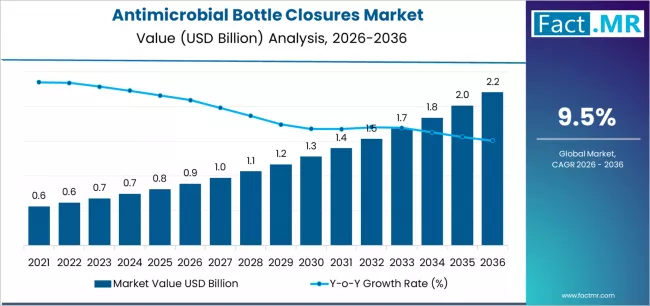
Antimicrobial bottle closures market is projected to grow from USD 0.9 billion in 2026 to USD 2.2 billion by 2036, at a CAGR of 9.5%. Personal Care & Pharma will dominate with a 38.0% market share, while screw caps & pumps will lead the packaging format/type segment with a 50.0% share.
Antimicrobial Bottle Closures Market Forecast and Outlook 2026 to 2036
The global antimicrobial bottle closures market is valued at USD 0.89 billion in 2026. The market is forecast to reach USD 2.20 billion by 2036, an increase of USD 1.31 billion. This represents total growth of 147.2%, expanding at a compound annual growth rate (CAGR) of 9.5% between 2026 and 2036.
Quick Stats for Antimicrobial Bottle Closures Market
- Market Value (2026): USD 0.89 Billion
- Market Forecast Value (2036): USD 2.20 Billion
- Market Forecast CAGR: 9.5%
- Leading End-Use: Personal Care & Pharma (38.0%)
- Key Growth Regions: Asia Pacific, North America, Europe
- Key Players: AptarGroup, Inc., Berry Global, Inc., Amcor plc, Uflex Limited, Klabin S.A., Takemoto Yohki Co., Ltd.

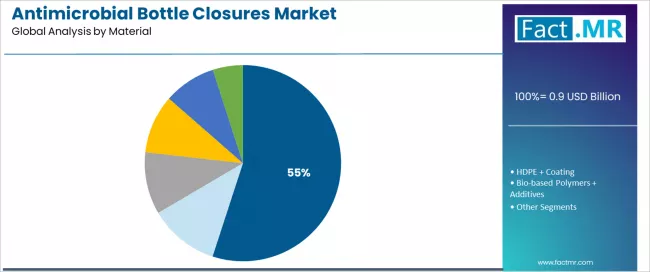
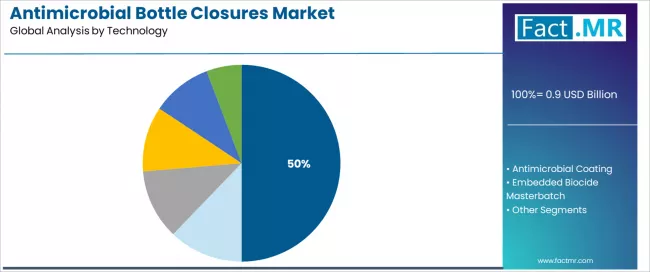
Segmentation indicates a market focused on hygiene and preservation. By end-use, the personal care and pharmaceutical sector commands a leading 38.0% share in 2026. Screw caps and pumps dominate the packaging format segment with a 50.0% share. Polypropylene infused with antimicrobial additives holds a 55.0% material share, while silver-based surface coating is the primary technology with a 50.0% share. This data reflects a priority on integrating active protection into high-touch, everyday dispensing systems.
An important trend in the market is the permanent shift in consumer and regulatory expectations for product hygiene following the global pandemic. This has elevated antimicrobial features from a niche benefit to a standard expectation for products where human contact is frequent, such as hand creams, shampoos, and liquid soaps. The closure is now a critical line of defense against microbial transfer, driving brands to adopt this technology to reinforce claims of cleanliness and safety.
Demand is shaped by the need for functional additives to coexist with sustainability goals. Innovations focus on ensuring antimicrobial efficacy does not hinder the recyclability of polypropylene or HDPE closures. Development is concentrated on surface-localized treatments and compatible masterbatches that protect the product without contaminating the polymer stream during recycling.
Key Takeaways from the Antimicrobial Bottle Closures Market
| Metric | Value |
|---|---|
| Estimated Value in (2026E) | USD 0.89 Billion |
| Forecast Value in (2036F) | USD 2.20 Billion |
| Forecast CAGR (2026 to 2036) | 9.5% |
Category
| Category | Segment |
|---|---|
| End-use/Application | Personal Care & Pharma, Food & Beverage, Healthcare, Household Cleaners, Dairy & Beverage, Others |
| Packaging Format/Type | Screw Caps & Pumps, Tamper-evident Closures, Dispensing Pumps, Flip-top & Pump Closures, Snap Caps, Others |
| Material | PP with Antimicrobial Additive, HDPE + Coating, Bio-based Polymers + Additives, Recycled PP + Coating, Multi-layer PP, Others |
| Technology | Surface Coating (Ag-based), Antimicrobial Coating, Embedded Biocide Masterbatch, Antimicrobial Laser Treatment, Surface Functionalization, Others |
| Region | North America, Europe, Asia Pacific, Latin America, MEA |
Segment Analysis
How is the Personal Care & Pharma Sector Redefining Hygiene at the Point of Dispense?
The personal care and pharma segment holds a 38.0% market share in 2026. This leadership stems from a fundamental change in how consumers interact with daily-use bottles. For lotions, nasal sprays, or eye drops, the closure is repeatedly touched, creating a risk of contamination that can degrade the product or pose a health risk.
Integrating antimicrobial properties directly into the cap or pump head addresses this concern at the source. Development focuses on solutions that offer long-lasting efficacy against a broad spectrum of microbes without affecting the product's fragrance or formulation. This transforms the closure from a simple seal into an active guardian of product integrity and user safety.
What Makes Screw Caps and Pumps the Ideal Platform for Integrated Protection?

Screw caps and pumps lead the packaging format segment with a 50.0% share. Their dominance is due to their universal application and high-frequency contact. These formats offer ample surface area for coatings and are structurally suited for incorporating additive masterbatches during molding.
For pumps, the added complexity lies in protecting both the external actuator and the internal mechanical components from microbial growth. The industry prioritizes these formats because they represent the most common interface between consumer and product; enhancing them delivers immediate perceived and functional value. Their standardized designs also allow for relatively straightforward integration of new antimicrobial materials into global production lines.
Why is PP with Additives the Preferred Material for Balancing Cost and Function?

Polypropylene with embedded antimicrobial additives accounts for a 55.0% material share. PP is favored for its excellent chemical resistance, durability, and cost-effectiveness. Incorporating additives directly into the polymer matrix during manufacturing ensures the antimicrobial property is distributed throughout the material, not just on the surface, offering longer-lasting protection even if the closure is scratched.
This method is also production-efficient. The key development challenge is selecting additives that are thermally stable during the high-heat injection molding process and that do not migrate into the product. PP’s versatility makes it the workhorse material for achieving a reliable, economical, and functional antimicrobial solution.
Are Silver-based Surface Coatings Setting the Standard for Immediate Efficacy?
Silver-based surface coating technology commands a 50.0% share. Its prevalence is due to the proven, broad-spectrum antimicrobial activity of silver ions. The coating approach allows for a highly concentrated active layer exactly where it is needed, on the surface where contact occurs. This method is particularly effective for applications requiring immediate and potent antimicrobial action, such in healthcare or food contact.
Development within this technology focuses on improving the durability of the coating to withstand repeated cleaning and abrasion, and on formulating coatings that are compliant with strict food and drug safety regulations. The powerful and recognizable efficacy of silver continues to make it a benchmark in the market.
What are the Drivers, Restraints, and Key Trends of the Antimicrobial Bottle Closures Market?
Enduring health and hygiene consciousness, stringent safety regulations in pharmaceutical and food packaging, and brand differentiation in crowded consumer goods markets propel market growth. The expansion of home healthcare and self-care product segments is a significant demand driver. Higher manufacturing costs compared to standard closures and potential regulatory complexities regarding the approval of new antimicrobial agents for food contact serve as key restraints.
Long-term environmental impact and end-of-life processing of treated plastics also require further study. Development concentrates on next-generation agents, such as plant-derived biocides and photocatalytic coatings. Another focus is on creating "smart" closures where an antimicrobial property works in tandem with indicators that signal contamination or product spoilage.
Analysis of the Antimicrobial Bottle Closures Market by Key Countries
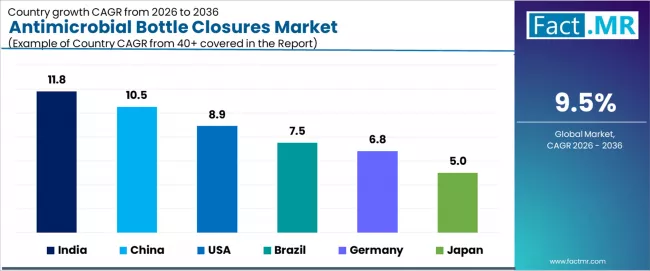
| Country | CAGR (2026-2036) |
|---|---|
| USA | 8.9% |
| Germany | 6.8% |
| China | 10.5% |
| India | 11.8% |
| Brazil | 7.5% |
| Japan | 5.0% |
How are USA’s Market Dynamics Shaped by Home Healthcare and Premium Personal Care?

The USA’s market grows at an 8.9% CAGR, strongly influenced by the growth of the home healthcare sector and the premiumization of personal care. Consumers managing health at home seek added assurance from medical device packaging and supplement bottles. In personal care, antimicrobial closures are a value-added feature justifying higher price points in segments like natural deodorants and scalp treatments. Development focuses on closures that meet both FDA requirements for relevant applications and the aesthetic demands of the beauty market.
- The rise of direct-to-consumer brands in wellness and beauty allows for rapid introduction and marketing of innovative closures with hygiene benefits.
- Retailer sustainability scorecards are pushing for solutions that pair antimicrobial function with use of recycled content in the closure substrate.
How does Germany’s Pharmaceutical Industry Influence Rigorous Standards for Closure Safety?
Germany’s market advances at a 6.8% CAGR, where demand is closely tied to the country's leading pharmaceutical and chemical sectors. Closures for medical solutions, disinfectants, and sensitive chemicals must have antimicrobial properties validated under rigorous testing protocols.
The market favors technologies with comprehensive data on efficacy spectrum, longevity, and material compatibility. Growth is methodical, driven by product reformulations and packaging upgrades that incorporate enhanced safety features as a competitive differentiator in B2B and professional markets.
- There is high demand for closures with technical documentation suitable for pharmaceutical dossiers and medical device registration.
- Development aligns with the EU’s push for safe and sustainable materials, focusing on biocides that are effective yet environmentally benign.
Is China’s Rapid Adoption Fueled by Food Safety and Mass-Market Personal Care?
China’s market is projected to grow at a 10.5% CAGR, driven by pervasive consumer concern over food safety and the scale of its personal care industry. In food and beverage, especially for sauces, condiments, and dairy, antimicrobial closures help address spoilage and safety concerns.
In personal care, the feature is becoming a common expectation in mid-market products. Development prioritizes cost-optimized manufacturing, such as highly efficient masterbatch processes, to serve the immense volume of the domestic market.
- Government food safety initiatives and standards create a favorable regulatory environment for adopting protective packaging technologies.
- Large domestic manufacturers are integrating antimicrobial compound production to secure supply chains and reduce costs for local brands.
Can India’s Healthcare Expansion and Climatic Needs Drive Specific Innovations?
India demonstrates the highest growth potential at an 11.8% CAGR. The booming pharmaceutical manufacturing sector and challenging hot, humid climate create a strong use case. Closures for oral liquids, syrups, and topical medications benefit from added protection against microbial growth.
Development focuses on affordable solutions effective against microbes prevalent in tropical environments. The market also sees growth in household insecticides and cleaners, where closures prevent contamination of the bottle neck.
- The growth of affordable generic medicines and over-the-counter products creates volume demand for functionally enhanced yet low-cost closures.
- Local innovation targets additive blends that remain effective in high humidity and are compatible with locally sourced polymer grades.
How is Brazil’s Market Focused on Household and Personal Care in a Humid Climate?
Brazil’s market is set to grow at a 7.5% CAGR, with demand centered on household cleaning products, personal disinfectants, and hair and skin care suited for a tropical climate. The feature helps preserve product efficacy in frequently opened bottles used in humid bathrooms and kitchens.
Growth leverages the local packaging manufacturing base to develop tailored solutions. The market favors technologies that are easily integrated into existing production lines for flip-top and pump closures commonly used in these segments.
- Consumer marketing heavily emphasizes the hygiene benefit, linking it to family health and well-being.
- There is growing interest in combining antimicrobial properties with closures made from bio-based or recycled polymers.
Does Japan’s Market Prioritize Precision, Cleanliness, and Dairy Safety?
Japan’s market grows at a 5.0% CAGR, characterized by an extreme focus on technical precision, cleanliness, and food safety. In the dairy and beverage sector, closures must prevent any risk of contamination in small-format, high-turnover products like milk drinks and yogurts. The market demands ultra-reliable, clean-touch surfaces.
Development focuses on incredibly smooth, defect-free coatings and additives that leave no odor or taste transfer, ensuring the closure protects without impacting the sensitive flavor profile of the product.
- Integration of antimicrobial features into sophisticated dispensing systems for liquid seasonings and condiments is a niche growth area.
- Stringent regulations on food-contact materials drive the development of specifically approved antimicrobial agents for use in Japan.
Competitive Landscape of the Antimicrobial Bottle Closures Market
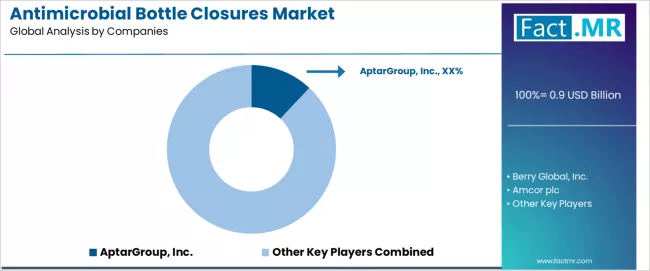
The competitive landscape features global closure specialists and material science companies. Competition centers on proprietary antimicrobial formulations, whether as additives, masterbatches, or coatings, and on securing regulatory approvals for key markets. Key players differentiate through close technical partnerships with brand owners to develop application-specific solutions and by investing in R&D for next-generation biocides.
Success requires a dual expertise in polymer processing and antimicrobial science, as well as the ability to navigate a complex global regulatory environment. Companies that can offer a full suite of services, from efficacy testing and regulatory support to scalable manufacturing, are positioned to lead, especially as demand expands from premium niches into broader consumer markets.
Key Players in the Antimicrobial Bottle Closures Market
- AptarGroup, Inc.
- Berry Global, Inc.
- Amcor plc
- Uflex Limited
- Klabin S.A.
- Takemoto Yohki Co., Ltd.
Scope of the Report
| Items | Values |
|---|---|
| Quantitative Units (2026) | USD 0.89 Billion |
| End-use/Application | Personal Care & Pharma, Food & Beverage, Healthcare, Household Cleaners, Dairy & Beverage, Others |
| Packaging Format/Type | Screw Caps & Pumps, Tamper-evident Closures, Dispensing Pumps, Flip-top & Pump Closures, Snap Caps, Others |
| Material | PP with Antimicrobial Additive, HDPE + Coating, Bio-based Polymers + Additives, Recycled PP + Coating, Multi-layer PP, Others |
| Technology | Surface Coating (Ag-based), Antimicrobial Coating, Embedded Biocide Masterbatch, Antimicrobial Laser Treatment, Surface Functionalization, Others |
| Regions Covered | North America, Europe, Asia Pacific, Latin America, MEA |
| Key Companies Profiled | AptarGroup, Inc., Berry Global, Inc., Amcor plc, Uflex Limited, Klabin S.A., Takemoto Yohki Co., Ltd. |
Antimicrobial Bottle Closures Market by Segments
-
End-use/Application :
- Personal Care & Pharma
- Food & Beverage
- Healthcare
- Household Cleaners
- Dairy & Beverage
- Others
-
Packaging Format/Type :
- Screw Caps & Pumps
- Tamper-evident Closures
- Dispensing Pumps
- Flip-top & Pump Closures
- Snap Caps
- Others
-
Material :
- PP with Antimicrobial Additive
- HDPE + Coating
- Bio-based Polymers + Additives
- Recycled PP + Coating
- Multi-layer PP
- Others
-
Technology :
- Surface Coating (Ag-based)
- Antimicrobial Coating
- Embedded Biocide Masterbatch
- Antimicrobial Laser Treatment
- Surface Functionalization
- Others
-
Region :
-
North America
- USA
- Canada
- Mexico
-
Europe
- Germany
- UK
- France
- Italy
- Spain
- Rest of Europe
-
Asia Pacific
- China
- India
- Japan
- South Korea
- Australia
- Rest of Asia Pacific
-
Latin America
- Brazil
- Argentina
- Rest of Latin America
-
MEA
- Saudi Arabia
- UAE
- South Africa
- Rest of MEA
-
Table of Content
- Executive Summary
- Global Market Outlook
- Demand to side Trends
- Supply to side Trends
- Technology Roadmap Analysis
- Analysis and Recommendations
- Market Overview
- Market Coverage / Taxonomy
- Market Definition / Scope / Limitations
- Market Background
- Market Dynamics
- Drivers
- Restraints
- Opportunity
- Trends
- Scenario Forecast
- Demand in Optimistic Scenario
- Demand in Likely Scenario
- Demand in Conservative Scenario
- Opportunity Map Analysis
- Product Life Cycle Analysis
- Supply Chain Analysis
- Investment Feasibility Matrix
- Value Chain Analysis
- PESTLE and Porter’s Analysis
- Regulatory Landscape
- Regional Parent Market Outlook
- Production and Consumption Statistics
- Import and Export Statistics
- Market Dynamics
- Global Market Analysis 2021 to 2025 and Forecast, 2026 to 2036
- Historical Market Size Value (USD Million) Analysis, 2021 to 2025
- Current and Future Market Size Value (USD Million) Projections, 2026 to 2036
- Y to o to Y Growth Trend Analysis
- Absolute $ Opportunity Analysis
- Global Market Pricing Analysis 2021 to 2025 and Forecast 2026 to 2036
- Global Market Analysis 2021 to 2025 and Forecast 2026 to 2036, By End-use/Application
- Introduction / Key Findings
- Historical Market Size Value (USD Million) Analysis By End-use/Application, 2021 to 2025
- Current and Future Market Size Value (USD Million) Analysis and Forecast By End-use/Application, 2026 to 2036
- Personal Care & Pharma
- Food & Beverage
- Healthcare
- Household Cleaners
- Dairy & Beverage
- Others
- Y to o to Y Growth Trend Analysis By End-use/Application, 2021 to 2025
- Absolute $ Opportunity Analysis By End-use/Application, 2026 to 2036
- Global Market Analysis 2021 to 2025 and Forecast 2026 to 2036, By Packaging Format/Type
- Introduction / Key Findings
- Historical Market Size Value (USD Million) Analysis By Packaging Format/Type, 2021 to 2025
- Current and Future Market Size Value (USD Million) Analysis and Forecast By Packaging Format/Type, 2026 to 2036
- Screw Caps & Pumps
- Tamper-evident Closures
- Dispensing Pumps
- Flip-top & Pump Closures
- Snap Caps
- Others
- Y to o to Y Growth Trend Analysis By Packaging Format/Type, 2021 to 2025
- Absolute $ Opportunity Analysis By Packaging Format/Type, 2026 to 2036
- Global Market Analysis 2021 to 2025 and Forecast 2026 to 2036, By Material
- Introduction / Key Findings
- Historical Market Size Value (USD Million) Analysis By Material, 2021 to 2025
- Current and Future Market Size Value (USD Million) Analysis and Forecast By Material, 2026 to 2036
- PP with Antimicrobial Additive
- HDPE + Coating
- Bio-based Polymers + Additives
- Recycled PP + Coating
- Multi-layer PP
- Others
- Y to o to Y Growth Trend Analysis By Material, 2021 to 2025
- Absolute $ Opportunity Analysis By Material, 2026 to 2036
- Global Market Analysis 2021 to 2025 and Forecast 2026 to 2036, By Technology
- Introduction / Key Findings
- Historical Market Size Value (USD Million) Analysis By Technology, 2021 to 2025
- Current and Future Market Size Value (USD Million) Analysis and Forecast By Technology, 2026 to 2036
- Surface Coating (Ag-based)
- Antimicrobial Coating
- Embedded Biocide Masterbatch
- Antimicrobial Laser Treatment
- Surface Functionalization
- Others
- Y to o to Y Growth Trend Analysis By Technology, 2021 to 2025
- Absolute $ Opportunity Analysis By Technology, 2026 to 2036
- Global Market Analysis 2021 to 2025 and Forecast 2026 to 2036, By Region
- Introduction
- Historical Market Size Value (USD Million) Analysis By Region, 2021 to 2025
- Current Market Size Value (USD Million) Analysis and Forecast By Region, 2026 to 2036
- North America
- Latin America
- Western Europe
- Eastern Europe
- East Asia
- South Asia and Pacific
- Middle East & Africa
- Market Attractiveness Analysis By Region
- North America Market Analysis 2021 to 2025 and Forecast 2026 to 2036, By Country
- Historical Market Size Value (USD Million) Trend Analysis By Market Taxonomy, 2021 to 2025
- Market Size Value (USD Million) Forecast By Market Taxonomy, 2026 to 2036
- By Country
- USA
- Canada
- Mexico
- By End-use/Application
- By Packaging Format/Type
- By Material
- By Technology
- By Country
- Market Attractiveness Analysis
- By Country
- By End-use/Application
- By Packaging Format/Type
- By Material
- By Technology
- Key Takeaways
- Latin America Market Analysis 2021 to 2025 and Forecast 2026 to 2036, By Country
- Historical Market Size Value (USD Million) Trend Analysis By Market Taxonomy, 2021 to 2025
- Market Size Value (USD Million) Forecast By Market Taxonomy, 2026 to 2036
- By Country
- Brazil
- Chile
- Rest of Latin America
- By End-use/Application
- By Packaging Format/Type
- By Material
- By Technology
- By Country
- Market Attractiveness Analysis
- By Country
- By End-use/Application
- By Packaging Format/Type
- By Material
- By Technology
- Key Takeaways
- Western Europe Market Analysis 2021 to 2025 and Forecast 2026 to 2036, By Country
- Historical Market Size Value (USD Million) Trend Analysis By Market Taxonomy, 2021 to 2025
- Market Size Value (USD Million) Forecast By Market Taxonomy, 2026 to 2036
- By Country
- Germany
- UK
- Italy
- Spain
- France
- Nordic
- BENELUX
- Rest of Western Europe
- By End-use/Application
- By Packaging Format/Type
- By Material
- By Technology
- By Country
- Market Attractiveness Analysis
- By Country
- By End-use/Application
- By Packaging Format/Type
- By Material
- By Technology
- Key Takeaways
- Eastern Europe Market Analysis 2021 to 2025 and Forecast 2026 to 2036, By Country
- Historical Market Size Value (USD Million) Trend Analysis By Market Taxonomy, 2021 to 2025
- Market Size Value (USD Million) Forecast By Market Taxonomy, 2026 to 2036
- By Country
- Russia
- Poland
- Hungary
- Balkan & Baltic
- Rest of Eastern Europe
- By End-use/Application
- By Packaging Format/Type
- By Material
- By Technology
- By Country
- Market Attractiveness Analysis
- By Country
- By End-use/Application
- By Packaging Format/Type
- By Material
- By Technology
- Key Takeaways
- East Asia Market Analysis 2021 to 2025 and Forecast 2026 to 2036, By Country
- Historical Market Size Value (USD Million) Trend Analysis By Market Taxonomy, 2021 to 2025
- Market Size Value (USD Million) Forecast By Market Taxonomy, 2026 to 2036
- By Country
- China
- Japan
- South Korea
- By End-use/Application
- By Packaging Format/Type
- By Material
- By Technology
- By Country
- Market Attractiveness Analysis
- By Country
- By End-use/Application
- By Packaging Format/Type
- By Material
- By Technology
- Key Takeaways
- South Asia and Pacific Market Analysis 2021 to 2025 and Forecast 2026 to 2036, By Country
- Historical Market Size Value (USD Million) Trend Analysis By Market Taxonomy, 2021 to 2025
- Market Size Value (USD Million) Forecast By Market Taxonomy, 2026 to 2036
- By Country
- India
- ASEAN
- Australia & New Zealand
- Rest of South Asia and Pacific
- By End-use/Application
- By Packaging Format/Type
- By Material
- By Technology
- By Country
- Market Attractiveness Analysis
- By Country
- By End-use/Application
- By Packaging Format/Type
- By Material
- By Technology
- Key Takeaways
- Middle East & Africa Market Analysis 2021 to 2025 and Forecast 2026 to 2036, By Country
- Historical Market Size Value (USD Million) Trend Analysis By Market Taxonomy, 2021 to 2025
- Market Size Value (USD Million) Forecast By Market Taxonomy, 2026 to 2036
- By Country
- Kingdom of Saudi Arabia
- Other GCC Countries
- Turkiye
- South Africa
- Other African Union
- Rest of Middle East & Africa
- By End-use/Application
- By Packaging Format/Type
- By Material
- By Technology
- By Country
- Market Attractiveness Analysis
- By Country
- By End-use/Application
- By Packaging Format/Type
- By Material
- By Technology
- Key Takeaways
- Key Countries Market Analysis
- USA
- Pricing Analysis
- Market Share Analysis, 2025
- By End-use/Application
- By Packaging Format/Type
- By Material
- By Technology
- Canada
- Pricing Analysis
- Market Share Analysis, 2025
- By End-use/Application
- By Packaging Format/Type
- By Material
- By Technology
- Mexico
- Pricing Analysis
- Market Share Analysis, 2025
- By End-use/Application
- By Packaging Format/Type
- By Material
- By Technology
- Brazil
- Pricing Analysis
- Market Share Analysis, 2025
- By End-use/Application
- By Packaging Format/Type
- By Material
- By Technology
- Chile
- Pricing Analysis
- Market Share Analysis, 2025
- By End-use/Application
- By Packaging Format/Type
- By Material
- By Technology
- Germany
- Pricing Analysis
- Market Share Analysis, 2025
- By End-use/Application
- By Packaging Format/Type
- By Material
- By Technology
- UK
- Pricing Analysis
- Market Share Analysis, 2025
- By End-use/Application
- By Packaging Format/Type
- By Material
- By Technology
- Italy
- Pricing Analysis
- Market Share Analysis, 2025
- By End-use/Application
- By Packaging Format/Type
- By Material
- By Technology
- Spain
- Pricing Analysis
- Market Share Analysis, 2025
- By End-use/Application
- By Packaging Format/Type
- By Material
- By Technology
- France
- Pricing Analysis
- Market Share Analysis, 2025
- By End-use/Application
- By Packaging Format/Type
- By Material
- By Technology
- India
- Pricing Analysis
- Market Share Analysis, 2025
- By End-use/Application
- By Packaging Format/Type
- By Material
- By Technology
- ASEAN
- Pricing Analysis
- Market Share Analysis, 2025
- By End-use/Application
- By Packaging Format/Type
- By Material
- By Technology
- Australia & New Zealand
- Pricing Analysis
- Market Share Analysis, 2025
- By End-use/Application
- By Packaging Format/Type
- By Material
- By Technology
- China
- Pricing Analysis
- Market Share Analysis, 2025
- By End-use/Application
- By Packaging Format/Type
- By Material
- By Technology
- Japan
- Pricing Analysis
- Market Share Analysis, 2025
- By End-use/Application
- By Packaging Format/Type
- By Material
- By Technology
- South Korea
- Pricing Analysis
- Market Share Analysis, 2025
- By End-use/Application
- By Packaging Format/Type
- By Material
- By Technology
- Russia
- Pricing Analysis
- Market Share Analysis, 2025
- By End-use/Application
- By Packaging Format/Type
- By Material
- By Technology
- Poland
- Pricing Analysis
- Market Share Analysis, 2025
- By End-use/Application
- By Packaging Format/Type
- By Material
- By Technology
- Hungary
- Pricing Analysis
- Market Share Analysis, 2025
- By End-use/Application
- By Packaging Format/Type
- By Material
- By Technology
- Kingdom of Saudi Arabia
- Pricing Analysis
- Market Share Analysis, 2025
- By End-use/Application
- By Packaging Format/Type
- By Material
- By Technology
- Turkiye
- Pricing Analysis
- Market Share Analysis, 2025
- By End-use/Application
- By Packaging Format/Type
- By Material
- By Technology
- South Africa
- Pricing Analysis
- Market Share Analysis, 2025
- By End-use/Application
- By Packaging Format/Type
- By Material
- By Technology
- USA
- Market Structure Analysis
- Competition Dashboard
- Competition Benchmarking
- Market Share Analysis of Top Players
- By Regional
- By End-use/Application
- By Packaging Format/Type
- By Material
- By Technology
- Competition Analysis
- Competition Deep Dive
- AptarGroup, Inc.
- Overview
- Product Portfolio
- Profitability by Market Segments (Product/Age /Sales Channel/Region)
- Sales Footprint
- Strategy Overview
- Marketing Strategy
- Product Strategy
- Channel Strategy
- Berry Global, Inc.
- Amcor plc
- Uflex Limited
- Klabin S.A.
- Takemoto Yohki Co., Ltd.
- AptarGroup, Inc.
- Competition Deep Dive
- Assumptions & Acronyms Used
- Research Methodology
List Of Table
- Table 1: Global Market Value (USD Million) Forecast by Region, 2021 to 2036
- Table 2: Global Market Value (USD Million) Forecast by End-use/Application, 2021 to 2036
- Table 3: Global Market Value (USD Million) Forecast by Packaging Format/Type, 2021 to 2036
- Table 4: Global Market Value (USD Million) Forecast by Material, 2021 to 2036
- Table 5: Global Market Value (USD Million) Forecast by Technology, 2021 to 2036
- Table 6: North America Market Value (USD Million) Forecast by Country, 2021 to 2036
- Table 7: North America Market Value (USD Million) Forecast by End-use/Application, 2021 to 2036
- Table 8: North America Market Value (USD Million) Forecast by Packaging Format/Type, 2021 to 2036
- Table 9: North America Market Value (USD Million) Forecast by Material, 2021 to 2036
- Table 10: North America Market Value (USD Million) Forecast by Technology, 2021 to 2036
- Table 11: Latin America Market Value (USD Million) Forecast by Country, 2021 to 2036
- Table 12: Latin America Market Value (USD Million) Forecast by End-use/Application, 2021 to 2036
- Table 13: Latin America Market Value (USD Million) Forecast by Packaging Format/Type, 2021 to 2036
- Table 14: Latin America Market Value (USD Million) Forecast by Material, 2021 to 2036
- Table 15: Latin America Market Value (USD Million) Forecast by Technology, 2021 to 2036
- Table 16: Western Europe Market Value (USD Million) Forecast by Country, 2021 to 2036
- Table 17: Western Europe Market Value (USD Million) Forecast by End-use/Application, 2021 to 2036
- Table 18: Western Europe Market Value (USD Million) Forecast by Packaging Format/Type, 2021 to 2036
- Table 19: Western Europe Market Value (USD Million) Forecast by Material, 2021 to 2036
- Table 20: Western Europe Market Value (USD Million) Forecast by Technology, 2021 to 2036
- Table 21: Eastern Europe Market Value (USD Million) Forecast by Country, 2021 to 2036
- Table 22: Eastern Europe Market Value (USD Million) Forecast by End-use/Application, 2021 to 2036
- Table 23: Eastern Europe Market Value (USD Million) Forecast by Packaging Format/Type, 2021 to 2036
- Table 24: Eastern Europe Market Value (USD Million) Forecast by Material, 2021 to 2036
- Table 25: Eastern Europe Market Value (USD Million) Forecast by Technology, 2021 to 2036
- Table 26: East Asia Market Value (USD Million) Forecast by Country, 2021 to 2036
- Table 27: East Asia Market Value (USD Million) Forecast by End-use/Application, 2021 to 2036
- Table 28: East Asia Market Value (USD Million) Forecast by Packaging Format/Type, 2021 to 2036
- Table 29: East Asia Market Value (USD Million) Forecast by Material, 2021 to 2036
- Table 30: East Asia Market Value (USD Million) Forecast by Technology, 2021 to 2036
- Table 31: South Asia and Pacific Market Value (USD Million) Forecast by Country, 2021 to 2036
- Table 32: South Asia and Pacific Market Value (USD Million) Forecast by End-use/Application, 2021 to 2036
- Table 33: South Asia and Pacific Market Value (USD Million) Forecast by Packaging Format/Type, 2021 to 2036
- Table 34: South Asia and Pacific Market Value (USD Million) Forecast by Material, 2021 to 2036
- Table 35: South Asia and Pacific Market Value (USD Million) Forecast by Technology, 2021 to 2036
- Table 36: Middle East & Africa Market Value (USD Million) Forecast by Country, 2021 to 2036
- Table 37: Middle East & Africa Market Value (USD Million) Forecast by End-use/Application, 2021 to 2036
- Table 38: Middle East & Africa Market Value (USD Million) Forecast by Packaging Format/Type, 2021 to 2036
- Table 39: Middle East & Africa Market Value (USD Million) Forecast by Material, 2021 to 2036
- Table 40: Middle East & Africa Market Value (USD Million) Forecast by Technology, 2021 to 2036
List Of Figures
- Figure 1: Global Market Pricing Analysis
- Figure 2: Global Market Value (USD Million) Forecast 2021 to 2036
- Figure 3: Global Market Value Share and BPS Analysis by End-use/Application, 2026 and 2036
- Figure 4: Global Market Y to o to Y Growth Comparison by End-use/Application, 2026 to 2036
- Figure 5: Global Market Attractiveness Analysis by End-use/Application
- Figure 6: Global Market Value Share and BPS Analysis by Packaging Format/Type, 2026 and 2036
- Figure 7: Global Market Y to o to Y Growth Comparison by Packaging Format/Type, 2026 to 2036
- Figure 8: Global Market Attractiveness Analysis by Packaging Format/Type
- Figure 9: Global Market Value Share and BPS Analysis by Material, 2026 and 2036
- Figure 10: Global Market Y to o to Y Growth Comparison by Material, 2026 to 2036
- Figure 11: Global Market Attractiveness Analysis by Material
- Figure 12: Global Market Value Share and BPS Analysis by Technology, 2026 and 2036
- Figure 13: Global Market Y to o to Y Growth Comparison by Technology, 2026 to 2036
- Figure 14: Global Market Attractiveness Analysis by Technology
- Figure 15: Global Market Value (USD Million) Share and BPS Analysis by Region, 2026 and 2036
- Figure 16: Global Market Y to o to Y Growth Comparison by Region, 2026 to 2036
- Figure 17: Global Market Attractiveness Analysis by Region
- Figure 18: North America Market Incremental Dollar Opportunity, 2026 to 2036
- Figure 19: Latin America Market Incremental Dollar Opportunity, 2026 to 2036
- Figure 20: Western Europe Market Incremental Dollar Opportunity, 2026 to 2036
- Figure 21: Eastern Europe Market Incremental Dollar Opportunity, 2026 to 2036
- Figure 22: East Asia Market Incremental Dollar Opportunity, 2026 to 2036
- Figure 23: South Asia and Pacific Market Incremental Dollar Opportunity, 2026 to 2036
- Figure 24: Middle East & Africa Market Incremental Dollar Opportunity, 2026 to 2036
- Figure 25: North America Market Value Share and BPS Analysis by Country, 2026 and 2036
- Figure 26: North America Market Value Share and BPS Analysis by End-use/Application, 2026 and 2036
- Figure 27: North America Market Y to o to Y Growth Comparison by End-use/Application, 2026 to 2036
- Figure 28: North America Market Attractiveness Analysis by End-use/Application
- Figure 29: North America Market Value Share and BPS Analysis by Packaging Format/Type, 2026 and 2036
- Figure 30: North America Market Y to o to Y Growth Comparison by Packaging Format/Type, 2026 to 2036
- Figure 31: North America Market Attractiveness Analysis by Packaging Format/Type
- Figure 32: North America Market Value Share and BPS Analysis by Material, 2026 and 2036
- Figure 33: North America Market Y to o to Y Growth Comparison by Material, 2026 to 2036
- Figure 34: North America Market Attractiveness Analysis by Material
- Figure 35: North America Market Value Share and BPS Analysis by Technology, 2026 and 2036
- Figure 36: North America Market Y to o to Y Growth Comparison by Technology, 2026 to 2036
- Figure 37: North America Market Attractiveness Analysis by Technology
- Figure 38: Latin America Market Value Share and BPS Analysis by Country, 2026 and 2036
- Figure 39: Latin America Market Value Share and BPS Analysis by End-use/Application, 2026 and 2036
- Figure 40: Latin America Market Y to o to Y Growth Comparison by End-use/Application, 2026 to 2036
- Figure 41: Latin America Market Attractiveness Analysis by End-use/Application
- Figure 42: Latin America Market Value Share and BPS Analysis by Packaging Format/Type, 2026 and 2036
- Figure 43: Latin America Market Y to o to Y Growth Comparison by Packaging Format/Type, 2026 to 2036
- Figure 44: Latin America Market Attractiveness Analysis by Packaging Format/Type
- Figure 45: Latin America Market Value Share and BPS Analysis by Material, 2026 and 2036
- Figure 46: Latin America Market Y to o to Y Growth Comparison by Material, 2026 to 2036
- Figure 47: Latin America Market Attractiveness Analysis by Material
- Figure 48: Latin America Market Value Share and BPS Analysis by Technology, 2026 and 2036
- Figure 49: Latin America Market Y to o to Y Growth Comparison by Technology, 2026 to 2036
- Figure 50: Latin America Market Attractiveness Analysis by Technology
- Figure 51: Western Europe Market Value Share and BPS Analysis by Country, 2026 and 2036
- Figure 52: Western Europe Market Value Share and BPS Analysis by End-use/Application, 2026 and 2036
- Figure 53: Western Europe Market Y to o to Y Growth Comparison by End-use/Application, 2026 to 2036
- Figure 54: Western Europe Market Attractiveness Analysis by End-use/Application
- Figure 55: Western Europe Market Value Share and BPS Analysis by Packaging Format/Type, 2026 and 2036
- Figure 56: Western Europe Market Y to o to Y Growth Comparison by Packaging Format/Type, 2026 to 2036
- Figure 57: Western Europe Market Attractiveness Analysis by Packaging Format/Type
- Figure 58: Western Europe Market Value Share and BPS Analysis by Material, 2026 and 2036
- Figure 59: Western Europe Market Y to o to Y Growth Comparison by Material, 2026 to 2036
- Figure 60: Western Europe Market Attractiveness Analysis by Material
- Figure 61: Western Europe Market Value Share and BPS Analysis by Technology, 2026 and 2036
- Figure 62: Western Europe Market Y to o to Y Growth Comparison by Technology, 2026 to 2036
- Figure 63: Western Europe Market Attractiveness Analysis by Technology
- Figure 64: Eastern Europe Market Value Share and BPS Analysis by Country, 2026 and 2036
- Figure 65: Eastern Europe Market Value Share and BPS Analysis by End-use/Application, 2026 and 2036
- Figure 66: Eastern Europe Market Y to o to Y Growth Comparison by End-use/Application, 2026 to 2036
- Figure 67: Eastern Europe Market Attractiveness Analysis by End-use/Application
- Figure 68: Eastern Europe Market Value Share and BPS Analysis by Packaging Format/Type, 2026 and 2036
- Figure 69: Eastern Europe Market Y to o to Y Growth Comparison by Packaging Format/Type, 2026 to 2036
- Figure 70: Eastern Europe Market Attractiveness Analysis by Packaging Format/Type
- Figure 71: Eastern Europe Market Value Share and BPS Analysis by Material, 2026 and 2036
- Figure 72: Eastern Europe Market Y to o to Y Growth Comparison by Material, 2026 to 2036
- Figure 73: Eastern Europe Market Attractiveness Analysis by Material
- Figure 74: Eastern Europe Market Value Share and BPS Analysis by Technology, 2026 and 2036
- Figure 75: Eastern Europe Market Y to o to Y Growth Comparison by Technology, 2026 to 2036
- Figure 76: Eastern Europe Market Attractiveness Analysis by Technology
- Figure 77: East Asia Market Value Share and BPS Analysis by Country, 2026 and 2036
- Figure 78: East Asia Market Value Share and BPS Analysis by End-use/Application, 2026 and 2036
- Figure 79: East Asia Market Y to o to Y Growth Comparison by End-use/Application, 2026 to 2036
- Figure 80: East Asia Market Attractiveness Analysis by End-use/Application
- Figure 81: East Asia Market Value Share and BPS Analysis by Packaging Format/Type, 2026 and 2036
- Figure 82: East Asia Market Y to o to Y Growth Comparison by Packaging Format/Type, 2026 to 2036
- Figure 83: East Asia Market Attractiveness Analysis by Packaging Format/Type
- Figure 84: East Asia Market Value Share and BPS Analysis by Material, 2026 and 2036
- Figure 85: East Asia Market Y to o to Y Growth Comparison by Material, 2026 to 2036
- Figure 86: East Asia Market Attractiveness Analysis by Material
- Figure 87: East Asia Market Value Share and BPS Analysis by Technology, 2026 and 2036
- Figure 88: East Asia Market Y to o to Y Growth Comparison by Technology, 2026 to 2036
- Figure 89: East Asia Market Attractiveness Analysis by Technology
- Figure 90: South Asia and Pacific Market Value Share and BPS Analysis by Country, 2026 and 2036
- Figure 91: South Asia and Pacific Market Value Share and BPS Analysis by End-use/Application, 2026 and 2036
- Figure 92: South Asia and Pacific Market Y to o to Y Growth Comparison by End-use/Application, 2026 to 2036
- Figure 93: South Asia and Pacific Market Attractiveness Analysis by End-use/Application
- Figure 94: South Asia and Pacific Market Value Share and BPS Analysis by Packaging Format/Type, 2026 and 2036
- Figure 95: South Asia and Pacific Market Y to o to Y Growth Comparison by Packaging Format/Type, 2026 to 2036
- Figure 96: South Asia and Pacific Market Attractiveness Analysis by Packaging Format/Type
- Figure 97: South Asia and Pacific Market Value Share and BPS Analysis by Material, 2026 and 2036
- Figure 98: South Asia and Pacific Market Y to o to Y Growth Comparison by Material, 2026 to 2036
- Figure 99: South Asia and Pacific Market Attractiveness Analysis by Material
- Figure 100: South Asia and Pacific Market Value Share and BPS Analysis by Technology, 2026 and 2036
- Figure 101: South Asia and Pacific Market Y to o to Y Growth Comparison by Technology, 2026 to 2036
- Figure 102: South Asia and Pacific Market Attractiveness Analysis by Technology
- Figure 103: Middle East & Africa Market Value Share and BPS Analysis by Country, 2026 and 2036
- Figure 104: Middle East & Africa Market Value Share and BPS Analysis by End-use/Application, 2026 and 2036
- Figure 105: Middle East & Africa Market Y to o to Y Growth Comparison by End-use/Application, 2026 to 2036
- Figure 106: Middle East & Africa Market Attractiveness Analysis by End-use/Application
- Figure 107: Middle East & Africa Market Value Share and BPS Analysis by Packaging Format/Type, 2026 and 2036
- Figure 108: Middle East & Africa Market Y to o to Y Growth Comparison by Packaging Format/Type, 2026 to 2036
- Figure 109: Middle East & Africa Market Attractiveness Analysis by Packaging Format/Type
- Figure 110: Middle East & Africa Market Value Share and BPS Analysis by Material, 2026 and 2036
- Figure 111: Middle East & Africa Market Y to o to Y Growth Comparison by Material, 2026 to 2036
- Figure 112: Middle East & Africa Market Attractiveness Analysis by Material
- Figure 113: Middle East & Africa Market Value Share and BPS Analysis by Technology, 2026 and 2036
- Figure 114: Middle East & Africa Market Y to o to Y Growth Comparison by Technology, 2026 to 2036
- Figure 115: Middle East & Africa Market Attractiveness Analysis by Technology
- Figure 116: Global Market - Tier Structure Analysis
- Figure 117: Global Market - Company Share Analysis
- FAQs -
How big is the antimicrobial bottle closures market in 2026?
The global antimicrobial bottle closures market is estimated to be valued at USD 0.9 billion in 2026.
What will be the size of antimicrobial bottle closures market in 2036?
The market size for the antimicrobial bottle closures market is projected to reach USD 2.2 billion by 2036.
How much will be the antimicrobial bottle closures market growth between 2026 and 2036?
The antimicrobial bottle closures market is expected to grow at a 9.5% CAGR between 2026 and 2036.
What are the key product types in the antimicrobial bottle closures market?
The key product types in antimicrobial bottle closures market are personal care & pharma, food & beverage, healthcare, household cleaners, dairy & beverage and others.
Which packaging format/type segment to contribute significant share in the antimicrobial bottle closures market in 2026?
In terms of packaging format/type, screw caps & pumps segment to command 50.0% share in the antimicrobial bottle closures market in 2026.