- Base Value(2026): 0.98 Bn
- Estimated Value(2026): 1.0 Bn
- Forecast Value (2036): 2.4 Bn
- CAGR (2026 - 2036): 9.1%
Reusable Beverage Bottles & Crates Market under PPWR Targets Market Forecast and Outlook 2026 to 2036
The global reusable beverage bottles & crates market under PPWR targets is valued at USD 0.98 billion in 2026 and is projected to reach USD 2.35 billion by 2036, expanding at a CAGR of 9.1% over the decade. In 2026, the Retail refill & deposit systems application segment is estimated to hold a 40% share, while reusable glass & PET bottles constitute 45% by packaging format and Glass / rPET leads material adoption with a 50% share.
Key Takeaways from the Reusable Beverage Bottles & Crates Market under PPWR Targets Report
- Market Value (2026): USD 0.98 Billion
- Market Forecast Value (2036): USD 2.35 Billion
- Forecast CAGR (2026-2036): 9.1%
- Leading Application Segment: Retail refill & deposit systems (40%)
- Leading Packaging Format: Reusable Glass & PET Bottles (45%)
- Leading Material: Glass / rPET (50%)
- Leading Technology: Reverse-logistics + sanitisation (45%)
- Key Growth Regions: USA, Germany, China, India, Brazil, Japan
- Key Players: Vetropack Holding Ltd, ORBIS Corporation, Wanhua Chemical Group Co. Ltd., UFLEX Limited, Klabin S.A., Toyo Seikan Group Holdings Ltd., Schoeller Allibert Group B.V., ALPLA Werke Alwin Lehner GmbH & Co KG, Plastipak Holdings Inc.
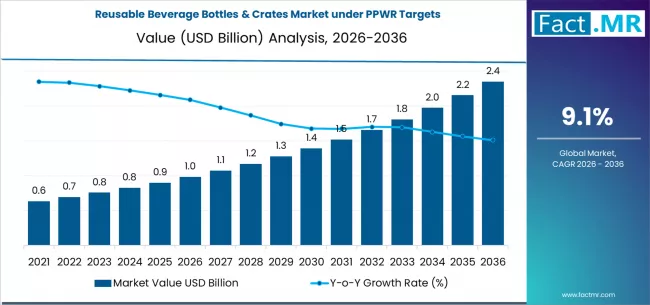
Reusable Beverage Bottles & Crates Market Under Ppwr Targets Market Value Analysis | Source: Fact.MR
Stringent regulatory frameworks, particularly the EU's Packaging and Packaging Waste Regulation (PPWR) mandating reusable packaging targets, are the primary force propelling market growth. This legislative push establishes reuse and refill systems as a critical compliance pathway for beverage producers, moving beyond single-use models. Rising consumer preference for circular economy solutions and corporate sustainability commitments to reduce plastic waste are accelerating the adoption of standardized reusable formats. This shift represents a systemic transformation of beverage packaging logistics, prioritizing reverse-cycle infrastructure over linear disposal.
Advancements in reverse-logistics efficiency and container design are critical to market expansion. Innovation in automated washing, sanitization, and tracking technologies is reducing operational costs and hygiene concerns associated with reusable systems. Simultaneously, design improvements for bottle life-extension and lightweighting, alongside material innovations in rPET and durable polymers, are enhancing the economic and environmental feasibility of large-scale reuse models, aligning with extended producer responsibility (EPR) and net-zero goals.
Reusable Beverage Bottles & Crates Market under PPWR Targets
| Metric | Value |
|---|---|
| Estimated Value in (2026E) | USD 0.98 Billion |
| Forecast Value in (2036F) | USD 2.35 Billion |
| Forecast CAGR (2026 to 2036) | 9.1% |
Source: Fact.MR analysis. Updated Dec 22, 2025
Category
| Category | Segments |
|---|---|
| End-use/Application | Retail refill & deposit systems, On-trade (restaurants, bars), Beverage producers, Local refill schemes, Breweries, Others |
| Packaging Format/Type | Reusable Glass & PET Bottles, Crates & Carriers, Refillable PET Bottles, Reusable Bottles, Others |
| Material | Glass / rPET, HDPE Crates, PET blends, HDPE / PP, Others |
| Technology | Reverse-logistics + sanitisation, Automated crate washing, Bottle life-extension design, Low-cost sanitisation, Others |
| Region | North America, Europe, Asia Pacific, Latin America, MEA |
Source: Fact.MR analysis. Updated Dec 22, 2025
Segmental Analysis
Why do Retail Refill & Deposit Systems drive the leading Application Segment?

Reusable Beverage Bottles & Crates Market Under Ppwr Targets Analysis By End Use | Source: Fact.MR
Retail refill & deposit systems will command a 40% share, fueled by direct regulatory mandates under PPWR and similar policies that require large retailers to offer reusable packaging options. These systems leverage existing consumer familiarity with deposit-return schemes, scaling them from bottles to broader beverage containers. For retailers and brands, they serve as a direct tool for compliance, waste reduction, and enhancing sustainability credentials in a highly visible consumer touchpoint.
- The integration of digital tracking and smart bins is streamlining the return process, improving consumer participation rates and system efficiency.
- Brands are utilizing standardized bottles and crates within these systems to ensure cross-compliance and reduce reverse-logistics complexity, turning regulatory necessity into a brand loyalty opportunity.
What establishes Reusable Glass & PET Bottles as the dominant Packaging Format?
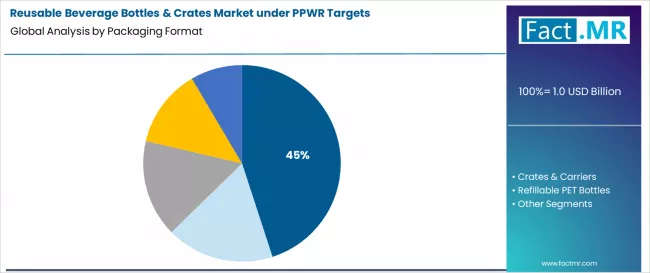
Reusable Beverage Bottles & Crates Market Under Ppwr Targets Analysis By Packaging Format | Source: Fact.MR
Reusable Glass & PET Bottles hold a 45% share due to their established infrastructure, consumer trust, and material properties suited for multiple lifecycles. Glass offers unparalleled barrier properties and consumer perception of purity and premium quality, while PET provides lightweight, shatter-resistant benefits crucial for logistics efficiency. Both formats have mature, large-scale washing and inspection technologies, making them the foundational units for mandated reuse quotas.
- Standardization of bottle designs such as lightweight, durable necks across brands is accelerating to maximize pooling efficiency and reduce sorting costs in the reverse chain.
- Investment is focused on enhancing the return rate through financial incentives and convenient drop-off networks, directly linking system success to consumer engagement.
What are the Drivers, Restraints, and Key Trends in the Reusable Beverage Bottles & Crates Market under PPWR Targets?
The legislative force of the EU’s Packaging and Packaging Waste Regulation (PPWR) and similar mandates fundamentally drives the market globally, which set specific, escalating targets for reusable packaging formats, making investment in reuse systems a compliance imperative for beverage producers. Coupled with aggressive corporate net-zero pledges and heightened consumer activism against plastic waste, this creates a powerful triad pushing the shift from single-use to circular packaging models.
A primary restraint is the significant upfront capital expenditure required for establishing or scaling reverse-logistics infrastructure, including collection networks, automated washing facilities, and tracking systems. The higher per-unit cost of durable reusable containers compared to single-use alternatives also poses a challenge, requiring a clear total cost-of-ownership analysis that factors in EPR fee avoidance, material savings, and brand value.
The market is trending strongly towards smart pooling systems that utilize digital IDs such as QR codes and RFID on bottles and crates to optimize sorting, track lifecycle data, and ensure supply chain transparency. Furthermore, design-for-reuse innovations are critical, focusing on ultra-lightweighting, reinforced structures for extended trip life, and material harmonization to streamline the washing and refilling processes across brands.
Analysis of the Reusable Beverage Bottles & Crates Market under PPWR Targets by Key Countries

Reusable Beverage Bottles & Crates Market Under Ppwr Targets Cagr Analysis By Country | Source: Fact.MR
| Country | CAGR (2026-2036) |
|---|---|
| USA | 7.20% |
| Germany | 9.00% |
| China | 10.50% |
| India | 12.00% |
| Brazil | 8.00% |
| Japan | 5.00% |
Source: Fact.MR analysis. Updated Dec 22, 2025
What underpins steady adoption in the USA's market?
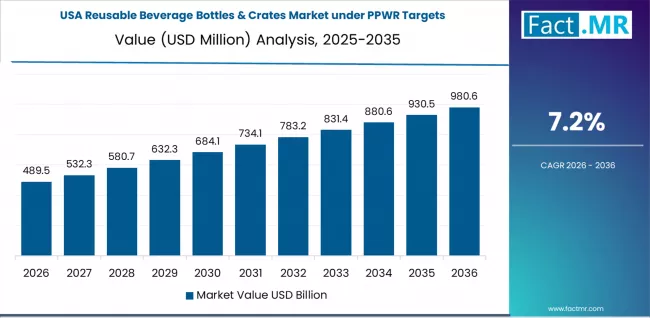
Reusable Beverage Bottles & Crates Market Under Ppwr Targets Country Value Analysis | Source: Fact.MR
State-level EPR laws and voluntary corporate sustainability initiatives drive growth in the USA at a 7.20% CAGR, even in the absence of federal reuse mandates. Major beverage companies are investing in pilot reusable bottle programs to pre-empt regulation and meet consumer demand. The focus is on building regional pooling systems and partnerships with retailers for return logistics.
How does Germany's regulatory framework shape its leading market?
Germany's 9.00% CAGR reflects its role as an EU frontrunner under PPWR. Its stringent VerpackG law and well-established Pfand (deposit) system for single-use are being expanded to meet ambitious reusable beverage packaging targets. Growth is engineered through high-return-rate infrastructure, investment in automated washing plants, and industry collaboration on standardized crates and bottles.
What factors propel China's rapid expansion?
National dual carbon goals and urban waste management directives that promote reuse fuel China’s 10.50% CAGR. The vast scale of its food delivery and beverage market is driving innovation in low-cost, digitally-managed reusable bottle systems for milk, water, and soft drinks, with significant investment in closed-loop logistics networks.
Why does India exhibit the highest growth trajectory?
India leads with a 12.00% CAGR, driven by the national ban on single-use plastics and the deeply embedded cultural practice of local milk and beverage refill systems. This traditional model is being modernized and scaled by startups and FMCG giants for packaged water, juices, and dairy, leveraging hyper-local delivery networks to manage returns efficiently.
How does Brazil leverage its market dynamics?
Brazil's 8.00% CAGR is supported by a strong culture of returnable glass bottles for beer and carbonated soft drinks. Growth is sustained by beverage producers investing to modernize crate pooling and bottle washing infrastructure, and by expanding these systems to new beverage categories to maintain cost competitiveness and sustainability appeal.
What Characterizes Japan's Mature Market Approach?
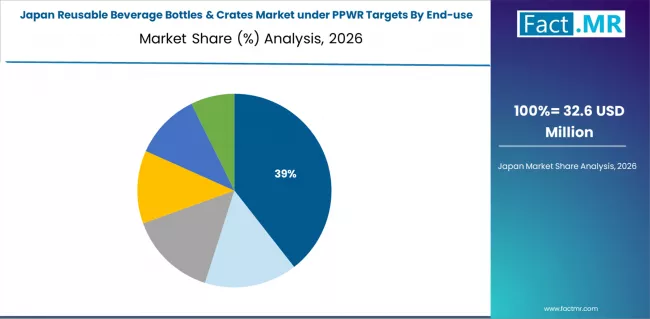
Reusable Beverage Bottles & Crates Market Under Ppwr Targets Japan Market Share Analysis By End Use | Source: Fact.MR
Japan's mature market grows at a measured 5.00% CAGR, focusing on high-value, high-hygiene standards for reusable bottles in the beer, sake, and tea sectors. Innovation centers on ultra-lightweight, durable bottle designs and sophisticated tracking systems to ensure quality and safety across dozens of reuse cycles, catering to a discerning consumer base.
Competitive Landscape of the Reusable Bottles & Crates Market under PPWR Targets

Reusable Beverage Bottles & Crates Market Under Ppwr Targets Analysis By Company | Source: Fact.MR
The competitive environment features strong specialization across the value chain. Global packaging giants like Toyo Seikan and ALPLA compete through integrated expertise in bottle design, advanced polymer materials (rPET), and blow-molding technology.
Logistics and pooling specialists like ORBIS Corporation and Schoeller Allibert dominate in reusable crate and carrier systems, competing on the efficiency and intelligence of their return, tracking, and washing services. Competition hinges on forming strategic alliances with major beverage brands, achieving cost-effectiveness in reverse logistics, and providing data on reuse cycles and carbon savings.
Key Players Profiled
- Vetropack Holding Ltd
- ORBIS Corporation
- Wanhua Chemical Group Co. Ltd.
- UFLEX Limited
- Klabin S.A.
- Toyo Seikan Group Holdings Ltd.
- Schoeller Allibert Group B.V.
- ALPLA Werke Alwin Lehner GmbH & Co KG
- Plastipak Holdings Inc.
Segmentation
Scope of the Report
| Items | Values |
|---|---|
| Quantitative Units (2026) | USD 0.98 Billion |
| End-use/Application | Retail refill & deposit systems, On-trade (restaurants, bars), Beverage producers, Local refill schemes, Breweries, Others |
| Packaging Format/Type | Reusable Glass & PET Bottles, Crates & Carriers, Refillable PET Bottles, Reusable Bottles, Others |
| Material | Glass / rPET, HDPE Crates, PET blends, HDPE / PP, Others |
| Technology | Reverse-logistics + sanitisation, Automated crate washing, Bottle life-extension design, Low-cost sanitisation, Others |
| Regions Covered | North America, Europe, Asia Pacific, Latin America, Middle East & Africa |
| Key Companies Profiled | Vetropack Holding Ltd, ORBIS Corporation, Wanhua Chemical Group Co. Ltd., UFLEX Limited, Klabin S.A., Toyo Seikan Group Holdings Ltd., Schoeller Allibert Group B.V., ALPLA Werke Alwin Lehner GmbH & Co KG, Plastipak Holdings Inc. |
| Additional Attributes | Cost analysis of reverse-logistics, regulatory compliance roadmap for PPWR, lifecycle assessment (LCA) comparisons, analysis of return rate mechanisms and consumer engagement. |
Source: Fact.MR analysis. Updated Dec 22, 2025
Reusable Beverage Bottles & Crates Market under PPWR Targets by Segments
-
By End-use/Application :
- Retail refill & deposit systems
- On-trade (restaurants, bars)
- Beverage producers
- Local refill schemes
- Breweries
- Others
-
By Packaging Format/Type :
- Reusable Glass & PET Bottles
- Crates & Carriers
- Refillable PET Bottles
- Reusable Bottles
- Others
-
By Material :
- Glass/rPET
- HDPE Crates
- PET blends
- HDPE/PP
- Others
-
By Technology :
- Reverse-logistics + sanitisation
- Automated crate washing
- Bottle life-extension design
- Low-cost sanitisation
- Others
-
By Region :
-
North America
- USA
- Canada
- Mexico
-
Europe
- Germany
- UK
- France
- Italy
- Spain
- Nordic Countries
- BENELUX
- Rest of Europe
-
Asia Pacific
- China
- India
- Japan
- South Korea
- Australia
- Rest of Asia Pacific
-
Latin America
- Brazil
- Argentina
- Rest of Latin America
-
Middle East & Africa
- Saudi Arabia
- UAE
- South Africa
- Rest of MEA
-
Frequently Asked Questions
How big is the reusable beverage bottles & crates market under PPWR targets in 2026?
What will be the size of reusable beverage bottles & crates market under PPWR targets in 2036?
How much will be the reusable beverage bottles & crates market under PPWR targets growth between 2026 and 2036?
What are the key product types in the reusable beverage bottles & crates market under PPWR targets?
Which packaging format segment to contribute significant share in the reusable beverage bottles & crates market under PPWR targets in 2026?
Who worked on this report


Preview the report firsthand - request a free sample
Free SampleGet the brochure for pricing and purchase details
Download PDF