- Base Value(2025): 45 Mn
- Estimated Value(2026): 51 Mn
- Forecast Value (2036): 165 Mn
- CAGR (2026 - 2036): 12.5%
Aquafaba Functional Ingredients Market Size, Share and Forecast and Outlook By FACT.MR
In 2025, the aquafaba functional ingredients market was valued at USD 45 million. Fact MR analysis indicates demand for aquafaba functional ingredients is expected to reach USD 51 million in 2026 and USD 165 million by 2036. FMR estimates the market will expand at a CAGR of 12.5% across the forecast period.
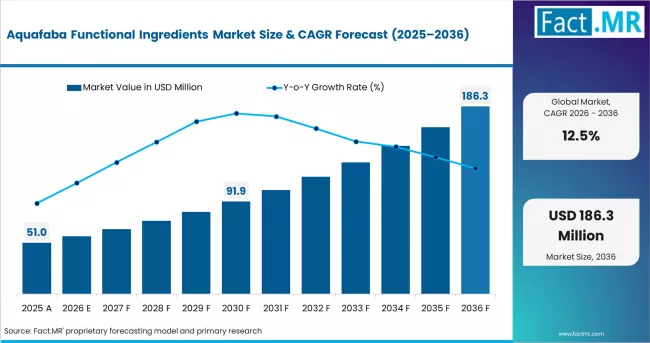
Aquafaba Functional Ingredients Market Value Analysis | Source: Fact.MR
Summary of the Aquafaba Functional Ingredients Market
- Market Definition
- The aquafaba functional ingredients market comprises plant-derived ingredients produced from legume cooking liquid, primarily chickpeas, utilized as functional substitutes for egg proteins in food formulations. Aquafaba delivers foaming, emulsifying, binding, and gelling properties supporting structural stability and texture development across bakery, confectionery, sauces, and dairy-alternative applications within plant-based product formulation systems.
- Demand Drivers
- Increasing demand for plant-based ingredient systems supporting replacement of egg proteins in bakery and confectionery formulations.
- Expansion of vegan and allergen-free product portfolios requiring emulsification and foaming functionality derived from pulse-based sources.
- Growth in clean-label food formulation encouraging adoption of recognizable plant-derived functional ingredients.
- Rising utilization of pulse-derived hydrocolloid systems supporting texture formation and aeration performance in processed foods.
- Increasing commercialization of standardized powdered and concentrated aquafaba formats improving formulation consistency.
- Expansion of alternative protein product development supporting functional ingredient diversification across plant-based categories.
- Key Segments Analyzed
- Product Type: Liquid aquafaba leads with 42% share due to direct usability in industrial mixing systems without rehydration requirements.
- Application: Bakery products dominate with 36% share supported by demand for egg replacement functionality in cakes, meringues, cookies, and aerated baked goods.
- Function: Foaming and emulsification represent primary functional mechanisms supporting structure formation and texture stability across plant-based formulations.
- Geography: China and India demonstrate highest growth rates supported by expansion of plant-based food manufacturing, while the United States, Germany, and the United Kingdom reflect scaling adoption across established vegan product categories.
- Analyst Opinion at Fact MR
- Shambhu Nath Jha, Principal Consultant, Fact MR, opines, 'In this updated edition of the Aquafaba Functional Ingredients Market report, industry participants observe a transition from niche culinary usage toward standardized ingredient integration across commercial plant-based food production. Market participants are aligning processing technologies with viscosity control and protein solubility targets supporting consistent foaming and emulsification performance. Demand expansion reflects increasing utilization of pulse-derived functional systems capable of replacing egg proteins across bakery and sauce applications. Competitive positioning is influenced by consistency of functional performance, supply chain standardization, and compatibility with automated food manufacturing processes through 2036.'
- Strategic Implications/Executive Takeaways
- Invest in process standardization improving consistency of foaming capacity and emulsification stability across batch production environments.
- Expand development of powdered and concentrated aquafaba formats supporting extended shelf stability and simplified logistics.
- Strengthen collaboration with bakery and plant-based food manufacturers requiring egg replacement functionality aligned with clean-label formulation requirements.
- Improve raw material sourcing consistency supporting uniform viscosity and protein concentration levels across production batches.
- Develop customized functional blends supporting texture optimization across sauces, confectionery, and dairy-alternative product categories.
- Enhance quality control systems ensuring reproducible functional performance across industrial-scale formulation environments.
- Methodology
- Built on primary interviews with plant-based ingredient manufacturers, food formulation specialists, bakery technologists, and procurement managers.
- Benchmarked against plant-based product launch trends, egg replacement ingredient adoption patterns, and pulse-derived ingredient consumption data.
- Applied hybrid market sizing approach combining supplier revenue evaluation with top down assessment of plant-based food ingredient demand.
- Validated through triangulation using technical literature, patent filings, supplier product specifications, and industry expert consultation.
- Periodically updated to reflect developments in plant-based food formulation technologies, ingredient processing improvements, and alternative protein market expansion trends.
Aquafaba Functional Ingredients Market
| Metric | Details |
|---|---|
| Industry Size (2026E) | USD 51 million |
| Industry Value (2036F) | USD 165 million |
| CAGR (2026 to 2036) | 12.5% |
Source: Fact.MR analysis. Updated Apr 22, 2026
A CAGR of 12.5%, with value increasing from USD 51 million to USD 165 million, indicates a breakpoint transition from niche adoption toward broader commercial scaling in plant-based formulation systems. Growth is supported by rising demand for egg replacement functionality in vegan bakery and confectionery applications, while structural constraints include raw material standardization challenges, processing consistency, and substitution pressure from established hydrocolloids and protein isolates offering predictable performance.
China records the fastest growth at 13.9%, supported by increased use of plant-based foaming agents in bakery and confectionery formulations. India follows at 13.5%, driven by expanding demand for egg replacement ingredients in vegan food processing applications. The United Kingdom shows 13.2% growth, linked to reformulation of clean-label bakery products using pulse-derived functional binders. Germany at 13.0% and the United States at 12.5% represent mature markets where demand is largely replacement-driven as plant-based ingredient adoption stabilizes across established product categories. A structural constraint across mature markets is formulation consistency requirements, which limit rapid substitution of traditional protein foaming agents.
Segmental Analysis
Aquafaba Functional Ingredients Market Analysis by Product Type
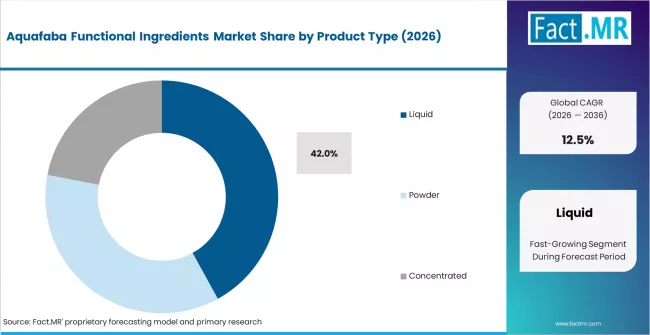
Aquafaba Functional Ingredients Market Analysis By Product Type | Source: Fact.MR
- Market Overview: Liquid aquafaba is projected to hold 42% share of the aquafaba functional ingredients market in 2026. Dominance reflects its direct applicability as an egg substitute in food processing systems requiring emulsification, foaming, and binding performance without additional rehydration or preprocessing stages. Manufacturers prioritize liquid formats due to ease of integration into standardized production workflows.
- Demand Drivers:
- Functional Performance Stability: Liquid aquafaba demonstrates consistent foaming and emulsification behavior required in formulations replacing egg whites across plant-based food categories.
- Processing Compatibility: Food manufacturers utilize liquid formats to reduce preparation complexity, supporting efficient incorporation into mixing and whipping operations used in industrial production lines.
- Supply Chain Standardization: Packaged liquid aquafaba enables controlled viscosity and concentration specifications, supporting predictable functionality across batch-based food manufacturing environments.
Aquafaba Functional Ingredients Market Analysis by Application
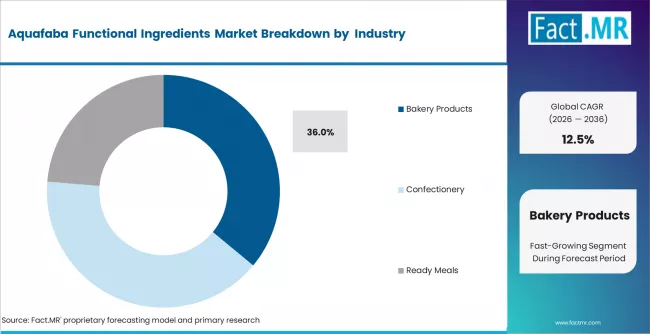
Aquafaba Functional Ingredients Market Analysis By Application | Source: Fact.MR
- Market Overview: Bakery products are estimated to account for 36% share in 2026, supported by increasing use of aquafaba as a plant-based functional ingredient replacing eggs in cakes, meringues, cookies, and aerated baked goods. Functional requirements focus on maintaining structural integrity and moisture retention properties across varied baking conditions.
- Demand Drivers:
- Egg Replacement Functionality: Aquafaba supports aeration and structure formation in bakery formulations requiring stable foam formation and moisture balance during thermal processing.
- Plant-Based Product Development: Food producers integrate aquafaba into vegan bakery recipes to align with formulation strategies removing animal-derived ingredients from processed foods.
- Texture Consistency Requirements: Bakery manufacturers prioritize ingredients capable of maintaining crumb softness and structural stability across production batches and shelf-life conditions.
Key Dynamics
Aquafaba Functional Ingredients Market Drivers, Restraints, and Opportunities
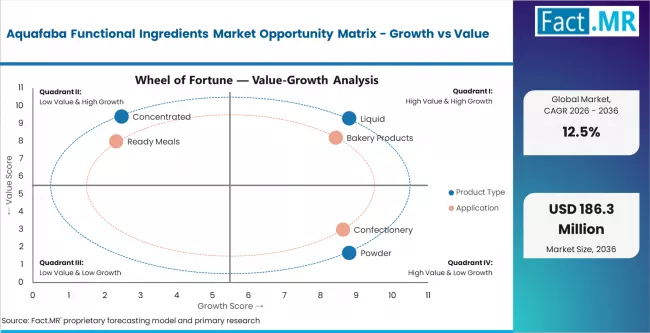
Aquafaba Functional Ingredients Market Opportunity Matrix Growth Vs Value | Source: Fact.MR
Fact MR analysis indicates the market reflects an emerging functional ingredient segment shaped by structural growth in plant-based formulation technologies replacing animal-derived proteins. Market size exists because aquafaba provides foaming, emulsifying, binding, and gelling functionality comparable to egg whites, enabling reformulation of bakery, confectionery, and dairy-alternative products without allergen exposure or animal inputs. The current valuation reflects scaling adoption in B2B food manufacturing, where cost efficiency is achieved through upcycling legume processing byproducts into value-added hydrocolloid systems.
Current market dynamics show declining reliance on conventional egg proteins in vegan bakery and mayonnaise applications, while powdered and standardized aquafaba formats command higher per-unit pricing due to stability and consistency requirements in industrial production. Higher processing costs for spray-dried and concentrated formats are offset by improved shelf life, standardized viscosity profiles, and compatibility with automated food processing lines. Market expansion reflects the shift from experimental culinary use toward controlled ingredient systems integrated into commercial plant-based food supply chains.
- Plant-Based Substitution: Growth is driven by increasing vegan and flexitarian diets that require egg-free emulsifiers capable of delivering comparable texture and aeration performance in baked goods and sauces.
- Clean Label Formulation: EU food labeling frameworks and allergen transparency requirements encourage replacement of synthetic emulsifiers with recognizable plant-derived ingredients such as legume extracts.
- North America Adoption: United States and European food processors lead commercialization as gluten-free and allergen-free product portfolios expand across retail bakery and dairy-alternative segments.
Regional Analysis
The aquafaba functional ingredients market is assessed across Asia Pacific, Europe, and North America, segmented by country-level demand for plant-based foaming agents, egg replacers, emulsifiers, and vegan bakery stabilizers. Geographic variation reflects plant-based product innovation, clean label ingredient adoption, and alternative protein formulation expansion. The full report offers market attractiveness analysis.
.webp "Top Country Growth Comparison Aquafaba Functional Ingredients Market Cagr (2026 2036)")
Top Country Growth Comparison Aquafaba Functional Ingredients Market Cagr (2026 2036) | Source: Fact.MR
CAGR Table of Aquafaba Functional Ingredients Market
| Country | CAGR (2026–2036) |
|---|---|
| China | 13.9% |
| India | 13.5% |
| United Kingdom | 13.2% |
| Germany | 13.0% |
| United States | 12.5% |
Source: Fact.MR analysis. Updated Apr 22, 2026
Source: Fact MR analysis, based on proprietary forecasting model and primary research
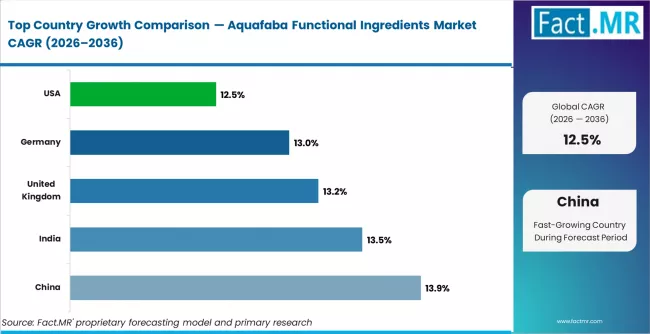
Aquafaba Functional Ingredients Market Cagr Analysis By Country | Source: Fact.MR
Asia Pacific
Asia Pacific functions as the plant-based ingredient formulation hub supported by rapid expansion of vegan bakery products and alternative protein innovation ecosystems. Ingredion Incorporated strengthens plant-derived stabilizer development capability. ADM supports pulse-based functional ingredient processing scale. Roquette Frères expands plant protein formulation expertise.
- China: China is projected to record 13.9% CAGR in aquafaba functional ingredients through 2036. National Nutrition Plan update (National Health Commission, January 2023) supports plant-based diet adoption initiatives. Ingredion Incorporated expanded pulse-derived ingredient application development (July 2023).
- India: India is expected to observe 13.5% CAGR in aquafaba functional ingredients through 2036. Eat Right India initiative expansion (FSSAI, April 2023) promotes clean label food formulation practices. Roquette Frères expanded plant protein ingredient application research (June 2023).
Europe
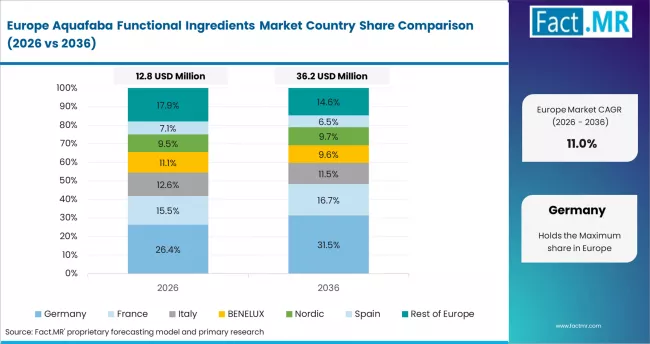
Aquafaba Functional Ingredients Market Europe Country Market Share Analysis, 2026 & 2036 | Source: Fact.MR
Europe operates as the regulatory and formulation innovation laboratory for plant-based ingredients supported by structured food labeling standards and reformulation requirements encouraging vegan ingredient substitution. Roquette Frères strengthens pulse-derived emulsifier development capability. Ingredion Incorporated expands hydrocolloid ingredient formulation expertise. ADM supports plant protein processing innovation.
- United Kingdom: The United Kingdom is anticipated to expand at 13.2% CAGR in aquafaba functional ingredients through 2036. UK National Food Strategy update (Department for Environment, Food and Rural Affairs, February 2023) supports alternative protein adoption. ADM expanded plant-based ingredient application program (May 2023).
- Germany: Germany is forecast to grow at 13.0% CAGR in aquafaba functional ingredients through 2036. Federal nutrition strategy update (Federal Ministry of Food and Agriculture, March 2023) supports plant protein product development. Roquette Frères strengthened pulse ingredient production capacity (April 2023).
North America
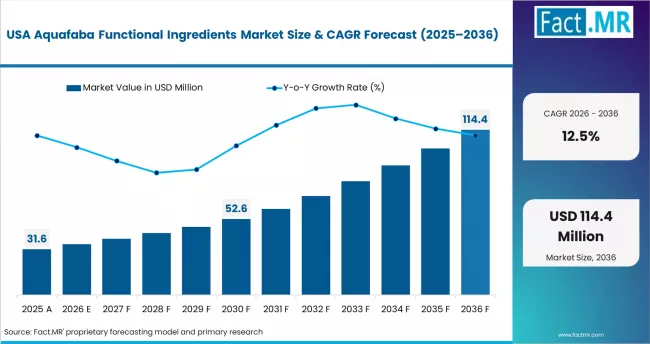
Aquafaba Functional Ingredients Market Country Value Analysis | Source: Fact.MR
North America functions as the commercial plant-based product development center supported by strong consumer adoption of vegan bakery ingredients and egg replacement formulations in processed foods. Ingredion Incorporated strengthens specialty hydrocolloid ingredient portfolio depth. ADM expands plant protein processing capability. Tate & Lyle supports texturizing ingredient innovation.
- United States: The United States is projected to register 12.5% CAGR in aquafaba functional ingredients through 2036. FDA draft guidance on plant-based labeling clarity update (September 2023) supports alternative ingredient adoption. Ingredion Incorporated expanded plant-based formulation development program (June 2023).
Fact MR's analysis of aquafaba functional ingredients market in global regions consists of country-wise assessment that includes China, India, United Kingdom, Germany, and United States. Readers can find plant-based formulation trends, alternative protein adoption signals, ingredient innovation developments, and competitive positioning insights.
Competitive Landscape
What is the Competitive Structure of the Aquafaba Functional Ingredients Market?
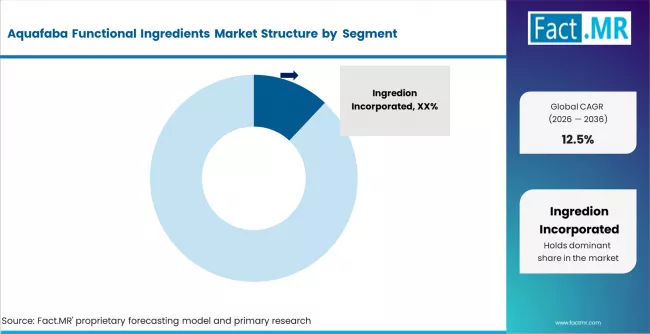
Aquafaba Functional Ingredients Market Analysis By Company | Source: Fact.MR
The Aquafaba Functional Ingredients Market demonstrates a moderately fragmented competitive structure, supported by plant protein processors and specialty ingredient suppliers focused on pulse-derived functional systems. Companies including Ingredion Incorporated, ADM (Archer Daniels Midland Company), Kerry Group plc, Roquette Freres SA, Cosucra Groupe Warcoing SA, and Puris Proteins LLC collectively account for approximately 50–60% of global supply, particularly in egg replacement and emulsification applications used in plant-based formulations. Competitive positioning is primarily defined by foaming stability, emulsification efficiency, protein solubility, and consistency of functional performance across bakery and confectionery production conditions. Processing expertise in pulse fractionation and protein standardization creates moderate entry barriers, limiting rapid scale expansion by smaller ingredient producers.
Structural advantages are held by companies possessing integrated pulse sourcing networks and advanced protein extraction capabilities that ensure stable supply and uniform functional characteristics. ADM (Archer Daniels Midland Company) and Ingredion Incorporated benefit from established plant protein portfolios and long-term relationships with plant-based food manufacturers seeking texture and binding performance comparable to egg proteins. Buyers typically manage supplier dependency through multi-source qualification and validation of ingredient functionality across different formulations. Procurement decisions often consider batch consistency, labeling compliance, and supply reliability aligned with large-scale food production cycles. Pricing power remains relatively balanced, though suppliers retain moderate leverage where proprietary processing methods support consistent foaming and emulsification performance required in commercial product formulations.
Key Players of the Aquafaba Functional Ingredients Market
- Ingredion Incorporated
- ADM (Archer Daniels Midland Company)
- Kerry Group plc
- Puris Proteins LLC
- Roquette Freres SA
- The Scoular Company
- Vestkorn Milling AS
- Axiom Foods Inc.
- Cosucra Groupe Warcoing SA
- Batory Foods Inc.
Report Scope
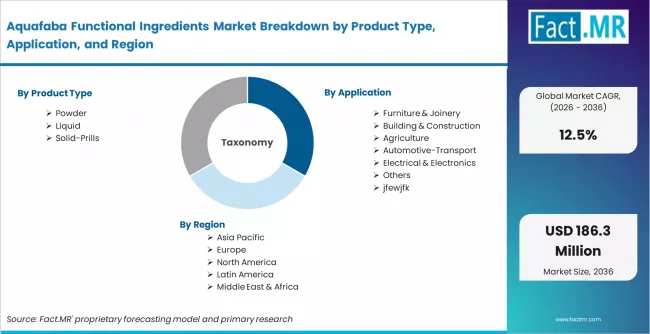
Aquafaba Functional Ingredients Market Breakdown By Product Type, Application, And Region | Source: Fact.MR
| Metric | Value |
|---|---|
| Quantitative Units | USD 51 million (2026) to USD 165 million (2036), at a CAGR of 12.5% |
| Market Definition | The aquafaba functional ingredients market includes plant-based ingredients derived from legume cooking water, primarily chickpeas, used as functional substitutes for egg proteins in food formulations. These ingredients provide foaming, emulsifying, binding, and gelling properties in vegan and allergen-free product development across bakery, sauces, confectionery, and dairy alternative applications. |
| Product Type Segmentation | Liquid aquafaba, Powdered aquafaba, Concentrated aquafaba, Functional blends |
| Application Segmentation | Bakery products, Confectionery, Sauces and dressings, Dairy alternatives, Ready meals |
| Function Segmentation | Foaming, Emulsification, Binding, Gelling |
| Regions Covered | North America, Latin America, Europe, East Asia, South Asia, Oceania, Middle East and Africa |
| Countries Covered | United States, Canada, Mexico, Brazil, Argentina, Germany, France, United Kingdom, Italy, Spain, China, India, Japan, South Korea, Indonesia, Australia, and 40+ countries |
| Key Companies Profiled | Ingredion Incorporated, ADM (Archer Daniels Midland Company), Kerry Group plc, Puris Proteins LLC, Roquette Freres SA, The Scoular Company, Vestkorn Milling AS, Axiom Foods Inc., Cosucra Groupe Warcoing SA, Batory Foods Inc. |
| Forecast Period | 2026 to 2036 |
| Approach | Hybrid top-down and bottom-up market estimation validated through primary interviews with plant protein processors, food ingredient manufacturers, and formulation specialists, supported by trade data analysis, product innovation tracking, and benchmarking of functional ingredient adoption across plant-based food production systems |
Source: Fact.MR analysis. Updated Apr 22, 2026
Aquafaba Functional Ingredients Market Key Segments
-
Product Type:
- Liquid Aquafaba
- Powdered Aquafaba
- Concentrated Aquafaba
- Functional Blends
-
Application:
- Bakery Products
- Confectionery
- Sauces and Dressings
- Dairy Alternatives
- Ready Meals
-
Function:
- Foaming
- Emulsification
- Binding
- Gelling
-
Region:
- North America
- USA
- Canada
- Mexico
- Europe
- Germany
- UK
- France
- Italy
- Spain
- Nordic Countries
- BENELUX
- Rest of Europe
- Asia Pacific
- China
- Japan
- South Korea
- India
- Australia
- Rest of Asia Pacific
- Latin America
- Brazil
- Argentina
- Rest of Latin America
- Middle East and Africa
- Kingdom of Saudi Arabia
- United Arab Emirates
- South Africa
- Rest of Middle East and Africa
- Other Regions
- Oceania
- Central Asia
- Other Markets
- North America
Bibliographies
- [1] National Health Commission (China). (2023, January). National Nutrition Plan update.
- [2] Food Safety and Standards Authority of India. (2023, April). Eat Right India initiative expansion.
- [3] Department for Environment, Food and Rural Affairs (United Kingdom). (2023, February). UK National Food Strategy update.
- [4] Federal Ministry of Food and Agriculture (Germany). (2023, March). Federal nutrition strategy update.
- [5] U.S. Food and Drug Administration. (2023, September). FDA draft guidance on plant-based labeling clarity update.
- [6] Ingredion Incorporated. (2023, July). Pulse-derived ingredient application development expansion.
- [7] Roquette Frères. (2023, June). Plant protein ingredient application research expansion.
- [8] ADM (Archer Daniels Midland Company). (2023, May). Plant-based ingredient application program expansion.
- [9] Kerry Group plc. (2023). Plant-derived stabilizer development capability expansion.
- [10] Puris Proteins LLC. (2023). Pulse-derived functional ingredient production capacity expansion.
This Report Addresses
- Market size estimation and revenue forecasts from 2026 to 2036, supported by validated pulse processing capacity benchmarks and plant-based ingredient commercialization trends across food formulation systems.
- Growth opportunity mapping across liquid, powdered, and concentrated aquafaba formats aligned with egg replacement requirements in bakery, confectionery, sauces, and dairy alternative applications.
- Segment and regional revenue forecasts covering foaming, emulsification, binding, and gelling functionality across plant-based food processing and clean-label ingredient adoption environments.
- Competition strategy assessment including benchmarking of pulse protein extraction capability, formulation stability performance, and functional ingredient standardization across commercial food manufacturing conditions.
- Regulatory impact analysis covering clean-label compliance frameworks, allergen labeling considerations, and plant-based formulation standards influencing adoption of pulse-derived functional ingredients.
- Market report delivery in PDF, Excel, PPT, and structured data formats designed for food technologists, ingredient procurement teams, and plant-based product developers.
- Supply chain vulnerability assessments identifying concentration risks in chickpea processing infrastructure, spray-drying capacity, and standardized hydrocolloid functionality development networks.
Aquafaba Functional Ingredients Market Definition
The aquafaba functional ingredients market refers to the commercial production and use of aquafaba, a plant-based ingredient derived from legume cooking water, commonly chickpeas. It acts as a foaming, emulsifying, binding, and thickening agent, widely used as an egg substitute in bakery, confectionery, sauces, and dairy alternatives.
Aquafaba Functional Ingredients Market Inclusions
The report covers global and regional market size assessment and forecast outlook across the defined period. It includes segmentation by ingredient format such as liquid and powder, application across bakery, confectionery, sauces, and plant-based foods, and end users including food manufacturers and ingredient suppliers. Pricing analysis, supply chain evaluation, and trade flow assessment are included.
Aquafaba Functional Ingredients Market Exclusions
The scope excludes whole pulses, chickpea flour, and plant protein isolates not processed into aquafaba-based functional ingredients. Finished consumer food products such as vegan desserts, mayonnaise, and bakery goods are not included. Egg replacers derived from starches, gums, or synthetic emulsifiers are excluded unless blended with aquafaba formulations.
Aquafaba Functional Ingredients Market Research Methodology
- Primary Research
- Interviews were conducted with plant-based ingredient manufacturers, food technologists, bakery formulators, and procurement specialists involved in egg replacement and clean-label product development.
- Desk Research
- Scientific journals, patent literature, company product specifications, and food ingredient databases were reviewed to evaluate functionality characteristics and commercial adoption trends.
- Market-Sizing and Forecasting
- A hybrid modeling approach combining bottom-up supplier revenue analysis and top-down evaluation of plant-based ingredient demand across bakery and processed food sectors was applied.
- Data Validation and Update Cycle
- Findings were cross-verified using technical literature, supplier disclosures, and expert consultations. Updates reflect changes in plant-based food adoption, ingredient standardization methods, and commercial processing technologies.
Frequently Asked Questions
How large is the demand for Aquafaba Functional Ingredients in the global market in 2026?
What will be the market size of Aquafaba Functional Ingredients in the global market by 2036?
What is the expected demand growth for Aquafaba Functional Ingredients in the global market between 2026 and 2036?
Which Product Type is poised to lead global demand by 2026?
What is Driving Aquafaba Functional Ingredient Demand in China?
What is the China Growth Outlook in this Report?
What is Driving Aquafaba Functional Ingredient Demand in India?
What is the India Growth Outlook in this Report?
What is Driving Aquafaba Functional Ingredient Demand in the United Kingdom?
What is the United Kingdom Growth Outlook in this Report?
What is Driving Aquafaba Functional Ingredient Demand in Germany?
What is the Germany Growth Outlook in this Report?
What is Driving Aquafaba Functional Ingredient Demand in the United States?
What is the United States Growth Outlook in this Report?
Which Companies are Identified as Leading Participants in the Aquafaba Functional Ingredients Market?
What are Aquafaba Functional Ingredients and What are They Mainly Used For?
What does Aquafaba Functional Ingredients Market Mean in this Report?
What is Included in the Scope of this Aquafaba Functional Ingredients Market Report?
What is Excluded from the Scope of this Report?
What does Market Forecast Mean on this Page?
How is the Aquafaba Functional Ingredients Market Forecast Developed in this Report?
What does Data Validation Approach Mean in this Report?
Who worked on this report


Preview the report firsthand - request a free sample
Free SampleGet the brochure for pricing and purchase details
Download PDF