Multifunctional Food Additive Blends Market
Multifunctional Food Additive Blends Market Size and Share Forecast Outlook 2026 to 2036
Multifunctional food additive blends market is projected to grow from USD 8.3 billion in 2026 to USD 15.1 billion by 2036, at a CAGR of 6.2%. Texture and Rheology Enhancement will dominate with a 30.0% market share, while bakery & confectionery will lead the application segment segment with a 28.0% share.
Multifunctional Food Additive Blends Market Size and Share Forecast Outlook 2026 to 2036
The multifunctional food additive blends market is projected to reach USD 8.3 billion in 2026, growing to USD 15.5 billion by 2036, reflecting a CAGR of 6.2%. Capital intensity in this market will be driven by the need for advanced manufacturing processes, requiring significant upfront investments in production capabilities and R&D.
Key Takeaways from Multifunctional Food Additive Blends Market
- Multifunctional Food Additive Blends Market Value (2026): USD 8.3 billion
- Multifunctional Food Additive Blends Market Forecast Value (2036): USD 15.5 billion
- Multifunctional Food Additive Blends Market Forecast CAGR 2026 to 2036: 6.2%
- Leading Segment in Multifunctional Food Additive Blends Market: Texture and Rheology Enhancement (30%)
- Key Growth Region in Multifunctional Food Additive Blends Market: India (8%)
- Key Players in Multifunctional Food Additive Blends Market: Cargill, Incorporated, Ingredion Incorporated, Archer Daniels Midland Company (ADM), DuPont Nutrition & Biosciences (IFF), Kerry Group plc, BASF SE, DSMFirmenich, Tate & Lyle PLC, Corbion NV, Sensient Technologies Corporation
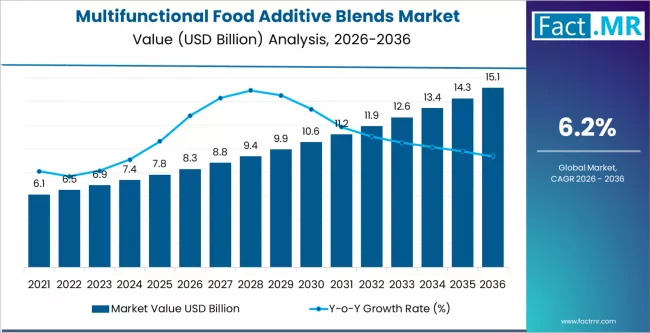
Investors will prioritize return timelines, with medium to long-term gains expected as demand for value-added products increases. Investment selectivity will focus on companies with scalable, cost-efficient production models and innovative formulations that can cater to diverse applications. Expansion will be contingent on managing production efficiency while ensuring regulatory compliance and consistent product quality. Companies capable of securing strategic partnerships and adapting quickly to consumer trends will have an edge in attracting investment. As market maturity accelerates, investors will seek companies demonstrating clear pathways to profitability and stable cash flows, shaping capital allocation strategies for the next decade.
Multifunctional Food Additive Blends Market
| Metric | Value |
|---|---|
| Estimated Value in (2026E) | USD 8.3 billion |
| Forecast Value in (2036F) | USD 15.5 billion |
| Forecast CAGR (2026 to 2036) | 6.2% |
Category
| Category | Segments |
|---|---|
| Functional Category | Texture and Rheology Enhancement; ShelfLife and Preservation Support; Flavor and Sensory Modulation; Nutritional Fortification Blends; Processing Stability and Emulsification |
| Application Segment | Bakery & Confectionery; Dairy & Dairy Alternatives; Beverages & RTD Drinks; Prepared & Processed Foods; Snacks & Others |
| Region | North America; Europe; Asia Pacific; Latin America; Middle East & Africa |
Segmental Analysis
What Is the Impact of Functional Category on the Multifunctional Food Additive Blends Market?
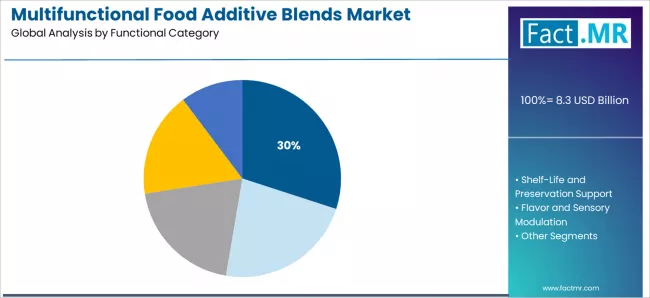
In the multifunctional food additive blends market, functional category plays a significant role in determining the demand for various blends in food formulations. Texture and rheology enhancement lead the market with a 30% share, as these additives are crucial for improving the mouthfeel, consistency, and overall sensory experience of food products. They are particularly important in applications like bakery and confectionery, where the texture and structure of the product are key to consumer satisfaction. As demand for high-quality and consistent food products grows, the use of multifunctional additives that improve texture and rheology will continue to drive market expansion.
How Does Application Segment Influence the Multifunctional Food Additive Blends Market?
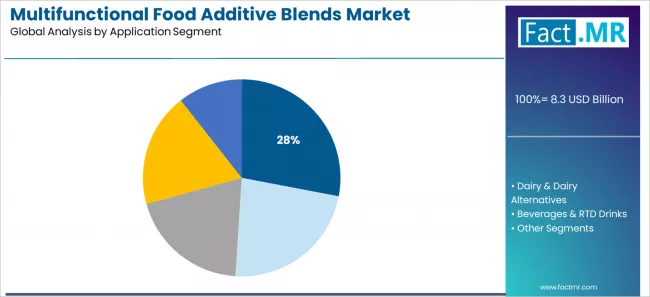
Application segment plays a pivotal role in shaping the demand for multifunctional food additive blends, with bakery and confectionery accounting for 28% of the market share. Additive blends in this segment are used to enhance texture, stability, and sensory appeal, which are crucial for the success of bakery products and confectionery. The ability of these blends to improve dough handling, moisture retention, and product shelf life is key to meeting consumer expectations for quality and taste. As the demand for innovative and high-quality bakery and confectionery items continues to rise, the use of multifunctional food additive blends in this segment will remain a significant driver of market growth.
What are the Key Drivers, Constraints, and Emerging Trends in the Multifunctional Food Additive Blends Market?
- Drivers: Demand for multifunctional food additive blends is influenced by manufacturers’ need to streamline formulations while achieving multiple performance objectives such as emulsification, stabilization, and moisture control. Food producers in bakery, dairy, confectionery, and processed meat sectors seek blends that reduce the number of separate inputs, simplify supply chains, and support consistent processing outcomes. Growth in value added and highprotein segments further shapes requirements for additive systems that deliver combined functional benefits.
- Restraints: Functional performance of blend systems can vary depending on product matrix, thermal profile, and water activity, requiring extensive testing and pilot validation. Some multifunctional blends may introduce complexity in regulatory labeling or allergen declarations, which affects global formulation strategies. Cost considerations also arise where premium blends command higher unit prices compared with single function ingredients, influencing adoption in cost sensitive categories.
- Trend 1: Integration of predictive formulation tools by suppliers that link blend performance with processing and storage conditions to accelerate product development.
- Trend 2: Expansion of ingredient portfolios that offer customizable blend platforms, enabling manufacturers to tailor functional profiles to specific category challenges.
Analysis of the Multifunctional Food Additive Blends Market by Key Country
| Country | CAGR (2026–2036) |
|---|---|
| India | 8% |
| China | 7.6% |
| Brazil | 7.2% |
| USA | 6.8% |
| UK | 6.4% |
| Germany | 6.1% |
The report covers an in-depth analysis of 40+ countries; top-performing countries are highlighted below.
What is the Growth Outlook for Multifunctional Food Additive Blends Market in India?
India’s multifunctional food additive blends market is projected to grow at a CAGR of 8% from 2026 to 2036. As India’s food and beverage industry continues to expand, the demand for multifunctional food additives that enhance flavor, texture, and shelf life is increasing. These blends are essential for improving food product stability, sensory properties, and nutritional value. With India’s growing focus on convenience foods, health, and sustainability, coupled with increasing consumer demand for cleaner, more functional ingredients, the market for multifunctional food additive blends is expected to continue its strong growth trajectory.
How is the Multifunctional Food Additive Blends Market Performing in China?
China’s multifunctional food additive blends market is expected to grow at a CAGR of 7.6% from 2026 to 2036. As one of the largest and most diverse food markets in the world, China’s demand for food additives that improve food quality, flavor, and stability is rising. Multifunctional food additive blends are key to meeting the growing consumer demand for convenient, flavorful, and nutritious food products. With China’s focus on food innovation, evolving consumer tastes, and the growing demand for functional and health-oriented food options, the market for these additives will continue to expand, driven by both local trends and global food innovations.
What is the Market Outlook for Multifunctional Food Additive Blends Market in Brazil?
Brazil’s multifunctional food additive blends market is projected to grow at a CAGR of 7.2% from 2026 to 2036. As Brazil’s food industry embraces modern food trends, such as health-conscious eating and clean-label products, the demand for multifunctional food additives that improve product quality, texture, and shelf life is increasing. These blends help meet consumer demand for convenient, flavorful, and healthier food options. Brazil’s growing interest in functional foods and beverages, along with its expanding middle class, will drive steady growth in the multifunctional food additive blends market.
What is the Growth Potential for Multifunctional Food Additive Blends Market in the USA?
The USA’s multifunctional food additive blends market is forecast to grow at a CAGR of 6.8% from 2026 to 2036. With the increasing consumer demand for convenience foods, clean-label ingredients, and functional products, the market for multifunctional food additives is expected to continue growing steadily. These additives are used to enhance flavor, texture, and stability in a variety of food products, including processed foods, beverages, and dairy products. The USA’s food industry is increasingly focused on health, sustainability, and product innovation, which will support the continued growth of the multifunctional food additive blends market.
What is the Demand for Multifunctional Food Additive Blends Market in the UK?
The UK’s multifunctional food additive blends market is set to grow at a CAGR of 6.4% from 2026 to 2036. As the UK’s food sector embraces healthier, functional, and convenient food options, the demand for multifunctional food additives that improve taste, texture, and shelf life is rising. These additives help food manufacturers meet consumer preferences for clean-label, natural ingredients that provide enhanced sensory experiences and nutritional benefits. With the increasing popularity of plant-based, functional foods, and the UK’s strong regulatory focus on food quality and safety, the market for multifunctional food additives will continue to expand steadily.
What is the Market Expansion Outlook for Multifunctional Food Additive Blends Market in Germany?
Germany’s multifunctional food additive blends market is projected to grow at a CAGR of 6.1% from 2026 to 2036. Germany’s food industry is driven by a strong emphasis on quality, sustainability, and health, which is fueling the demand for multifunctional food additives. These ingredients are critical for improving food texture, flavor, and stability, particularly in functional, plant-based, and convenience food products. As Germany continues to focus on food innovation and responding to consumer preferences for healthier, sustainable products, the market for multifunctional food additive blends will grow steadily, supported by both local trends and broader European food industry developments.
How is Competition Structured in the Multifunctional Food Additive Blends Market?
Competition in the multifunctional food additive blends market is defined by breadth of ingredient functionality, ease of use in formulation, and documented multi purpose performance across product categories. Cargill, Ingredion, and ADM leverage extensive ingredient platforms that combine texturizing, stabilizing, and nutritional attributes in single systems. Their emphasis is on solutions that reduce bill of materials while delivering consistent performance in bakery, dairy, and beverage applications. Tate & Lyle and Corbion focus on carbohydratebased and fermentationderived blends that support clean label positioning and formulator flexibility.
DuPont Nutrition & Biosciences (IFF), Kerry Group, and DSM Firmenich differentiate with integrated systems that address flavor, texture, and shelf life simultaneously. BASF SE and Sensient Technologies Corporation position offerings with engineered additive combinations designed for process resilience and sensory neutrality. Competitive factors include technical support for rapid prototyping, regulatory compliance across regions, and ease of scaling from pilot to commercial production. Buyers evaluate suppliers based on documented multifunctional performance data, supply reliability, and fit with specific product targets.
Key Players in the Multifunctional Food Additive Blends Market
- Cargill, Incorporated
- Ingredion Incorporated
- Archer Daniels Midland Company (ADM)
- DuPont Nutrition & Biosciences (IFF)
- Kerry Group plc
- BASF SE
- DSMFirmenich
- Tate & Lyle PLC
- Corbion NV
- Sensient Technologies Corporation
Scope of the Report
| Items | Values |
|---|---|
| Quantitative Units (2026) | USD Billion |
| Functional Category | Texture and Rheology Enhancement, Shelf-Life and Preservation Support, Flavor and Sensory Modulation, Nutritional Fortification Blends, Processing Stability and Emulsification |
| Application Segment | Bakery & Confectionery, Dairy & Dairy Alternatives, Beverages & RTD Drinks, Prepared & Processed Foods, Snacks & Others |
| Regions Covered | North America, Europe, Asia Pacific, Latin America, Middle East & Africa |
| Countries Covered | United States, Canada, Mexico, Brazil, Germany, United Kingdom, France, Italy, Spain, China, Japan, South Korea, India, Australia & New Zealand |
| Key Companies Profiled | Cargill, Incorporated, Ingredion Incorporated, Archer Daniels Midland Company (ADM), DuPont Nutrition & Biosciences (IFF), Kerry Group plc, BASF SE, DSM-Firmenich, Tate & Lyle PLC, Corbion NV, Sensient Technologies Corporation |
| Additional Attributes | Dollar revenue by functional category, application segment; regional demand trends, competitive landscape, technological advancements in multifunctional food additives, and innovations in food processing and formulation |
Multifunctional Food Additive Blends Market Key Segments
-
Functional Category :
- Texture and Rheology Enhancement
- Shelf-Life and Preservation Support
- Flavor and Sensory Modulation
- Nutritional Fortification Blends
- Processing Stability and Emulsification
-
Application Segment :
- Bakery & Confectionery
- Dairy & Dairy Alternatives
- Beverages & RTD Drinks
- Prepared & Processed Foods
- Snacks & Others
-
Region :
-
North America
- U.S.
- Canada
- Mexico
-
Europe
- Germany
- UK
- France
- Italy
- Spain
- Nordic Countries
- BENELUX
- Rest of Europe
-
Asia Pacific
- China
- Japan
- South Korea
- India
- Australia
- Rest of Asia Pacific
-
Latin America
- Brazil
- Argentina
- Rest of Latin America
-
Middle East and Africa
- Kingdom of Saudi Arabia
- United Arab Emirates
- South Africa
- Rest of Middle East and Africa
-
Other Regions
- Oceania
- Central Asia
- Other Markets
-
Bibliographies
- Dickinson, E. (2023). Ingredient interactions and functional synergy in complex food additive systems. Food Hydrocolloids, 141, 108612.
- Zhang, L., Liu, Y., & Chen, J. (2024). Design and performance of multifunctional additive blends in modern food formulations. Comprehensive Reviews in Food Science and Food Safety, 23(3), 1521–1544.
- European Food Safety Authority. (2024). Assessment of combined use of food additives: Technological function, exposure, and safety considerations. EFSA Journal, 22(6), e08984.
- U.S. Food and Drug Administration. (2023). Food additive petitions and combined-function ingredient systems: Regulatory considerations. FDA.
- Institute of Food Technologists. (2024). Multifunctional additive blends: Reducing complexity while improving performance. Food Technology, 78(9), 40–49.
Table of Content
- Executive Summary
- Global Market Outlook
- Demand to side Trends
- Supply to side Trends
- Technology Roadmap Analysis
- Analysis and Recommendations
- Market Overview
- Market Coverage / Taxonomy
- Market Definition / Scope / Limitations
- Market Background
- Market Dynamics
- Drivers
- Restraints
- Opportunity
- Trends
- Scenario Forecast
- Demand in Optimistic Scenario
- Demand in Likely Scenario
- Demand in Conservative Scenario
- Opportunity Map Analysis
- Product Life Cycle Analysis
- Supply Chain Analysis
- Investment Feasibility Matrix
- Value Chain Analysis
- PESTLE and Porter’s Analysis
- Regulatory Landscape
- Regional Parent Market Outlook
- Production and Consumption Statistics
- Import and Export Statistics
- Market Dynamics
- Global Market Analysis 2021 to 2025 and Forecast, 2026 to 2036
- Historical Market Size Value (USD Million) Analysis, 2021 to 2025
- Current and Future Market Size Value (USD Million) Projections, 2026 to 2036
- Y to o to Y Growth Trend Analysis
- Absolute $ Opportunity Analysis
- Global Market Pricing Analysis 2021 to 2025 and Forecast 2026 to 2036
- Global Market Analysis 2021 to 2025 and Forecast 2026 to 2036, By Functional Category
- Introduction / Key Findings
- Historical Market Size Value (USD Million) Analysis By Functional Category, 2021 to 2025
- Current and Future Market Size Value (USD Million) Analysis and Forecast By Functional Category, 2026 to 2036
- Texture and Rheology Enhancement
- Shelf‑Life and Preservation Support
- Flavor and Sensory Modulation
- Nutritional Fortification Blends
- Processing Stability and Emulsification
- Texture and Rheology Enhancement
- Y to o to Y Growth Trend Analysis By Functional Category, 2021 to 2025
- Absolute $ Opportunity Analysis By Functional Category, 2026 to 2036
- Global Market Analysis 2021 to 2025 and Forecast 2026 to 2036, By Application Segment
- Introduction / Key Findings
- Historical Market Size Value (USD Million) Analysis By Application Segment, 2021 to 2025
- Current and Future Market Size Value (USD Million) Analysis and Forecast By Application Segment, 2026 to 2036
- Bakery & Confectionery
- Dairy & Dairy Alternatives
- Beverages & RTD Drinks
- Prepared & Processed Foods
- Snacks & Others
- Bakery & Confectionery
- Y to o to Y Growth Trend Analysis By Application Segment, 2021 to 2025
- Absolute $ Opportunity Analysis By Application Segment, 2026 to 2036
- Global Market Analysis 2021 to 2025 and Forecast 2026 to 2036, By Region
- Introduction
- Historical Market Size Value (USD Million) Analysis By Region, 2021 to 2025
- Current Market Size Value (USD Million) Analysis and Forecast By Region, 2026 to 2036
- North America
- Latin America
- Western Europe
- Eastern Europe
- East Asia
- South Asia and Pacific
- Middle East & Africa
- Market Attractiveness Analysis By Region
- North America Market Analysis 2021 to 2025 and Forecast 2026 to 2036, By Country
- Historical Market Size Value (USD Million) Trend Analysis By Market Taxonomy, 2021 to 2025
- Market Size Value (USD Million) Forecast By Market Taxonomy, 2026 to 2036
- By Country
- USA
- Canada
- Mexico
- By Functional Category
- By Application Segment
- By Country
- Market Attractiveness Analysis
- By Country
- By Functional Category
- By Application Segment
- Key Takeaways
- Latin America Market Analysis 2021 to 2025 and Forecast 2026 to 2036, By Country
- Historical Market Size Value (USD Million) Trend Analysis By Market Taxonomy, 2021 to 2025
- Market Size Value (USD Million) Forecast By Market Taxonomy, 2026 to 2036
- By Country
- Brazil
- Chile
- Rest of Latin America
- By Functional Category
- By Application Segment
- By Country
- Market Attractiveness Analysis
- By Country
- By Functional Category
- By Application Segment
- Key Takeaways
- Western Europe Market Analysis 2021 to 2025 and Forecast 2026 to 2036, By Country
- Historical Market Size Value (USD Million) Trend Analysis By Market Taxonomy, 2021 to 2025
- Market Size Value (USD Million) Forecast By Market Taxonomy, 2026 to 2036
- By Country
- Germany
- UK
- Italy
- Spain
- France
- Nordic
- BENELUX
- Rest of Western Europe
- By Functional Category
- By Application Segment
- By Country
- Market Attractiveness Analysis
- By Country
- By Functional Category
- By Application Segment
- Key Takeaways
- Eastern Europe Market Analysis 2021 to 2025 and Forecast 2026 to 2036, By Country
- Historical Market Size Value (USD Million) Trend Analysis By Market Taxonomy, 2021 to 2025
- Market Size Value (USD Million) Forecast By Market Taxonomy, 2026 to 2036
- By Country
- Russia
- Poland
- Hungary
- Balkan & Baltic
- Rest of Eastern Europe
- By Functional Category
- By Application Segment
- By Country
- Market Attractiveness Analysis
- By Country
- By Functional Category
- By Application Segment
- Key Takeaways
- East Asia Market Analysis 2021 to 2025 and Forecast 2026 to 2036, By Country
- Historical Market Size Value (USD Million) Trend Analysis By Market Taxonomy, 2021 to 2025
- Market Size Value (USD Million) Forecast By Market Taxonomy, 2026 to 2036
- By Country
- China
- Japan
- South Korea
- By Functional Category
- By Application Segment
- By Country
- Market Attractiveness Analysis
- By Country
- By Functional Category
- By Application Segment
- Key Takeaways
- South Asia and Pacific Market Analysis 2021 to 2025 and Forecast 2026 to 2036, By Country
- Historical Market Size Value (USD Million) Trend Analysis By Market Taxonomy, 2021 to 2025
- Market Size Value (USD Million) Forecast By Market Taxonomy, 2026 to 2036
- By Country
- India
- ASEAN
- Australia & New Zealand
- Rest of South Asia and Pacific
- By Functional Category
- By Application Segment
- By Country
- Market Attractiveness Analysis
- By Country
- By Functional Category
- By Application Segment
- Key Takeaways
- Middle East & Africa Market Analysis 2021 to 2025 and Forecast 2026 to 2036, By Country
- Historical Market Size Value (USD Million) Trend Analysis By Market Taxonomy, 2021 to 2025
- Market Size Value (USD Million) Forecast By Market Taxonomy, 2026 to 2036
- By Country
- Kingdom of Saudi Arabia
- Other GCC Countries
- Turkiye
- South Africa
- Other African Union
- Rest of Middle East & Africa
- By Functional Category
- By Application Segment
- By Country
- Market Attractiveness Analysis
- By Country
- By Functional Category
- By Application Segment
- Key Takeaways
- Key Countries Market Analysis
- USA
- Pricing Analysis
- Market Share Analysis, 2025
- By Functional Category
- By Application Segment
- Canada
- Pricing Analysis
- Market Share Analysis, 2025
- By Functional Category
- By Application Segment
- Mexico
- Pricing Analysis
- Market Share Analysis, 2025
- By Functional Category
- By Application Segment
- Brazil
- Pricing Analysis
- Market Share Analysis, 2025
- By Functional Category
- By Application Segment
- Chile
- Pricing Analysis
- Market Share Analysis, 2025
- By Functional Category
- By Application Segment
- Germany
- Pricing Analysis
- Market Share Analysis, 2025
- By Functional Category
- By Application Segment
- UK
- Pricing Analysis
- Market Share Analysis, 2025
- By Functional Category
- By Application Segment
- Italy
- Pricing Analysis
- Market Share Analysis, 2025
- By Functional Category
- By Application Segment
- Spain
- Pricing Analysis
- Market Share Analysis, 2025
- By Functional Category
- By Application Segment
- France
- Pricing Analysis
- Market Share Analysis, 2025
- By Functional Category
- By Application Segment
- India
- Pricing Analysis
- Market Share Analysis, 2025
- By Functional Category
- By Application Segment
- ASEAN
- Pricing Analysis
- Market Share Analysis, 2025
- By Functional Category
- By Application Segment
- Australia & New Zealand
- Pricing Analysis
- Market Share Analysis, 2025
- By Functional Category
- By Application Segment
- China
- Pricing Analysis
- Market Share Analysis, 2025
- By Functional Category
- By Application Segment
- Japan
- Pricing Analysis
- Market Share Analysis, 2025
- By Functional Category
- By Application Segment
- South Korea
- Pricing Analysis
- Market Share Analysis, 2025
- By Functional Category
- By Application Segment
- Russia
- Pricing Analysis
- Market Share Analysis, 2025
- By Functional Category
- By Application Segment
- Poland
- Pricing Analysis
- Market Share Analysis, 2025
- By Functional Category
- By Application Segment
- Hungary
- Pricing Analysis
- Market Share Analysis, 2025
- By Functional Category
- By Application Segment
- Kingdom of Saudi Arabia
- Pricing Analysis
- Market Share Analysis, 2025
- By Functional Category
- By Application Segment
- Turkiye
- Pricing Analysis
- Market Share Analysis, 2025
- By Functional Category
- By Application Segment
- South Africa
- Pricing Analysis
- Market Share Analysis, 2025
- By Functional Category
- By Application Segment
- USA
- Market Structure Analysis
- Competition Dashboard
- Competition Benchmarking
- Market Share Analysis of Top Players
- By Regional
- By Functional Category
- By Application Segment
- Competition Analysis
- Competition Deep Dive
- Cargill, Incorporated
- Overview
- Product Portfolio
- Profitability by Market Segments (Product/Age /Sales Channel/Region)
- Sales Footprint
- Strategy Overview
- Marketing Strategy
- Product Strategy
- Channel Strategy
- Ingredion Incorporated
- Archer Daniels Midland Company (ADM)
- DuPont Nutrition & Biosciences (IFF)
- Kerry Group plc
- BASF SE
- DSM‑Firmenich
- Tate & Lyle PLC
- Corbion NV
- Sensient Technologies Corporation
- Cargill, Incorporated
- Competition Deep Dive
- Assumptions & Acronyms Used
- Research Methodology
List Of Table
- Table 1: Global Market Value (USD Million) Forecast by Region, 2021 to 2036
- Table 2: Global Market Value (USD Million) Forecast by Functional Category, 2021 to 2036
- Table 3: Global Market Value (USD Million) Forecast by Application Segment, 2021 to 2036
- Table 4: North America Market Value (USD Million) Forecast by Country, 2021 to 2036
- Table 5: North America Market Value (USD Million) Forecast by Functional Category, 2021 to 2036
- Table 6: North America Market Value (USD Million) Forecast by Application Segment, 2021 to 2036
- Table 7: Latin America Market Value (USD Million) Forecast by Country, 2021 to 2036
- Table 8: Latin America Market Value (USD Million) Forecast by Functional Category, 2021 to 2036
- Table 9: Latin America Market Value (USD Million) Forecast by Application Segment, 2021 to 2036
- Table 10: Western Europe Market Value (USD Million) Forecast by Country, 2021 to 2036
- Table 11: Western Europe Market Value (USD Million) Forecast by Functional Category, 2021 to 2036
- Table 12: Western Europe Market Value (USD Million) Forecast by Application Segment, 2021 to 2036
- Table 13: Eastern Europe Market Value (USD Million) Forecast by Country, 2021 to 2036
- Table 14: Eastern Europe Market Value (USD Million) Forecast by Functional Category, 2021 to 2036
- Table 15: Eastern Europe Market Value (USD Million) Forecast by Application Segment, 2021 to 2036
- Table 16: East Asia Market Value (USD Million) Forecast by Country, 2021 to 2036
- Table 17: East Asia Market Value (USD Million) Forecast by Functional Category, 2021 to 2036
- Table 18: East Asia Market Value (USD Million) Forecast by Application Segment, 2021 to 2036
- Table 19: South Asia and Pacific Market Value (USD Million) Forecast by Country, 2021 to 2036
- Table 20: South Asia and Pacific Market Value (USD Million) Forecast by Functional Category, 2021 to 2036
- Table 21: South Asia and Pacific Market Value (USD Million) Forecast by Application Segment, 2021 to 2036
- Table 22: Middle East & Africa Market Value (USD Million) Forecast by Country, 2021 to 2036
- Table 23: Middle East & Africa Market Value (USD Million) Forecast by Functional Category, 2021 to 2036
- Table 24: Middle East & Africa Market Value (USD Million) Forecast by Application Segment, 2021 to 2036
List Of Figures
- Figure 1: Global Market Pricing Analysis
- Figure 2: Global Market Value (USD Million) Forecast 2021 to 2036
- Figure 3: Global Market Value Share and BPS Analysis by Functional Category, 2026 and 2036
- Figure 4: Global Market Y to o to Y Growth Comparison by Functional Category, 2026 to 2036
- Figure 5: Global Market Attractiveness Analysis by Functional Category
- Figure 6: Global Market Value Share and BPS Analysis by Application Segment, 2026 and 2036
- Figure 7: Global Market Y to o to Y Growth Comparison by Application Segment, 2026 to 2036
- Figure 8: Global Market Attractiveness Analysis by Application Segment
- Figure 9: Global Market Value (USD Million) Share and BPS Analysis by Region, 2026 and 2036
- Figure 10: Global Market Y to o to Y Growth Comparison by Region, 2026 to 2036
- Figure 11: Global Market Attractiveness Analysis by Region
- Figure 12: North America Market Incremental Dollar Opportunity, 2026 to 2036
- Figure 13: Latin America Market Incremental Dollar Opportunity, 2026 to 2036
- Figure 14: Western Europe Market Incremental Dollar Opportunity, 2026 to 2036
- Figure 15: Eastern Europe Market Incremental Dollar Opportunity, 2026 to 2036
- Figure 16: East Asia Market Incremental Dollar Opportunity, 2026 to 2036
- Figure 17: South Asia and Pacific Market Incremental Dollar Opportunity, 2026 to 2036
- Figure 18: Middle East & Africa Market Incremental Dollar Opportunity, 2026 to 2036
- Figure 19: North America Market Value Share and BPS Analysis by Country, 2026 and 2036
- Figure 20: North America Market Value Share and BPS Analysis by Functional Category, 2026 and 2036
- Figure 21: North America Market Y to o to Y Growth Comparison by Functional Category, 2026 to 2036
- Figure 22: North America Market Attractiveness Analysis by Functional Category
- Figure 23: North America Market Value Share and BPS Analysis by Application Segment, 2026 and 2036
- Figure 24: North America Market Y to o to Y Growth Comparison by Application Segment, 2026 to 2036
- Figure 25: North America Market Attractiveness Analysis by Application Segment
- Figure 26: Latin America Market Value Share and BPS Analysis by Country, 2026 and 2036
- Figure 27: Latin America Market Value Share and BPS Analysis by Functional Category, 2026 and 2036
- Figure 28: Latin America Market Y to o to Y Growth Comparison by Functional Category, 2026 to 2036
- Figure 29: Latin America Market Attractiveness Analysis by Functional Category
- Figure 30: Latin America Market Value Share and BPS Analysis by Application Segment, 2026 and 2036
- Figure 31: Latin America Market Y to o to Y Growth Comparison by Application Segment, 2026 to 2036
- Figure 32: Latin America Market Attractiveness Analysis by Application Segment
- Figure 33: Western Europe Market Value Share and BPS Analysis by Country, 2026 and 2036
- Figure 34: Western Europe Market Value Share and BPS Analysis by Functional Category, 2026 and 2036
- Figure 35: Western Europe Market Y to o to Y Growth Comparison by Functional Category, 2026 to 2036
- Figure 36: Western Europe Market Attractiveness Analysis by Functional Category
- Figure 37: Western Europe Market Value Share and BPS Analysis by Application Segment, 2026 and 2036
- Figure 38: Western Europe Market Y to o to Y Growth Comparison by Application Segment, 2026 to 2036
- Figure 39: Western Europe Market Attractiveness Analysis by Application Segment
- Figure 40: Eastern Europe Market Value Share and BPS Analysis by Country, 2026 and 2036
- Figure 41: Eastern Europe Market Value Share and BPS Analysis by Functional Category, 2026 and 2036
- Figure 42: Eastern Europe Market Y to o to Y Growth Comparison by Functional Category, 2026 to 2036
- Figure 43: Eastern Europe Market Attractiveness Analysis by Functional Category
- Figure 44: Eastern Europe Market Value Share and BPS Analysis by Application Segment, 2026 and 2036
- Figure 45: Eastern Europe Market Y to o to Y Growth Comparison by Application Segment, 2026 to 2036
- Figure 46: Eastern Europe Market Attractiveness Analysis by Application Segment
- Figure 47: East Asia Market Value Share and BPS Analysis by Country, 2026 and 2036
- Figure 48: East Asia Market Value Share and BPS Analysis by Functional Category, 2026 and 2036
- Figure 49: East Asia Market Y to o to Y Growth Comparison by Functional Category, 2026 to 2036
- Figure 50: East Asia Market Attractiveness Analysis by Functional Category
- Figure 51: East Asia Market Value Share and BPS Analysis by Application Segment, 2026 and 2036
- Figure 52: East Asia Market Y to o to Y Growth Comparison by Application Segment, 2026 to 2036
- Figure 53: East Asia Market Attractiveness Analysis by Application Segment
- Figure 54: South Asia and Pacific Market Value Share and BPS Analysis by Country, 2026 and 2036
- Figure 55: South Asia and Pacific Market Value Share and BPS Analysis by Functional Category, 2026 and 2036
- Figure 56: South Asia and Pacific Market Y to o to Y Growth Comparison by Functional Category, 2026 to 2036
- Figure 57: South Asia and Pacific Market Attractiveness Analysis by Functional Category
- Figure 58: South Asia and Pacific Market Value Share and BPS Analysis by Application Segment, 2026 and 2036
- Figure 59: South Asia and Pacific Market Y to o to Y Growth Comparison by Application Segment, 2026 to 2036
- Figure 60: South Asia and Pacific Market Attractiveness Analysis by Application Segment
- Figure 61: Middle East & Africa Market Value Share and BPS Analysis by Country, 2026 and 2036
- Figure 62: Middle East & Africa Market Value Share and BPS Analysis by Functional Category, 2026 and 2036
- Figure 63: Middle East & Africa Market Y to o to Y Growth Comparison by Functional Category, 2026 to 2036
- Figure 64: Middle East & Africa Market Attractiveness Analysis by Functional Category
- Figure 65: Middle East & Africa Market Value Share and BPS Analysis by Application Segment, 2026 and 2036
- Figure 66: Middle East & Africa Market Y to o to Y Growth Comparison by Application Segment, 2026 to 2036
- Figure 67: Middle East & Africa Market Attractiveness Analysis by Application Segment
- Figure 68: Global Market - Tier Structure Analysis
- Figure 69: Global Market - Company Share Analysis
- FAQs -
How big is the multifunctional food additive blends market in 2026?
The global multifunctional food additive blends market is estimated to be valued at USD 8.3 billion in 2026.
What will be the size of multifunctional food additive blends market in 2036?
The market size for the multifunctional food additive blends market is projected to reach USD 15.1 billion by 2036.
How much will be the multifunctional food additive blends market growth between 2026 and 2036?
The multifunctional food additive blends market is expected to grow at a 6.2% CAGR between 2026 and 2036.
What are the key product types in the multifunctional food additive blends market?
The key product types in multifunctional food additive blends market are texture and rheology enhancement, shelf‑life and preservation support, flavor and sensory modulation, nutritional fortification blends and processing stability and emulsification.
Which application segment segment to contribute significant share in the multifunctional food additive blends market in 2026?
In terms of application segment, bakery & confectionery segment to command 28.0% share in the multifunctional food additive blends market in 2026.